
So, you’re thinking about a ceramic coating—that invisible, glass-like shield that promises to keep your car looking incredible for years. But what does “years” really mean? How long does this stuff actually last?
The short answer is, it depends. A professional-grade coating, done right, can protect your paint for anywhere from 2 to 7+ years. If you go the DIY route with a consumer kit, you’re more likely looking at 1 to 2 years of solid performance. The real secret isn’t just the bottle—it’s the prep work, the environment your car lives in, and how you take care of it afterward.
How Long Do Ceramic Coatings Really Last?
Let’s put this in perspective. Think about Alex, a car guy who just bought his dream ride. He loved that showroom shine but absolutely hated the thought of waxing it every few months. More than that, he was worried about the real world: brutal summer sun, freezing winters, and that gritty road film that seems to permanently scratch a car’s clear coat. He wanted something that would lock in that “new car” look without chaining him to a weekend polishing routine.
Alex started digging and found himself swimming in a sea of waxes, sealants, and, finally, ceramic coatings. He quickly realized that not all coatings are the same. You’ve got everything from easy-to-use spray products claiming a year of protection to multi-layer professional systems that sound almost too good to be true.
Understanding the Durability Spectrum
The lifespan of a ceramic coating isn’t one simple number; it’s a wide spectrum. Research and real-world results consistently show that a professionally installed coating typically lasts between 2 and 5 years, with some of the truly premium formulas pushing well past the 7-year mark.
A survey from a major automotive detailing association really drove this point home. It found that 68% of vehicles with pro-grade coatings kept their protective properties for at least three years. In stark contrast, only 22% of DIY applications made it past the two-year mark. You can learn more about these industry findings and see what they mean for your car’s long-term health.
This data confirmed what Alex was starting to figure out: the quality of the product and the skill of the person applying it are absolutely crucial. But his research revealed something even more important—the chemistry inside the bottle.
The Problem with Being Too Rigid
Alex lives somewhere with wild temperature swings, from freezing cold to blistering hot. He learned that a standard, brittle ceramic coating can have a tough time dealing with the metal panels on his car expanding and contracting. A frosty winter morning followed by a drive on a sun-drenched highway can create tiny micro-cracks in a rigid coating, slowly breaking it down.
That’s when he stumbled upon a serious innovation from Titan Coatings: elastomer technology. This was the missing piece he was looking for. It wasn’t just a hard, glass-like layer; it was a flexible one, engineered to handle the exact environmental stresses that cause other coatings to fail.
So, you’re wondering what really determines how long your ceramic coating will last. It’s a great question. It’s easy to think of these coatings as some kind of indestructible force field, but the reality is a bit more nuanced.
Think of it less like armor and more like a high-performance shield. How well that shield holds up depends on how it was made, the battles it faces every day, and how you take care of it after the fight. These factors are what separate a coating that fades in a year or two from one that’s still going strong for the better part of a decade.
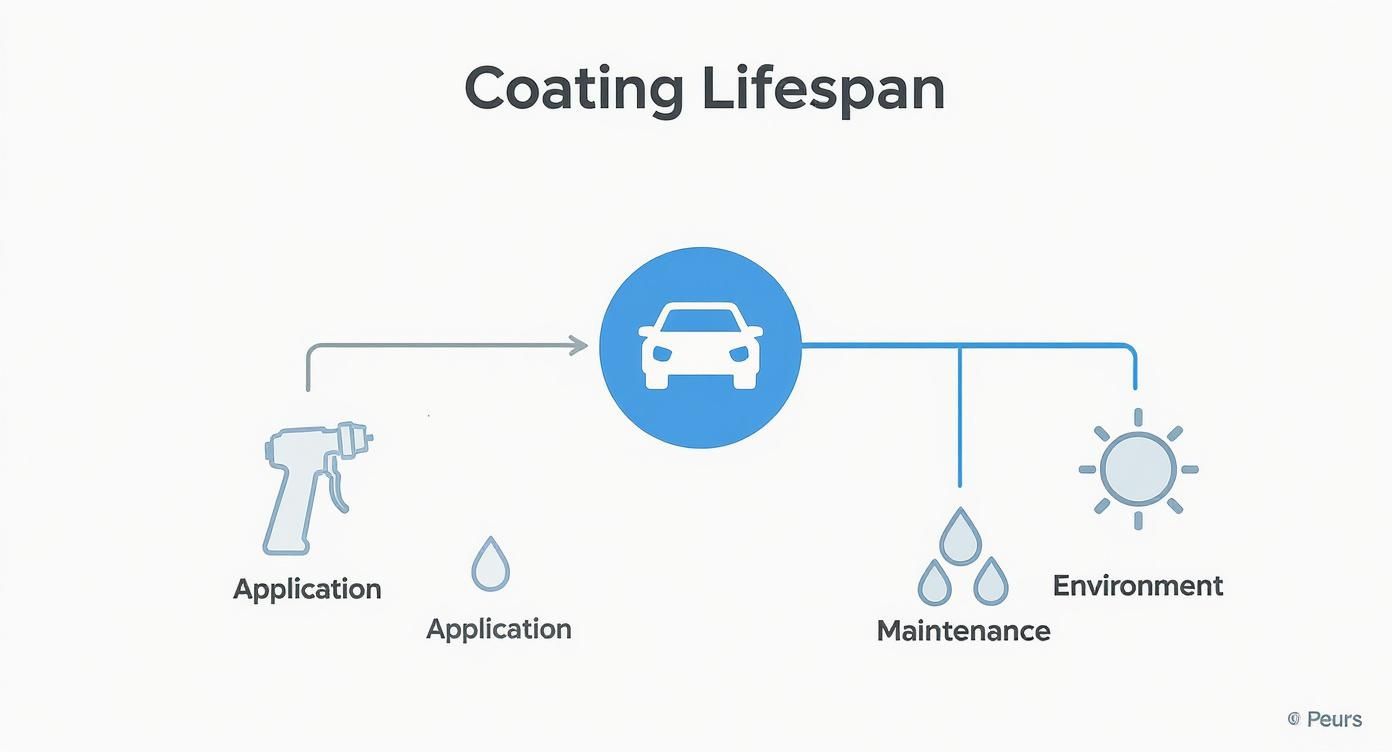
As you can see, it’s a three-part equation: the initial application, the environment your car lives in, and your maintenance routine. Nail all three, and you’ll get the maximum life out of your investment. Let’s break down exactly what that means.
H3: It All Starts with Application Quality
The road to a long-lasting coating starts way before the bottle is even opened. The single most important step is flawless surface preparation. Period. If you skip this, you’re setting the coating up for failure from day one.
Imagine trying to apply a screen protector to a dusty, greasy phone screen. It’s never going to stick properly, right? Same principle. The paint has to be surgically clean and perfectly smooth. That means a full decontamination, clay bar treatment, and paint correction to eliminate any swirls, scratches, or embedded grime. This is what allows the coating to form a powerful, uniform chemical bond directly with your car’s clear coat.
This is also where a professional application really shines. A seasoned pro has the tools and, more importantly, the experience to create that perfect canvas, ensuring the coating anchors itself as strongly as possible.
H3: The Daily Grind: Environmental Exposure
Once that coating is on, it’s in a constant fight with the elements. The world is surprisingly tough on a car’s finish, and your coating is the frontline defense against some key enemies:
- UV Radiation: The sun is a relentless force. Its UV rays are constantly bombarding your vehicle, trying to break down the coating’s molecular structure. Over time, this can degrade its gloss and hydrophobic properties. This is why finding the best UV protection for your car paint is non-negotiable, especially if you live somewhere sunny.
- Chemical Contaminants: Bird droppings, bug splatters, acid rain, and road salt aren’t just ugly—they’re chemically aggressive. If left to sit, they can literally etch into the coating and weaken it.
- Abrasive Elements: Think about all the sand, dust, and road grit your car kicks up. At highway speeds, this stuff acts like low-grade sandpaper, physically wearing down the coating over time.
Location plays a huge role here. Real-world data from over 10,000 vehicles showed that professional-grade coatings last an average of 4.2 years. But for cars in salty coastal areas, that lifespan dropped by 20%. On the flip side, cars that were consistently garaged saw their coating life extended by 30%.
H3: Your Role in the Game: Maintenance Habits
Here’s the hard truth: you are the single biggest factor in your coating’s lifespan. You can have the best coating in the world applied by a master detailer, but if you treat it poorly, it won’t last.
The fastest way to kill a ceramic coating? Take it through an automatic car wash. Those giant, gritty brushes are brutal, creating thousands of micro-scratches that will shred that protective layer in no time.
The right way is gentle hand washing. Use a pH-neutral soap, the two-bucket method to avoid dragging dirt back onto the paint, and dry with soft, clean microfiber towels. This careful approach is what preserves the coating’s integrity for the long haul.
It’s also worth thinking about the type of coating itself. Older, more rigid formulas can become brittle and even develop micro-cracks when exposed to dramatic temperature swings. This is what pushed us at Titan to focus on more flexible elastomer-based technologies—coatings that can expand and contract with the metal, ensuring they adapt instead of break.
To put it all together, here’s a quick-glance table breaking down what helps and what hurts your coating.
Factors Impacting Ceramic Coating Lifespan
| Factor | Negative Impact (Reduces Lifespan) | Positive Impact (Extends Lifespan) |
|---|---|---|
| Preparation | Incomplete decontamination, uncorrected paint defects. | Professional paint correction, iron removal, and panel wipe. |
| Application | Uneven application, improper curing, DIY errors. | Professional, climate-controlled application with proper technique. |
| Climate | High UV exposure, acid rain, road salt (winter), coastal air. | Mild climate, garaged storage, protection from extreme weather. |
| Driving | High mileage, gravel roads, frequent highway driving. | Low mileage, city driving on paved roads, avoiding debris. |
| Washing | Automated car washes, harsh chemicals, improper technique. | Regular, gentle hand washing with pH-neutral soap. |
| Maintenance | Using abrasive polishes or waxes, neglecting contaminants. | Using SiO₂ boosters, promptly removing bird droppings/bugs. |
Ultimately, a quality ceramic coating is a partnership between the product, the installer, and you, the owner. When all three are in sync, you get years of incredible gloss and protection.
The Next Evolution in Paint Protection Technology
Traditional ceramic coatings have a reputation for being incredibly hard, which is great, but they also have a hidden weakness: they’re rigid. Think of a pane of glass—it’s tough, but it’s also brittle. This is precisely where the old rules for “how long does a ceramic coating last” fall apart.
The problem starts with your car’s body panels. They’re constantly expanding and contracting as temperatures change. When you drive from a blistering hot highway into a cool garage, or when a freezing night gives way to a sunny morning, that inflexible coating layer just can’t keep up. Over time, tiny stress fractures start to form, compromising the entire shield and leading to premature failure. It’s this exact challenge that pushed our founder, Alex, to find a better way.
Introducing a Smarter, More Resilient Shield
This is where Titan Coatings completely rewrites the rulebook. We were the first company to bring Elastomer coatings to the market, pioneering a far superior solution by integrating advanced nano tube and Dark Matter technologies. Our coatings are engineered to be both hard and flexible, setting an entirely new standard for what paint protection can be.
Imagine a shield that doesn’t just block attacks but actually absorbs their impact. That’s the core idea behind our elastic coatings. They are designed to flex right along with your vehicle’s paint, meaning extreme temperature swings are no longer a threat. The coating expands and contracts in perfect harmony with the surface, preventing the microscopic cracks that kill lesser products.
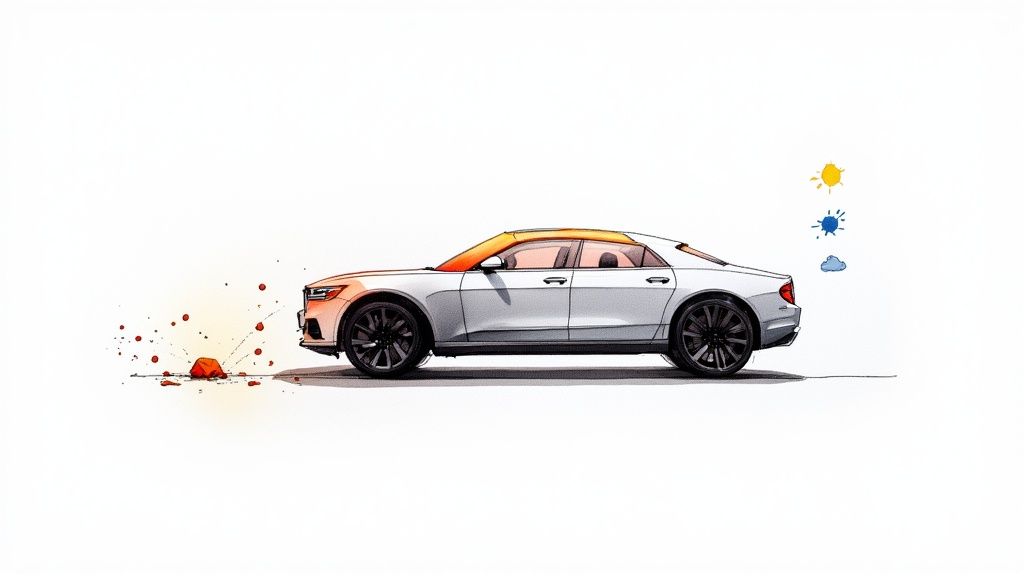
This kind of multi-faceted protection is what real-world durability is all about. It’s a comprehensive shield that adapts to everything the environment throws at it, from UV rays to physical impacts, ensuring genuine, long-term performance.
The Power of Flexibility in Action
The difference in real-world driving is night and day. A conventional coating might get fragile and chip away after a minor rock impact on the highway. An elastic coating, on the other hand, can absorb and dissipate that force, preserving both the protective layer and the pristine paint underneath. It’s the difference between a delicate glass vase and a sheet of reinforced, flexible armor.
This adaptability is the secret to extreme longevity. By eliminating the primary failure point of traditional coatings—their brittleness—we’ve created a product that maintains peak performance for years longer, even in the most demanding climates.
A perfect example from our lineup is Titan Vulcan TX155. It embodies this philosophy completely, delivering an unbelievable level of gloss and slickness while providing the resilience that only an elastomer-based formula can. This isn’t just about surviving the elements; it’s about thriving in them. For car owners like Alex, this was the ultimate solution—a coating that adapts to its environment, ensuring his car looks impeccable year after year.
This level of protection often has people weighing their options carefully. If you’re wondering how this technology stacks up against other forms of defense, you can explore an in-depth comparison in our guide on paint protection film vs. ceramic coating. Ultimately, we believe the future of paint protection lies in this kind of intelligent flexibility, completely redefining what’s possible for vehicle care.
How to Perform a Visual Health Check on Your Coating
So, your car has been coated for months, maybe even a few years. How can you tell if that protective shield is still doing its job? You don’t need a microscope or a lab coat to figure it out—you just need to know what to look for. A quick visual check can tell you everything you need to know about your coating’s health.
The most obvious and reliable sign is how it handles water. A healthy, high-performance ceramic coating is intensely hydrophobic. It doesn’t just resist water; it actively pushes it away, forcing it into tight, round beads that sit right on top of the paint. When you wash your car or drive through a rainstorm, these beads should roll right off, taking dirt and grime along for the ride.
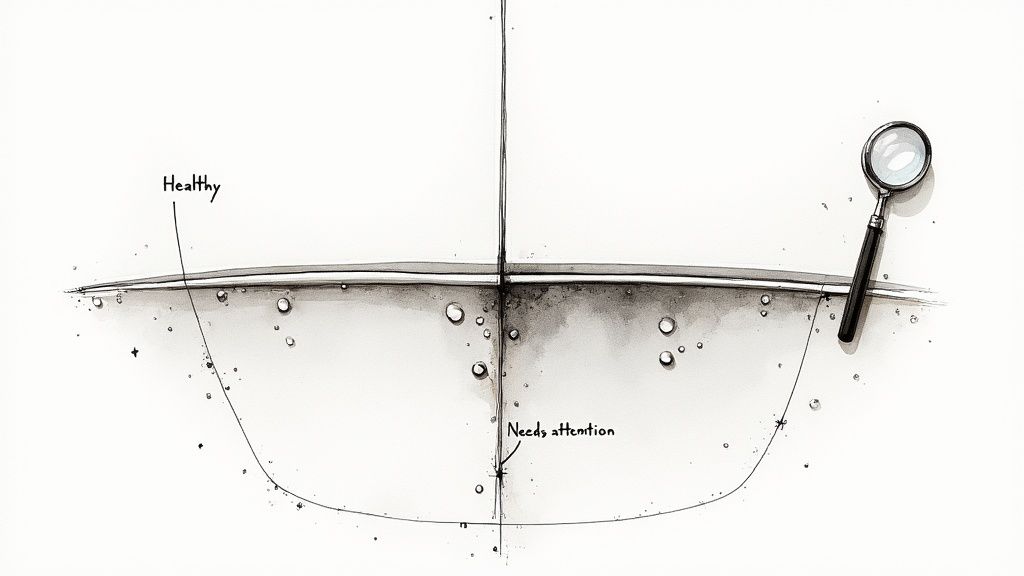
Reading the Signs of Wear
Over time, constant exposure to UV rays, road salt, and other contaminants will begin to wear down the coating. When that happens, you’ll see a clear change in how it behaves. Here’s what to keep an eye on:
- Degraded Water Beading: The first warning sign. Instead of those perfect, uniform beads, you’ll start to see flatter, misshapen droplets.
- Water Sheeting: This is the big one. If water no longer beads up and instead clings to the surface in large, slow-moving “sheets,” the coating’s surface tension is gone. It’s no longer doing its primary job of repelling water.
- Reduced Slickness: A fresh coating feels incredibly smooth and slick (always test with a clean microfiber towel, not your hand!). If the paint feels a bit gritty or “grabby” after a good wash, the protective layer is wearing thin.
- Increased Cleaning Effort: Remember how easy it was to wash off bugs and dirt? If you find yourself scrubbing harder to get the car clean, the coating’s self-cleaning properties are fading.
The Evolution of Durability
The fact that we can even talk about coatings lasting for years shows just how far the technology has come. Early advancements in SiO2 concentration and professional application methods gave us coatings that could last 3 to 5 years. A 2023 industry benchmark report actually found the average lifespan of high-end professional ceramic coatings has climbed to 5.1 years, with a surprising 38% of vehicles still showing solid protection after 7 years. You can read the full research about these coating findings to see how modern formulas are rewriting the rules.
This is precisely why a flexible formula matters so much. Old-school, brittle coatings would crack and fail when the vehicle’s panels expanded and contracted with temperature changes. Our elastic coatings are engineered to flex with the vehicle, resisting that stress and maintaining their hydrophobic and self-cleaning properties for far longer.
Key Takeaway: The way water behaves on your paint is the ultimate report card for your ceramic coating. Tight, fast-moving beads mean it’s healthy. Slow-moving sheets of water mean it’s time for some attention.
A Simple Maintenance Routine for Maximum Longevity
Putting on a high-end ceramic coating is a huge first step, but the job isn’t done when the coating cures. What you do after is what truly determines how long it lasts and how good your car looks. The golden rule? Be gentle. Your maintenance habits are the single biggest factor in your coating’s lifespan.
Think of it like this: you just invested in a top-of-the-line security system for your home. You wouldn’t turn around and leave the front door wide open, right? The same logic applies here. A great coating needs a great maintenance routine to back it up, ensuring you get every ounce of performance you paid for. It’s a partnership between the tech and you, the owner.
The biggest mistake I see car owners make is slipping back into their old, damaging wash habits. Those drive-through car washes with their giant, spinning brushes and harsh, recycled water are the number one enemy of any ceramic coating. They grind thousands of tiny scratches into the surface, slowly stripping away the gloss and water-beading magic with every single visit.
The Ideal Maintenance Wash Step-by-Step
To keep your coating in top shape, a proper hand wash is non-negotiable. This isn’t just about getting the car clean; it’s about doing it safely. The two-bucket method has been the gold standard in detailing for decades for one simple reason: it drastically cuts down the risk of putting swirl marks into your paint.
Here’s a straightforward and effective process:
- Rinse Thoroughly: Before you even think about touching the paint, give the whole vehicle a good rinse. A pressure washer (from a safe distance!) or a hose with a strong nozzle will knock off all the loose grit and heavy grime.
- Use Two Buckets: Get one bucket for your pH-neutral car shampoo and another filled with plain, clean water. Make sure both have a grit guard sitting at the bottom to trap any dirt that comes off your wash mitt.
- Wash Panel by Panel: Dunk your plush wash mitt into the soapy water, wash one small section at a time (like a door or half the hood), and then rinse the mitt out completely in the clean water bucket. Then you can go back for more soap. This little step is crucial—it stops you from dragging dirt from one panel all over the rest of the car.
- Dry with Care: Never, ever let your car air dry. That’s a surefire way to get stubborn water spots from mineral deposits. Instead, grab a high-quality, ultra-plush microfiber drying towel and gently blot the surface dry.
This careful approach makes sure you’re only taking off the dirt, not the protective layer you invested so much time and money in. For a deeper dive, check out our complete guide on how to maintain a ceramic coating for more pro tips to perfect your technique.
Topping It Off for Added Protection
If you really want to squeeze every last month of performance out of your coating, using a silica-based maintenance spray every so often is a game-changer. Think of these “toppers” or “boosters” as a vitamin shot for your coating. They’re formulated to bring back that slick, hydrophobic feel and lay down a fresh, sacrificial layer of protection.
This simple step essentially “feeds” the original coating, reinforcing it and keeping that incredible water-beading action sharp and responsive. It’s like putting a fresh coat of wax on a beautifully polished floor to protect the underlying finish.
This is especially important for advanced formulas like our elastomer-based coatings. While they are built with incredible flexibility to resist cracking from heat cycles, a solid maintenance plan ensures their self-cleaning and hydrophobic properties stay at peak performance for years to come. By following these simple steps, you’re taking control of the durability equation, ensuring your coating doesn’t just survive—it thrives.
When to Reapply Your Ceramic Coating
Even the most bulletproof armor needs a tune-up eventually. A ceramic coating is an incredible long-term sacrificial barrier for your paint, but it’s not a “set it and forget it” lifetime pass. After years of taking a beating from UV rays, road salt, bird droppings, and everything else the world throws at it, the coating will naturally wear down. Reapplication isn’t a sign that something went wrong—it’s just a smart part of keeping your car looking its best.
Think back to Alex, the car owner we talked about earlier. A few years after getting his car coated, he noticed the water on his hood wasn’t popping off into those tight, perfect beads anymore. That slick, just-waxed feeling was a little less pronounced. This wasn’t a catastrophic failure overnight; it was the coating telling him, “I’ve done my job, I’ve taken the hits for years, and now I’m getting tired.”
Recognizing It’s Time for a Refresh
So, how do you know when it’s actually time to re-up that protection? It really comes down to paying attention to how the coating is behaving.
The most obvious tell-tale sign is a major drop-off in hydrophobicity. If you’ve tried a good maintenance topper and the water still wants to lay flat and “sheet” off the car instead of beading up and flying off, the coating’s protective muscle is fading.
Another clue is a subtle change in the paint’s appearance. A great coating keeps your paint looking impossibly deep and glossy. As it wears down over the years, you might notice that a bit of that “wet look” and vibrancy has faded. With a premium, flexible coating from Titan, you could be looking at a reapplication timeline of anywhere from 5 to 10 years, all depending on how the car was kept and what it was exposed to.
Reapplication is all about getting your vehicle’s protection back to 100%. This isn’t just about looks—it’s about renewing the armor that guards your car’s finish and value for its next chapter on the road.
The Reapplication Process: A Fresh Start
Putting on a new coat isn’t quite the same as the first installation. To do it right, the process starts with a full chemical and mechanical decontamination to carefully strip away what’s left of the old, tired layer. This step is non-negotiable; it ensures the new coating can get a clean, solid grip directly on your car’s clear coat.
Once the surface is perfectly prepped and pure, a fresh layer of an advanced formula like our Titan Vulcan TX155 goes on. For a savvy owner like Alex, this isn’t an emergency repair. He’s not waiting for his paint to be at risk. He’s booking his reapplication proactively to keep his car in that flawless condition he loves.
This is where our flexible coatings really shine. Because they are engineered to be hard as glass but also elastic, they don’t get brittle and crack like many other coatings do in places with wild temperature swings. That built-in durability means a much longer time between services, giving you more years of peak performance. It’s like restoring your car’s shield to full strength, ready for whatever the road throws at it next.
Common Questions About Ceramic Coating Lifespan
Even after laying out all the factors, a few specific questions always seem to pop up. Let’s dig into some of the most common ones I hear from car owners, so you know exactly what to expect from your investment in paint protection.
Does Layering Ceramic Coatings Make Them Last Longer?
In a word, yes. Applying multiple layers of a professional-grade ceramic coating absolutely extends its lifespan. Think of it like adding extra coats of varnish to a piece of wood—each layer builds on the last, creating a thicker, tougher barrier against the elements.
The first layer, or base coat, is all about hardness and creating that tenacious bond with your paint. The layers on top are usually designed to boost the slickness and that incredible water-beading effect. Most pro installers will apply two, maybe three, layers to hit that 5+ year durability mark. Any more than that, and you start to see diminishing returns for your money.
Will a Ceramic Coating Stop Scratches and Rock Chips?
This is probably the biggest myth out there. While a quality ceramic coating adds a hard, sacrificial layer that helps resist light swirl marks from a bad wash job, it will not make your car bulletproof. It won’t stop scratches from keys, and it certainly won’t prevent rock chips.
A coating is a microscopic, glass-like layer. It’s not a suit of armor. For real-world protection against flying rocks and physical impacts, you need Paint Protection Film (PPF). In fact, the ultimate setup for many enthusiasts is applying a flexible ceramic coating over the PPF. You get the best of both worlds: the self-healing impact resistance of the film, plus the amazing gloss and chemical resistance of the coating.
Does Garaging My Car Really Extend the Coating’s Life?
Without a doubt. Keeping your car in a garage is one of the single best things you can do to get the maximum life out of your coating. A garage is a shield against the coating’s two biggest enemies: the sun’s UV rays and a constant barrage of environmental fallout.
Think about it: relentless sun exposure is like a slow-burn that breaks down the coating’s polymer structure. At the same time, things like bird droppings, acid rain, and tree sap are left to sit and etch into the surface. Parking indoors minimizes all of that, easily adding years to your coating’s effective life.
This is especially true for the newer elastomer-based coatings. Our Titan Coatings formulas are engineered with incredible flexibility to handle heat cycles, but reducing that constant environmental stress by garaging the vehicle ensures its self-cleaning abilities stay sharp for years to come.
Ready to see what a truly advanced coating can do for your vehicle’s finish? The flexible, durable, and long-lasting elastomer technology from Titan Coatings is changing the game. Explore our solutions and give your car the armor it deserves at https://www.titancoatings.us.
0 Comments