
Before you ever touch a polisher to paint, the real work of building a successful detailing business begins. It all starts with a solid plan—a blueprint that guides every decision you’ll make, from the clients you target to the money you make.
Laying The Groundwork: Your Business Blueprint
Jumping straight into buying equipment without a plan is like trying a full paint correction without a proper wash and decon. You’ll miss the critical prep work and end up with a flawed result. This initial planning phase is your prep work. It’s where you decide who you want to be in this industry and how you’re going to get there.
Are you going to be the premium, high-end detailer for exotic car owners who won’t settle for anything less than perfection? Or maybe you’ll be the super-convenient mobile service for busy families who need their daily driver cleaned up. Nailing down your niche is everything. It’s how you’ll stand out from the crowd.
Defining Your Market And Legal Foundation
First things first, get to know your local scene. Scope out the competition. What services are they pushing? What are their prices? More importantly, what are they not doing? That gap in the market is where you can make your mark.
The demand is definitely there. The global car detailing market was valued at around $41.40 billion and is expected to climb to $58.06 billion by 2030. You don’t need a huge slice of that pie to build a very profitable business, but you do need to be smart about how you grab your piece.
Once you know who you’re serving, it’s time to make it official. Choosing a legal structure is a huge step. A lot of new detailers go with a Limited Liability Company (LLC). It’s a smart move because it helps shield your personal assets if something goes wrong. This is also the point where you absolutely must commit to separating business and personal finances. Trust me, it will save you massive headaches come tax time.
Setting Clear Financial Goals
With the big-picture stuff sorted, let’s get down to the numbers. A business plan needs real, honest financial projections. This isn’t just wishful thinking; it’s about mapping out a realistic path to profitability.
Start by listing every single startup cost you can think of—equipment, chemicals, insurance, business licenses, a simple website, you name it. Then, figure out your pricing. Your prices need to cover all your costs, reflect the high quality of your work, and still leave you with a healthy profit. Don’t be the cheapest guy in town.
Your financial plan is your operational playbook. It’s not just some stuffy document you create for a loan officer. It’s what will tell you when you can afford to hire your first employee, when it’s time to upgrade that pressure washer, and how to price a big job so you actually make money.
Finally, set some clear revenue goals. What do you need to make in your first three months? Six months? What does a successful first year look like? Breaking that big annual number down into smaller monthly or weekly targets makes it feel way less intimidating and keeps you on track. This blueprint is the foundation of a business that’s built to last.
To put it all together, here are the core decisions you need to lock down.
Key Startup Decisions at a Glance
This table breaks down the foundational pillars you’ll be building. Getting these right from the start sets the stage for everything that follows.
| Pillar | Key Action Items | Why It Matters |
|---|---|---|
| Business Plan | Define your niche (e.g., mobile, luxury, daily drivers). Research local competitors and identify market gaps. Outline your services. | A clear plan acts as your roadmap, preventing you from wasting time and money on strategies that don’t fit your goals. |
| Legal Structure | Choose a business entity (LLC is common). Register your business name. Open a separate business bank account. | Protects your personal assets from business liabilities and makes tax filing significantly easier. |
| Financials | List all startup costs (equipment, insurance, etc.). Set your service pricing. Create realistic revenue goals for the first year. | Ensures your pricing is profitable from day one and gives you clear targets to work toward for sustainable growth. |
Think of these pillars as the concrete slab your entire detailing business will be built on. A little extra time spent here ensures you’re not trying to fix a cracked foundation down the road.
Design Your Services and Set Profitable Prices

Alright, let’s get into the heart of your business: what you’re actually going to sell and how much you’ll charge for it. This isn’t just theory; your service menu and pricing strategy are what will keep the lights on and the profits rolling in. Get this part right, and you’re building a solid foundation for everything else.
A classic mistake I see new detailers make is trying to offer everything under the sun right out of the gate. Don’t do it. Your goal should be to start with a focused menu of services that you can nail perfectly, every single time. A simple, tiered package structure is your best friend here.
Think of it as a “Good, Better, Best” approach. Your entry-level package covers the essentials—a solid exterior wash and a meticulous interior vacuum and wipe-down. Your mid-tier package kicks it up a notch, adding things like a clay bar treatment and a high-quality wax. This setup makes it easy for customers to see the value and choose what fits their needs, which takes a ton of pressure off the sales process.
Crafting High-Margin Service Packages
Let’s be honest: you’re not going to get rich doing basic washes. The real money in this business comes from the high-value, specialized services that solve real problems for car owners and showcase your skill.
We’re talking about services like paint correction and, most importantly, advanced protective coatings. These aren’t just simple add-ons; they are premium solutions that can become the cornerstone of your business. They’re what separate the pros from the bucket-and-sponge crowd.
Imagine a client, let’s call him David, who just brought home his dream car. A few months in, he’s already seeing fine scratches and a dullness creeping into that brilliant finish. He’s not looking for a quick wash; he wants to protect his investment for the long haul. This is where you shine.
The Power of Premium Coatings: A Story
Instead of offering David a standard wax that might last a couple of months, you introduce him to something truly next-level: Titan Coatings’ PYR ELITE with Dark Matter Technology™. You explain that this isn’t just another ceramic coating; it’s an Elastomer coating, a technology Titan was the first to bring to the market.
This is a game-changer. The unique technology uses nano tubes to create a coating that cures as hard as Apex Glass Coating- 50mlglass but stays incredibly flexible. This is the key difference you need to communicate. You can tell David that traditional ceramic coatings can get brittle and might even crack under stress from extreme temperature swings—like going from a freezing morning to a blazing hot afternoon.
Titan’s elastic coatings, on the other hand, are engineered to flex right along with the car’s body panels. Because the coating won’t crack down, this flexibility ensures it lasts longer and won’t be affected by temperature changes between frozen and hot conditions, providing superior, longer-lasting protection. The bond is stronger, the gloss is deeper, and the durability is simply in another league.
By applying PYR ELITE, you’ve provided a premium, long-term solution to David’s problem. He’s more than happy to pay a premium price because you’ve delivered real value that protects his pride and joy. This is how you transform your business from a car wash service into a high-end protection specialist. Of course, delivering these elite results means you need to perfect your technique, which starts by understanding the proper steps for coating application.
Setting Prices That Actually Make You Money
Okay, you’ve got your packages. Now, how do you price them? Here’s a critical piece of advice: don’t just peek at what your competitors are charging and try to be the cheapest. That’s a race to the bottom. Your prices need to be built on your actual costs.
Start by breaking everything down:
- Cost of Goods: How much do your soaps, polishes, and coatings cost per vehicle? Get specific.
- Labor: How much time does each service take? You have to pay yourself a fair hourly wage. Don’t work for free.
- Overhead: A slice of your insurance, marketing, software, and other business expenses has to be baked into every single job.
The numbers in the detailing industry back this up. Profitability is strong and getting stronger, with average net margins projected to hit nearly 20% of revenue. That profit potential is there for the taking, but only if you price your services intelligently from day one. You can read more about the U.S. car wash and auto detailing industry overview to see why specialized services are driving this growth. Your pricing should reflect the premium quality of your work and the advanced products you use—that’s how you capture your piece of that healthy margin.
Assemble Your Professional Detailing Toolkit
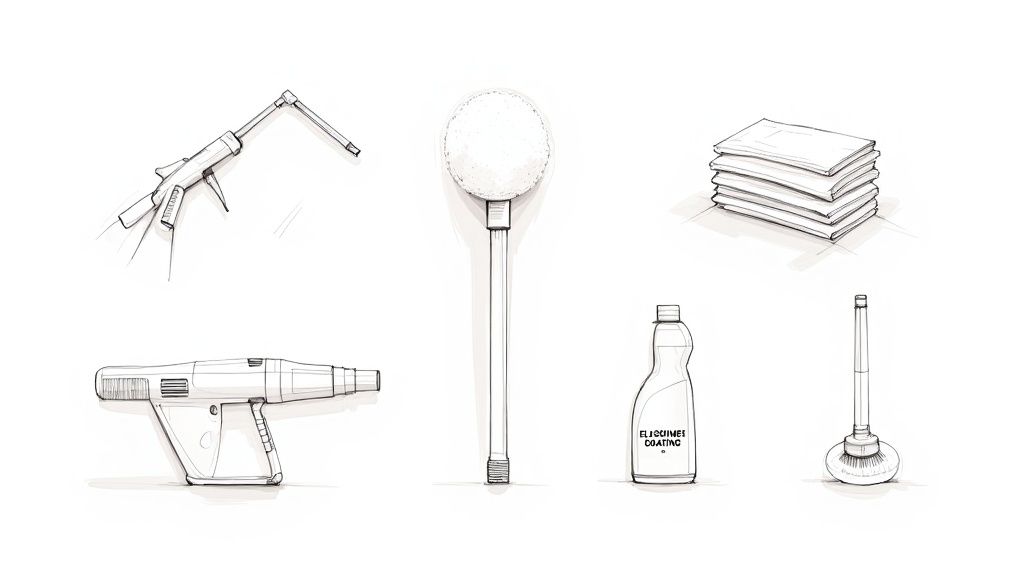
Let’s get one thing straight: you can’t deliver jaw-dropping results that build a five-star reputation with amateur gear. Your toolkit is a direct reflection of your skill, and buying quality equipment isn’t just an expense—it’s a critical investment in your future. This is what separates the pros from the guys with a bucket and a sponge from the local auto parts store.
A chef is only as good as their knives. For you, a reliable pressure washer, a workhorse polisher, and premium chemicals are your instruments of choice. Trying to save a few bucks on a cheap polisher might feel smart now, but it’ll bite you later with inconsistent results or, worse, damaged paint. That’s a quick way to lose a client and torpedo your reputation before you even get started.
The Foundation of Your Arsenal
You don’t need every shiny new gadget on the market right out of the gate. Your goal is to build a core set of high-performance tools that will let you handle the vast majority of jobs with excellence. This lets you master your craft and produce work you can be proud of, every single time.
Here’s what I consider the non-negotiables for any serious startup kit:
- Pressure Washer: Look for an electric model pushing 1.5 to 1.9 GPM. That’s the sweet spot—enough power to blast away grime without being so aggressive you risk damaging the paint.
- Foam Cannon: This is mandatory for a safe, touchless pre-wash. A thick blanket of foam does the heavy lifting, pulling dirt and grit off the surface before you ever touch it with a mitt. This is your best defense against inflicting swirls.
- Dual-Action (DA) Polisher: A quality DA polisher is your money-maker, plain and simple. It’s safe enough for a beginner to learn paint correction but versatile enough for applying waxes and sealants like a seasoned pro.
- Shop Vacuum: Don’t skimp here. A powerful wet/dry vac with a full set of attachments is your secret weapon for interiors. The ability to pull spills out of carpets and deep-clean crevices is what clients notice and pay extra for.
My “Aha!” Moment With Premium Coatings
Let me tell you a quick story. Early on, I was using a decent, off-the-shelf ceramic sealant. The results looked good initially, but I started noticing a pattern: clients would come back after a harsh winter, and the coating’s performance would be practically gone. The extreme freeze-thaw cycles were clearly breaking it down, leaving the paint exposed.
That was a turning point. I realized my toolkit wasn’t just about the hardware; it was about the chemicals that delivered the final, lasting protection. That’s when I made the switch to a truly professional-grade product: Titan’s VULCAN TX155, one of their standout Elastomer coatings.
The difference was unbelievable. Because Titan pioneered the use of nano tubes technology, their coatings do something unique: they cure hard as glass but stay flexible. This elasticity means the coating can expand and contract with the metal body of the car, so it doesn’t crack or fail when temperatures swing wildly.
My clients’ cars started coming back a year later looking just as glossy as the day I finished them. That single upgrade didn’t just improve my results—it built my reputation for providing superior, long-lasting protection. That reputation is what allows you to command a higher price. You can see the full range of professional ceramic coating products from Titan and find the right solution to build your own brand.
Consumables: The Details That Make the Difference
Beyond the big-ticket items, your daily-use supplies are just as critical. Skimping on towels or buckets can ruin an otherwise perfect job.
Here’s a quick shopping list of essentials you should never cheap out on:
- Microfiber Towels: You need dedicated towels for every job. Seriously. Get waffle-weaves for drying, plush towels for polish removal, and a separate stack of utility towels for interiors. Cross-contamination is a rookie mistake you can’t afford to make.
- Brushes and Mitts: A good set of soft-bristled detailing brushes for emblems and vents, plus a high-quality wash mitt, are non-negotiable for a safe and thorough wash.
- Buckets with Grit Guards: The two-bucket wash method is detailing 101 for a reason. Those little plastic grit guards trap dirt at the bottom of the bucket, preventing you from dragging it all over the paint.
Putting together your professional toolkit is the first real step toward becoming a trusted detailer. When you choose quality from the start, you’re not just cleaning cars—you’re delivering a durable, high-value service that clients will happily pay for and rave about to their friends.
Market Your Business and Win Your First Clients

You can have the best polishing technique in the world and a hand steadier than a surgeon’s for applying coatings, but those skills won’t pay the bills without a steady stream of clients. Once your services are dialed in and your gear is ready, you have to switch hats. You’re no longer just a detailer; you’re a marketer.
Let me tell you about a guy I know, Alex. His technical skills were off the charts, but his calendar was wide open. He’d spent every waking hour perfecting his craft but gave zero thought to marketing. Meanwhile, across town, another new detailer named Mark was booked solid within two months. The difference wasn’t better skills—it was smarter marketing. Mark took incredible before-and-after photos and plastered them all over local Facebook groups. That powerful visual proof did all the selling for him.
This is what I mean by smart marketing. It’s not about pushy sales tactics. It’s about showing people the incredible value and quality of your work in a way that truly connects with car owners.
Building Your Digital Showroom
Whether you’re working out of a fixed shop or a mobile van, your online presence is your storefront. It’s the very first place potential customers will look you up, and a sloppy website or social media page can kill their interest on the spot.
You don’t need a wild-expensive, complicated website right out of the gate. All you need is a clean, professional-looking site that nails three things:
- Showcase Your Work: Your photo gallery is your single most powerful sales tool. High-quality, well-lit photos and short videos of your transformations are absolutely non-negotiable.
- Explain Your Services: Clearly lay out your packages and exactly what’s included. Ditch the industry jargon and focus on the benefits for the customer, like “protect your investment” or “restore that new-car feeling.”
- Make It Easy to Book: A simple contact form and a phone number that’s easy to find are critical. Don’t make people hunt for a way to give you their business.
Social media platforms like Instagram and Facebook are goldmines for a detailing business because they’re all about visuals. Post those stunning before-and-afters, share quick tips on car care, and run special offers for your followers. This is how you start building a real community around your brand.
Pro Tip: Don’t just post the glossy “after” photos. The “before” is what makes the final result so staggering. A 50/50 shot, showing the grimy, swirled paint right next to the gleaming, corrected side, is one of the most effective ways to stop someone mid-scroll.
Mastering Local Search
Put yourself in your customer’s shoes. When they decide they need their car detailed, what’s the first thing they do? They pull out their phone and search “car detailing near me.” If your business doesn’t pop up, for all intents and purposes, you don’t exist. This is where local Search Engine Optimization (SEO) becomes your best friend.
Getting the basics right here can give you a massive advantage. Start by setting up a free Google Business Profile. Fill out every single section—your services, hours, service area, and upload tons of high-quality photos. Then, make it a habit to encourage every single happy customer to leave a review. Those positive reviews are one of the biggest signals to Google that you’re a legitimate, high-quality business.
To really make sure you’re visible when people are searching, you’ll need a solid strategy. Learning more about effective SEO strategies for auto detailing is one of the best time investments you can make to gain a competitive edge.
Offline Tactics That Still Win
While a strong online game is essential, don’t sleep on the power of old-school, real-world connections. These relationships build a level of trust that digital marketing sometimes just can’t replicate.
- Connect with Car Clubs: Get out there and find the local car enthusiast groups on social media or at weekend meetups. These are your people—they’re passionate about their vehicles and willing to invest in them. Offer a special discount for club members to get your foot in the door.
- Partner with Other Businesses: Start building relationships with local auto repair shops, tire installers, or even high-end car dealerships. Work out a deal where you offer them a small referral fee for any clients they send your way. This can create a surprisingly consistent stream of new business.
The good news is that the market for professional detailing is incredibly strong and getting bigger. Market trends show the global market is projected to grow from $38.93 billion to $56.59 billion by 2032, with mobile detailing being one of the fastest-growing segments. This boom is driven by people wanting convenience and premium care for their cars, creating a huge opportunity for new businesses that know how to market themselves.
Winning those first crucial clients is all about being visible, being credible, and making a fantastic first impression—both online and off.
Streamline Your Operations for a Flawless Customer Experience
What’s the real difference between a weekend warrior washing cars in their driveway and a professional detailer? It’s consistency. Building a business that people trust—and keep coming back to—hinges on creating smooth, repeatable systems for every single thing you do. This is how you guarantee that every car gets the same meticulous level of care, turning a one-off job into a long-term client relationship.
Don’t think of systems as boring paperwork. They’re the very foundation of your business, governing how you schedule jobs, talk to clients, and manage the entire customer journey from first call to final handshake. A solid process gets rid of the guesswork, drastically cuts down on mistakes, and frees you up to do what you do best: deliver unbelievable results.
Developing Your Standard Operating Procedures
Let’s get practical. Think about your most popular detail package. Could you write down every single step, in order, from the moment the car rolls in to the moment you hand the keys back? That’s the start of your Standard Operating Procedure, or SOP. Taking the time to create an SOP for each service you offer is an absolute game-changer.
Your SOPs should be your playbook for perfection, covering everything:
- Vehicle Check-In: This isn’t just a glance-over. Use a detailed inspection sheet to note every scratch, ding, or swirl mark. Get the client’s signature on it before you even touch the car. This protects both of you.
- The Wash Process: Spell out the exact sequence. Your two-bucket method, the specific wheel-cleaning chemicals and brushes you use, and every step of your decontamination process. No shortcuts.
- Interior Detailing: Map out your workflow. Do you vacuum first? Steam clean? How do you tackle different surfaces like leather, plastic, and Alcantara? Write it down.
- Final Inspection: Create a quality control checklist. Go over the car under different lighting conditions to make sure you didn’t miss a single spot before the client arrives.
When these procedures are documented, it doesn’t matter if it’s you or a future employee doing the work—the outcome is always held to your high standard.
Elevating the Customer Journey
Imagine a client named Sarah books a detail with you. You immediately confirm her appointment via text. The day before, she gets an automated reminder. Halfway through the job, you snap a quick photo of her car looking amazing and send it over with a short update. When Sarah comes to pick it up, the car is immaculate, but there’s also a small thank-you card and a quality air freshener on the dash.
That extra touch cost you maybe a couple of bucks and five minutes of your time, but it made Sarah feel genuinely valued. She didn’t just get a clean car; she got a premium experience she’s going to tell her friends about.
The most successful detailing businesses get it: their product isn’t just a shiny car. It’s the feeling of trust, professionalism, and being cared for. Small gestures transform a simple transaction into a memorable experience that generates powerful word-of-mouth marketing.
These thoughtful touches are part of a larger operational system. It also extends to client education, especially after a high-end service. When you apply a premium, flexible coating like one of Titan’s Elastomer coatings, you’re not just done; you’re delivering long-term value. A key part of your process should be teaching the client how to care for that investment. This could be recommending specific products or even providing a link to a helpful guide on using a specialized ceramic car wash to maintain that amazing gloss and water-beading.
Tools for Smooth Operations
You can’t do it all with a pen and paper forever. While a simple calendar and spreadsheet might work for the first few months, the right tools will help you stay organized and look professional as you grow.
- Scheduling Software: Look into tools like Acuity or Calendly. They let clients book themselves online based on your live availability, which kills the endless back-and-forth phone calls and texts.
- Invoicing and Payments: Using software like QuickBooks or Wave makes you look legit. It simplifies sending professional invoices and tracking payments, which is a lifesaver come tax time.
- Customer Relationship Management (CRM): Even a basic CRM is a huge help. It lets you keep track of client details, what services they’ve had, and any personal notes (like their kid’s name or their favorite sports team). This is gold for personalizing future conversations.
By putting these systems in place from day one, you’re not just getting ready for your first few jobs. You’re building a scalable, professional detailing business that people will rave about for years to come.
Answering the Tough Questions About Starting a Detailing Business
Jumping into any new business is going to bring up a lot of questions. It’s totally normal. Let’s walk through some of the big ones I hear all the time from people just like you, so you can get started with your detailing business on the right foot.
What’s the Real-World Cost to Get Started?
Honestly, this can swing wildly. I’ve seen guys get a solid mobile detailing rig up and running for just a few thousand dollars. That covers the essentials: a good pressure washer, a reliable polisher, your initial batch of supplies, insurance (don’t skip this!), and a little cash for marketing.
Now, if you’re dreaming of a brick-and-mortar shop, that’s a whole different ballgame. You’re looking at a much steeper investment. Think rent, security deposits, utilities, and maybe even some construction to get the space just right. That can easily push you into the tens of thousands. The smartest thing you can do right now is open a spreadsheet and build a line-by-line budget for everything you can think of.
Do I Actually Need a Certification to Detail Cars?
Legally? Probably not. Most places don’t require it. But should you get one? Absolutely.
Getting certified is one of the fastest ways to build trust and show you’re serious. When a potential customer is looking at you and three other detailers, that certification on your website or van can be the one thing that makes them pick up the phone and call you. It’s not just a piece of paper; it’s proof that you’ve invested in your craft and know how to deliver a professional result.
How Can I Possibly Stand Out When There’s So Much Competition?
A new detailer asked me this exact question just the other day, completely stressed about all the other guys in his town. My answer to him is my answer to you: don’t even think about competing on price. That’s a race to the bottom, and you’ll never win.
Instead, you stand out by offering services and results that nobody else can. This is where your choice of products becomes your secret weapon. Picture this: you’re explaining to a client that while most ceramic coatings are rigid and can get brittle, you use Titan’s Elastomer coatings. You can tell them how this stuff is a true breakthrough, using nano tube technology to create a coating that’s hard as glass but stays flexible.
That elasticity is a complete game-changer. It means the coating can handle wild temperature swings without cracking, giving your client’s car a level of protection that your competitors simply can’t offer. When you lead with superior technology like that and back it up with an incredible customer experience, you become the go-to expert who’s worth every penny.
What’s the Single Most Important Thing for Long-Term Success?
If you take away just one thing, let it be this: consistent, high-quality work is everything. Your reputation is your number one asset, period.
A single jaw-dropping detail job will create more buzz and bring you more new clients than any ad you could ever buy. Pour your energy into becoming a master of your craft, choose products that you know will last, and make it your personal mission to blow every customer’s expectations out of the water. That obsession with quality is what builds a profitable business that lasts for years.
Ready to give your clients the best protection on the market? Check out the full lineup of advanced coating solutions at Titan Coatings and give your new business a serious competitive edge right from the start. Find out more at https://www.titancoatings.us.
0 Comments
Trackbacks/Pingbacks