
If you’re looking for the absolute best paint protection for new cars, the answer isn’t just one product—it’s a hybrid approach. The real secret to a bulletproof finish is combining the brute-force impact resistance of Paint Protection Film (PPF) with the slick, chemical-resistant gloss of a flexible elastomer coating. This duo creates a comprehensive shield that’s ready for pretty much anything the road throws at it.
Protecting Your Investment from Day One
Nothing beats that feeling of driving a brand-new car off the lot. But the second those wheels hit the pavement, that perfect, mirror-like paint is under assault. We’re talking road debris, harsh UV rays, acidic bird droppings, and all sorts of chemical contaminants. Protecting your new ride isn’t just a nice idea; it’s a crucial first step in preserving its value and that showroom shine for years.
Why Modern Paint Needs a Proactive Defense
It’s a common misconception that a factory finish is rock-solid. The truth is, due to environmental regulations, modern automotive paints are often thinner than they used to be. This makes them far more vulnerable to scratches, chips, and fading over time.
Waiting until you see the first scratch is a reactive move, one that often leads to expensive repairs and a lower resale value. A proactive defense is always the smartest play. You’re not just buying a product; you’re buying peace of mind and preserving the very look that made you choose that car. To dive deeper, you can learn more about how to protect car paint with our detailed guide: https://titancoatings.us/how-to-protect-car-paint/
The Main Contenders in Paint Protection
The market has a few different tiers of protection, and each one brings something different to the table. Getting the basics down is the key to choosing what’s right for your new vehicle.
| Protection Type | Primary Function | Durability |
|---|---|---|
| Traditional Wax/Sealant | A temporary glossy layer | Weeks to Months |
| Paint Protection Film (PPF) | A physical shield against impacts | 5-10+ Years |
| Advanced Coatings | A hard, chemical-resistant surface | 2-10+ Years |
The moment you start driving, your car’s paint is exposed to elements that degrade its finish. Early protection is the most cost-effective way to prevent future touch-ups, repainting, and significant detailing work.
The right shield really comes down to your driving habits, budget, and what you want for your car in the long run. And remember, car care goes beyond the paint. Using a preventive maintenance checklist is a great way to keep every part of your vehicle in top-notch condition.
A Guide to Modern Car Paint Protection
So you’ve got a new car, and you want to keep it looking that way. But what’s the right choice? To figure that out, you need to understand how each paint protection option actually works on a chemical and physical level. Let’s break down the most popular choices, from old-school waxes to the most advanced coatings, so you can see what truly sets them apart.
Traditional Waxes and Sealants
For decades, the gold standard for enthusiasts was carnauba wax. It gives that deep, warm glow everyone loves. But here’s the catch: it’s an organic product derived from palm leaves. That natural origin means it breaks down fast, usually lasting just a few weeks before you’re out there applying it all over again.
Synthetic paint sealants were the next evolution. These polymer-based products were engineered to actually bond with your paint, giving them a leg up on wax. They certainly offer better durability—maybe a few months—but they still only provide a paper-thin layer of defense against the harsh chemicals and contaminants your car faces every day.
Physical Armor with Paint Protection Film
Paint Protection Film (PPF) is a totally different ballgame. This isn’t just a chemical layer; it’s a physical shield. Think of it as a tough, clear, self-healing urethane film that literally takes the hit for your paint. Its main job is to absorb the impact from rock chips, road debris, and light scratches that would otherwise spell disaster for your car’s finish.
Modern PPF is virtually invisible and often comes with its own hydrophobic properties. It’s the perfect sacrificial layer for those high-impact zones like the front bumper, hood, and side mirrors. It’s no wonder the global PPF market is booming, especially with luxury and EV owners who are dead set on protecting their investment. This trend just goes to show how much people value real, physical paint defense.
The Rise of Nanotechnology Coatings
Ceramic coatings protect your car in a completely different way. They are liquid polymers that, once applied, create a chemical bond with your factory paint. Through a process called cross-linking, they form a semi-permanent, incredibly hard, and slick layer of protection. It’s like adding a microscopic shell of glass over your clear coat.
This glassy shield is a champion at repelling water (hydrophobicity), fighting off damage from UV rays, acid rain, and bird droppings, and making the car ridiculously easy to clean. But for all their chemical resistance, traditional ceramic coatings have a well-known Achilles’ heel: they can be brittle.
John, the proud owner of a new black sedan, learned this the hard way. He had a standard ceramic coating applied, and it looked incredible. Then winter hit. After a few months of extreme temperature swings—from freezing nights to sunny afternoons—he started noticing tiny micro-cracks spiderwebbing across the coating. The rigid formula just couldn’t handle the expansion and contraction, a common failure point for conventional ceramics.
His experience is exactly why a more advanced solution was needed—a coating that wasn’t just hard, but also flexible. This is where Titan Coatings changed the game. We pioneered Elastic Coatings, the first to introduce Elastomers to the market using nano-tube and Dark Matter tech. These coatings, like the ones detailed in our guide to automotive ceramic coatings, are engineered to be hard like glass but flexible like rubber. This unique elasticity allows them to expand and contract with the temperature, preventing the cracking that dooms lesser coatings and delivering far more reliable, long-term protection.
Comparing Your Top Paint Defense Options
So, you’ve got a new car and you want to keep that showroom shine. Smart move. But picking the right protection can feel like navigating a minefield of marketing claims. The truth is, there’s no single “best” option—it all comes down to what’s best for you, your car, and your lifestyle.
Let’s cut through the noise and break down the real-world differences between Paint Protection Film (PPF), traditional ceramic coatings, and the new breed of elastomer coatings.
This is a great starting point for understanding how the technology has evolved.
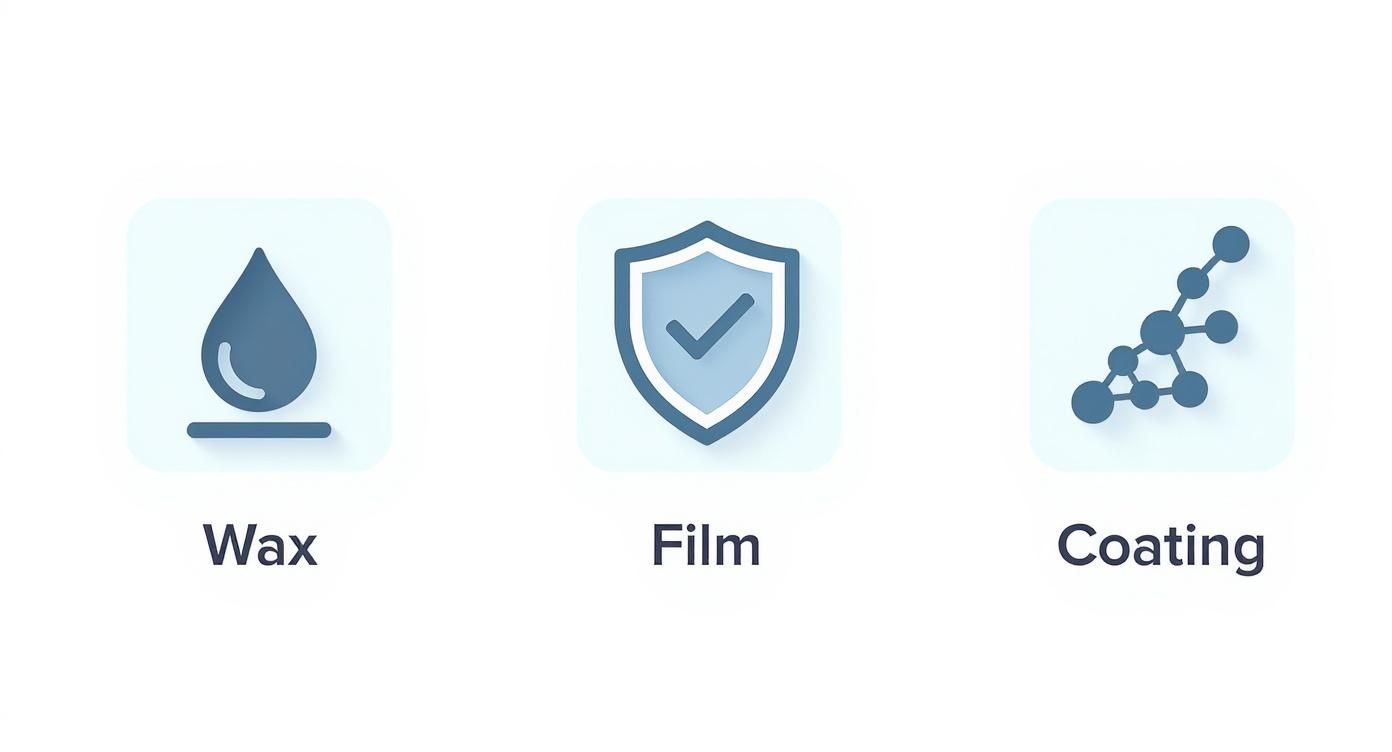
You can see the progression from a simple, temporary wax to a physical film and finally, to advanced molecular bonding. Each serves a very different purpose.
Durability and Longevity
The first question everyone asks is simple: “How long will it last?” Let’s be honest, nobody wants to reapply a product every few weeks. Traditional waxes and sealants are just that—temporary. You’re looking at a few weeks, maybe a couple of months if you’re lucky. They provide a decent gloss but require constant upkeep to offer any real defense.
When it comes to sheer staying power, Paint Protection Film (PPF) is in a league of its own. We’re talking about a thick, rugged urethane film designed to take a beating for 5 to 10 years, sometimes even longer. Think of it as a long-term investment in physical armor for your paint. This durability is a huge reason for its surge in popularity. In fact, Europe now accounts for the largest market share at around 31.5%, and that number is only expected to climb.
Ceramic coatings are the powerful middle ground. A quality professional-grade coating can give you anywhere from 2 to 10 years of solid protection, but this can vary. Its lifespan really depends on the quality of the product, the number of layers applied, and how you maintain it.
Protection Type: Physical vs. Chemical
Here’s where the fundamental differences really shine. Paint Protection Film is the undisputed king of physical impact resistance. Its whole job is to absorb the kinetic energy from rock chips, road debris, and even a stray shopping cart in the parking lot. If you spend a lot of time on the highway, PPF is your paint’s best friend. No question.
Ceramic coatings, on the other hand, are masters of chemical resistance. They create an incredibly hard, non-porous surface that acts as a shield against the nasty stuff: acidic bird droppings, bug guts, tree sap, and relentless UV rays. They stop these contaminants from etching into your clear coat, which is what preserves your car’s color and integrity over time.
Think of it like this: PPF is the heavy-duty plate armor that stops a direct hit. A ceramic coating is the high-tech, flexible chainmail underneath that’s impenetrable to chemical attacks and environmental fallout.
But what if you didn’t have to choose? This is where coating technology has taken a massive leap forward. For a deeper dive, our guide comparing paint protection film vs. ceramic coating breaks down exactly how they stack up.
Aesthetic Finish and Maintenance
Let’s be real—how your car looks is just as important as how well it’s protected. While modern PPF is remarkably clear, it can sometimes slightly alter the texture of the paint. Its main aesthetic benefit is simply preserving the perfect factory finish it’s covering.
Ceramic coatings are legendary for the unbelievable gloss and depth they add. They create that slick, “wet” look that makes water bead up and fly off the surface, taking dirt and grime with it. This self-cleaning property is a game-changer, making car washes faster, easier, and less frequent.
This is exactly where we at Titan Coatings saw an opportunity to redefine what’s possible. It all started when a client—we’ll call him Alex—brought in his brand-new sports car. He was sold on the gloss of a ceramic coating but had seen how brittle, traditional ceramics on his friend’s cars developed micro-cracks over time. He needed something that looked incredible but could also survive the dramatic temperature swings where he lived, from brutal summer track days to freezing winter mornings.
This challenge was the reason we exist. We introduced him to Titan Vulcan TX155, one of our premier Elastomer Coatings. Unlike rigid ceramics, our coatings are engineered with advanced nano-tube and Dark Matter tech to be incredibly hard, yet flexible. This elasticity is the secret sauce.
The Vulcan TX155 wrapped Alex’s car in a glass-hard shield that remained pliable enough to expand and contract with the vehicle’s panels. He got that jaw-dropping, liquid gloss he craved, but without the risk of cracking under pressure. Months later, after a punishing season of weather extremes, the coating was flawless. Alex’s car wasn’t just protected; its finish was on a whole other level. It was proof that you no longer have to sacrifice flexibility for hardness.
Paint Protection Options At-a-Glance
This table gives you a quick summary of the key attributes for each major paint protection type to help you assess the best fit for your new car. Our product comparison page can offer even more detail on specific formulations.
| Attribute | Wax / Sealant | Paint Protection Film (PPF) | Ceramic Coating | Titan Elastomer Coating |
|---|---|---|---|---|
| Longevity | 1-3 Months | 5-10+ Years | 2-10 Years | 5-10+ Years |
| Protection | Minimal Chemical | Excellent Physical Impact | Excellent Chemical & UV | Excellent Chemical, UV & Minor Impact |
| Gloss | Good | Preserves Original | Excellent Candy-Like | Exceptional Deep, Rich Gloss |
| Maintenance | High (Frequent Reapplication) | Low (Self-Healing) | Low (Hydrophobic) | Very Low (Extreme Hydrophobicity) |
| Ideal For | Enthusiasts on a Budget | Daily Drivers, High-Impact Areas | Show Cars, New Vehicles | Demanding Environments, Ultimate Gloss |
As you can see, the choice depends heavily on your priorities. Whether you need the brute-force physical defense of PPF or the slick, chemical-resistant gloss of a coating, understanding these differences is the key to making the right call.
The Evolution of Coatings: Enter Titan Elastomers
For years, the world of paint protection was a story of compromise. Car owners had to choose between the physical defense of a film and the chemical resistance of a coating. Even within the world of coatings, the choice was stark: you could have a surface that was incredibly hard, or one that was flexible, but you couldn’t really have both. This constant trade-off was the driving force behind a major shift in material science, a shift that led directly to a new class of protection.
This image perfectly mirrors the journey we’ve seen in coatings—from rigid, simple structures to more dynamic, adaptable designs. It’s the same path from brittle ceramics to flexible elastomers.
The Problem with Traditional Ceramics
When ceramic coatings first hit the scene, they were a massive leap forward. Suddenly, we could apply a liquid that bonded with a car’s paint, creating a glass-like shell that was incredibly resistant to chemicals and UV rays. It gave cars a deep, candy-like gloss that was just stunning.
But these early-generation ceramics had a hidden weakness: their rigidity. Much like glass, they were hard but also brittle. This became a serious problem when faced with the realities of daily driving. A car’s body panels aren’t static; they expand with summer heat and contract in the winter cold. This constant, subtle movement puts immense stress on a rigid coating.
Over time, this thermal cycling causes microscopic fractures to form. These tiny cracks compromise the protective layer, letting moisture and contaminants seep underneath, which ultimately leads to coating failure. This was the fundamental challenge that needed a completely new way of thinking to solve.
The Birth of a Flexible Solution
The story of the next step forward began not with a coating, but with a simple question: “What if a coating could be as hard as glass, but also flexible?” This question sent the engineers at Titan Coatings down a path of deep material science research, pushing the boundaries of what we all thought was possible in nano-engineering. The goal was to create a protective layer that could move with the vehicle, not fight against it.
This research led to a major breakthrough: the development of Elastomer Coatings. This was a completely new category of surface protection, and Titan was the first company to bring this technology to the automotive market. By integrating advanced nano-tube technology and our proprietary Dark Matter tech, we created something truly unique.
An elastomer coating is engineered at a molecular level to have both crystalline (hardness) and amorphous (flexibility) structures. This dual nature allows it to absorb impacts and stresses without fracturing, providing a level of resilience that rigid ceramics simply cannot match.
This unique molecular architecture is the key. The coating forms a durable, cross-linked network that is intensely hard and chemically resistant, yet it possesses an elastic quality. This elasticity is what allows it to stretch and compress with temperature changes, effectively eliminating the risk of micro-cracking and ensuring the protection lasts significantly longer. You can explore the science behind this groundbreaking technology and learn more about what makes Titan Coatings Elastomer technology different.
Titan Vulcan TX155: The New Gold Standard
To understand the real-world impact of this technology, look no further than Titan Vulcan TX155. This isn’t just another coating; it’s the embodiment of our elastic philosophy and the definitive choice for the best paint protection for new cars seeking the ultimate in durability and finish.
Imagine a client, Sarah, who just bought her dream car—a dark metallic gray performance sedan. She lives in a region with scorching summers and frigid, snowy winters. She’d heard horror stories from friends whose expensive ceramic coatings failed after just a couple of years, succumbing to the harsh climate.
We introduced her to Vulcan TX155. Once applied, her car was enveloped in a layer of protection that was not only incredibly glossy but also resilient. That summer, as temperatures soared, the coating expanded seamlessly with the car’s metal panels. When the first deep freeze of winter hit, it contracted without a single micro-fissure. Sarah’s car endured the wild temperature swings without any degradation to the coating’s integrity or appearance.
The flexibility of Vulcan TX155 translated directly into superior longevity and peace of mind. The same elastic properties that prevent thermal cracking also help the coating better absorb and dissipate energy from minor impacts, adding a layer of defense that traditional, brittle ceramics lack. When exploring the materials behind advanced car protection, it’s beneficial to see the broader scope of Titan brand coating technologies and their applications across different industries. This evolution from a rigid shield to an adaptive, elastic one represents a new gold standard for car enthusiasts who demand the absolute best.
What’s the Right Paint Protection for Your New Car?
Picking the best paint protection isn’t about finding one miracle product. It’s about building a defense strategy that fits your car and your life. What works for a daily driver battling the elements is completely different from what a pristine show car needs. Let’s dig into some real-world situations to figure out the perfect setup for you.
This is all about matching your driving habits, environment, and how you want your car to look with the right technology. Once you understand these scenarios, you’ll be able to make a smart, confident decision that keeps your car looking incredible for years to come.
The Daily Driver in a Tough Climate
Picture Mark. He just bought a new SUV for his 40-mile daily commute through a region with brutal summers and winters that throw snow, salt, and road grime at him. His vehicle is a workhorse, always facing extreme temperature swings, corrosive road salt, and intense UV rays. For Mark, durability is everything.
A traditional, rigid ceramic coating would be a terrible choice here. The metal body panels of a car are constantly expanding and contracting with temperature changes. A brittle coating can’t keep up, leading to micro-cracking and eventual failure. This is exactly where the flexibility of an elastomer coating proves its worth.
For anyone driving in a demanding climate, a coating’s ability to flex is its most important feature. A rigid coating is fighting a losing battle against thermal cycles from the moment it’s applied.
This is the perfect job for Titan Vulcan TX155. Its revolutionary elastic properties, developed from nano-tube and Dark Matter tech, let it stretch and shrink right along with the car’s panels without damaging its glass-hard protective shell. It shrugs off road salt, fights UV fading, and its unbelievable water-beading makes washing off winter muck almost effortless. For Mark, this means he gets rock-solid, reliable protection that won’t quit under the stress of his daily grind.
The Performance Car Enthusiast
Now, let’s think about Jessica. She has a high-performance sports car for weekend blasts and the occasional track day. Her biggest worries are rock chips from aggressive driving and getting the deepest, wettest shine imaginable. She needs physical armor and a show-stopping finish.
For an owner like Jessica, one product just won’t cut it. The ultimate solution here is a hybrid strategy, combining the unique strengths of two different technologies.
- Front-Line Defense: First, apply Paint Protection Film (PPF) to the high-impact zones—the front bumper, hood, side mirrors, and rocker panels. This is the only real way to stop rock chips at speed.
- Ultimate Gloss and Chemical Shield: Then, coat the entire vehicle (including over the PPF) with a premium elastomer coating to create a seamless, unified layer of protection.
By layering a Titan coating over the PPF, Jessica gets the best of both worlds. The coating amps up the gloss of the film, adds a powerful shield against chemical damage from bug guts and road tar, and makes the whole car ridiculously easy to clean. This hybrid approach is the gold standard for enthusiasts who refuse to compromise. You can explore our full lineup on the Titan Coatings shop page to find the perfect combo for your needs.
The Leased Vehicle Driver
Finally, meet David. He’s leasing a new luxury sedan and knows he has to return it in showroom condition in three years or face huge fees for “excess wear and tear.” He doesn’t need a decade of protection, but he absolutely needs to keep the paint flawless to protect his wallet.
For someone leasing a car, a professional-grade coating is a brilliant financial move. It acts as a durable, sacrificial shield against all the things that trigger lease-end charges: light swirl marks from automatic car washes, chemical etching from bird droppings, and paint fade from the sun. Applying a tough coating like Titan Graphene V3 basically locks the factory paint in a protective bubble. When his lease is up, the car’s finish will look as good as it did on day one, potentially saving him thousands in reconditioning fees.
Your Top Questions About New Car Paint Protection, Answered
Deciding on the best way to protect your new car is a big deal, and it’s smart to have a few questions. We get it. You want the facts before you commit, and we’re here to give you clear, straight-up answers so you can make the right call with total confidence.
Let’s dive into the most common questions we hear from new car owners just like you.
When’s the Best Time to Get Protection Applied?
The short answer? As soon as possible. The second your brand-new car rolls off the dealership lot, its perfect finish is up against the elements. UV rays, bird droppings, road grit—they don’t waste any time, and you shouldn’t either.
Ideally, you want to get your car to a professional detailer within the first week. By getting a coating or PPF on that early, you’re working with a pristine surface. This means less prep work (and cost) for paint correction and ensures the protective layer bonds perfectly from day one.
Can You Put a Coating on Top of Paint Protection Film?
Absolutely. In fact, for a lot of us who are serious about protection, this is the holy grail. Think of it as creating a multi-layered defense that plays to the strengths of both products.
This combo is like giving your car body armor with a high-tech force field over it. The PPF is your frontline defense, taking the hits from rocks and debris. The elastomer coating on top adds that unbelievable gloss and makes the surface so slick that water and dirt just slide right off.
It’s the ultimate setup for anyone who wants serious protection against everything—physical impacts and chemical contaminants—while making the car ridiculously easy to keep clean.
What’s Involved in Maintaining a Coated Car?
Here’s the great news: taking care of a professionally coated car is way easier than dealing with raw paint. The goal is just to maintain the coating’s performance and longevity, which is pretty straightforward.
- Wash It Right: Stick with a pH-neutral car soap and use a two-bucket wash method. This prevents you from accidentally grinding dirt into the finish and creating swirl marks. Because the surface is so hydrophobic, grime will lift off with almost no effort.
- No Abrasives: Your coating is a tough, semi-permanent shield. Don’t use abrasive polishes or compounds, as they can wear it down and shorten its lifespan.
- Boost It Periodically: Most pro-grade coatings have a matching maintenance spray. Using one of these “toppers” every few months is a great way to refresh the water-beading action and add even more gloss and slickness.
Following these simple steps will keep your coating working like new for years. If you want to get into the nitty-gritty of its lifespan, our article on how long ceramic coatings last breaks it all down.
What Really Makes an Elastomer Coating a Smarter Investment?
It all boils down to one word: flexibility.
We had a customer with a gorgeous dark metallic sedan who lived where the seasons are extreme. His car was protected with a well-known, traditional ceramic coating. It looked incredible at first, but after one year of sizzling summer heat followed by a freezing winter, it was covered in microscopic, web-like cracks. The rigid coating just couldn’t handle the metal panels expanding and contracting.
This is precisely the problem we set out to solve at Titan Coatings. We pioneered the use of nano-tube and Dark Matter tech to create the first true Elastic Coatings. Our formulas, like the legendary Titan Vulcan TX155, are engineered to be as hard as glass but remain flexible. This unique ability allows the coating to expand and contract right along with your car’s paint, stopping the micro-cracking that causes other coatings to fail.
That resilience means a Titan Elastomer Coating not only looks better over its lifetime but also lasts significantly longer. It’s an investment in a technology built for the real world, not just a static showroom display.
Ready to give your new car the most advanced, durable, and brilliant protection on the market? The Titan Coatings lineup, featuring our groundbreaking elastomer technology, offers a defense that’s as flexible as it is tough.
Explore our full range of products in the Titan Coatings Shop
0 Comments