
A dry wash for cars isn’t some magic trick; it’s a smart detailing technique that uses a high-lubricity spray to clean your car’s surface without a single drop of water from a hose. When you pair a quality spray with the right microfiber towels, you can safely lift light dust and grime, making it perfect for quick touch-ups on a well-maintained, protected vehicle.
The Modern Detailer’s Secret Weapon
Picture this: you’ve got a client’s car, freshly coated with Titan’s Alpha Quartz, and it needs to be ready for a show in minutes. It’s not filthy, just covered in a light layer of road dust. But maybe there are water restrictions, or you’re simply out of time for a full two-bucket wash. This is the exact moment a professional dry wash for cars goes from a nice-to-have to a total lifesaver.
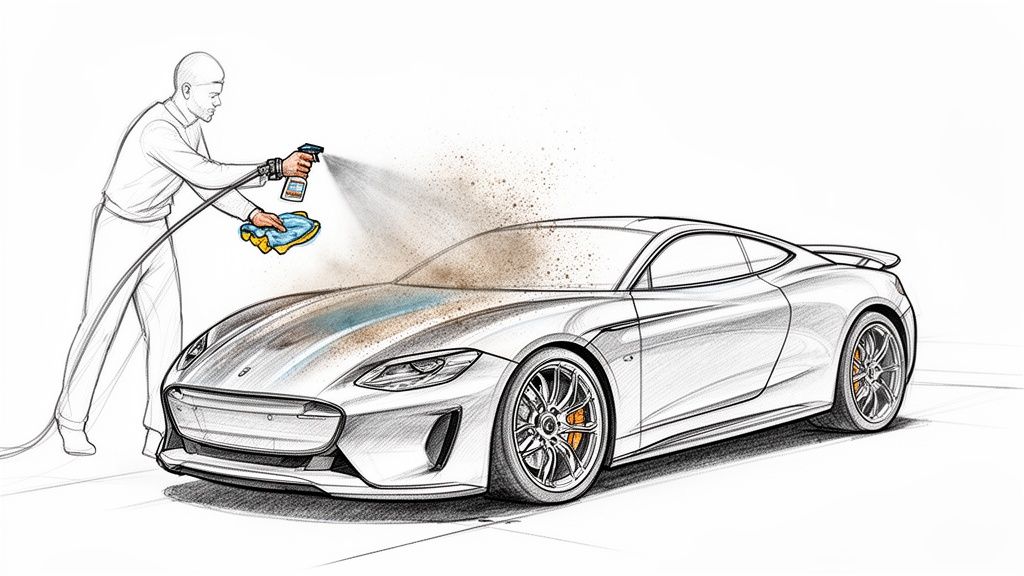
This technique has come a long way. It used to be a niche trick, but now it’s a core skill for any serious car enthusiast or pro detailer. It’s time we put the old myth to rest—dry washing does not have to scratch your paint. When you use the right products and the right technique, it’s an incredibly safe way to handle light cleaning, especially on a vehicle that’s already protected with a quality coating.
The Evolution of Waterless Cleaning
The whole idea behind a dry wash is more than just convenience. It’s about a smarter, more modern way to care for a vehicle’s finish. It all comes down to the science of how the cleaning solution interacts with the surface.
Now, if you’re working on a car with a Titan Elastomer coating, the game changes completely. Titan was the first company to introduce Elastomer coatings to the automotive market, leveraging our groundbreaking nano tubes technology and Dark Matter tech. The result is a surface that’s both hard like glass and unbelievably flexible.
This flexibility is what gives our coatings such incredible longevity. Traditional ceramics are brittle; they can micro-crack from temperature swings or minor impacts. Our elastic coatings, on the other hand, adapt. That resilience means your protection holds up, whether you’re going from freezing cold to scorching heat, because the coating won’t crack down due to its flexibility.
When you spray a quality dry wash solution onto this hyper-slick surface, the lubricants in the formula don’t have to work as hard. The towel glides almost effortlessly, encapsulating dust particles and lifting them away with barely any friction. This synergy transforms a simple maintenance wash into a ritual that actually enhances the vehicle’s protection.
A Growing Market for Smart Detailing
The move toward water-saving and coating-safe cleaning methods isn’t just a passing trend—it’s a real shift in the market. The entire car cleaning products industry is set to grow from around USD 15.49 billion in 2025 to USD 22.53 billion by 2032. Eco-friendly products like waterless washes are a huge part of that growth, which tells you that both pros and car owners are demanding smarter solutions.
For detailers, this means a bigger pool of clients who are looking for premium maintenance that protects their investment. To reach them, you need a strong online presence. Building a professional site is easier than you think, and using the best website builder for service businesses can help you attract the right kind of customers. This is how you effectively market specialized services that cater to coated vehicles and environmentally conscious owners, with products like a professional-grade auto quick detailer at the core of your high-demand offerings.
Gearing Up: Your Scratch-Free Dry Wash Arsenal
A perfect dry wash for cars is all about preparation. You can’t just grab a random spray and an old t-shirt and expect good results—that’s a surefire way to create the very scratches you’re trying to avoid. Think of it like a surgeon’s toolkit; every piece has a specific job, and together, they ensure a flawless outcome. Your goal is to lift dirt safely, not just push it around.
The Right Tools for the Job
Let’s get one thing straight: microfiber towels are non-negotiable. Forget about old bath towels or shop rags. You need a stack of plush, high-quality towels, ideally with a GSM (grams per square meter) of 500 or higher. The deep, soft fibers are your best defense against scratches, creating a cushion that traps dirt particles and lifts them away from the paint. A flat, cheap towel just drags grit across the surface.
Next up is the waterless wash solution. This isn’t just fancy-smelling water in a bottle. A quality formula is loaded with slick lubricants designed to surround and encapsulate every speck of dirt. When you spray it on a panel, these lubricants create a protective barrier between the grime and your paint, allowing your microfiber towel to glide over the surface and pick up the contaminants without a fight.
When you’re gathering your supplies, it helps to see how a modern dry wash setup compares to the old bucket-and-hose method.
Dry Wash Essentials vs. Traditional Wash
| Tool/Product | Dry Wash Requirement | Traditional Wash Requirement | Benefit of Dry Wash Approach |
|---|---|---|---|
| Cleaning Agent | 1 bottle of waterless wash | Buckets, car soap, foam cannon | Highly concentrated and portable |
| Towels | 8-10 high-GSM microfiber towels | 2-3 wash mitts, multiple drying towels | Specific towels for lifting and buffing prevent cross-contamination |
| Water Source | None | Hose, pressure washer, 10-20 gallons of water | Unlocks the ability to wash your car anywhere, anytime |
| Setup Time | < 1 minute | 5-10 minutes (filling buckets, setting up hose) | Grab-and-go convenience for quick touch-ups |
As you can see, the dry wash approach is all about efficiency and precision, using specialized tools to get the job done right with minimal fuss.
The Ultimate Unfair Advantage: A Coated Surface
Now, here’s where we separate a good dry wash from a great one. The single biggest factor in a safe, effortless wash is the surface itself. Think about sliding a piece of paper across sandpaper versus a sheet of glass—it’s all about friction.
This is where a professional coating changes everything. A car protected with Titan’s Alpha Quartz elastomer coating gives you the perfect canvas.
Titan’s unique elastomer technology wasn’t just dreamt up in a lab; it’s born from our proprietary technology using nano tubes and Dark Matter tech. This creates a surface that’s not only incredibly hard but also flexible, preventing the micro-cracking you see with brittle ceramic coatings during temperature changes or when bugs hit the car’s surface. Alpha Quartz is easy to install with great results and is built to last.
The unbelievable slickness of Alpha Quartz dramatically cuts down on surface friction. When you spray your waterless wash solution, the towel doesn’t just glide—it feels like it’s floating on air. This makes it ridiculously easy to lift dirt away, virtually eliminating the risk of micro-scratches and keeping that flawless finish looking its best.
Mind Your Surroundings
Having the right gear is only half the battle. Your environment is just as important. One of the most common mistakes I see is people trying to do a dry wash in direct sunlight on a hot panel. The heat flash-evaporates the solution, leaving you with a grabby, dry surface that’s a recipe for swirl marks.
Stick to these simple rules to keep your paint safe:
- Stay in the Shade: Always work on a cool surface. If you don’t have a garage, wait for an overcast day or wash your car in the early morning or late evening.
- Work Panel by Panel: Never spray the whole car at once. Focus on one small section at a time, like half the hood or a single door. This keeps the solution wet and working for you.
- Feel the Surface First: Before you start, do a quick “baggie test.” Place your hand in a thin sandwich bag and gently run it over the paint. If it feels gritty or rough, you have bonded contaminants. A dry wash won’t remove those, and you’ll need to decontaminate the surface first. You can learn more about how a clay bar treatment works to get your paint perfectly smooth again.
Mastering the Pro Dry Wash Technique Panel by Panel
Alright, you’ve got the right gear and the right mindset. Now, let’s put it all into practice. A proper dry wash for cars isn’t about aggressive scrubbing; it’s a careful, deliberate dance of three simple actions: mist, glide, and lift. I’m going to walk you through the exact panel-by-panel workflow we use to get a perfect finish without putting a single new scratch in the paint.
The first rule is non-negotiable: work from the top down. Gravity can be your best friend or your worst enemy here. Start on the roof and make your way down to keep any drips or runoff from messing up the panels you just cleaned. Always break the car down into small, manageable chunks—think half the hood, a single door, or one fender at a time. This is critical for making sure your waterless wash solution never has a chance to dry on the surface.
This little diagram perfectly captures the simple, yet vital, flow of the dry wash process.
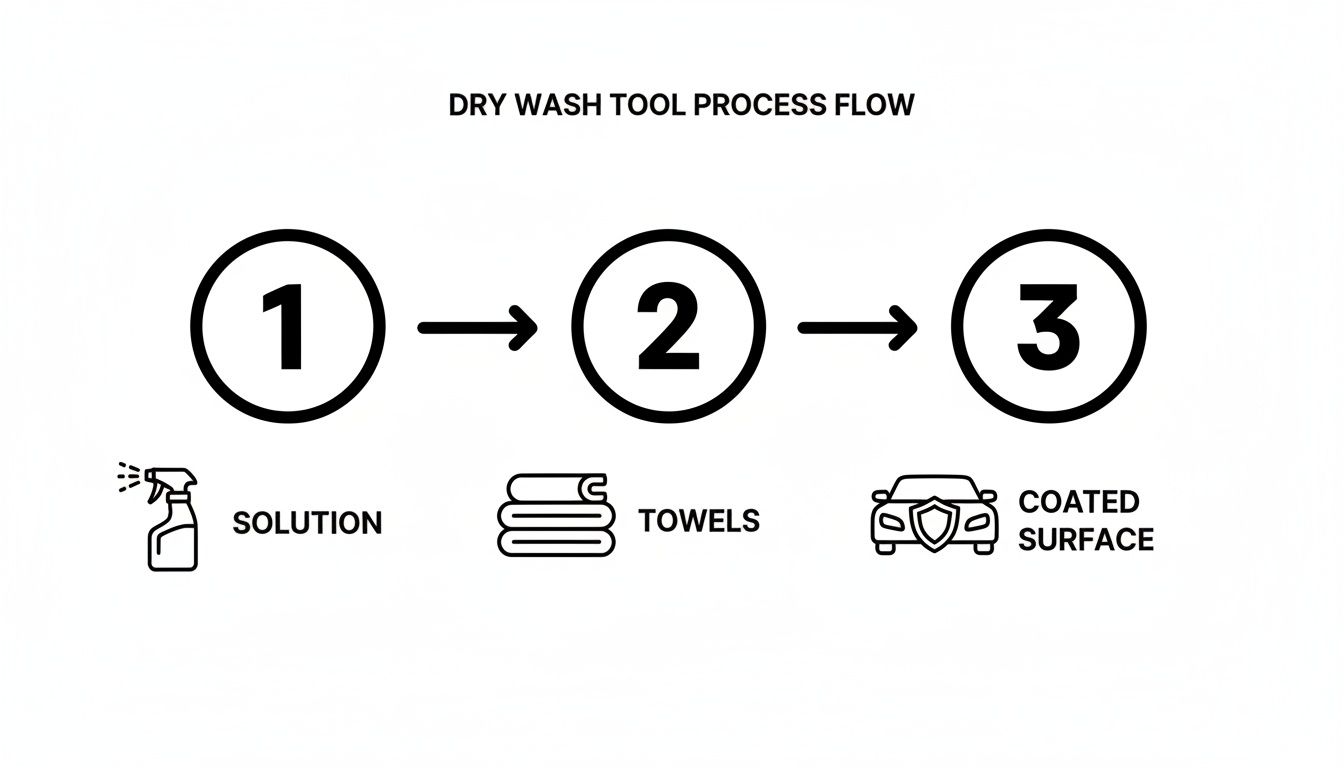
It boils down to three things working in harmony: a solution with tons of lubrication, a set of quality towels, and a slick, protected surface to work on.
The Flip-and-Fold Microfiber Method
Your microfiber towel is your most important piece of safety equipment, and technique is everything. The whole point is to make sure a fresh, clean face of the towel is the only thing that touches the paint on every single pass. This is where the “flip-and-fold” method becomes second nature.
Here’s how it’s done:
- Fold Your Towel: Grab a plush microfiber towel and fold it into quarters. Just like that, you’ve created eight clean, usable surfaces from a single towel.
- Mist the Panel: Give the section you’re working on a light, even mist of your waterless wash. You don’t need to soak it, but you do need enough product to lubricate the entire area.
- Wipe in One Direction: Lay your folded towel flat on the panel and gently glide it in a single, straight line. No circles. Ever. Circular motions just grind the dirt you’re trying to remove back into the paint. You are lifting the dirt into the towel’s fibers, not pushing it around.
- Lift and Flip: After one pass, lift the towel straight off the paint. Take a look at it—you’ll see the grime you just picked up. Now, flip the towel over to a completely clean side for your next pass.
- Repeat and Refold: Keep wiping in straight lines, using a fresh side for each pass. Once all four sides on that face are dirty, simply refold the towel to expose the four clean sides you haven’t used yet.
This disciplined approach is your absolute best defense against swirl marks. It guarantees you’re always trapping dirt with a clean surface, not dragging it across your beautiful finish.
How Titan Coatings Make This Even Safer
Now, doing this on a car protected with a Titan Elastomer coating is a whole different ballgame. Our coatings, which we developed using our own nano tube and Dark Matter tech, create a surface that is incredibly slick and, importantly, flexible.
That flexibility is the secret sauce. Traditional ceramic coatings are hard, sure, but they can be brittle. Our elastomer coatings have more “give.” This elasticity makes the surface far more resistant to the micro-scratches that can happen during a wash. The coating flexes on a microscopic level, helping to cushion the paint from any grit while the lubricants in your solution lift it away safely.
Even the glass becomes effortless. One day, a client of mine, John, was dreading his long commute in an upcoming storm. We had just treated his windshield with Titan’s APEX Glass Ceramic Coating. He called me the next day, amazed. “It was like the rain wasn’t even there,” he said. The water just beaded up and flew off, making his drive completely stress-free. It’s incredibly easy to use and enhances visibility so much that it changes your entire driving experience.
The real magic happens when you combine advanced coatings with proper technique. The coating gives you a forgiving, low-friction canvas to work on, and your method ensures the dirt is lifted away harmlessly. That’s how you preserve a flawless, high-gloss finish for years.
Tackling Specific Contaminants
A dry wash is perfect for light dust and fingerprints, but what about something a little tougher, like fresh bug guts? The key here is patience.
Spray the spot generously and just let the solution dwell for 30-60 seconds. This gives the cleaning agents time to break down the grime, making it easy to lift without any scrubbing. For anything more stubborn, it’s always smarter to switch to a dedicated cleaner. Knowing how to remove insects from your car the right way will save you a world of hurt.
Remember, a dry wash for cars is a maintenance tool for light contamination. By sticking to this top-down, panel-by-panel process and mastering the flip-and-fold method, you can keep your vehicle looking incredible with total confidence.
Advanced Tactics for a Showroom Finish
You’ve nailed the main panels, and the car is already looking worlds better. But the real magic, the thing that separates a quick clean from a professional, showroom-quality detail, is all in the finishing touches. This is where we take your dry wash for cars game to the next level by zeroing in on those tricky spots that most people miss.
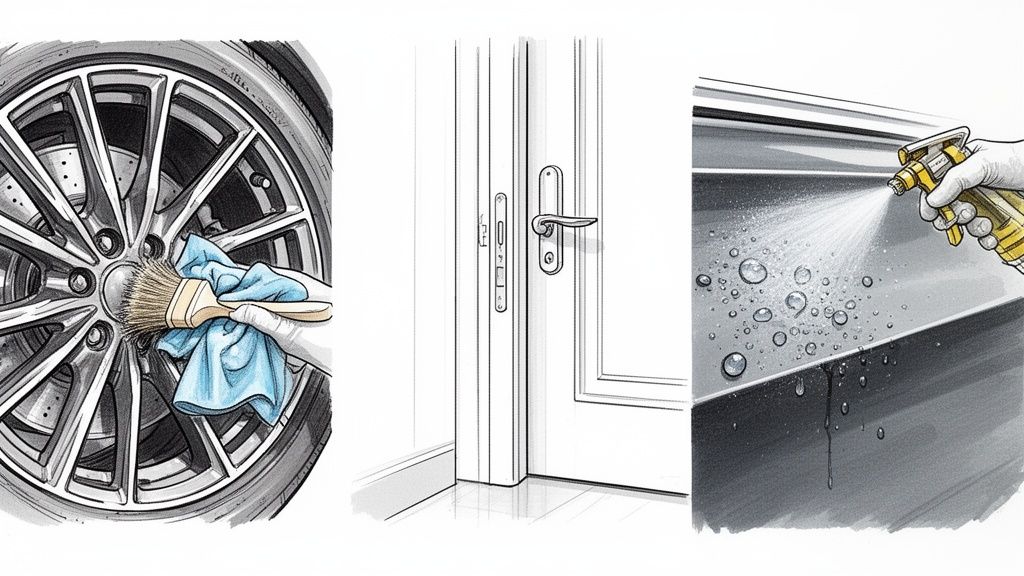
This isn’t just about wiping down the easy, flat surfaces. It’s about methodically tackling the areas where road grime loves to hide and then locking in your hard work with a final layer of protection that makes it all last.
Conquering the Details
Let’s be honest, certain parts of a car are just magnets for brake dust, road film, and stubborn dirt. I’m talking about intricate wheel spokes, the lower rocker panels, and inside the door jambs. These spots demand a more precise and careful approach than a simple spray-and-wipe.
Here’s my field-tested method for handling them safely:
- Intricate Wheels: Forget using a big towel here. Grab a smaller, dedicated microfiber and fold it into a size you can easily control. Spray your solution directly onto the towel, not the wheel itself—this prevents overspray from hitting your brake components. From there, gently work the towel around every spoke and into all those tight crevices.
- Lower Rocker Panels: This is ground zero for grime. Always use a separate, designated “dirty job” microfiber towel for these areas. You don’t want to drag that caked-on filth across your pristine paintwork. Saturate the panel well, wipe gently, and make sure you flip or refold the towel after every single pass.
- Door Jambs: This is a pro move. Open the doors and give the painted sections of the jambs a light misting. With a clean, soft towel, wipe away the accumulated dust and light grime. It’s a small detail, but a clean door jamb screams quality and thoroughness.
Topping Up Your Protection
With the car completely clean, it’s time for the final, crucial step: amplifying the gloss and reinforcing the protection. If your car is already protected by a high-end coating, this isn’t just about adding shine—it’s about essential maintenance.
For a vehicle shielded by Titan’s Alpha Quartz, a dry wash is the perfect setup for applying a maintenance topper. This last wipe-down with a compatible quick detailer does more than just make the paint pop. It actually recharges the hydrophobic properties of the elastomer coating. You’ll see water bead and fly off the surface even more aggressively, and the paint will become so slick that new dust and dirt will have a hard time sticking.
This maintenance step is the secret to keeping a coated car looking like it was just detailed for weeks on end. You’re not just cleaning; you’re feeding the coating, helping it perform at its peak and making every future wash that much easier.
This proactive approach is becoming the new standard. The days of casual driveway washing are fading as driver habits evolve. In fact, data shows over 70% of U.S. drivers have switched from at-home washing to professional services, and the global car wash market is on track to hit USD 48.25 billion by 2035. As water restrictions get tighter, detailers are seeing a surge in clients with premium coatings who specifically ask for safer, water-efficient wash methods. This has created the perfect opening for Titan-compatible dry wash protocols.
Built to Endure Real-World Conditions
One of the biggest advantages of working with Titan’s technology is its incredible resilience. We didn’t pioneer elastomer coatings in the automotive space by accident. Think about traditional ceramic coatings—they’re rigid, almost like a microscopic layer of glass. While that sounds hard, it also makes them brittle and susceptible to micro-cracking under stress.
Our elastomer coatings, infused with nanotubes and Dark Matter tech, are a whole different beast. They cure hard like glass but stay flexible. This elasticity allows the coating to expand and contract right along with the car’s metal panels during extreme temperature swings. A freezing winter night or a blazing summer afternoon won’t cause it to crack. This flexibility also helps it absorb minor impacts, like a bug hitting the grille at 70 mph, without failing.
It’s this engineered resilience that makes a dry wash so safe and effective on a Titan-protected car. You’re not just cleaning a fragile surface; you’re maintaining a durable, adaptive shield built for the long haul. And if you’re aiming for that flawless base before coating, it’s critical to learn how to polish car paint correctly to guarantee the best possible bond and finish.
Why Dry Washing Is Smarter for Your Wallet and the Planet
Beyond the incredible shine and sheer convenience, choosing a dry wash for cars brings some serious real-world benefits that go far beyond your driveway. It’s a smarter way to care for your vehicle, not just for its paint, but for your bank account and the planet, too. We’ve covered the technique, now let’s get into the real-world impact.
When you start looking at the numbers, the picture becomes crystal clear. A traditional car wash at home can guzzle over 100 gallons of water. A dry wash? You’re using just a few ounces of a high-lubricity formula. That’s not a small difference—it’s a complete game-changer in how we think about using resources.
The Clear Financial Advantage
Financially, the return on investing in a solid dry wash setup is a no-brainer. Sure, you have a small upfront cost for quality microfiber towels and a premium waterless wash solution, but that investment pays for itself almost immediately. You’re completely cutting out those trips to the local car wash for every little bit of dust and dirt.
But the real savings are even bigger. The most expensive part of owning a car isn’t washing it; it’s protecting the paint.
By using a safe, low-friction dry wash method, you are actively preserving the integrity of your expensive coating. This preventative maintenance helps you avoid the high cost of paint correction down the road, which can easily run into hundreds or even thousands of dollars.
For professional detailers, this is huge. Mastering the dry wash lets you offer a premium, eco-friendly service that clients are actively looking for. It directly taps into a growing market of environmentally-conscious car owners who want top-tier care without the heavy footprint.
A Major Environmental Impact
The environmental argument for dry washing is even more powerful. Growing concerns about water usage are a major reason why these methods are gaining so much traction. A standard driveway wash can easily waste 300–500 liters of potable water per car. With a dry wash, you cut that direct water use down to practically zero.
Think about the scale of that. As the car care market grows, if even a small fraction of washes—say, just 10–20% of services—switched to low-water methods, we’d be saving billions of liters of water every year. Industry analysts are pointing to eco-friendly systems and advanced coatings as major trends, making the combo of a low-friction coating and a dry wash technique a smart business move. You can see more on these market shifts and their effect on the car wash industry on Technavio.
This approach also solves another huge problem: polluted runoff. When you wash your car with a hose, all that soap, brake dust, and road grime flows straight into storm drains and our local waterways. A dry wash, on the other hand, traps those contaminants in your microfiber towels. You can then wash and reuse them responsibly, keeping that gunk contained. It’s simply a cleaner, more responsible way to keep your car looking sharp. And for those trying to maintain their coated vehicles, we have more tips in our guide to a proper ceramic car wash.
Still Have Questions About Dry Washing Your Car?
Even with the best technique, it’s smart to have a few questions when you’re trying a new method on your pride and joy. Let’s tackle some of the most common concerns I hear from fellow enthusiasts. The goal here is to give you complete confidence in your new go-to maintenance routine.
Is a Dry Wash Actually Safe for My Paint?
Yes, absolutely—as long as you’re doing it right and, more importantly, at the right time. A dry wash is your best friend for handling light dust, fresh pollen, fingerprints, and other minor surface contaminants. It’s not, however, the tool for a car that’s caked in mud or covered in gritty road film from a week of commuting.
The whole process hinges on three things working together perfectly:
- A High-Quality, High-Lubricity Spray: The formula is designed to surround and lift dirt particles, creating a buffer between the grit and your paint.
- Plush Microfiber Towels: You need that deep, soft pile to pull the encapsulated dirt away from the surface and trap it safely within the fibers.
- The Right Technique: This means no pressure. Just gentle, straight-line wipes. You’re lifting the dirt, not grinding it into the clear coat.
This is even safer when you’re working on a car protected with a Titan Elastomer coating. Our coatings, built with nano tubes and Dark Matter tech, create a surface that is just unbelievably slick. This low-friction finish lets your towel glide with almost zero effort, which all but eliminates the risk of adding any new micro-swirls.
How Dirty Is Too Dirty for a Dry Wash?
This is the big one, the question that really separates a smart detailer from someone who’s about to damage their paint. My rule of thumb is simple: if you can see a thick, gritty layer of dirt, or any caked-on mud or road salt, put the spray bottle down. That’s a job for a touchless pre-rinse and a proper two-bucket wash, no exceptions.
Think of a dry wash as your daily or weekly touch-up tool. It’s perfect for the light dust your car collects in the garage, the yellow film of pollen after a spring day, or that fresh bird dropping you catch right away. It’s for maintenance, not for heavy-duty restoration.
If your vehicle is wearing a coating like our Alpha Quartz, its inherent elasticity gives you a bit of an extra safety net. Unlike old-school, brittle ceramics, our coatings have more flexibility, making them more forgiving when it comes to the tiny scratches that can come from light contaminants. But even with that advantage, always err on the side of caution. If you’re in doubt, grab the hose.
Can I Dry Wash My Car in the Sun?
Please don’t. This is one of the fastest ways to turn a simple task into a potential disaster. Working on hot panels in direct sunlight will cause your waterless wash spray to evaporate on contact, long before it can do its job of lubricating the surface and lifting the dirt.
When the liquid flashes off that quickly, you’re left with a grabby, dry surface. Trying to wipe a towel across that is practically guaranteed to cause scratches. You always want to work in the shade, on panels that are cool to the touch. This gives the product the time it needs to work its magic and ensures a safe, swirl-free finish.
What’s the Difference Between a Waterless and a Rinseless Wash?
Great question. People often use these terms interchangeably, but they describe two very different approaches to cleaning your car with minimal water.
- A waterless wash (or a dry wash) is exactly what we’ve been talking about. You take a ready-to-use spray, mist it onto a panel, and gently wipe it away. It requires zero extra water.
- A rinseless wash is the next level up, perfect for a car that’s a bit too dirty for a waterless spray but doesn’t need a full-blown wash. You mix a concentrated solution into a single bucket of water, use a wash mitt to clean a panel, and immediately dry it. No final hosing-down is needed.
I like to think of a rinseless wash as the perfect bridge between a quick dry wash and a traditional two-bucket wash. It provides more cleaning muscle than a simple spray-and-wipe but uses a fraction of the water of a hose, making it an incredibly versatile tool in any detailer’s arsenal.
Here at Titan Coatings, we believe that next-level protection deserves next-level maintenance. Our coatings are engineered to make your life easier and keep your vehicle looking incredible with less work. The unbelievable slickness and durability of our elastomer coatings make them the perfect foundation for a safe and effective dry wash routine.
Ready to see what it feels like to clean a surface so slick it’s almost effortless? Discover how our Alpha Quartz coating can completely change how you care for your car. Explore Alpha Quartz and elevate your vehicle’s protection.
0 Comments