
When it comes to washing your ceramic-coated car, there's one golden rule: be gentle. That’s it. You’ve invested in a serious layer of protection, and the last thing you want to do is degrade it with harsh chemicals or abrasive washing methods. Using pH-neutral soaps, high-quality microfiber towels, and proven techniques like the two-bucket method isn't just about cleaning—it's about preserving that incredible gloss and protection.
Why Your Coated Car Deserves Better Than a Drive-Thru Wash
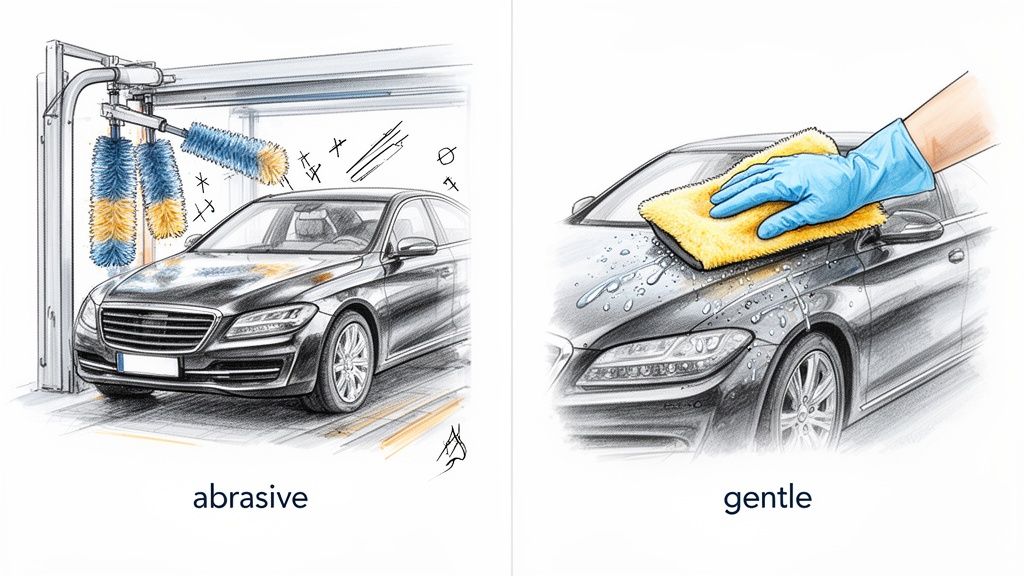
Think back to the moment you first saw your car after its Titan Coatings application—that flawless, liquid-glass finish. Now, imagine subjecting that perfect surface to the gritty, recycled brushes of an automatic car wash. It’s enough to make any car owner shudder, and for good reason. Those aggressive brushes can easily inflict thousands of tiny scratches, dulling the very shine you paid top dollar to protect.
Protecting Your Advanced Investment
Following a proper wash routine isn't just about keeping your car clean; it's about safeguarding a major investment in advanced paint protection. More and more car owners are recognizing this, which is why the global ceramic coating market hit a staggering value of roughly USD 11.23 billion in 2023 and is on track to nearly double. This trend highlights a massive shift towards prioritizing long-term vehicle care over quick, damaging fixes.
Just like regular oil changes and tire rotations, proper washing is a crucial part of your car's upkeep. Understanding the benefits of scheduled maintenance helps put into perspective how vital these small, consistent efforts are for preserving your vehicle's value.
The Titan Coatings Difference
This is particularly true for vehicles shielded by Titan’s unique elastomer coatings. While traditional ceramic coatings offer a hard, glassy shell, they can also be brittle. Titan was the first company to introduce elastomer coatings to the market, pioneering a revolutionary approach with nano tube technology and our proprietary Dark Matter Tech. The result is a surface that’s both incredibly hard and remarkably flexible.
Think of it like this: a pane of glass is hard, but it shatters under impact. A sheet of plexiglass is also hard, but it has enough give to absorb a hit without cracking. Our elastic coatings behave like that plexiglass shield for your paint.
This built-in elasticity makes our coatings, such as Alpha Quartz, exceptionally resilient. They’re better equipped to handle minor impacts from road debris and—crucially—won't crack under the stress of extreme temperature swings from freezing winters to scorching summers. That flexibility makes them last longer.
You can learn more about how this works in our guide on ceramic coatings on cars. By ditching harsh automatic washes for proper hand-washing techniques, you ensure this flexible shield maintains its mind-blowing gloss and water-beading magic for years.
Gathering Your Essential Detailing Tools
Before a single drop of water hits your paint, the perfect wash for a ceramic-coated car has already begun. It starts with having the right gear on hand. Seriously, grabbing an old bath towel or the same bucket you use for mopping the garage is the fastest way to put swirls and scratches right back into the paint your coating is meant to protect. It completely defeats the purpose of your investment.
Think about it this way: a surgeon wouldn't use dull, unsterilized tools, right? Your vehicle, especially one wearing a high-end coating like Titan, deserves that same meticulous approach. Our flexible elastomer coatings are incredibly tough against micro-scratches, but using the right tools isn’t just a suggestion—it's the foundation for keeping that unbelievable gloss and slickness for years.
Let's build your ultimate wash kit and talk about why each piece is so important.
Your Essential Ceramic Coating Wash Kit
Getting your wash kit dialed in is the first step. Below is a breakdown of the must-have tools. Don't skimp here; these items are your first line of defense against damaging your vehicle's finish.
| Tool | Why It's Essential | Pro Tip |
|---|---|---|
| Two 5-Gallon Buckets | One is for your suds, the other for rinsing your mitt. This simple separation prevents you from re-introducing dirt onto the paint. | Label them! A simple "SOAP" and "RINSE" sticker can prevent a costly mix-up. |
| Grit Guards | These plastic inserts sit at the bottom of your buckets, trapping dirt and grit below. This prevents your wash mitt from picking it back up. | Always push your wash mitt against the guard every time you rinse it. You'll be amazed at what settles at the bottom. |
| pH-Neutral Car Shampoo | Harsh soaps strip coatings and clog their pores with waxes or silicones, killing the hydrophobic effect. A pure, pH-neutral soap cleans safely. | Check out our full guide on choosing the perfect car wash soap for ceramic coating for a deep dive. |
| Foam Cannon/Gun | This is your pre-wash powerhouse. It covers the car in thick foam, lifting and loosening heavy grime so it can be rinsed away before you touch the paint. | Let the foam dwell for 3-5 minutes, but never let it dry on the surface, especially in direct sunlight. |
| Microfiber Wash Mitt | A high-quality mitt has deep fibers that trap dirt particles, pulling them away from the surface instead of dragging them across it like a sponge would. | Have one mitt for the upper, cleaner parts of the car and a separate, older one for the grimy lower sections and wheels. |
| Plush Drying Towels | High-GSM (Grams per Square Meter) microfiber towels are ultra-absorbent. They allow you to blot the car dry, not wipe it, which is much safer. | Use a large "waffle-weave" or twisted-loop towel for the main body panels. They can often dry a whole car in one pass. |
Investing in these specific items isn't about being fancy; it's about creating a system that protects your coating with every single wash.
The Gentle Touch Approach
Once you've got your soap and buckets ready, it's all about minimizing physical contact with the paint. The real secret to a swirl-free finish is to let your tools do the work for you.
This is where a foam cannon or pressure washer becomes your best friend. Blasting a thick layer of suds over the entire vehicle is the ideal pre-wash. It encapsulates all that heavy dirt and road film, letting gravity and a gentle rinse pull most of it off the car. This one step dramatically cuts down on the amount of grime your wash mitt has to deal with later.
A veteran detailer once told me, "Treat every wash like you're trying to touch the paint as little as possible." That's the exact philosophy behind a good pre-wash. It handles the heavy lifting so your contact wash is just a light, final cleanup.
When it's finally time for that contact wash, your microfiber wash mitt takes center stage. Its long, plush fibers are designed to be a safe haven for any remaining dirt particles, pulling them deep into the pile and away from your precious clear coat. It’s a completely different world from those old yellow sponges that just push grit around, creating a microscopic mess.
And for the final step, drying? Put away the chamois. A big, fluffy microfiber drying towel is what you need. A high-quality towel can soak up an incredible amount of water, letting you gently blot or drag the towel across the surface. This gentle touch is the perfect, scratch-free way to wrap up your wash and reveal that flawless, glossy finish.
The Perfect Two-Bucket Wash Method
Let's turn a routine car wash into a masterclass in paint preservation. If you want a flawless, swirl-free finish every single time, the absolute gold standard is the two-bucket wash method. It’s not complicated, but it’s a game-changer because it eliminates the number one cause of wash-induced scratches: dragging dirt back across your paint.
First things first, get your car into a cool, shaded spot. Direct sunlight is your worst enemy here—it’ll cause soap and water to evaporate too quickly, leaving you with frustrating water spots and streaks. Once you’re out of the sun, give the car a good pre-rinse with a pressure washer or hose to blast away all the loose dirt and grit.
Now, break out the foam cannon. Lay down a thick, rich blanket of pH-neutral foam over the entire vehicle. This isn’t just for looks; those suds are hard at work, softening and encapsulating stubborn grime so it rinses away easily, long before your wash mitt ever touches the paint.
The Heart of the Technique
The real magic here is in the simple setup. You’ll need two buckets, and each one absolutely needs a Grit Guard at the bottom.
- The Wash Bucket: This is your "clean" bucket, filled with your diluted, pH-neutral car shampoo.
- The Rinse Bucket: This one is just for clean, fresh water. It's the "dirty" bucket.
Here's the rhythm: dip your clean microfiber wash mitt into the soapy Wash Bucket and load it up. Gently wash a single panel of your car. Now, here's the crucial part. Before you ever go back for more soap, you first dunk that dirty mitt into the clean water of your Rinse Bucket. Scrub it against the Grit Guard, which will pull the dirt and grit out of the fibers and trap it safely at the bottom.
That one simple step means you're only ever touching your paint with a clean, sudsy mitt, not a gritty, damaging one.
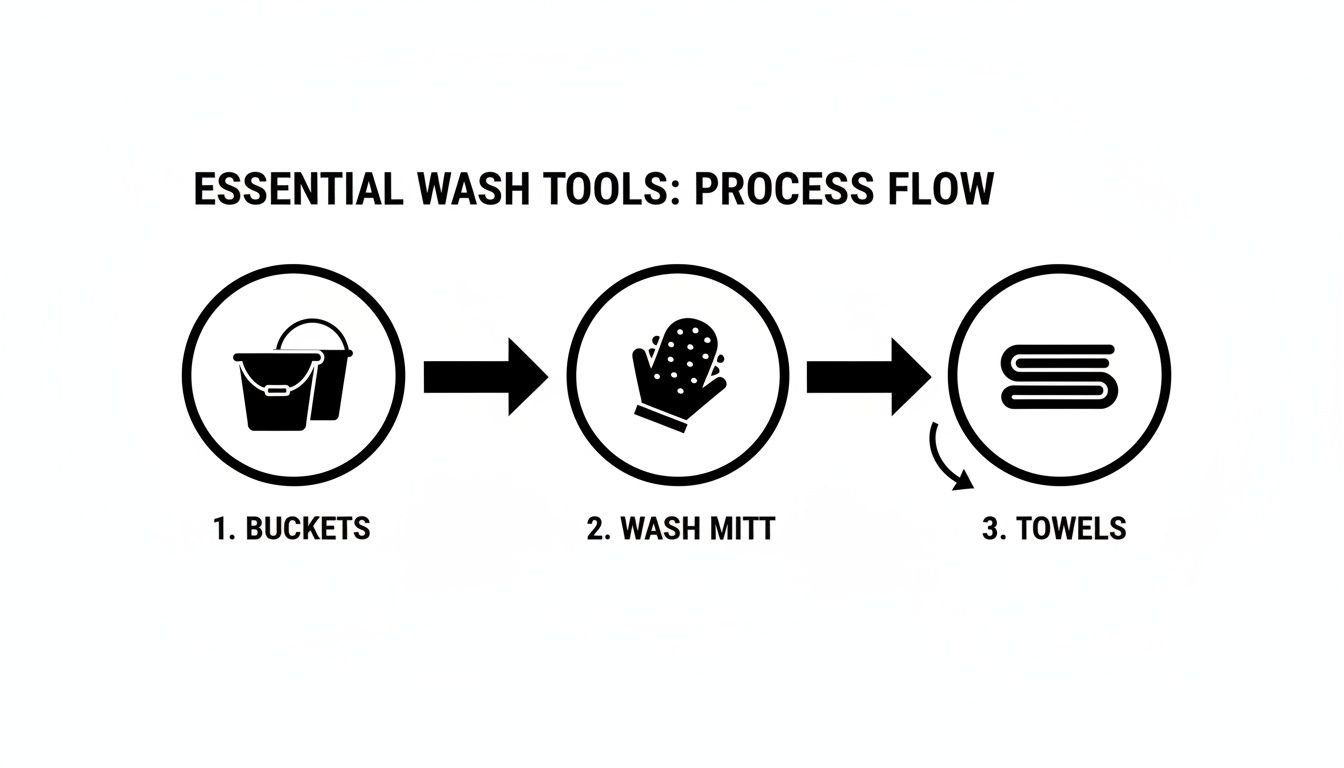
This process might seem meticulous, but separating your soap and rinse water is the fundamental secret to preserving your car's finish.
A Story of Resilience
I had a wake-up call a while back. I was washing a client's car that had a standard, brittle-style ceramic coating. It was a cold morning, and as I was gliding my mitt over the hood, a tiny piece of gravel flicked up from the driveway and just tapped the surface. The result? A small but very obvious chip in the coating. I was doing everything right, but it still happened.
A few weeks later, the exact same thing happened to my own car, which is protected with Titan's Alpha Quartz. A pebble kicked up and hit the fender. I honestly held my breath, expecting to see another chip. But when I rinsed the panel, there was nothing. Not a single mark. The elastomer-based coating had flexed, absorbed the minor impact, and was perfectly fine.
This is where the true value of Titan’s advanced elastomer technology really hits home. Its inherent flexibility, derived from our cutting-edge nano tube and Dark Matter tech, provides a level of resilience that hard, glass-like coatings simply can't match.
This elasticity makes the surface dramatically more resilient, not just to random impacts but also to the microscopic pressures of a simple wash. It's especially important in climates with big temperature swings. A traditional coating can get brittle when it's frozen, making it prone to cracking under stress. Titan coatings, on the other hand, stay flexible whether they’re baking in the summer sun or covered in ice. That flexibility prevents cracking and makes the protection last a whole lot longer.
Executing the Perfect Wash
When you start the contact wash, always work from the top of the car down. Your roof, hood, and windows are usually the cleanest parts, while the lower panels and bumpers are caked with road grime. Washing top-to-bottom prevents you from dragging the worst of that contamination all over the car.
Tackle one panel at a time, washing in straight, overlapping lines—never, ever in circles. That circular motion is how swirl marks are born. After each panel, it's back to the buckets: dunk and scrub in the rinse water, then get fresh suds from the wash bucket. It's a rhythm that quickly becomes second nature.
It’s no surprise that demand for this level of protection is exploding. The premium ceramic car coatings market hit USD 1.80 billion in 2024 and is on track to reach USD 3.43 billion by 2033. People want durable, long-lasting solutions, and advanced formulas like Titan's are exactly what they're looking for. You can dig into more of the data in the full report on premium ceramic car coatings.
Mastering the two-bucket method is simply the best way to protect that premium investment.
Safe Drying and Decontamination Techniques
You’ve just given your car a perfect, gentle wash. Honestly, this next step is where most people go wrong. All that careful work can be undone in ten minutes flat with a bad drying technique, which is the number one cause of swirl marks on an otherwise pristine vehicle. Let's make sure that doesn't happen.
How to Dry Your Coated Car Without Causing Scratches
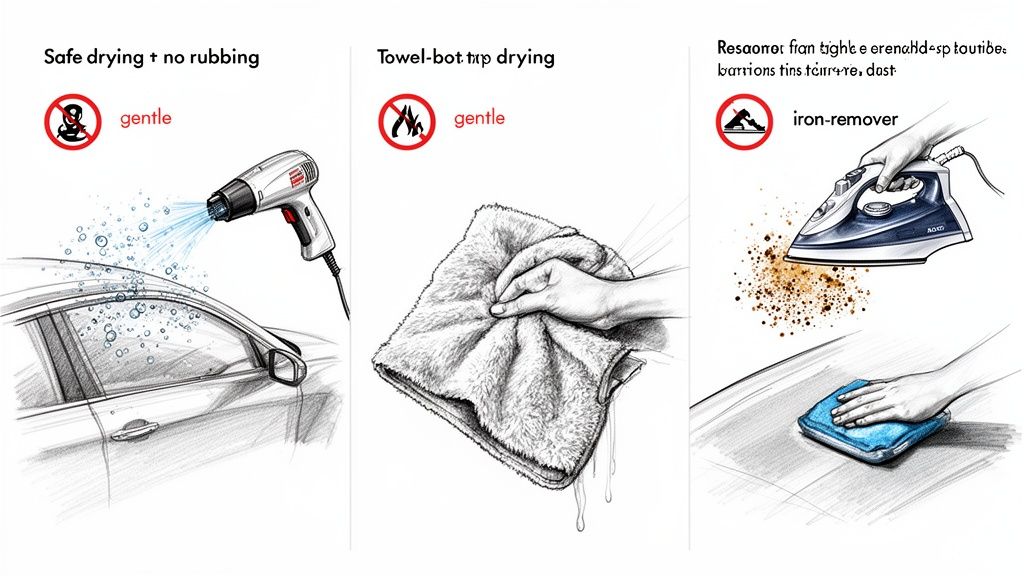
Your ceramic coating is already doing a lot of the heavy lifting, shedding most of the water right off the paint. But what about the droplets that are left? The absolute safest way to handle them is to never touch the paint at all. A dedicated car dryer or even a powerful electric leaf blower is your best friend here. You can blast water out of every nook and cranny—mirror caps, grilles, emblems—without a single swipe.
Don't have a car dryer? No problem. The next best thing is what I call the "towel blot" method. Grab a big, plush, high-quality microfiber drying towel. The key is to never wipe. Instead, lay the towel flat on a panel, let it soak up the water for a second, then lift it straight up. Move to the next spot and repeat. It takes a little longer, but you’ll be rewarded with a flawless, streak-free finish.
Unclogging Your Coating with Decontamination
Sooner or later, you might notice the water isn't beading quite as frantically as it did when the coating was fresh. Don't panic—your coating isn't failing! It’s just "clogged" with stuff a normal wash can’t touch. We’re talking about tiny iron particles from brake dust and industrial fallout that have bonded to the surface, smothering your coating’s hydrophobic power.
The fix is a periodic chemical decontamination using an iron remover spray. This stuff is almost magic.
- How it works: You just spray it onto a clean, cool panel and let it sit for a few minutes.
- The "bleeding" effect: The cool part is watching the chemical turn a deep purple or red as it reacts with and dissolves the iron. That's how you know it's working.
- The result: After it's done its thing, you just rinse it all away. You'll immediately feel the difference—the paint is slick and glassy again, and water beading is back in full force.
If you want to take it a step further, you can follow up with a physical decontamination. To really nail this, check out our full guide on how to decontaminate car paint.
The Gentle Approach to Physical Decontamination
A traditional clay bar in the wrong hands can be too aggressive for a coated car. A much safer bet is a modern clay mitt or clay towel. These use a synthetic polymer face to gently glide over the paint, grabbing any leftover embedded gunk without the high risk of scratching.
This is where the advanced formulation of Titan’s coatings really shines. Our elastomer-based coatings, a market first using nano-tube technology, have an inherent flexibility. This allows the surface to absorb the minor pressure from a clay mitt, dramatically reducing the risk of marring compared to a rigid, brittle traditional coating.
I was chatting with a pro detailer who uses Titan on all his high-end client cars. He told me about a brand-new SUV he saw with a competitor's hard ceramic coating. A bug hit the hood on the highway, and the impact actually cracked the coating because it was so rigid.
Contrast that with his own truck, which is protected with our Alpha Quartz elastomer coating. He’s seen bugs hit it at 80 mph without leaving a single mark. The coating flexes, absorbs the hit, and stays perfect. It’s that same resilience that makes the decontamination process so much safer on a Titan-protected vehicle. That's true peace of mind.
Long-Term Maintenance for Lasting Protection
A solid wash routine is the cornerstone of caring for your ceramic coating, but a smart long-term maintenance plan is what truly locks in that stunning gloss for years to come. To keep your car looking as good in year three as it did on day one, you have to think beyond just the wash bucket.
This means periodically giving the coating a little boost to keep its protective muscle and hydrophobic magic at full strength. Think of it as a tune-up for your car's invisible shield.
Rejuvenating Your Coating's Performance
Every few months, it’s a brilliant move to apply a ceramic topper or a maintenance booster spray. These aren't just fancy detailer sprays; they're specifically designed to refresh the very top layer of your coating. They bring back that amazing water-beading action and add a fresh layer of slickness and shine. It's like feeding your coating exactly what it craves to stay healthy.
If your vehicle is protected with Titan Coatings, it's crucial to use a maintenance product built with our proprietary Dark Matter Technology. This isn't some generic, off-the-shelf spray. It’s formulated to form a perfect molecular bond with our elastomer base coatings, ensuring the topper integrates seamlessly and reinforces the flexible, durable shield you count on. You can dive deeper into these strategies in our complete guide to ceramic coating maintenance.
The Story of a Stressful Drive Transformed
I’ll never forget one particular drive through a blinding downpour. It was one of those storms where rain comes down in solid sheets and you can barely see the hood of your own car. My wipers were on full blast, just slapping uselessly against the glass as every oncoming headlight smeared into a disorienting blur. Honestly, it was a white-knuckle experience that felt genuinely unsafe.
That same weekend, I treated my windshield with Titan's Apex Glass Ceramic Coating. The difference was night and day. The next time it rained, as soon as I hit about 40 mph, the water just beaded up into tiny spheres and flew right off the windshield. I barely even needed my wipers. The clarity was shocking, and that feeling of stress? It was just gone.
This screenshot gives you a glimpse of how intensely hydrophobic the surface becomes. The water forms into these tight, perfect beads instead of sheeting out, and that's the secret to its self-clearing magic at driving speeds.
It’s an easy-to-use coating that creates a powerful hydrophobic barrier on your glass. This isn't just about looks; it's a real upgrade in driving safety and comfort, turning a nerve-wracking storm into a stress-free drive.
It's this kind of advanced, real-world protection that explains why the nano ceramic coating for cars market is the fastest-growing segment in the industry. Projections show it exploding from USD 1.25 billion in 2023 to USD 4.71 billion by 2033. This growth isn't just hype; it reflects people choosing high-performance formulas that deliver tangible benefits, just like seeing clearly in a downpour.
The Foundation of Lasting Care
Ultimately, long-term maintenance is a holistic approach. It’s about combining the right wash techniques, decontaminating the surface when needed, and boosting the coating with products that are designed to work with it, not against it. To get the most out of your coating's lifespan, understanding the general principles for maintaining a flawless, lasting finish on various surfaces can provide some great long-term care insights.
This is especially true for our Alpha Quartz elastomer coating. We engineered it to be flexible, so it won’t crack under the stress of heat, cold, or even minor impacts from things like bug strikes. That resilience is the core of its longevity. When you back it up with a solid maintenance plan, you’re ensuring this incredible protection performs flawlessly for its entire lifespan.
Answering Your Top Ceramic Coating Care Questions
Even after you've got your wash routine down pat, some questions always seem to surface. It's totally normal—you've made an investment in your vehicle's appearance, and you want to make sure you're doing everything right to protect it. Let's dig into some of the most common things we hear from car owners about keeping their ceramic coating in top shape.
How Often Should I Be Washing My Car?
Honestly, this really comes down to how you use your car. If it's your daily driver, constantly battling traffic, rain, and road grime, you’ll want to give it a good wash every one to two weeks. Sticking to this schedule prevents that grimy layer of road film from building up and hiding your coating's awesome hydrophobic effects.
On the other hand, for a weekend warrior that mostly lives in the garage, washing it every three to four weeks is usually more than enough. The golden rule, though? Wash it immediately if it gets tagged with something nasty like bird droppings or a major bug splatter. That stuff can be acidic and will do a number on your coating if you let it sit and bake in the sun.
Are Waterless or Rinseless Washes Safe to Use?
You bet they are. Both are fantastic, safe options for dealing with light to moderate dirt, and they're a huge help if you're trying to conserve water. A rinseless wash is perfect when your car is more dusty than muddy. You just need one bucket of solution and a good stack of clean, plush microfiber towels to get the job done right.
A waterless wash spray is your best friend for quick touch-ups—think fingerprints, a light layer of dust, or that one bird dropping that landed right after your last wash. As long as you're using quality products and plenty of clean towels, these methods are perfectly safe for your coating and a brilliant way to keep that "just-washed" shine between full-blown two-bucket washes.
What’s the Big Deal If I Use the Wrong Kind of Soap?
Using the wrong soap is probably the single most common mistake we see people make. Soaps that are packed with waxes, silicones, or so-called "gloss enhancers" are a real problem. They're designed to leave a film behind, which clogs the microscopic surface of your ceramic coating and instantly suffocates its hydrophobic properties. The first thing you'll notice is that water stops beading and starts clinging to the paint.
Worse yet are the really harsh, high-pH soaps or aggressive degreasers. Over time, these can literally eat away at the top layer of your coating, dramatically shortening its life. Play it safe and always stick to a dedicated, pH-neutral car shampoo. That way, you know you're just cleaning the surface without causing any damage.
Help! My Coating Isn't Beading Water Anymore. Is It Gone?
This is the question that sends owners into a panic, but take a deep breath—in 99% of cases, your coating is still there and working just fine! When a coating stops beading, it almost always means the surface has become "clogged" with a layer of bonded contaminants that a regular wash just can't lift.
The fix is usually pretty simple: it's time for a deep clean. Start with a proper two-bucket wash. If the water beading doesn't snap back to life, the next step is a chemical decontamination with an iron remover. This process dissolves those stubborn bonded particles, frees up the surface, and almost always brings that wild water-beading action roaring back.
Getting these little details right is what will help you enjoy your coating for years to come. To get a better idea of what to expect from your coating's lifespan, our guide explains in detail how long does ceramic coating last. Proper care is truly the secret to getting the most out of it.
Ready to bring that same level of protection to your glass, especially for driving in bad weather? The same cutting-edge science Titan Coatings uses for your paint is ready for your windshield. Our Apex Glass Ceramic Coating creates an intensely slick surface that makes rain fly right off, dramatically improving your visibility and making stormy drives far less stressful.
Discover the clarity and safety of Titan's Apex Glass Ceramic Coating today!
0 Comments