
If you’re just starting out, the single best tool you can buy is a dual-action (DA) polisher. It’s the go-to choice for a reason. Its unique movement makes it incredibly safe, forgiving, and more than capable of erasing the light swirls and scratches that dull your car’s finish.
Think of it as a polisher with built-in training wheels. This safety net lets you jump right in and get professional-looking results on your very first try, without the high-stakes risk of damaging your paint.
Why A Dual-Action Polisher Is Your Best First Choice
Staring at a car covered in a web of fine scratches can be frustrating. You want that deep, mirror-like shine, but the thought of taking a power tool to your paint job is intimidating. We get it. Many enthusiasts feel stuck between wanting a perfect finish and fearing a costly mistake.
The game-changer for so many people is the dual-action (DA) polisher. This is the tool that transforms paint correction from a stressful unknown into an incredibly satisfying project.
The Built-In Safety Net For Beginners
So, what makes a DA so safe? Unlike an aggressive rotary polisher that spins on a single, fixed axis, a DA polisher moves in two ways at once. It spins the polishing pad in a large circle while also oscillating in a smaller, random pattern.
Imagine how you’d polish a car by hand—you’d use overlapping circular motions. A DA polisher essentially mimics that same movement, just with the speed and consistency that only a machine can deliver.
This dual motion is the secret sauce. It keeps heat from building up in one spot, which is the number one cause of “burning” through your car’s clear coat. This forgiving design almost completely eliminates the risk of irreversible damage, making it the undisputed champion for anyone new to machine polishing.
A dual-action polisher’s design prioritizes safety and control. It lets a beginner focus on learning the right technique and getting great results, not on worrying about messing up the paint. It’s the perfect entry point into the world of paint perfection.
Choosing the right machine is the first step toward restoring your car’s gloss with real confidence. A DA polisher isn’t just a tool; it’s your ticket to achieving a level of shine you might have thought was only possible for seasoned pros. Before you start, it’s a great idea to get a feel for the whole process. You can learn more about how to polish car paint correctly in our detailed guide.
Key Features To Look For In A Starter Polisher
When you’re shopping for your first polisher, it’s easy to get lost in the specs. Don’t worry about all the noise. For a beginner, a few key features make all the difference between a frustrating experience and a fantastic one.
We’ve put together a quick guide to help you focus on what truly matters.
Quick Guide: Top Polisher Features For Beginners
Focus on these key features to choose a machine that’s safe, effective, and easy to handle for your first paint correction project.
| Feature | Why It Matters For Beginners | What To Look For |
|---|---|---|
| Orbit Size (Throw) | A larger orbit (e.g., 15mm or 21mm) corrects paint faster and more efficiently, reducing the time you spend on each panel. Smaller orbits (8-12mm) are great for tight, curved areas. | A 15mm orbit is a fantastic all-around choice for beginners, balancing correction speed with control. |
| Variable Speed Control | Different steps require different speeds. You need a lower speed for spreading polish and a higher speed for correction. Good control is non-negotiable. | A machine with 6 distinct speed settings and a soft-start feature that prevents polish from slinging everywhere when you turn it on. |
| Power (Amps/Watts) | More power helps the pad keep spinning under pressure, which is called “pad stall.” A machine that stalls easily is frustrating and ineffective. | Look for a polisher with at least a 7-8 Amp motor or around 800-1000 Watts. |
| Ergonomics & Weight | You’ll be holding this machine for hours. A polisher that is heavy, vibrates excessively, or is poorly balanced will wear you out fast. | Choose a polisher that feels balanced in your hands. A weight between 5-7 lbs (2.3-3.2 kg) is a good target for minimizing fatigue. |
Ultimately, a polisher with these features will feel like an extension of your own hands, giving you the control you need to do the job right.
Remember, polishing is the critical step you take before adding protection. After you’ve perfected the paint, you need to lock in that flawless finish. This is where a product like Titan Coatings’ Alpha Quartz comes in, providing a durable, flexible shield that preserves all your hard work for years to come.
Rotary vs. Dual-Action Polishers Explained
This is it—the first big decision on your path to paint perfection. Picking a polisher isn’t just about buying a tool; it’s about choosing your partner for the job. The two main players on the field are rotary and dual-action polishers, and they couldn’t be more different in how they work and what they demand from you.
The Pro’s Power Tool: The Rotary Polisher
Think of a rotary polisher as a wild stallion—powerful, fast, and incredibly effective, but it will throw you off in a heartbeat if you don’t know how to handle it. This machine spins on a single, fixed axis, a bit like a drill. All of its power is channeled directly down into one small spot.
That direct-drive action creates a ton of heat and friction, which is exactly what lets a seasoned pro slice through deep scratches and heavy oxidation. But for a beginner, that same power is a massive risk. One wrong move, a moment of hesitation, or a little too much pressure, and you can burn right through your clear coat. That’s a permanent mistake that only a body shop can fix.
The Beginner’s Best Friend: The Dual-Action Polisher
Now, let’s talk about the dual-action (DA) polisher. This is the tool we recommend to 99% of people starting out. It’s engineered from the ground up to be safe and forgiving. A DA polisher doesn’t just spin in a circle; it also jiggles and oscillates in a random pattern.
This two-way motion is brilliant because it mimics how you’d polish by hand, just with the speed and consistency you can only get from a machine. By constantly moving, it spreads the heat and abrasive action over a much wider area. This makes it almost impossible to burn your paint, giving you the confidence to learn without the fear of causing irreversible damage.
The explosive growth of the detailing world is built on tools like these. The global car polisher market is set to jump from $0.49 billion in 2026 to $0.85 billion by 2035, driven by enthusiasts who want pro-level results without the old-school risks.
This simple decision tree spells it out perfectly.
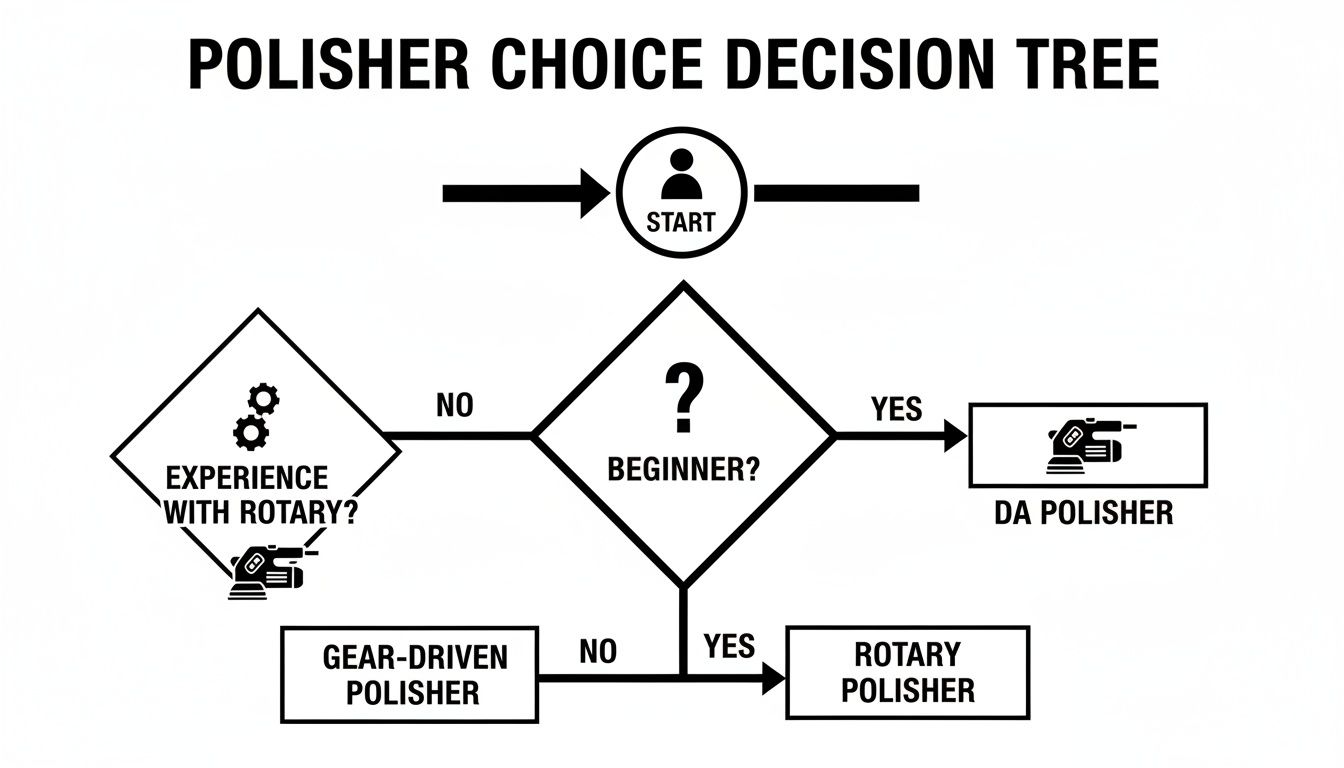
As you can see, for anyone new to this, all roads lead straight to a dual-action machine.
Free-Spinning vs. Forced Rotation: One More Detail
Once you’re in the DA world, you’ll hear two terms pop up: “free-spinning” and “forced rotation.”
- Free-Spinning DA: This is your go-to as a beginner. The pad’s rotation is created by the oscillating head’s momentum. If you press too hard or get the angle wrong, the pad simply stops spinning. This “stall” is a built-in failsafe that protects your paint.
- Forced Rotation DA: Think of this as a hybrid. It’s a gear-driven machine that forces the pad to both spin and oscillate, no matter how much pressure you apply. It has more cutting power but comes with a slightly steeper learning curve.
For your first polisher, make it a free-spinning DA. No question. It has more than enough muscle to tackle the swirls and light scratches on most daily drivers, all while giving you a stress-free and truly rewarding experience.
Mastering the polisher is a huge step, but it’s just one piece of the puzzle. To really understand how it fits into the bigger picture of creating a flawless finish, you should check out our guide that dives deep into what is paint correction. Starting with the right tool sets you up for success from day one.
Getting to Grips with Polisher Specs
Alright, you’ve decided a dual-action polisher is the way to go. Smart move. Now comes the part that can feel a little intimidating: deciphering the technical specs. The numbers and terms on the box can look like a foreign language, but they’re actually pretty straightforward once you know what they mean for you and your car’s paint.
Let’s break down the three big ones. Nailing these will give you the confidence to pick the right machine for the job.
Orbit Size: The Heart of the Machine
The first spec you’ll always see is orbit size, sometimes called the “throw.” This is measured in millimeters—you’ll see numbers like 8mm, 15mm, or 21mm—and it tells you how much the pad wobbles off-center as it spins.
Here’s a simple way to think about it. Imagine you’re sanding a table by hand. If you make tiny, tight circles, you’re focusing all your energy on one small spot. But if you use big, sweeping arm movements, you cover a ton more ground with each pass. A polisher’s orbit size works the exact same way. A bigger orbit means the pad is covering more paint surface with every rotation, which translates to faster defect removal.
- Small Orbit (8-12mm): These are fantastic for getting into tight spots. Think of the intricate curves around a bumper, skinny door pillars, or spoiler mounts. You have more control in these complex areas.
- Large Orbit (15-21mm): This is your workhorse for the big, flat panels—the hood, roof, and doors. The larger throw chews through swirls and scratches much faster, saving you a significant amount of time and effort.
So, what’s the sweet spot for a beginner? A 15mm orbit machine is a fantastic all-rounder. It gives you a huge boost in correction speed over the smaller-throw models but is still easy enough to manage, making it a versatile tool for just about any car you’ll work on.
Speed Control: Your Gas Pedal
Next up is speed control, measured in Orbits Per Minute (OPM). This is your polisher’s gas pedal. It lets you control how fast the head is oscillating and rotating, and having variable speed is absolutely essential.
Different jobs require different speeds. You’ll start on a very low speed (think setting 1 or 2) just to spread your polish over the paint. This prevents it from splattering all over the garage. Once it’s spread, you’ll crank it up to a higher speed (around 4 or 5) to do the heavy lifting—this is where the abrasives in the polish break down and actually remove the swirls. For that final, super-glossy finish, you’ll dial it back down again.
A “soft-start” feature is a massive quality-of-life bonus. Instead of jolting to full power instantly, the machine gently ramps up to your chosen speed. This completely prevents that frustrating “polish sling” where half your product ends up on the floor.
Ergonomics and Weight: The Comfort Factor
This last one might be the most overlooked spec, but trust me, it’s crucial: the machine’s weight and overall ergonomics. It might not seem like a big deal when you pick it up in a store, but an hour into polishing a roof, you’ll feel every single ounce.
Think about holding a five-pound dumbbell at arm’s length for an entire afternoon. That’s what a poorly balanced, heavy polisher can feel like. It’ll wear out your hands, arms, and back in no time. When you’re tired, you get sloppy, applying uneven pressure and getting inconsistent results. It just makes the whole process a chore.
When you’re shopping, hold the machine. Get a feel for it. A polisher in the 5-7 pound range is usually a great starting point—heavy enough to feel solid and do some of the work for you, but light enough to stay in control without getting fatigued.
Thankfully, the global car polisher market, valued at around $370.4 million in 2025, is incredibly competitive. This fierce competition has pushed manufacturers to innovate, leading to better-balanced and more comfortable designs that make pro-level tools easier for everyone to use. You can discover more insights about the growing car polisher market and see how this benefits you, the consumer.
Getting these three specifications right is the key to a successful first polishing experience. It’s not just about getting a great shine on your current project—it’s about setting yourself up with a tool you’ll actually enjoy using for years to come.
Choosing The Right Pads And Polishes
Your shiny new polisher is a beast, but it doesn’t work in a vacuum. It’s one-third of a critical partnership, where the pad you choose and the liquid you use are just as important as the machine itself.
Think of it this way: the polisher is the engine, the pad is the tire, and the polish is the fuel. You need the right combination to put the power down and get a flawless finish. This is the spot where a lot of newcomers get tripped up, but it’s really not as complicated as it seems.
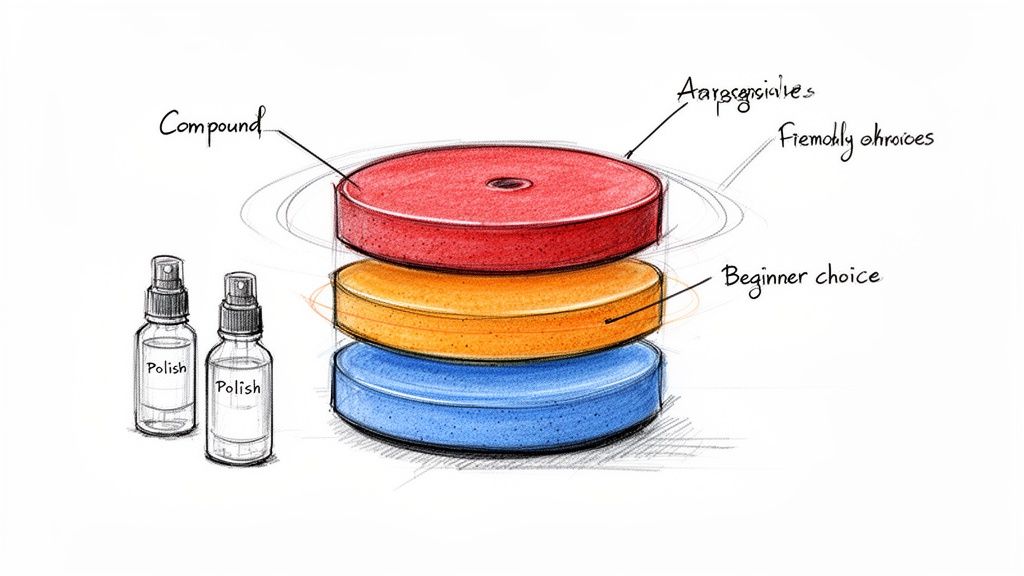
Compounds vs. Polishes: The Simple Difference
First things first, let’s talk liquids. You’re going to see two main players on the shelf: compounds and polishes. They do a similar job, but the key difference is how aggressive they are.
- Compounds: These are the heavy hitters. They’re packed with larger abrasives meant to level out deeper scratches, heavy swirl marks, and serious oxidation by removing a microscopic layer of clear coat. This is your paint correction powerhouse.
- Polishes: These are the finishing artists. Their job is to refine the surface using much smaller, gentler abrasives. They either follow up the compounding step to remove any haze or work alone to tackle very light swirls, restoring incredible depth and gloss.
As a beginner, it’s easy to think you need the strongest stuff you can find, but that’s a rookie mistake. The golden rule of detailing is to use the least aggressive method that gets the job done. This simple principle protects your car’s precious clear coat and keeps you out of trouble. To see this in action, check out our guide on how to buff out scratches, which breaks down the process.
The Color Code Of Polishing Pads
Thankfully, pad manufacturers make our lives easier by color-coding their products based on how aggressive they are. The exact colors might change from brand to brand, but the system is universal. You’ll always find a range from heavy-cutting pads for serious correction down to ultra-soft pads for that final, jaw-dropping shine.
Beginner’s Pro Tip: Trust your hands. A coarse cutting pad will feel firm and have a more open-cell structure. A fine finishing pad will feel incredibly soft and plush. This simple touch test tells you a lot about what the pad is designed to do.
You’d pair a heavy cutting pad with a compound for deep defects. For that final “wet look,” you’d use a soft finishing pad and a fine polish. So, where should you start?
Your Winning Combination For The First Time
For your first go, keep it simple. Your mission is to get a fantastic result without getting overwhelmed, not to chase absolute perfection on day one.
The perfect entry point is a medium polishing pad paired with a good one-step polish. This combo is the sweet spot. It has enough bite to knock out the majority of swirl marks and light imperfections on a daily driven car, yet it’s gentle enough to finish down with impressive gloss.
This approach saves you from having to learn a multi-stage correction process right away. You get a massive improvement in a single step, which builds the confidence you need to take on more advanced projects later.
Protecting Your Hard Work With An Elastomer Coating
You’ve done it. Hours of careful work with your new polisher have paid off, transforming your car’s paint from dull and swirled into a stunning, flawless mirror. Leaving that pristine surface unprotected is like commissioning a masterpiece and then leaving it outside in a storm.
This was the hard lesson learned by a fellow enthusiast, let’s call him Alex. After his first paint correction, he was on top of the world. The shine was unbelievable. But just a few weeks later, a careless wash put fresh, frustrating scratches right back into the paint. That fleeting perfection sent him searching for a truly durable solution, which is how he discovered Titan Coatings and their pioneering Elastomer technology.
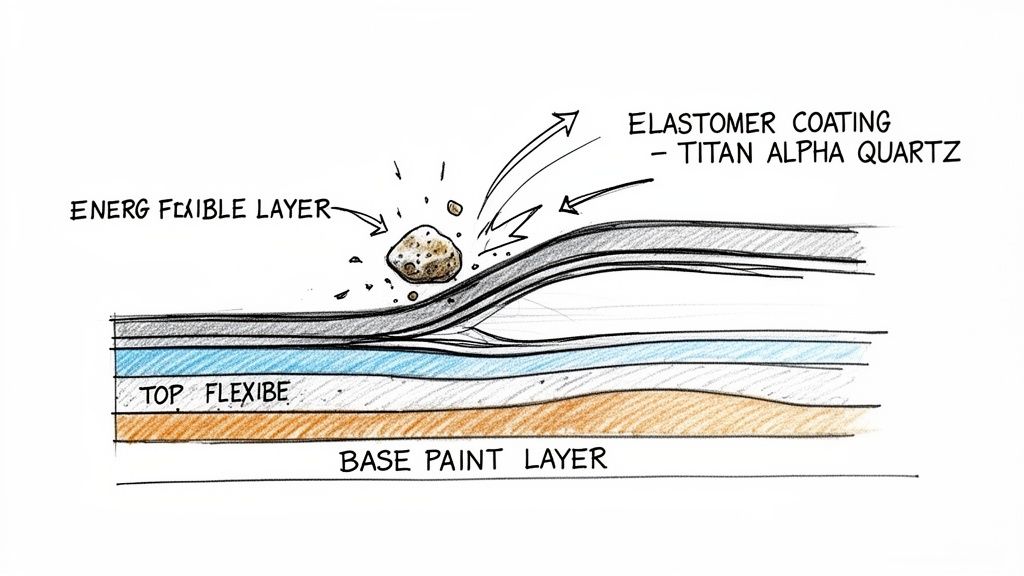
Why Elastomer Technology Changes The Game
Traditional ceramic coatings are great, but they’re rigid, like a thin sheet of glass. While hard, this rigidity makes them vulnerable to cracking or chipping from impacts or extreme temperature changes. Titan was the first company to introduce Elastomer coatings to the market, utilizing cutting-edge nano-tubes and Dark Matter technology. Their Alpha Quartz is a prime example.
Think of it as flexible armor for your paint. It’s hard like glass but uniquely flexible. This elasticity allows the coating to absorb and deflect the energy from impacts—like a stone kicked up on the highway or a bug hitting the surface—rather than chipping away.
This unique flexibility is also the secret to its longevity. A normal coating can become brittle and develop micro-cracks as it expands and contracts through freezing winters and scorching summers. Titan’s elastic coatings, however, flex with these temperature shifts. The coating won’t crack down, maintaining its integrity year-round. You can learn more about our unique Elastomer Technology and see what makes it so different.
The Long-Term Benefits Of True Protection
Choosing a durable, flexible coating like Alpha Quartz isn’t just about preventing scratches; it’s about preserving your time and effort. Here’s what that protection looks like in the real world:
- Impact Resistance: The coating’s elasticity helps it absorb impacts from road debris and even bugs, which can etch rigid coatings.
- Thermal Stability: It withstands extreme temperature cycles, from frozen to hot, without cracking or failing.
- Effortless Maintenance: The super-slick surface means dirt, grime, and water have a harder time sticking, making your car ridiculously easy to wash.
- Lasting Gloss: It locks in that deep, wet shine you just created, ensuring your car looks freshly polished for years, not just weeks.
Protecting your polished paint is not an optional final step; it’s the step that validates all the hard work that came before it. An Elastomer coating ensures the results you achieved are the results you get to keep.
Securing Your Investment In A Growing Market
The desire for this level of protection is why the car detailing market is booming. The market reached $1.67 billion in 2025 and is projected to expand to $1.84 billion in 2026. This rapid expansion highlights a clear trend: car owners are investing more than ever in maintaining their vehicles’ appearance, creating strong demand for advanced solutions that preserve a perfect finish. You can read the full research about the car detailing market to understand this industry growth.
By choosing the best car polisher for beginners, you’ve taken the first step. By protecting that polished surface with a scientifically superior coating like Alpha Quartz, you’re ensuring your investment of time and money pays off with a lasting, jaw-dropping shine.
Extending Protection To Your Entire Vehicle
You’ve put in the work, you’ve mastered the polisher, and that paint looks absolutely incredible. But what about the rest of the car?
True, head-turning perfection is about the whole package. After spending hours getting your paint flawless, the last thing you want is for dirty glass or a dull finish to drag down the entire look. Luckily, protecting the rest of your investment is easier than you think.
See Clearly and Drive Safer
Let’s start with your glass. We’ve all been there—caught in a sudden downpour, wipers smearing a blurry mess across the windshield. It’s stressful and downright dangerous. This is where Titan’s Apex Glass Ceramic Coating is an absolute game-changer.
Picture this: instead of a sheet of water clinging to your windshield, raindrops instantly ball up into tiny beads and zip right off as you drive. That’s the magic of a real hydrophobic coating. It creates an incredibly slick surface that water just can’t stick to, making a huge difference in visibility. It turns a white-knuckle drive into a non-issue, making driving under rain stress-free. The best part? It’s unbelievably easy for a beginner to apply.
Maintain That Perfect Shine Effortlessly
Now, let’s talk about keeping that freshly detailed look. For that, you need the Ultra Ceramic Spray. Think of this as your secret weapon for incredible gloss and protection without the effort.
This isn’t some weak, watery detailer. With a simple spray-and-wipe application, you get a shocking level of slickness and a durable, water-beading layer that keeps your car cleaner, longer. It’s the fastest way to add a layer of ceramic protection or to boost an existing coating you might already have, with great results.
If you’re just starting out, the Apex Glass Coating and Ultra Ceramic Spray deliver the biggest bang for your buck. They complete your detailing toolkit, ensuring every surface on your vehicle looks and performs at its best.
Polishing created the perfect canvas. These products are the finishing touch that protects it. They’re designed to work with the effort you’ve already invested, taking your results to the next level. If you’re ready to go even further, you can explore the full lineup of long-lasting paint protection coating for cars to lock in that shine for years.
The days of professional-grade results being out of reach for a beginner are over. These two products prove you can get maximum impact with minimal fuss, making them essential additions to your new detailing skillset.
Got Questions? We’ve Got Answers.
Stepping into the world of paint correction can feel a little intimidating, even with the best beginner-friendly polisher in your hands. That’s perfectly normal. Let’s walk through some of the most common questions that pop up, so you can start your project with total confidence.
“Am I Going to Ruin My Paint with a Dual-Action Polisher?”
This is probably the number one fear for anyone starting out, and it’s a valid concern. The short answer? It’s extremely difficult to burn through modern clear coat with a dual-action (DA) polisher.
Unlike a high-torque rotary, a DA’s oscillating and spinning motion is specifically engineered to prevent heat from building up in one spot—and intense, focused heat is what melts paint. As long as you follow a few simple rules, you’ll be perfectly safe. Always keep the machine moving, use light to moderate pressure (let the polisher do the work!), and start on a low-speed setting. This built-in safety net is exactly why we always recommend a DA for beginners.
“How Do I Pick the Right Pad and Polish Combo?”
Walking into the world of pads and compounds can feel like staring at a wall of options. The golden rule here is simple: start with the least aggressive method that gets the job you want done. Your goal is to preserve as much of that precious clear coat as you can.
A great starting point for most cars is a medium-light polishing pad paired with a quality one-step polish. Before you go to town on the whole vehicle, mark out a small 2×2 foot “test spot” on an inconspicuous area, like the lower part of a door. If that combination removes the defects to your satisfaction, you’ve found your winning formula. If not, you can step up to a slightly more aggressive pad or compound, but always start light.
“Do I Really Need to Apply a Coating Like Alpha Quartz After Polishing?”
Think of it this way: polishing is like sanding a beautiful piece of hardwood furniture to get a perfectly smooth finish. Would you then leave that raw wood outside without a sealant? Of course not.
Polishing creates an amazing, glass-like surface by removing a microscopic layer of your car’s clear coat. This leaves the paint fresh and clean, but also totally exposed to UV rays, bird droppings, and new scratches.
Applying a durable protective layer like Titan’s Alpha Quartz Elastomer coating acts as a tough, flexible shield for your freshly perfected paint. It preserves all your hard work for years, not just weeks, and makes keeping the car clean ridiculously easy.
Skipping this final step means your flawless finish will start to degrade almost immediately. Locking in your results with a proper coating is what makes the whole effort truly worthwhile.
Ready to give your freshly polished paint the long-lasting, flexible protection it deserves? Titan Coatings offers the advanced technology you need. Lock in that flawless shine and protect your hard work for years with our scientifically formulated Alpha Quartz Elastomer Coating.
0 Comments