
When you're on the hunt for the best automotive paint protection film, you'll quickly find the answer isn't just a single brand. It’s about the perfect blend of material quality, self-healing smarts, and optical clarity. The best films out there are made from Thermoplastic Polyurethane (TPU), pack impressive self-healing capabilities, and lay down a nearly invisible, high-gloss shield that keeps your car’s original paint looking brand new.
What Defines the Best Automotive Paint Protection Film
You know that feeling—driving your car right after a full detail, the paint just pops under the sun. Then you hear it. That sharp ping of a rock kicked up from the truck in front of you. Your heart sinks. You just know there's a fresh chip ruining that perfect finish.
If you’re tired of that scenario, you’re in the right place. We're going to break down what truly makes a paint protection film (PPF) the 'best,' and it's a lot more than just a sheet of plastic.
The Growing Demand for Flawless Finishes
This isn’t just about avoiding a few chips. For a growing community of owners, our vehicles are serious investments that deserve to be preserved. This shift in mindset is fueling a massive expansion in the vehicle protection industry.
The global paint protection film market, valued at USD 502.55 million, is on track to hit USD 726.63 million by 2030. It's no surprise that automotive applications absolutely dominate this space, claiming 73.64% of the market share as more owners insist on protecting high-impact areas like bumpers, hoods, and side mirrors.
A Lesson Learned the Hard Way
Let’s talk about a real-world experience. A friend of mine, Alex, learned the hard way that not all films are created equal. He went with a cheaper option for his pride and joy, and within a year, it was yellowing and peeling at the edges. Utterly frustrated, he went on a mission to find the absolute best protection for his next car.
He dug deep, talking to installers and reading everything he could find. He discovered that the best automotive paint protection film isn't just about being thick; it's a finely tuned balance of several critical factors. A premium film is a true sacrificial shield, built to take the daily abuse of the road so your paint doesn't have to.
"My biggest mistake was chasing the lowest price," he told me. "The best film isn't just a product; it's a piece of technology. It's engineered to be tough, invisible, and to actually repair itself. It’s peace of mind you can’t see."
His journey is the perfect framework for our deep dive. We'll give you the knowledge to make a smart choice that protects your car's beauty and value for the long haul. By understanding what separates the elite films from the rest, you can avoid the common traps and find a solution that delivers on its promise of invisible armor.
If you're weighing your options for a brand-new vehicle, our guide on the best paint protection for new cars provides even more specific insights.
Understanding the Science Behind an Invisible Shield
So, what exactly turns a thin, see-through sheet into a near-impenetrable shield for your car's paint? It’s not magic—it's a serious feat of material science. The real story is the massive jump from old, flawed films to the advanced technology we use today.
Decades ago, early films were often made from PVC (Polyvinyl Chloride). Anyone who worked with that stuff remembers it well: a rigid plastic that would yellow in the sun, turn brittle with age, and offer pretty mediocre protection. The game changed completely with the arrival of Thermoplastic Polyurethane (TPU), a far superior polymer celebrated for its incredible elasticity, toughness, and resistance to impacts.
Why Thermoplastic Polyurethane is King
TPU is the heart and soul of any premium PPF. It's what gives the film its incredible strength and flexibility. Unlike its rigid PVC ancestor, TPU can stretch and absorb the impact from a flying rock, spreading that force across its surface instead of letting it ding the paint underneath. That built-in elasticity is what makes it a true long-term shield.
This single innovation has completely remade the industry. TPU now commands a 60% market share, largely because of its incredible self-healing ability. Light scratches literally disappear with a little heat, restoring the finish and giving it a lifespan 3x longer than old PVC films. The global market is set to explode, projected to hit USD 1.06 billion by 2035 at a 6.3% CAGR.
More Than Just One Layer
Here’s something most people don’t realize: high-quality PPF isn't just a single sheet of plastic. It’s an advanced, multi-layered system where every single layer has a critical job. Think of it less like a phone screen protector and more like a high-tech suit of armor for your car.
A top-tier film is almost always made of four distinct layers working together:
- Protective Cap Sheet: This is just a temporary liner that gets peeled off during installation. Its only job is to protect the film from getting scuffed up before it even touches the car.
- Self-Healing Top Coat: This is the outermost layer, and it’s where a lot of the magic happens. It's a sophisticated clear coat, usually just a few microns thick, engineered to resist stains from things like bird droppings and bug guts. More importantly, it can "heal" itself of light scratches and swirls when you apply a little heat.
- TPU Film Core: This is the workhorse of the system. It’s the thickest and most important layer, giving the film its real impact resistance. This is the polyurethane barrier that stops rocks in their tracks and prevents deep scratches from ever touching your paint.
- Specialized Adhesive: The final layer is a powerful but gentle acrylic adhesive. It’s designed to be optically clear, so it doesn't distort your paint's color, and it bonds securely without causing any damage. This ensures a clean, bubble-free look that can be safely removed years down the road if needed.
Together, these layers create an invisible, sacrificial shield. The top coat fights off chemical attacks and minor scuffs, while the TPU core absorbs the heavy hits. It’s this smart, synergistic design that makes modern PPF so incredibly effective.
This layered construction is what truly separates the good stuff from the cheap imitations. It’s a dynamic defense system, not just a physical barrier. Understanding this science helps you see past the marketing hype and invest in proven technology. You can learn even more about how these finishes work by exploring our guide on protective car paint coatings.
Comparing the Top Paint Protection Film Brands
Now that we've covered the science behind PPF, it's time to get into the good stuff: a head-to-head comparison of the industry's biggest names. When you’re hunting for the best automotive paint protection film, the real decision comes down to how these top-tier brands perform where it actually counts—on the road.
We’re going to cut through the marketing fluff and look at real-world performance. Think crystal-clear optical quality, serious impact resistance (which usually comes down to thickness), how quickly and effectively the film self-heals, and the strength of the warranty backing it all up.
The Key Players in the PPF Arena
Walk into any high-end detail shop, and you'll hear the same names come up again and again. Brands like XPEL, SunTek, and LLumar consistently dominate the conversation for a reason—they deliver quality, durability, and are always pushing the technology forward.
Each brand has its own unique personality. Some are all about delivering that dripping-wet, ultra-high-gloss look, while others are engineered for maximum brute-force protection or designed to make life easier for the installer. Nailing down these subtle differences is the key to matching a film to your car and your specific needs.
The demand is undeniable. The North American PPF market was valued at USD 287.56 million and is on track to hit USD 479.50 million by 2033. This boom is fueled by owners of luxury and performance cars who see a full PPF wrap not as a luxury, but as a necessity for protecting their investment.
A Scenario-Based Comparison
Forget boring feature lists. Let's see how these films handle the real-world situations that make every car owner cringe.
Scenario 1: The Highway Rock Chip
A chunk of gravel gets launched at your front bumper on the freeway. Brand X, famous for its beefy 8 mil thickness, simply shrugs it off without a trace. Meanwhile, Brand Y, which is a bit thinner but has a more pliable top coat, also stops the rock from chipping the paint, but might show a tiny surface mark on the film that quickly heals itself.
Scenario 2: The Parking Lot Mishap
Someone carelessly scrapes a shopping bag with a metal zipper across your door. The scratch on Brand A's film, with its cutting-edge self-healing layer, literally disappears after a few minutes in the sun. Brand B's film also heals, but it might need a little encouragement from a heat gun to fully erase the mark, hinting at a different chemical makeup in its top coat.
This is where the engineering comes into play. A quality film is a multi-layered shield, and each layer has a critical job.
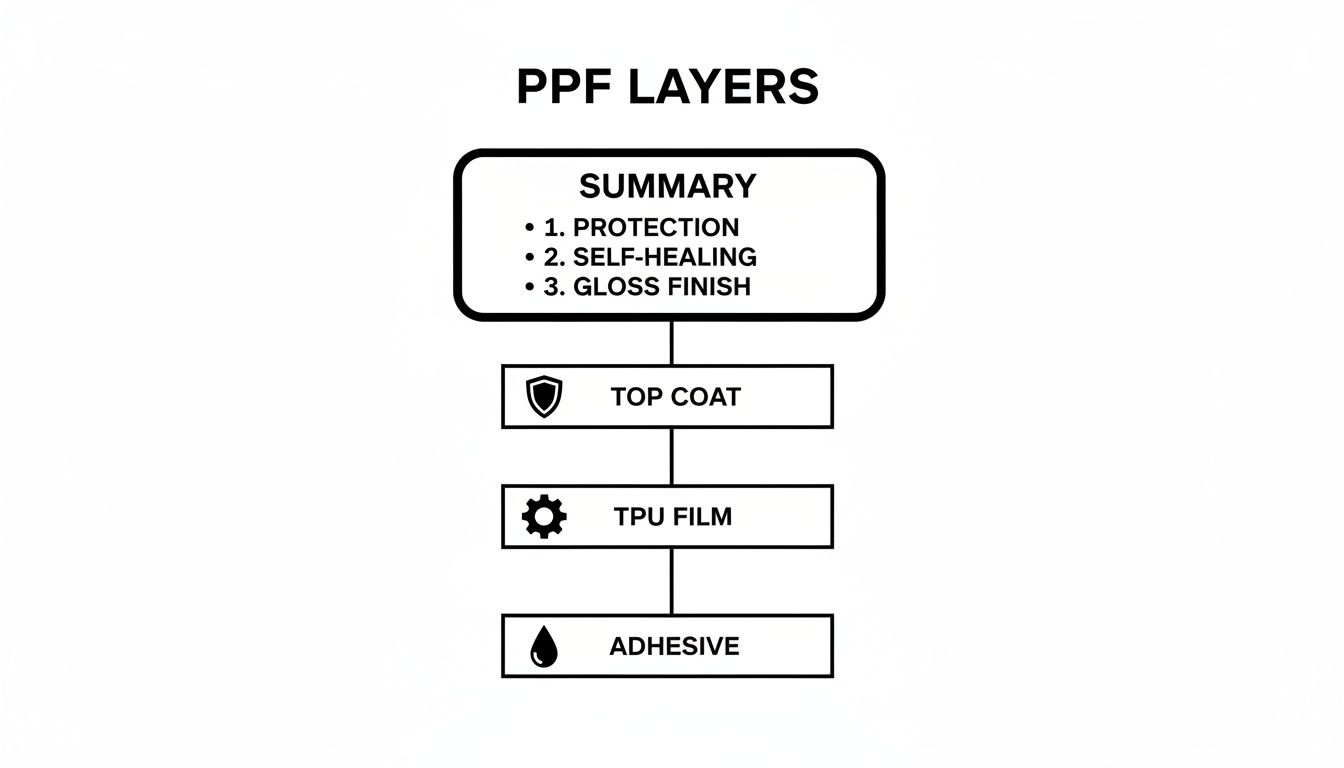
From the self-healing top coat to the impact-absorbing TPU core, they all work in concert to keep your paint looking perfect.
Evaluating Clarity and UV Resistance
Another massive difference-maker is long-term optical clarity. The best films are so clear they’re practically invisible, with none of that ugly "orange peel" texture that can dull your paint’s finish. Top-tier brands use incredibly stable adhesives and pure thermoplastic urethane (TPU) that won’t yellow from sun exposure—a classic sign of a cheap, inferior film.
A premium film should make your car’s gloss pop, not hide it. The true test of a great PPF is forgetting it’s even there a week after installation.
The warranty is your final piece of security. The industry leaders typically offer solid 10-year warranties covering defects like yellowing, bubbling, or cracking. Just remember to read the fine print; that warranty is only as good as the certified pro who installed the film.
Ultimately, picking the right film is about understanding the trade-offs. Do you need the absolute thickest protection for track days, or is a flawless, glass-like finish your top priority? By judging the brands on these real-world metrics, you can make a confident choice that truly fits your goals. To see how PPF stacks up against another popular option, take a look at our complete breakdown of paint protection film vs. ceramic coating.
Taking Protection to the Next Level with Elastomer Coatings
Paint protection film on its own is a fantastic physical shield against whatever the road throws at your car. But what if you could crank that defense up a notch? What if you could add a layer that brings out unbelievable gloss, slickness, and an even tougher resilience? This is where we go beyond just the film and start talking about a true partnership with advanced liquid coatings.
Think about a true car enthusiast like Alex. For him, "good enough" just isn't in the vocabulary. His pursuit of perfection led him to discover an incredible synergy between PPF and a completely new breed of coating. He found Titan Coatings, the very first company to bring elastomer coatings to the detailing world—a technology that genuinely changes the game.
Finally, a Hard Coating That’s Flexible
Look, traditional ceramic coatings are great, but they have one fundamental flaw when you put them on top of PPF: they’re rigid. The film underneath is designed to be flexible, to expand and contract with heat. When you put a hard, glass-like coating over it, that constant movement can cause tiny stress fractures in the coating. It's a basic mismatch in material science.
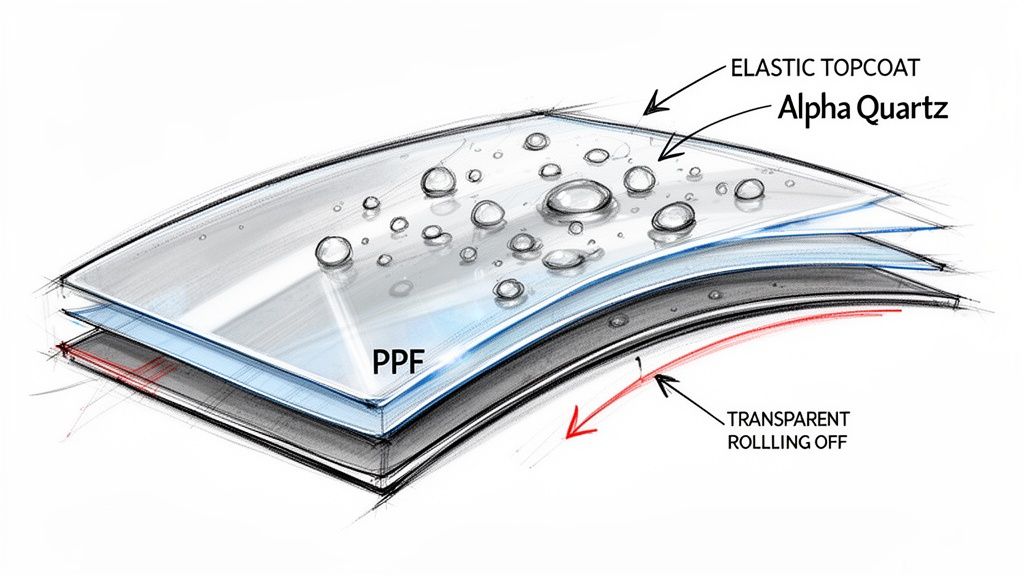
This is the exact problem Titan’s Alpha Quartz elastomer coating was built to solve. It uses cutting-edge nano tubes technology and proprietary Dark Matter Tech to create a coating that’s engineered to be just as flexible as the film it’s protecting. It’s an elastic shield that has the hardness of glass but remains pliable. This means the coating moves with the film, never fighting against it.
This flexibility is a total game-changer. It means the coating won't crack under the stress of a scorching summer day or a freezing winter night. It also means it can absorb the energy from a bug impact without chipping or failing.
What you get is a combined defense system where the whole is far greater than the sum of its parts. The PPF handles the heavy lifting against rock chips, while Alpha Quartz adds that slick, impenetrable top layer.
More Than Just Another Sacrificial Layer
Putting Alpha Quartz over PPF isn’t just about adding more protection; it's about making the entire surface better. The elastomer formula creates an unbelievably hydrophobic surface. Water, dirt, and road grime just can't get a grip, sheeting off so effortlessly that your maintenance washes become almost laughably easy.
Here’s a quick rundown of what this one-two punch delivers:
- Mind-Blowing Gloss and Clarity: The coating fills in the microscopic pores of the PPF, creating a deep, wet-looking shine that makes the paint underneath absolutely pop.
- Serious Chemical Resistance: It provides a rock-solid barrier against the nasty stuff like bird droppings and acid rain that can stain or etch your film over time.
- Unbeatable Durability: Since the coating is both hard and flexible, it shrugs off the daily abuse that would wear down other products. Your film stays looking brand new for years.
You can dive deeper into the science behind Titan's elastomer technology to see what sets it apart.
On top of all that, Alpha Quartz is surprisingly easy to install, which has made it a go-to for pros and serious DIYers alike. You get amazing results without the finicky application of older ceramic tech. This combination of PPF and an elastomer coating truly is the ultimate sacrificial shield, preserving not just your paint, but the film that protects it. It’s the final piece of the puzzle for total, long-term vehicle preservation.
Thinking Beyond the Paint
A truly protected vehicle is more than just shiny paint. After all, what’s the point of a flawless finish if you can't see through a rain-streaked windshield in a downpour? Real-world vehicle preservation means protecting every surface that takes a beating, and that’s where the story continues.
Once you’ve protected the paint, you start noticing the other vulnerable areas, especially the glass. It became clear that top-tier paint protection film was only one piece of the puzzle. The goal shifted from just protecting the car to creating a solution that would make driving in bad weather genuinely stress-free and safer.
Making Rainy Drives an Afterthought
This is exactly why we developed Titan's APEX Glass Ceramic Coating. It was engineered with one powerful purpose: to radically improve your visibility when it rains. Applying it to the windshield is incredibly straightforward, but the results are something you have to see to believe.
The first time you drive in a heavy storm after applying APEX, you'll be amazed. Water doesn't smear across the glass; it forms into tight, perfect beads that seem to dance on the surface. As soon as you hit about 35 mph, the airflow alone is enough to send them flying off, leaving your windshield almost perfectly clear. Your wipers suddenly feel like a backup plan, not a necessity.
This intense hydrophobic effect isn’t just for show—it's a massive safety upgrade. By forcing water to bead and roll off so quickly, APEX cuts down on the blinding glare from other cars' headlights at night and gets rid of the visual distortion you get from wipers working overtime. A drive in a storm goes from a white-knuckle event to just… a drive.
Of course, protecting your vehicle's surfaces is just one part of the equation. A complete care plan always includes the basics. For those looking to go the extra mile, there are some solid tips on how to make your car last longer through regular upkeep.
High-Level Protection, Zero Hassle
We know that not everyone has the time for a multi-stage coating process. For those who want powerful protection without the complexity, there’s Ultra Ceramic Spray. This product proves you don't need to be a pro to get a professional-grade finish. It’s all about delivering exceptional gloss, slickness, and durability in minutes.
Its simple spray-and-wipe application makes it a go-to for both seasoned detailers needing a quick touch-up and weekend warriors who want fantastic results without the fuss. You don't need special equipment or a controlled garage space to get it right.
Applying Ultra Ceramic Spray is as easy as it sounds:
- Spray: Mist a light amount onto a cool, clean panel. Work one section at a time.
- Wipe: Use a clean microfiber towel to gently spread the product evenly.
- Buff: With a second, dry microfiber, buff the surface to a slick, brilliant shine.
And that's it. You've just added a tough, hydrophobic layer that sheds water and dirt while making your paint’s gloss pop. It's the perfect way to top up your existing ceramic coating or to use as a standalone sealant when you want speed and simplicity.
If you're trying to decide where to invest your budget, our guide on ceramic coating vs PPF cost can help you weigh the options. By thinking holistically, you ensure every part of your vehicle, from paint to glass, is shielded with the best technology out there.
Alright, you've done the homework and waded through all the technical specs. Now it’s time to put that knowledge into action and make a smart, confident decision. This is where it all comes together.
Let’s think back to Alex, our car owner who was determined to get this right. He reached a point where all the data clicked into place. He realized the ultimate solution wasn't just film or a coating; it was a strategic combination of both. He chose a high-quality, self-healing PPF for its tough physical shield and then locked in that perfection with an advanced Titan coating. That one-two punch is the real secret to total vehicle preservation.
Questions to Ask Your Installer
Before you hand over your keys, you need to interview your installer. Think of it this way: their skill is just as important as the quality of the film they're putting on your car.
- What PPF brands do you carry, and why those specifically? A true pro won’t just list names. They’ll tell you the real-world pros and cons of each film and explain exactly which one makes the most sense for your car and your goals.
- Do you use a plotter for pre-cut kits or do you bulk install? There are benefits to both. A plotter delivers incredible precision, but a bulk install allows an expert to wrap every edge for a seamless, invisible look. You need to know their approach and why they prefer it.
- Walk me through your paint prep process. The answer you're listening for should be detailed. It must include a meticulous wash, full chemical and mechanical decontamination, and at least a light polish to create a perfectly clean slate for the film.
- How much experience do you have applying ceramic coatings over PPF? This is a huge one. Make sure they genuinely understand how a flexible film and an elastic coating need to work together, not against each other.
Matching the Protection to Your Reality
The "best" setup is never one-size-fits-all. It comes down to where you live, what you drive, and how you drive it.
Think about your daily grind. If your commute is a rock-chip-gauntlet on the highway, a thicker, more durable PPF on the entire front end is a no-brainer. But if you're dealing with brutal sun and wild temperature shifts, the built-in flexibility of an elastomer-based coating becomes just as critical.
This is exactly how Alex locked in his final plan. He opted for a top-tier PPF on the most vulnerable areas: the front bumper, hood, and mirrors. Then, he decided to protect the entire vehicle—film and all—with Titan’s Alpha Quartz. Its elasticity, powered by nano tube technology, was the key. It moves with the film, preventing the micro-cracking you often see when rigid coatings are forced onto a flexible surface.
For the finishing touch, he added Titan’s APEX Glass Ceramic Coating to his windshield. This wasn’t just a nice extra; it was a core part of his plan for safer, less stressful driving. Knowing he’d have a crystal-clear view in a downpour was non-negotiable.
By layering the best physical shield with the most advanced chemical protection, he built a complete, intelligent defense system for his car. That’s how you get real peace of mind every time you get behind the wheel.
Answering Your Top Questions About PPF and Coatings
We get asked about the relationship between paint protection film and ceramic coatings all the time. The right answers can make a huge difference in how you protect your vehicle, saving you a ton of hassle and money down the road. Let's tackle some of the most common questions we hear.
Can I Apply a Coating Over Paint Protection Film?
Yes, and you absolutely should. Think of it as the ultimate one-two punch for vehicle protection. Putting a flexible, elastic coating like Titan's Alpha Quartz on top of your PPF adds a powerful sacrificial layer. It gives the film an amazing level of slickness and hydrophobicity, making water and dirt just slide right off.
This synergy shields the film itself from UV damage, chemical etching, and environmental stains, which can dramatically extend its life and keep it looking crystal clear. The key is using a coating that can flex. Our elastomer technology was engineered to move and stretch with the film, so you never have to worry about the cracking you'd see with a rigid, traditional coating.
How Long Does Paint Protection Film Last?
Realistically, you can expect a quality, professionally installed TPU-based paint protection film to last anywhere from 7 to 10 years. A lot of factors play into that number, though. The quality of the film is paramount, but so is your climate, how often the car is exposed to harsh sun, and how well you maintain it.
This is exactly where a dedicated coating helps. By protecting the film from the elements that try to break it down, a product like Alpha Quartz helps push that lifespan toward the upper end of the spectrum, ensuring your investment looks great for years.
Is Paint Protection Film Worth the Investment?
For anyone with a new car or a vehicle they truly care about, the answer is a resounding yes. PPF is one of the few things that offers a true physical barrier against the kind of damage that leads to expensive, frustrating trips to the body shop. We're talking rock chips, deep scratches, and nasty bug guts that can permanently etch your clear coat.
But it's not just about preventing damage. It’s also about preserving value. Keeping the factory paint in perfect condition can boost your car's resale value by more than the initial cost of the film. It's an upfront investment that pays you back when it's time to sell.
Ready to create an unbeatable shield for your vehicle? Explore how Titan Coatings can elevate your paint protection film with our advanced, flexible elastomer technology. Discover the difference with Alpha Quartz Elastomer Coating today.
0 Comments