
Washing a car with a ceramic coating isn’t just a chore; it’s a critical maintenance step. The key is a gentle, pH-neutral approach, whether you’re using a classic two-bucket method or a foam cannon. Stick with high-quality microfiber wash mitts and drying towels to prevent scratches, and you’ll protect the coating’s hydrophobic properties, ensuring that unbelievable gloss and protection last for years.
Why Your Wash Method Is Critical for a Ceramic Coating
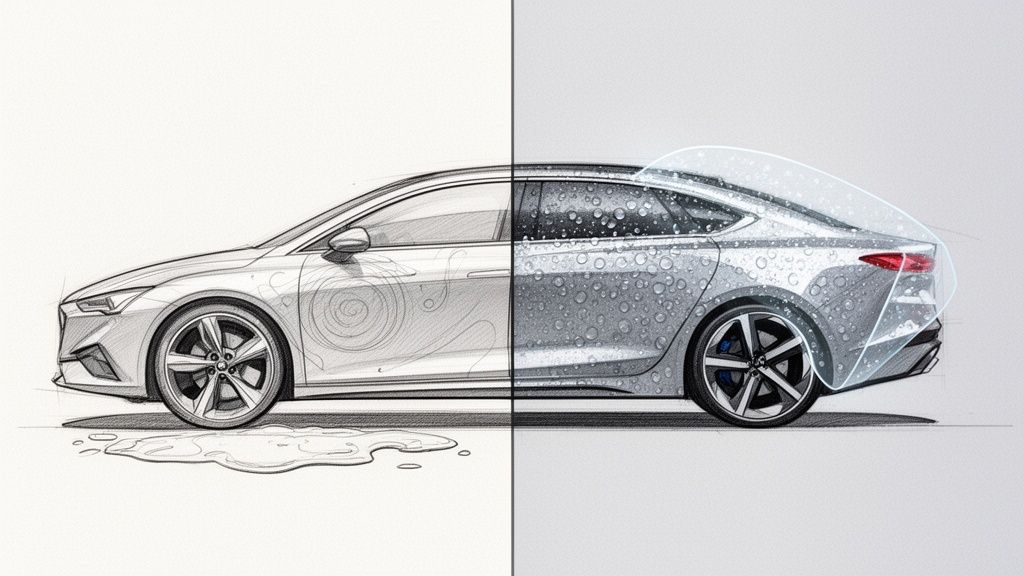
Think back to the first time you saw your car after it was coated. That mirror-like, liquid shine was more than just good looks—it was a sophisticated, high-tech shield bonded directly to your paint. But the longevity of that shield? It’s all in your hands and depends entirely on your maintenance routine.
I learned this lesson the hard way through a client, Mark. He’d just invested in a premium coating but figured any old car wash would do the trick. After just a few runs through a cheap automated wash with its abrasive brushes, that magical water-beading was gone. Worse, the surface was covered in a web of fine scratches.
This is exactly why your washing technique is so crucial. You’re not just wiping off dirt; you’re preserving the complex science that makes the coating effective. The whole point is to lift contaminants away from the surface without grinding them into it, which is precisely what harsh brushes and improper washing methods do.
The Titan Coatings Advantage
The specific technology behind your coating also plays a massive role here. Many traditional ceramic coatings are incredibly hard, like a thin layer of glass, but that hardness can also make them brittle. They can develop micro-cracks under the stress of temperature swings or minor impacts, which completely compromises their protective abilities.
Titan Coatings pioneered a different path, introducing the first elastomer coatings to the market. Powered by our proprietary Dark Matter tech and nanotube technology, our formulas create a shield that is not only hard but also incredibly flexible.
This elasticity is a genuine game-changer. It means the coating is hard like glass but flexible, allowing it to expand in the blistering summer heat and contract in a frozen winter without cracking. When a rock chip or a big bug splatters against the surface, the coating flexes to absorb the impact, shielding the paint underneath. This flexibility is the secret to its remarkable longevity.
This built-in resilience is why a proper wash routine is non-negotiable; it supports and enhances the coating’s advanced properties, ensuring it performs at its peak for years to come. The market for these advanced protective layers has grown significantly, which you can explore in more detail with these insights on the global ceramic coatings market from Fortune Business Insights. You can also learn more about the science behind coatings by reading our guide explaining what is ceramic coating.
Your Essential Ceramic Coating Wash Arsenal
Before you even think about turning on the hose, let’s talk tools. Getting this part right is everything. You’ve invested in a premium ceramic coating to protect your paint, and the last thing you want to do is scratch it up with a dirty sponge or strip it with harsh chemicals.
Using the wrong gear is a surefire way to inflict swirl marks, dulling the finish and undoing all the benefits of your coating. So, let’s build the perfect, safe-wash toolkit.
Your Essential Ceramic Coating Wash Arsenal
Here’s a quick-reference guide to the must-have tools for safely washing your ceramic coated vehicle. Think of this as your shopping list for a flawless, scratch-free finish every single time.
| Tool | Why It’s Essential | Pro Tip |
|---|---|---|
| Two 5-Gallon Buckets | Separates your soapy wash water from your clean rinse water, preventing cross-contamination. This is the heart of a safe wash. | Label them “WASH” and “RINSE” with a permanent marker. It’s a simple trick that eliminates any guesswork. |
| Grit Guards (x2) | These plastic grates sit at the bottom of each bucket, trapping dirt and debris that comes off your mitt. This stops you from picking that grit back up and dragging it across your paint. | After rinsing your mitt, scrub it against the grit guard in the rinse bucket to dislodge any stubborn particles before reloading with soap. |
| Plush Microfiber Wash Mitt | Ditch the old sponges and brushes for good. A high-quality mitt has a deep pile that pulls dirt and grime away from the surface, trapping it safely within the fibers. | Have a separate, dedicated mitt for the lower, dirtier sections of your car (rocker panels, bumpers) to avoid dragging heavy grime onto your pristine upper panels. |
| pH-Neutral Car Shampoo | Your coating is a resilient but specific chemical layer. Harsh, high-alkaline, or acidic soaps (like dish soap) can break it down, weakening its protective and hydrophobic qualities. | Look for a shampoo specifically formulated for ceramic coatings. These are designed to clean effectively without leaving behind residue that can interfere with water beading. |
With these core items in your possession, you’ve built the foundation for a professional-grade, safe wash that will preserve your coating’s integrity for years to come.
The Secret Weapon for That “Just Coated” Look
Now, with the fundamentals covered, let’s talk about taking your results from “clean” to “show-stopping.” A proper wash removes the dirt, but to keep your coating performing at its peak, you need to occasionally replenish its top layer. This is the difference between simple maintenance and active enhancement.
I remember a client who followed every wash step perfectly but was frustrated because his car’s gloss seemed to be fading after six months. He was cleaning it, but he wasn’t feeding the coating. The moment I had him add our Titan Ultra Ceramic Spray to his routine, the depth and slickness came roaring back.
The Ultra Ceramic Spray isn’t just a quick detailer; it’s a true coating rejuvenator. It’s incredibly easy to use, laying down a fresh, slick layer of SiO2 with a simple spray-and-wipe, instantly boosting gloss and bringing back that amazing water-beading you love.
Using it as a drying aid or as a final wipe-down is a game-changer. It adds maybe 5-10 minutes to your wash, but the visual payoff is massive. It’s the easiest way to ensure your car always has that deep, liquid shine. While this product is a key player, understanding the full range of options is helpful; you can learn more by exploring our guide on choosing the right auto quick detailer.
Mastering the Safe Two-Bucket Wash Method
Alright, you’ve got your gear ready. Now it’s time to put it to work. We’re going to walk through the two-bucket wash method, which is hands-down the single best way to wash a coated car without introducing swirl marks. This isn’t just about getting the car clean; it’s about preserving the coating and the paint underneath.
The process is straightforward: we’ll start with a contactless pre-wash to get the heavy grime off, then move into the careful contact wash.
This visual gives you a quick breakdown of the core pillars of a truly safe wash.
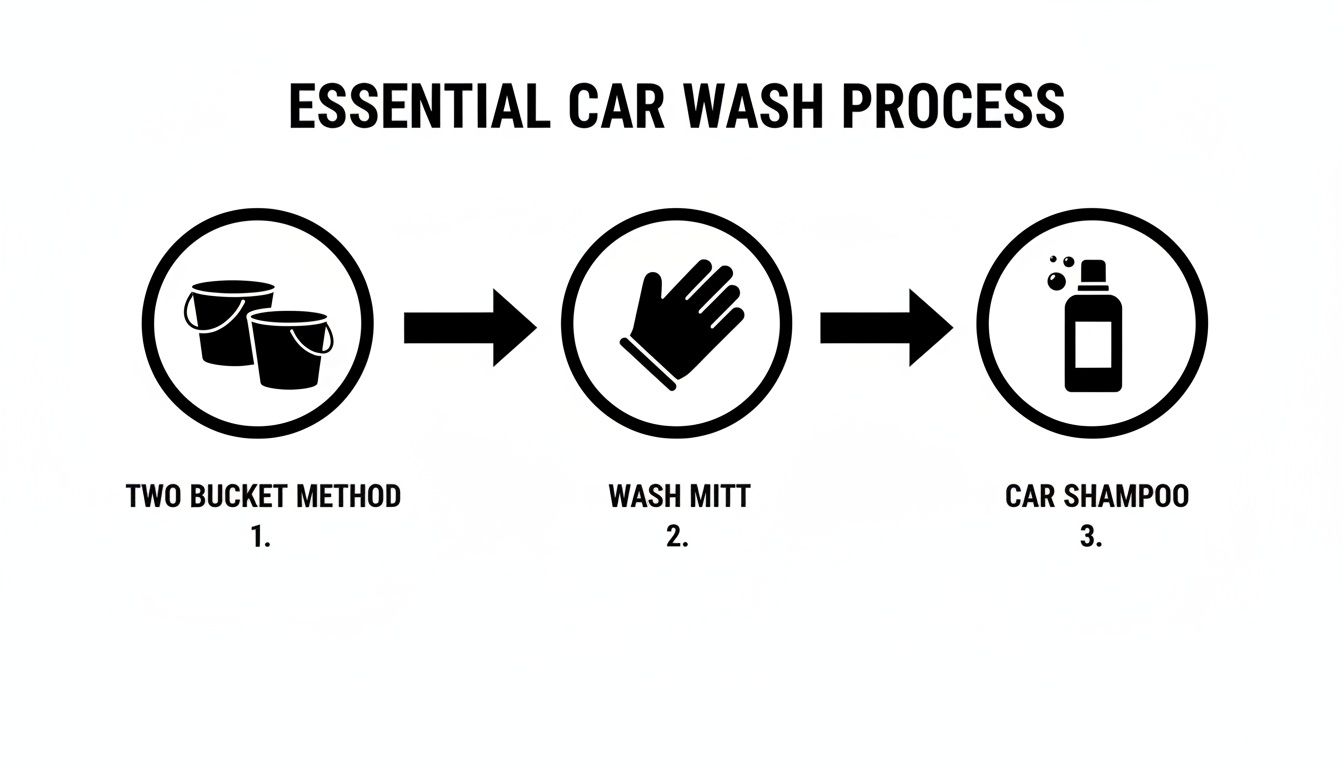
It really boils down to those three things: separating your clean and dirty water, using a gentle wash mitt, and choosing the right soap. Get those right, and you’re golden.
Start with a Pre-Wash Foam Bath
Before your mitt ever touches the paint, you want to get as much loose dirt and grit off as possible. This is exactly what a foam cannon is for. By covering the car in a thick blanket of pH-neutral snow foam, you’re encapsulating all that heavy road film, dust, and grime, letting it lift off the surface so you can safely rinse it away.
Think of it this way: you’re doing 90% of the cleaning before you even start the “real” wash. Let that foam dwell for a good 3-5 minutes—just don’t let it dry in the sun. As you rinse it off, you’ll literally see sheets of dirt just slide off the car. This step is a game-changer for reducing the risk of dragging grit across your precious coating.
Tackle the Wheels and Tires First
Here’s a tip that immediately separates the pros from the rookies: always wash your wheels and tires first. They are, without a doubt, the dirtiest part of your vehicle, caked in brake dust and road grime. If you wash the paint and then do the wheels, you’re just asking to splash all that gunk back onto your clean panels.
Grab a separate set of brushes and a dedicated wheel cleaner for this job. Get the messiest part out of the way first. It keeps your whole process cleaner and prevents any nasty cross-contamination.
The Two-Bucket Contact Wash
This is the heart of the whole operation. You’ll have one bucket with your pH-neutral car soap solution (your “Wash” bucket) and a second bucket with plain water (your “Rinse” bucket). It’s crucial that both have a grit guard at the bottom.
The rhythm is simple and methodical:
- Load Up: Dunk your clean wash mitt into the soapy “Wash” bucket.
- Wash a Panel: Gently glide the mitt over one panel, working from top to bottom in straight lines. No frantic circles or aggressive scrubbing—that’s how swirls are born.
- Rinse the Mitt: Before reloading with soap, plunge the dirty mitt into the “Rinse” bucket. Scrub it against the grit guard to dislodge all the dirt and particles you just picked up.
- Repeat: Squeeze out the mitt and head back to the “Wash” bucket for fresh, clean suds. Then move on to the next panel.
This cycle is everything. It ensures you’re only ever touching the paint with a clean, well-lubricated mitt. All the harmful grit you remove gets trapped at the bottom of the rinse bucket, far away from your car’s finish. It’s a simple system that offers incredible protection.
This focus on safe washing is becoming more widespread as more people take detailing into their own hands. The market for automotive ceramic kits is set to explode, jumping from $720 million in 2026 to over $1.5 billion by 2036. Detailers understand that avoiding things like automatic car wash brushes, which can slash a coating’s water-beading ability by 40% after just 10 passes, is key.
The Power of pH-Neutral Shampoo
Using the right shampoo is not optional. Aggressive, high-pH detergents or all-purpose cleaners will attack your coating, stripping away its protective properties over time. A quality pH-neutral shampoo is designed to be tough on dirt but incredibly gentle on your protection.
It cleans effectively without leaving behind any polymers or residues that can “clog” the coating and mute its hydrophobic behavior. A good soap also provides crucial lubrication, letting your wash mitt glide across the surface instead of dragging. To really understand the science behind different formulations, check out our guide to the best soaps for cars.
The Art of a Scratch-Free Dry and Finish
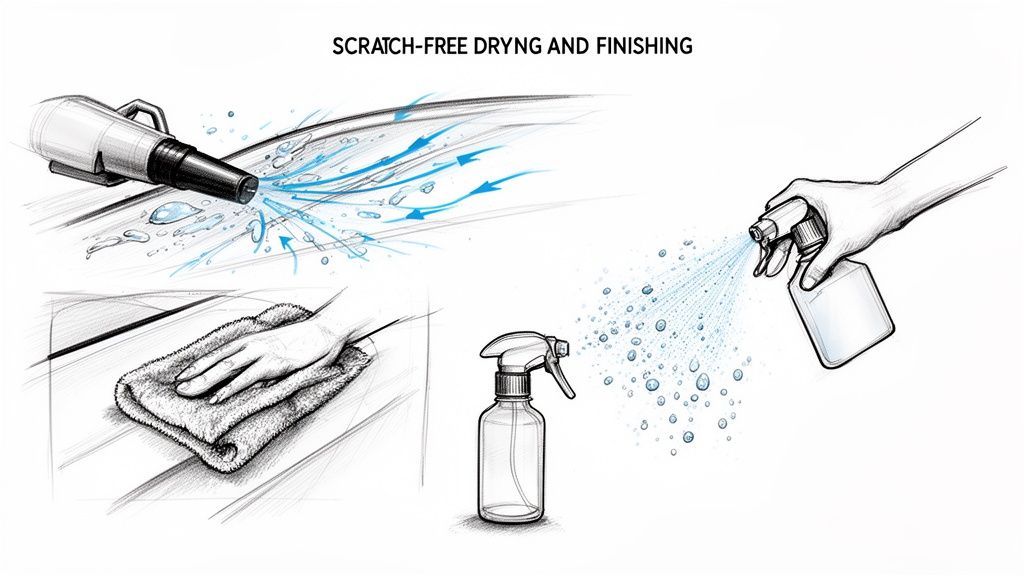
You’ve done the hard part. The soap is rinsed away, and your car is looking incredible. But these next few minutes are critical—this is where most people unknowingly inflict the very swirl marks they just worked so hard to prevent.
Improper drying is the number one cause of fine scratches and those frustrating water spots that seem to etch themselves into the finish. When your car is wet, the paint is at its most vulnerable. Any spec of dirt you might have missed becomes an abrasive particle, ready to be dragged across the surface by a towel. We’re going to sidestep that risk entirely.
Go Touchless First
The best way to dry your car is to avoid touching it as much as you possibly can. This is where a powerful leaf blower or a dedicated car dryer becomes your most valuable tool. These devices let you blast away about 90% of the standing water from your paint, glass, and all the little crevices without ever making physical contact.
I once had a client who was incredibly careful with his two-bucket wash but kept finding new swirl marks. Turns out, he was using an old chamois and aggressively wiping the car down. The moment he switched to an electric leaf blower for the first pass, the problem completely disappeared.
Start at the roof and work your way down, pushing the water off in large sheets. Pay special attention to the problem areas:
- Mirrors and trim: Water loves to hide here and will drip out later, leaving long, ugly streaks.
- Door handles and grilles: Blast them out now to prevent those annoying drips from ruining your perfect finish.
- Wheels and lug nuts: A strong gust of air is the only way to get these spots truly dry and prevent rust spots.
The Gentle Blot and Final Touch-Up
For the last bit of moisture, it’s time to bring out a high-quality microfiber drying towel. The technique here is everything: blot, don’t wipe. Simply lay the towel flat on a panel, give it a moment to soak up the water, and then lift it straight off.
Dragging even the softest towel creates friction and multiplies the risk of marring your coating. The blotting method is gentle, incredibly effective, and the safest way to finish the job.
This is also the perfect time to give your coating a little boost. A light mist of a quality maintenance spray on each damp panel acts as a fantastic drying aid. It adds crucial lubrication for your towel while topping up the protective layer.
Pro Tip: As you dry, use Titan’s Ultra Ceramic Spray. A spritz or two per panel followed by a final, gentle buff with a clean microfiber does so much more than just dry the surface. It lays down a fresh layer of SiO2, instantly amplifying that deep gloss, slickness, and unbelievable water-beading. It’s a simple step that pays huge dividends.
Don’t Let Streaky Glass Ruin the Look
A perfectly polished body paired with streaky windows just doesn’t cut it. Your glass needs attention too, and a dedicated glass coating makes keeping it clean almost effortless. A product like our Apex Glass Ceramic Coating creates an incredibly slick surface that sends water flying off as you drive. It’s very easy to apply and the results are immediate.
This simple treatment makes driving under rain stress-free by dramatically improving visibility. After a wash, a quick final wipe is all you’ll need for crystal-clear, spot-free glass. For anyone who values safety and a truly finished look, treating your glass is an essential final step.
While we’ve covered the final drying stage here, you can learn more about waterless cleaning by checking out our complete guide on the dry wash for cars.
Dealing With The Tough Stuff: Advanced Decontamination
Even with the most meticulous weekly wash, your car is constantly bombarded by things a simple shampoo just won’t touch. I’m talking about the gritty, baked-on brake dust, splatters of road tar, and those stubborn bug guts that seem to weld themselves to your paint.
This is where a proper decontamination comes in. Don’t sweat it—this isn’t a weekly chore. Think of it as a deep clean you perform every few months, or whenever you feel the surface isn’t as slick as it used to be. Letting these contaminants build up is what “clogs” a coating, robbing it of its signature water-beading magic and slick feel.
Safely Eliminating Iron Fallout
Ever notice those tiny, rust-colored specks on your paint? They show up like wild on white or silver cars. That’s iron fallout—nasty little metal particles from your brakes (and everyone else’s) that embed themselves in the finish. If you try to scrub them off, you’re just asking for scratches.
The right way to handle this is with a dedicated iron remover spray. The process is almost like magic.
- Spray it generously over a clean, cool, dry panel.
- Give it 3-5 minutes to work its magic, but whatever you do, don’t let it dry on the paint.
- You’ll see the clear liquid start to “bleed” a deep, dramatic purple. That’s the chemical reaction literally dissolving the iron particles before your eyes.
- Once the reaction stops, give the panel a thorough rinse with your pressure washer or a strong jet from the hose.
It’s a completely touch-free process that safely melts away the metal without you ever having to scrub the paint.
Banishing Tar and Other Bonded Grime
Road tar, tree sap, and bug splatter are a different kind of enemy. They’re sticky, bonded messes that laugh at regular soap. For these, you need a dedicated tar remover solvent to break them down safely.
Just apply a little bit of the remover to a microfiber towel, not directly on the paint. Gently press and agitate the spot until you see it dissolve, then wipe the gunk away. No aggressive scrubbing needed. It’s always a good idea to follow up by washing that little spot with your pH-neutral soap to make sure no solvent is left behind.
This is where a truly advanced coating proves its worth. I hear this story constantly: a customer takes a long road trip, and their front bumper looks like a war zone. On a lesser, more brittle coating, that acidic bug mess can actually etch the surface. But with Titan’s Alpha Quartz Elastomer coating, it’s a totally different ballgame. Our Dark Matter tech gives it a unique flexibility, allowing it to absorb impacts from bugs hitting the car’s surface instead of chipping. The contaminants just sit on top of this resilient layer, making them incredibly easy to release with the right product.
This flexible-yet-hard characteristic is also why the coating doesn’t crack under the stress of going from a frozen winter to a scorching summer—it’s a huge part of its incredible longevity. It’s easy to install and delivers great results every time.
When to Bring Out the Clay Bar
After you’ve chemically decontaminated the paint, run your hand over the surface (a good trick is to put your hand in a thin plastic sandwich bag to amplify the feel). If you still feel some grittiness, it might be time for a clay bar or a clay mitt.
But use this tool sparingly. Claying is a physical process, and overdoing it can introduce fine scratches or micro-marring. For a coated car, this should be a once-or-twice-a-year procedure, max. We’ve actually put together a full breakdown on the right way to do it, which you can find in our guide on how to clay bar your car.
The push for this level of protection is driving massive growth in the automotive sector, which is projected to make up 32% of the entire ceramic coatings market by 2035. With 85.4 million motor vehicles produced globally in 2023, more and more owners are looking for real-world solutions to protect their investment. A quality coating provides that stellar UV protection and water repellency, turning car care from a weekend-long chore into a quick, satisfying ritual. This protection is more critical than ever when you realize that corrosion costs an astounding $2.2 trillion worldwide each year, dramatically shortening the life of vehicles. You can get a deeper look at these market trends and statistics from Research Nester.
Answering Your Top Ceramic Coating Wash Questions
Alright, let’s get into the nitty-gritty. Even with the best plan, you’re going to have questions. You’ve made a serious investment in your vehicle’s protection, and it’s only natural to want to get the maintenance just right.
Here are the most common questions we hear from owners just like you, with the straightforward, no-nonsense answers you need.
Can I Run My Coated Car Through an Automatic Car Wash?
This is easily the number one question we get, and the answer is a hard no. I know the convenience is tempting, but automatic car washes are the arch-nemesis of a perfect finish.
Why? It comes down to two things: harsh chemicals and dirty brushes. The soaps used in tunnel washes are typically high-pH detergents designed to rip through grime aggressively. Over time, these will inevitably start to break down your coating, weakening its hydrophobic properties and dulling that deep gloss.
But the real damage comes from the giant spinning brushes. Think about it—they’re caked with abrasive dirt and grit from every single car that went through before yours. They will, without a doubt, inflict a web of swirl marks and scratches on your beautiful finish.
Even a “touchless” wash is just a lesser of two evils; it still relies on powerful, potentially harmful chemicals to do the work. Nothing, and I mean nothing, beats the gentle and controlled two-bucket hand wash we’ve covered. It’s the only way to be absolutely sure you’re keeping your coating and your paint pristine.
How Often Should I Wash My Ceramic Coated Car?
There isn’t a single magic number here—it really comes down to how and where you drive. But I can give you some solid, real-world guidelines.
- Daily Driver: Aim for a wash every one to two weeks. This is the sweet spot to keep road film, dust, and other gunk from building up and potentially “clogging” the coating’s surface.
- Garage Queen / Weekend Toy: You can stretch this out to every three or four weeks, or simply wash it when it looks like it needs it.
One of the best perks of a quality Titan coating is that it genuinely keeps your car cleaner, longer. Dirt and grime just can’t get a good grip on the slick surface. This means you’ll be washing less often, and when you do, the job will be worlds easier and faster.
Do I Need to Wax My Car After It’s Been Coated?
Absolutely not. In fact, please don’t! Traditional carnauba waxes and paint sealants are designed to bond with the microscopic pores of your car’s clear coat. A ceramic coating, however, is engineered to be incredibly dense and non-porous.
If you try to smear wax on top of your coating, it has nowhere to bond. You’ll just end up with a greasy, streaky mess that masks the true gloss of the coating and completely kills its incredible water-beading performance.
Instead of waxing, think about “topping” or “rejuvenating” your coating. This is where a dedicated SiO2 maintenance spray shines. A product like Titan’s Ultra Ceramic Spray is formulated to perfectly complement your coating. It lays down a fresh, slick layer of SiO2, boosting the hydrophobic effect and bringing back that just-coated slickness.
What’s the Best Way to Deal with Water Spots?
The key here is speed. Water spots are just mineral deposits—calcium and magnesium—left behind when a water droplet evaporates. If you catch them right away, a quick wipe with a quality detail spray and a fresh microfiber towel is usually all it takes.
If they’ve been sitting for a while, especially if they’ve baked in the sun, you’ll likely need a dedicated water spot remover that’s safe for ceramic coatings.
But the best defense is a good offense: prevention. Always wash in the shade, never let soap dry on the paint, and get the vehicle dried thoroughly and quickly after that final rinse. This is where having coated glass with something like Titan’s Apex Glass Ceramic Coating is a game-changer. Water flies off so fast it barely has a chance to sit, let alone spot, making your glass clearer and your drives much safer in the rain.
At Titan Coatings, we believe superior protection is born from superior science. Our unique elastomer coatings, powered by Dark Matter tech, are engineered to be both incredibly hard and flexible, offering a level of durability that rigid, old-school coatings simply can’t touch.
Ready to see the difference for yourself? Explore our full line of professional-grade coatings and maintenance products to keep your vehicle looking better than new.
0 Comments