
Ever wash your car meticulously, only to run your hand over the paint and feel a gritty, rough texture? It’s frustrating. Those tiny bumps are stubborn contaminants that have bonded to your car’s clear coat, and no amount of washing will get them out. This is where clay barring comes in.
It’s a deep-cleaning process that removes bonded surface contaminants that a regular wash simply can’t handle. Think of it as a mechanical decontamination that safely lifts embedded particles like industrial fallout, brake dust, and tree sap from the paint, leaving the surface feeling perfectly smooth.
The Secret to an Unbelievably Smooth Paint Finish
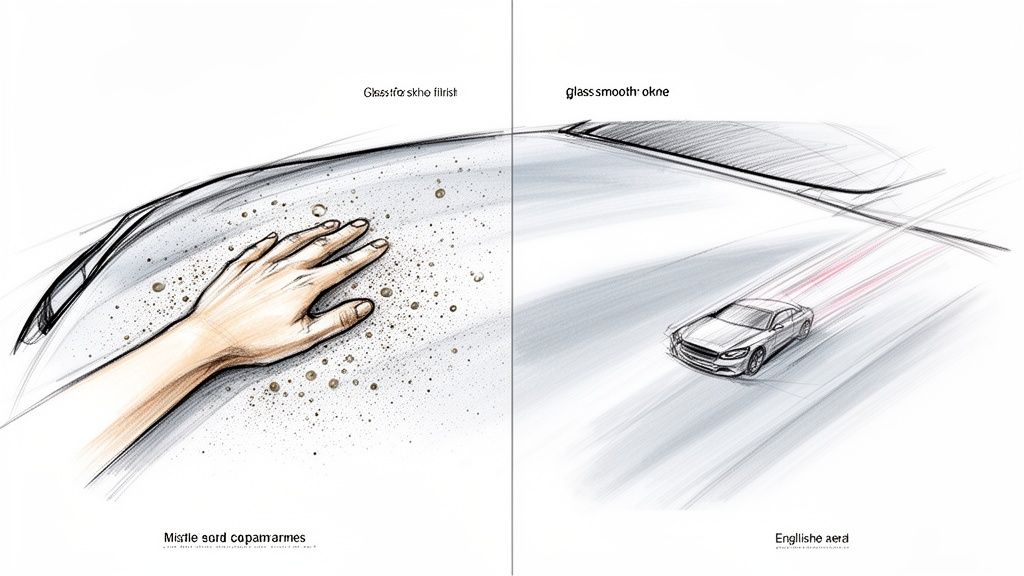
The problem with these bonded contaminants is that they act as a barrier. They prevent waxes, sealants, and especially advanced coatings from properly adhering to the paint. Your protection fails prematurely, and that deep gloss you worked so hard for fades away far too quickly.
Imagine trying to apply a screen protector to a dusty phone. No matter how good the protector is, those little dust particles underneath will create bubbles and weak spots. It’s the same concept with your car’s paint. You’re just applying expensive protection on top of a layer of grime.
How Clay Barring Works
A detailer’s clay bar is essentially a specially engineered resin compound. When you glide it across a lubricated surface, its tacky nature gently grabs and pulls out anything protruding from the clear coat. It doesn’t dissolve the contaminants; it physically shears them off, leaving a truly clean slate.
Let’s look at what a standard wash leaves behind compared to what a clay bar can actually remove.
Contaminants Before and After Clay Bar Treatment
| Contaminant Type | Result After Regular Washing | Result After Clay Barring |
|---|---|---|
| Industrial Fallout | Remains embedded; feels gritty. | Physically lifted from the clear coat. |
| Brake Dust | Hot particles remain bonded to paint. | Removed, preventing future corrosion spots. |
| Tree Sap | Still feels sticky and rough. | Sheared off the surface completely. |
| Rail Dust | Tiny orange specks persist. | Extracted from the pores of the paint. |
| Paint Overspray | Gritty texture remains. | Safely abraded away for a smooth finish. |
As you can see, a wash cleans the surface, but a clay bar purifies it. This is the professional’s secret to achieving a finish that feels like glass.
Preparing the Perfect Canvas for Titan Coatings
This step is absolutely non-negotiable for anyone serious about paint protection. At Titan Coatings, we pioneered the use of Elastomer coatings in the auto industry, leveraging unique nano-tube and Dark Matter technologies to create protection that’s both hard like glass and incredibly flexible. This flexibility is key—it allows our coatings to resist cracking from temperature extremes, from frozen winters to scorching summers. But for this revolutionary tech to work, it must bond directly to the clear coat itself.
For our flagship Alpha Quartz elastomer coating, this is critical. Without a proper clay treatment, you’re not just wasting your time; you’re wasting the potential of the coating. To get it right, check out our in-depth guide on how to decontaminate car paint before you apply any protection.
How a Clay Bar Restores Your Paint’s Clarity
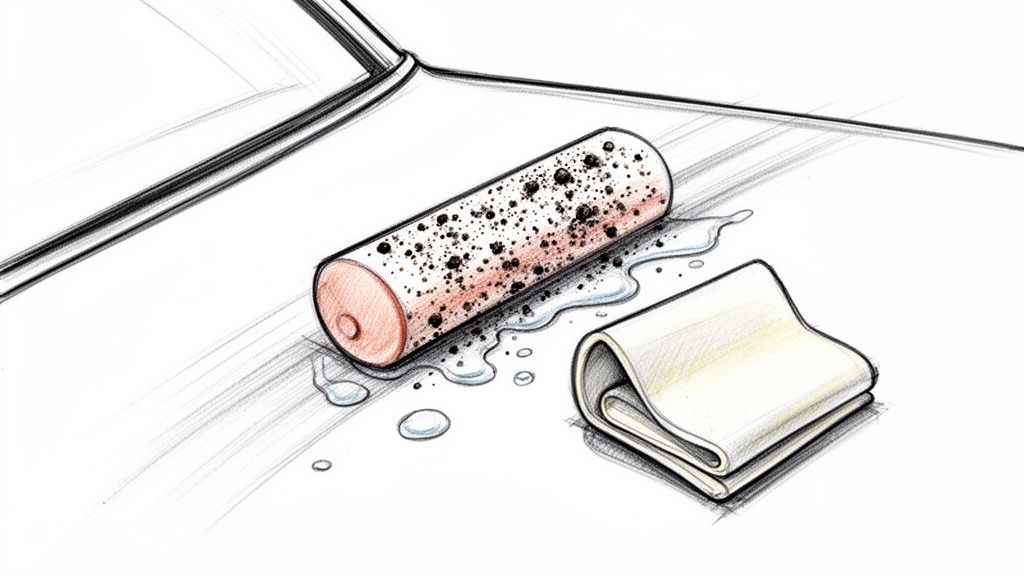
So, how does this little bar of clay actually work its magic? Let’s break it down without all the overly technical jargon. The simplest way to think about it is like a high-tech lint roller, but made specifically for your car’s clear coat.
The clay itself is a special resin compound. It’s just abrasive enough to grab onto any particle sticking up from the surface, but it’s also soft enough that it won’t damage the paint underneath. It’s a really clever bit of engineering.
When you slide the clay bar across a lubricated panel, its slightly sticky surface catches the tops of those embedded contaminants—things like rail dust, overspray, or industrial fallout—and literally plucks them out. The clay then surrounds these tiny particles, pulling them away from your paint and trapping them safely inside the bar. This is a purely mechanical decontamination; it’s not an aggressive chemical stripping process.
The Unsung Hero: Clay Lube
I can’t stress this enough: lubricant is the clay bar’s most critical partner. Trying to use a clay bar on a dry surface is a surefire way to create a mess of scratches and marring. It’s a disaster waiting to happen.
The lubricant creates a slick, protective barrier between the clay and your car’s finish. This does two key things:
- It Prevents Scratching: The slickness lets the clay glide smoothly over the paint instead of dragging and catching.
- It Boosts Cleaning Power: The lube helps lift and float the contaminants as they’re pulled out, making it easier for the clay to grab them.
As you work a section, you’ll actually see the clay getting dirty. That’s your proof that it’s doing its job! It’s also why you constantly need to knead and fold the clay to expose a fresh, clean surface. Using a dirty piece of clay is just like trying to wash the floor with a muddy mop—you end up just grinding all that captured grit right back into the paint.
For a deeper dive into this foundational prep step, check out our guide on what a clay bar treatment involves.
The whole point is to restore your paint’s optical clarity. By shearing off all those microscopic peaks caused by contaminants, you’re left with an incredibly smooth surface. This allows light to reflect perfectly, giving you that deep, brilliant shine you’re after.
This is the only way to get a surface truly ready for sealants or a professional-grade coating. It creates a pure foundation, ensuring the protection you apply bonds directly to the clear coat for the best possible performance and longevity.
Long-Term Benefits That Protect Your Investment
Think of clay barring your car as more than just a quick cosmetic fix. It’s one of the most fundamental things you can do to protect your vehicle’s health and value for the long haul. All those tiny, invisible contaminants—industrial fallout, rail dust, brake dust—are like microscopic enemies. If you just leave them there, these corrosive little particles will slowly but surely chew away at your car’s clear coat, leading to oxidation, dullness, and eventually, total paint failure.
When you mechanically lift these embedded aggressors out with a clay bar, you’re stopping that slow-burn damage right in its tracks. You aren’t just making the paint feel slick; you’re actively preventing serious problems down the road. This kind of proactive care is what keeps a car looking great and, just as importantly, protects its resale value. After all, a well-maintained finish is a huge factor in the overall steps to the car sale.
Maximizing Protection and Durability
There’s another massive benefit to having a perfectly decontaminated surface: it lets your protective products do their job properly. Whether you’re applying a simple wax, a sealant, or a high-tech coating, you need it to bond directly to the clear coat itself, not to a layer of gritty contamination.
Clay barring creates that perfectly clean slate, and the difference it makes is night and day. This is especially critical when you’re working with advanced elastomer coatings like the ones we’ve developed at Titan Coatings.
The cleaner the surface, the stronger the bond. A clay bar treatment ensures that every molecule of your protectant anchors directly to the paint, maximizing its lifespan and effectiveness. This means the protection you apply works better and lasts significantly longer.
Take our Alpha Quartz coating, for example. It uses our unique elastomer technology that’s hard as glass but stays flexible. That elasticity is what keeps it from cracking as your vehicle’s panels expand and contract from freezing winters to scorching summers or when bugs hit the surface. But for that tech to work its magic, it needs a flawless bond that only a properly decontaminated surface can offer. By clay barring first, you’re giving Alpha Quartz the perfect foundation to deliver maximum durability. You can learn more about the real-world advantages of ceramic coatings when they’re applied the right way.
Preventing Costly Paint Damage
Let’s talk about the long-term financial payoff here, because it’s huge. Industry data shows that contaminants like brake dust and industrial fallout can degrade a vehicle’s clear coat 15-25% faster if left untreated. In polluted areas, this can even lead to rust spots in just a few years.
By simply taking the time to safely pull those particles out with a clay treatment—maybe two to four times a year—you can extend the life of your factory finish by up to 30%. That’s not just about looking good; it’s about avoiding a very expensive trip to the body shop for a repaint.
Creating the Perfect Foundation for Titan Coatings
To get the absolute most out of Titan Coatings’ advanced technology, your prep work has to be flawless. It’s the difference between a good job and a great one.
Let me tell you a quick story about Marco, a mobile detailer out in Phoenix. He’d been using standard ceramic coatings for years, always with solid results. But he was looking for an edge, something to make his work truly stand out. He discovered our Alpha Quartz Elastomer coating and was intrigued by the promise of glass-like hardness combined with unique flexibility.
For his first job with Alpha Quartz, he prepped the car like he always did—a thorough wash and chemical decontamination. The result was good; the client was happy. But Marco, a perfectionist, felt it could be better. On the next car, a black SUV, he added one more step: a meticulous clay bar treatment on every single panel. The change was unbelievable. Suddenly, the gloss was deeper, the reflections were razor-sharp, and the paint felt like liquid glass. His clients weren’t just happy anymore—they were absolutely blown away by the mirror finish and how long it lasted.
Why Perfect Prep Unlocks Peak Performance
Marco’s story gets to the heart of a crucial principle: our unique elastic coatings need a perfectly pure clear coat to bond to. It’s the only way they can perform at their peak.
Think about it like this: you can’t glue two pieces of glass together if there’s a fine layer of dust between them. The bond will be weak and fail. The same exact logic applies to your car’s paint.
Our coatings are engineered for incredible flexibility and hardness. But for products like Alpha Quartz, which is perfect for both DIYers and pros, or our easy-to-use Ultra Ceramic Spray, they need that clean slate. Clay barring provides that foundation, ensuring the coating adheres perfectly and creates a seamless, powerful layer of protection that becomes one with the paint. It’s this level of prep that elevates a detail from just good to truly professional. For a deep dive, check out our complete guide on how to apply ceramic coating to a car.
The Tangible Difference of a Decontaminated Surface
The difference between coating a properly clayed surface versus one that’s just been washed is night and day. If you skip this step, those microscopic contaminants left behind act like tiny roadblocks, preventing the coating from forming a uniform, cross-linked bond with the clear coat. This can lead to premature failure, duller gloss, and weak water-beading.
Let’s look at how this plays out in the real world. This table shows just how much proper prep matters when applying a coating like Titan’s Alpha Quartz.
Coating Performance With vs Without Clay Bar Prep
| Performance Metric | Without Clay Bar Prep | With Clay Bar Prep |
|---|---|---|
| Coating Bond | Weak and uneven, sitting on top of contaminants. | Strong and uniform, directly to the clear coat. |
| Gloss & Clarity | Good, but slightly muted by underlying grit. | Exceptional, with deep, crystal-clear reflections. |
| Durability | Reduced lifespan; may fail in high-wear areas. | Maximized lifespan; uniform protection that lasts. |
| Hydrophobics | Inconsistent water beading and sheeting. | Intense, uniform beading and rapid water sheeting. |
As you can see, clay barring isn’t just an optional add-on; it’s the critical first step to making sure your investment in a high-quality coating actually pays off. It guarantees that the hard, flexible protection of Titan’s elastomer technology can perform exactly as designed—resisting everything from bird droppings to bug impacts while delivering that stunning, long-lasting shine you’re after.
Your Step-by-Step Guide to Clay Barring a Car
Ready to roll up your sleeves and get that professional-level finish yourself? Great. This guide will walk you through the clay barring process, breaking it down into simple steps anyone can follow. Getting this right is the secret to a jaw-dropping shine and making sure your protective coatings last.
First things first, you need a clean slate. Give your car a meticulous wash and dry to get rid of all the loose dirt and grit. It’s also best to work in the shade on a cool surface—this keeps your lubricant from drying up mid-pass, which is key to doing this safely.
The Clay Barring Process
Now for the fun part. The two golden rules here are patience and lubrication. Don’t rush it, and don’t be shy with the spray.
Prep Your Gear: Grab a piece of your clay bar and flatten it into a pancake that fits comfortably in your palm. Now, generously spray your clay lubricant on a small 2×2 foot section of the car. Hit the clay itself with a good spray, too. Seriously, you can’t overdo it with the lube.
Glide, Don’t Scrub: Lay the clay on the lubricated panel and just let it glide. Use light, straight-line motions—back and forth or up and down. You’ll actually feel and hear the clay working as it shears off those tiny contaminants. With each pass, you’ll feel the surface getting slicker and smoother.
Check and Knead Often: After covering a small area, take a look at the clay’s surface. See all those tiny black and brown specks? That’s the gunk you just pulled out of your paint. Fold the clay over on itself and knead it until you have a fresh, clean surface. This is vital to avoid dragging that collected grit across the rest of your paintwork.
Crucial Tip: If you drop your clay bar on the ground, it’s done. Throw it away. It will instantly pick up sharp particles that will act like sandpaper on your clear coat, causing deep scratches. It’s a cheap piece of clay—don’t risk your expensive paint job.
This simple diagram shows exactly what we’re accomplishing here: taking a contaminated surface and making it the perfect canvas for a coating.
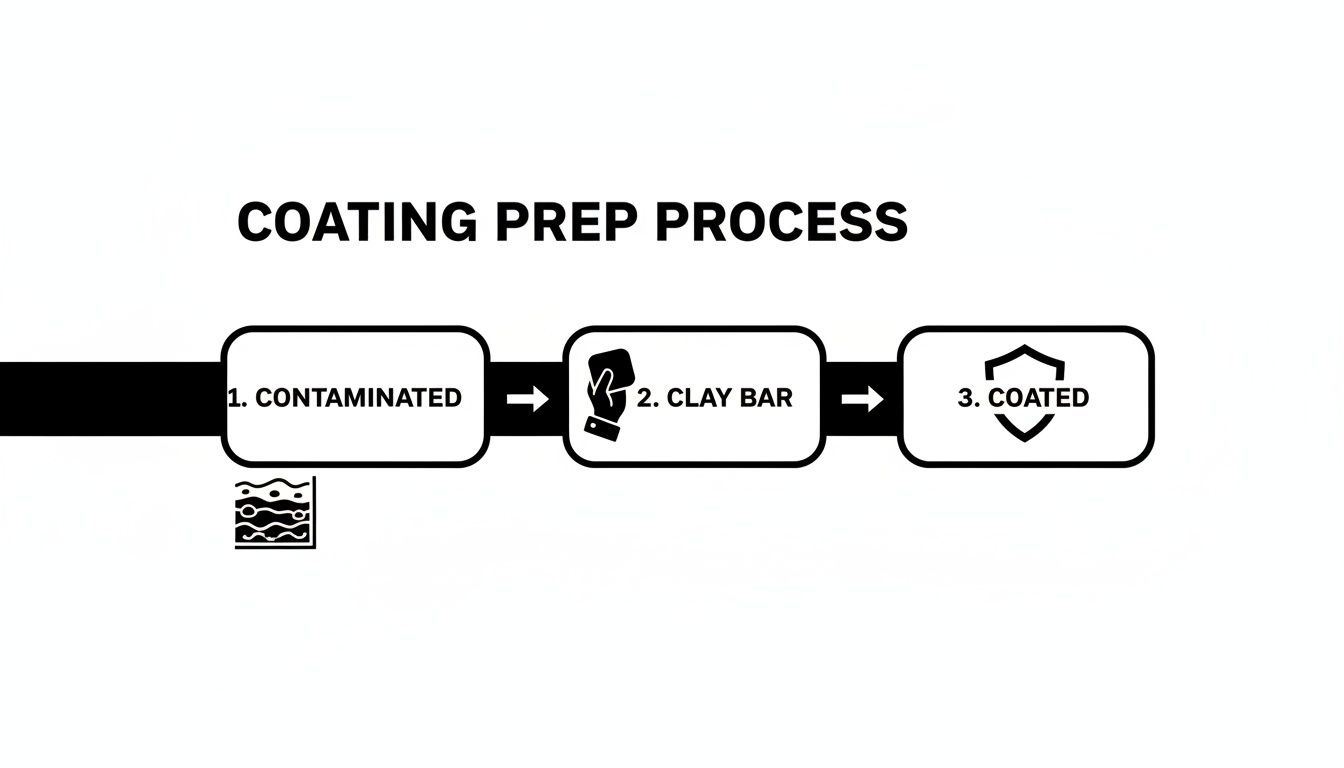
As you can see, the process purifies the surface, creating the ultra-clean foundation needed for a protective coating to bond properly.
Finalizing Your Work
Once you’ve methodically worked your way around the entire vehicle, panel by panel, a couple of quick final steps will confirm you’ve nailed it.
Final Wipe-Down: Take a clean, plush microfiber towel and gently buff off any leftover lubricant residue.
The “Baggie Test”: This is the ultimate test. Put your hand inside a thin plastic sandwich bag and lightly run your fingertips over the paint. The plastic is so sensitive it will magnify any tiny bumps you missed. If it doesn’t feel as smooth as glass, just re-lube that spot and give it another quick pass with the clay.
For an even deeper dive with more pro tips, check out our complete guide on how to clay bar your car. Nailing this process sets you up for a flawless coating application, ensuring you get the absolute best performance and gloss from your products.
See Clearly and Drive Safer with Decontaminated Glass
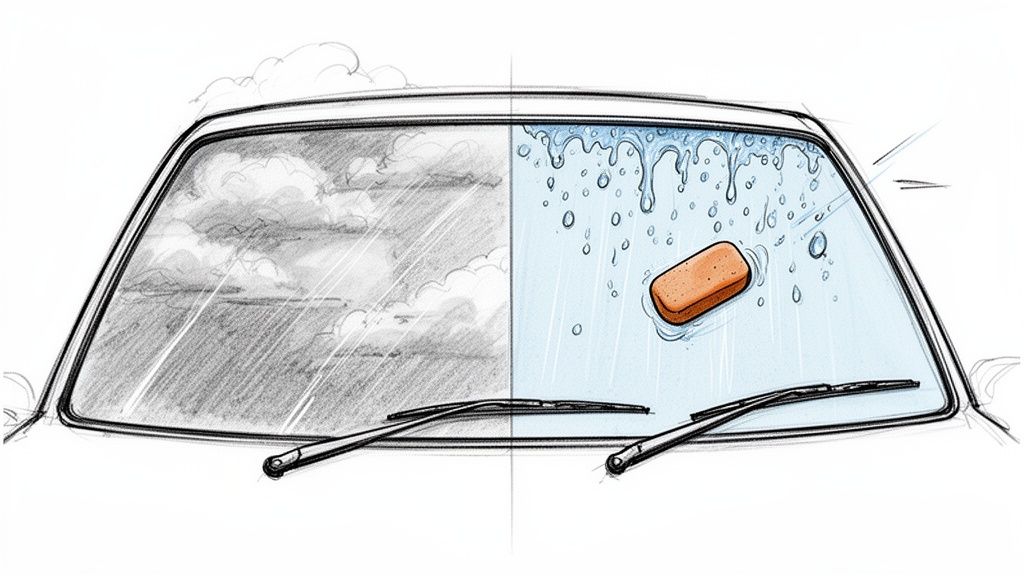
The magic of a clay bar doesn’t stop at your paintwork. Honestly, one of its most important jobs is on your glass, where it can make a night-and-day difference in driving safety.
We’ve all been there. A sudden downpour hits, you crank up the wipers, and instead of a clear view, you get a streaky, hazy mess that makes it impossible to see. That’s not just water; it’s a stubborn mix of road film, oily residue, and mineral deposits that even the best glass cleaners leave behind.
The Perfect Foundation for Glass Coatings
This is where knowing what does clay barring a car do for your glass is a total game-changer. When you clay your windshield, you’re doing the exact same thing you do for the paint: physically pulling out all those embedded particles that are stuck to the surface.
Doing this creates a perfectly smooth, completely naked surface. Why does that matter? Because it’s the only way to get a proper bond from a high-quality glass sealant or ceramic coating.
Think of it this way: you wouldn’t put a screen protector on a dirty phone. Claying your glass first means your coating bonds directly to the glass, not to a layer of invisible grime. This direct bond is the secret to getting unbelievable water-beading and long-lasting protection.
This step is non-negotiable if you’re using a professional-grade product like Titan’s APEX Glass Ceramic Coating. The clean surface allows the coating to anchor itself perfectly, creating a super-slick, hydrophobic shield that completely changes how you drive in the rain, making it stress-free.
A Whole New Driving Experience
The moment you drive in the rain after properly claying and coating your glass, you’ll get it. Water doesn’t smear or cling; it instantly forms into tiny, tight beads and just flies off the windshield, often without you even needing to use your wipers at highway speeds.
- Crystal Clear Vision: Removing that bonded road film restores the true optical clarity of your glass, enhancing visibility.
- Wipers Work Better (and Last Longer): Your wipers glide effortlessly across the slick surface, clearing water more effectively and reducing wear and tear on the blades.
- Cleaning Becomes a Breeze: Coated glass is a hostile environment for dirt, bugs, and ice, making them far easier to wash away.
This simple detailing step takes your windshield from being a frustrating weak link to a genuine high-performance safety feature. It’s a small bit of effort that pays off big time in confidence every single time you head out on the road.
If you’re ready to see the difference for yourself, check out the APEX Glass Ceramic Coating on our shop page.
Clay Bar FAQs: Your Questions Answered
Even after getting the hang of what a clay bar does, you probably still have a few questions rattling around. That’s perfectly normal. Let’s tackle some of the most common ones I hear so you can get to work with total confidence.
Is This Going to Scratch My Paint?
This is the number one concern, and the answer is no—a clay bar won’t damage your car’s paint if you use it correctly. The secret is lubrication, and lots of it. Never, ever try to use a clay bar on a dry panel. Keep the surface slick with a good lubricant, let the clay glide without forcing it, and your clear coat will be perfectly safe.
How Often Should I Be Doing This?
For a daily driver, you’ll probably only need to clay the paint once or twice a year. That’s usually enough to keep things smooth.
But, if you live near an industrial area or park under trees that drop a lot of sap, you might need to do it more often. The best way to know for sure is the “baggie test.” Just run your hand over the paint inside a thin plastic bag every few months. If it feels gritty, it’s time to clay.
Okay, I’ve Clayed the Car. Now What?
This is where you lock in all your hard work. After claying, your paint is surgically clean, but it’s also completely naked and unprotected. You must apply a layer of protection immediately afterward.
This is your prime opportunity to apply a durable wax, a sealant, or—for the best possible long-term defense—a professional-grade ceramic coating from Titan Coatings.
Don’t skip claying just because the car is brand new. Those vehicles pick up a surprising amount of contamination, from rail dust during shipping to industrial fallout sitting on the dealer’s lot. A quick clay session is the best first step you can take for your new investment.
Do I Really Need to Clay a Brand New Car?
Yes, you absolutely do. New cars almost always need it. Think about the journey they take from the factory to you—trains, trucks, and massive parking lots. They collect all sorts of bonded grime along the way.
Claying your new car right away gives you a truly pure surface to work with. It creates the perfect foundation for a coating like Titan’s Alpha Quartz to bond to. Its flexible elastomer technology can then grab on tight, giving you a tough, durable layer of protection that won’t crack under stress and will keep your car looking new for years.
Ready to give your vehicle a protective shield built on unique hard-yet-flexible elastomer technology? Explore Titan Coatings’ Alpha Quartz and see what ultimate defense looks like.
0 Comments