
That new-car gleam feels like it’ll last forever, doesn’t it? But while you’re admiring the shine, a silent, relentless enemy is already plotting its attack. Rust is a structural disease, and it’s eating away at your car’s safety, integrity, and value from the inside out. Getting ahead of it isn’t just a good idea—it’s the only smart way to protect your investment.
Why Rust Is Your Car’s Silent Destroyer
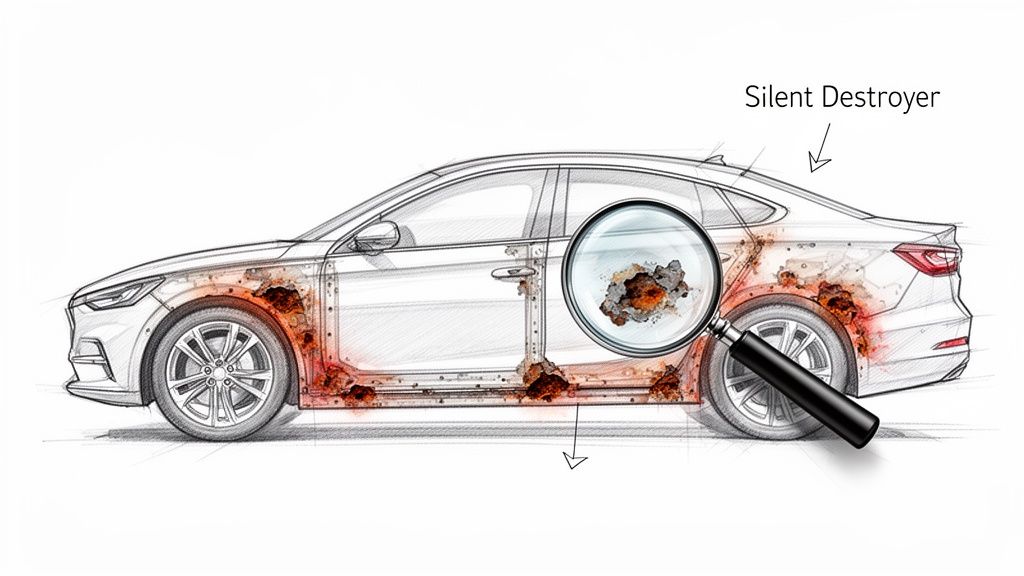
It’s tempting to write off rust as a cosmetic problem—just an ugly orange stain on an older car. The reality is that the visible blemish is just the tip of the iceberg. The real damage is happening where you can’t see it, deep inside the frame rails, body panels, and undercarriage.
This process, called oxidation, is a simple chemical reaction between iron, oxygen, and water. When those three get together, they create iron oxide—rust. This isn’t just a surface stain; it’s a chemical breakdown that turns strong, solid steel into a weak, brittle mess.
The Hidden Costs of Corrosion
Too many car owners don’t grasp the scale of the problem until it’s way too late. And the old myth that rust only hits cars in the snowy, salt-covered “Rust Belt”? That’s dangerously wrong. High humidity, salty coastal air, and even just regular rain are all it takes to get corrosion started. Once it takes hold, it spreads like a virus.
This silent decay has staggering financial consequences. Automotive corrosion is a massive part of a global problem costing economies over $500 billion worldwide. Here in the US, the 25 million tons of road salt dumped on our roads each year can slash a vehicle’s lifespan by up to 30%, especially in the Midwest and Northeast. You can read more in this automotive rust-proofing market analysis.
The single biggest mistake you can make is waiting for rust to show up. By the time you see that first paint bubble or orange streak, the metal underneath is already compromised. Real protection is about building a shield before the battle even starts.
From Reactive Repairs to Proactive Shielding
For decades, the standard approach was reactive: sand it, patch it, and paint over it. That’s a band-aid solution that only covers up the symptom, not the root cause. Thankfully, modern vehicle protection has shifted its focus to creating an impenetrable barrier that stops moisture and corrosive elements from ever touching the metal in the first place.
This proactive strategy is the only way to truly safeguard your vehicle’s:
- Structural Integrity: Keeping rust out of the frame, subframe, and suspension points is non-negotiable for safety.
- Resale Value: A clean, rust-free car will always be worth significantly more than one with even minor corrosion.
- Long-Term Reliability: Protecting brake lines, fuel lines, and exhaust parts from rust prevents failures that are both expensive and dangerous.
The very first signs of trouble are often subtle, starting as tiny specks of iron contamination on your paint. Knowing how to use an iron fallout remover is a critical first line of defense. Once you understand the enemy, you can finally build the right defense to make your vehicle last.
Your Proactive Rust Prevention and Cleaning Playbook
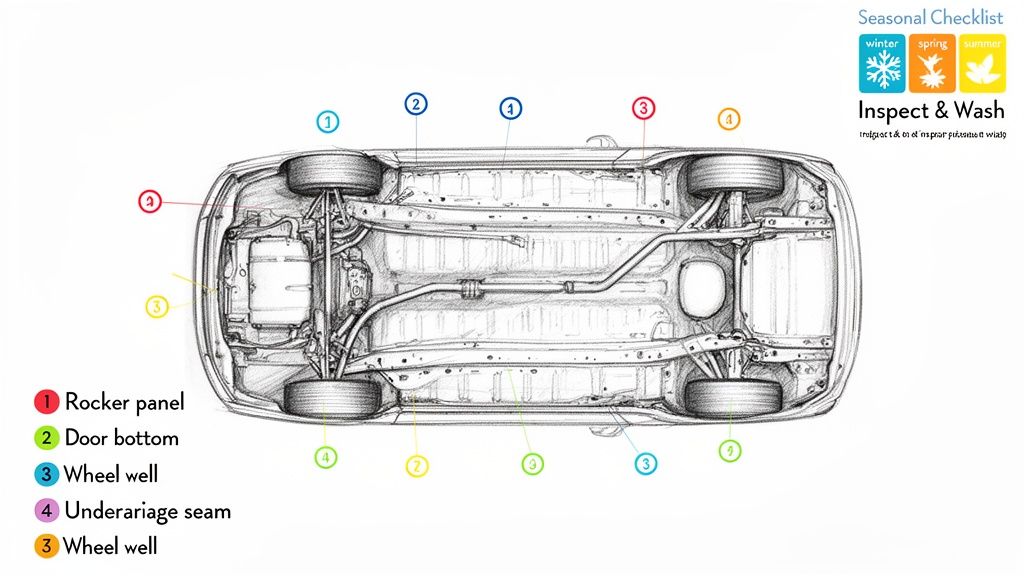
Winning the war against rust isn’t about dramatic, last-minute fixes. It’s won through a consistent, proactive defense. It all starts with getting to know your vehicle on an intimate level—understanding its weak spots and building a routine that shuts down threats before they ever get a foothold.
A clean, dry car is rust’s worst enemy.
This playbook doesn’t require a professional lift or a shop full of expensive tools. It’s about developing a sharp eye and a disciplined approach. When you make regular inspection and cleaning a habit, you’re laying the perfect foundation for any protective coatings you apply later and guaranteeing your vehicle’s long-term health.
Master the Seasonal Rust Inspection
The first step is learning where to look. Rust never starts on a flat, open panel. It loves to hide in the nooks and crannies where moisture, salt, and dirt get trapped and just sit there. A quick, 15-minute walk-around with every change of season can literally save you thousands in future repairs.
Grab a bright flashlight. You’ll need it to see what’s really going on in the shadows underneath.
Your Essential Inspection Checklist:
- Wheel Wells & Fender Lips: These areas get sandblasted by road debris and slush. Run your hand along the inner lip of the fender—any bubbling, flaking, or roughness in the paint is a major red flag.
- Rocker Panels: These are the panels right below your doors. They catch everything your front tires kick up, making them a prime target.
- Door Bottoms & Drain Holes: Open every door and look at the bottom seams. More importantly, find the little drain holes and make sure they’re clear. If they’re clogged, water pools inside the door shell.
- Undercarriage & Frame Rails: You don’t need a lift to spot the big problems. Get down and look underneath, focusing on welds, seams, and anywhere mud loves to cake on.
- Trunk & Hood Seams: Pop the hood and trunk. Check the channels where leaves and water collect. It’s a perfect storm for corrosion.
This isn’t just a chore; it’s a strategic investment. The automotive rust protection market is projected to hit $3.39 billion by 2033 precisely because more owners are catching on. Unchecked corrosion can shorten a vehicle’s lifespan by 20-40% and tank its resale value by 10-25%, especially in salty climates. Think about it: half of all trade-ins in those areas show underbody rust after just five years.
Build a Powerful Cleaning Routine
Once you know where to look, you need to deny rust the ingredients it needs to form. A powerful, consistent cleaning routine is absolutely non-negotiable, especially for the underbody.
Simply washing the top of your car is like only brushing your front teeth. The real damage is happening where you can’t easily see it. The undercarriage needs just as much, if not more, attention.
Your main goal is to neutralize corrosive agents like road salt and acidic grime. A high-pressure wash, particularly one with a good undercarriage spray, is your best weapon. After you’ve been driving on salted roads, make it a point to wash the car within a day or two. Don’t let that stuff linger.
This cleaning process does more than just get the dirt off. It’s the essential prep work for any real protection. Before you can even think about applying a sealant or coating, that surface has to be perfectly clean and decontaminated. To get a truly bulletproof bond, you need to learn how to properly decontaminate car paint. A truly clean surface is the cornerstone of protecting your car from rust.
Your Best Defense: How Advanced Coatings Create an Impenetrable Shield
Keeping your car clean and regularly checking for trouble spots is the foundation of any good rust prevention plan. But if you want to truly armor your vehicle against the elements, modern coating technology is where the real magic happens. This is how you move from basic maintenance to active, long-term defense.
Let’s talk about a real-world scenario. Alex, a mobile detailer, built his business on delivering incredible results. For years, he swore by traditional ceramic coatings. But he kept running into the same frustrating issue. Clients from snowy regions would come back a year later, and their once-perfect coatings were brittle and covered in micro-cracks from the brutal freeze-thaw cycles. The mirror-like shine that looked amazing in July just couldn’t hang on through a harsh winter.
He was tired of using products that couldn’t live up to their promises. Alex needed something that wouldn’t just look good on day one, but would actually perform under pressure. His search led him to Titan Coatings, where he discovered the game-changing power of elastomer technology.
The Problem with a Hard Shell and the Power of Flex
The issue Alex kept seeing is one we’ve all dealt with. Standard ceramic coatings harden into a rigid, glass-like shell. That’s fantastic for gloss and fending off light scratches, but that same rigidity is their biggest weakness when temperatures fluctuate or a rock gets kicked up on the highway.
Metal naturally expands and contracts with heat and cold. A rigid coating can’t flex along with it, which inevitably leads to stress fractures that break the protective seal. Once that barrier is compromised, moisture and salt get in, and rust is right behind.
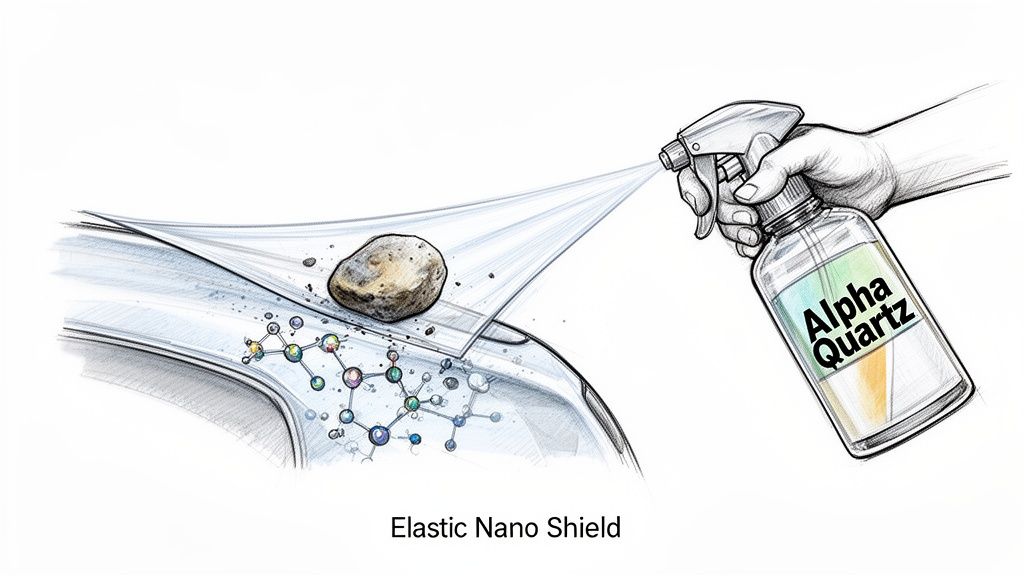
This is exactly why Titan’s Alpha Quartz is such a breakthrough. As the first company to bring elastomer coatings to market, Titan developed it with advanced nano tube and Dark Matter tech. The result is a surface that’s hard like glass, yet has the flexibility of rubber.
That elasticity is the key to its incredible durability. It allows the coating to absorb the impact from a bug or rock chip and flex right along with the body panels, whether it’s a scorching summer day or a sub-zero winter night. The coating won’t crack under pressure; it adapts.
This unique resilience means the protective barrier stays completely intact, year after year, locking out the moisture and corrosive agents that want to eat away at the metal. For a detailer like Alex, it meant he could finally offer a solution that lasts, protecting his client’s investment and his own reputation. The fact that Alpha Quartz is so easy to apply—perfect for pros and dedicated DIYers alike—was just the icing on the cake.
Make no mistake, the demand for real rust solutions is growing fast. The global rust converter market was valued at $2.5 billion in 2025 and is on the rise. Why? Because corrosion impacts one in every four vehicles under 10 years old. With over 280 million vehicles on the road in the U.S. alone, more and more owners are looking for better ways to protect their cars themselves.
Choosing Your Rust Protection: Titan Coatings vs. Traditional Methods
Deciding on the right protection can be confusing. To simplify it, here’s a look at how advanced coatings from Titan stack up against the old-school methods and, well, doing nothing at all.
| Feature | Titan Coatings (Alpha Quartz / Ultra Spray) | Traditional Wax/Tar Coatings | No Protection |
|---|---|---|---|
| Durability | Years of protection with a single application. | A few months; requires frequent reapplication. | Vulnerable to immediate damage. |
| Flexibility | High elasticity prevents cracking from temperature changes and impacts. | Brittle; can crack or chip easily, exposing the metal. | Paint is directly exposed to all impacts. |
| Chemical Resistance | Resists salt, road grime, bird droppings, and industrial fallout. | Limited resistance; chemicals can break it down quickly. | Paint is easily etched and stained. |
| Water Behavior | Extremely hydrophobic; water beads and rolls off, taking dirt with it. | Some water beading, but it diminishes fast. | Water sits on the surface, accelerating rust. |
| Application | User-friendly for both professionals and DIY enthusiasts. | Often messy, smelly, and difficult to apply evenly. | N/A |
| Long-Term Value | Higher initial investment but saves money on repairs and maintains resale value. | Lower initial cost but requires constant re-application and labor. | Leads to costly rust repairs and devaluation. |
Ultimately, while traditional waxes and tar sprays offer a temporary barrier, they simply can’t compete with the long-lasting, flexible, and chemically resistant shield provided by modern elastomer and ceramic coatings. You can find the full range of innovative products in the Titan Coatings shop.
Your First Layer of DIY Defense
For anyone wanting to get serious about rust protection without a huge learning curve, a quality spray-on ceramic coating is the perfect place to start. It offers an incredible balance of high-level performance and dead-simple application.
Titan’s Ultra Ceramic Spray was designed for this exact purpose. Forget traditional waxes that just sit on the surface and wash away after a few weeks. This spray creates a powerful, semi-permanent bond with your vehicle’s clear coat. That bond forms a slick, hydrophobic shield that sheds water, dirt, and salt like you wouldn’t believe.
Here’s why a ceramic spray is such a great starting point:
- Unbelievably Easy to Apply: If you can spray and wipe, you can get professional-grade results right in your own garage.
- Real, Lasting Protection: It delivers a much more durable shield than any wax or sealant, often lasting for months at a time.
- Head-Turning Gloss: Beyond just protection, it brings out a deep, rich shine that makes your paint look better than new.
Using Ultra Ceramic Spray after a thorough wash is the key. You’re locking in that perfectly clean surface under a slick, non-porous barrier. Water instantly beads up and flies off the paint, taking dirt and grime with it. This keeps moisture from lingering in panel gaps and tight crevices—the very places where rust loves to start.
Of course, ceramic sprays are just one tool in the arsenal. If you’re exploring different long-term protection options, it’s worth understanding the pros and cons. To go deeper, we put together a guide to learn more about Paint Protection Film vs. Ceramic Coating and find the best fit for your car.
Seeing Clearly: Why Your Glass Deserves Protection, Too
A truly protected vehicle isn’t just about pristine, rust-free paint. While we focus heavily on the body and undercarriage, the massive panes of glass surrounding you are just as critical. After all, what good is a perfect finish if you can’t see the road ahead?
We’ve all been there. Driving along, minding our own business, when a sudden downpour unleashes itself from the heavens. Your wipers thrash back and forth at full speed, but they’re just smearing a wall of water. Headlights from oncoming traffic blur into a blinding, disorienting mess. It’s a white-knuckle situation that turns a routine drive into a genuine hazard.
From Blinding Glare to Effortless Clarity
That heart-stopping moment when you lose clear sight of the road isn’t just an annoyance—it’s a massive safety compromise. This is where a proper glass treatment changes the entire game, turning a reactive, stressful situation into a proactive, confident one. The goal is to make the surface so slick that water has no choice but to get out of your way.
That’s the magic behind Titan’s APEX Glass Ceramic Coating. Forget those temporary sprays that wash away after a few storms. APEX forges a legitimate, semi-permanent bond with the glass, creating an intensely hydrophobic shield that makes driving in the rain completely stress-free.
What does that mean in the real world? Water doesn’t smear; it’s instantly forced into tight, perfect little beads. As you pick up speed to around 35-40 mph, the wind whisks those beads right off your windshield. Seriously, you often don’t even need to turn on your wipers.
This dramatically cuts down on glare and enhances visibility in the worst weather, making it far easier to spot lane lines and navigate safely. It transforms a dangerous scenario into one you can handle with total calm.
Pro-Level Results Without the Pro-Level Hassle
Here’s the best part: you don’t need a professional’s workshop to get these results. We specifically formulated APEX Glass Ceramic Coating to be dead simple for any DIYer. It’s the perfect way to spend a bit of time on a weekend to make a huge upgrade to your driving experience.
The whole process is incredibly straightforward:
- Start with a Squeaky Clean Surface: First, give your glass a deep clean. You want to remove every trace of dirt, film, and oil for the best bond.
- Apply the Coating: Using the applicator pad, wipe a small amount of APEX onto the glass. A simple cross-hatch pattern works perfectly to ensure you don’t miss any spots.
- Buff it Off: Let it cure for a few moments, then take a clean microfiber towel and buff the residue away until the glass is crystal clear and streak-free.
And that’s it. In less than an hour, you’ve added a tough, durable layer of protection that not only makes rainy drives a breeze but also makes scraping ice and scrubbing off bug guts way, way easier.
When you extend your protection strategy from the metal to the glass, you’re building a complete shield for your vehicle. A fully protected car isn’t just about preventing rust; it’s about creating a safer, more enjoyable drive every single time you’re behind the wheel. To see just how much of a difference it makes, check out our full guide on applying ceramic coating for your windshield.
Your Year-Round Rust Prevention Action Plan
Look, the secret to beating rust isn’t some magic bullet—it’s consistency. A professional-grade coating is your first and best line of defense, but it’s the simple, ongoing maintenance that keeps that shield strong year after year. Forget the guesswork; this is the straightforward, manageable schedule I use and recommend to all my clients.
This is your roadmap to a rust-free ride. By weaving these habits into your routine, you turn rust prevention from a massive project into a simple part of car ownership.
Even your glass plays a role in the overall health of your vehicle. Keeping it sealed and protected is a simple but critical step.
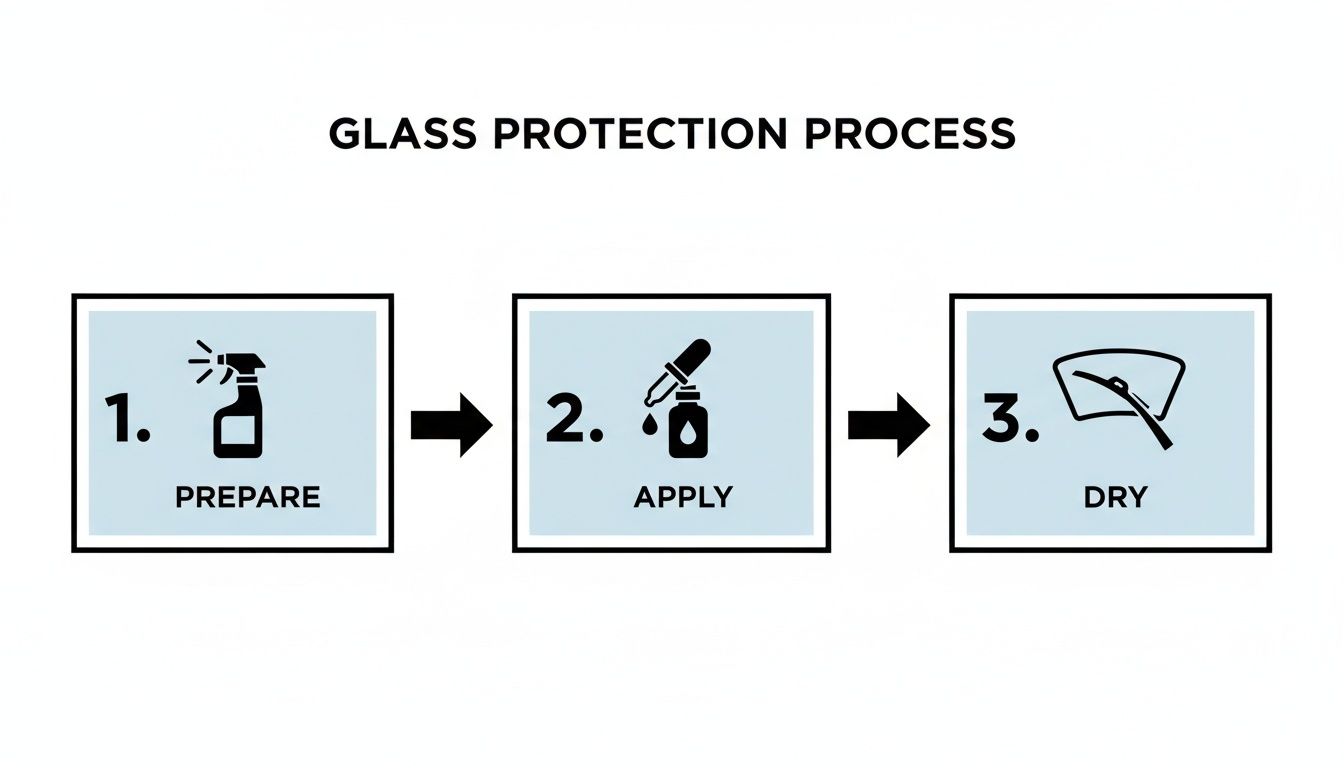
As you can see, getting that pro-level water repellency on your glass is an easy three-stage process anyone can handle.
The Five-Minute Weekly Checkup
Think of this as your quick, first line of defense. All it takes is about five minutes to spot trouble before it starts.
- Quick Walk-Around: I always tell people to take a quick lap around their car. Pay attention to the usual suspects: lower door edges, the lips of your wheel wells, and the rocker panels. That’s where rust loves to start.
- Spot Clean Immediately: See bird droppings, bug guts, or tree sap? Get them off. Now. That stuff is incredibly acidic and will eat right through your clear coat and any protective coatings if you let it sit.
- Check Your Drains: Glance at the drainage channels at the bottom of your windshield and around the trunk or tailgate. Make sure they’re clear of leaves and gunk so water can get out instead of sitting there.
Your Monthly Deep Clean and Inspection
Once a month, you need to get a little more serious. This is about washing away the grime that traps moisture against the metal and giving everything a closer look.
- A Proper Hand Wash: Get in there and really clean the wheel wells and lower body panels. Make sure you’re using a quality car shampoo that won’t strip off the wax or coatings you’ve already applied.
- Blast the Undercarriage: You absolutely have to rinse the underbody. A pressure washer is great, but even a strong spray from a garden hose can knock off the mud, salt, and road grime that collects down there. This is non-negotiable, especially after driving on treated roads in the winter. If you live where it snows, understanding how to handle a car wash in cold weather is a game-changer.
- Check for Dampness Inside: Feel the carpets, especially in the footwells and trunk. Any damp spots are a red flag for a water leak, probably from a failing weather seal.
Of course, a solid year-round plan goes beyond just rust. It’s about total vehicle care, right down to the components you choose to keep your vintage bug like new.
The Annual Coating Refresh and Seal
This is your big yearly check-in. It’s when you take a hard look at your protective layers and beef them up for the seasons ahead. Honestly, this is the most critical part of making sure your vehicle’s armor stays intact.
The whole game is about maintaining the barrier. An annual inspection and touch-up is what stops a tiny chip from turning into a full-blown rust disaster down the road.
Here’s your annual game plan:
- Decontamination Wash: Kick off the process with a deep-cleaning wash to strip away any bonded contaminants that have latched onto the paint and glass over the year.
- Inspect Your Coatings: Get a good light and carefully examine your primary coating, like Alpha Quartz. You’re looking for any spots compromised by deep scratches or rock chips. While its elastomer tech is great at preventing cracks from temperature swings, a sharp impact can still breach the shield.
- Touch-Up Where Needed: Find a breach? Clean it meticulously and reapply your coating to that specific spot to reseal the surface. Don’t leave any part of the armor down.
- Boost the Protection: Now’s the perfect time to apply a fresh layer of Ultra Ceramic Spray. It’s a simple spray-and-wipe that adds an incredibly slick, hydrophobic topcoat. It brings back that deep gloss and water-beading and acts as a sacrificial layer for the next 12 months.
- Re-Coat the Glass: Don’t forget the windows. A quick application of APEX Glass Ceramic Coating restores that amazing water repellency, keeping your vision crystal clear no matter how bad the storm.
To simplify this, here is a handy checklist you can follow. It breaks down the key tasks by how often you should do them, ensuring nothing gets missed.
Year-Round Rust Prevention Checklist
| Frequency | Task | Key Focus Areas | Recommended Titan Product |
|---|---|---|---|
| Weekly | Visual Walk-Around & Spot Clean | Paint chips, scratches, acidic contaminants (bird droppings), clear drainage channels. | N/A – Inspection Focus |
| Monthly | Thorough Wash & Deeper Inspection | Wheel wells, undercarriage, rocker panels, interior carpets for dampness. | N/A – Cleaning Focus |
| Seasonally | Underbody Rinse (Especially in Winter) | Frame rails, suspension components, floor pans, exhaust system. | N/A – Cleaning Focus |
| Annually | Decontamination & Coating Inspection | Full paint surface, checking for breaches in the protective coating. | Alpha Quartz (Primary) |
| Annually | Protection Boost & Reapplication | Adding a sacrificial layer, touching up compromised spots, renewing water repellency. | Ultra Ceramic Spray |
| Annually | Glass Coating Refresh | Windshield and all exterior glass to maintain hydrophobic properties. | APEX Glass Ceramic Coating |
By sticking to this simple schedule—weekly, monthly, and annually—you create a cycle of protection that makes it almost impossible for rust to ever get a foothold. It’s the smartest investment you can make in your vehicle’s longevity.
Answering Your Top Car Rust Protection Questions
We’ve walked through the a-to-z of building a fortress against corrosion. But I know from experience that when you get down to the nitty-gritty, specific questions always pop up. Let’s tackle some of the most common ones I hear from car owners and fellow detailers about making rust protection last.
Can I Just Put a Coating Like Alpha Quartz Over a Little Rust?
I get this question all the time. It’s tempting to think you can just seal over a small rust spot and call it a day, but that’s like putting a band-aid on a broken bone. It only hides the real problem, which will continue to get worse underneath.
For a coating to do its job, you have to give it a clean, stable surface to bond to. Alpha Quartz is designed to create a rock-solid barrier that stops rust before it even thinks about starting, but it can’t magically reverse existing damage.
Before you even think about coating a compromised area, you have to:
- First, get in there and mechanically clean all the loose, flaky rust off.
- Next, treat the area with a quality rust converter to neutralize the corrosion.
- Finally, prime the surface to create a solid foundation for the coating.
Once you’ve done that prep work, then you can apply the coating. It will permanently seal that repair and make sure rust doesn’t get a second chance.
How Long Does Titan Coatings Protection Really Last?
Durability is where our coatings shine, but the real-world lifespan always comes down to the specific product you choose and the kind of climate you’re battling. The good news is, they’re all built for the long haul.
Our top-tier elastomer coating, Alpha Quartz, uses some seriously impressive nano tube and Dark Matter tech to create a shield that’s both hard and flexible. With a little bit of basic care, a single application can last for years. If you’re looking for something simpler but still potent, a product like our Ultra Ceramic Spray gives you a solid year of protection and is a breeze to reapply during your annual detail.
The real game-changer with an elastic coating like Alpha Quartz is its resilience. Think about it: traditional hard coatings get brittle. They chip from flying road debris or crack under extreme temperature swings, creating a tiny opening for moisture to sneak in. The flexibility of an elastomer lets it absorb impacts and flex with temperature changes without ever breaking the seal. That’s what delivers that durable, long-lasting protection.
Do I Really Need a Pro to Apply These Coatings?
While having a professional detailer handle the job is the surest way to get a flawless result, we specifically formulated many of our products for the dedicated DIYer or mobile detailer who takes pride in their work.
Both Alpha Quartz and our APEX Glass Ceramic Coating are known for being surprisingly straightforward to apply. The absolute non-negotiable secret to success, though, is meticulous prep work. As long as you follow the instructions to the letter—cleaning, decontaminating, and prepping the surface—you can absolutely achieve a professional-grade finish in your own garage.
Beyond keeping your vehicle structurally sound and looking sharp, a rust-free car holds its value far better. To get a clearer picture of all the factors that go into a vehicle’s valuation, it’s helpful to understand how much is my car worth.
Ready to give your vehicle the ultimate, long-lasting shield against rust and the elements? Titan Coatings has engineered the perfect solution. Discover the power of our user-friendly, incredibly durable Alpha Quartz elastomer coating.
Shop for Titan Coatings Alpha Quartz today and build an impenetrable defense for your car.
0 Comments
Trackbacks/Pingbacks