
Every car owner knows that gut-wrenching sound—the sharp ping of a rock hitting the front bumper on the highway. Or the frustration of discovering a fresh scratch after a trip to the grocery store.
That one tiny imperfection can ruin your day and chip away at the pride you have in your vehicle. This is exactly where Paint Protection Film (PPF) comes in. It’s not just an accessory anymore; it’s a non-negotiable part of modern car care.
Your Armor Against the Elements
At its heart, PPF is a high-tech, transparent urethane shield designed to take the beating so your paint doesn't have to. It's the first line of defense against a relentless onslaught of hazards.
- Rock chips and flying road debris
- Acidic bug guts that can etch clear coats
- Corrosive bird droppings
- Fading and oxidation from harsh UV rays
- Annoying swirl marks and minor scuffs from washing
This isn't some niche product reserved for exotic supercars. The demand for serious vehicle preservation has exploded. The global PPF market is projected to jump from USD 502.55 million in 2024 to an incredible USD 726.63 million by 2030.
And get this: automotive applications account for a massive 73.64% of that market. It’s clear proof that everyday drivers are getting serious about protecting their investments.
For anyone who's ever obsessed over keeping their car looking perfect, installing a quality PPF is a game-changer. Here's a quick look at the core benefits.
Quick Guide: Key PPF Benefits at a Glance
| Benefit | Impact on Your Vehicle |
|---|---|
| Impact Resistance | Absorbs the force from rock chips and debris, preventing paint damage. |
| Self-Healing Surface | Minor scratches and swirl marks disappear with heat, keeping the finish flawless. |
| UV Protection | Blocks harmful UV rays to prevent your paint from fading and oxidizing over time. |
| Stain Resistance | Repels bug splatter, bird droppings, and chemicals, preventing etching and stains. |
| Enhanced Gloss | Adds depth and clarity to your paint, locking in that "just detailed" look. |
| Easier Maintenance | The slick, hydrophobic surface makes washing your car faster and easier. |
Simply put, a top-tier film acts as an invisible barrier that maintains your car’s value and appearance day in and day out.
It's More Than Just a Shield
Beyond just stopping damage in its tracks, a great PPF keeps that "showroom shine" locked in for years. It actually enhances the depth and gloss of your factory paint, making colors pop.
Plus, it makes your life easier. The hydrophobic properties of modern films mean that dirt, mud, and grime have a hard time sticking. Washing your car goes from being a chore to a quick, satisfying rinse.
Ultimately, choosing the right PPF is an investment in your peace of mind. It frees you up to actually enjoy your car without flinching at every piece of gravel you see on the road. This guide will give you the expert insights needed to make the right choice, ensuring your car’s finish stays as perfect as the day you first saw it. For more great tips, see our complete guide on how to protect car paint.
What Makes a Great PPF? A Look Under the Hood
When you start shopping for paint protection film, you'll find a dizzying array of options. But here's the honest truth: not all films are created equal. The real difference between a temporary shield and a decade of worry-free protection comes down to the science baked into the material itself. Let's peel back the layers and see what really matters.
The heart of any PPF is its foundational material. You'll still find some older, budget-friendly films made from Polyvinyl Chloride (PVC). While cheap, PVC has a bad habit of turning yellow and brittle when exposed to the sun over time. That's why the gold standard in the industry today is Thermoplastic Polyurethane (TPU). Its incredible flexibility lets it hug every curve of your car, and its built-in UV resistance ensures it stays crystal clear for years.
The Self-Healing Trick Is Pure Science
The feature that really wows people is the self-healing ability of premium PPF. This isn't just clever marketing; it's a brilliant bit of polymer science at work. The top layer of the film is a network of special, flexible polymers. When a light scratch or swirl mark happens, it's like creating a dent in that network.
Introduce a little heat—either from the sun on a warm day or a professional's heat gun—and those polymers relax. They naturally want to return to their original, interlinked state, and as they do, the scratch simply disappears. It’s this regenerative quality that keeps your car looking like it just rolled off the showroom floor.
Think of it this way: a high-quality TPU film can literally erase minor damage, keeping the finish flawless. This self-healing property is the single biggest performance indicator separating the best films from the rest.
The Specs That Actually Matter
Beyond the base material, a few key metrics really define a film's real-world performance. You're not just looking for one good feature; you're looking for a film that nails the balance of all of them.
- Clarity and Gloss: A top-tier film should be completely invisible. There should be zero "orange peel" texture or haziness that dulls your paint. In fact, a great PPF will actually deepen your car's color and crank up the gloss.
- Thickness: You'll see thickness measured in mils (one-thousandth of an inch). The sweet spot for most applications is between 6 to 8 mils. This provides serious protection against rock chips and road debris without being so thick that it's a nightmare to install on complex curves.
- Stain Resistance: The film's top coat is its first line of defense against chemical attacks. This is what stops acidic bug guts, bird droppings, and tree sap from etching into the film and, eventually, your paint.
This decision-making flow really helps visualize how car owners arrive at the decision to invest in PPF.
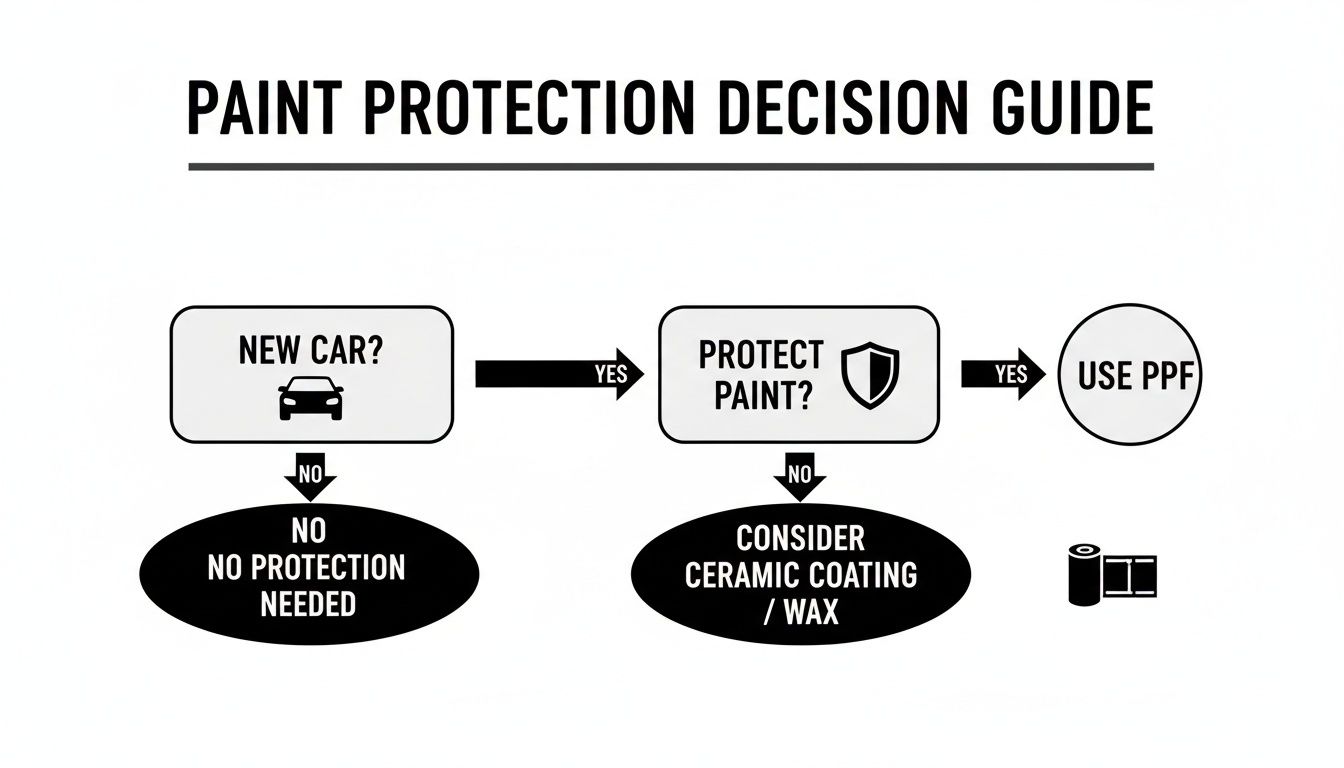
As you can see, for anyone serious about preserving their vehicle's finish, especially on a new car, PPF becomes the most logical and effective solution.
Taking Protection to the Next Level with Coatings
While a high-quality PPF is an incredible standalone product, the game has evolved. Today, the ultimate protection strategy involves pairing PPF with an advanced coating. This is a big topic, and we dive deep into the pros and cons in our guide on paint protection film vs. ceramic coating.
Adding a specialized coating on top of your PPF unlocks a whole new level of performance. For instance, applying a product like Titan Coatings' Alpha Quartz over the film doesn't just add a candy-like gloss; it creates an intensely hydrophobic surface. Water and dirt have nothing to cling to, making washes faster and easier than you've ever experienced.
What makes Alpha Quartz a perfect partner for PPF is its elastomeric nature. It cures hard like glass but maintains its flexibility, so it won’t crack or fail during extreme temperature swings. This synergy—the impact resistance of PPF combined with the chemical resistance and hydrophobicity of a coating—is the definition of modern vehicle care.
What Titan Coatings Brings to the Table: The Elastomer Advantage
Paint protection film is a fantastic first line of defense, but the game has changed in recent years. The most significant leap forward didn't come from a detailing shop—it grew out of advanced polymer research. This is where Titan Coatings comes in, pioneering an entirely new class of protection as the first company to introduce elastomeric coatings to the market.
Imagine a shield for your car that’s as hard as glass but can flex on impact. That’s the breakthrough behind Titan’s technology. They combined cutting-edge nano-tube technology with their proprietary Dark Matter Tech to create coatings that behave unlike anything else available. This isn't just a slightly tougher ceramic coating; it's a completely different philosophy on how to protect a surface.
Flexibility That Fights Back
Traditional ceramic coatings are incredibly hard, which is great for preventing fine scratches. But that same rigidity can become a liability. When your car goes from a frozen winter morning to a scorching afternoon, that extreme temperature swing can cause microscopic cracks to form in a rigid coating, leading to its eventual failure.
Titan's elastic coatings completely sidestep this issue. Their molecular structure is designed to expand and contract right along with your car’s body panels. This means the coating won’t crack under thermal stress, keeping that protective barrier solid and unbroken for years.
The real magic, though, is how this flexibility handles impacts. When a pebble or bug hits the surface, an elastomeric coating flexes, absorbing and dissipating the energy across a wider area. Instead of a chip or crack, the impact is simply shrugged off.
Alpha Quartz: Pro-Grade Tech for Everyone
This kind of advanced material science isn't just for high-end professional installers anymore. Titan made it accessible with products like Alpha Quartz, a true elastomeric coating built for both seasoned pros and dedicated DIYers.
- Forgiving Application: Alpha Quartz was designed from the ground up to be user-friendly. It’s a great option for mobile detailers or car enthusiasts who demand professional results without the stress of a difficult application.
- Real-World Resilience: That elasticity means it holds up to the daily grind. Bug guts that would etch a lesser coating are no match, and the surface remains tough against whatever the road throws at it.
This blend of hardness and flexibility is what makes Titan's coatings the perfect partner for the best car paint protection film. The PPF takes the hit from larger debris, while the elastomeric coating on top adds a layer of unbelievable chemical resistance, UV protection, and an easy-to-clean, super-glossy finish. You can dive deeper into the science behind this powerful combination and learn more about Titan's elastomer technology.
Beyond Just Paint: Expanding the Shield
Titan's focus on practical, high-performance protection doesn't stop at your car's paint. We all know how stressful driving in a downpour can be when visibility drops to near zero.
That's precisely why Titan developed APEX Glass Ceramic Coatings. This is an incredibly easy-to-use treatment that creates a super-hydrophobic surface on your windshield. Water beads up so intensely and flies off so fast that at highway speeds, you barely even need your wipers. It’s a simple product that turns a white-knuckle drive into a much safer, more confident, and stress-free experience.
And for those times you need a quick-and-easy boost of protection, Ultra Ceramic Spray is a simple spray-and-wipe workhorse. Its easy installation and great results make it perfect for topping off an existing coating or using as a standalone sealant, giving you that signature gloss and water-beading with almost no effort.
Titan's journey has always been about taking concepts forged in extreme environments and refining them for the people who are truly passionate about their vehicles. By focusing on flexible, resilient elastomer technology, they’ve created a smarter, more durable way to protect every inch of your investment.
Professional Installation vs a DIY Approach
Choosing the right paint protection film is only half the story. The real make-or-break moment is the installation. This is where you hit a fork in the road: do you hand your keys over to a seasoned pro, or do you clear out the garage and tackle it yourself? The best path for you really boils down to your budget, your patience, and how much you'll obsess over a perfect finish.
A professional installer brings a level of precision to the table that’s nearly impossible to match at home. They work in a clean-room environment for a reason—dust is the arch-nemesis of a flawless PPF job. Just one tiny speck of dust or a stray hair trapped under the film will become a permanent, frustrating bubble that will mock you every time you look at your car.
Beyond the environment, top shops have invested in high-tech gear. They use specialized software and massive computer-guided plotters to cut film patterns specific to your vehicle’s exact make and model. This means no razor blades ever get near your paint. Their experience in stretching the film over tricky curves on bumpers and side mirrors without leaving stretch marks is a skill honed over hundreds, if not thousands, of cars.
Vetting a Professional Installer
If you’re leaning toward a professional install, remember that not all shops are created equal. A bad installation—with peeling edges, hazy stretch marks, and trapped debris—can look far worse than having no film at all.
Here’s my advice on how to find a true craftsman:
- Look for Certifications: The best PPF brands don't just sell their film to anyone. They train and certify installers to ensure their product is applied correctly. Ask about these credentials.
- Inspect Their Work: Don't just look at glossy photos online. Go to the shop and ask to see vehicles they've completed. Look closely at the edges, seams, and around emblems. Is the film perfectly tucked, or is it lifting?
- Read Real-World Reviews: Go beyond their curated website testimonials. Dig into Google reviews, Yelp, and car enthusiast forums to see what actual customers are saying about the installation's durability months or years down the line.
A top-tier installer won't just take your money. They'll walk you through the entire process, explain how to care for the film, and offer a solid warranty on their workmanship. Don't be shy—ask them what happens if you spot an imperfection a week later.
The DIY Enthusiast's Path
For the hands-on car owner, installing your own PPF can be an incredibly satisfying project that saves you a good chunk of change. But be warned: this is not a weekend whim. It demands immense patience, obsessive prep work, and the right set of tools.
Your entire success hinges on getting the paint surface surgically clean. I mean flawless. Any residual wax, sealant, or microscopic contaminant will ruin the film’s adhesion and your day.
This is also a key consideration for those starting their own detailing businesses; understanding the nuances of a Professional Installation vs a DIY Approach is crucial for delivering quality and managing client expectations.
Even with a perfect DIY install, you need to protect your investment. This is where a product like Titan’s Ultra Ceramic Spray becomes your secret weapon. After the film has cured, a quick mist-and-wipe with this spray adds a ridiculously slick, hydrophobic layer. It makes washing a breeze and provides an extra sacrificial barrier over your new film, giving you that pro-level gloss and protection.
Combining PPF with Coatings for Ultimate Defense
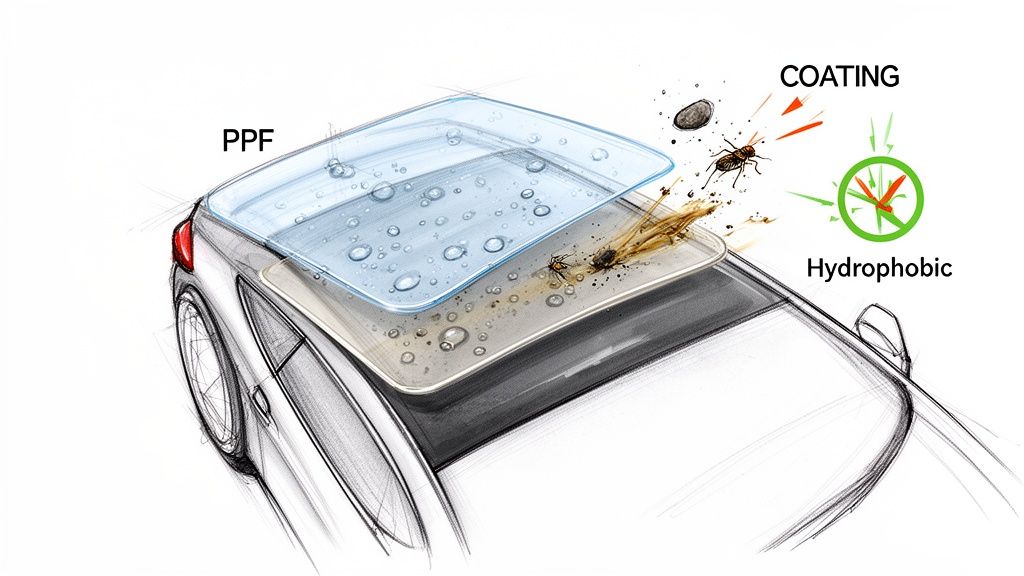
So, you've wrapped your car in some top-tier paint protection film. It’s now armored against rock chips and ready to shrug off daily abuse. But what if you could layer a force field on top of that armor? That’s exactly what happens when you combine a quality PPF with an advanced coating. It’s a synergy that takes protection to a whole different level.
Think of it this way: PPF is the muscle, built to absorb physical impacts. A coating, on the other hand, is the technical skill. It adds that slick, chemical-resistant, and super hydrophobic surface that film alone can't offer. This two-part system delivers a depth of gloss and ease of maintenance that neither product can achieve by itself. It’s the ultimate one-two punch for keeping your car pristine.
I remember working with a client named Mark, a meticulous owner of a black performance sedan. He’d had the entire front end wrapped in a premium PPF. While it did its job stopping rock chips, he was still frustrated by water spots and bug guts that seemed to weld themselves to the film after highway drives. The paint was safe, but keeping the car looking clean was a constant battle.
The Elastomeric Advantage Over PPF
This is where the unique chemistry of Titan Coatings’ elastomer technology really changes the game. Many traditional ceramic coatings are incredibly hard, but that hardness can also make them rigid. Titan's Alpha Quartz, which has its roots in military-grade polymer research, was engineered to be both hard and flexible.
That elasticity is the secret sauce. When applied over PPF, Alpha Quartz forms a resilient shield that won't crack or delaminate under the stress of expansion and contraction, from a frozen winter morning to a scorching summer afternoon. This flexibility also helps dissipate the energy from smaller impacts, like bug splatter, preventing them from etching into the film’s top layer.
After hearing about this, Mark decided to have Alpha Quartz applied over his existing PPF. The difference was night and day.
The next time he drove through a swarm of insects, he was floored. Instead of needing harsh chemicals and a ton of elbow grease, he found that a simple blast from a pressure washer washed almost everything away. The surface was so slick that contaminants had nothing to grab onto.
This is the power of that synergy. The PPF was still on duty, ready to take a hit from a flying rock, but the elastomeric coating was now handling all the day-to-day chemical and environmental abuse. His maintenance routine went from a chore to a simple rinse.
Extending Protection Beyond the Paint
This philosophy of smart, layered protection shouldn’t stop at your painted panels. Think about one of the most stressful driving situations: a sudden, torrential downpour that kills your visibility. Your wipers are flapping furiously but can't keep up, and every oncoming headlight creates a blinding glare on the glass.
Titan tackled this problem with the same approach. Now, imagine that same storm, but the water on your windshield beads up so intensely that it just flies off the glass as you pick up speed. That’s the reality with a product like APEX Glass Ceramic Coating. It creates such a hydrophobic surface that driving in the rain is no longer a white-knuckle experience. At highway speeds, you often don't even need your wipers.
It’s also incredibly easy to apply, making it one of the most impactful and straightforward upgrades for improving driving safety. You can check out the simple science behind APEX Glass Ceramic Coatings right on our product page.
Pairing the best car paint protection film with specialized formulas like Alpha Quartz and APEX creates a truly comprehensive shield. You get the impact resistance of film, the chemical resilience of an elastomer, and safer visibility in any weather. It's not just about protecting your paint—it's about making your entire driving experience better.
Long-Term PPF Care for a Decade of Defense
Your journey with PPF doesn't stop the moment you drive away from the shop. That's actually where it begins. If you want your film to last a solid decade—or even longer—it all comes down to a smart and consistent care routine. You have to protect your protection.
The golden rule? Be gentle. For your regular washes, the two-bucket method is non-negotiable. One bucket is for your soapy, pH-neutral car wash solution, and the other is just for clean rinse water. This simple system keeps you from grinding dirt and grit right back into the film, which is the primary culprit behind fine scratches on any car finish.
When it's time to dry, throw out that old chamois. Grab a plush, high-quality microfiber drying towel instead. The best technique is to pat or gently blot the surface dry, not drag the towel across the paint. Even better, use an electric leaf blower or a dedicated car dryer to blast the water away without ever touching the surface. Zero contact means zero risk of scratching.
Products to Use and Avoid
You have to remember that PPF has its own top coat, just like your car’s clear coat, and the wrong chemicals will absolutely destroy it.
- Avoid: Harsh solvents, aggressive degreasers, and most bug and tar removers are off-limits. The same goes for any abrasive polishes or waxes. These products can easily dull the film’s finish and break down its self-healing capabilities over time.
- Embrace: Stick with pH-neutral shampoos, dedicated PPF maintenance sprays, and high-quality microfiber towels. These are designed to clean effectively without compromising the film’s integrity.
Revitalizing Your Film with a Protective Boost
After a few months, you might notice that water doesn't bead up and roll off quite like it used to. The film's hydrophobic properties are starting to fade, and that’s perfectly normal. This is where a periodic booster becomes your secret weapon.
A product like Titan’s Ultra Ceramic Spray is the perfect tool for the job. Applying it every few months instantly brings back that intense water-beading and adds a slick, sacrificial layer of protection right on top of the film.
It’s a five-minute task that makes future washes a breeze and prevents nasty environmental contaminants from sticking. It’s the easiest way to extend the life and performance of your investment.
The payoff for this simple routine is huge. Good self-healing films can eliminate 90% of swirl marks, and a vehicle with well-maintained PPF can retain 85% more gloss after five years compared to an unprotected one. That directly impacts resale value—a luxury SUV with verified film can fetch an extra $2,000-$5,000. You can dig into the numbers yourself in the North America paint protection film market report.
Always keep your warranty documents handy. Know exactly what’s covered (like yellowing or cracking) and what isn’t (like damage from improper care). This knowledge is your power—it helps you maintain your film correctly and protect your investment for years of flawless shine.
And remember, before you apply any maintenance product, the surface has to be perfectly clean. We break down the entire process in our guide on how to decontaminate car paint.
Got Questions About Paint Protection Film? We’ve Got Answers.
Diving into the world of PPF can feel a bit overwhelming, and it's natural to have questions. We hear them all the time. To clear things up, I’ve put together some straight answers to the most common queries we get from car owners just like you.
Can You Put a Ceramic Coating Over PPF?
Not only can you, but you absolutely should. Think of it as the ultimate one-two punch for paint protection.
Laying down an elastomeric coating, like Titan's Alpha Quartz, on top of your new film creates a slick, super-hydrophobic surface. This does a few amazing things: it makes washing the car a breeze, dials up the gloss to an unbelievable level, and adds another barrier against chemical stains and UV damage. It's the best way to get total peace of mind.
How Long Does This Stuff Actually Last?
A top-shelf Thermoplastic Polyurethane (TPU) film is a serious investment in your car's future. With the right care, you can expect it to last anywhere from 5 to 10 years—sometimes even longer.
Of course, its lifespan depends on a few things, like the climate you live in, how much sun it gets, and your maintenance routine. A simple habit of regular washing and using a quality sealant will go a long way in keeping it looking pristine for years.
Is Paint Protection Film Really Invisible?
When you get a high-quality film installed by a true professional, it's virtually impossible to spot. The clarity of modern films is incredible.
The horror stories you hear about a hazy or "orange peel" texture usually come from two culprits: a cheap, low-grade film or a sloppy installation. This is one area where you don't want to cut corners. Your reward for choosing a premium film and a skilled installer is a finish that’s completely seamless and crystal clear.
Can You Take PPF Off Without Wrecking the Paint?
Yes, and that’s one of its biggest advantages. A quality PPF is designed to be completely removable without harming the factory paint it was protecting.
A professional installer will typically use a steamer or heat gun to gently warm the film. This softens the adhesive and allows them to peel it away safely, revealing the perfectly preserved paint underneath. It’s like a time capsule for your car's finish.
It's no wonder the market for this stuff is projected to hit USD 1.06 billion by 2035. Today, 73% of luxury car owners have PPF installed within the first year of ownership. Why? Because a good film blocks 99.9% of UV rays, stopping oxidation in its tracks and preserving the car's value. You can dig deeper into the paint protection film market trends to see where the industry is headed.
At Titan Coatings, we designed our elastomeric coatings, especially Alpha Quartz, to be the perfect partner for your PPF. It creates a flexible, glass-hard shield that won't crack or delaminate as temperatures fluctuate. Better yet, it’s remarkably easy to apply, making it a favorite for both pro detailers and dedicated DIYers.
Ready to experience that next level of protection? Check out Titan Coatings Alpha Quartz.
0 Comments
Trackbacks/Pingbacks