
The first time you bring home a matte car, the finish feels almost unreal. Then the first bird drop lands, and the relationship changes from admiration to vigilance.
The Agony and Ecstasy of Owning a Matte Car
A matte car has a way of stopping people in parking lots. It doesn’t shout like gloss. It pulls light into the surface and gives the body lines a deeper, more sculpted look. That’s the ecstasy.
The agony starts when you realize you can’t treat it like a normal finish.

A gloss car gives you recovery options. A matte car gives you consequences. A rushed wash, a harsh towel, a cleaner with the wrong chemistry, or a quick attempt to “buff out” a mark can leave behind a shiny patch that stands out more than the original defect. That’s why so many owners start looking for a real barrier soon after delivery, often while comparing options for paint protection and coating systems.
The emotional side of matte ownership
Most matte owners go through the same cycle.
- Day one excitement: The finish looks distinctive, premium, and different from every glossy car around it.
- Week one caution: You start second-guessing where you park, what soap you use, and whether that drip on the hood needs immediate attention.
- Long-term frustration: The finish still looks exceptional, but maintenance feels less forgiving than it should.
That anxiety is justified. Matte paint needs protection that doesn’t “improve” it in the glossy sense. It needs protection that respects the surface exactly as it is.
Practical rule: If a product is designed to add gloss, fill defects, or intensify reflection, it’s already the wrong starting point for matte paint.
Why owners look for coating solutions fast
The problem isn’t only dirt. It’s the fact that matte paint gives you fewer correction paths after something goes wrong. Owners quickly learn that prevention matters more than rescue.
That’s where ceramic coating for matte paint enters the conversation. The right coating can act as a sacrificial barrier, make contamination easier to remove, and reduce the need for aggressive cleaning. The wrong coating can create the very finish change you were trying to avoid.
A matte finish is one of the most rewarding looks in automotive care. It also exposes every weak decision in your wash routine, product selection, and maintenance habits. If you own one, you don’t need more hype. You need a system that protects the texture, keeps the sheen honest, and makes day-to-day ownership less tense.
Why Matte Paint Demands a Different Kind of Care
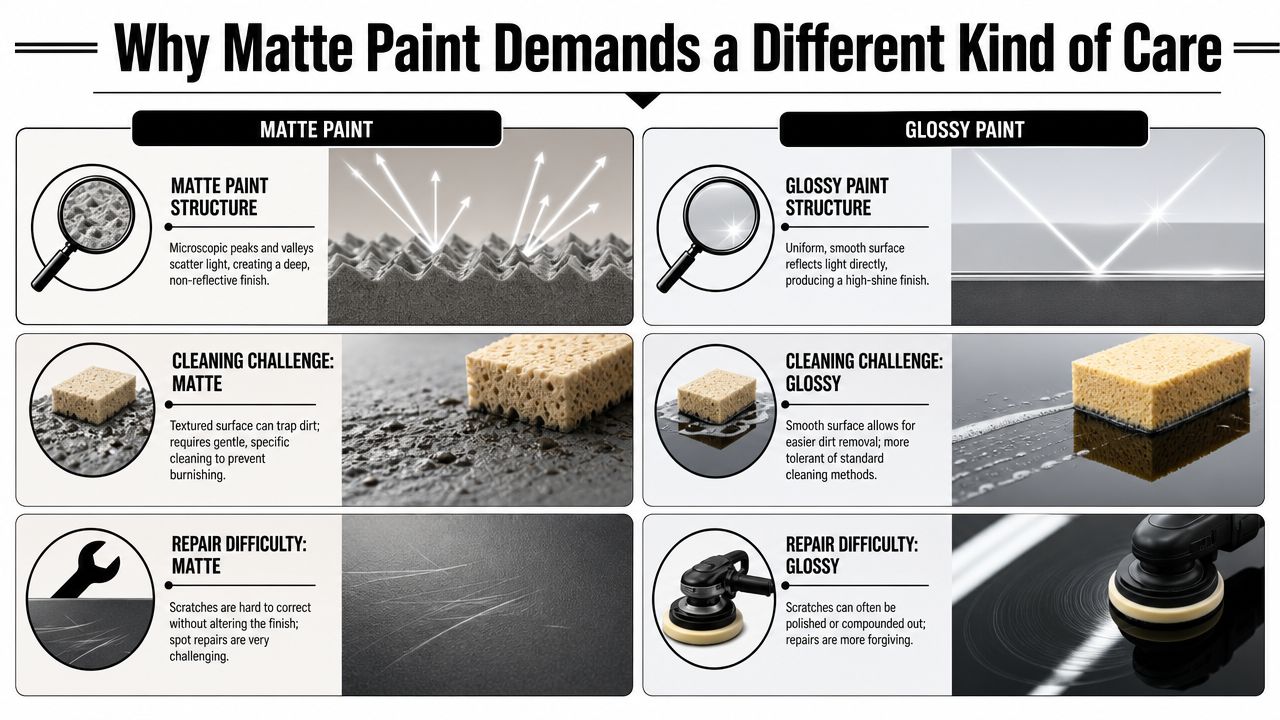
Matte automotive finishes aren’t a recent niche. The modern rebound is widely traced to the early 2000s, and one technical point has remained constant: protection has to preserve the texture and sheen level, because standard gloss-focused coatings can visually change the finish, while matte-specific coatings were developed to maintain the non-reflective appearance and add a hydrophobic barrier, as explained in this matte paint ceramic coating guide.
Matte paint is textured by design
Gloss paint works like a smooth pane of glass. Light hits it and reflects cleanly. Matte paint works more like a field of microscopic peaks and valleys. That micro-texture scatters light, which is why the finish looks soft, muted, and non-reflective.
That texture is the look.
If you smooth it too much, fill it, burnish it, or level it with the wrong product, you don’t just change protection. You change appearance.
A lot of people first understand this after reading a basic overview like what ceramic coating is and how it works, then realizing matte paint creates a different standard entirely. On gloss, “slick and shiny” is often a win. On matte, it can be damage.
What goes wrong in normal car care
Here’s where owners and inexperienced detailers get into trouble:
- Automatic washes: Brushes and harsh contact can burnish the surface.
- Traditional waxes and polishes: These products are built to increase shine or visually level defects.
- Aggressive spot cleaning: Scrubbing one stain too hard can leave a visible sheen change in one small area.
- Wrong microfiber habits: Dirty or low-quality towels drag contamination and force more friction into the finish.
Matte paint doesn’t reward correction. It rewards restraint.
The products matte paint can’t tolerate well
A quick comparison makes the issue easier to see:
| Surface type | What improves it | What damages the look |
|---|---|---|
| Gloss paint | Polishing, gloss enhancers, defect-filling products | Improper polishing, harsh contamination |
| Matte paint | pH-neutral washing, gentle decontamination, matte-safe protection | Waxes, polishing compounds, gloss-focused coatings |
The core lesson is simple. A matte finish isn’t delicate because it’s weak. It’s demanding because its appearance depends on a surface texture you can’t casually alter and then fix later.
That’s why ceramic coating for matte paint has to do two things at once. It must protect the finish from contamination and routine wash wear, and it must stay visually neutral enough that the finish still looks matte when you’re done.
Introducing Elastic Coatings The Titan Breakthrough
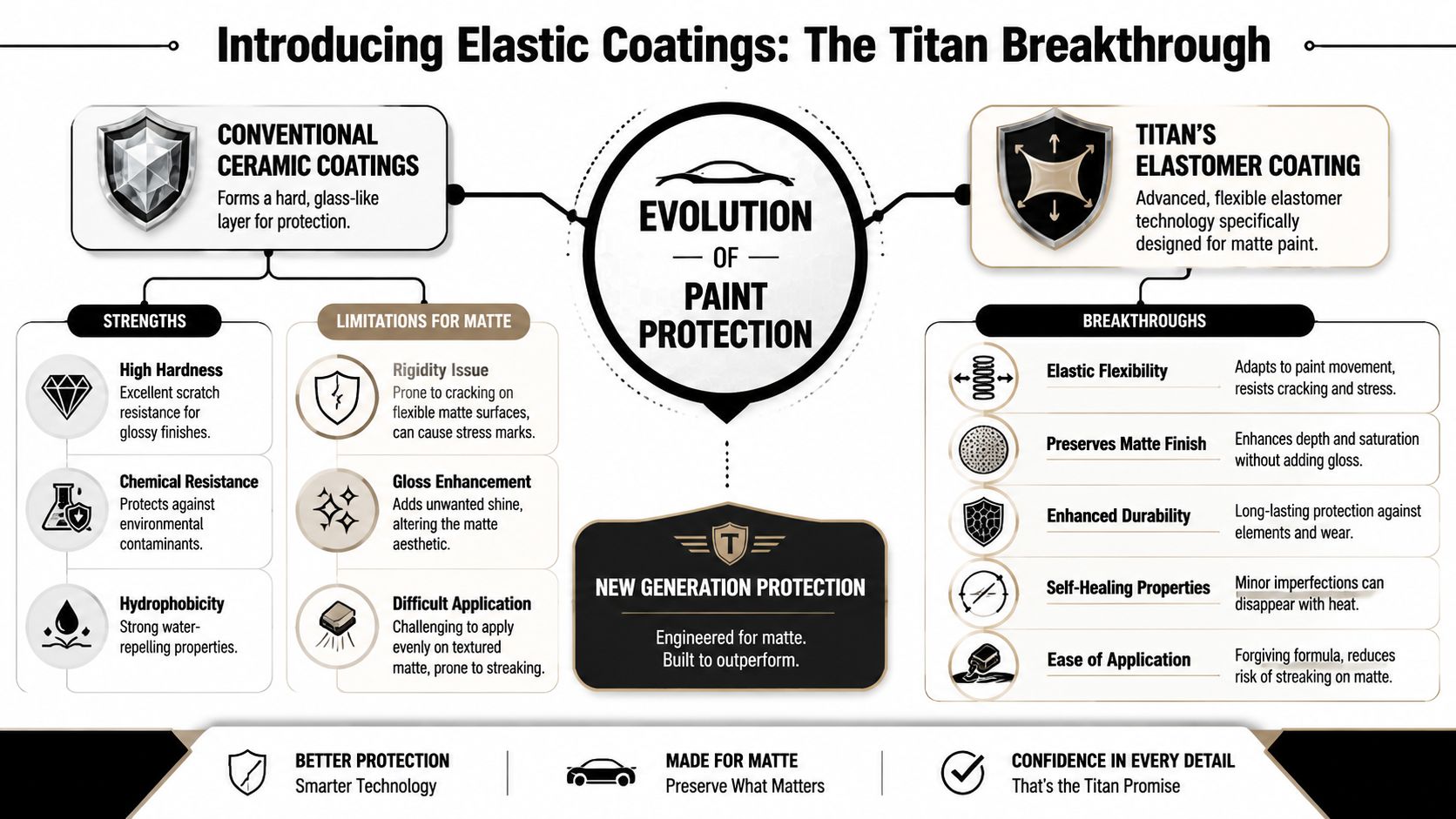
Traditional ceramic coatings solved an important problem. They created a hard, protective layer that helps separate the vehicle from contamination, weather, and wash wear. On many surfaces, that approach works well.
But hardness alone doesn’t solve every real-world problem.
Where rigid coatings can fall short
Matte paint adds one challenge. Modern vehicles add another. Surfaces move with heat cycles, daily use, panel expansion, road vibration, and impact from routine driving. A coating can be very hard and still become the wrong fit if it behaves too rigidly on a stressed surface.
For matte finishes, there’s also a second requirement. The film needs to stay visually neutral. Matte-specific ceramic coatings are engineered to preserve a low-gloss surface with an optically neutral protective film, and proper product selection matters because standard coatings can level the surface too much and alter how light scatters off the micro-texture, as noted in this technical explanation of matte-safe ceramic coatings.
That’s the baseline. Preserve the look. Add protection. Avoid accidental glossing.
Why flexibility changes the conversation
Titan’s elastomer approach stands apart. The concept is straightforward. A protective layer shouldn’t only be hard. It should also move with the surface instead of fighting it.
Titan developed elastomer coating technology around that idea, combining a hard protective character with flexibility. That matters on matte paint because the coating isn’t sitting on a static display panel. It’s living on a vehicle that sees cold starts, hot panels, wash contact, bug impact, and constant environmental stress. The Titan elastomer coating platform is built around that hard-yet-flexible philosophy.
In practical terms, that means:
- Temperature shifts matter less: A flexible coating is better positioned to move through hot and cold cycles without becoming the weak point.
- Minor impact stress is handled differently: Bug strikes and routine road contact don’t create the same stress profile as a rigid shell trying to hold its exact shape.
- Matte appearance stays the priority: Protection only makes sense if the finish still reads as matte when the job is done.
A matte vehicle doesn’t need a product that makes it look more finished. It needs a product that lets the original finish survive real use.
Why Alpha Quartz fits this use case
For pros and DIY users, Alpha Quartz is one of the most relevant options in this category because it aligns with how matte owners use their cars. It’s approachable to install, it’s designed around elastic coating behavior rather than brittle feel, and it makes sense for detailers who need a coating that works outside perfect lab conditions.
That combination matters more than marketing language. Matte owners aren’t chasing extra shine. They’re trying to avoid visible mistakes, reduce maintenance risk, and give the finish a protective layer that can handle the stress of normal driving without turning into a liability of its own.
Your Matte Protection Application Playbook
Application is where good theory either becomes a clean matte finish or a long-term problem. Matte paint is less forgiving, so the process has to stay disciplined from the first rinse to the final wipe.
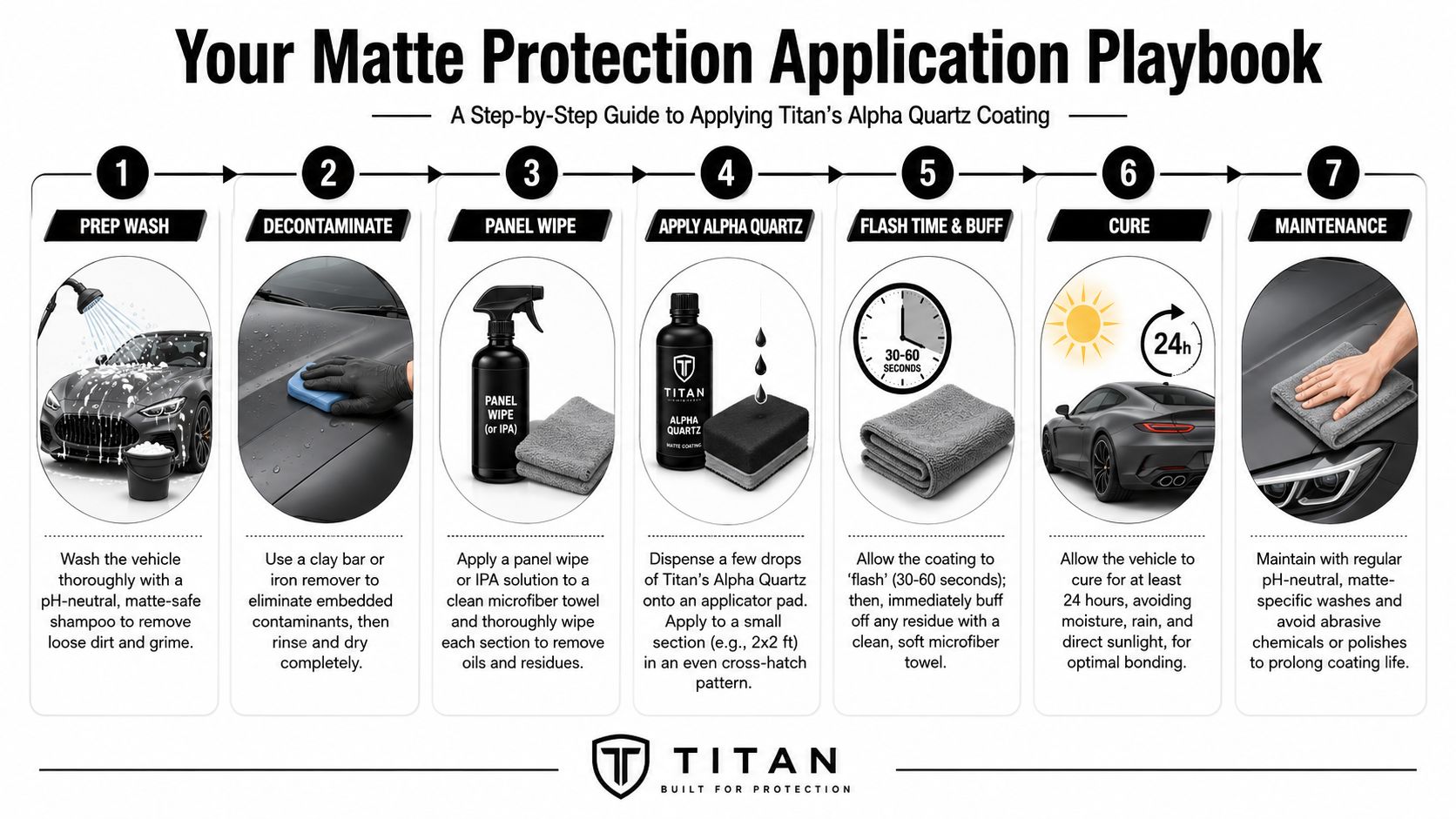
A key concern for matte owners is irreversible staining and burnishing from routine washing. A proper coating helps by creating a sacrificial barrier that stops many contaminants from etching the paint and reduces the need for aggressive cleaning, which makes prevention more powerful than correction on a finish that can’t be polished, as discussed in this matte paint maintenance analysis.
Step one starts before the coating bottle opens
The coating can only perform as well as the surface underneath it. If you trap residue, traffic film, or wash leftovers under the film, the finish can show patchiness or uneven sheen.
Use this sequence:
- Wash with a pH-neutral shampoo. Matte finishes respond best to non-abrasive cleaning.
- Decontaminate carefully. Remove bonded contamination without turning the process into correction.
- Dry completely. Water hiding in trim edges or badges can interfere later.
- Panel wipe each section. The goal is a clean bonding surface, not a rushed handoff from wash to coating.
For anyone working mobile or in a home garage, process control matters more than fancy surroundings. If the paint is cool, clean, and dry, you’re already ahead.
How to apply without creating visible mistakes
A lot of coating issues on matte paint come from one habit. People use too much product and work too large an area.
Keep the section size manageable. Use a clean applicator. Apply the coating in a controlled cross-hatch pattern so coverage stays even rather than heavy in one direction.
A useful reference for the broader sequence is Titan’s guide on how to apply ceramic coating to a car, but matte work demands more restraint than speed. Thin and even beats wet and flashy every time.
Shop-floor advice: On matte paint, high spots aren’t just annoying. They can become appearance defects you can’t casually polish away.
What to do and what to avoid
This is where experienced installers separate themselves.
Do:
- Use matte-safe towels: Soft, clean microfiber reduces friction and surprise marring.
- Work panel by panel: Small sections give you better control over leveling.
- Watch the light carefully: Matte doesn’t reflect like gloss, so inspect from multiple angles.
- Keep your hands clean: Residue from trim dressings, greasy gloves, or old towels can transfer fast.
Don’t:
- Don’t use circular scrubbing motions: They increase the chance of inconsistent pressure and uneven visual change.
- Don’t over-apply: More product doesn’t mean better protection.
- Don’t chase perfection with aggressive wiping: If you’ve made a mistake, force usually makes it worse.
- Don’t mix in gloss enhancers later: A maintenance spray that looks harmless on gloss can alter a matte surface.
A practical workflow for DIY users and pros
| Stage | Goal | Main risk |
|---|---|---|
| Prep wash | Remove loose dirt safely | Grinding contamination into the finish |
| Decontamination | Clear bonded residue | Overworking the surface |
| Panel wipe | Ensure clean bonding | Leaving oils behind |
| Coating application | Create a thin, even film | High spots and patchiness |
| Cure period | Let the layer set properly | Early water exposure or handling |
If you’re using Alpha Quartz, the main advantage in real-world work is that the product is approachable for people who want pro-level behavior without turning application into a stressful ritual. That matters for mobile detailers, first-time users, and owners who want ceramic coating for matte paint to be protective, not intimidating.
Achieving Total Vehicle Clarity and Protection
A protected matte finish is only part of the ownership experience. The other part happens when weather turns, road spray builds, and the driver realizes the windshield matters just as much as the hood.
On a rainy drive, poor visibility changes your whole posture behind the wheel. You lean forward. Wipers work harder. Headlight glare stretches across the glass. A good glass coating doesn’t remove the storm, but it can make the windshield easier to read and easier to keep clear.
Protection has to match the surface
One mistake I see often is the assumption that one “matte-safe” statement covers everything. It doesn’t. There’s a compatibility gap between matte paint, matte PPF, and matte wraps, and those surfaces can respond differently to coating chemistry. Surface misidentification is often the biggest risk, which is why this discussion of matte paint versus film compatibility is so relevant.
That same logic applies across the rest of the vehicle. Paint, film, glass, trim, and wheels don’t all need the same chemistry or the same maintenance routine.
Where Apex Glass and Ultra Ceramic Spray fit
For glass, Apex Glass Ceramic Coating is the practical add-on. It’s designed for windshield and glass protection, and the use case is simple: improve water behavior on the surface and make bad-weather driving less stressful. It’s also easy to work into a regular protection routine when you want the whole vehicle to feel consistently maintained rather than partly protected.
For upkeep, Ultra Ceramic Spray fills a different role. It’s the fast maintenance product. On a coated vehicle, that matters because owners need a simple topper for routine care without reaching for old wax habits that don’t belong anywhere near matte paint.
A complete setup usually looks like this:
- Body protection: A matte-appropriate coating with a visually neutral finish
- Glass protection: A dedicated windshield and glass product
- Maintenance support: A spray product that refreshes slickness and wash behavior without changing the look
- Correct identification first: Paint, matte PPF, and matte wrap should never be treated as identical by default
The best maintenance plan is the one that reduces the number of aggressive decisions you have to make later.
Frequently Asked Questions About Matte Coatings
Can you coat matte paint and matte PPF the same way
Not automatically. Matte paint, matte PPF, and matte wraps can react differently to prep solvents, abrasion, and coating chemistry. The safe move is to identify the surface first, then choose the coating and prep process that matches it. A label that sounds universal can still be the wrong choice if the surface itself was identified incorrectly.
What’s the best wash method after applying ceramic coating for matte paint
Use a pH-neutral, matte-safe wash routine with soft microfiber and controlled contact. Keep the process gentle, rinse thoroughly, and don’t let contamination sit longer than necessary. The goal isn’t to scrub harder because the coating is there. The goal is to let the coating reduce how much scrubbing you need.
Can you polish out scratches on coated matte paint
That’s the wrong mindset for matte. On gloss, correction is often the answer. On matte, correction can change the sheen and leave a visible mismatch. If the mark is superficial contamination, careful cleaning may solve it. If the texture or finish has been altered, aggressive polishing usually creates a bigger appearance problem.
Is Alpha Quartz suitable for DIY users
Yes, that’s one reason it’s appealing. It’s easier to work with than many people expect from an advanced coating product, which makes it useful for ambitious DIY owners and mobile detailers who need a controlled, repeatable process. A lot of users start by comparing options like a 5-year ceramic coating system and then decide based on how realistic the install is for their environment and skill level.
Does coating matte paint eliminate all staining risk
No. It reduces risk. It doesn’t make the surface invincible. Bird droppings, bug residue, traffic film, dye transfer, and water spotting still need timely attention. The advantage is that a proper coating gives you a sacrificial barrier and usually lowers the need for aggressive cleanup.
Can you layer products on top of a matte coating
Only if the maintenance product is compatible with matte finishes. Owners frequently encounter problems. They install a matte-safe coating, then later use a gloss booster, filler spray, or conventional wax that changes reflectivity. If you’re going to maintain the coating, make sure the topper supports the finish instead of visually altering it.
What’s the biggest mistake people make with matte protection
Misidentifying the surface is high on the list. The next mistake is trying to force gloss-paint habits onto matte care. Matte ownership gets easier when you stop asking, “How do I make this shinier, slicker, or corrected?” and start asking, “How do I keep this texture clean, even, and unchanged?”
If you want a full vehicle protection system that covers matte paint, glass, and ongoing maintenance, explore APEX NANO – Titan Coatings for product options built around real-world use, careful surface matching, and practical application.
0 Comments