
You’ve probably felt it after a spirited drive. You pop the hood, and the engine bay radiates heat like an open oven. The turbo housing ticks as it cools. The manifold looks like it’s been through a furnace cycle. Even if you love detailing, polishing, and protecting the visible parts of a vehicle, the harshest battle often happens where nobody sees it.
That’s where high temperature ceramic coatings stop being a niche materials topic and start becoming practical. They protect metal from heat, oxidation, and corrosion, but their true benefit is deeper than that. Done right, they help parts survive longer, behave more consistently, and resist the kind of heat cycling that progressively impairs performance hardware over time.
The Battle Against Extreme Heat in Your Engine Bay
A friend brought me a modified street car after a weekend run through the hills. The paint still looked sharp, the wheels were clean, and the hood graphics gave it attitude. If you like bold truck styling, something like Custom Sticker Shop Ram decals shows how much owners care about the visual personality of a build. But under the hood, the story was different. The exhaust side had absorbed punishing heat again and again, and the metal was already showing the dull, tired look that comes before long-term damage.
Heat attacks in layers. First it dries out nearby plastics and rubber. Then it promotes oxidation on bare or poorly protected metal. Then it adds repeated expansion and contraction, which is where fatigue starts to build.
Heat damage rarely starts with one dramatic failure
Most parts don’t fail all at once. They age through cycles.
- Exhaust manifolds face constant heating and cooling that can warp surfaces and stress fasteners.
- Turbo housings trap intense heat, which can raise under-hood temperatures and punish nearby lines, sensors, and wiring.
- Exhaust systems see both hot gas flow and external moisture, which creates a bad combination of heat stress and corrosion.
- Engine bay hardware often suffers secondhand damage from radiant heat, even if it never touches the hottest components.
That’s why basic cleaning matters too. If you want a safer starting point before coating work, proper engine bay cleaning practices help remove grime that can hide leaks, trap contaminants, and interfere with inspection.
Heat doesn’t just make parts hot. It changes how metal ages.
People have been trying to shield surfaces for a very long time. The first recorded use of ceramic-based protective layers dates back over 4,000 years to ancient civilizations in China and Mesopotamia, where kiln-fired ceramic glazes were used to protect pottery, tools, and metal items from environmental exposure, as noted in this history of ceramic coating development.
That ancient idea still makes sense today. Add a protective ceramic layer between a vulnerable surface and a hostile environment, and the surface lasts longer. Modern high temperature ceramic coatings are the advanced version of that same instinct. They are engineered armor for parts that live in punishing thermal conditions.
Why stock metal alone isn’t enough
Bare metal can be strong. It can also be predictable in normal conditions. But high heat changes the rules.
A manifold, turbine housing, or downpipe doesn’t just need strength. It needs protection against oxidation, resistance to thermal cycling, and a surface that helps the component keep working after repeated abuse. That’s the role of a coating. It becomes the sacrificial and protective layer, so the part underneath doesn’t take the full beating every time you drive hard.
The Science of High Temperature Coatings
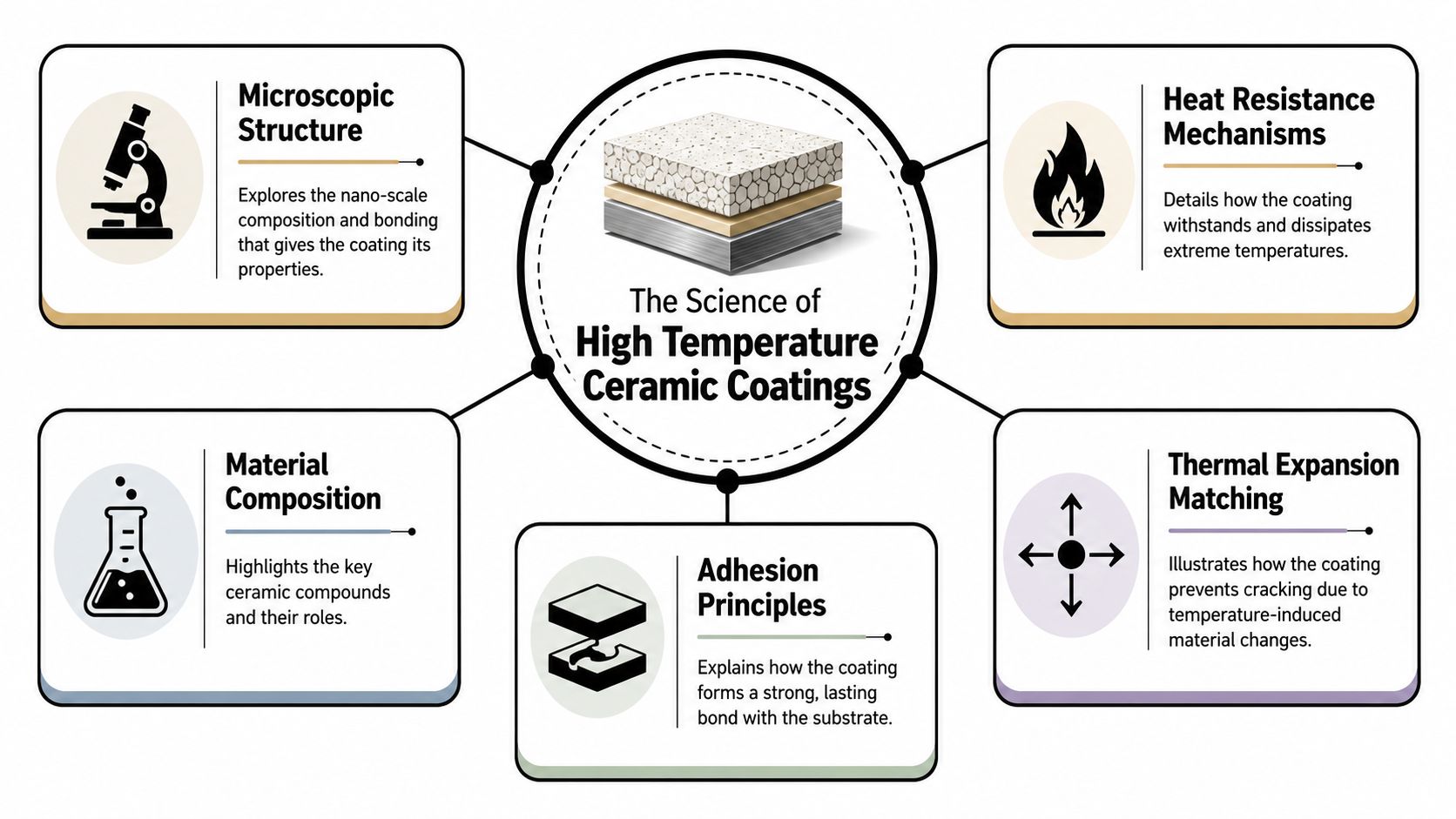
Heat changes metal in ways you can’t always see at first. A manifold may look fine from the outside, yet every hard drive cycle is pushing oxygen into the surface, growing oxide scale, and stressing the metal as it expands and contracts. A high temperature coating changes that surface battle.
What the coating is doing at the surface
At the microscopic level, the coating becomes the part’s first line of defense. Instead of heat, oxygen, moisture, and contaminants attacking bare metal directly, they meet a ceramic-rich barrier designed to tolerate abuse better than the substrate underneath.
That barrier does several jobs at once:
- It slows heat transfer because ceramic phases usually conduct heat less readily than steel or other common automotive metals.
- It reduces oxidation by making it harder for oxygen to reach and react with the base material.
- It helps resist corrosion by separating the metal from moisture, salts, and combustion byproducts.
- It cushions the surface from repeated stress during vibration and temperature cycling.
A useful comparison is cookware. A bare steel pan and a ceramic-coated pan both get hot, but the surface behavior is different. One is exposed directly to the environment. The other has a purpose-built layer that changes how heat and chemistry interact at the boundary. For readers comparing coating families, Titan’s guide to boron nitride coating technology shows how different chemistries solve different combinations of heat, friction, and release problems.
The temperature range depends on the chemistry
“High temperature coating” is a broad label, not a single material. Some formulas are built for exhaust parts that see repeated street and track heat. Others are engineered for environments far beyond anything in an engine bay.
That difference starts with chemistry. Ceramic-filled coatings can provide thermal insulation and oxidation resistance in automotive use, while ultra-high-temperature ceramic systems use refractory materials for aerospace-level conditions. Ultramet’s technical summary of ultra-high-temperature ceramic coatings explains why materials such as hafnium carbide are studied for rocket nozzles and hypersonic vehicle leading edges.
The practical takeaway is simple. Generic “heat resistant” language tells you very little. The resin system, ceramic content, bond strength, and flexibility of the cured film determine whether a coating survives real service or starts failing after repeated cycles.
Why flexibility matters more than many enthusiasts realize
This is the point many traditional coatings miss. Hardness sounds impressive in marketing, but heat-cycled automotive parts do not live a calm life. They expand, contract, vibrate, and twist slightly every time the engine heats up and cools down.
A rigid coating can resist heat well and still fail mechanically. Small cracks form. Those cracks let oxygen and contaminants reach the metal. Once that happens, the protective barrier is no longer continuous, and the part starts aging faster from the exact spots the coating was supposed to protect.
Titan Coatings approaches the problem differently. Our proprietary flexible elastomer technology is designed to give the coating a hard, protective surface while still allowing it to move with the substrate. That matters because a coating that can flex with thermal cycling is less likely to craze, chip, or break its seal over time.
Why coatings prevent premature aging
A good high temperature coating does not make heat disappear. It manages the path heat takes and reduces how aggressively the environment attacks the metal surface.
That is why the best coatings are judged by more than peak temperature claims. The real question is whether they stay bonded, intact, and protective after repeated abuse. In automotive use, that often makes a flexible high temperature coating more durable than a rigid one that looks good on paper but cannot keep up with how real parts move.
Unlocking Performance with Automotive Applications
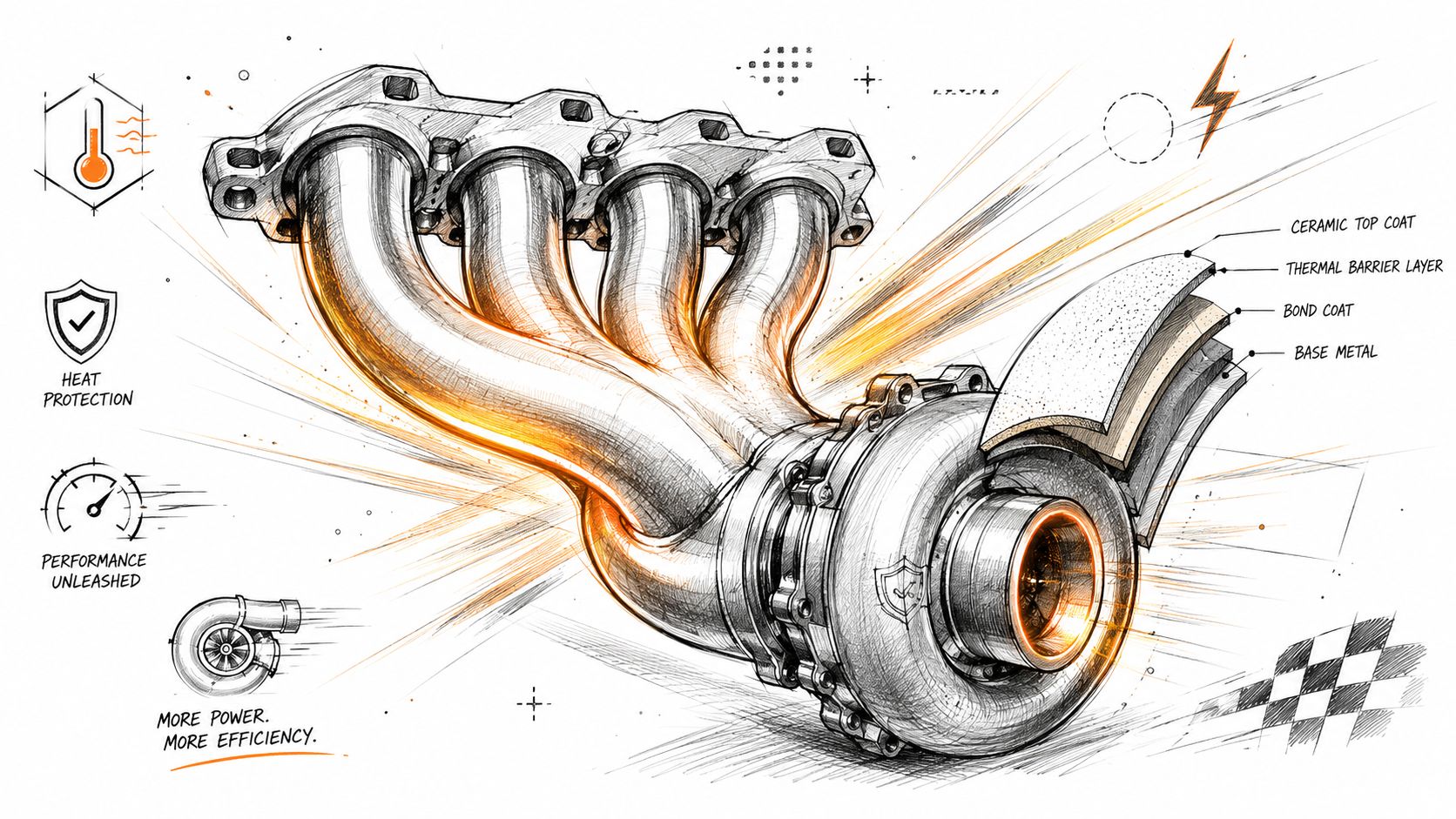
The first time many enthusiasts notice the value of a high temperature coating is on the exhaust side. A coated manifold looks purposeful, but its true value emerges while the engine is running. More of the heat stays where it can support exhaust flow instead of soaking every nearby part in the engine bay.
Exhaust parts gain more than cosmetic protection
Take an exhaust manifold or turbo housing. Those parts live in one of the most punishing environments on the vehicle. A high temperature ceramic coating helps by holding heat in the exhaust path and reducing the amount that radiates outward.
That matters for several reasons:
- Turbo response can feel sharper because hotter exhaust gas stays more energetic as it moves through the system.
- Under-hood temperatures become easier to manage, which is good news for hoses, wiring, sensors, and nearby plastics.
- Part life improves because the base metal isn’t taking the full assault from oxidation and repeated heat cycles.
Move farther downstream and the same logic still applies. Coated exhaust sections can reduce heat-soak and help the whole system behave more consistently in repeated use.
Real-world efficiency matters too
This isn’t only about racing or dyno talk. There’s a practical emissions and efficiency angle that many enthusiasts overlook. Recent 2025 field trials by the International Energy Agency found that properly applied ceramic coatings on exhaust systems reduced heat-soak by 18% compared to uncoated parts, leading to a 3-5% improvement in catalytic converter efficiency, according to the cited National Academies chapter hosting that reference.
That’s a useful reminder that thermal management affects more than peak performance. It can also support cleaner, more stable operation in real driving.
On a street car, lowering the thermal burden on the engine bay is often just as valuable as chasing another headline power figure.
Where enthusiasts often see the best payoff
Not every component delivers the same return. In practice, a few areas tend to stand out.
| Component | Why coating helps |
|---|---|
| Exhaust manifold | Reduces oxidation and limits outward heat radiation |
| Turbo housing | Helps contain heat energy and reduce nearby heat-soak |
| Downpipe and exhaust sections | Improves thermal control and helps protect surrounding areas |
| Valve and combustion-facing parts | Supports durability in hot, hostile conditions |
The common thread is simple. Coatings become part of the thermal strategy of the vehicle. They are not decoration for hot parts. They are functional materials that change how those parts survive and perform.
The Titan Coatings Revolution Hard Like Glass Yet Flexible
Traditional ceramic coatings solved one problem and exposed another. They protected surfaces well, but many rigid systems didn’t like constant movement, vibration, or repeated expansion and contraction. On a vehicle, that matters because metal rarely stays still. It heats up, grows, cools down, shrinks, and vibrates the entire time.
That’s where elastomer-based technology changes the conversation.
Why flexibility matters in a ceramic system
A rigid coating can be excellent at blocking heat and resisting chemicals. But if it can’t tolerate the movement of the substrate, tiny failures begin. Small cracks form. Moisture and oxygen exploit them. Thermal cycling widens them. Protection drops long before the owner realizes it.
Titan introduced its own coating technology and brought elastomer coatings to market using nano tubes technology together with Dark Matter Technology®. The big idea is easy to understand. Instead of forcing a brittle shell onto a moving surface, the coating moves with the surface.
Titan Coatings’ elastic elastomer-based coatings combine glass-like hardness of 9H with high flexibility, allowing them to withstand extreme temperature transitions between frozen and hot environments without degradation, according to the company’s technology overview on Titan Coatings.
That combination is unusual because hardness and flexibility usually fight each other. In coating design, hard often means brittle. Flexible often means softer. The engineering value here is getting both in one system.
Alpha Quartz makes the concept practical
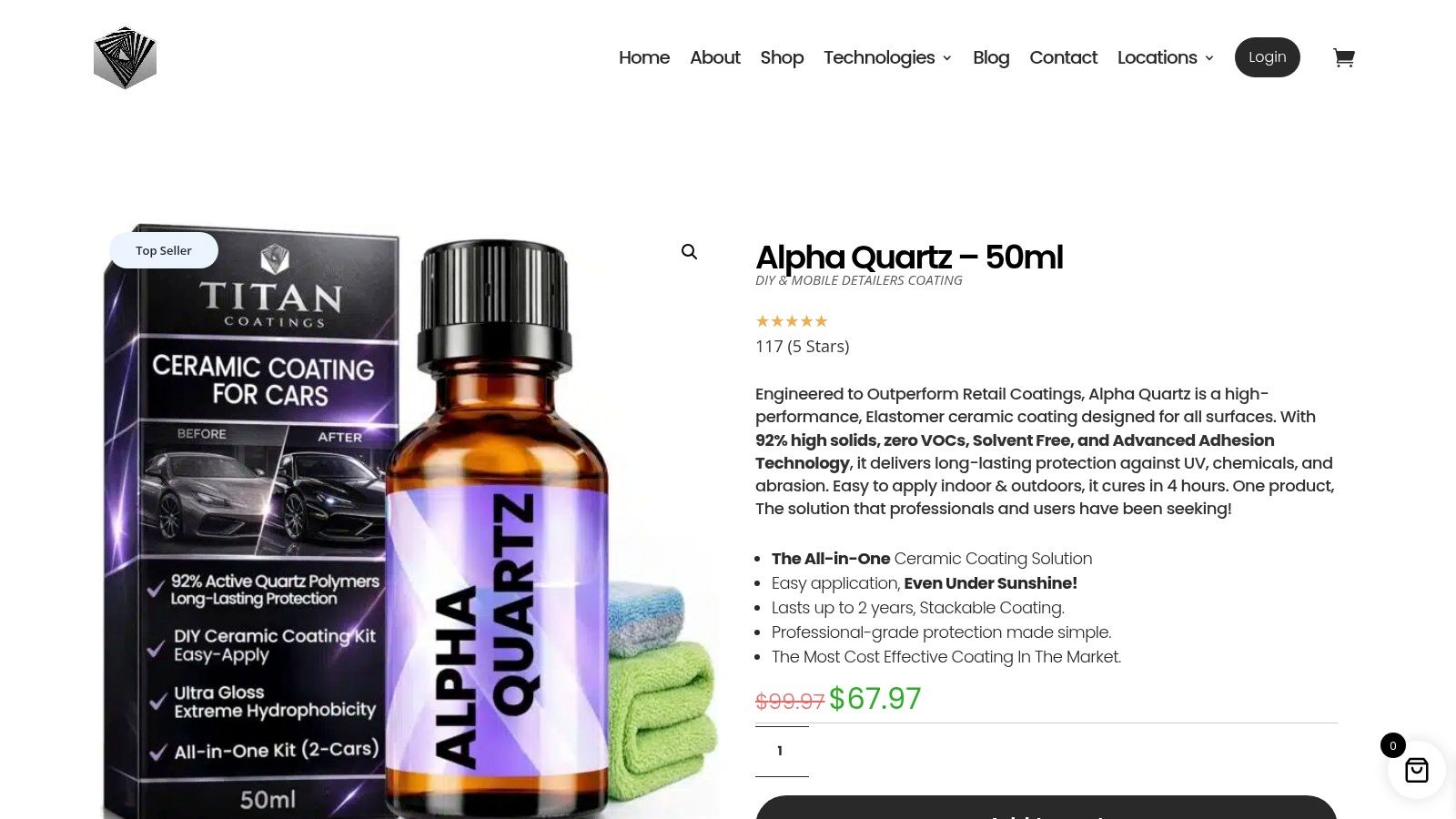
For detailers, DIY users, and mobile installers, the value becomes very tangible with Alpha Quartz. It’s easy to install, gives strong visual results, and its elasticity helps it resist cracking when temperatures swing or when the surface takes minor impacts such as bug strikes at speed.
If you want the deeper technical background behind that material family, Titan’s explanation of elastomer coating technology helps connect the material science to real-world durability.
Here’s why the flexible approach stands out:
- Thermal cycling resistance keeps the coating from becoming the weak point when a panel or component moves between cold mornings and hot operation.
- Impact tolerance helps the surface absorb small hits without behaving like a brittle shell.
- Longer service life comes from staying intact instead of developing failure paths early.
A coating that stays bonded and intact will usually outperform a harder coating that cracks.
Dark Matter Technology adds high-heat durability
Titan’s proprietary Dark Matter Technology® was designed to improve oxidation resistance and thermal durability in ultra-high-temperature ceramic coatings. In the company’s SIO-8161H waterborne nano ceramic coating, this technology supports surface performance integrity up to 1500°C while maintaining 9H surface hardness, based on the cited SIOResin product documentation summary.
That matters because heat resistance alone isn’t enough. A high-heat coating also has to remain coherent, bonded, and mechanically useful after repeated exposure. Titan’s broader operating approach supports that goal too. The company uses ISO 9001-certified quality management systems and performs third-party ISO/ASTM testing alongside real-world analysis in extreme climates, with products used across over 30 countries, as provided in the verified business context.
The same thinking applies beyond paint protection
This flexible-hard philosophy isn’t limited to body panels. It changes how you think about any surface that deals with movement, thermal stress, and daily abuse. That’s why the elastomer idea is so compelling. It doesn’t ask the surface to stop moving. It allows the coating to survive because movement is expected.
How To Choose the Right High Temperature Coating
You pop the hood after a hard drive, and every part in the engine bay has lived through a different kind of heat. The valve cover may see steady warmth. The area near the exhaust sees sharper spikes. The coating that works beautifully on one surface can fail early on another because heat is only part of the story. Expansion, vibration, and repeated thermal cycling usually decide whether a coating stays intact.
Start with the real service conditions
Begin with the part, not the label.
Ask three questions. How hot does the part get in normal use? Does that heat come in short bursts or long holds? How much does the part expand, contract, or vibrate while the vehicle is running?
Those details separate a suitable coating from a bad match. A coating on a windshield, a wheel, and an exhaust-adjacent bracket may all be sold with heat-resistant language, but the demands are completely different. Rigid ceramic systems can perform well in stable conditions, yet parts that constantly move through heat cycles often need a coating that can flex with the substrate instead of fighting it.
A classic materials mistake is choosing by peak temperature alone. That is like buying tires based only on top speed while ignoring wet grip, sidewall stiffness, and road surface. In coating selection, the equivalent mistake is ignoring thermal shock, substrate movement, and adhesion over time.
Use a practical selection framework
A simple filter helps.
- For engine-bay components near hot spots: choose a coating built for direct thermal exposure and repeated cycling, not one marketed mainly for gloss or water beading.
- For parts that expand and contract often: favor flexible elastomer-based chemistry. Titan Coatings takes this route because flexibility helps the coating absorb stress instead of forming microscopic cracks.
- For daily drivers and DIY installs: look for products that go on consistently and do not demand an overly narrow application window. Cure behavior matters here too, so it helps to review how long ceramic coating takes to cure before you choose a product.
- For moderate-heat surfaces where easy maintenance matters: a sprayable ceramic can offer a sensible mix of protection, appearance, and user-friendliness.
Product category matters just as much as the marketing claim on the bottle. Ultra Ceramic Spray fits owners who want practical protection with a simpler install process. For glass, the goal shifts from thermal durability to visibility and water behavior. Apex Glass Ceramic Coatings are designed around that use case, helping water clear faster and making wet-weather driving easier to manage.
Match the coating chemistry to the job
The best way to choose is to connect the coating’s behavior to the part’s behavior.
| Use case | Best mindset |
|---|---|
| Track-driven wheels near repeated braking heat | Question broad “high-heat” claims and look for coatings built for cycling and contamination |
| Paint and exterior parts exposed to weather swings | Favor flexibility and resistance to stress cracking |
| Quick protection for mobile detailing clients | Prioritize repeatable application and predictable cure behavior |
| Glass and windshield treatment | Focus on visibility, water shedding, and easy cleaning |
Titan’s flexible elastomer approach stands out for one reason. Real automotive parts move. A rigid coating can be very hard and still fail if it cannot stretch with the surface underneath. A flexible high-temperature coating works more like a controlled spring. It stays bonded while the substrate grows and shrinks, which helps prevent cracking and can extend the life of both the coating and the component.
Choose the coating that matches the heat, the movement, and the surface. That is how you get durability that lasts beyond the first few heat cycles.
A DIY Guide to Flawless Application and Curing
You finish coating a hot-side component, it looks uniform, and the gloss is there. After a few hard heat cycles, small failures start showing up at edges, corners, or tight bends. In many cases, the problem started long before the part ever got hot. It started with prep, film build, or cure.
Preparation decides the outcome
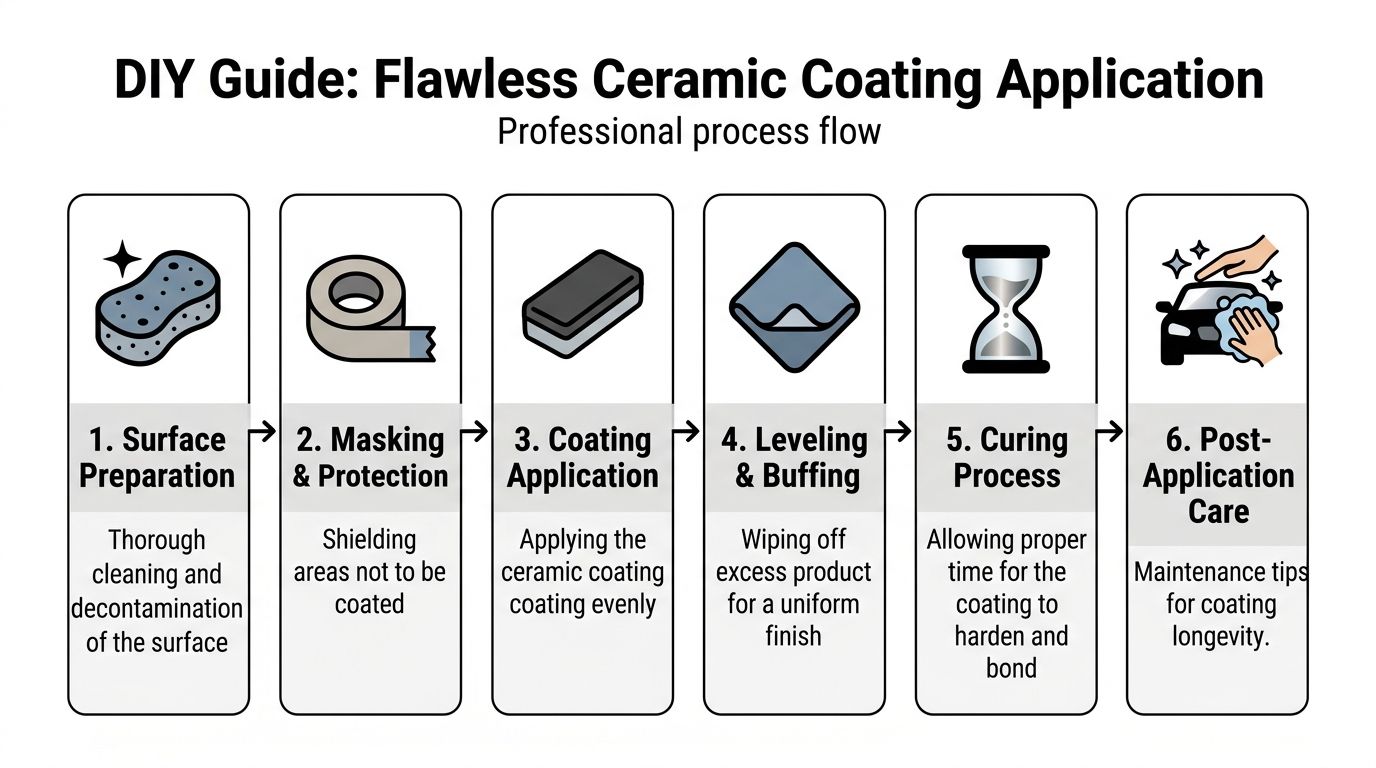
A coating bonds to the surface you give it, not the surface you think is there. If grease, polishing oils, oxidation, road film, or trapped moisture remain, the coating sits on contamination instead of anchoring to the part itself. That is like painting over dust on a wall. The paint may look fine at first, but the weak layer underneath becomes the failure point.
Heat makes that weakness easier to see. As the part expands and contracts, any poorly bonded area gets stressed again and again. Traditional rigid coatings are less forgiving here because they have less ability to move with the substrate. A flexible elastomer coating has a better chance of staying intact through that motion, but even flexible chemistry needs a clean, stable foundation.
Use this prep checklist:
- Clean first: Remove dirt, oils, and leftover residues completely.
- Correct the surface: Address corrosion, oxidation, or staining before coating.
- Dry thoroughly: Moisture trapped in seams, pores, or hardware can interfere with bonding.
- Mask carefully: Protect trim, threads, sensors, and nearby surfaces you do not want coated.
Surface prep controls adhesion, appearance, and long-term durability.
Application should be steady and repeatable
The goal is an even film, not the fastest possible install. Too little product can leave gaps. Too much can create high spots, solvent trapping, or uneven cure. A good application works like laying down a uniform thermal jacket. Thin spots and heavy spots change how that jacket performs.
Different products use different methods, so always follow the product instructions first. In general, DIY users get better results when they slow the process down and watch what the coating is doing on the surface.
A reliable workflow looks like this:
- Apply in small sections so you can monitor leveling and catch high spots early.
- Use consistent pressure to keep film build more uniform.
- Watch flash behavior so you know when to level or remove excess.
- Change towels or applicators as needed to avoid dragging partially cured coating across the surface.
For timing between application, initial set, and full cure, Titan’s guide on how long ceramic coating takes to cure gives a practical breakdown.
Curing is where chemistry becomes protection
Dry does not mean cured.
That distinction causes a lot of DIY frustration. A coating may feel ready within hours, yet the network that gives it chemical resistance, heat tolerance, and durability is still forming. Disturbing the surface too early can weaken the film before it has finished building strength.
Follow the cure instructions exactly. If the product needs clean air, low moisture, staged heat, or delayed washing, treat those steps as part of the installation, not as optional extras. This matters even more around high-heat automotive parts, where the coating will be pushed by rapid thermal cycling.
A few habits make the result more consistent:
- Wear proper PPE: Gloves, eye protection, and ventilation are required.
- Control the environment: Dust, humidity, and water exposure can interfere with early cure.
- Do not overapply: Extra product often creates defects instead of extra protection.
- Inspect under strong lighting: High spots, misses, and streaks are much easier to correct early.
A clean, even install gives the coating its best chance to do its job. With Titan’s flexible elastomer technology, that job is not only to resist heat, but also to stay bonded as the part moves through repeated expansion and contraction. That combination of careful application and flexible chemistry is what helps a coating last beyond the first impressive finish.
Protecting Your Investment for the Long Haul
Once a coating is on the vehicle, the job shifts from installation to preservation. That doesn’t mean constant fussing. It means smart maintenance, gentle cleaning, and paying attention to how the coated surface lives in everyday use.
Keep the protection working
A coated surface lasts best when you avoid unnecessary abuse.
- Wash with care: Use methods that remove contamination without grinding it into the coating.
- Inspect hot components regularly: Look for discoloration, contamination buildup, or early signs of surface stress.
- Maintain on schedule: A coated car still benefits from routine upkeep, especially in harsh weather or frequent-use conditions.
For paint and exterior care, Titan’s guide to ceramic coat maintenance offers a practical starting point.
The larger takeaway is simple. High temperature ceramic coatings are not just a finishing touch. They are functional protection for parts that deal with heat, oxidation, weather, and wear. And when flexibility is built into the technology, the coating stops fighting the surface and starts working with it. That’s a better way to protect a vehicle that gets driven, detailed, and enjoyed.
APEX NANO – Titan Coatings brings that next step in protection to drivers, detailers, and shops that want more than a rigid, short-lived surface layer. If you want to explore elastomer technology, glass coatings for better rain visibility, or easy-to-install options like Alpha Quartz and Ultra Ceramic Spray, visit APEX NANO – Titan Coatings and browse the full range through the Titan Coatings shop.
0 Comments