
Mark spent every Saturday doing what careful owners do. He protected his skin before a drive, washed the paint, and chased a perfect finish, but he still climbed into a cabin that was taking sun damage every time the car sat outside.
Your Car’s Unseen Sunburn
He first noticed it in small ways. The dash didn’t look as rich as it used to. Long afternoon drives felt harsher on his eyes, even when the windshield looked spotless. The cabin was clean, but the sun was still working on every exposed surface and on the driver behind the glass.
That’s the part many people miss. UV damage isn’t dramatic at first. It shows up as fading, dryness, surface fatigue, visual discomfort, and a steady loss of clarity in the places you rely on most.
The same mistake people make with sunglasses
Drivers often think about sun protection as a skin problem. They remember sunscreen, a hat, or maybe a dark pair of shades. They rarely think about how light passes through glass, reflects off surfaces, and keeps attacking materials inside the vehicle.
That blind spot matters because protection has to cover two jobs at once:
- Guard the person: reduce harmful UV reaching the eyes during daily driving.
- Guard the machine: limit the solar stress that degrades interior trim and exposed glass surfaces.
- Keep visibility reliable: protection that clouds, cracks, or wears unevenly creates a new problem.
Practical rule: If a surface spends hours facing the sun, it needs more than cosmetic treatment. It needs a coating system that keeps performing after heat, cold, washing, and road abuse.
A lot of standard protection products look good on day one and fall apart under real use. That’s where coating design matters. A rigid layer can struggle when the environment keeps swinging from cold mornings to hot glass under direct sun. A better coating has to protect without becoming brittle.
Why this matters behind the wheel
Driving adds a second layer of complexity that eyewear doesn’t face. Your windshield deals with direct sun, reflected glare, wiper friction, dust, bug impact, washer fluid, and abrupt temperature shifts. A coating that works on paper but can’t hold up to those stresses won’t stay useful for long.
That’s why the conversation around UV protection coating on glasses is a useful starting point, but not the finish line. Eyeglass science teaches the core principle. Automotive protection raises the bar. The coating has to remain clear, durable, and stable while the glass and surrounding surfaces go through constant punishment.
How UV Protection Coatings Create an Invisible Shield
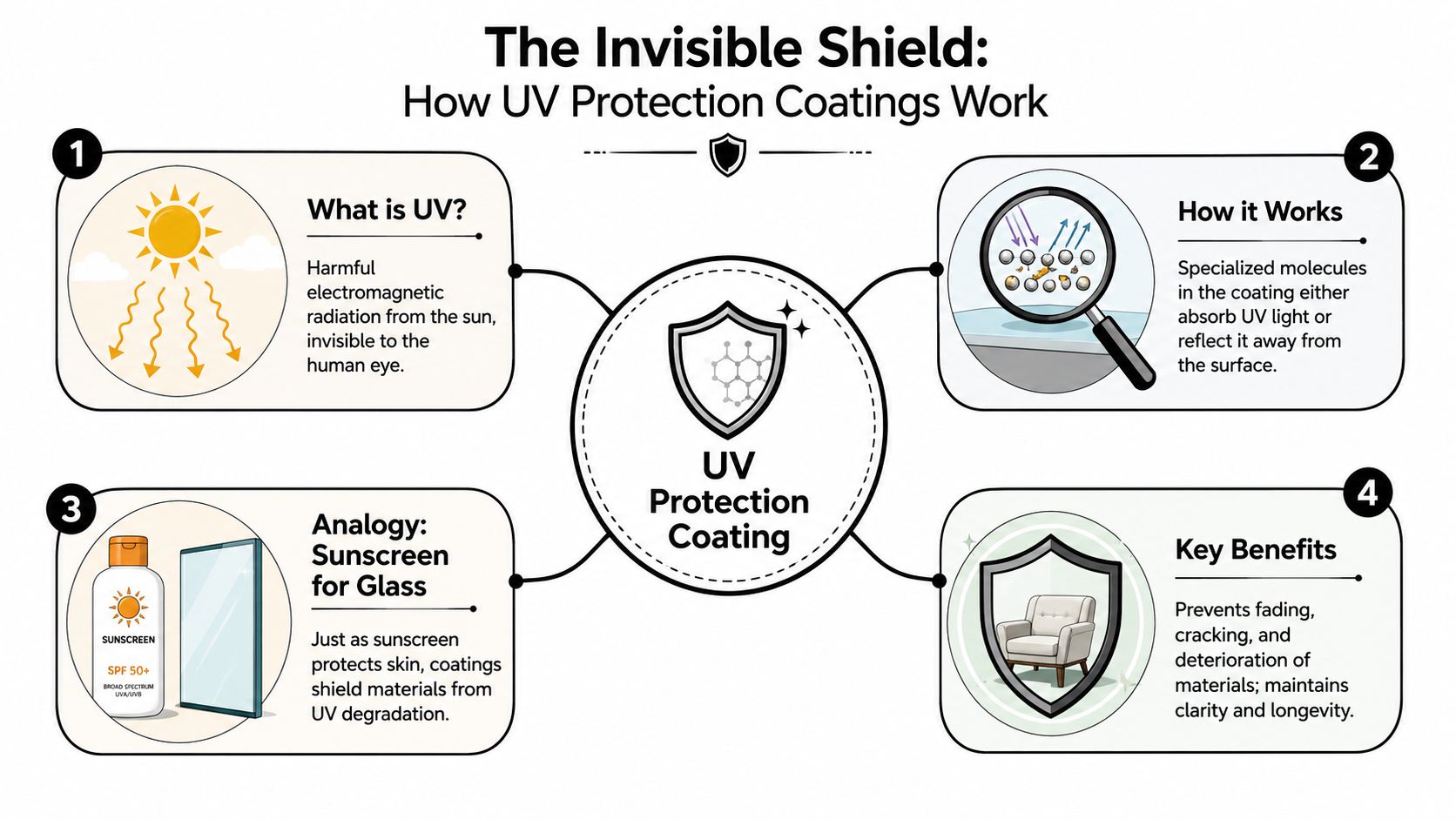
Years ago, I watched a customer reject a perfectly clear test panel because it “didn’t look protected.” That reaction is common. People trust dark tint because they can see it. UV control usually works through chemistry inside a thin surface layer, and the best versions stay visually quiet.
A UV coating on glasses or transparent substrates absorbs or reflects ultraviolet radiation before that energy reaches what sits behind the surface. The visible result can remain crystal clear. The protection happens at the molecular level, which is why a lens, screen, or coated panel does not need a dark appearance to do real work.
Clear can protect better than dark
In eyewear, the confusion usually starts with tint. A darker lens can reduce brightness, but UV performance depends on the base material and the coating stack. As the optometrists.org lens guide explains, some lens materials provide stronger native UV blocking than others, and UV400-rated products are designed to block harmful UV up to 400 nm.
That distinction matters outside eyewear too. A surface can look light, neutral, or nearly invisible and still screen a meaningful share of solar radiation. In hot regions, layered strategies often work best, which is why solutions such as UV screen options for hot climates are useful to compare alongside coatings. They solve a related problem through a different barrier.
What the coating has to do in the real world
For a protective layer to earn its place on a vehicle or high-use transparent surface, it has to do more than intercept UV.
It needs to keep optical clarity high, resist weathering, and stay bonded after repeated cleaning, heat cycles, and daily exposure. That is the practical gap between a lab concept and a surface treatment people will trust for years.
For polycarbonate, the substrate already brings useful UV resistance. The coating still matters because the outermost layer takes the abuse first. A purpose-built UV protective coating for polycarbonate helps preserve surface quality, makes cleaning easier, and extends performance under sun and environmental wear.
The result should be simple for the user. Clear view, lower solar stress, and protection that does not advertise itself every time you look through it.
From Eyeglasses to Automotive Armor
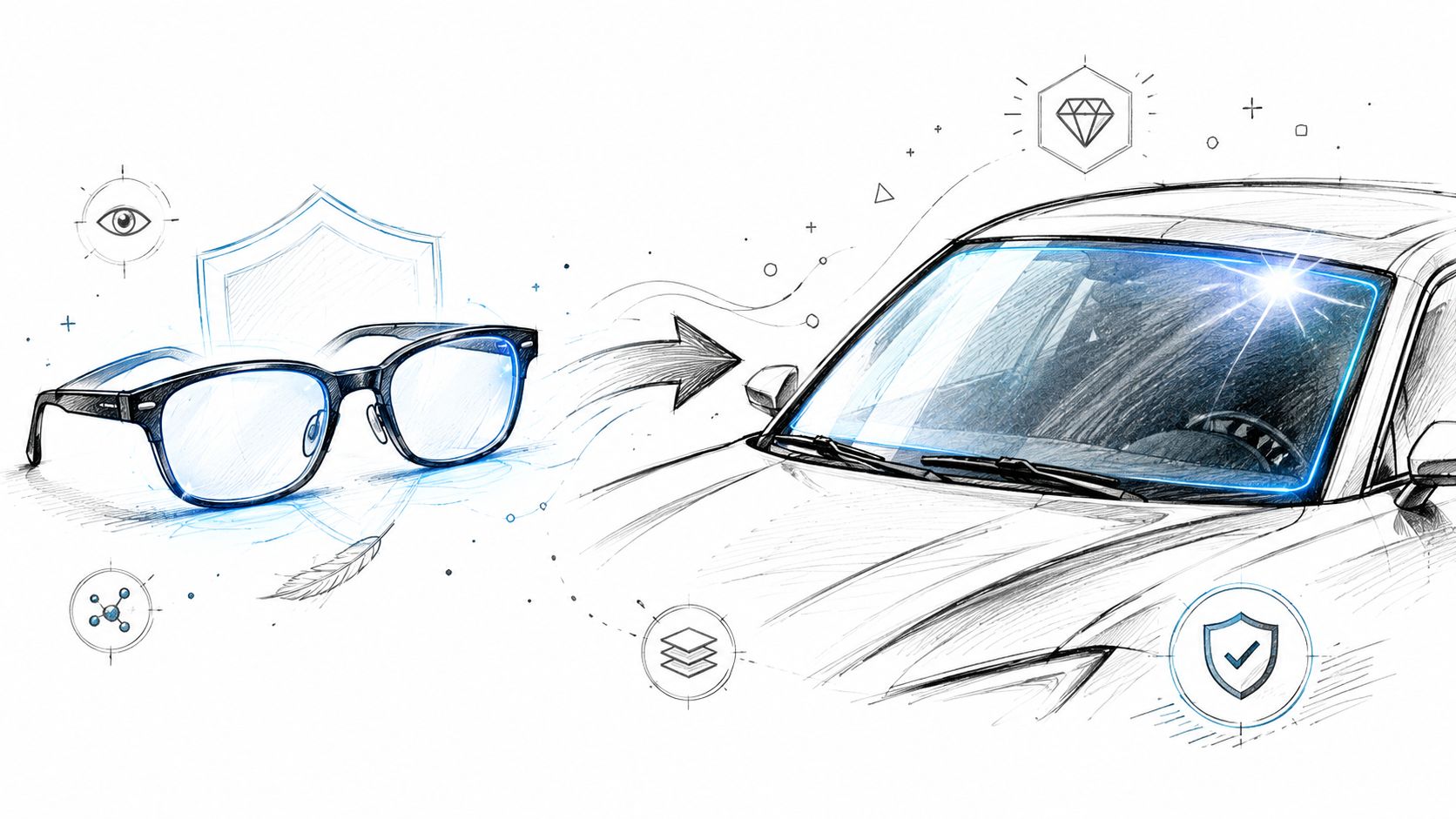
Eyeglasses live a sheltered life compared with a windshield. Even a pair worn every day doesn’t face bug strikes at highway speed, wiper abrasion, road film, freezing nights, and baking sun on the same surface. Automotive glass does.
That difference is why copying a basic optical coating approach into the vehicle world isn’t enough. The principle of UV control is the same, but the engineering demands are much tougher.
Why rigid coatings fail on real vehicles
A coating can test well in ideal conditions and still struggle in service. Vehicles expand, contract, vibrate, heat-soak, cool rapidly, and take constant physical contact. If the protective layer is too brittle, cracking becomes the weak point. Once the surface integrity starts to go, the benefits drop with it.
This is why many detailers and informed owners now look beyond hardness alone. Hardness matters, but so does controlled flexibility. A coating that’s hard like glass yet able to move with the surface has a much better shot at surviving real temperature swings and impact events.
If you want a good primer on what people often prioritize when they protect your windshield, visibility and weather behavior usually come first. That’s sensible. But from an engineering standpoint, durability under stress should sit right beside those concerns.
The automotive standard is higher
Automotive coatings need to deliver more than one benefit at once:
| Demand | What users notice | What the coating must handle |
|---|---|---|
| Sun exposure | glare, interior wear, visual fatigue | continuous UV stress |
| Weather changes | surface instability | cold-to-hot cycling without cracking |
| Road use | bug hits, contamination, abrasion | impact tolerance and retained performance |
| Daily maintenance | streaking or difficult cleaning | easy upkeep and optical clarity |
A true ceramic coating for glass has to prove itself in the field, not just in a product description. Glass protection on a car isn’t only about beading. It’s about preserving function after the surface has been pushed hard for months.
A windshield coating shouldn’t ask the driver to choose between protection and clarity. It has to deliver both, every day, without becoming fragile.
Once you understand that, the next question isn’t whether a vehicle needs UV defense. It’s what kind of coating architecture can survive long enough to make that defense meaningful.
The Titan Difference Elastomer and Dark Matter Technology
Anyone who has worn a cheap pair of sunglasses knows the pattern. The lenses may block UV on day one, then the surface starts picking up fine scratches, heat stress, and haze from normal use. Automotive glass protection faces the same physics, but with far harsher exposure. The difference is scale, temperature swing, and impact load.
That is why Titan built its coating architecture around flexibility as well as hardness.
A rigid film can test well in a controlled setting and still fail early on a vehicle. Windshields, side glass, trim, and painted surfaces expand and contract every day. If the coating cannot move with that substrate, microscopic fractures start first. Loss of clarity, uneven water behavior, and weaker UV defense follow after that.
Titan’s answer is its elastomer platform, supported by Dark Matter Technology®. The formulation uses carbon-based nanostructures, silicon carbide, and metallic additives to improve thermal stability and maintain film integrity under real use. The goal is simple. Keep the protective layer intact long enough for the UV screening, chemical resistance, and surface performance to keep doing their job.
Hard like glass, built to flex
In product engineering, hardness alone is an incomplete target. Drivers do not experience a coating in a lab coupon test. They experience it after summer heat soak, winter cold starts, road debris, washer fluid, and repeated cleaning.
That is where elastomer chemistry earns its place. The coating cures into a hard surface, but it still has enough compliance to handle movement and stress that can make brittle films fail sooner. For automotive use, that trade-off matters more than headline hardness numbers.
The same principle helps explain the jump from personal eyewear to vehicle protection. UV coating on glasses is mainly about filtering radiation and preserving optical comfort. On a vehicle, the coating also has to survive wiper passes, contamination, thermal cycling, and mechanical wear without giving up clarity. Style Site Optical’s eye care tips are useful for understanding the personal side of UV protection. Automotive coatings have to solve that same UV problem inside a much tougher durability envelope.
Why Dark Matter Technology matters in the field
Dark Matter Technology® is not marketing shorthand for “harder.” It is a materials strategy aimed at stability under stress. By reinforcing the coating matrix with advanced additives, Titan improves resistance to temperature-related fatigue and helps reduce the cracking risk that shortens service life.
Users see that in practical ways:
- More consistent performance after hot-cold cycles
- Better resistance to the small impacts and abrasion that wear down brittle films
- Longer retention of the properties that made the coating worth applying in the first place
That last point gets missed in many product comparisons. UV rejection, slickness, easier cleaning, and visual clarity all depend on one basic condition. The film has to stay continuous.
Alpha Quartz is a strong example of that design philosophy. It gives installers a coating that is forgiving enough to apply without an overly narrow process window, while still delivering the surface hardness and weather resistance people expect from a premium system. The technical background on Titan Coatings elastomer technology explains why that balance matters on real vehicles, not just on a spec sheet.
Engineering takeaway: a coating that stays intact keeps protecting. A coating that turns brittle starts giving up benefits one by one.
That is the Titan difference. The company did not treat flexibility as a weakness to hide. It treated controlled flexibility as a way to make advanced UV and surface protection last longer on glass and other exposed automotive surfaces.
Achieve Crystal Clear Safety in Any Weather
A coating’s value is most apparent during adverse weather, particularly rain.
Drivers feel the difference at highway speed, when water starts sheeting across untreated glass and oncoming headlights scatter through every streak. Wipers can clear the surface, but they cannot change the way water clings to the windshield between passes. Good glass protection changes that surface behavior first, which is why visibility improves before a driver ever thinks about chemistry.
What better glass behavior feels like on the road
With the right coating, water forms tighter beads and releases faster from the glass. The practical result is less smear, fewer heavy wiper passes, and less eye fatigue in poor conditions. Drivers usually describe it in simple terms. The windshield feels clearer and the car feels easier to place on the road.
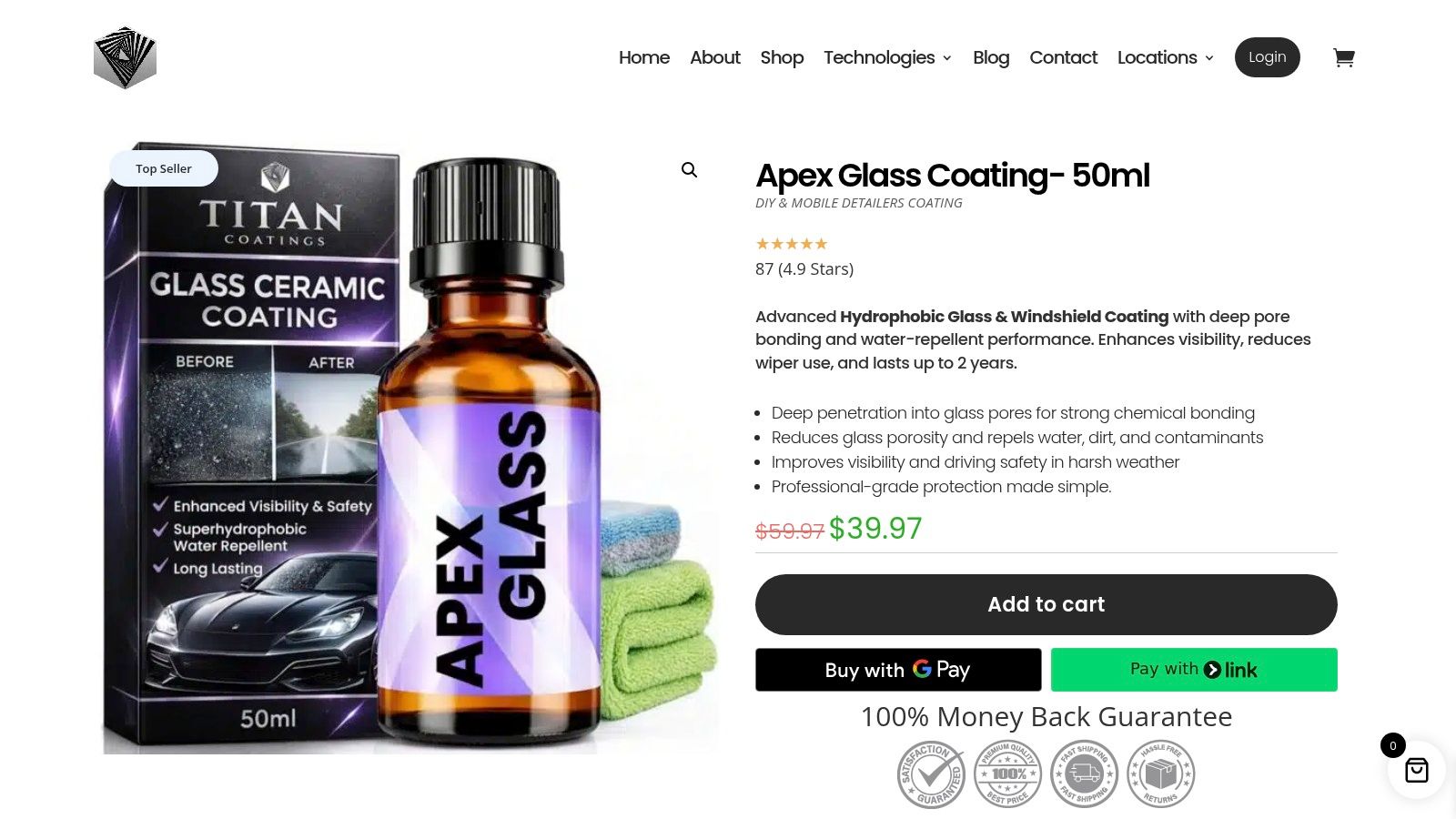
That is where APEX Glass Ceramic Coating earns its place. It improves wet-weather visibility while staying realistic to apply, which matters for both professional installers and careful DIY users. The product page for windshield ceramic coating gives a clear look at where that fit makes sense.
UV protection still matters on glass
Rain shows the benefit immediately. UV exposure works more subtly, but it still matters because the same surface that has to shed water also has to hold up under constant sunlight, heat, and environmental stress.
This is the useful connection between eyewear and automotive glass. Good sunglasses protect vision without adding haze or distortion. Good automotive coatings should meet the same standard on a larger, harsher stage. The target is clear optics, stable performance, and protection that lasts through real use instead of fading after the first stretch of hard weather.
Titan’s coating approach was built around that trade-off. A hard but brittle film can lose clarity and performance as it ages. A more resilient film keeps its surface properties longer, which supports both UV defense and wet-weather visibility over time.
For drivers comparing personal eye protection with vehicle glass protection, Style Site Optical’s eye care tips help clarify an important point. Glare reduction and UV protection are related, but they are not the same thing.
Why ease of use matters
Application discipline still matters. Surface prep, cure conditions, and wipe technique all affect the final result.
But usability matters too. If a coating is overly sensitive during install, field results become inconsistent, especially for mobile detailers and owners working outside a controlled shop. APEX stands out because it is practical to use while still delivering the benefits people notice on the road: cleaner glass, quicker water movement, and better visibility when weather turns against you.
Durability Testing and Stacking Your Defenses
A coating only proves itself after a season of abuse. Install-day gloss is easy. Holding optical clarity, UV screening, and surface behavior through sun, washing, heat cycling, and road contamination is the harder test.
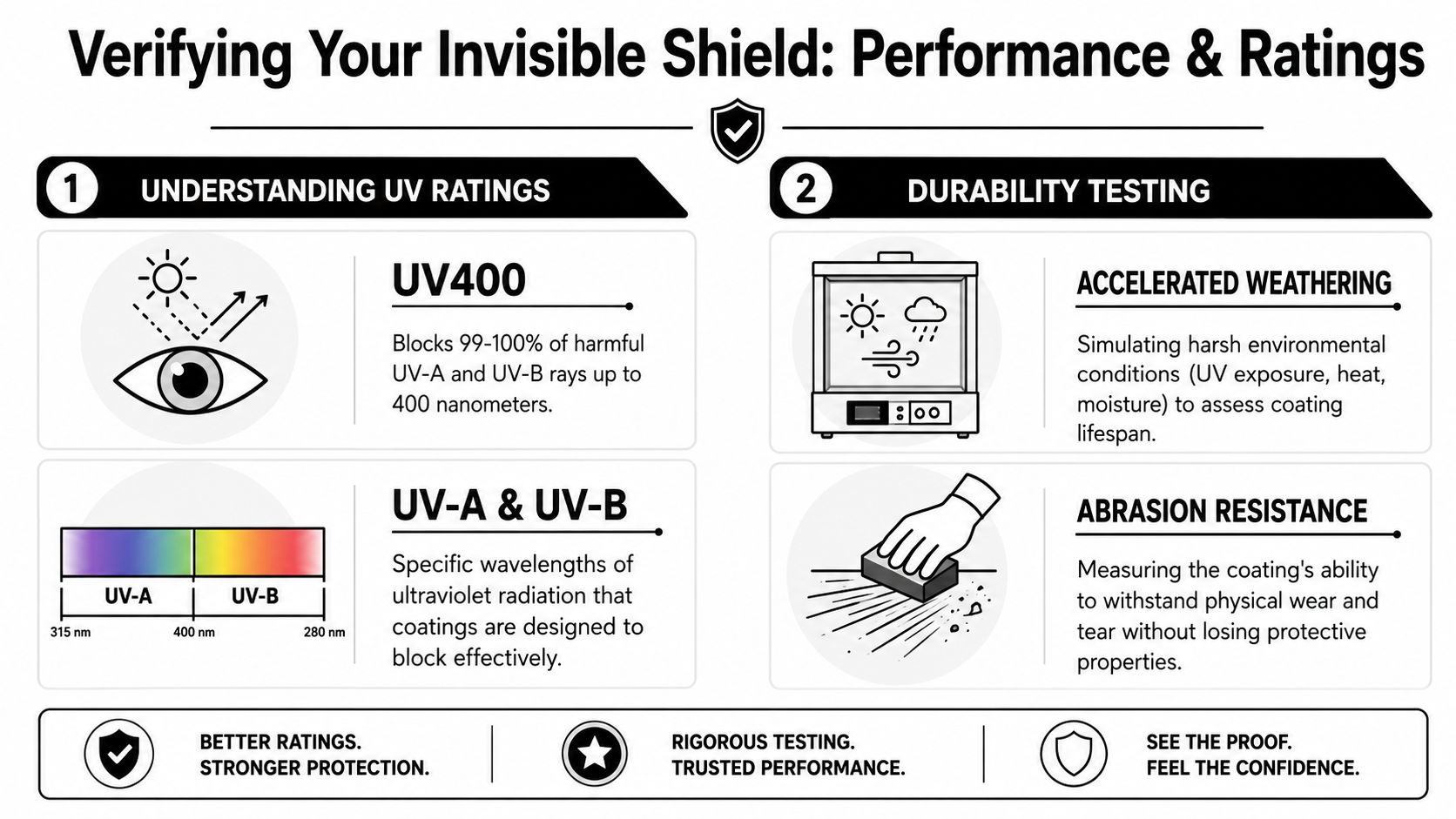
Eyewear gives us a useful baseline. UV400 remains the familiar shorthand for lenses because it signals coverage through the UV range people care about most. In automotive protection, the label matters less than retention. A primary concern is whether the coating still performs after months of thermal expansion, wiper passes, detergents, and airborne grit.
What durability proof looks like
Good test programs do more than confirm initial UV blocking. They check whether the film stays bonded, clear, and functional after simulated solar exposure and environmental stress. Optical industry reporting on ISO and ASTM-style testing has highlighted that better coating systems can maintain UV performance even after extended artificial weathering (Optometry Innovations review).
That standard matters even more on vehicles than on eyeglasses. Glass on a car sees broader temperature swings, harsher contamination, mechanical abrasion, and constant flex at the microscopic level. A brittle film can test well when fresh, then lose ground once the surface starts expanding and contracting in service.
That is the gap basic hard coatings often miss.
Build a system, not a single layer
The strongest protection strategy is layered. Different surfaces fail for different reasons, so one chemistry should not be forced to do every job.
- Foundation layer: choose the main coating based on substrate movement and exposure. For paint and high-stress exterior surfaces, Alpha Quartz is a strong fit because the elastomeric structure helps it stay intact instead of turning crack-prone over time.
- Glass-specific layer: use a dedicated glass coating where optical precision, fast water evacuation, and stable visibility matter most.
- Maintenance topper: add a sacrificial refresh layer when quick upkeep, added slickness, and easier wash behavior are the goal.
Ultra Ceramic Spray fits that maintenance role well. It installs quickly, refreshes surface feel, and helps preserve the performance of the base system without adding a complicated process.
I also recommend paying attention to removal and rework. Anyone who has dealt with aging lens films knows that failed coatings are frustrating to strip cleanly. The same lesson applies here. If you have ever looked into how scratch-resistant coating removal behaves on eyeglasses, the automotive parallel is obvious. Long-term serviceability matters almost as much as initial performance.
Premium coatings earn trust through repeat exposure, not first-day appearance.
A simple stacking model
| Layer role | Best use | Why it helps |
|---|---|---|
| Primary protection | long-term surface defense | takes the main environmental load |
| Glass coating | windshield and other glass | improves wet-weather clarity and glass behavior |
| Spray maintenance layer | fast refresh and upkeep | boosts slickness and helps preserve the system |
This stacking approach is where the eyewear-to-automotive comparison becomes useful. Both depend on invisible UV control. Automotive surfaces add a tougher requirement. The coating also has to flex, stay clear, and keep working after real-world wear. That is why elastomer nano-coatings change the conversation. They do not just block exposure. They hold their surface properties longer, which is what users notice on the road and in the wash bay.
FAQ UV Coating Myths and Maintenance
A lot of confusion around coatings starts with assumptions that sound reasonable but aren’t technically true. The biggest one comes straight from the eyewear world.
Myth one darker means safer
It doesn’t. A clear lens with a UV400 rating can offer 100% protection, while a dark, untreated lens may offer none. This is because UV blocking is an invisible chemical property, not a function of tint (Optyx explanation).
That same mindset causes problems in automotive care. Darker appearance, stronger shine, or a heavier visual effect doesn’t automatically mean better UV defense.
Common questions from drivers and detailers
Does tint replace UV coating?
No. Tint changes visible light transmission. UV protection depends on the material and coating chemistry.
Do hard coatings always last longer?
Not always. Hardness without flexibility can become a liability when surfaces face major temperature shifts and impact.
Is a glass coating only about water beading?
No. Better water behavior is the most obvious effect, but clarity, cleaning ease, and retained surface performance matter just as much.
What should I watch for if performance starts to drop?
Look for uneven water behavior, surface contamination that becomes harder to remove, or signs that the coating is no longer responding consistently after proper cleaning.
Simple maintenance that preserves performance
Keep the routine basic and disciplined.
- Wash first, wipe second: remove grit before touching the surface with towels or applicators.
- Use compatible products: harsh chemicals can undermine the coating stack.
- Refresh deliberately: a maintenance product like Ultra Ceramic Spray works best when the base layer is clean and intact.
- Inspect optics objectively: if an old lens coating is failing, replacement or proper removal is better than pretending the damage isn’t there. For readers dealing with worn eyewear layers, this guide on how to remove scratch resistant coating from eyeglasses is a useful reference point.
If you can only remember one rule, remember this one. Visible darkness is not UV protection.
For anyone researching UV protection coating on glasses, that’s the lesson worth carrying into vehicle care as well. The best protection is often invisible, but its effects are very real. Better eye safety, better material preservation, and better driving clarity all start with the same decision. Choose chemistry and durability, not appearance alone.
APEX NANO – Titan Coatings builds that kind of protection for people who expect more from a surface than short-term shine. If you want advanced coating solutions for glass, paint, and beyond, explore APEX NANO – Titan Coatings and review the shop for products designed for easy application, long service life, and next-generation elastomer performance.
0 Comments