
The first car in the bay that morning was a black sedan with fresh water spots on the hood and faint holograms across the doors. A mobile detailer had parked beside it at dawn, watching the weather swing from cool shade to hot sun, and he knew the job had to be finished before the afternoon heat changed the way the paint behaved. He reached for an orbital auto detail buffer, because the machine had to remove haze without chewing through the finish.
That choice sits at the center of modern detailing. A buffer is part of a correction and protection workflow, the step between defect removal and long-term preservation. In the U.S. alone, the car wash and auto detailing industry had 16,879 businesses in 2026, and IBISWorld says the sector grew at a 1.5% CAGR from 2021 to 2026 IBISWorld industry data. One independent projection for car buffer polishers also puts the global market at USD 1.2 billion in 2024 rising to USD 1.8 billion by 2033, a projected 5.0% CAGR.
That growth makes sense on the shop floor. Detailers now talk about the machine itself in terms of control, pressure, overlap, and coating prep, because those details decide how well a finish holds up after the work is done. One technician may be chasing swirl marks before a ceramic layer goes down, while a DIY owner may only want the gloss back on a hood before sealing it. The same tool can do both, if the hands on it know when to stop.
Understanding Auto Detail Buffer Mechanics
A black sedan rolled into a detail bay with faint holograms on the doors and a thin layer of haze on the hood. One technician reached for a machine that moved in a wide, forgiving pattern, because the paint needed cleaning up before any coating could bond well. Another technician, working on a harder correction job, chose a tool with more direct force and kept a closer eye on heat, pad contact, and edge pressure.
That difference is why buffer mechanics matter before a finish gets protected. The machine does more than remove defects. It shapes how the surface will accept later layers, including Titan's next-gen elastomer and ceramic coatings, where evenness and surface prep can make the difference between strong performance and a finish that struggles to hold up.
Orbital motion versus rotary force
A random orbital buffer moves in a wider path, which helps reduce visible holograms and lowers the chance of concentrating heat in one spot. A rotary polisher spins in a direct circle, so pad contact stays more focused and the machine removes material more aggressively in practiced hands. Detailers who want a safer finishing step often start with orbital motion, while a rotary tool still has a place for deeper correction work when the panel needs more controlled bite.
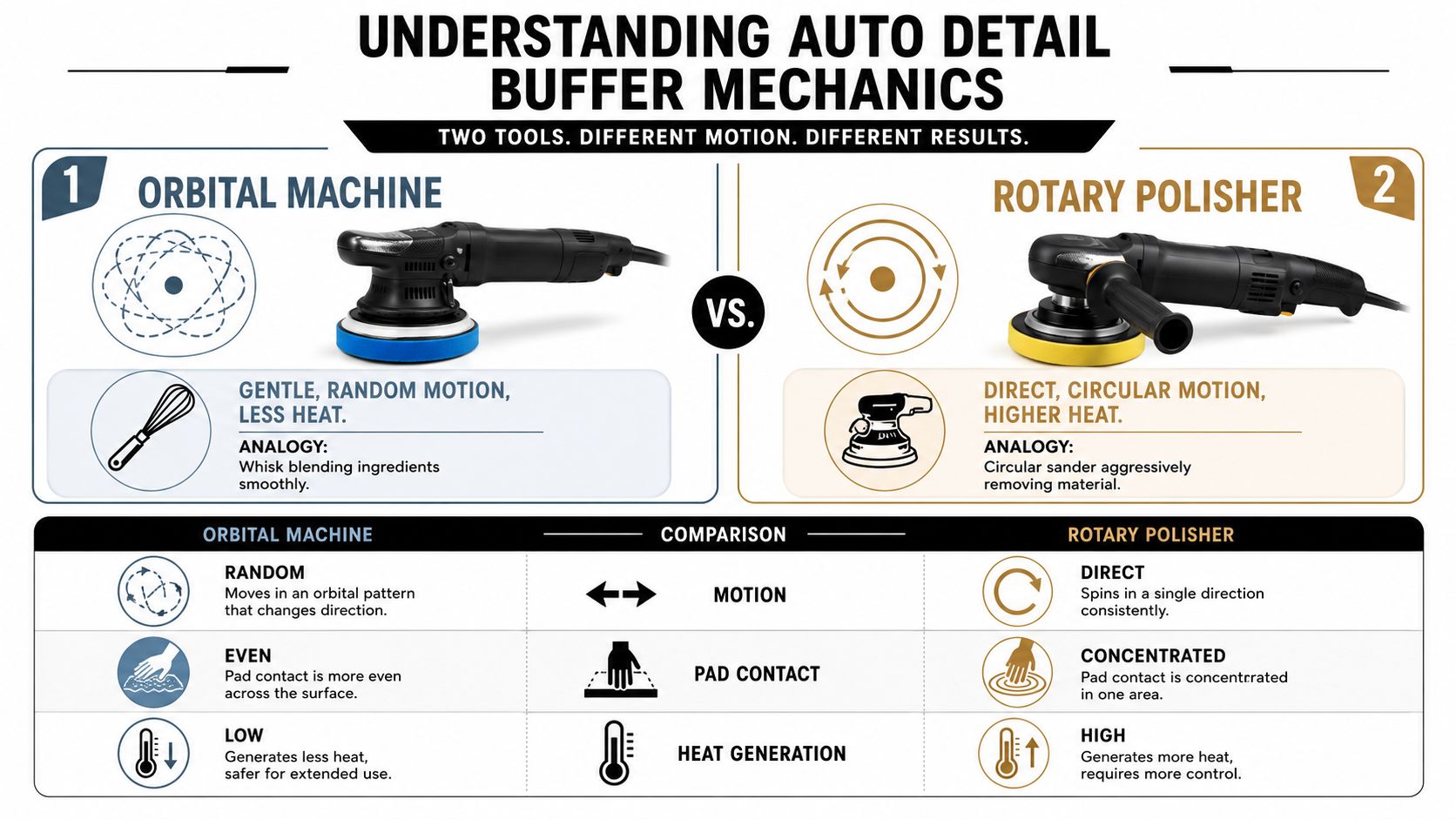
Practical rule: if the paint already looks close to ready and the goal is a cleaner surface before coating, a gentler motion usually gives you more control.
Why motion changes finish quality
Motion changes how energy lands on the paint. When the pad concentrates force in one area, abrasion rises and heat builds faster, which can help on marked-up panels but can also expose thin clear coat or delicate body lines to unnecessary stress. A buffer is not better because it is stronger, it is better when its movement matches the condition of the paint.
A shop owner in a mobile detailing crew described it plainly after a hood correction on a dark SUV. The orbital machine smoothed the swirls without leaving the kind of trail that would need another pass, while the rotary tool was reserved for stubborn spots where the panel could handle more direct action. That same judgment matters before Titan coatings go on, because a cleaner, more even surface gives those coatings a better foundation and helps them perform the way they are designed to.
If you want a closer look at how a rotary car polisher behaves in the hand, that tool makes the contrast with orbital polishing easier to see.
Choosing the Right Pad and Speed
A skilled detailer doesn't start with speed, they start with the least aggressive combination that can still solve the defect. That approach matters because pad foam, pad cut, and machine speed all influence how much material gets removed and how much heat builds up on the surface. The wrong combination can leave the paint duller than before, even if the marks are technically reduced.
Match the task to the motion
The simplest way to dial in a buffer is to pair the task with the right speed range and the right pad. A retail technical guide lists 3000 to 4000 OPM for waxing, 4000 to 5000 OPM for polishing, and 5000 to 6000 OPM for cutting Chemical Guys speed guide. That range is useful because it keeps the machine's abrasiveness in step with the goal, instead of forcing every job into the same setting.
| Task | Speed (OPM) | Pad Type | Pressure (lbs) |
|---|---|---|---|
| Waxing | 3000 to 4000 | Soft finishing pad | Light, just enough to keep contact |
| Polishing | 4000 to 5000 | Medium-cut foam pad | Moderate, controlled and even |
| Cutting | 5000 to 6000 | Cutting foam or microfiber pad | Heavier, but still measured |
The table above gives the broad map, but the paint decides the final answer. A softer clear coat often responds quickly and needs less machine time. A harder finish may tolerate a more assertive pad, but that doesn't mean it wants one. Titan's polishing and buffing pads are relevant here because the pad is often the primary control point, not just the speed dial.
The smartest pass is the one that solves the defect without forcing a second correction later.
Pressure and overlap matter more than people think
One detailing guide says compound cutting commonly lands around 5 to 7 lbs of pressure, while finishing can drop to 2 to 3 lbs, and technicians often use about 50% overlap in a crosshatch pattern to keep the correction even GPMobileCarWash guidance. That overlap helps prevent striping and keeps one section from looking richer than the panel beside it.
A dual-action machine can feel forgiving, but it still responds to hand pressure. Push too hard and heat rises. Back off too much and the pad skates without doing useful work. The goal is stable contact, not brute force. If you can hear the machine strain or see the pad stall, the setup probably needs adjustment before you keep going.
Compatibility with Ceramic and Elastomer Coatings
A polished panel and a coated panel are not the same thing, even if they look similar in daylight. The panel that gets coated has to be clean, level enough, and free of the tiny defects that would get trapped under the final layer. That's why controlled machine polishing matters so much before a premium coating goes down.
Why prep decides coating performance
Titan's coating lineup stands out because it pairs elastomer behavior with coating durability, plus its own Dark Matter and nanostructured approach. The practical takeaway is simple. When a coating is designed to protect the surface, the surface has to be prepared with the same level of care. Heavy, impatient buffing works against that goal because it can introduce marring right before the finish gets sealed.
For windshield and glass work, Titan's APEX Glass ceramic coating fits the same logic. A clean, properly prepared surface gives rain behavior and visibility a better starting point than a rushed, uneven prep ever will. For paint, the paint correction before ceramic coating workflow is the bridge between visible defect removal and a coating that lays down evenly.

Elasticity changes the conversation
Titan's elastomer coatings are described as hard like glass and flexible at the same time, and that flexibility matters when temperatures swing from freezing to hot. A rigid layer can be more vulnerable to cracking under stress, while a more elastic one is better suited to movement in the substrate and the thermal swings that come with real-world driving. That doesn't mean prep becomes optional. It means the finish has a better chance of staying intact when the prep and the application both respect the paint underneath.
Ultra-fine polishing before coating is usually where people win or lose the final look. If the buffer is too aggressive, the surface may look better for a few hours but become harder to coat cleanly. If it's too soft, swirls remain and the coating only preserves what's already there. Titan's Ultra Ceramic Spray sits naturally in that middle ground for owners who want a quicker protective layer after light correction, not a full corrective marathon.
Examples of Buffer Applications in Real Detail Jobs
At a small detailing studio, a black sports coupe rolled in with faint wash scratches and a hood that reflected the garage lights like a spiderweb. The lead technician reached for a dual-action buffer with a medium foam pad, worked one small panel at a time, and paused after each test spot to check the finish under angled lighting. The goal was simple. Clean the surface enough to let a protective coating hold its own, without chasing perfection so hard that the paint paid for it later.
A studio job that needed restraint
He started with the least aggressive combination that still moved the defects. Once the test spot looked even, he kept going panel by panel, making deliberate passes and staying away from edges where clear coat is easier to thin. On a car like that, Titan's Alpha Quartz fits naturally afterward, because the gloss is already there and the coating's role is to preserve the correction rather than cover up a rushed one.
The rear quarter panel showed why restraint matters. A previous owner had overbuffed near an edge, leaving a section that looked better from a distance but carried less margin under the clear coat. Guidance from the Autogeek rotary buffer thread warns that aggressive polishing past safe limits can remove too much clear coat and lead to edge burn-through or soft-paint marring. The studio handled it by backing off the cut, finishing with lighter polishing, and preserving what was left instead of forcing a stronger pass.
That kind of decision is what separates a careful correction from a repair bill.
A DIY job that valued speed and control
Across town, a daily driver came in coated in road film and uneven gloss. The owner used a rotary buffer with a soft first pass, then moved to a quick protection step with Titan's Ultra Ceramic Spray once the surface looked uniform. He was not trying to turn commuter paint into a show field mirror. He needed a clean, protected finish before the week started.
The choice made sense because the paint still had life left in it. A gentler buffer setup removed the dull layer, and the spray coating gave the panel an easier path back to slickness and water behavior without dragging out the job. For DIY work, that balance matters more than chasing the strongest cut available.
The best buffer setup matches the condition of the paint and the clear coat you have left. If the panel is sensitive, lighter polishing wins. If the paint is tired but still sound, controlled correction followed by protection usually makes more sense than repeated heavy passes.
Maintenance Safety and Avoiding Mistakes
A buffer can feel indestructible until dust gets into the vents, a pad starts to glaze, or the cord develops wear. At that point, the machine stops behaving like a precision tool and starts behaving like a risk. Good maintenance is boring in the best possible way, because boring maintenance keeps the pad spinning evenly and the paint looking clean.
Keep the machine healthy
Daily care should be quick and repetitive. Clean the vents so dust doesn't build up and trap heat. Inspect pads for tearing, caking, or embedded debris before each job. If a pad is dirty or hardened, it won't glide evenly, and the finish usually tells on you before the owner does.
Monthly care goes deeper. Check the wiring for fraying, inspect the housing for stress, and make sure moving parts feel smooth rather than rough. Safety gear matters too, especially eye protection and hearing protection, because polish splash and long machine sessions can wear on you even when the paint itself looks fine.
Practical rule: if the machine sounds louder than it did last week, stop and inspect it before it touches paint again.
Avoid the mistakes that cause repeat work
The most common user errors are painfully simple. People skip test spots, use the wrong pad for the defect, or press too hard because they want the scratch gone faster. Others run the buffer at the wrong speed for the task, which can create heat without improving the finish.
A good technique keeps those errors in check. One instructional video recommends working in small sections, using about five dots of polish, applying 5 to 7 lbs of pressure, and moving in a 50/50 overlapping cross-hatch pattern until the polish turns clear before final buffing YouTube detailing instruction. Titan's how to buff paint off car resource fits neatly with that approach because the same discipline that improves correction also protects the coat beneath it.
The bigger lesson is restraint. Let the machine do the work. If the panel needs more aggression, step up carefully rather than jumping straight to a harsh pad or heavy pressure. That's how you avoid marring one section while trying to save another.
Professional and DIY Buying Checklist
A mobile detailer loading a van before sunrise usually checks the same things a weekend hobbyist checks in a garage, just for different reasons. One wants speed, balance, and durability because the buffer will see constant use. The other wants comfort, clear controls, and a setup that reduces the cost of small mistakes.
What pros should look for
- Ergonomic handle: A buffer that stays stable in one hand and keeps the wrist in line makes long correction sessions easier to manage.
- Variable speed control: A broad working range lets a pro shift from finishing passes to heavier correction without changing machines mid-job.
- Detachable cord: Storage and transport get simpler, especially for mobile work where gear has to load and unload fast.
- Warranty and service support: Daily use exposes weak tools quickly, so downtime matters more than the sticker price.
A mobile operator building out a van can also use Titan's mobile detailing equipment list to compare the buffer with pads, polish, lighting, and power needs before a job ever starts. That kind of planning matters when the same machine is expected to correct paint, prep a panel for Titan's next-gen coating systems, and still hold up after repeated use.
What DIY users should prioritize
- Compact size: Smaller machines feel less intimidating on curved panels and in tight spaces.
- User-friendly pad system: Quick pad changes reduce confusion during a first correction session.
- Starter-friendly maintenance kit: Clean pads and a simple storage routine help the machine last longer.
- Matched coating bundle: A straightforward aftercare path lowers the urge to overcomplicate the finish.
DIY buyers should also pay attention to support quality before they spend money. Reading about red flags in Autosource Biz reviews can help spot weak product support or unreliable service patterns before a buffer, pad set, or coating package shows up at the door.
The coating choice should be part of the same decision. An Alpha Quartz starter kit, plus related Titan options like the Ultra Ceramic Spray bundle and APEX Glass ceramic windshield coating, keeps the machine and the protection plan aligned in one purchase path instead of being treated like separate projects. That matters because the right buffer choice helps finish the surface cleanly, and the coating choice decides how well that finish holds up afterward.
Conclusion and Next Steps
One detailer in a small shop learned the hard way that a buffer can save a finish or ruin it. He had the right machine on the bench, but the first pass on a soft panel left hazing because the pad was too aggressive and the speed never matched the paint. After he adjusted his motion, eased off the pressure, and switched to a pad that suited the surface, the same panel came back with clear gloss and far less cleanup.
A good auto detail buffer earns its place by matching motion, pad, pressure, and speed to the paint in front of it. The machine matters, but the hands using it matter more. Safe correction limits, regular maintenance, and coating compatibility keep the finish from being worn back down after the work is done. Titan's next-gen elastomer and ceramic coatings fit that same logic, because they are meant to hold gloss and stay stable when the buffer has already done its job well.
The next step is simple. Choose a buffer that fits the work, use it with restraint, and pair the correction with a coating system that supports the result instead of fighting it. That is the part many competitors miss, the buffer is not separate from the coating plan, it shapes how well Titan's protection bonds, looks, and lasts on the car after the final wipe.
0 Comments