
You're probably looking at a cabin that doesn't need another random spray bottle. It needs the right product for the right surface.
That's the mistake made when they shop for the best products for car interior detailing. They buy one “interior cleaner,” hit leather, screens, piano black trim, cloth, and glass with the same towel, then wonder why the dash looks greasy, the glass streaks, and the seats still smell like yesterday's drive-thru. A good interior detail starts with one question: what surface am I touching right now?
Interior demand keeps moving toward cleaning, hygiene, and preservation, not just shine. Market data shows strong demand around interior-focused cleaning and maintenance, with interior detailing representing about 37.2% of application revenue in 2025 in one global market study, and projected to grow at about 7.4% through 2034 according to Dataintelo's car detailing products market outlook. That tracks with what detailers see every day. Customers care about odor, touch, clarity, and how the cabin ages.
A Cabin That's Seen Better Days
A 2018 SUV rolled into a mobile job not long ago with the usual mess. Coffee had been ground into the seat bolster. Sunscreen was smeared across the rear door glass. A child seat had left compression marks, crumbs, and a film of who-knows-what on half the back seat.
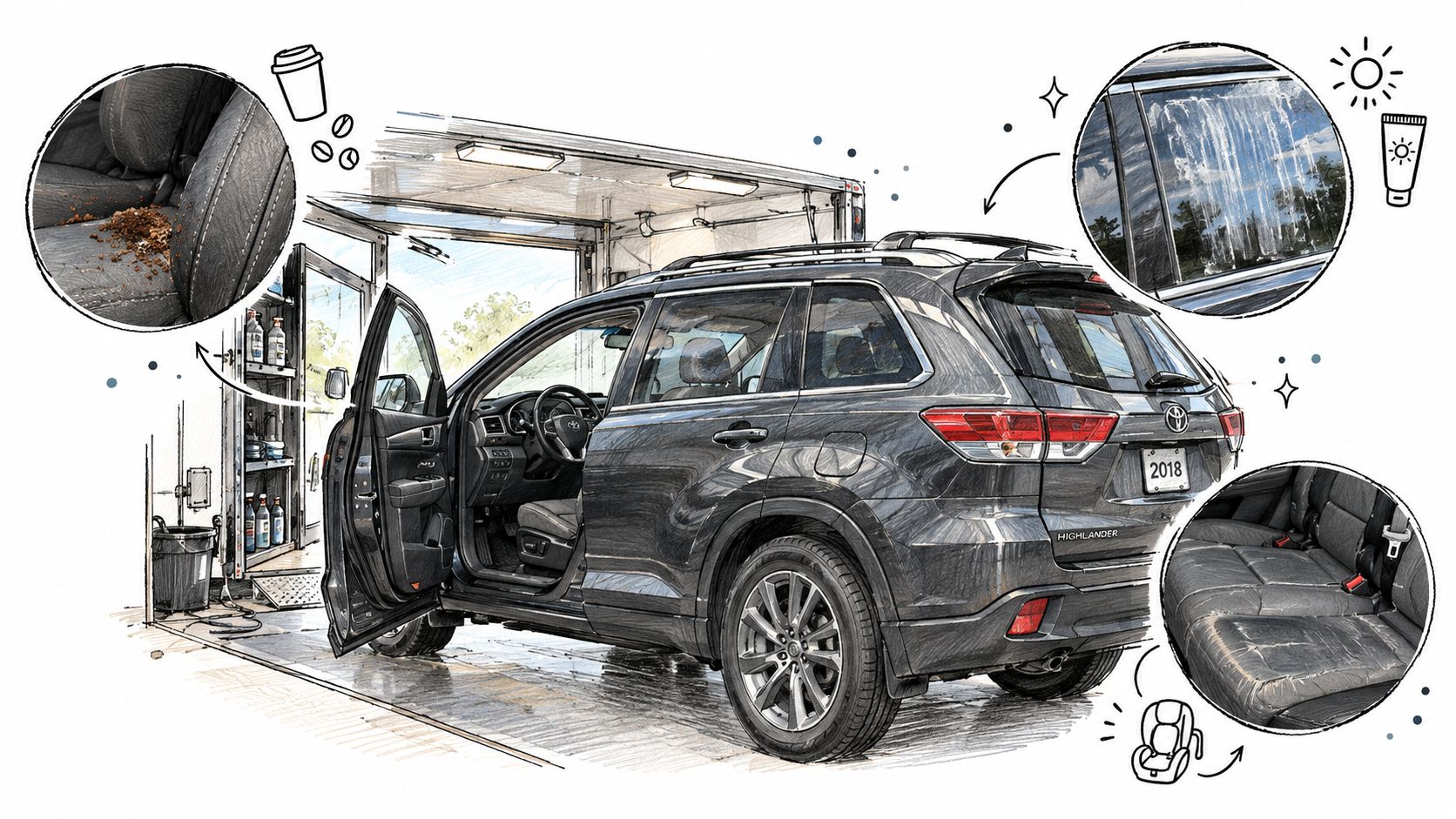
I didn't reach for an all-purpose cleaner first. I stopped and read the cabin. That's what pros do. The steering wheel told me one story, the coated seat surface another, the fabric mat another, and the glossy screen another.
Read the cabin before you spray
A fast interior triage usually looks like this:
- Check the seat material by feel: Coated leather feels tighter and less absorbent. Vinyl usually feels more uniform and slightly colder. Fabric grabs your fingertips more.
- Look for mixed-surface zones: Door panels often combine plastic, soft-touch trim, fabric insert, speaker mesh, and gloss trim in one panel.
- Watch how contamination sits: Oily body oils on a steering wheel need a different approach than dry dust in vents or sticky sugar on cupholders.
- Use a light moisture check: On some surfaces, a tiny damp microfiber tells you quickly whether the material is sealed and easy-wipe or absorbent and likely to stain.
Practical rule: If one bottle claims it does every interior surface perfectly, assume it does most of them only adequately.
One spray-bottle solution fails because modern cabins are layered. Leather wants a pH-balanced cleaner that won't leave it tacky. Fabric wants dwell time and extraction-friendly behavior. Screens want almost no liquid and zero residue. Glass wants a cleaner that cuts oily film without smearing.
If you want a simple walkthrough before you build a full system, Titan's guide to DIY car interior detailing is a useful starting point. But skill is product matching, not product collecting.
Why brand-first shopping gives weak results
People shop by label. Detailers work by substrate.
That SUV ended up needing four separate product types just to get a factory-looking result. The fabric needed agitation and lift. The leather-look seating needed a residue-free wipe down. The glass needed its own towel and chemistry. The screen got the gentlest treatment of all.
That pause before the first spray matters. Everything that follows depends on it.
The Five Core Categories of Interior Detailing Products
If your kit is missing one category, the result looks unfinished. That's true whether you're cleaning your own daily driver or turning cars fast in a mobile setup.
Here's the quick comparison I'd use before talking brands.
| Category | Job | Where It Matters Most | What Good Looks Like |
|---|---|---|---|
| Cleaners | Remove oils, dirt, food residue, film | Dash, wheel, seats, carpets, door cards | Low residue, surface-appropriate, easy wipe-off |
| Brushes and tools | Loosen embedded grime | Seams, vents, stitching, carpet pile | Correct stiffness for the surface |
| Microfibers and towels | Lift contamination and control finish | Every surface | Lint-free, dedicated by task |
| Protectants and dressings | Leave a sacrificial layer | Plastic, vinyl, leather, trim | Matte or factory-like finish, no greasy film |
| Glass cleaners | Cut haze and oils | Windshield, side glass, mirrors | Fast flash, no streaking |
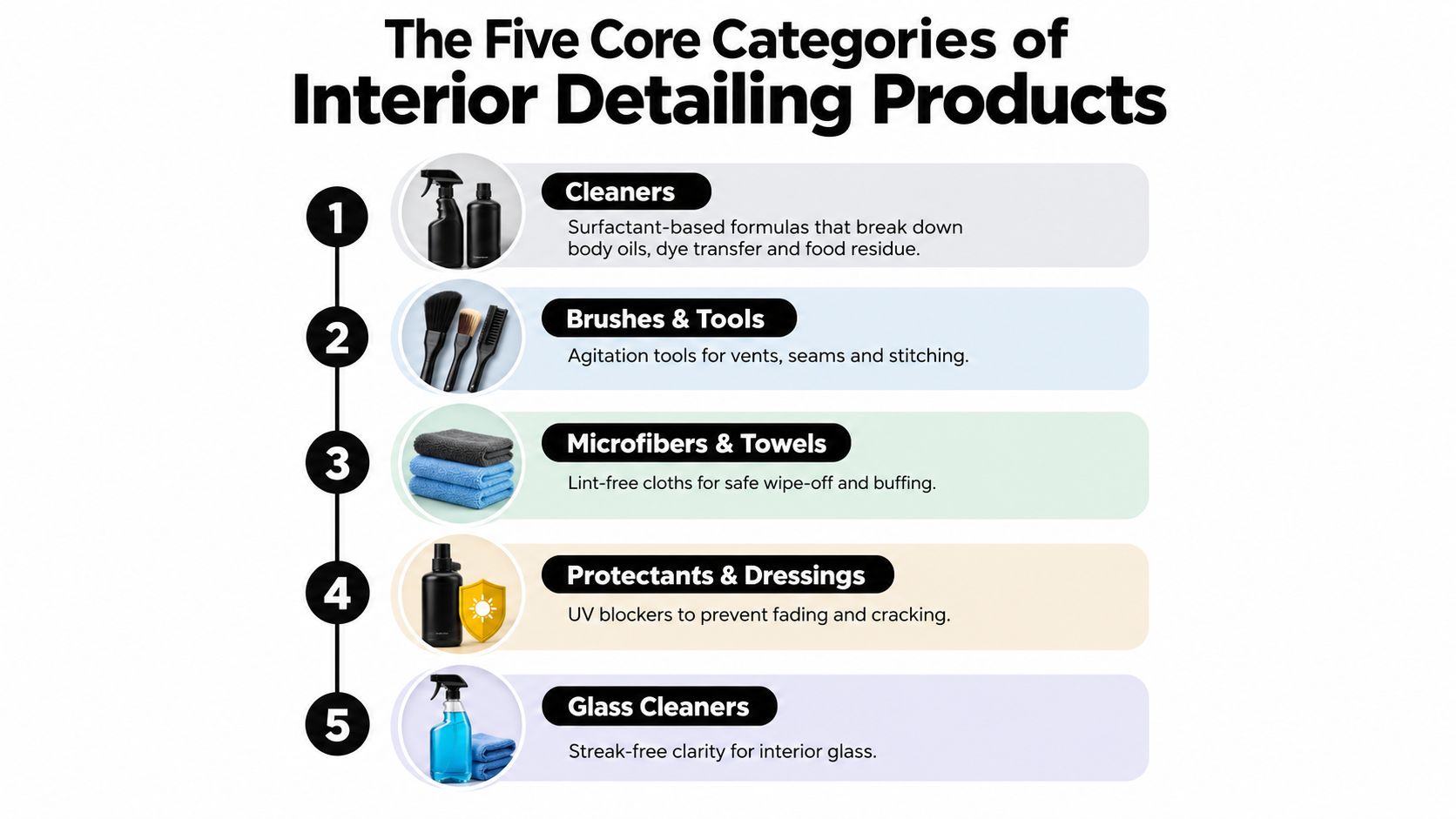
Cleaners do the chemistry work
Cleaning products carry the heavy load. They break down body oils, food residue, dye transfer, sunscreen film, and the grime that builds up where hands touch everything.
For broad interior use, I like cleaners that behave predictably across mixed surfaces. Independent testing highlighted Chemical Guys Nonsense as odorless, pH balanced, safe on all surfaces, and drying with zero residue, while Meguiar's Quik Interior Detailer Cleaner was highlighted by Car and Driver's testing as a value pick for broad interior use in their interior cleaner testing roundup. That matters because residue is what turns a clean dashboard into a dust magnet.
Tools decide whether the cleaner can actually work
A good cleaner without agitation is half a job. You need soft brushes for leather and coated trim, tighter utility brushes for seams and vents, and proper towels that don't smear what you just loosened.
A lot of people underbuy towels. That's backward. Cheap towels create most of the marring, lint, and streaking people blame on the product. If you're tightening up your setup, a guide on the best detailing microfiber towels is worth reviewing because towel choice changes your finish more than people admit.
Dirty vents, cupholders, and seat seams almost never need a stronger chemical first. They usually need better agitation and a cleaner towel rotation.
Protection is what keeps the result from collapsing
Conditioners and protectants aren't the same thing. Conditioners matter more on leather-focused work. Protectants matter more on plastics, vinyl, and high-touch trim.
Then there's the practical side. Interior care products are a big market because people keep buying what they use. A separate outlook projects the car care products market from $12.28 billion in 2025 to $16.14 billion by 2031, with cleaning and washing solutions holding 50.26% share in 2025, while interior care is projected to expand at 5.26% CAGR through 2031 in Dataintelo's car care products market report. The category is huge because cabins take abuse every day.
Cleaning Formats Compared
A trashed family SUV and a lightly dusty commuter car do not need the same product format, even if the label says both cleaners are safe on interiors. Format decides how the chemistry lands, how long it stays in place, and how easy it is to remove before it streaks, swells a seam, or runs into electronics.
That is why ranking interior cleaners by bottle alone misses the point. Match the format to the cabin problem first, then worry about brand.
Interior Cleaning Formats at a Glance
| Format | Best For | Residue Control | Approx. Market Share | Growth Trend |
|---|---|---|---|---|
| Liquid | General interior cleaning across dash, trim, fabric spot work | Good when applied to towel or brush, not over-sprayed | 38.2% according to Dataintelo's automotive interior cleaner market outlook | Leading format |
| Wipes | Fast maintenance, family vehicles, quick wipe-downs | Very controlled | Smaller than liquids | Fast-growing in maintenance use |
| Foam | Vents, stitching, vertical panels, tighter control | Strong because it stays put better than liquid | Growing where drip control matters | Useful on tight, upright, or sensitive areas |
| Concentrate | Pros, mobile detailers, repeat jobs | Depends on dilution discipline | Common in professional setups | Best fit for high-volume operators |
What each format actually does well
Liquids are the default for a reason. They give you the most flexibility across coated leather, vinyl, plastics, and fabric spot cleaning. Spray them into a towel or brush, not straight onto every surface, and they clean fast without flooding buttons, shifters, or screen edges.
Wipes are maintenance tools. They work for fresh fingerprints, light dust, and quick cleanups in ride-share cars, kid haulers, and lease returns that already stay fairly clean. They do not have the bite, dwell, or agitation support for ground-in grime.
Foams solve control problems. On vents, door panels, seat bolsters, headliners, and stitched areas, foam keeps the cleaner where you need it instead of letting it run downhill. That matters on modern cabins packed with switchgear, touch points, and glued trim.
Concentrates save money only if you mix them correctly. In a shop or mobile setup doing repeated interior work, they make sense. In the hands of a casual user guessing ratios, they cause most of the avoidable problems. Streaking, sticky residue, overwetting, and inconsistent cleaning usually come from bad dilution, not bad chemistry.
Product format also tracks with how people buy interior cleaners now. Analysts at Grand View Research note continued demand in the car care market for products that are easier to use and safer on modern vehicle materials, especially in categories tied to maintenance cleaning and appearance care: Grand View Research car care products market analysis.
If you work from a mobile rig, use a trigger spray bottle that meters interior cleaner evenly. Consistent spray output matters more than people think. A bad sprayer dumps too much product, and then the cleaner gets blamed for streaks and drips.
The rule I use on real interiors
Choose format by surface position and soil level.
Use liquids for broad, wipeable surfaces like dashboards, consoles, door cards, and coated leather seats. Use wipes for maintenance passes on lightly soiled cabins. Use foam for vertical panels, seams, vents, and any area where run control matters. Use concentrates when you clean enough vehicles to justify mixing, labeling, and testing your dilution ratios properly.
Matching Products to Each Interior Surface
Most interior jobs are won or lost. If the surface changes, the product should usually change with it.
Interior Surface Selection Criteria
| Surface | Key Selection Criteria | Compatible Product Types | Avoid |
|---|---|---|---|
| Leather | pH-balanced, residue-free, factory-finish preserving | Dedicated leather cleaner, light conditioner, matte protectant | Harsh alkaline cleaners, greasy dressings |
| Fabric and carpet | Dwell time, surfactant action, easy extraction or wipe-off | Upholstery cleaner, foam cleaner, extractor-safe cleaner | Heavy dressings, products that stay sticky |
| Alcantara | Low moisture, gentle wipe-off, nap-safe behavior | Alcantara-safe textile cleaner, microfiber application | Saturation, aggressive brushing, glossy protectants |
| Vinyl and soft-touch plastic | Low residue, matte finish, dust resistance | Interior detailer, water-based protectant, light cleaner | Oily silicone-heavy dressing |
| Interior glass | Streak-free, ammonia-free, film-cutting | Glass cleaner, foam glass cleaner | Dirty towels, over-application |
| Touchscreens and gloss trim | Static-safe, very low moisture, no direct spray | Damp microfiber, screen-safe cleaner | Direct spraying, heavy solvents |
Leather and coated leather-look surfaces
Most automotive leather is coated. Treat it that way. You're cleaning a protected surface, not feeding a baseball glove.
Look for:
- pH-balanced behavior
- Easy wipe-off
- A matte finish after drying
Road & Track made an important point that too many generic lists skip. The best interior products should match the substrate because chemistry, wipe-off behavior, and finish quality vary by material. Their review also positions kits like Griot's Garage Ultimate Interior Kit and Stoner Car Care's 8-Piece Interior Detailing Kit as strong picks for upholstery and fabric-oriented work in their guide to interior cleaners. That's the key distinction. Don't buy a dashboard winner and expect it to be your leather specialist.
For ongoing maintenance, a practical reference on how to care for leather interior in cars helps if you're trying to keep the factory look instead of making seats shiny.
Fabric, carpet, and Alcantara need a different mindset
Fabric likes controlled dwell time. It needs enough cleaner contact to loosen soils, but not so much residue that the seat attracts dirt again next week.
Alcantara is even pickier. Too much liquid flattens the nap and can leave dark patches while it dries. Use low moisture, gentle agitation, and patience.
If fabric still feels crunchy after it dries, the product stayed behind. That's not clean. That's residue.
Plastic, glass, and screens punish sloppy technique
Vinyl and soft-touch plastics look worst when people over-dress them. Greasy shine is not protection. It's a dust trap.
For glass, interior film is usually oily and stubborn, especially on the windshield. Use dedicated glass towels. Fold often. Don't use the same towel that touched dash product.
Screens and piano black trim need the lightest touch in the cabin. Spray the towel, not the surface. Keep liquid away from edges, buttons, and seams.
Beyond Cleaning The Case for Flexible Interior Protection
Cleaning fixes today's mess. Protection decides how the cabin ages.
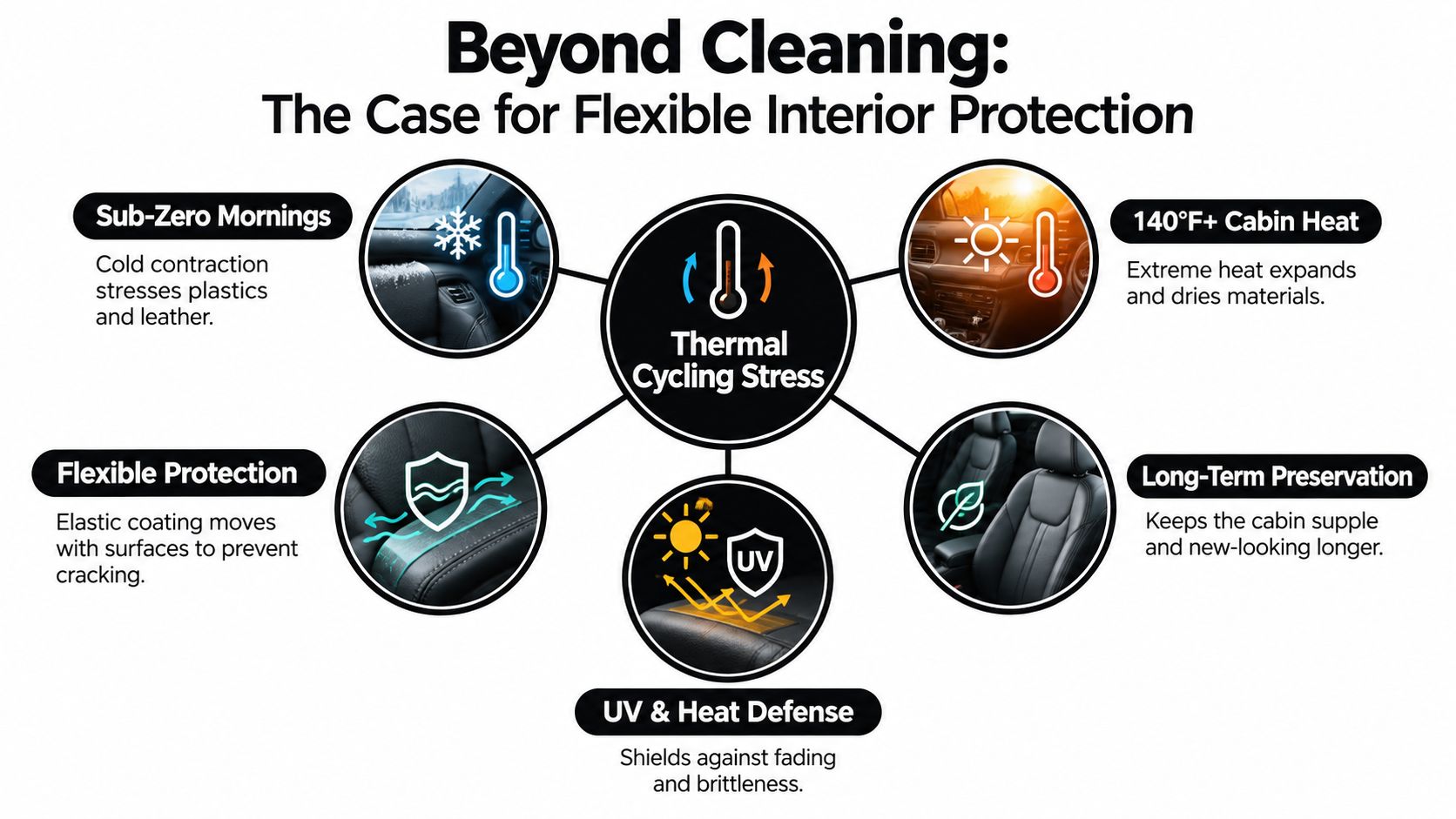
A lot of trim damage doesn't come from one dramatic event. It comes from expansion, contraction, skin oils, friction, heat soak, and repeated wipe-downs. That's why I don't like rigid protection as a default mindset for surfaces that flex, warm up, cool down, and get handled constantly.
Why flexibility matters more than people think
Published materials research is clear on a core principle. Coatings often fail when the coating and substrate expand at different rates during heating and cooling cycles. Thermal-expansion mismatch is identified as a primary driver of residual stress, cracking, and delamination in this overview of thermal barrier coating cracking mechanisms. That's an industrial example, but the logic applies cleanly to vehicle surfaces that see constant temperature swings.
A published review on thermal-shock resistance also explains that rigid ceramic layers can be engineered to relieve strain through controlled microcracking instead of catastrophic failure, and notes a quench-cracking treatment range of roughly 1,900 to 2,100°F (1,038 to 1,149°C) in this PatSnap review on boosting thermal shock resistance in ceramics. Again, different context, same lesson. Flexibility and strain relief matter.
Titan has built its coating approach around elastomer technology, nanotubes, and Dark Matter tech. That's worth paying attention to because flexibility is not a gimmick. It's a durability strategy.
Where this matters in real vehicle care
Glass is the obvious example. A clean windshield isn't enough if it immediately loads up with water and haze during bad weather. Titan's Apex Glass Ceramic Coating fits this conversation because it's a glass-focused option intended to improve water behavior and visibility, and it's easy to apply for someone who wants a practical upgrade rather than a complicated process.
For cabin-adjacent and trim-focused maintenance, a flexible protection mindset makes more sense than piling on greasy dressing. If you're comparing options for coated leather and trim preservation, Titan's ceramic leather coating is one route to look at when you want protection without chasing a wet look.
Rigid shine doesn't mean durable protection. On interiors, it often means the product is sitting on top instead of working with the surface.
Best Product Pairings for Common Detailing Scenarios
Not everybody needs the same kit. A parent cleaning a daily driver shouldn't buy like a studio detailer. A mobile detailer shouldn't work from a stripped-down DIY tote.
Interior Detailing Kits by Persona
| Persona | Core Cleaning Products | Brushes and Tools | Protection Layer | What to Skip |
|---|---|---|---|---|
| DIY enthusiast | One broad interior cleaner, fabric spot cleaner, glass cleaner | Vacuum, crevice tool, one soft brush, one medium brush, microfiber stack | One matte protectant for trim and vinyl | Too many specialty products you won't use often |
| Mobile detailer | Broad interior cleaner, dedicated leather cleaner, upholstery cleaner, glass cleaner, odor treatment as needed | Multiple brushes, drill brush for mats if appropriate, extractor, air tool or blower, separate towels by surface | Separate leather and hard-surface protection | Wipes as primary cleaning method |
| Premium leather owner | Gentle leather cleaner, screen-safe wipe method, glass cleaner | Soft detailing brush, premium microfiber only | Matte leather-safe protectant | Strong APCs, glossy dressings, stiff brushes |
DIY enthusiast
Keep it lean. You need one dependable residue-free interior cleaner, a real vacuum, proper towels, and a plastic-safe protectant that doesn't leave gloss.
Skip the giant kits full of overlapping bottles. Most DIY users get better results by buying fewer, better-matched products and changing towels more often.
Mobile detailer
You need range, not clutter.
Carry:
- One broad cleaner for plastics, dash, door panels
- One fabric or upholstery cleaner for seats and mats
- One dedicated leather option for higher-end interiors
- A true glass product with its own towel set
- An odor solution when smell is the actual complaint
This is also where a simple spray protectant earns a place. Titan's Ultra Ceramic Spray makes sense for detailers who want an easy-to-install protection step with fast workflow and straightforward results on appropriate hard surfaces. It's not an interior cleaner. It's a protection option when your job includes adjacent trim and broader vehicle care.
Premium leather owner
This owner should be the least aggressive of the three.
Use soft brushes only. Keep towels dedicated. Don't drench seams. Don't use a strong cleaner because one stain annoyed you. Premium interiors age badly when owners “deep clean” them too often and too harshly.
How to Apply Interior Protectants and Glass Coatings the Right Way
Application is where good products get judged unfairly. A strong product applied too heavily looks bad. A simple product applied correctly often looks excellent.
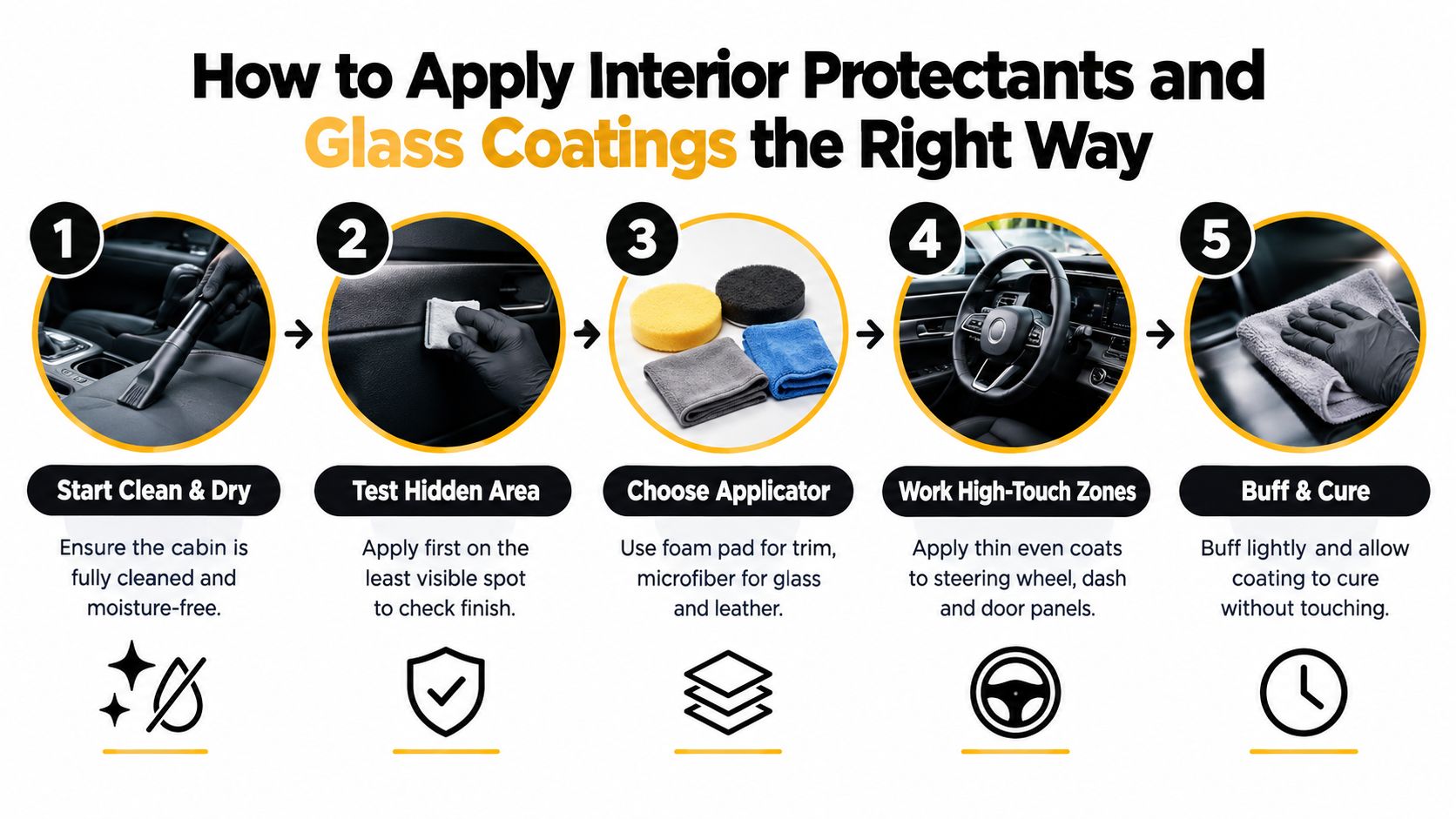
The workflow I trust
Start with a fully cleaned, dry cabin
Don't protect dirt. Don't trap moisture. If the surface still feels slick from cleaner residue, fix that first.Test the least visible area first
Lower door trim, seat base plastic, or a tucked-away section of glass is enough. Check sheen, wipe-off, and compatibility.Apply to applicator, not straight to sensitive surfaces
For vinyl and soft-touch trim, use a foam or microfiber applicator. For leather, use a soft microfiber or dedicated pad. For glass coatings, follow the product method and keep towels clean and dry for leveling.Work in sequence
Hard trim first. Leather or delicate trim second. Glass last. That way, if you touch the glass with anything during earlier steps, you still clean and coat it at the end.
Safety and inspection matter
Ventilate the cabin. Doors open. Air moving. Don't work trapped inside a closed vehicle with coating products or strong interior chemistry.
Use a diffused LED light at an angle across the surface when you inspect. That's how you catch streaks on gloss trim, patchy dressing on door panels, and missed residue on the windshield.
If you're judging durability claims, use standards, not bottle language. Automotive coating evaluation commonly uses tests such as ASTM D2794 for impact resistance, ASTM D7234 and ISO 4624 for pull-off adhesion, and ISO 4628-4 for cracking assessment, as outlined by InfinitiLab's automotive coating testing overview. That matters because real durability can be checked.
Thin, even coverage beats heavy application every time. Most interior streaking is overuse, not product failure.
On glass coatings and curing
Interior protectants usually want a light wipe, brief set time, and a final buff if needed. Glass coatings are less forgiving. Prep matters more, towel quality matters more, and rushed leveling shows up fast when headlights hit the windshield at night.
Let the vehicle sit undisturbed as long as the product directions require. Don't touch coated surfaces immediately after application unless the product specifically calls for a final leveling wipe.
Choosing Products That Last Without Damaging Modern Cabins
A strong cleaner isn't automatically a smart cleaner. I've seen more interiors dulled by “powerful” products than rescued by them.
Interior Detailing Ingredients Surface-Safe vs. Damaging
| Ingredient Type | Effect on Leather | Effect on Vinyl/Soft-Touch | Effect on Glass | Recommendation |
|---|---|---|---|---|
| Harsh solvents | Can dry and strip finish | Can dry, haze, or weaken delicate coatings | Can smear and create vapor film issues | Avoid for routine interior care |
| Heavy silicone dressings | Can leave slippery, unnatural feel | Attracts dust, leaves greasy shine | Transfers easily and causes smearing | Avoid unless you want gloss more than cleanliness |
| Strong alkaline cleaners | Can strip coated leather finish | Can over-clean and flatten appearance | Not ideal for interior haze removal | Use cautiously, not as a default |
| pH-balanced residue-free cleaners | Safer routine maintenance | Cleaner finish, less dust attraction | Better towel control when used correctly | Preferred for regular use |
| Flexible protectants | Helps preserve finish without stiffness | Better fit for trim that heats and cools | Not a glass cleaner, but useful in broader preservation strategy | Strong long-term choice where appropriate |
Buy for preservation, not force
The best products for car interior detailing are the ones that clean enough and stop there. They don't leave gloss where there shouldn't be gloss. They don't harden the feel of trim. They don't turn leather slick. They don't make your windshield worse in sunlight.
Odor is part of that decision too. If the cabin smells stale after you've cleaned it correctly, adding fragrance without fixing the source is lazy detailing. If you want a separate read on choosing scent that lasts after the cabin is clean, this guide on how to find a long lasting car air freshener is useful.
Read the product sheet. Test a hidden spot. Build a kit around surfaces, not marketing promises. If a product can't preserve the finish you started with, it doesn't belong in your regular routine.
If you want protection that fits this surface-first mindset, APEX NANO – Titan Coatings offers coating solutions built around durability, flexibility, and real-world vehicle use. That includes options for glass clarity, leather care, and easy-apply protection that make sense when you're trying to keep a cabin and the surrounding surfaces cleaner, clearer, and easier to maintain.
0 Comments