
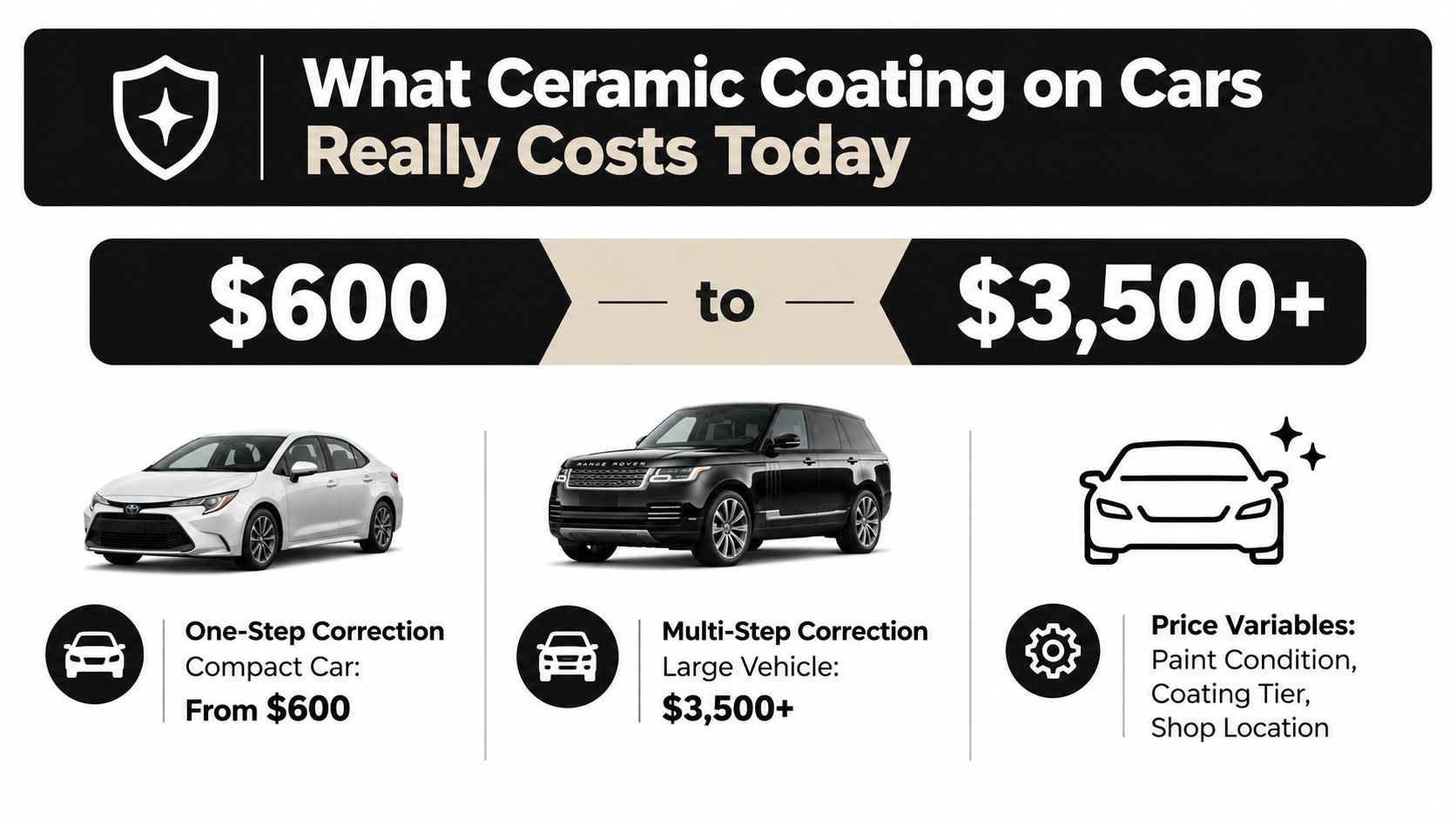
Ceramic coating on cars cost typically runs $600 to $3,500 professionally and $50 to $400 for DIY, with labor and paint correction driving most of the professional price. The bottle is rarely the expensive part, and that’s why two cars parked beside each other can receive the same coating yet receive very different quotes.
You’re probably looking at your car after a wash, noticing dullness, water spots, or a web of fine swirls under the sun. The online offer says “ceramic coating” for a few hundred dollars, while a reputable detailer quotes well over $1,000. Both may be describing a real product, but they’re not describing the same preparation, surface coverage, correction work, or risk.
I’ve quoted enough coating jobs to give you the useful answer: paint condition, vehicle size, preparation time, and coating tier matter more than the product bottle alone. Professional applications can take 15 to 20 hours, while a DIY exterior kit costs far less in materials, as documented in Autotrader’s ceramic coating cost guide. The right budget depends on what your paint needs before the coating ever touches it.
What Ceramic Coating on Cars Really Costs Today
A detailer can quote $600 to $3,500 for a professional ceramic coating, while premium multi-layer or warranty-backed work may reach $2,000 to $5,000 or more in high-end segments, according to Goods Detailing’s pricing overview. DIY products commonly cost $50 to $400, and some retail guidance places product-only exterior costs around $200 to $400. Those figures describe different levels of preparation, coverage, product, and installation, so a single headline price is a poor budget guide.
Start with the paint, not the bottle. A compact car with newer paint and minor defects may begin near $600. A large SUV or truck with heavy swirls, oxidation, or water-spot damage can exceed $3,500 after multi-stage polishing. A $199 special may cover selected panels, minimal correction, or an entry-level product. Get the inclusions in writing before calling it a bargain.
Three price tiers that make sense
| Tier | What you should expect | Best fit |
|---|---|---|
| Entry | Decontamination, basic application, and limited correction or no correction | Newer paint with few defects |
| Mid-range | More thorough preparation, light correction, and a stronger professional coating | Most daily drivers |
| Premium | Multi-stage correction, premium coating system, broader coverage, and written warranty terms | Luxury vehicles, heavily marked paint, long-term ownership |
A garage-kept car may need only a light polish. A heavily swirled commuter vehicle may require far more preparation before the same coating can bond correctly. The four main quote variables are vehicle size, paint condition, correction level, and coating tier. Location and shop overhead affect the final figure, but they come after those fundamentals.
Use this guide to compare ceramic coating prices only after confirming that the competing quotes cover the same work. That condition-based comparison gives you a usable budget instead of an average detached from the car in your driveway.
Where the Money Goes in a Professional Quote
A professional quote pays for far more than the bottle of coating. Independent detailing estimates place materials and labor at roughly 60% to 70% of the total ticket, as reported by CarTipsDaily’s ceramic coating cost guide. Preparation can take one to three days and add $100 to $2,000 or more, depending on paint defects, vehicle condition, and the correction required.
A clear estimate should separate four cost buckets:
- Decontamination, including the wash, iron fallout removal, clay bar treatment, drying, and panel wipe.
- Paint correction, including machine polishing to reduce swirls, oxidation, haze, and water-spot damage.
- Coating application, including the product, applicators, leveling, panel inspection, and coverage.
- Overhead and curing, including lighting, climate control, a clean workspace, warranty administration, and the space needed for curing.
The liquid coating usually costs less than the labor required to prepare the paint. Ask the shop to list paint correction before ceramic coating as its own line item instead of burying it inside a vague premium package.
A worked estimate
Take a mid-size sedan with moderate swirls, a two-stage correction, and a five-year coating. The invoice will change with the shop and the car, but the structure should look like this:
| Line Item | What’s Included | Typical Cost | Share of Total |
|---|---|---|---|
| Decontamination wash | Wash, iron remover, clay bar, drying, panel wipe | Qualitative line item within the quote | Smaller share |
| Paint correction labor | Two-stage machine polishing and inspection | Main labor component | Often the largest share |
| Coating application | Professional coating, application, leveling, inspection | Material and application charge | Smaller than correction on damaged paint |
| Shop overhead | Curing space, lighting, administration, warranty process | Included in shop rate | Supporting share |
Do not assume the coating itself accounts for the full invoice. A product such as Alpha Quartz 50ml Ceramic coatig is described by Titan as an Elastomer ceramic coating for all surfaces, with 92% high solids, zero VOCs, a solvent-free formulation, advanced adhesion technology, and a stated four-hour cure. Those specifications do not replace proper correction or careful application.
Practical rule: Pay for the condition of your paint, not for a grand-sounding warranty label.
The shop also charges for time under proper lighting, machine polishers, pads, microfiber towels, inspection tools, and a controlled cure area. Ask one direct question: “What exact work must happen before the bottle is applied?”
DIY Versus Professional Installation
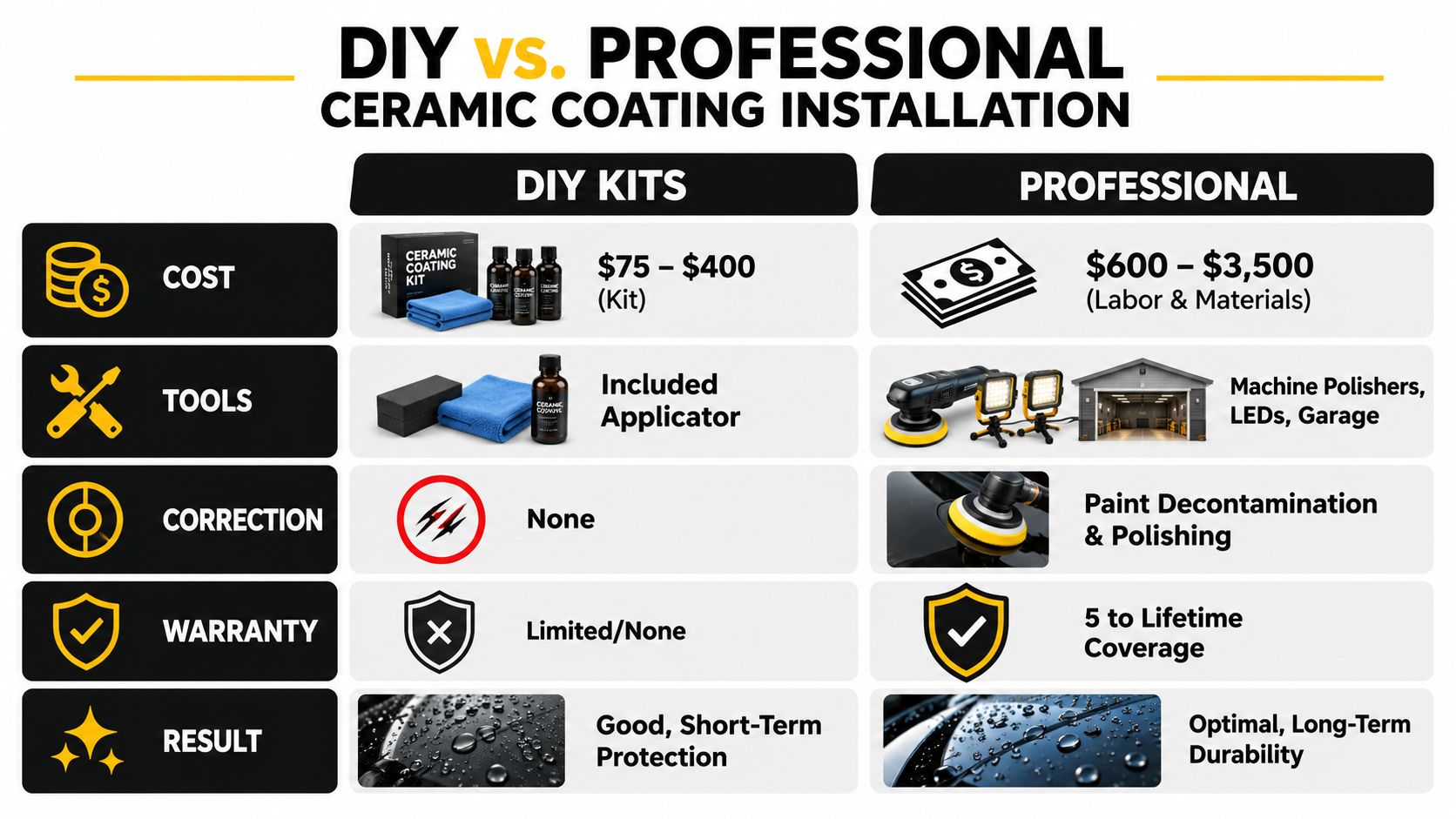
DIY coating makes sense for some owners, but it isn’t automatically the cheaper version of professional work. A kit may cost $50 to $400, while professional installation commonly ranges from $600 to $3,500, as outlined by AutoZone’s ceramic coating cost guide. The difference is mostly the service around the product.
Five trade-offs that decide the answer
Price. DIY removes shop labor, but it doesn’t remove the cost of wash chemicals, clay, polish, pads, towels, lighting, and a suitable workspace. Professional pricing buys correction, application discipline, and a process designed to reduce mistakes.
Tools. At minimum, a serious DIY job needs applicators, clean microfiber towels, strong inspection lighting, a dual-action polisher for correction, suitable pads, and a clean area where dust won’t settle into the coating. An infrared lamp can help a professional inspect or manage curing, but it doesn’t replace preparation.
Skill. The difficult part is often the wipe-off timing. Wash contamination, clay residue, polishing oils, uneven application, and high spots can leave visible defects. An experienced hobbyist can manage that process. A first-time installer may spend more time correcting a coating mistake than the original application.
Durability. Real-world longevity depends on product tier and maintenance. Consumer-grade coatings are commonly reported at 12 to 24 months, while professionally installed premium coatings commonly last three to five years, and well-maintained top-tier products may reach six to seven years, according to Aqualine Performance’s durability guide.
Risk. A DIY job usually carries limited or no meaningful warranty. If you create high spots, miss contamination, or coat over defects, you’ll pay in time and potentially in removal and correction work.
DIY ceramic coating for cars can be a sensible route for a patient owner with a dust-controlled garage and realistic expectations. Titan’s ULTRA Ceramic Spray is described as a concentrated, water-based flexible membrane sealant for paint, wraps, PPF, glass, wheels, trim, household items, and personal items.
The rule is simple. DIY pays when you have time, patience, tools, and acceptable paint. Professional work pays when the car has defects, the panels are difficult, or the finish matters more than saving installation labor.
Real Quotes by Vehicle Type and Paint Condition
A black daily driver arrives after years of automatic washes. Under bright inspection lights, the owner sees fine swirls everywhere, plus deeper marks across the hood and doors. The requested coating hasn’t changed, but the quote has. The shop must correct the surface before protecting it.
A lightly driven sedan kept indoors tells a different story. Its paint may need decontamination and a light polish, so the same coating package requires less preparation. The coating choice doesn’t erase the condition of the paint.
Representative quote scenarios
A compact sedan with light swirl marks can land around $900 to $1,400 once a single-stage polish is included. A black SUV with heavy wash-induced scratches can move toward $2,500 to $3,500 when it needs two-stage correction. These are condition-based examples within the broader ranges reported in independent pricing guidance, not universal menu prices.
| Vehicle Type | Light Swirls | Moderate Defects | Heavy Correction Needed |
|---|---|---|---|
| Compact sedan | Around $900 to $1,400 | Higher after additional polishing | Can reach premium pricing |
| SUV | Higher than a comparable sedan | Preparation expands with surface area | Around $2,500 to $3,500 in demanding cases |
| Truck | Higher product and labor demand | Quote depends heavily on bed and panel condition | Premium pricing is common |
Darker colors don’t change the coating chemistry, but they expose defects more clearly. That usually means longer polishing cycles, additional inspection, and more pad changes. Trucks also add surface area, awkward panel shapes, and often a bed that must be washed, corrected, and coated.
Matte finishes, exotic paint systems, and repainted panels deserve a separate conversation. A shop may need to adjust its correction approach because aggressive polishing can change the appearance of a matte surface or reveal unevenness in a repaired panel. The cost of car paint detailing should never be treated as an afterthought when the finish requires specialized handling.
A reputable shop should inspect the vehicle in person or through detailed evidence, examine paint under strong LED lighting, assess contamination and defects, decide the correction level, and then match the coating tier to the owner’s goals. If the quote arrives without a paint assessment, it’s a guess dressed as a package.
Annual Maintenance and Ownership Costs
A coated car still needs regular care. Skip safe washing and the finish will lose the behavior you paid for, even if the coating itself remains on the paint. Use clean wash media, controlled drying, and products that suit the coating. An abrasive brush wash can still mark the clear coat.
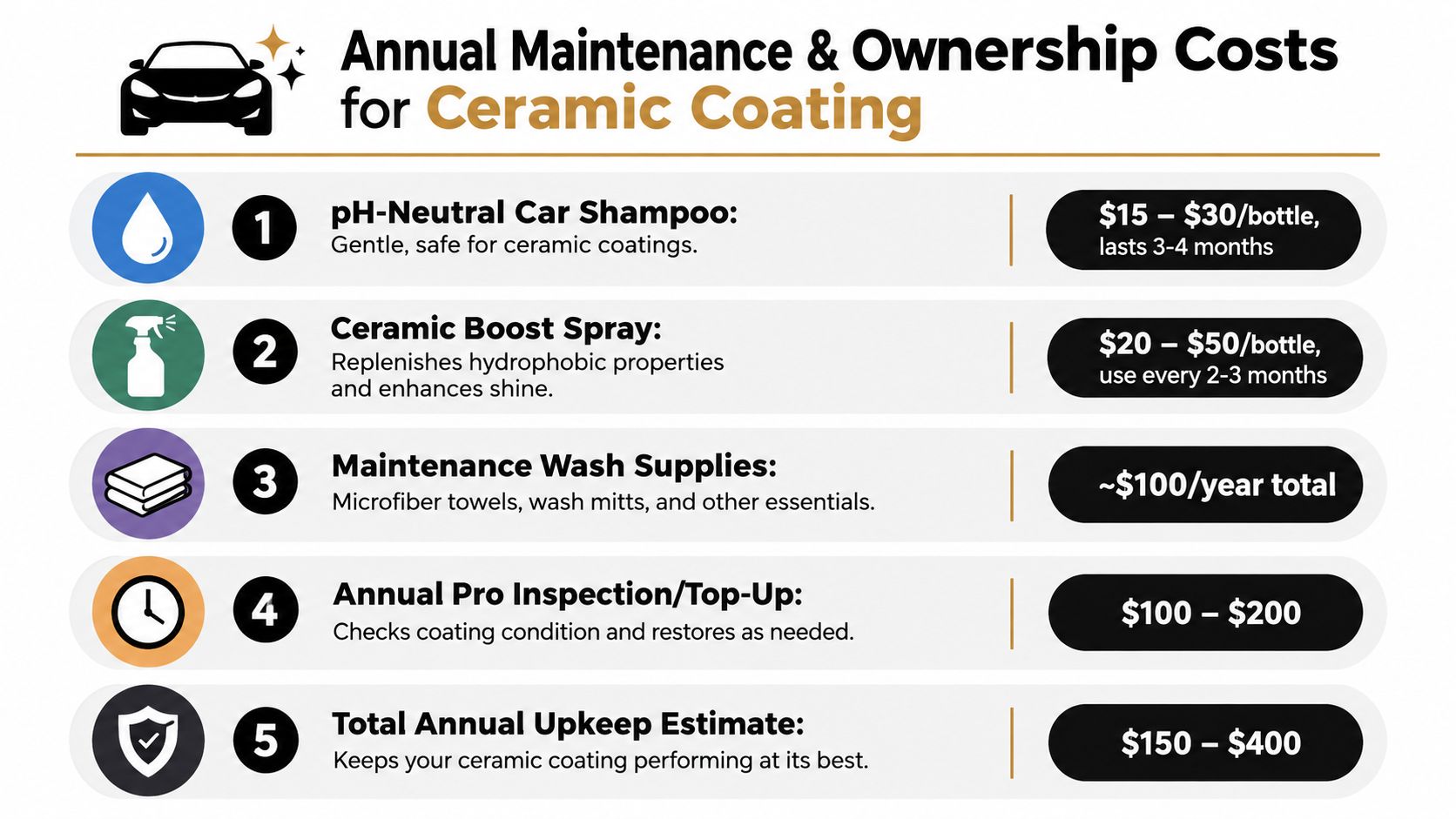
DIY upkeep usually means buying pH-neutral shampoo, a ceramic maintenance spray, iron fallout remover, clean wash media, and replacement microfiber towels. Published guidance places shampoo around $15 to $30 per bottle, top-up sprays around $25 to $60, iron remover around $15 to $25, and microfiber supplies around $20 to $40, according to Ceramic Pro’s maintenance cost guidance. Follow each product’s instructions. More product does not automatically mean better protection.
What to budget beyond installation
- Wash chemistry: Choose pH-neutral shampoo and uncontaminated tools. Dirty mitts and harsh chemicals create avoidable problems.
- Hydrophobic maintenance: Use a compatible ceramic detailer or top-up product when the coating’s water behavior starts to weaken.
- Decontamination: Iron fallout can accumulate even when the paint looks clean, particularly near industrial roads and rail corridors.
- Professional upkeep: Depending on the coating system and driving conditions, a shop may inspect and refresh the vehicle about once each year.
Budget roughly $100 to $350 annually for DIY maintenance and $250 to $600 when a shop handles the work. Treat that expense as part of protecting the original installation, not as an optional add-on. Skipping upkeep can leave contamination and mineral deposits to address later, often requiring more aggressive detailing.
Avoid automated brush washes, abrasive polishing, and random wax layering. Use the installer’s recommended products and follow the manufacturer’s process. Titan’s guide to ceramic coat maintenance provides a practical routine for washing, drying, and maintaining coated paint.
When Ceramic Coating Actually Pays for Itself
A coating makes financial sense when your car lives outside, gets washed often, and stays in your ownership for years. It makes less sense for a garage-kept weekend car, a vehicle you plan to trade soon, or paint that already needs major correction. The installed coating is only part of the decision. Vehicle condition, size, labor, and ongoing care determine whether the protection earns its keep.
Owners who usually get the most value
- High-mileage drivers who wash frequently and want faster, easier cleaning.
- Outdoor parkers exposed to UV, contamination, and changing weather.
- Dark-car owners who want to reduce recurring polishing bills.
- Lease customers who care about presentation and visible wear.
- Enthusiasts keeping a vehicle for years and prepared to maintain the coating correctly.
Severely oxidized or failing paint is a poor candidate. A coating can preserve sound paint, not stabilize a failing finish or repair deep damage. Correct the surface first, then price the coating. Otherwise, you risk paying for protection over defects that still demand expensive work.
Run your own break-even calculation. Add your last 12 months of washes, details, polishing, and presentation work, multiply that spending by the years you expect to keep the vehicle, then compare it with the installed coating and $100 to $350 in annual DIY maintenance. Frequent outdoor washing can bring the payback forward. Infrequent washing in a garage may leave too little avoided spending for the coating to break even.
The strongest return is easier cleaning, reduced correction frequency, and better-presented paint. Do not buy it for stone-chip protection. Ceramic coating helps resist contamination and chemical exposure, but it will not stop deep scratches, careless washing, or collision damage. Compare the ceramic coating versus PPF cost before choosing protection for a specific paint risk.
Choosing the Right Path for Your Budget
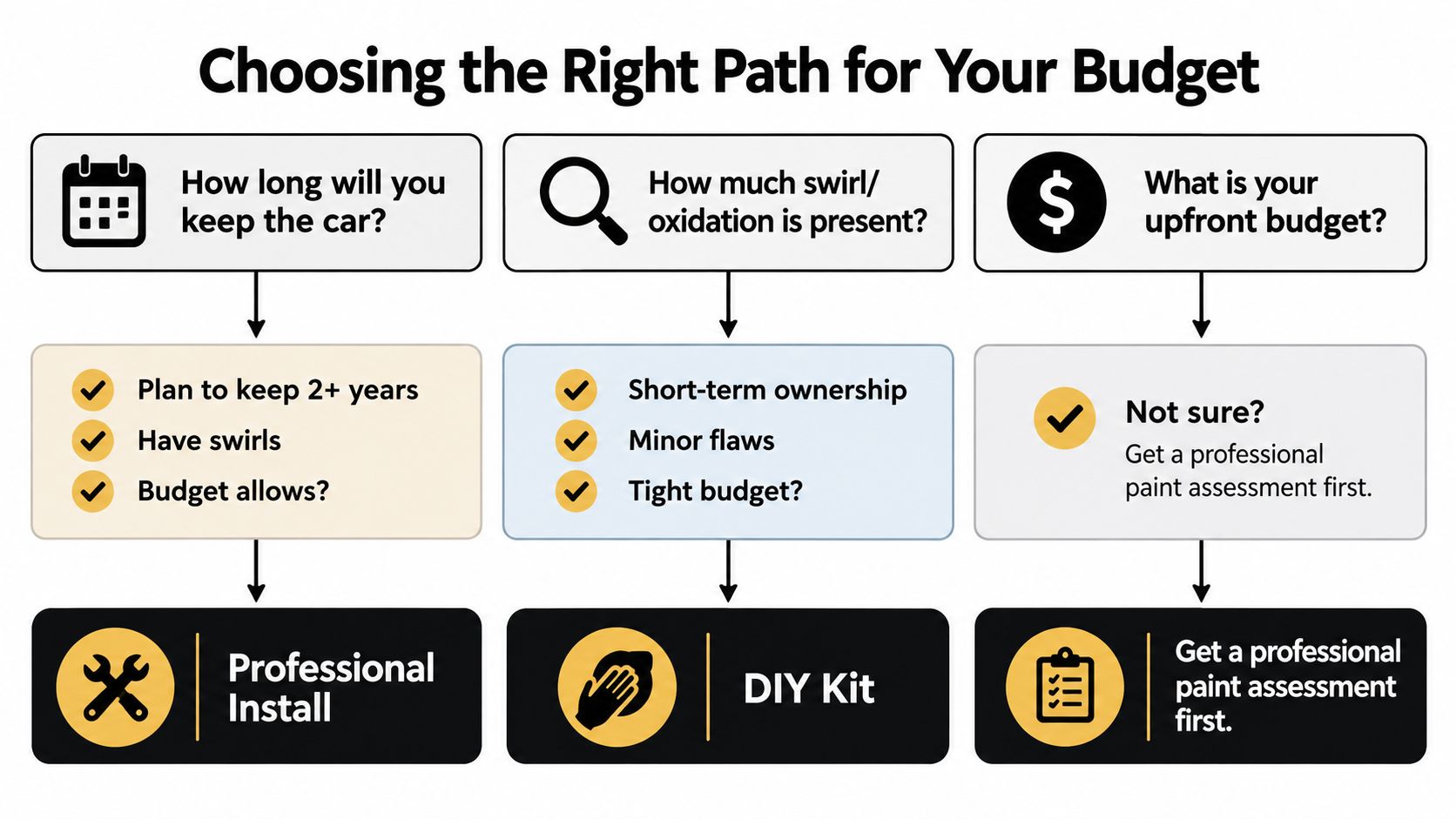
A coating decision starts with the car, not the product brochure. I ask three questions before quoting the job:
- How long will you keep the car?
- How much swirl, oxidation, and etching already exists?
- Do you have a clean garage, suitable tools, and time to learn the process?
A newer sedan with light defects can suit DIY application. You still need thorough decontamination, strong lighting, and enough skill to correct the paint. If you cannot control a dual-action polisher for several hours, do not use your own vehicle as practice.
Match the route to the vehicle
Choose professional installation for heavily swirled daily drivers, large SUVs, trucks, exotic finishes, repainted panels, or vehicles where resale presentation matters. The quote covers correction judgment, controlled preparation, and careful application, not just a bottle of coating.
Choose DIY when the paint is already sound, you will keep the vehicle long enough to justify the learning curve, and your garage can remain clean and dry during application and curing. For upkeep, OMNIGUARD – Waterless Wash is described as a quick sealant for wipe-downs, water-mark removal, and UV protection, with HYPERBEAD™ particles and durability of up to six weeks.
Reject vague upsells. Require written maintenance terms for any multi-year warranty. Question mandatory quarterly detailing contracts and premium top-up sprays whose cost exceeds their practical benefit. Ask for a paint-thickness reading, corrected-light photographs, the coating brand, registered installer status where applicable, and a written preparation scope.
Titan has developed coating technology that includes Elastomer coatings introduced with nano tubes technology and Dark Matter technology. Titan describes its Elastic coatings as glass-hard while remaining flexible, a design intended to accommodate temperature changes and impacts such as bug strikes without cracking. Review APEX NANO – Titan Coatings products, including glass and windshield options, before selecting a system for paint, glass, or other surfaces.
Apex Glass Ceramic Coating is intended for glass and windshields. Its hydrophobic behavior can improve rain visibility and reduce frequent wiper use. It is a practical add-on for drivers who dislike wet-weather glare and constant wiper work, provided the glass is properly cleaned and prepared first.
APEX NANO – Titan Coatings offers automotive coating options for paint, glass, windshields, wraps, PPF, wheels, and trim, including Elastic coating technology designed to combine hardness with flexibility. Visit APEX NANO – Titan Coatings to review the range and choose a coating path that fits your paint condition, installation skill, and long-term budget.
0 Comments