
A customer once brought me a glossy sedan that felt like sandpaper after a careful wash. The paint looked clean, but industrial fallout and construction dust had bonded to the clear coat, turning every careless wipe into a potential scratch.
The Hidden Blade on Your Paintwork
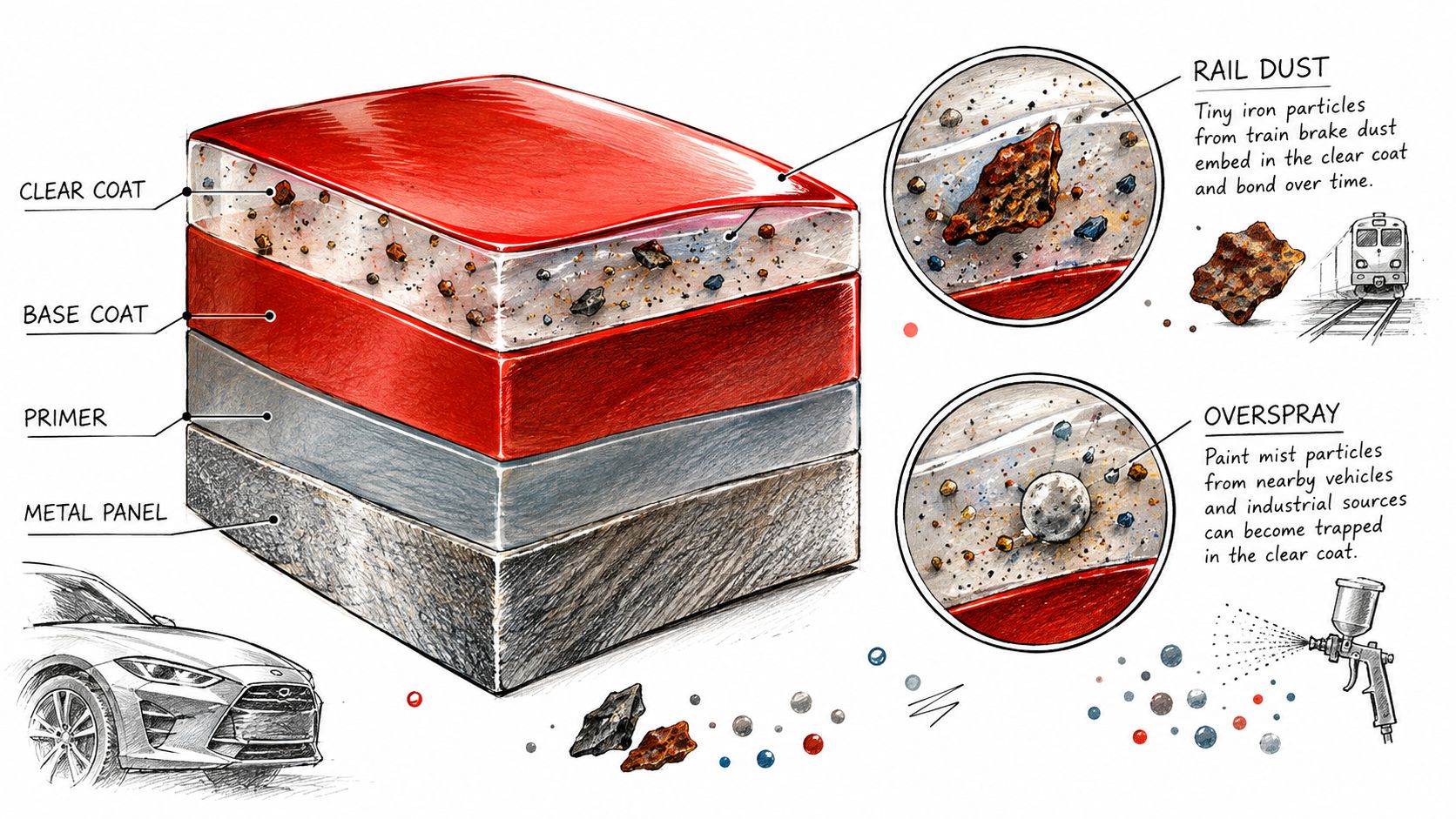
Modern paint doesn't fail only because of visible dirt. Bonded contamination can sit above the clear coat as industrial fallout, rail dust, tar residue, tree residue, or paint overspray. It may look like a few harmless specks, but those particles create a rough surface that ordinary washing can't fully remove.
I remember a waxed sedan that arrived looking excellent under the driveway shade. Its owner had driven through a construction zone and washed it afterward, yet the finish felt harsh under a fingertip. The wax had improved the gloss, but it hadn't removed the contamination. Loose soil was gone. The embedded debris remained, acting like a microscopic saw blade whenever a towel, wash mitt, or drying cloth crossed the panel.
Washing and decontamination do different jobs
An auto cleaning clay bar isn't a stronger car wash. Washing primarily removes loose dirt and abrasive road film. Claying addresses material that remains attached after washing, using a lubricated polymer surface to shear and capture particles protruding from or bonded to the paint. That physical mechanism is why clay can remove contamination such as industrial fallout, overspray, tar, and other bonded debris. Fresh Start Detail's explanation of clay-bar operation also places the tool's origin in Japan in 1987, when chemist Tadao Kodate developed the material for modern automotive paint.
The history matters because clay was created as a paint-preparation tool, not as a cosmetic shortcut. It became broadly available to professional detailers in the United States during the late 1990s, after first being associated with automotive production and repair applications in Japan. Its purpose is to restore a smoother substrate before polishing or applying wax, sealant, protective film, or ceramic coating.
Practical rule: If freshly washed paint still feels gritty, don't compensate with more pressure. Find out what remains bonded before you touch it again.
The safest starting point is a tactile inspection after washing. A thin plastic bag over your fingertips can make tiny raised particles easier to detect, a method associated with U.S. Patent No. 5,716,259 in this detailing patent history. For a broader vehicle-specific process, use this car paint decontamination guide, especially when the next step involves polishing or coating installation.
Prepping the Canvas for Decontamination
I have seen impatient owners grind contamination into otherwise saveable paint just because the car looked clean from six feet away. Clay on a dirty panel does that fast. Loose grit, brake dust, and hard ferrous particles turn the bar into a dragging abrasive, and now a contamination job becomes a correction job.
Start on a cool vehicle, out of direct heat, and rinse it like you mean it. Wash from the top down with a clean mitt and a soap that suits the finish. Spend extra time on lower doors, rocker panels, wheel arches, and the rear bumper area, because that is where road film, grit, and oily residue build up the worst. The goal here is simple. Remove anything loose before the clay ever touches the paint.
A proper pre-wash for cars helps break that layer up before your contact wash, which lowers the odds of dragging grit over the clear coat with the mitt. Flush panel gaps, badges, trim lines, fuel doors, and wheel-area edges thoroughly. If you leave debris hiding there, rinse water and lubricant will pull it back onto the panel later.
Use chemistry before friction
Once the paint is washed, check for signs of iron fallout. Orange or brown specks, roughness clustered behind the wheels, or regular exposure to rail dust, industrial activity, ports, or dense traffic all point to ferrous contamination. Clay can shear surface junk off the top, but it does not change the fact that metal particles are hard, sharp, and capable of scoring paint if you force them around by hand.
Use a compatible iron remover exactly as directed by its manufacturer, let it react for the stated time, then rinse it fully. That step cuts down how much bonded metal your clay has to move across the surface. The EPA-documented case involving airborne iron and automobile-paint damage describes iron concentrations of 11 to 63 micrograms per cubic meter in the affected environment. Location changes the contamination load, and the paint pays for it.
Deal with residues before claying
Tar, sap, adhesive smears, and old decal residue need the right chemistry first. Repeated clay passes over that mess waste time and increase the chance of marring. If the vehicle still has vinyl lettering or stubborn adhesive, this auto graphic removal advice is a solid reference before you start rubbing on the panel. Strip the residue, wash the area again, and then reassess by touch.
By this stage, the surface should be clean, cool, and free of loose residue from your wash and decon chemicals. Stop if the paint is peeling, badly oxidized, chipped, rusted, or otherwise unstable. Clay is a prep tool, not a rescue tool, and damaged paint can fail quickly under mechanical contact.
If you want light protection after prep and before heavier correction or coating work, use a factual product fit, not hype. Apex Glass Coating is presented for hard-surface protection, but protection still comes after proper decontamination. Clay removes bonded contamination. It does not solve the root problem of future exposure, which is why the actual fix starts after the surface is properly prepared.
Mastering the Clay Bar Technique
The clay bar should glide. If it sticks, skips, chatters, or feels dry, the process is wrong, regardless of how clean the panel looks. Good technique is controlled and almost boring. That's a compliment. Boring work leaves fewer defects.
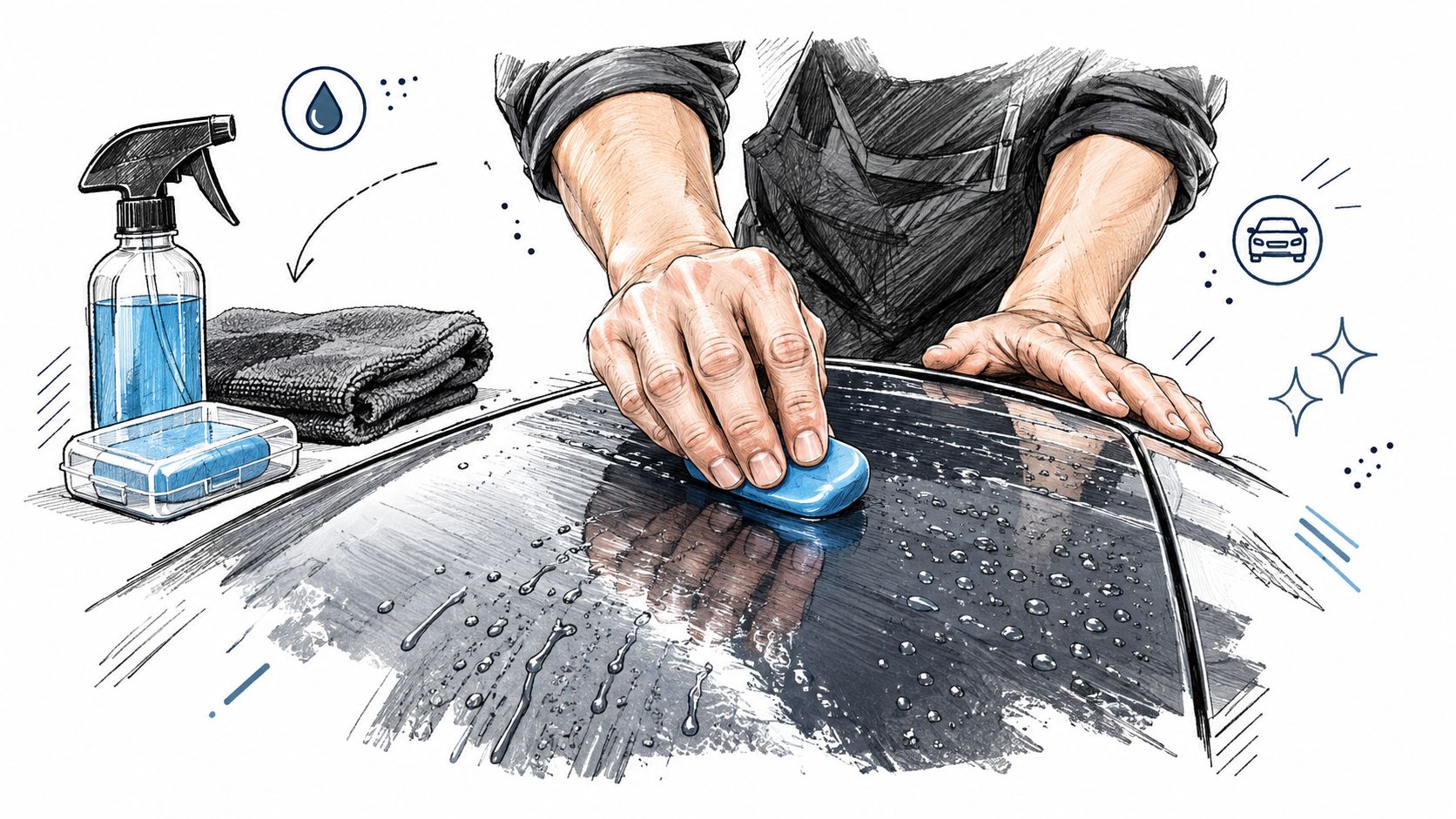
Break off a manageable piece and flatten it into a pad. Don't use the entire bar in your hand. A smaller working piece gives you room to fold contaminated material inward and expose a clean face. If the clay touches the ground, discard it. You can't reliably remove the grit it picked up.
Work in controlled sections
Divide the vehicle into areas of approximately 2 × 2 feet. Spray enough high-slip lubricant to keep the section continuously wet, then lay the clay flat and move it in straight, overlapping passes. Use minimal pressure. The clay's pliable polymer and the lubricant should do the work, not the weight of your arm.
Circular rubbing is a bad habit because it can distribute trapped particles in random directions and create marring that's harder to evaluate and correct. Straight passes make any light marking more predictable if correction becomes necessary. Keep checking the feel. Roughness often gives way to a smooth glide as the bonded material lifts.
- Lubricate generously: Never let the bar travel over a drying section.
- Use light contact: Increased pressure doesn't make the clay more effective. It increases the chance of marring.
- Overlap straight passes: Cover the section methodically rather than scrubbing one spot.
- Wipe immediately: Use a clean microfiber towel to remove residue before it dries.
- Inspect and fold: Look at the clay face after each section, then fold and knead it to expose clean material.
Know when to stop
Don't keep claying a panel because you're chasing a perfectly sterile feel. Recheck with a gloved hand or thin plastic film after wiping. If one area remains rough, treat that area again instead of repeatedly working the entire panel.
For iron-heavy vehicles, use an appropriate iron fallout remover before increasing clay pressure or choosing a more aggressive tool. A clay bar removes bonded surface contamination, but it doesn't polish scratches, remove oxidation, or repair failing clear coat. If the bar introduces light marring, paint correction may be needed before protection.
Glass can be clayed when it has bonded residue, but it needs the same lubrication and inspection discipline as paint. Once the glass is clean, Apex Glass Coating- 50ml is described as an advanced hydrophobic glass and windshield coating with deep pore bonding, water-repellent performance, enhanced visibility, reduced wiper use, and a stated durability of up to 2 years.
Why Clay Is Only the First Step
A smooth panel can fool you. After claying, the paint feels clean and refined, but that doesn't mean it's protected, corrected, or ready for a coating without further inspection. Clay removes contamination. It doesn't fill defects, stabilize failing paint, or create a durable barrier against the next exposure.
A clayed surface is like a freshly stripped wooden table. It feels excellent because the debris is gone, but it remains exposed. If the next step is polishing, inspect for marring and defects first. If the next step is a sealant or coating, remove polishing oils and confirm that the substrate is stable and properly prepared.
The surface determines the protection
Many DIY jobs go wrong at this point. The owner spends time making the paint smooth, then applies a product over oxidation, residue, or an uncorrected surface without checking compatibility. The result may look good briefly, but a coating can't turn failing clear coat into sound paint.
Use a small test area under suitable lighting. Check whether the finish is glossy, matte, peeling, chalky, chipped, or wrapped. Never clay matte paint, unstable clear coat, rusted areas, unfinished metal, or damaged wraps without confirming that the material and process are suitable. On matte finishes, mechanical contact can flatten texture and leave glossy streaks that correction may not restore.
More decontamination isn't automatically better. Stop when the contamination is gone, not when impatience demands another pass.
Hardness isn't the complete durability story
Rigid films can struggle when the coating and its substrate respond differently to temperature. Research on brittle coatings over polymer substrates shows that crack-onset behavior changes with temperature and material system. Separate testing of inorganic coatings on polymer substrates found critical cracking strains of approximately 0.5% to 1.5%, depending on coating composition and thickness, while the polymer substrate became considerably more compliant at 150°C than at 23°C. The EPFL materials research provides the engineering context.
That doesn't mean every hard automotive coating will fail in the same way. It does mean hardness alone is an incomplete selling point. A coating also needs adhesion and controlled flexibility so it can follow movement in the panel instead of resisting every change until the film cracks or loses integrity. Read this paint correction guidance before ceramic coating before treating a smooth tactile result as a finished job.
Applying Advanced Elastomer Coatings
A clay bar leaves paint cleaner. It does not leave it protected. I see DIY jobs fail right here, after the owner has done the hard part, felt that slick finish, and assumed the work is finished. It isn't. Once the surface is decontaminated, corrected if needed, and stripped of residue, the decision starts. You either lock in that finish with a coating that can live with heat, cold, impact, and panel movement, or you leave fresh paintwork exposed to the same abuse that contaminated it in the first place.
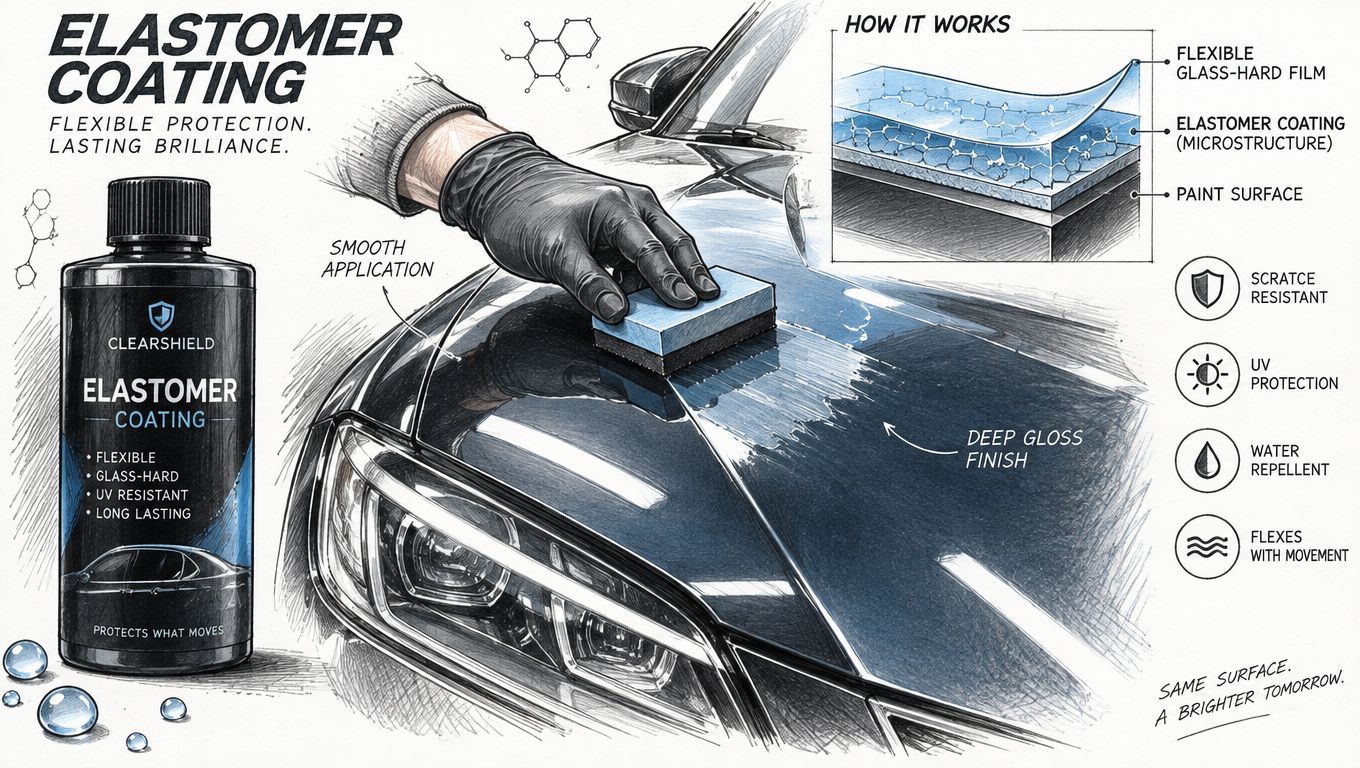
That is why flexible protection deserves more attention than it gets. Titan Coatings describes its elastomer system as a coating built to be hard like glass while remaining flexible, including its stated use of nanotube technology and Dark Matter technology. Whether a brand uses those terms or not, the practical point is sound. A protective film has to resist wash marring, fallout, and weathering, but it also has to move with the surface under it. Rigid protection can look fine in the bay and struggle later when the panel expands, contracts, or takes a hit from road debris.
A thermal-shock experiment helps explain the risk. In The Frontiers in Materials study, polymer-matrix-composite samples were heated to 230°C for one hour and then quenched in ice water. The study also discusses flexible coatings as a way to compensate for thermal expansion in plastic components. That does not prove the behavior of every automotive coating on the market. It does show why room-temperature gloss and initial slickness are a weak standard for judging long-term protection.
Paint application requires discipline
Good coating work starts before the bottle is opened. Inspect the panel under proper lighting. If you still have polishing oils, trapped dust, or missed residue in body lines, stop and fix it. Coatings magnify sloppy prep because they preserve what is under them.
Follow the coating's own directions for temperature, humidity, flash timing, coverage, and cure handling. Use a clean applicator. Work in small sections you can control. Lay down a thin, even film. Heavy application does not buy extra durability. It buys high spots, grabby wipe-off, and patchy curing that can leave you polishing the panel again.
Application pattern matters too. Use a crosshatch only when the product instructions call for it. If they specify another method, use that method. Watch the surface as the film flashes, level it before residue hardens, and change microfiber towels often. A loaded towel stops leveling cleanly and starts dragging semi-cured coating across the paint.
The Titan elastomer coating system overview gives the broader protection concept. In the bay, the goal is simple. Build a bonded layer that can take abrasion and weather exposure without turning into a brittle shell that fights every movement in the panel.
For an all-surface option, Alpha Quartz 50ml Ceramic coating is presented as an elastomer ceramic coating designed for multiple surface types, with product-page claims that include UV, chemical, and abrasion protection, indoor or outdoor application, and specific curing guidance. Treat those product details as product-specific, not universal. Read the current label and directions before you apply it, because coating routine, flash behavior, and cure handling should come from the actual product you are installing.
Glass needs a separate process
Glass is its own job. Clean it thoroughly, remove bonded contamination, and make sure no polishing film or oily residue is left behind. Then apply a dedicated glass coating exactly as directed for that product, using the specified pattern and amount, and level any residue before it turns stubborn.
The payoff is practical. A hydrophobic layer can help water move off the windshield more readily and cut down on wiper dependence in wet conditions. It does not excuse bad wiper blades, dirty washer fluid, or poor maintenance. Check the glass from several angles before cure completes, because faint smears that look harmless in shade can become glaring under streetlights.
Spray protection has a place
Spray coatings fit certain jobs well, especially when you need faster application, broad material compatibility, or a more flexible membrane approach than a traditional wipe-on coating. They are still only as good as the prep under them. If the surface holds bonded debris, polishing oils, or unstable paint, the product seals in the problem.
Use any spray-applied protection exactly as directed by its manufacturer and confirm compatibility on a test spot before you commit to an unfamiliar surface. Paint, wraps, PPF, glass, wheels, and trim can respond differently, even when a product is marketed as multi-surface. The right approach is boring and disciplined. Clean substrate, controlled application, prompt leveling, proper cure conditions.
No honest detailer should promise perfect performance in every climate. The better answer is to choose a coating with the right balance of hardness, adhesion, and flexibility, then install it correctly. Clay removes contamination. Elastomer technology addresses what happens next, which is the harder problem.
APEX NANO – Titan Coatings develops coating systems for automotive and other demanding applications, including elastomer solutions that connect directly to the preparation work described here. Visit APEX NANO – Titan Coatings to review the available coating options and choose a protection system that matches your paint, glass, climate, and application method.
0 Comments