
You parked for twenty minutes beside a body shop, grabbed coffee, and came back to a hood that looks dusty in a way yesterday's wash did not explain. Those fine dots are not dirt. They are a paint problem, and the wrong first move turns a removable mark into a dull patch you will still see at the next red light.
Car paint stains are not one problem. Some sit on the clearcoat. Some eat into it. Some have already gone through it. Polish is not the default answer. Name the mark first, then pick one action, then stop if that action fails.
Identify Your Car Paint Stain Before You Treat It
Say you leave the car on the street while a painter works a nearby bumper. You return, see speckles on the hood and roof, and reach for a sponge. That is how people grind fresh overspray into a finish that was still intact an hour ago.
Airborne overspray is paint that never landed on the job it was meant for. A U.S. Environmental Protection Agency review of automotive refinishing found that conventional spray guns typically achieve only 20%–40% transfer efficiency, so about 60%–80% of the sprayed material never becomes part of the intended coating, and bounce-back alone can account for about 20% of the paint that fails to reach the vehicle surface. Those particles settle on parked cars, buildings, tools, and anything else downwind of a booth, a road crew, or a facility repaint. A fresh dot next to active spraying is overspray until the surface tells you otherwise. Fresh particles can still lift. Bonded ones need mechanical correction or a refinish.
Six marks and the first check
Use this as a lookup, not a shopping list of chemicals. Find the row, run the check, and do not jump ahead.
| Stain type | Typical source | Appearance | First check | Removable by washing alone? |
|---|---|---|---|---|
| Overspray | Spray booths and nearby body shop work | Fine dots or rough speckles, often on horizontal panels | Feel for grit with a fingertip | Often, if fresh |
| Road-marking paint | Road striping or pavement work | Splashes or streaks, usually white or yellow | Check whether it has dried for more than a day | Sometimes, if rinsed early |
| Bird droppings | Birds perched on or above the car | Dark, dull or sunken spot | Look under direct light for a dip or dull patch | Only the deposit, not any etching |
| Acid deposits | Industrial pollution, rain and dew | Circular, irregular or shallow pit spots | Inspect for pits after washing | Usually no, because etching remains |
| Rust particles | Brake dust and iron fallout | Orange-brown pinpoints | Rub with a clean cloth and see if the color stays | Sometimes, but the spot can etch |
| Tree sap or tar | Trees and road surfaces | Sticky or tacky spot, sometimes amber | Gentle test with a dab of cleaner | Usually, with a safe cleaner |
Overspray feels like fine grit and clusters on flat panels. Road paint arrives as a splash, white or yellow, and the clock starts the moment it lands. Bird waste looks dark and dull, and a dip under the light means the clearcoat has already moved. Acid marks show up as round or irregular spots after rain or dew, and the pit is still there after the panel is clean. Iron fallout reads as orange pinpoints. If a clean cloth picks up color, you are moving loose oxide. If the color stays put, the particle is seated. Sap and tar feel tacky. A safe cleaner test on one spot tells you whether the film will release. Mineral rings from hard water are a separate film problem, and the steps on our water spot remover for car paint page are the right lane for those, not for bonded paint.
Two minutes, three checks
Stand the panel in direct sun or a bright inspection lamp. A mark that throws a shadow or looks raised is sitting on the paint. A mark that looks like a shallow crater is inside it.
Drag a clean fingertip across the spot. Grit means loose or semi-bonded material. A smooth dip means the clearcoat has lost material. Sticky drag means sap or tar.
Then decide location. On top of the paint, you clean. Inside the paint, you stop treating it like dirt.
Name it before you touch it: If you cannot point to one row in that table, you are not ready to clay, solvent, or polish.
Emergency Steps for Fresh Paint Stains
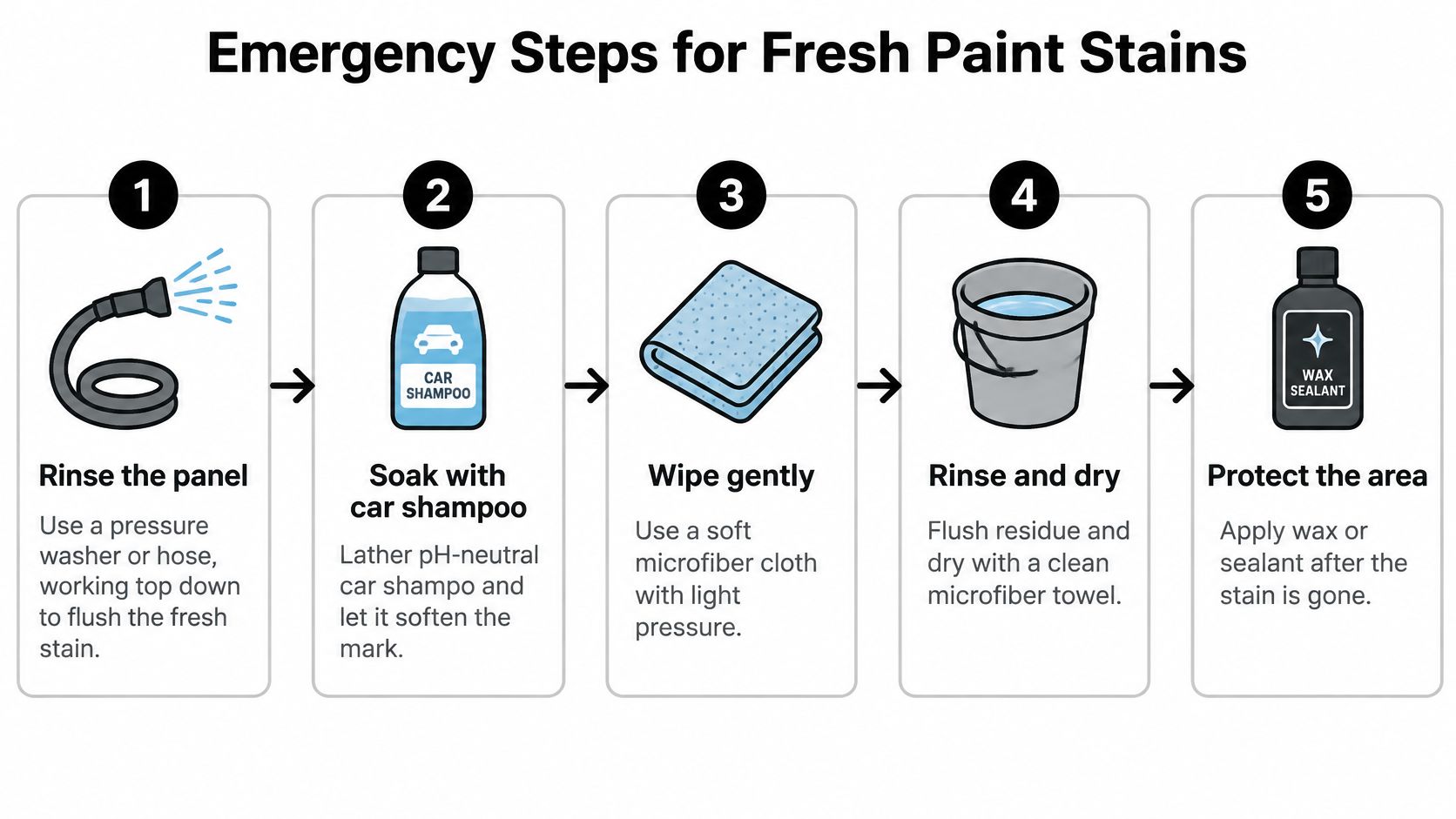
A fresh stripe of road paint or a wet overspray can look like a simple surface stain. Treat it promptly, but inspect what remains before choosing another method. Material sitting on the paint calls for gentle cleaning. A mark that persists after residue is gone may involve the clearcoat, and more scrubbing will not fix damage beneath it.
The Maine Department of Transportation wet-paint guide advises washing road-striping paint as soon as possible. It says pressure washing can remove most residue before it has dried for more than a day. Start with a rinse, not an abrasive correction. A gentle first pass gives you a cleaner surface to inspect.
The sequence that actually works
Rinse from the top down. Use a pressure washer on a wide fan or a hose with a steady flow, moving from the roof toward the rockers. Rinsing lifts loose material before a wash mitt can drag it across the finish. Keep the nozzle moving. A concentrated jet can damage soft clearcoat.
Dry the panel and inspect it. Use a clean microfiber towel, then check the surface in direct light. If the mark has gone, stop. If a shadow, crater, or discoloration remains, diagnose it before applying another cleaner.
Rewash any remaining surface film. Use pH-neutral car shampoo and a clean microfiber, working gently over the affected spot. Rinse and inspect again. Do not add an oily solvent or scrub harder if the mark stays put. A surface film may release with washing; clearcoat etching or damage below the clearcoat will not.
Mask nearby trim and glass. Keep cleaning products off rubber trim, tires, and glass unless their labels say they are safe for those surfaces. Protecting them helps prevent unwanted residue or damage while you work on the paint.
Keep a record if the paint came from a road or work site. Note where and when the stain appeared, what cleaning method you used, and take photos in consistent light. A clear record helps if you need to discuss the damage with a body shop, property owner, or highway agency.
Where people wreck the panel
Do not use solvents or scouring cleansers, and do not attack cured material with a kitchen pad. The transportation guide warns against those approaches because they can damage the vehicle finish. If a gentle rewash leaves the mark behind, stop and inspect rather than making repeated, more aggressive passes.
Sap needs its own approach. Amber, tacky residue is not the same as a paint splash, and applying an unsuitable solvent can leave the surface marred. Follow a dedicated tree sap removal method instead.
If the mark remains after two gentle wash rounds, stop. Determine whether residue is still on the surface or the clearcoat itself is damaged before choosing a correction.
Why Bird Droppings and Acid Deposits Etch Clearcoat
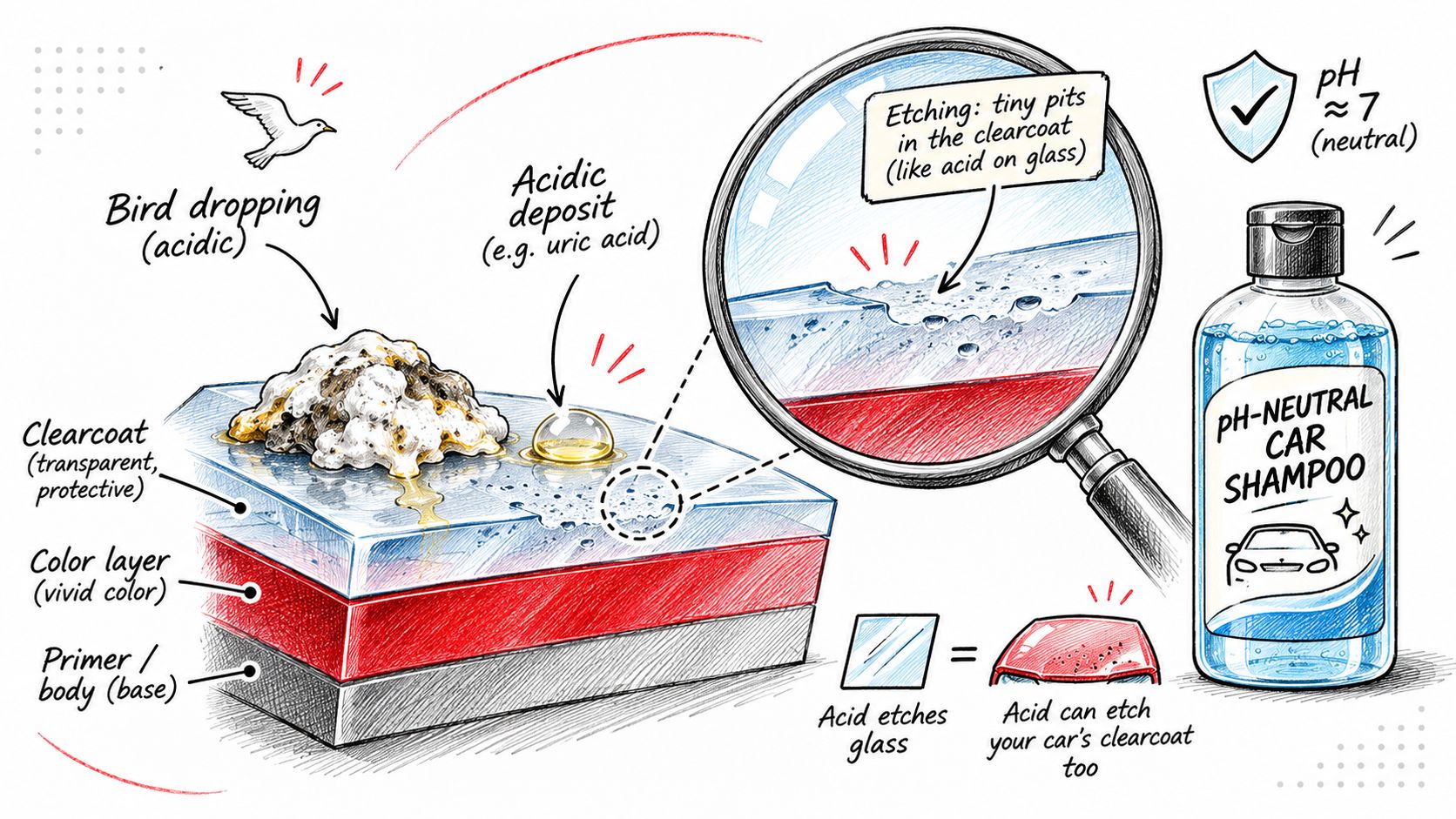
A bird dropping can leave a lasting mark even when it is not strongly acidic. Clearcoat protects the color beneath it, but deposits that dry against the surface can still cause chemical damage. Diagnose the mark before choosing a fix: residue sits on top, etching affects the clearcoat, and deeper damage may reach the paint below.
In testing on a typical acrylic–melamine automotive clearcoat, natural droppings and a pancreatin-based synthetic analogue had a near-neutral pH of 6.25–6.30 and still caused localized etching, along with losses in gloss, distinctness of image, and color, according to PCI Magazine's coverage of that clearcoat work. FTIR analysis pointed to hydrolytic cleavage of ether and ester linkages in the film. Digestive enzymes, including amylase- and lipase-related activity, were the dominant catalysts in those tests. Acid and metal ions contributed little under those conditions, so trying to neutralize a spot does not address the main mechanism.
Heat finishes what the enzyme starts
As a dropping dries, water evaporates and nonvolatile residue concentrates against the paint. Heat speeds the reaction. A deposit left in summer sun can therefore do more damage than one in a cool garage. Remove it promptly rather than relying on pH neutralization.
Use a rinse or a wet, lubricated microfiber to soften the deposit. Never drag a dry towel across a crusted dropping; that can scratch the finish. Once the residue is gone, inspect the area under direct light. If a chemical cleaner lifts the mark, it was surface residue. A depression or loss of gloss points to etching. Controlled polishing may reduce shallow etching by leveling the surrounding clearcoat, but a deep defect needs refinishing, not another pass with a polishing pad.
Acid marks are a different scar
Industrial fallout can pit a finish through chemical exposure. A review of acid damage to automotive finishes describes darkening, fading, loss of gloss, chalking, pitting, and cracking. Its field notes describe dark spots on exposed vehicles, while lab droplets of nitric and sulfuric acid reproduced shallow pits. Horizontal panels are especially exposed: hoods, roofs, and trunks collect rain and dew as water evaporates and acid becomes concentrated.
If a mark remains after careful, lubricated cleaning, treat it as possible etching. Wiping harder will not restore lost clearcoat.
In hot weather, remove bird deposits as soon as you see them rather than waiting for a wash. Clearcoat is thin, and repeated polishing removes more of it. If the mark has cut into the finish, further polishing is not the answer.
Match Each Stain State to the Right Fix
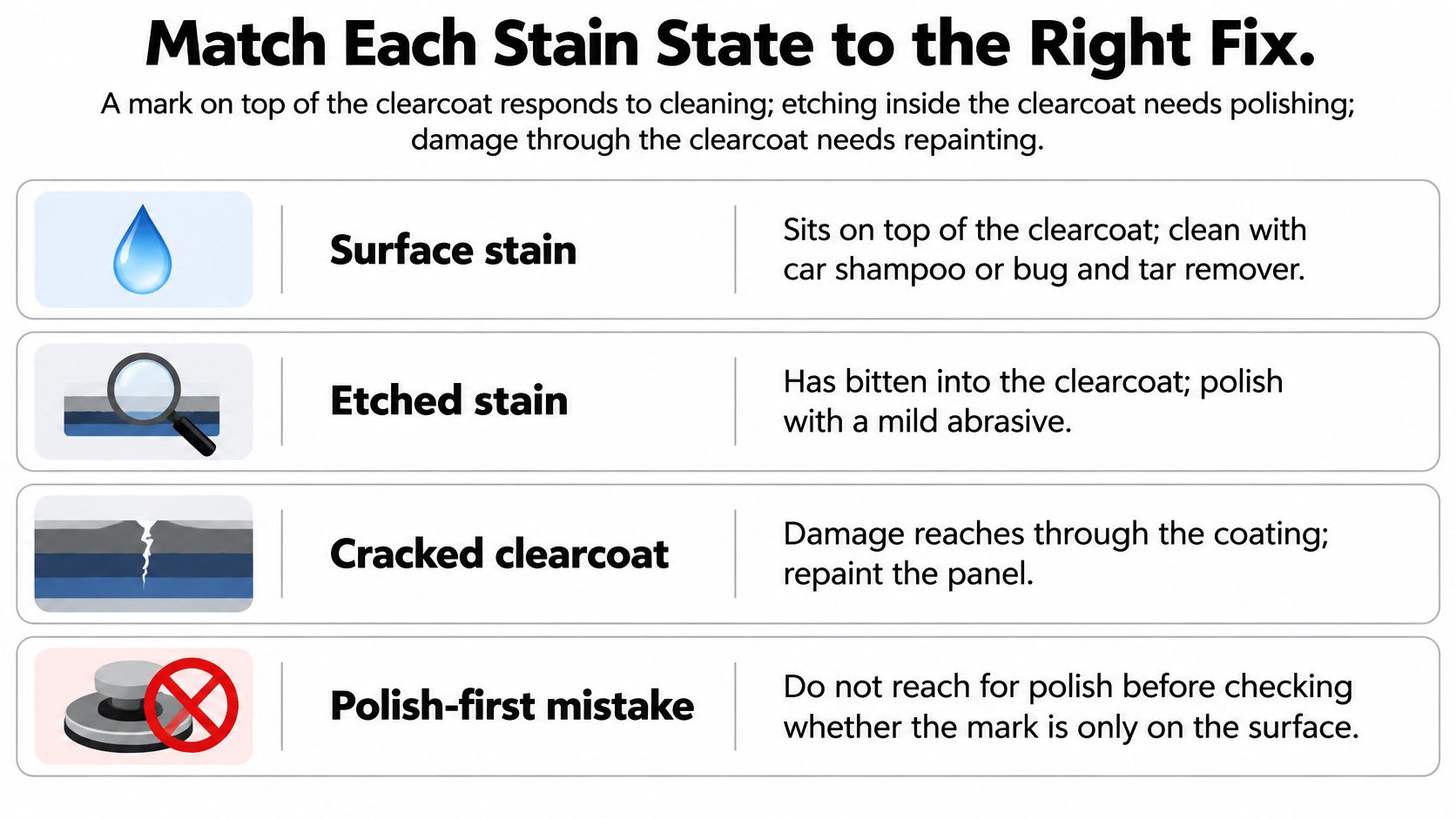
It's common to reach for polish first. That instinct ruins more panels than it saves. Polish removes clearcoat. If the mark is still a film on top, you just thinned a perfectly good layer to erase something a wash would have lifted.
The rule is simple. A mark on top of the clearcoat gets cleaned. Etching inside the clearcoat gets controlled polishing. Damage below the clearcoat gets refinished. Etching that has already cut the finish does not "come out" with a finer pad. Polishing only softens the look when the defect is still inside the clearcoat. Deeper loss needs paint.
One first action, then you look again
This table is a decision rule, not a substitute for your eyes. Take only the first action in the row. Then check. Do not stack steps because you are impatient.
| Stain state | First action | If it stays | Call a professional when |
|---|---|---|---|
| Fresh residue, not yet dry | Pressure rinse, then wash | Let dry, apply WD-40, rewash | It smears or stays after two rinses |
| Dried residue bonded to the paint | Soften with petroleum jelly for 8–12 hours | Wash gently, no solvent scrubbing | It remains bonded after softening |
| Bird or acid mark with no visible pit | Clean with a wet, lubricated microfiber | Light non-abrasive polish, then inspect | The mark survives light polishing |
| Etched pit inside the clearcoat | Controlled machine polishing | Re-check under direct light after each pass | The pit is deep or wide |
| Defect below the clearcoat or into the paint | Stop and do not compound further | Inspection for spot repair or refinishing | Always, with dated photos for your records |
Fresh residue is a rinse problem. Dried, bonded residue is a dwell problem. Give petroleum jelly the full 8–12 hours, wash, and accept the result. Bird or acid marks with no pit can take one light polish after a clean. An etched pit needs a machine, the finest compound that levels it, and a lamp after every pass. If you can see primer, missing color, or a crater that polish is widening, you are done compounding.
How to polish without guessing
Test a hidden spot first, such as a lower door edge behind the weatherstrip. Use the finest compound that cuts, not the heavy cut you happen to own. Check under direct light after each pass. If the mark has not changed after two or three passes, stop. More passes only make the panel thinner.
Tar on lower panels is a cleaner job, not a polish job. A dedicated tar removal method belongs in the bonded-residue row, before any pad comes out.
Removal of a coating is its own decision. The technique depends on the coating. PX10, for example, requires machine and polishing compounding, and a professional is the right person for that removal. Do not treat a coated panel like bare clearcoat and keep cutting until something changes.
When to Stop and Book a Professional
Check the mark today. A film still sitting on the surface is a cleaning job. A pit that has had a week of sun is a correction job, and sometimes a paint job. Waiting does not make either one cheaper.
The four moves that matter
Read the mark for one full minute under direct light. Decide whether it sits on the paint or inside it. If you cannot tell, you are not ready for a compound.
Take only the first action from the matching row. One action, then another look. Stacking chemicals is how a removable film becomes solvent haze.
Test on a small hidden area before any polish, prep, or residue remover covers a visible panel. If that patch dulls, streaks, or softens, the bottle goes away.
Book an inspection if you see a pit, a defect that is getting deeper, primer, missing color, or a mark that deepens with each polishing pass. Those are not DIY finishing problems.
A good tech can tell whether the defect is still inside the clearcoat or already below it. Bring dated photos taken before you touched it, in the same light, from the same angle. That record is what a shop, an insurer, or a property manager will use.
If a previous polish left oily film or silicone that is blocking the next step, BIOPREP removes polish residues and silicones from vehicle surfaces without damaging the paint or clear coat. Use it as a prep, not as a stain eraser. And if a protective coating is the thing that has failed, a certified installer has to inspect the vehicle, give you feedback, and restore that coating. Do not sand through someone else's film and hope the warranty conversation goes well.
Cost is the objection I hear most. A 2024 YouGov survey reported by Revive! UK found that 53% of respondents considered repairing small paint damage on their car too expensive. Ask for a quote on this defect, not a vague "paint job" number, and weigh it against another month of the pit growing. Early attention usually means less correction, not more.
Clean what is still on the surface. Leave anything deeper than the clearcoat to a professional. That split is the whole decision.
Prevent Stains With Flexible Protective Coatings
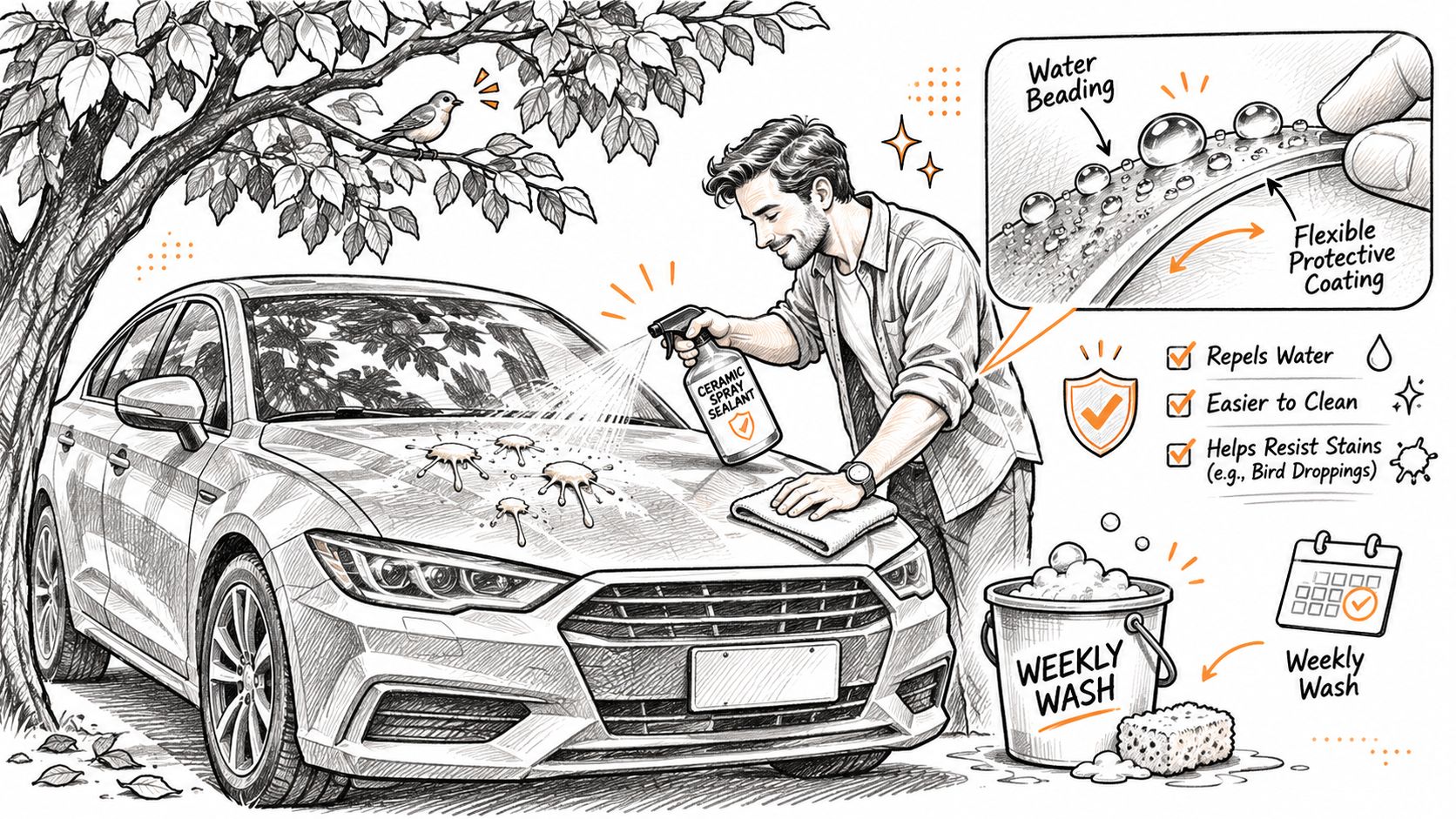
A car parked under a tree can collect bird droppings and other deposits even when it is washed regularly. A weekly wash removes surface dirt, but it cannot reverse clearcoat that has already been etched. First identify what the mark is: residue sitting on the surface, etching in the clearcoat, or damage below it. A coating can help reduce future staining, but it cannot repair damage that has already gone deeper.
Use a pH-neutral shampoo for routine washing, and avoid harsh chemicals and abrasive cleaning products. Lift droppings promptly rather than leaving them until the next wash. Titan Coatings have hydrophobic properties that significantly reduce water spots and stains, but that protection works alongside careful maintenance, not in place of it. When a mark remains after gentle cleaning, do not assume more aggressive polishing is the answer. Diagnose the paint before choosing a correction method.
What flexibility is actually for
Titan Coatings is a manufacturer of elastomer-based ceramic coatings for automotive surfaces. Its coatings are designed to provide protection and have hydrophobic properties that help reduce water spots and stains. Those facts are useful when deciding whether a coating fits your maintenance goals. They do not mean every coating prevents every stain, or that a coating can reverse etching already present in the clearcoat.
A 2023 study of polymer coatings with multiwall carbon nanotubes reported that, under ultraviolet exposure and salt fog, an unmodified coating lost up to 1.35% of its film thickness. In the study, a coating with 1% MWCNT lost about 0.275%, with fewer visible cracks. The reported thickness loss was roughly 4.9 times lower. These figures describe the generic coatings examined in that study, not Titan Coatings products. They are not proof of how a particular product will perform on your vehicle, and they do not establish that a coating prevents every kind of paint damage.
Products that match the job
For glass, Apex Glass is a coating option listed by Titan Coatings. Review the Apex Glass ceramic coating details before buying, and follow the product instructions for application. Glass protection addresses the glass surface, so do not treat it as a substitute for diagnosing stains or etching on painted panels.
Alpha Quartz is also listed in the Titan Coatings shop alongside products such as Ultra ceramic spray. Choose a product by checking its intended use and application instructions, rather than assuming that every coating has the same curing needs or maintenance routine. Some Titan Coatings are designed to be layered, and an installer can recommend a process for the vehicle. For an overview of protecting painted surfaces, see Titan Coatings' car paint guard protection guidance.
Other Titan Coatings take 12–24 hours for initial curing, and the vehicle should not be washed for 7 days to allow full chemical bonding. Follow the instructions for the coating you use, because curing requirements can differ. Washing too soon interrupts the recommended bonding window; a coating that has not finished curing should not be judged by the same standard as one that has.
For regular upkeep, wash with pH-neutral shampoo and steer clear of harsh chemicals and abrasive cleaners. Remove droppings promptly, since a coating does not give you unlimited time before a deposit can affect the surface. If a mark persists, determine whether it is residue, clearcoat etching, or damage below the clearcoat before reaching for polish. A coating is a protective layer, not a cure for paint that is already damaged.
The same outdoor exposure matters when maintaining other vehicles. This guide to caring for silver metallic carts covers a different vehicle, but it is a relevant reminder that metallic finishes need appropriate care when left outdoors. For cars, keep the routine simple: maintain the coating as directed, clean contaminants promptly, and do not use abrasive methods to chase a mark whose depth you have not established.
Titan Coatings' range serves automotive and other applications, including motorcycles, boats, and aircraft. To select a coating for a car, match the product to the surface and follow its stated application and care instructions. A coating can reduce water spots and stains, but prompt cleaning and correct diagnosis still determine whether a mark is removable or has etched the paint. For more information about the manufacturer, visit APEX NANO – Titan Coatings.
0 Comments