
Let’s be honest, that new car feeling is incredible. The paint is flawless, the gloss is deep, and it turns heads everywhere you go. But we all know that feeling doesn’t last. The daily grind—UV rays, bird droppings, road grime, and even the act of washing—starts to chip away at that perfect finish, leaving behind a dull, swirled-up surface.
It’s a frustrating, endless cycle of waxing and polishing, a constant battle to keep your car looking its best. But what if you could break that cycle for good? What if you could give your car a permanent, invisible shield that preserves that showroom shine for years?
That’s where automotive ceramic coatings come in, and they represent a complete shift in how we think about protecting our vehicles.
The Unseen Armor Your Car Deserves
Think of a ceramic coating not as a temporary polish, but as a liquid polymer that forms a semi-permanent, transparent layer of protection over your car’s exterior. It doesn’t just sit on top of the paint like wax; it creates a chemical bond, becoming one with the surface. This bond provides durability, gloss, and water-repelling properties that traditional products simply can’t match.
Simply put, it’s a serious investment in your car’s long-term appearance and resale value.
A New Generation of Protection
We’re not talking about another glorified wax here. This is about applying a tough, clear shield that integrates with your paint at a molecular level—think of it as a second skin for your car’s most vulnerable surfaces. And while protective coatings aren’t new, the science behind them has taken a massive leap forward.
Titan Coatings is leading that charge. We were the first company to introduce Elastomer coatings to the market, leveraging our own nano tubes technology and Dark Matter tech to create something entirely new. It’s a bit like how a quality car window security film provides an invisible but powerful layer of defense for your glass; our coatings do the same for your paintwork.
The real game-changer is a simple but profound idea: a coating that’s hard like glass, yet incredibly flexible. This elasticity is the secret to its superior, long-lasting defense.
The Power of Flexibility
Here’s the problem with most traditional coatings: they’re rigid. Your car’s body panels are constantly expanding and contracting with temperature changes—baking in the summer sun, freezing in the winter cold. A stiff coating can’t keep up. Over time, this stress leads to tiny micro-cracks, which compromise the entire protective layer.
Our elastic coatings are different. They flex right along with the vehicle’s panels, ensuring the bond never breaks, no matter what the weather throws at it. This ability to adapt prevents cracking and breakdown, dramatically extending the coating’s life and its ability to protect your investment. You can explore all the ceramic coating benefits to see just how this technology maintains your vehicle’s value.
So, What Exactly Is a Ceramic Coating?
Think of a standard ceramic coating as a thin, invisible shield of liquid glass for your car. When a detailer applies it, it’s not just sitting on the surface like a wax. It actually forms a chemical bond with your car’s clear coat, creating a tough, semi-permanent shell. This is a huge leap forward from old-school waxes and sealants, giving you a much more durable barrier against whatever the road throws at you.
But here’s where the story gets interesting. While those conventional coatings are hard, their rigidity is also their biggest flaw. Your car’s body panels are constantly expanding and contracting with temperature changes—swelling in the summer heat and shrinking in the winter cold. A completely stiff coating can’t keep up with that movement, which creates stress and, eventually, tiny microscopic cracks. Once that happens, the protection is compromised.
Titan Coatings: Hard Like Glass, But Flexible
That’s the exact problem we engineered our elastomer technology to solve. We were the first to bring elastomer-based coatings to the automotive world, built on our proprietary nano tubes technology and Dark Matter tech. The result is a coating that’s hard like glass but also incredibly flexible.
This elasticity is the real secret sauce behind their longevity and superior performance.
Instead of fighting the natural flex of your vehicle’s panels, our coatings move right along with them. This simple but critical difference prevents micro-cracks from ever forming, keeping that protective shield solid and effective whether it’s freezing cold or blisteringly hot.
Because it can flex, a Titan coating won’t break down or lose its bond over time. It’s a complete shift in thinking—from a static, brittle shield to a dynamic, responsive layer of armor that lasts.
The Magic of Self-Cleaning Hydrophobics
Beyond just being tough, one of the most satisfying benefits of a top-tier automotive ceramic coating is its hydrophobicity. Picture a lotus leaf after it rains: water beads up into perfect little spheres and rolls right off, taking every bit of dirt with it. That’s called the “lotus effect,” and it’s precisely how our coatings behave.
The surface of a Titan-coated vehicle is so incredibly slick and non-porous that water and grime have nothing to cling to. This powerful water-repelling effect brings a few game-changing advantages:
- Self-Cleaning: A good rainstorm literally washes your car for you, as the water whisks away loose dirt and dust. Your car stays cleaner, longer.
- Effortless Washing: When you do need to wash it, dirt and contaminants come off with almost no effort. You’ll spend way less time scrubbing to get that perfect, clean finish.
- Stain Protection: Nasty stuff like acid rain, bird droppings, and bug guts sit on top of the coating instead of etching into your paint, buying you precious time to wipe them away safely.
This combination of protection and convenience is perfectly captured in products like our Titan Graphene Coating V3. We formulated it for both pro detailers and serious DIY enthusiasts who want that extreme slickness and unbelievable water-beading. It’s the perfect way to experience the full effect of our technology, delivering that deep gloss and self-cleaning action everyone loves.
You can see a full comparison of our coatings to see how it measures up. At the end of the day, these self-cleaning properties don’t just make your life easier—they actively preserve your car’s finish for years.
Moving Beyond Wax to a New Era of Paint Protection
For years, the gold standard of car care was a can of carnauba wax and a lot of elbow grease. We all know the ritual: spend a sunny afternoon applying and buffing, all for a brilliant shine that, let’s be honest, would disappear after a couple of good rainstorms. It was a constant battle against the elements.
Synthetic sealants came along and offered a bit more staying power, maybe lasting a few months. But they were still just a temporary film sitting on top of the paint, a sacrificial layer that wore away far too quickly. This old way of doing things served a purpose, but it simply can’t hold a candle to today’s technology.
Automotive ceramic coatings, particularly the advanced elastomer formulas we’ve pioneered at Titan, are a completely different animal. This isn’t just about a temporary gloss. We’re talking about a semi-permanent shield that chemically bonds to your vehicle’s clear coat, becoming an integrated part of the surface.
A Tale of Two Car Owners
Picture this: two neighbors, Alex and Ben, drive home in identical brand-new cars. Alex is a traditionalist. He spends every other weekend in his driveway, painstakingly applying a fresh coat of high-end wax. His car looks fantastic for a few days, but after a week of commuting and a surprise storm, the water stops beading up, and that deep, wet look starts to fade.
Ben went a different route. He invested in a professional application of Titan Graphene Coating V3, one of our flagship products built with our Dark Matter tech. For the first few weeks, you can’t tell the cars apart. But fast-forward a year. The difference is staggering.
Alex’s car is showing the strain of constant washing and re-waxing; fine swirls and micro-scratches are visible under the garage lights. Ben’s car? It still has that same unbelievable, liquid gloss it had on day one. A simple maintenance wash is all it takes to make it look like it just rolled out of the detailer’s bay.
This is the power of a true ceramic coating.
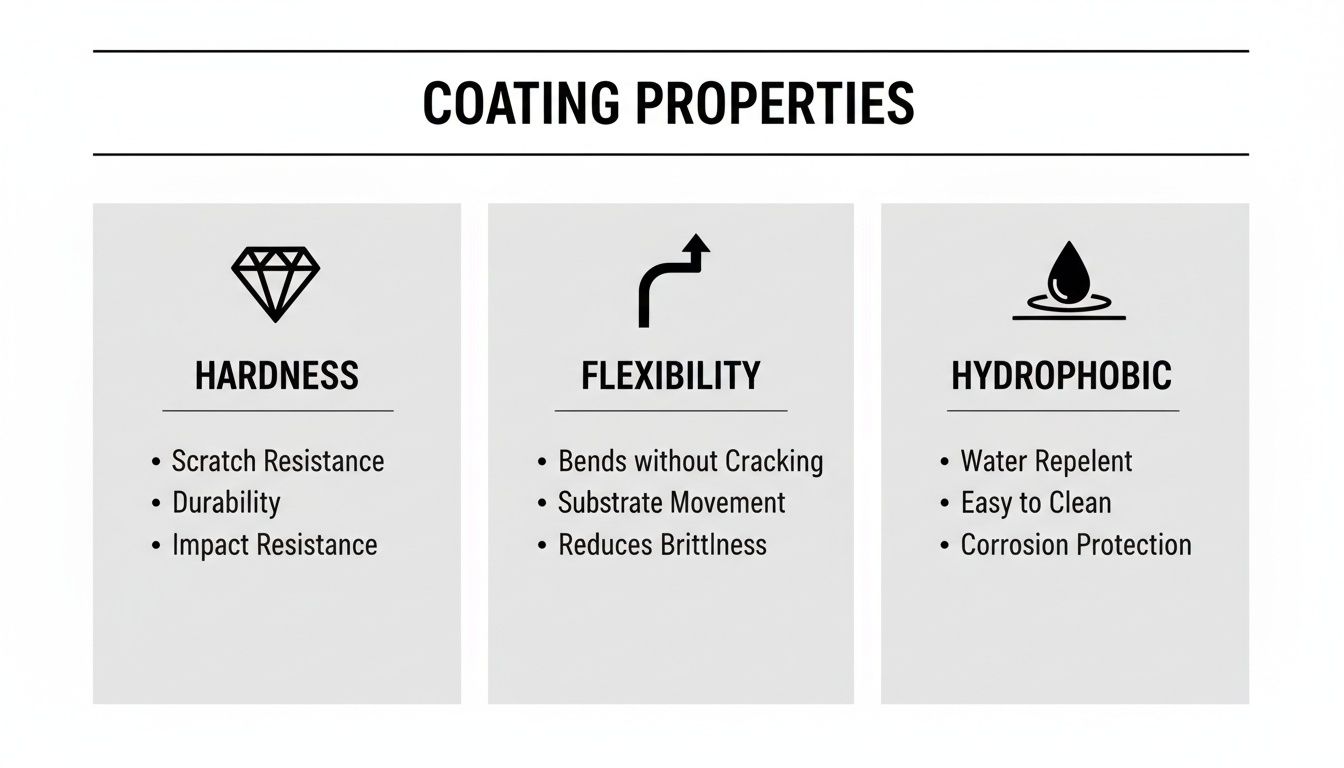
This incredible, long-term performance comes down to a few core properties: rock-solid hardness for scratch resistance, built-in flexibility to withstand the elements, and extreme hydrophobicity that makes the surface practically self-cleaning.
Why It’s More Than Just a “Nice-to-Have”
This huge leap in performance isn’t just a niche trend for hardcore enthusiasts; it’s a fundamental shift in how people protect their automotive investments. The market for professional ceramic coatings is exploding for a reason, projected to hit $2.5 billion by the end of 2025.
More importantly, it’s a smart financial move. Industry experts agree that a professionally applied, high-quality coating can boost a vehicle’s resale value by as much as 10-15%. It’s an upgrade that pays for itself by preserving the factory finish in pristine condition.
To see just how far we’ve come, let’s put the old guard head-to-head with modern coating technology.
Paint Protection Head-to-Head Comparison
The table below cuts through the marketing noise and lays out the real-world differences between your options. It becomes pretty clear why so many owners are making the switch. For a more in-depth breakdown, you can also check out our detailed guide on the difference between wax and ceramic coating.
| Feature | Traditional Wax | Synthetic Sealant | Titan Elastomer Coating |
|---|---|---|---|
| Durability | Lasts for weeks | Lasts for months | Lasts for years |
| Surface Bond | Sits on top of paint | Sits on top of paint | Chemically bonds with paint |
| UV Resistance | Low | Moderate | Extremely High |
| Chemical Resistance | Very Low | Low | Extremely High |
| Long-Term Cost | Low upfront, high ongoing effort | Moderate upfront, moderate ongoing | Higher upfront, very low ongoing |
While the initial investment in a professional ceramic coating is higher, the long-term value is undeniable. You’re not just buying a product; you’re buying back your time and gaining peace of mind. It’s about trading a repetitive, frustrating chore for years of durable, jaw-dropping protection.
Choosing Your Shield: A Guide To Titan Coatings
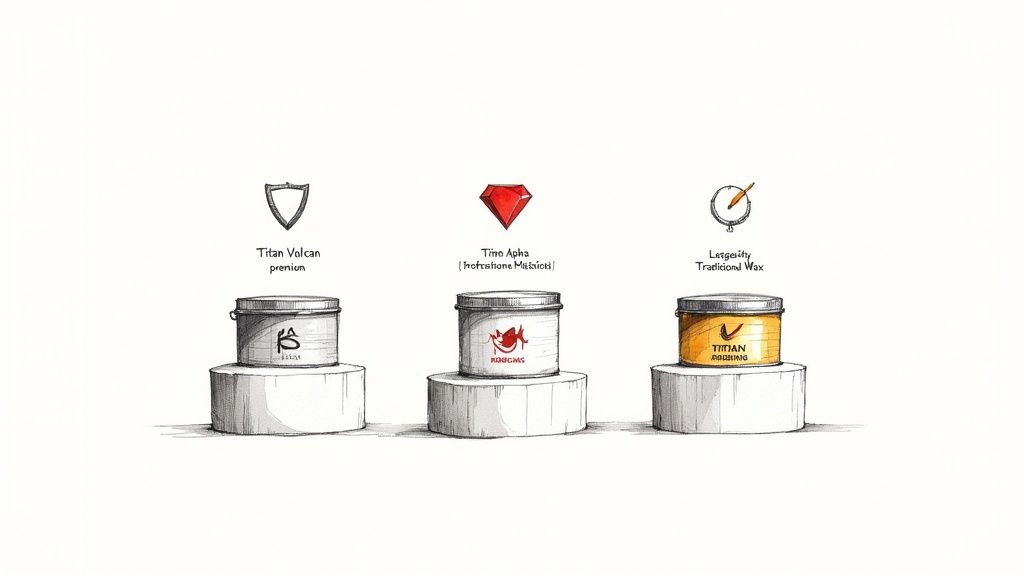
Stepping into the world of high-performance automotive ceramic coatings can feel like trying to choose the right suit of armor. Every option promises impenetrable defense, but the details are what truly matter. Here at Titan Coatings, we cut through the noise. We don’t just sell coatings; we engineer specific solutions for specific needs, built on our pioneering Elastomer, nano tubes technology, and Dark Matter tech.
This isn’t about just grabbing a bottle off the shelf. It’s about matching your vehicle, your driving habits, and your expectations to the right level of protection. Let’s walk through this together, turning what seems like an overwhelming choice into an exciting and empowering upgrade for your car.
The global demand for tough, high-performance materials is changing how we protect our vehicles. Innovation is supercharging the automotive ceramic coatings sector, with this segment valued at $13.16 billion in 2025 and projected to soar to $22.14 billion by 2032. This global surge highlights a clear shift towards advanced, resilient materials that redefine vehicle care.
The Enthusiast’s Ultimate Armor: Titan Vulcan TX155
For the dedicated enthusiast who accepts no compromises, there is Titan Vulcan TX155. Think of this as the final word in paint protection—a coating designed for those who want their vehicle to look better than new, permanently. It represents the absolute pinnacle of our research and development, blending extreme durability with an unbelievable, liquid-like gloss.
The story of this coating began in our lab with a simple, ambitious goal: create something that could not only resist damage but actively recover from it. Vulcan TX155 is the result. Its unique formulation offers regenerative, self-healing properties that can literally mend minor swirls and wash marks with a little bit of heat. It’s the ultimate armor for a prized possession, ensuring your investment remains flawless.
Titan Vulcan TX155 is engineered for those who seek the highest echelon of protection. Its combination of hardness, flexibility, and self-healing capabilities makes it the definitive choice for supercars, show cars, and any vehicle deserving of uncompromising preservation.
This product is more than just a shield; it’s a statement. It delivers a level of gloss and clarity that you have to see to believe, all while providing the signature flexibility of our elastic coatings. This ensures it won’t crack or break down under extreme temperature changes, from frozen winters to scorching summers.
The Professional’s Workhorse: Titan Alpha
Not every vehicle needs the regenerative capabilities of Vulcan, but every car deserves professional-grade, long-lasting protection. This is where a versatile and robust option like Titan Alpha comes into play. It’s a powerful, reliable coating that provides outstanding chemical resistance, intense water beading, and a brilliant shine that lasts for years.
Imagine a daily driver that has to endure everything—road salt, acid rain, bird droppings, and relentless UV exposure. Titan Alpha is built for that reality. It embodies our core philosophy: hard-like-glass protection with the essential flexibility to endure real-world conditions. For professional detailers, it’s the go-to product they can trust to deliver exceptional, consistent results for their clients, car after car.
Making Your Informed Decision
Choosing the right coating shouldn’t be a mystery. It all comes down to your goals and the level of protection your vehicle truly requires. Are you preserving a collector’s item or fortifying a daily workhorse? Answering that question is the first step.
To help you decide, we’ve created a few resources:
- The Titan Shop: Explore our full range of products, from flagship coatings to maintenance essentials. You can find detailed descriptions and specifications for products like Titan Vulcan TX155 and see what makes each one unique.
- The Comparison Page: See a direct, side-by-side breakdown of our coatings. Our product comparison chart makes it easy to evaluate features like durability, gloss, and hydrophobicity, helping you pinpoint the perfect match.
If you’re still getting familiar with the topic, our guide to finding the best ceramic coating for cars provides even more context to help you make a confident choice. By understanding your options, you’re not just buying a product—you’re investing in the future of your vehicle’s appearance and value.
From Meticulous Prep to Flawless Finish: The Application Process
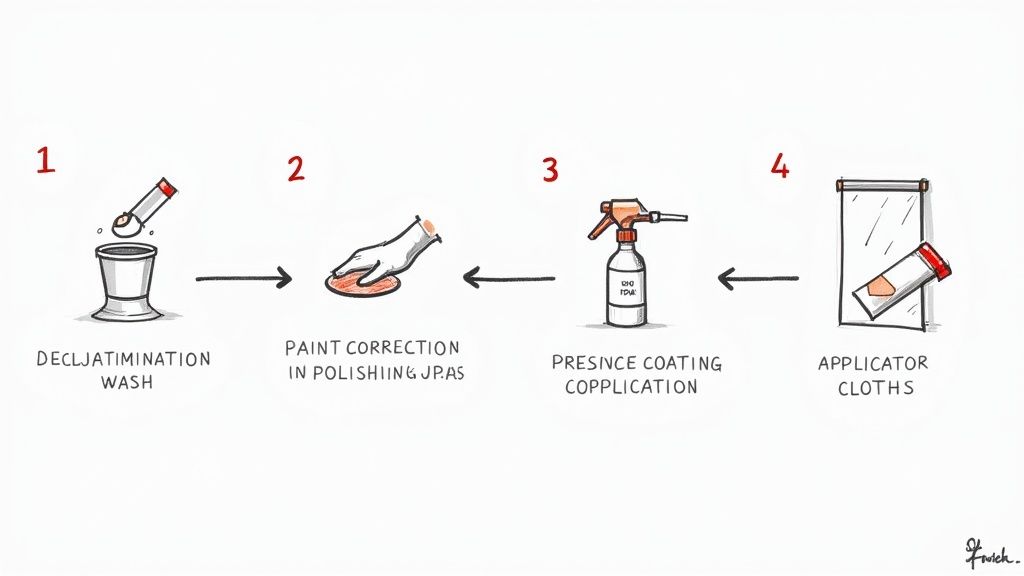
That incredible, glass-like finish you see on a professionally coated car doesn’t just come out of a bottle. It’s the final step in a demanding, multi-stage process where preparation is absolutely everything. Think of it less like a quick wax job and more like a master craftsman preparing a canvas for a masterpiece. The coating itself is just the grand finale.
Knowing what goes into a proper application is key. It helps you understand the true value and skill behind professional work and gives you the knowledge to spot a quality job from a corner-cutting one. While we’ll always stand by professional installation for a guaranteed, warranty-backed result, let’s pull back the curtain on how that perfection is achieved.
Laying the Foundation: Deep Decontamination
The entire journey starts with a wash that goes far beyond your typical weekend scrub. The goal here is to get the paint surgically clean, stripping away every last impurity that could get in the way of the coating’s bond. We’re not just talking about surface dirt; this is about eliminating the contamination you can’t even see.
This critical first stage involves a one-two punch:
- The Chemical Attack: Specialized iron removers and tar solvents get to work, chemically dissolving stubborn, bonded contaminants like industrial fallout, rail dust, and baked-on road grime. You can often see these chemicals turn purple as they react with and break down metallic particles embedded in your clear coat.
- The Physical Polish: Next, a detailing clay bar is meticulously glided across every inch of the paint. This process physically pulls out any microscopic particles that survived the chemical wash, leaving the surface feeling impossibly smooth to the touch.
The Art of Paint Correction
Here’s the single most important truth about ceramic coatings: they lock in whatever is underneath them. That means every swirl mark, minor scratch, and water spot will be sealed under that tough, glossy layer for years. This is precisely why paint correction isn’t just a step—it’s the heart of the entire process.
Using an arsenal of machine polishers, specialized compounds, and a range of polishing pads, a skilled technician painstakingly levels the clear coat to erase those imperfections. This isn’t about speed; it’s a delicate dance of pressure, heat, and movement that requires hours of intense focus to achieve a truly flawless, mirror-like surface. Rushing this stage is simply not an option. You can’t build a masterpiece on a flawed canvas. If you’re curious to see more, we break down the entire process of applying ceramic coating to a car in full detail.
Final Prep and Precise Application
With the paint now looking even better than it did on the showroom floor, there’s one final cleaning step. The entire vehicle is wiped down with an Isopropyl Alcohol (IPA) solution or a dedicated panel prep spray. This crucial wipe removes any leftover polishing oils and residues, making the surface completely sterile and ready for the strongest possible chemical bond.
Finally, it’s time for the main event. In a controlled, dust-free, and well-lit environment, the technician applies the liquid coating. They work meticulously, one small section at a time, often no bigger than a couple of square feet. This requires a steady hand and a keen eye for timing. The coating has a specific “flash” time—the window where it’s ready to be leveled and buffed off. Wait too long, and you get a high spot that’s tough to remove. Wipe it too soon, and the bond is weak. It’s this precision that separates a good result from a perfect one.
Living With A Coated Car: Aftercare And Maintenance
One of the biggest misconceptions I hear about automotive ceramic coatings is that they make your car completely maintenance-free. Let’s clear that up right now. While they don’t wrap your car in an invisible force field, they absolutely make protecting your investment easier and far more rewarding.
With just a few simple tweaks to your car care routine, you can keep that coating looking and performing its best for years.
The most critical period is right after the coating is applied. It needs about 24-48 hours to fully cure and bond with your car’s paint. During this window, you must keep the surface completely dry. That means no washing, no parking in the rain, and avoiding the morning sprinklers. A little patience here pays off big time down the road.
Simple Steps For Lasting Brilliance
Once that coating is fully cured, keeping that incredible, liquid-like gloss is surprisingly simple. The main goal is just to avoid the old habits that cause swirl marks and damage to unprotected paint. Think of it as protecting the shield that’s protecting your car.
Here are the essentials for smart aftercare:
- Master the Two-Bucket Wash Method: This is non-negotiable. One bucket holds your soapy, pH-neutral car shampoo, and the other has clean water for rinsing your wash mitt. This simple trick stops you from dragging abrasive dirt all over your paint—the number one cause of micro-scratches.
- Stick to pH-Neutral Shampoos: Aggressive, high-alkaline, or acidic soaps will slowly eat away at your coating’s hydrophobic properties. Always use a quality, pH-neutral car wash soap formulated for coated vehicles.
- Dry With Premium Microfiber Towels: It’s time to retire the old bath towels and chamois. A high-GSM, plush microfiber drying towel is infinitely softer and soaks up water without introducing scratches.
Preserving Your Investment Long-Term
Following these steps isn’t just about looks; it’s about protecting your vehicle’s value. These coatings are part of a larger automotive ceramics industry focused on a massive problem: corrosion, an issue that costs an estimated $2.2 trillion globally each year.
By forming a chemically bonded shield, ceramic coatings provide intense hydrophobic (water-repelling) properties that are crucial for fending off water, salt, and other contaminants. As more cars hit the road, this kind of advanced protection is key to preventing depreciation and keeping them in showroom condition. You can get a sense of the growing importance of this technology by exploring the broader impact of ceramic coatings on the market.
For a complete breakdown of how to wash and care for your newly protected vehicle, check out our detailed guide on ceramic coating maintenance. It’s packed with expert tips to help you get the most out of your Titan coating for years of effortless shine.
Still Have Questions About Ceramic Coatings? Let’s Clear Things Up.
Even after seeing all the benefits, it’s smart to have a few lingering questions before you commit to a top-tier automotive ceramic coating. We get it. This is your chance to get straight, no-nonsense answers to the questions we hear most often, so you can feel completely confident in your decision.
We’ll cover everything from how long these coatings really last to their real-world limitations.
How Long Do Titan Elastomer Coatings Actually Last?
This is where the game truly changes. You might be used to hearing about traditional ceramic coatings lasting anywhere from 2-5 years, but Titan’s elastomer technology is built for a different level of endurance. The secret is in its flexibility, which stops the micro-cracking that kills rigid coatings over time as your vehicle’s body panels naturally expand and contract.
With proper care and professional application, a Titan coating isn’t just a temporary shield—it’s a semi-permanent bond. Our heavy hitters like Vulcan TX155 are engineered to protect your paint for years, easily outlasting the conventional options on the market.
Can I Just Apply A Titan Coating Myself At Home?
Look, while we do have products aimed at the skilled DIY crowd, we’ll be straight with you: for the best possible finish and to activate your warranty, professional installation is the only way to go. The prep work—decontamination, paint correction, polishing—is non-negotiable. Whatever is on your paint when the coating goes on is sealed in for good, flaws and all.
A certified Titan installer isn’t just a detailer; they’re a trained technician with the right tools, a controlled environment, and the expertise to ensure the coating bonds perfectly and looks incredible.
So, Is A Ceramic Coating Completely Scratch-Proof?
Let’s bust this myth right now: no coating is invincible. Think of a ceramic coating as adding a super-hard, sacrificial layer of protection. It offers incredible resistance to the light stuff—annoying swirl marks from bad car washes, fine scratches from brushing against a hedge—but it’s not a suit of armor.
A ceramic coating won’t stop a deep key scratch, a rock chip on the highway, or deliberate vandalism.
For a true one-two punch against damage, the ultimate setup is laying a ceramic coating over a high-quality Paint Protection Film (PPF). You get the self-healing, impact-absorbing power of PPF combined with the slick, hydrophobic, and chemical-resistant properties of the coating.
How Does Flexibility Make A Coating Last Longer In Different Climates?
This is the heart of what makes Titan’s technology so special. Your car’s metal panels are constantly moving, expanding under the hot sun and shrinking in the cold. A traditional, rigid ceramic coating is like a thin sheet of glass; it can’t flex with the paint, which eventually leads to stress and microscopic cracks, compromising the entire protective layer.
Titan’s elastomer-based coatings, on the other hand, are engineered to remain flexible. They move with your vehicle’s surface, whether you’re dealing with a brutal winter freeze or a scorching summer heatwave. This ability to adapt is precisely why they don’t break down, maintaining their integrity and delivering unmatched durability.
Ready to give your vehicle the kind of protection that actually lasts? Dive into the groundbreaking elastomer technology at Titan Coatings and find the perfect shield for your ride. Head over to our online shop and see which coating is right for you.
0 Comments