
For a lot of us, finding the best car wax for black paint is about more than just shine—it's about finding a shield. It’s a battle against the flaws that seem to find their way onto this notoriously demanding color. While old-school carnauba waxes can give you that deep, wet look for a little while, today’s elastomer and ceramic coatings are what deliver the tough, long-term defense a black car really needs.
The Unforgiving Beauty of Black Cars
Let's be honest, owning a black car is a statement. When it's perfectly detailed, nothing beats that deep, liquid-like surface reflecting the world with crystal clarity. It’s the color of sophistication and style, and that flawless, mirror-like finish is a massive point of pride for any owner.
But we all know how fragile that perfection is. Every black car owner has felt that gut-sinking feeling of catching the car in the sun and seeing a dizzying spiderweb of swirl marks and fine scratches. Black paint is like a high-definition screen for every tiny flaw. A single speck of dust looks like a boulder, and a minor water spot becomes a crater on your otherwise pristine canvas.
The Challenge of Maintaining Perfection
The very thing that makes black paint so breathtaking—its ability to create deep, sharp reflections—is also what makes it a nightmare to maintain. The dark pigment absorbs light, meaning any surface defect, no matter how small, breaks that smooth reflection and instantly stands out.
This constant fight for a flawless finish has driven a huge market. The global demand for car wax shot up from USD 816.324 million in 2021 and is expected to hit USD 974.6 million by 2025. This isn’t just about making cars shiny; it shows a real shift toward premium protection, especially for black vehicles, which make up about 22% of new cars sold in Europe and North America since 2020. With roughly 70% of owners spotting swirls within six months without proper care, the case for a heavy-duty solution is crystal clear.
Traditional carnauba waxes have always been the quick-fix. They do a decent job of temporarily filling in minor swirls and adding a beautiful, warm glow. But that effect is fleeting, often gone after just a few washes. They're a band-aid, not the durable armor that a black car’s paint needs to fend off the elements and daily abuse. You can dive deeper into the best ways to protect your vehicle in our guide on ceramic coating for black cars.
Here’s the thing: black paint doesn't actually scratch any easier than other colors. It just puts every single scratch on full display. That’s why a tough, long-lasting protective layer isn't a luxury—it's an absolute necessity.
This is where modern paint protection technology comes in. The game has changed. It’s no longer about adding a temporary shine but about installing a resilient, semi-permanent shield. A truly effective coating needs to be hard enough to resist scratches but also flexible enough to handle temperature swings without cracking—a common problem with overly rigid coatings. The real goal is to lock in that flawless, deep gloss for years, not just for a few weeks.
From Carnauba Wax to Next-Generation Coatings
If you want to find the best protection for black paint, you first have to understand how we got here. The story of paint protection has evolved dramatically, moving from old-school classics that have been on every detailer’s shelf for decades to cutting-edge tech that acts like a flexible, armored shield for your car.
For the longest time, carnauba wax was king. Sourced from the leaves of a Brazilian palm tree, carnauba is legendary for creating a deep, warm, and almost liquid-looking gloss. It’s fantastic at filling and hiding minor swirls, giving black paint that rich, organic shine that purists absolutely swear by.
But there’s a catch: its beauty doesn't last. Because it's a natural substance, carnauba breaks down fast. You’ll be lucky to get a few weeks of protection before it's time to reapply. Think of it like a light jacket—it looks great on a cool evening, but it’s not what you want when a real storm hits.
The Rise of Synthetic Durability
As chemical engineering advanced, synthetic paint sealants came on the scene as a much tougher alternative. These polymers are cooked up in a lab and designed to chemically bond with your car’s clear coat. The result is a slicker, more resilient barrier that natural wax just can't match.
With a sealant, you trade some of that warm carnauba glow for a sharper, almost glassy reflection. The real win, though, is the durability. We’re talking months of protection, not weeks. They also stand up much better to environmental nasties like acid rain and harsh UV rays. A sealant is like a reliable raincoat; it’s all about practical, long-lasting protection from the elements.
This chart really drives home the challenges we're up against when dealing with black paint and the limitations of traditional waxes.
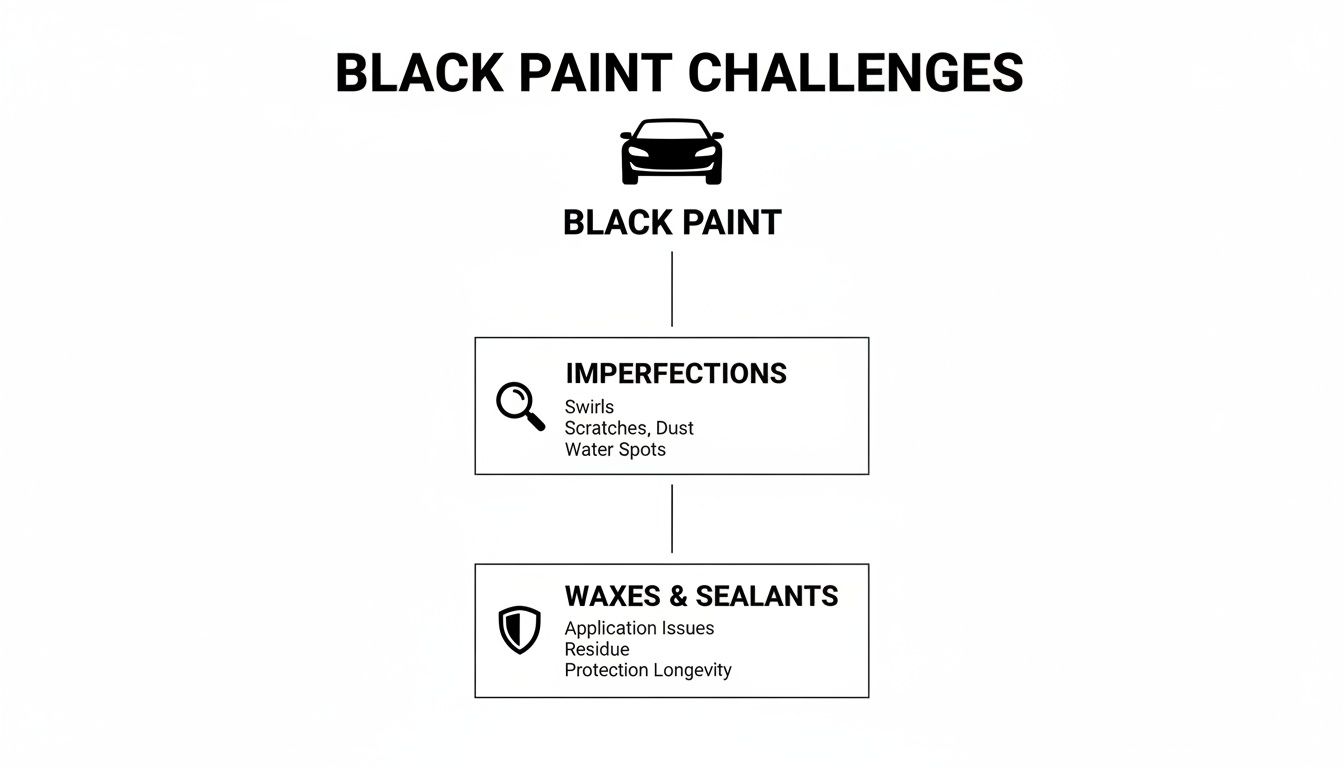
You can see how the problems stack on top of each other: the paint itself is sensitive, it shows every tiny flaw, and traditional waxes are just a temporary band-aid. It perfectly illustrates why we need a better, more permanent solution.
The Modern Era of Coatings
For a color as demanding as black, even a high-quality sealant eventually meets its match. This is where the real next-generation players come in: ceramic and elastomer coatings. These are a whole different ballgame. They don't just sit on top of the paint; they form a semi-permanent, hardened shell that offers a level of defense waxes and sealants can only dream of. We dive deep into the science in our guide explaining what ceramic coatings are.
While plenty of people still love their carnauba—the market is projected to hit USD 198.24 million in 2025—synthetics have taken over, now holding about 65% of the market share simply because they last longer. But with most waxes tapping out after just 4-6 weeks, it’s obvious there’s still a huge gap to fill. This is precisely where Titan Coatings comes in. We adapted military-grade polymers into our Dark Matter Technology®, and in real-world testing, it delivered 5x the durability of leading traditional products.
Comparing Paint Protection Options for Black Cars
Choosing the right protection for black paint can feel overwhelming. To make it easier, let's break down how the main contenders stack up against each other, especially when it comes to the deep, flawless finish every black car owner wants.
| Protection Type | Gloss Type | Durability | Scratch Resistance | Best For |
|---|---|---|---|---|
| Carnauba Wax | Warm, Deep, Organic | Weeks (3-6) | Very Low | Enthusiasts who love the ritual of waxing and the classic warm glow. |
| Synthetic Sealant | Sharp, Reflective | Months (4-6) | Low | The practical owner looking for solid, long-lasting protection over gloss. |
| Titan Elastomer Coating | Candy-Like, Liquid-Glass | Years (3-10+) | Extremely High | The perfectionist seeking the ultimate in gloss, protection, and durability. |
As you can see, while traditional options have their place, they simply can't compete with the all-around performance of a modern elastomer coating when it comes to preserving that perfect black finish.
An elastomer coating is the ultimate evolution—a flexible suit of armor. It marries glass-like hardness with an incredible elasticity that traditional, rigid ceramic coatings just don't have.
This flexibility is a complete game-changer. Standard ceramic coatings are hard, yes, but they can also be brittle. When a car goes through extreme temperature swings—from a frozen winter morning to a scorching summer afternoon—those rigid coatings can develop microscopic cracks that compromise the entire protective layer.
Our elastomer technology prevents this. The coating flexes and moves right along with the vehicle's body panels, ensuring that protective shield stays completely intact, year after year. It's this unmatched resilience that makes it the definitive choice for keeping black paint looking flawless.
How Elastomer Technology Perfects Black Paint
The hunt for the perfect finish on black paint can feel endless. You try wax after wax, sealant after sealant, but the deep, wet gloss always seems to fade, leaving you right back where you started. What if the solution wasn't just another wax, but a completely different approach to surface protection?
The story behind our elastomer technology didn't start in a detailing shop. It began in the demanding world of military polymer research, a place where coatings have to survive conditions that would destroy anything else. Failure simply isn't an option.
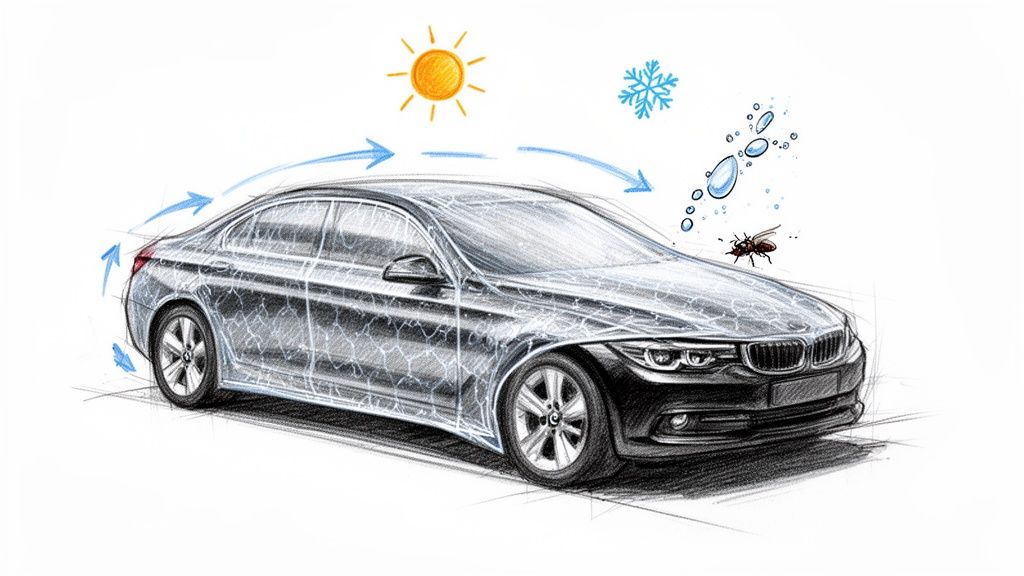
For years, scientists were tasked with creating a material that could do the impossible: be hard enough to deflect impacts and resist harsh chemicals, yet flexible enough to handle constant vibration and extreme temperature swings without breaking. The result was a breakthrough—a new class of polymers that had the hardness of glass and the elasticity of rubber. We saw the incredible potential for the automotive world and got to work, adapting this military-grade tech to create the first true elastomer coatings for vehicles.
Introducing Alpha Quartz: The DIYer's Dream
This effort led directly to products like Alpha Quartz. It’s a professional-grade elastomer coating, but we engineered it with our proprietary Dark Matter Technology® and advanced nano-tubes to make it accessible. We wanted to answer a simple question: what if the best protection for black paint was also easy enough for a dedicated weekend warrior or a busy mobile detailer to apply themselves?
Think about the mobile detailer who’s built a reputation as the guy for black cars. He spends his days fighting a losing battle against swirl marks, bug guts, and that inevitable dulling that robs his clients of the "wow" factor. He’s tried all the boutique waxes and high-tech sealants, but they’re always a temporary fix. A few months go by, and the car is vulnerable all over again.
Frustrated, he gives Alpha Quartz a shot. He's skeptical, because long-term coatings are notoriously finicky, often demanding a perfectly controlled environment he just doesn't have. But Alpha Quartz is different. It was designed for the real world, making it a game-changer for anyone who doesn't have a pristine, climate-controlled detailing bay.
The Power of a Flexible Shield
The application was surprisingly straightforward, but the results were what truly sold him. A jet-black sedan he coated came back months later, and it looked like he had just finished it. The gloss was deep, wet, and locked in. More importantly, the surface was incredibly resilient. Bug splatters that used to be a nightmare now wiped away without a trace. Bird droppings, the mortal enemy of dark paint, couldn't get a foothold to etch the clear coat.
The real test, though, was the change of seasons. Traditional ceramic coatings are rigid. As a car’s metal panels expand in the summer heat and contract in the winter cold, a brittle coating can develop micro-fractures. These tiny cracks compromise the entire shield, letting contaminants in and slowly ruining the finish.
This is where elastomer technology fundamentally changes the game. Alpha Quartz isn't rigid; it's elastic. It flexes right along with the vehicle's panels, maintaining a perfect, unbroken barrier whether the temperature is freezing or scorching. This flexibility is the secret to its incredible longevity and performance.
Because it can flex, the coating doesn't crack under the stress of temperature changes or shatter when a rock or bug smacks the surface at highway speeds. It absorbs the impact, protecting both itself and the precious paint underneath. To really get into the weeds, you can explore the science behind Titan Coatings' elastomer technology. This isn't just another shiny layer; it's an active, responsive shield.
More Than Just Paint Protection
This philosophy—advanced protection that’s actually user-friendly—drives everything we do. We took the same principles and created our APEX Glass Ceramic Coating. Driving in a heavy downpour can be a tense, white-knuckle affair when your wipers can’t keep up. APEX Glass completely changes that. Its super-hydrophobic surface makes raindrops bead up and fly right off the windshield as you drive, dramatically improving visibility and turning a stressful drive into a safe one.
Ultimately, whether it's the quick and easy Ultra Ceramic Spray that delivers a stunning finish in minutes or the long-term, rugged defense of Alpha Quartz, our goal is the same. We give perfectionists the tools they need to achieve and maintain that flawless, showroom look on the most challenging color there is. It's more than a product; it’s an investment in lasting beauty and your own peace of mind.
Your Step-By-Step Application Guide
Getting that jaw-dropping, mirror-like finish on black paint isn’t about some secret trick or a ridiculously expensive tool. It all comes down to a disciplined, methodical process. When you understand the three key phases—Preparation, Application, and Curing—you can achieve professional-grade results that make people stop and stare.
This guide will walk you through the entire process, whether you're reaching for a user-friendly product like Titan's Ultra Ceramic Spray for a quick boost or going all-in with the serious, long-term defense of Alpha Quartz.
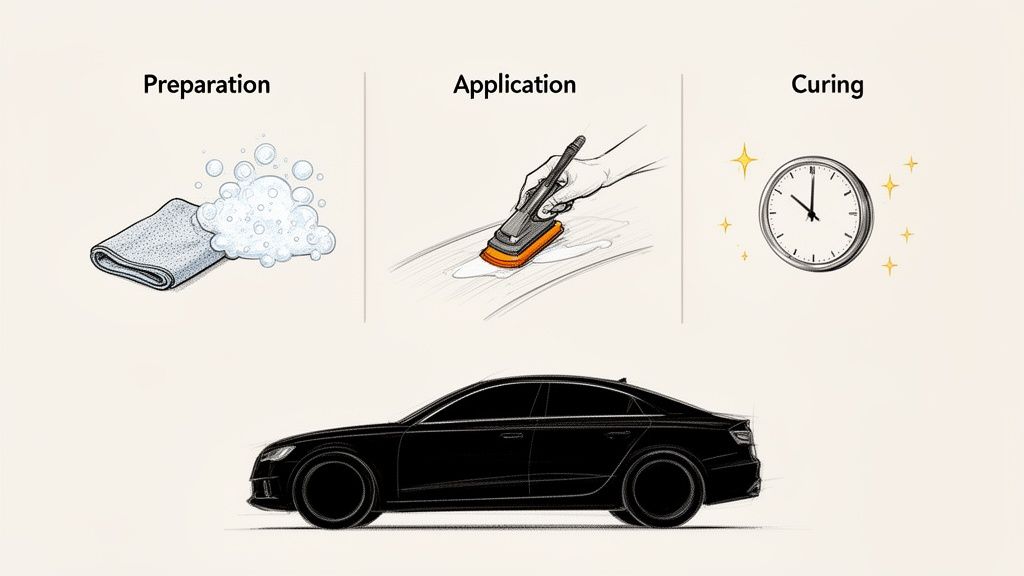
Phase 1: The Non-Negotiable Preparation
Let's get one thing straight: preparation is everything. Think of it like laying the foundation for a custom home. If that foundation is flawed, the entire structure is compromised. The same goes for your paint. A high-performance coating doesn't hide imperfections; it magnifies whatever is underneath. Cutting corners here just means you're permanently locking in flaws.
The goal is to create a perfectly clean and impossibly smooth canvas for the coating to grab onto.
- Thorough Decontamination Wash: Start with a quality, pH-neutral car shampoo and the two-bucket wash method. This removes all the loose dirt and road grime without creating new scratches.
- Chemical Decontamination: Now, get rid of the stubborn stuff. An iron remover will dissolve the tiny metal particles (rail dust, brake dust) embedded in your paint. You’ll see it "bleed" purple as it works its magic. A tar remover handles the rest.
- Mechanical Decontamination: Next, grab a clay bar or clay mitt. This step physically pulls out any remaining contaminants bonded to the surface, leaving the paint feeling as smooth as glass.
- Paint Correction: This is where you win or lose with black paint. Using a machine polisher with the right compounds, you’ll methodically erase swirl marks, fine scratches, and holograms. Your mission is to perfect the paint before you protect it.
- Final Panel Wipe: One last, crucial step. Wipe down every panel with an isopropyl alcohol (IPA) solution or a dedicated panel prep spray. This removes any leftover polishing oils and ensures the surface is totally bare for the strongest possible bond.
A common mistake is slapping a premium coating over uncorrected paint. It's like putting a beautiful glass case over a dusty museum piece. You aren't enhancing the beauty; you're just preserving the flaws for everyone to see.
Phase 2: The Application Process
With your black paint looking absolutely flawless, it's time to lay down that protective layer. Always work in a shaded, well-ventilated area—never apply a coating to a hot surface. The exact steps will change slightly depending on the product.
For an easy-to-use option like Ultra Ceramic Spray:
- Lightly mist a small section, like half the hood.
- Immediately spread the product evenly with a clean, high-quality microfiber towel.
- Grab a second, dry microfiber towel and buff the area to a brilliant gloss, making sure to remove any residue.
- Work panel by panel. It’s designed for simplicity and incredible results.
For a professional-grade elastomer like Alpha Quartz:
- Drip a few drops of Alpha Quartz onto the provided microfiber applicator block.
- Wipe the product onto a small, manageable area (think 2×2 ft) using a cross-hatch pattern—first side-to-side, then up-and-down—for perfectly even coverage.
- Let the product "flash." This is the initial cure, and you'll often see a cool, rainbow-like effect on the surface.
- Gently wipe away the residue with a clean microfiber, then use a second towel for a final, perfect buff. For more tips on application, you can check out our guide on the best way to wax a car for some foundational techniques.
Phase 3: The Curing Finalization
Don't close up shop just yet. The curing phase is where the real transformation happens. This is the chemical reaction where the liquid coating cross-links, bonding with your car's clear coat to form that hard, slick, and durable shield.
For the next 24-48 hours, you have one job: protect the vehicle from all moisture. Keep it in the garage, away from rain, sprinklers, and even heavy morning dew. While the surface might feel dry to the touch in an hour, the full chemical hardening is still underway. To be safe, avoid washing the car with any soaps for at least 7 days. This gives the coating time to achieve its maximum hardness and water-beading power.
Protecting More Than Just Your Paint
Getting that flawless, mirror-like finish on black paint is a victory in itself. But why stop there? The best detailing jobs go beyond the body panels, enhancing the entire experience of being behind the wheel, especially when the weather turns nasty. It's about more than just looks; it's about total confidence on the road.
We’ve all been there. You're cruising along, and out of nowhere, the sky opens up. It’s a full-on downpour, the kind where your wipers are slapping back and forth on their highest setting but can't possibly keep up. The road ahead becomes a stressful, blurry mess. Your knuckles are white, and you're just trying to see the taillights in front of you.
A New Level of Driving Clarity
Now, let's replay that scene. Same car, same storm, but this time, your windshield has been treated with Titan's APEX Glass Ceramic Coating. The moment the rain starts, something incredible happens. Instead of smearing across the glass, the water instantly beads up into tiny, perfect spheres.
As you get up to highway speed, those beads seem to defy gravity. They just lift off the windshield and zip up and over the roof. Your view remains crystal clear, even in the middle of the downpour. You barely even need your wipers. Suddenly, a chaotic drive becomes calm, controlled, and a whole lot safer.
That’s the magic of advanced hydrophobic science. APEX Glass creates an incredibly slick, invisible barrier that water just can't stick to. Not only does this make driving in the rain a breeze, but it also means bugs, ice, and road grime have a much harder time holding on.
The goal of modern coatings isn't just to make a car look good sitting still. It's to fundamentally improve the experience of driving it, especially when you need performance and safety the most.
The car care world is booming, with projections showing the global car wax market will swell by an impressive USD 411.5 million between 2026 and 2030. In tough climates like North America, detailers are leaning on durable polymer solutions that can take a beating. This is where Titan Coatings' advanced formulas, built on military-grade polymers, really shine. Our proprietary technologies like Dark Matter Technology® and HyperQuartz® offer a level of protection that old-school waxes just can't touch, including regenerative properties that fight back against UV rays—the culprit behind 80% of all paint degradation. You can see more on how market trends are driving this innovation over at Technavio.com.
When you extend this level of protection from your paint to your glass, you're not just detailing your car—you're upgrading it. It's about taking a holistic approach, ensuring every surface is performing at its peak. It gives you a sense of security that no ordinary wax can provide. Just like you protect your paint from swirls, protecting your glass is a critical step for visibility and safety. For a deeper look into a complete vehicle defense strategy, our guide on the best auto paint protection film is the perfect next step.
Keeping That Showroom Finish Pristine
Getting a high-performance elastomer coating on your black paint is one thing. It brings back that deep, wet look—often better than when it left the factory. But the job isn't done. While the heavy lifting is over, how you care for it from here on out determines how long that jaw-dropping gloss will last.
Let's clear up a common misconception: coatings aren't bulletproof. A tough, flexible shield like Alpha Quartz is incredibly resilient, but your daily habits are what truly preserve it. The goal shifts from constantly adding gloss with waxes to simply maintaining the perfect, protected finish underneath. This is where working smarter, not harder, really pays off.
The New Rules for a Flawless Finish
The first thing to change is how you wash your car. Forget the aggressive, high-pH soaps from the local auto parts store and definitely toss out those old, scratchy wash mitts. Those are the fastest way to kill a coating's water-beading magic and, worse, put fine scratches right back into your perfect paint.
Your new wash routine is simple, but it’s non-negotiable:
- Master the Two-Bucket Wash: One bucket for your soapy, pH-neutral shampoo, and another with clean water just for rinsing your mitt. This single technique stops you from grinding dirt back into the finish—the number one cause of swirls on a black car.
- Stick to pH-Neutral Shampoos: Think of harsh soaps like a solvent for your protection. A gentle, pH-balanced car shampoo cleans away grime without chemically attacking the elastomer coating you invested in.
- Embrace High-Quality Microfiber: Your wash mitts, your drying towels, everything that touches the paint should be soft, clean, and high-quality microfiber. A single dirty or low-quality towel can undo hours of polishing in a matter of seconds.
The secret to long-term perfection isn't about re-waxing every month. It’s about consistent, gentle cleaning. Your Titan elastomer coating is the permanent shield; your only job is to wash off the daily grime without inflicting any damage.
Long-Term Care and Boosting Your Coating
Want to keep that "just-coated" slickness and unbelievable water-beading going strong? A maintenance spray is your best friend. Every few washes, take a few extra minutes to apply a topper like Titan's Ultra Ceramic Spray.
Think of it like a booster shot for your coating. It revitalizes the hydrophobic properties, amps up the gloss, and adds a fresh layer of slickness that helps the car stay cleaner, longer. A quick spritz and wipe after a wash is all it takes to ensure your black paint sheds water and dirt with absolute ferocity, keeping that investment looking incredible for years.
Got Questions About Protecting Your Black Paint? We've Got Answers.
Stepping up from old-school waxes to a modern coating is a big leap, so it's only natural to have a few questions. Let's tackle some of the most common ones so you can feel completely confident about giving your black car the protection it truly needs.
Is a Modern Coating Really That Much Better Than Carnauba Wax for Black Paint?
In a word, yes. There's a certain romance to carnauba wax—it gives a beautiful, warm glow that's hard to beat. But that's where the fairy tale ends. Carnauba's protection is fleeting, often washing away after just a few weeks. For black paint, which acts like a magnifying glass for every single flaw, that's just not going to cut it.
A true coating like Titan's Alpha Quartz is on a different level. It offers a tough, long-term shield against the things that plague black paint: fine scratches, fading from UV rays, and etching from chemical stains. Its unique elastomer technology even allows it to flex with temperature changes, preventing the micro-cracking that other coatings can suffer from. For a daily-driven black car, it’s the clear winner.
Can I Actually Apply a Titan Coating Myself at Home?
You bet. We specifically designed our coatings to be accessible for both seasoned professionals and passionate car owners. If you're new to this, our Ultra Ceramic Spray is the perfect starting point. It delivers incredible results with a simple spray-on, wipe-off application that’s practically foolproof.
For those ready for professional-grade durability, Alpha Quartz is a favorite among DIYers and mobile detailers because we engineered it for a straightforward installation. Just be sure to follow the instructions to the letter—proper prep is everything.
How Can a Coating on My Windshield Make Driving Safer?
It might sound like a stretch, but it's all about visibility. Our APEX Glass Coating transforms your windshield into a super-hydrophobic surface. Instead of water smearing and blurring your vision, it instantly forms tiny, tight beads that fly right off the glass as you drive, especially at speeds over 40 mph.
In a downpour, the difference is night and day. You see more clearly, feel less stress, and can react faster. It also makes removing stubborn bug splatters, ice, and road grime a whole lot easier.
The real game-changer with modern coatings is that they solve the whole problem. You aren't just getting a temporary shine; you're investing in durable, year-round protection that elevates how your car looks and how you feel driving it.
Ready to give your black car the resilient, lasting protection it deserves? Explore the full range of advanced elastomer and ceramic solutions from Titan Coatings and lock in that perfect, mirror-like finish for years to come. Discover the best coating for your vehicle on our official website.
0 Comments