
The only soap that should ever touch your car is a pH-neutral formula made specifically for automotive paint. It’s that simple. Grabbing dish soap or any other household cleaner is one of the worst things you can do, as they're formulated to strip everything off a surface—including the essential waxes, sealants, and ceramic coatings that protect your paint.
Your choice of soap is literally the first line of defense in preserving your car’s finish.
Why Your Car Soap Choice Matters More Than You Think
Picking the right car soap is one of the most fundamental, yet easily overlooked, parts of proper car care. It's a common mistake to think "soap is soap," but that assumption can be incredibly costly for your vehicle's paintwork. The secret to a lasting, swirl-free shine isn’t just in your technique; it's in the bottle.
I can’t tell you how many times I’ve seen this happen. A proud owner spends a whole weekend detailing their car, getting it perfect. A few weeks later, they run out of their good car soap and grab some dish soap from the kitchen. They think, "It cuts grease on my pans, it must be great for road grime, right?" Wrong.
At first, the car looks clean. But over the next few washes, the deep, glossy shine is gone. That's because the dish soap completely stripped off the protective wax, leaving the clear coat naked and vulnerable to everything the road throws at it. It's a textbook case of how a simple choice can undo hours of hard work.
The Science of a Safe Wash
To really get why a dedicated car soap is non-negotiable, you have to understand the chemistry that separates it from a harsh, all-purpose cleaner. It really boils down to three key things.
- pH Balance: This is the big one. A pH-neutral soap has a pH of around 7, making it chemically gentle on your car's surfaces. Anything too alkaline or acidic will aggressively strip waxes and can even start to etch your clear coat over time.
- Lubricity: This is all about how slick the soap makes the water. High lubricity is critical—it creates a slippery barrier that lets your wash mitt glide across the paint, lifting dirt away safely instead of grinding it into the finish. Poor lubricity is the #1 cause of swirl marks and micro-scratches.
- Rinsing Agents: Good car soaps are formulated to help water "sheet" off the surface. This dramatically cuts down on water spots and streaks, especially if you live in an area with hard water. It makes drying faster and safer.
These three elements work in harmony to clean your car without causing damage. The goal is always to preserve whatever is protecting your paint, whether that's a simple carnauba wax or a professional-grade ceramic coating.
And if you’ve already invested in a protective layer, using the right soap is absolutely critical. Don't let a $10 bottle of soap ruin a $1,500 coating job. You can learn more about how to select the best car wash soap for ceramic coating to make sure you're not washing your investment down the drain.
Quick Guide to Car Soap Types
Feeling a bit overwhelmed by the options? Don't be. Most car soaps fall into just a few main categories. This quick guide will help you find the right starting point for your needs.
| Soap Type | Primary Use Case | Best For | Coating Safe? |
|---|---|---|---|
| pH-Neutral Shampoo | Routine maintenance washing | Removing dirt without stripping protection | Yes, ideal |
| High-Foaming Snow Foam | Pre-wash to loosen heavy grime | Touchless dirt removal before contact wash | Yes, when pH-neutral |
| Wash & Wax Soap | Cleaning and adding a temporary layer of wax | Enhancing gloss for non-coated cars | Use with caution |
| Rinseless Wash | Washing with minimal water | Lightly soiled cars in water-restricted areas | Yes, excellent |
Think of this table as your cheat sheet. For most people, a high-quality pH-neutral shampoo is the go-to for regular washes, while snow foams are fantastic for breaking down heavy dirt before you ever touch the paint.
Comparing Car Soap Formulas for Every Scenario
Anyone who's serious about detailing knows that not all car soaps are created equal. The real trick isn't finding one "best" soap, but understanding which formula is right for the job in front of you. What you need for a quick, dusty touch-up is a world away from the heavy-duty cleaner required to tackle a winter's worth of road grime.
Let's break down the main types of car soaps you'll encounter. We're going to get past the marketing hype and look at what actually matters for your car's finish, so you can pick the right tool for your specific situation.
This flowchart perfectly illustrates the fundamental choice every car owner faces: grabbing a dedicated car soap or reaching for a household cleaner.
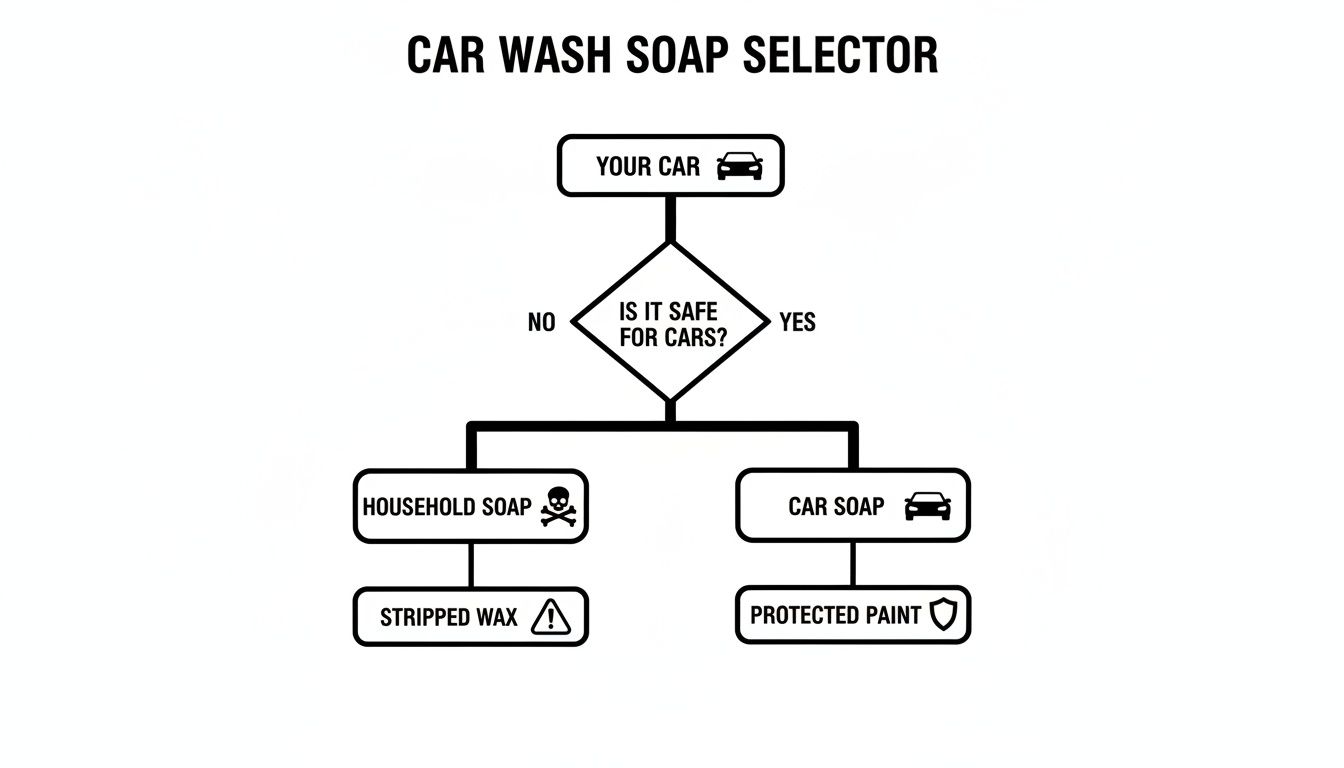
As you can see, it’s a critical decision. One path preserves your vehicle’s protection, while the other strips it away, leaving your paint vulnerable.
pH-Neutral Soaps: The Foundation of Safe Washing
For routine maintenance, a pH-neutral soap is your undisputed champion. These formulas hover right around a pH of 7, making them chemically balanced and incredibly gentle on every automotive surface they touch. Their job is to clean effectively without being aggressive.
This gentle nature is absolutely non-negotiable if your vehicle has a ceramic coating, sealant, or even a simple wax. Harsh, high-alkaline cleaners will eat away at these protective layers, destroying their hydrophobic (water-beading) properties and drastically shortening their lifespan. A quality pH-neutral soap, on the other hand, lifts away dirt while leaving your protection completely unharmed.
Key Differentiator: The single most important quality of a pH-neutral soap is its ability to preserve existing protection. It cleans without stripping, making it the safest and most reliable choice for maintaining a coated or waxed vehicle.
If your car is protected, especially with a professional-grade coating, using a dedicated ceramic car wash soap is a must. These are specifically formulated to work with coatings, and many even contain SiO2 additives that refresh and boost their performance. To dive deeper, check out our complete guide on the best ceramic car wash soap.
High-Foaming Snow Foams: The Pre-Wash Powerhouse
Snow foam is a dedicated pre-wash treatment, always applied with a foam cannon or gun. The goal is to blanket the car in a thick, clinging foam that dwells on the surface. This extended contact time allows the surfactants to break down and encapsulate heavy dirt, road film, and grit before you ever touch the paint with a wash mitt.
This step is a game-changer for preventing swirl marks and fine scratches. By loosening the most abrasive gunk first, you make the follow-up contact wash dramatically safer and more effective.
- Best For: Vehicles caked in mud, heavy dust, or road salt.
- When to Use: As the very first step in a proper two-bucket wash, before any physical contact.
- Coating Safety: Perfectly safe, as long as you choose a pH-neutral formula.
Car Soap Formula Comparison
To make the choice clearer, here’s a direct comparison of the most common soap formulas. Each has a distinct purpose, and seeing their strengths and weaknesses side-by-side helps pinpoint the right one for your needs.
| Feature | pH-Neutral Soap | Snow Foam | Wash & Wax | Rinseless Wash |
|---|---|---|---|---|
| Primary Use | Routine maintenance wash | Pre-wash decontamination | Quick cleaning with added gloss | Water-restricted or quick cleaning |
| Cleaning Power | Moderate | Moderate to High (loosens dirt) | Moderate | Light to Moderate |
| Lubricity | High | Varies (focus is on dwelling) | Moderate | Very High |
| Coating Safe? | Yes (Ideal) | Yes (if pH-neutral) | Not Recommended (can mask coating properties) | Yes |
| Best For | Maintaining protected vehicles | Removing heavy, caked-on grime before contact | Uncoated cars needing a quick shine boost | Apartment dwellers, winter cleaning, light dust & pollen |
| Requires Hose? | Yes | Yes | Yes | No |
This table highlights that there's no single "best" soap, only the best soap for a specific task. For coated cars, a pH-neutral soap is the daily driver, while a snow foam is the specialist called in for heavy cleaning.
Wash-and-Wax Hybrids: The Time-Saving Enhancer
These "all-in-one" soaps are designed for pure efficiency. They combine cleaning agents with a simple carnauba or synthetic wax, so they clean the surface while leaving behind a thin, temporary layer of protection that adds a bit of gloss and water beading.
While they're undeniably convenient, these are not the right choice for vehicles with high-performance ceramic or elastomer coatings. The waxes in these soaps can leave a film that interferes with the coating's properties, masking its true hydrophobic behavior and altering its self-cleaning ability. They’re best reserved for uncoated daily drivers where a quick shine is the main goal.
Rinseless and Waterless Washes: The Modern Solution
These formulas are brilliant problem-solvers, especially for detailers in water-restricted areas or anyone needing to clean a car without access to a hose and drain.
Rinseless Wash:
This method uses a single bucket of water mixed with a high-lubricity concentrate. You simply soak a plush microfiber towel in the solution, wash one panel at a time, and immediately follow with a clean, dry towel. There's no final hose rinse, which saves an incredible amount of water.
Waterless Wash:
This is a pure spray-on, wipe-off product. You mist the solution directly onto a panel, where its advanced polymers encapsulate the dirt particles. You then gently wipe the encapsulated grime away with one microfiber towel and buff the area to a clean shine with a second. This is strictly for light dust, pollen, and fingerprints—not for a truly dirty car.
Both of these rely on sophisticated polymer technology for lubrication, which makes them surprisingly safe when used correctly on cars with light to moderate soiling.
Protecting Your Investment with the Right Soap
You’ve just laid down a premium coating, a serious investment in your vehicle's future. But all that hard work and money can be undone in a few short weeks by one simple, devastating mistake: using the wrong car soap. It’s a classic case of winning the battle but losing the war. A quality soap and a protective layer have to work together; anything less is like trying to polish a diamond with sandpaper. You’ll just slowly strip away its brilliance and kill its performance.
This exact problem is what got us started at Titan Coatings. Years ago, we kept seeing the same frustrating story play out. Car owners would invest a small fortune in protective coatings, only to watch them degrade and fail because of poor maintenance or harsh weather. We knew there had to be a way to create protection that could stand up to more than just a little rain—it had to survive the reality of day-to-day car care.
That mission drove us to develop our groundbreaking Elastomer coatings, the first of their kind, built from the ground up with our proprietary nano tubes technology and Dark Matter Tech®.
The Problem with Rigid Protection
Let’s be clear: traditional ceramic coatings are incredible pieces of technology. But they have one fundamental weakness—they're rigid. While that glass-like hardness is great, it’s also their Achilles' heel. When a rock or a big June bug smacks the surface at 70 mph, a rigid coating is far more likely to get a micro-fracture. The same thing happens with wild temperature swings; the constant expansion and contraction from a frozen winter to a blistering summer can cause tiny stress cracks to form over time.
Our solution was simple in concept but complex in execution: create a coating that was both hard and flexible.
By pioneering the use of Elastomers, we developed a coating that can absorb impacts and flex with temperature shifts. This elasticity means our coatings, like Alpha Quartz, won't crack under pressure, ensuring they last significantly longer and provide more durable protection against the real-world hazards your vehicle faces daily.
This advanced chemistry is precisely why choosing the best soaps for cars becomes so critical. A harsh, high-alkaline soap won't just strip away the coating’s slick, water-beading surface; it can actually compromise the flexible properties of the elastomer itself over the long haul.
Preserving Advanced Coatings with Smart Maintenance
If you want to maintain the amazing hydrophobic and self-cleaning properties of these coatings, there’s only one way to do it: stick to a pH-neutral, high-lubricity soap. This is the magic combination that safely lifts dirt and grime off the surface without scratching the coating or messing with its chemical structure. You're not just cleaning the car; you're preserving the very technology you paid for.
Beyond just a good wash, smart car care is a cornerstone of vehicle longevity—a truth often emphasized in successful automotive shop marketing strategies. A properly maintained vehicle simply holds its value better and stands as a testament to the owner's commitment. This idea of long-term value is baked into the DNA of every product we make.
You can see this philosophy reflected in our product comparison, where each coating is engineered for a different level of durability and specific needs.
The chart really tells the story. Coatings like Alpha Quartz offer durability measured in years, not months, and that’s a direct result of their advanced elastomer foundation—a foundation that demands proper care. Truly understanding how to protect car paint is the key to getting that kind of longevity.
This focus on durable, long-lasting protection isn't just our philosophy; it's where the entire automotive care industry is heading. Whether you're a DIY enthusiast or rely on a professional service, the chemistry of the soap being used is what ultimately stands between your investment and the elements.
Achieving Perfect Clarity for Your Glass
We all love that feeling of standing back to admire a flawless, gleaming paint job. But what good is perfect paint if your view of the road is a mess of streaks and water spots? We spend so much time and effort protecting our car's bodywork, yet the glass—arguably one of the most critical safety components—often gets overlooked.
Here’s the thing: most car soaps, even the good ones, aren't formulated to leave glass perfectly residue-free. They can leave behind trace amounts of polymers or gloss enhancers that look great on paint but become painfully obvious on your windshield the moment it starts to rain.
Think about driving through a downpour at night. The glare from an oncoming car's headlights hits your windshield and explodes into a blurry, disorienting starburst. This was a real-world problem for a daily commuter I know. She thought her wipers were shot because all they did was smear the water around, making every rainy drive a white-knuckle experience. She just accepted that this was normal.
It wasn't until she tried a dedicated glass treatment that everything changed. The smearing stopped. Instead, water beaded up and flew right off the glass, almost like it was being pushed away by some invisible force. This isn't just about looking good; it's a massive upgrade in driving safety and confidence.
Transforming Your View with Hydrophobic Technology
That frustrating, real-world experience is exactly what drove the development of Titan's APEX Glass Ceramic Coating. This isn't just another glass cleaner. It's a purpose-built protective layer, engineered from the ground up for automotive glass. The specialized hydrophobic formula creates an incredibly slick surface that completely changes the way water behaves on your windshield, making rainy drives stress-free.
This image shows you exactly what I'm talking about. The difference is night and day.
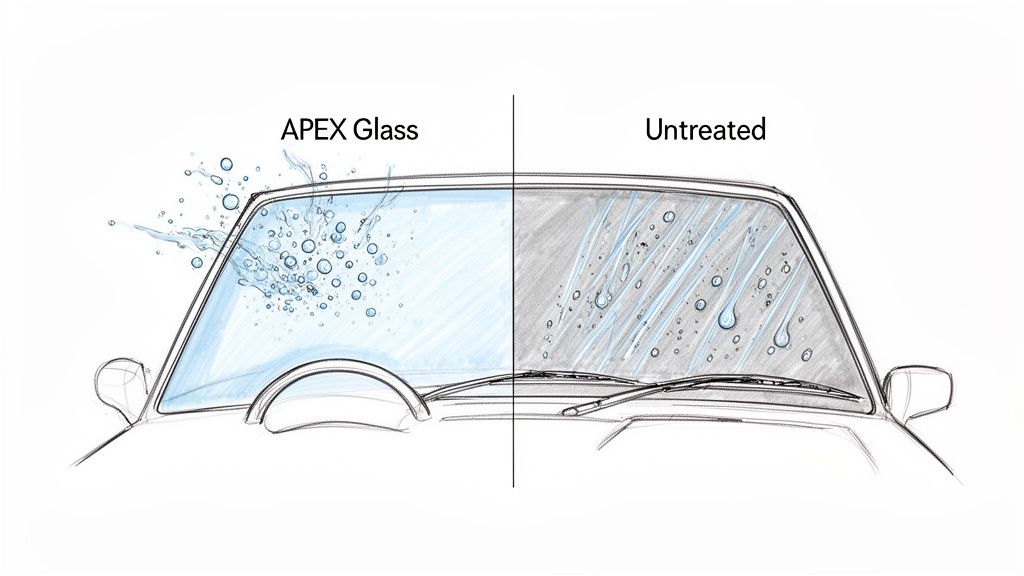
On the APEX-treated side, water forms tight, uniform beads that the wind just whisks away. The untreated side? It’s a sheet of water, clinging on and distorting your vision.
At highway speeds, the effect is so dramatic you'll find yourself using your wipers far less often. That means a clearer, less obstructed view of what’s ahead. You can dive deeper into the science and learn more about applying a ceramic coating for glass over on our resource page.
The real win here is a less stressful drive. By actively repelling water, a quality glass coating seriously improves visibility in bad weather, cuts down on night glare, and even makes scraping off ice and frost way easier.
The application is straightforward and very easy to use, making it one of the highest-impact upgrades any enthusiast or pro can make. Once cured, the coating creates a durable bond with the glass that protects against water spots, chemical etching, and all the usual road grime. It means that crystal-clear view you have after a wash isn't just temporary—it's there to stay, making every drive safer and more enjoyable, rain or shine.
Maintaining Professional Grade Elastomer Coatings
When you're a professional detailer or a serious enthusiast, the integrity of a vehicle's coating is everything. We're moving beyond basic upkeep here and into the world of preserving high-performance protection. The game changes from just washing a car to safeguarding a significant investment, and that's where advanced coatings demand a smarter approach.
Let me tell you about a pro detailer I know, a guy who built his entire reputation on delivering flawless, lasting finishes. For years, he worked with the best traditional ceramic coatings available, but a quiet frustration was building. He’d see cars come back with micro-cracking—tiny, hairline fractures in the coating caused by the brutal swing from a frozen winter morning to a scorching afternoon. Worse yet, a minor rock chip could shatter that rigid, glass-like layer, creating an immediate failure point. His search for something more resilient eventually led him to Titan.
The Power of Flexibility in Protection
That detailer's frustration boiled down to a core weakness in many conventional coatings: they’re rigid. While hardness is great for scratch resistance on paper, that same rigidity becomes a huge liability when faced with real-world stress. This is the exact problem our unique Elastomer technology was designed to solve.
By pioneering coatings powered by nanotubes and our Dark Matter tech, we developed a formula that’s as hard as glass but remains incredibly flexible. This one characteristic changes the entire equation.
- Impact Absorption: When a small rock or bug hits the paint, an elastomer coating can actually flex and absorb a good portion of the impact energy. This dramatically reduces the chances of the coating chipping or fracturing.
- Thermal Adaptability: As a car’s metal panels expand and contract with temperature changes from frozen to hot, the elastic coating flexes right along with them. This prevents the stress buildup that causes the micro-cracking that kills so many brittle coatings over time.
- Enhanced Longevity: Because it can withstand these real-world forces, an elastomer coating maintains its structural integrity and protective properties far longer. The protection you paid for doesn't just degrade prematurely.
This diagram gives you a clear visual of how our advanced multi-layered material actually protects your vehicle's paintwork.
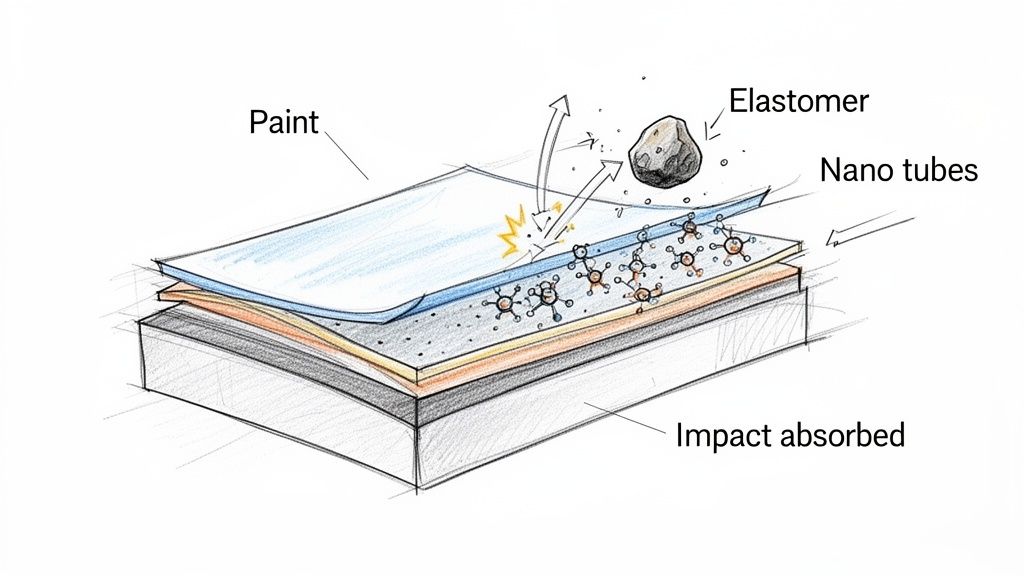
You can see how the elastomer layer, reinforced with nanotubes, acts like a microscopic shock absorber, dissipating force to shield the paint underneath.
Mandatory Maintenance for Lasting Performance
This advanced flexibility is the secret to its durability, but that flexibility has to be preserved. Using an aggressive, high-alkaline car soap is the quickest way to ruin the elastomer’s properties. Harsh chemicals will slowly harden the top layer, stripping away its ability to flex and absorb impacts. This is exactly why pairing this technology with one of the best soaps for cars—a premium, pH-neutral formula—is non-negotiable.
For a coating like Titan's Alpha Quartz Elastomer, which is easy to install with great results, a gentle, high-lubricity soap isn’t just a friendly recommendation; it's a critical part of the system. It safely removes contaminants without chemically attacking the coating itself, preserving its flexibility and ensuring you get the maximum performance and longevity for your clients.
This focus on durable, resilient solutions is driving major shifts across the industry. We're seeing varied growth rates depending on the region, with projections ranging from 2.9% to 7.3%, all influenced by these technological advancements and a growing consumer demand for longer-lasting protection. You can dive deeper into these global car care market trends to see where things are headed.
For my detailer friend, switching to our elastomer coatings was a complete game-changer. He could finally offer his clients a level of protection he knew could withstand the harsh realities of daily driving. The key, he found, was educating them on proper aftercare, starting with the absolute necessity of a pH-neutral soap. It’s the only way to ensure the coating he meticulously installed performs exactly as it was designed to, year after year.
To get a better handle on this groundbreaking technology, you can explore the science behind our Titan Coatings Elastomer solutions on our website.
Your Top Car Soap Questions Answered
Diving into the world of car detailing products can feel overwhelming. Let's clear up some of the most common questions I get about choosing and using the right car soap.
Is It Okay to Use Dish Soap on My Car?
That’s a hard no. Think about what dish soap is made for: cutting through caked-on grease and food. It’s an aggressive degreaser by design.
When you use that on your car, it doesn't just remove dirt—it strips away every last bit of your wax, sealant, or protective coating. It's like sending your paint out into the world naked, completely exposed to UV rays and road grime. Always, always stick with a dedicated car wash soap.
How Exactly Does a pH-Neutral Soap Protect My Coating?
Your high-tech ceramic or elastomer coating, like the ones we offer at Titan Coatings, is built to be tough. But even the toughest armor can be chipped away. Bombarding it with harsh, high-alkaline cleaners will slowly eat away at the top layer, killing the gloss and weakening its ability to bead water.
A pH-neutral soap is the smart choice. It has just enough cleaning power to lift dirt and contaminants without being chemically aggressive. It cleans the surface without attacking the protection, which is exactly what you want.
The goal is simple: clean the car, not the coating. A pH-neutral formula preserves the investment you've made in protection, ensuring your coating keeps performing at its peak for years.
What's the Real Difference Between a Rinseless and a Waterless Wash?
They might sound similar, but they're for totally different situations.
- A rinseless wash is your go-to for light to moderate dirt when you can't or don't want to drag out a hose. You'll use one bucket of water mixed with a high-lubricity rinseless solution. You wash a panel, then immediately follow with a quality microfiber drying towel. No final rinse needed.
- A waterless wash is a pure spray-and-wipe solution. It's designed for light dust, fingerprints, or cleaning up a car at a show. You spray it on, gently wipe the encapsulated dirt off with one towel, and buff to a shine with a second, clean towel. It's perfect for touch-ups when there's no water available at all.
How Often Should I Wash My Coated Car?
If you're driving the car daily, a wash every one to two weeks is the sweet spot. This keeps road film, bird droppings, and other grime from building up and potentially etching into your coating.
Consistent, proper washing is the secret to maintaining that incredible water-beading and self-cleaning effect you love. Don't let the grime build up and mask its performance.
Ready to give your vehicle the best defense on the market? Titan Coatings offers a complete system of products engineered for extreme durability and unbelievable gloss, from our flexible Alpha Quartz elastomer to the super-slick APEX Glass treatment. Explore the full lineup in our shop and see the difference for yourself.
0 Comments