
Choosing the right car wash soap for a ceramic coating isn’t just a recommendation; it’s a critical part of protecting your investment. The best soap will always be a pH-neutral formula that’s completely free of waxes or silicones. It needs to provide incredible lubricity to lift dirt safely without clogging or damaging that precious protective layer.
Seriously, using a dedicated soap is non-negotiable if you want to maintain the slick, hydrophobic properties that make a ceramic coating so amazing.
Why Your Ceramic Coating Demands a Specialized Soap
Think of your vehicle’s ceramic coating as a high-tech shield. It’s incredibly tough, designed to fend off environmental attacks and keep your paint looking perfect. But even the best shield has a weakness, and for a ceramic coating, that weak point is the wrong kind of car soap.
I’ve seen it happen more times than I can count. A stunning, freshly coated car with unbelievable water-beading is brought back a few months later looking dull and flat. The culprit? The owner was unknowingly using a cheap, high-pH car wash from the auto parts store, basically hitting his investment with harsh chemicals every weekend. This is precisely why understanding the chemistry of a proper car wash soap for ceramic coating is so crucial.
The pH Balance is Everything
The science here is pretty straightforward. Ceramic coatings are built from Silicon Dioxide (SiO2) nanoparticles that form a powerful, covalent bond with your car’s clear coat. This process creates that signature hard, slick, and chemically resistant surface.
Soaps with a high alkaline (high pH) or acidic (low pH) content are made to be aggressive. Their job is to strip away grease, road film, and old wax. When you use them on a ceramic coating, these harsh detergents attack and break down the very SiO2 bonds that give the coating its strength. Over time, this chemical assault degrades the coating, killing its protective qualities and that awesome hydrophobic effect.
A pH-neutral soap, which sits right around 7 on the scale, is the only safe bet. It gently lifts dirt and grime without chemically attacking the coating’s structure, ensuring it stays intact for the long haul.
The Hidden Danger of Waxes and Fillers
Another huge mistake is grabbing one of those “wash and wax” products. These formulas are loaded with waxes, silicones, or polymers meant to leave behind a temporary shiny layer. It sounds great, but it’s a total disaster for a ceramic coating.
A ceramic coating’s superpower is its perfectly engineered, non-porous surface that repels water. Adding waxes or fillers is like spreading a layer of sticky honey over a sheet of glass—it completely negates the intended effect by clogging the surface.
Instead of beading up and sheeting water away, a clogged coating starts to hold onto it, attracting even more dust and dirt. This not only makes your car look grubby faster but also masks the true, brilliant shine of the coating underneath. You can dive deeper into the core differences in our guide on wax vs. ceramic coating.
The Proof Is in the Performance
The detailing world has really keyed in on this, and for good reason. The numbers don’t lie. One study showed that 68% of ceramic-coated cars washed with standard soaps experienced a 40% loss in water-repellency after just 20 washes.
In stark contrast, cars washed with a dedicated ceramic-safe soap saw only a 5% decline. They maintained that all-important water contact angle above 110 degrees, which is the technical measure of that wild beading you love to see.
To make it even clearer, here’s a quick breakdown of how these soaps stack up.
Ceramic-Safe vs Traditional Car Soap
| Feature | Ceramic-Safe Soap | Traditional Car Soap | Impact on Coating |
|---|---|---|---|
| pH Level | Neutral (around 7.0) | Often Alkaline or Acidic | High/Low pH: Degrades and strips the coating over time. |
| Additives | None (No wax, silicone, or fillers) | Contains waxes, gloss enhancers | Fillers: Clog the coating’s pores, reducing hydrophobicity. |
| Lubricity | Very High | Varies, often lower | Low Lubricity: Increases the risk of wash-induced swirls and scratches. |
| Cleaning Action | Gentle Surfactants | Aggressive Detergents | Harsh Detergents: Can weaken the coating’s chemical bonds. |
As you can see, the choice is pretty obvious.
Picking the right soap isn’t just about getting your car clean; it’s about actively preserving the advanced protection you paid for. Get this foundational step right, and you’ll keep that “just detailed” look for years, not just weeks.
The Titan Coatings Difference: Elastomer Technology
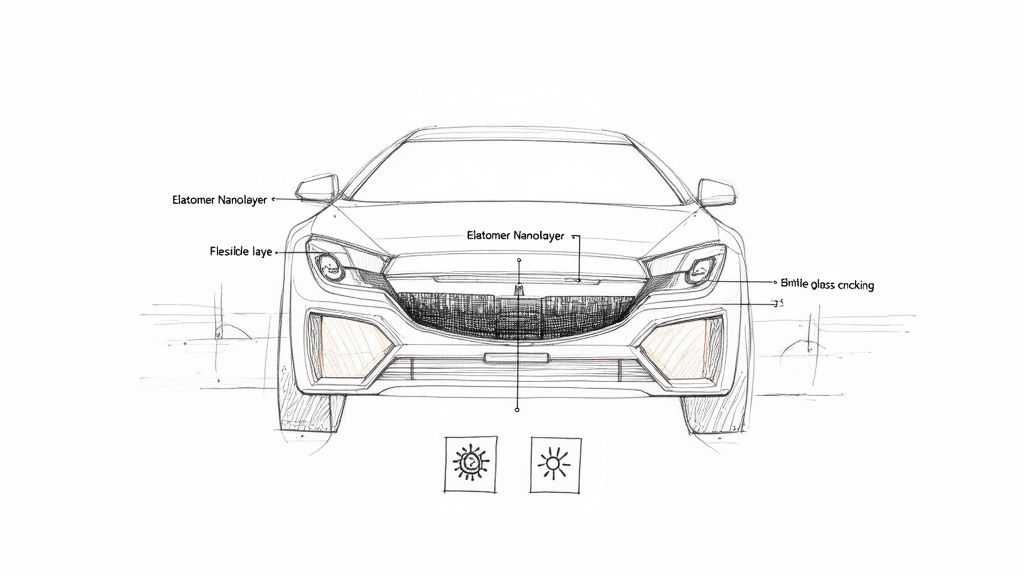
I was chatting with a pro detailer the other day—a guy who works on cars most of us only dream of seeing. He started telling me about a new type of coating he was using that completely changed his perspective on paint protection. It wasn’t just another hard, glass-like layer. It was an Elastomer coating, a true leap forward built on some seriously advanced nanotechnology.
He explained that Titan Coatings is the pioneer behind this, the first company to introduce these revolutionary coatings to the market using nano tubes and their proprietary Dark Matter Tech. This isn’t just a small tweak on an old formula; it’s a completely different approach to protecting a car’s finish. That unique flexibility is the secret sauce.
Built to Flex, Not to Crack
Let’s be honest, traditional ceramic coatings have a weakness, despite all their benefits. They encase your paint in an extremely hard but rigid shell. The problem? Your car’s body panels are constantly expanding and contracting with temperature swings—think frozen winter nights followed by a warm, sunny afternoon. A brittle coating can’t always move with the metal, which eventually leads to micro-fractures.
This is exactly where Titan’s elastic coatings rewrite the rules. They are hard like glass yet engineered to be flexible, expanding and contracting right alongside the vehicle’s panels. This built-in elasticity means the coating won’t crack down under the stress of thermal cycling, making it last much longer and giving it far greater real-world durability.
This flexibility is precisely why maintaining the coating with the right car wash soap for ceramic coating is so important. You have a dynamic, responsive shield on your car, and it needs a maintenance routine that works with its advanced chemistry, not against it.
When you pair a high-performance coating like this with the right aftercare, you’re ensuring it can do its job for years, not just a few seasons.
The Science of Superior Durability
The real magic behind this flexible protection is in the chemistry. Titan’s formulation goes way beyond the standard SiO2 structure. By weaving in nano-tubes, the coating creates an interlocking matrix that’s not only tough against scratches and impacts but also forgiving enough to handle the constant thermal expansion and contraction a car endures.
It’s this unique structure that also delivers that deep, wet gloss that car enthusiasts and detailers are always chasing. It’s the perfect blend of jaw-dropping aesthetics and rugged function. For anyone serious about preserving their car’s paint for the long haul, getting to know the unique properties of Titan Coatings’ Elastomer technology is the first step toward a smarter maintenance plan.
This is what allows your vehicle to shrug off everything from frozen road trips to sweltering summer heat without the coating’s integrity ever being at risk. That’s a level of resilience older technologies just can’t match. And protecting this advanced layer begins with the very first wash—using a soap formulated to preserve, not degrade, its unique flexible properties.
Putting Together Your Ceramic Coating Wash Kit
You’ve invested in a top-tier Titan Elastomer coating for its incredible, flexible protection. Now, grabbing any old soap and a dirty sponge to wash it would be like putting cheap, regular fuel in a finely tuned supercar—it just doesn’t make any sense. The truth is, the tools and products you use for maintenance are every bit as critical as the coating itself.
Let’s build the perfect wash kit, one designed from the ground up to keep that amazing gloss and water-beading action going for years. Think of your wash kit as the first line of defense in protecting your investment. And the absolute centerpiece of that kit? It’s the soap. No other product makes more contact with your vehicle’s surface.
How to Choose the Right Car Wash Soap for Ceramic Coating
For a coating as sophisticated as Titan’s, you don’t just need a cleaner; you need a maintenance partner. This is precisely where a product like Titan Coatings’ Hyper-Rinse SiO2 Infused shampoo shines. It’s not just another car soap. It’s engineered to be pH-neutral, which means it has the muscle to lift dirt and grime without being aggressive enough to strip away your precious protective layer.
But here’s the real magic: the SiO2 infusion actively revitalizes your coating with every wash. It’s like a booster shot for your paint. This infusion reinforces the hydrophobic properties, making sure water continues to fly off the surface just like it did on day one. This isn’t just cleaning; it’s active preservation.
The Titan Coatings shop is a great place to start, as it features a curated lineup of maintenance products, including Hyper-Rinse. These are all designed to work in perfect harmony with their Elastomer coatings, so you know you’re getting something tested and proven to be both safe and effective.
The Essential Tools for a Swirl-Free Wash
Beyond the perfect car wash soap for ceramic coating, the physical tools you use can make or break your finish. A tough coating can still be damaged by aggressive washing, leading to swirl marks and micro-scratches that dull the gloss. The goal is always to be as gentle as humanly possible.
Here’s what you absolutely need:
- The Two-Bucket Method with Grit Guards: This is non-negotiable. One bucket is for your soapy Hyper-Rinse solution, and the other is for rinsing your wash mitt. Each gets a Grit Guard at the bottom to trap the dirt you pull off the car, preventing it from being rubbed back onto the paint.
- High-Quality Microfiber Wash Mitts: Ditch the old sponges that are notorious for trapping and dragging grit across your paint. A plush microfiber mitt has a deep pile that pulls contaminants away from the surface, holding them securely until you dunk it in your rinse bucket.
- A Foam Cannon or Foaming Sprayer: This is a total game-changer for safe washing. A foam cannon lays down a thick blanket of suds that acts as a pre-wash. This foam dwells on the paint, loosening and lifting the heavy, abrasive dirt before you ever make physical contact. This simple step drastically cuts down the risk of scratching.
“Improper washing techniques and the wrong products are the number one cause of premature coating degradation. A well-assembled wash kit isn’t an expense; it’s insurance for your investment, ensuring the coating performs as intended for its entire lifespan.”
Putting this kit together might seem like a bit of work upfront, but it quickly becomes a simple, even satisfying, routine. And the stakes are high. One industry report from Detailing World, which analyzed 10,000 vehicles, found that improper washing causes a shocking 55% of coating failures. On the flip side, using specialized soaps with SiO2 boosters can recharge coatings, extending their life by 24-36 months and even boosting the vehicle’s resale value by 12-15%.
Beyond the Wash: Toppers and Detail Sprays
Once the car is perfectly clean and dry, a final touch can lock in the gloss and add another layer of slick, sacrificial protection. This is where maintenance sprays and quick detailers come into the picture, acting as a buffer against daily environmental exposure.
For example, a quality quick detailer is perfect for safely wiping away light dust, fingerprints, or water spots that pop up between full washes. It’s an essential tool for keeping that just-detailed look at all times. You can dive deeper into the benefits by checking out our guide to using an auto quick detailer and see how it fits into a complete maintenance plan.
By thoughtfully assembling your wash kit with the right soap, gentle tools, and smart maintenance products, you’re doing more than just cleaning your car—you’re actively preserving its advanced Elastomer protection.
The Perfect Wash Method for Flawless Results
Alright, let’s put all that knowledge into practice. This isn’t just about sudsing up your car; it’s a specific ritual we follow to keep your Titan Elastomer coating looking and performing its best. A professional workflow is the only way to guarantee a flawless, swirl-free finish every single time, protecting that flexible, durable shield you’ve invested in.
First things first: set the stage. Always, and I mean always, wash your vehicle in a cool, shaded spot. Never in direct sun. A hot panel will cause your soap and water to evaporate almost instantly, leaving behind nasty mineral deposits and water spots that are a real pain to get off.
The Pre-Rinse and Foam Bath
Your first move is a thorough pre-rinse. Grab a pressure washer or a hose with a strong jet nozzle and knock off all the loose dirt, dust, and grime. This is a critical first step. The less loose grit you have on the surface when you make contact, the lower your risk of scratching the finish. Simple, but so important.
Once it’s rinsed, it’s time for the fun part: the foam bath. A foam cannon loaded with a quality car wash soap for ceramic coating, like our Hyper-Rinse, is a total game-changer. You want to lay down a thick, rich blanket of foam over the entire car, starting from the roof and working your way down.
Let that foam dwell for a few minutes—but don’t let it dry on the paint. You’ll see it working as the surfactants break down and encapsulate the tougher road grime, lifting it right off the surface. This makes the next step infinitely safer for your coating.
Mastering the Two-Bucket Wash Technique
This is the absolute heart of a safe wash. If you’re serious about maintaining a perfect finish on your ceramic-coated car, the two-bucket method is non-negotiable. It’s a brilliant, simple system designed to trap dirt and keep it from ever touching your paint again.
- Bucket 1 (The Suds): Fill this one with clean water and your soap. For Titan’s Hyper-Rinse, a dilution ratio of 1-2 ounces per 3-5 gallons of water is perfect for a hand wash. This gives you an incredibly slick solution with tons of lubrication.
- Bucket 2 (The Rinse): This bucket gets nothing but plain, clean water. It’s the dedicated cleaning station for your wash mitt. Make sure both buckets have a Grit Guard at the bottom to trap all the nasty stuff.
Start washing from the top of the vehicle and work down, panel by panel. After you wash a single section, dunk that dirty mitt straight into the rinse bucket and give it a good scrub against the Grit Guard. You’re literally releasing all the trapped grit to the bottom. Only then do you dip it back into your suds bucket and move on. This is the single most effective way to prevent wash-induced swirls. Period.
Want to go even deeper? Our complete guide on the premium ceramic car wash process has even more pro tips.
This quick diagram shows you the essential tools you’ll want to have ready for a safe and effective wash.
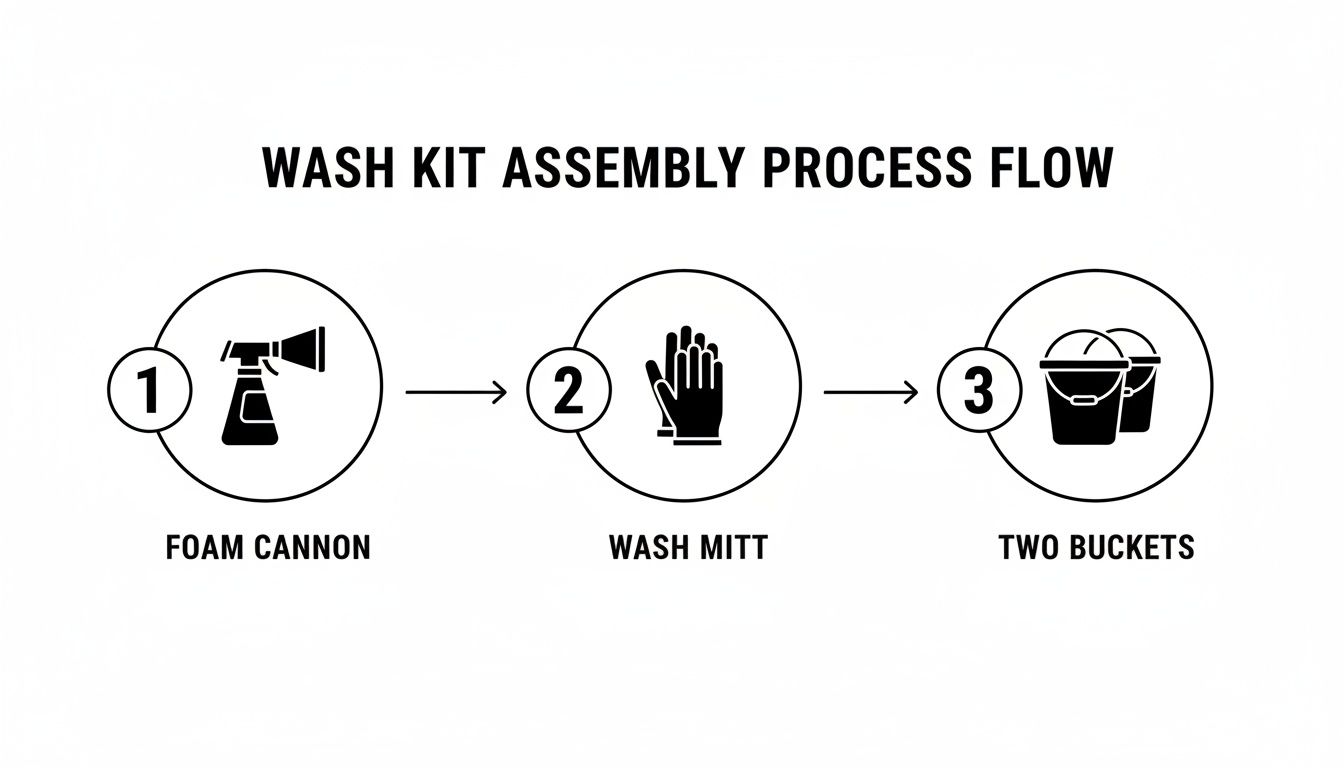
As you can see, pairing a foam cannon pre-wash with the two-bucket method is the gold standard for maintaining a ceramic-coated finish.
The Final Rinse and Drying Touch
With the contact wash done, it’s time for the final rinse. Here’s a pro tip: use free-flowing water without a high-pressure nozzle. Just take the nozzle right off your hose and let the water “sheet” across the panels. A healthy ceramic coating will cause the water to cascade off in sheets, leaving very few drops behind. This sheeting action makes drying way faster and helps prevent water spots.
The final step, drying, is just as crucial as the wash itself. Any remaining water droplets contain minerals that will leave spots behind if left to air dry. A proper drying technique is the finishing touch on a perfect wash.
The absolute safest way to dry your car is touch-free. Using a dedicated car dryer or even an electric leaf blower lets you blast water out of tight spots—like behind emblems and in panel gaps—without ever touching the paint.
If you don’t have a blower, your next best bet is a high-quality, plush microfiber drying towel. Instead of dragging the towel across the paint, gently lay it over a panel and pat it dry. This “blotting” technique is much gentler and dramatically reduces the risk of marring the finish. While coatings require specific care, general insights into effective vehicle cleaning methods for all kinds of surfaces reinforce the basic principle of using the right tool for the job.
Follow this meticulous process, and your Titan Elastomer coating will stay flawless, delivering that amazing gloss and protection for years to come.
Advanced Maintenance and Troubleshooting
A perfect wash routine is your first line of defense, but keeping a Titan Elastomer coating looking its best for the long haul requires a little more than just soap and water. Driving inevitably exposes your car to stubborn gunk, and knowing how to handle it is what separates a good finish from a great one.
This is where you graduate to advanced maintenance. We’re talking about things like bird droppings, bug guts, and that nasty road tar that seems to appear out of nowhere. You can’t let that stuff sit. The acidic compounds can start to etch even a tough-as-nails coating. As soon as you see it, gently lift it off with a dedicated bug and tar remover and a plush microfiber towel. Whatever you do, don’t scrub.
The Power of a Decontamination Wash
After a few months, you might notice water isn’t sheeting off quite as dramatically as it used to. Don’t panic—this almost never means your coating is failing. It’s usually just a sign that the surface is clogged with microscopic gunk, like iron particles from brake dust and other road fallout that a regular car wash soap for ceramic coating can’t touch.
Time for a “decon wash.” This is a game-changer. After your normal wash but before you dry the car, grab a good iron remover. Just spray it across the paint, and you’ll see the magic happen. The product will turn a deep, satisfying purple as it chemically dissolves all those embedded iron particles. It’s like unclogging the pores of the coating, and you’ll immediately see the slickness and wild water beading come roaring back.
For a deeper look into the whole process, we’ve put together a complete guide on how to properly decontaminate your car’s paint.
Adding a Sacrificial Layer for Peak Performance
Here’s another pro-level strategy for long-term care: using a coating topper or maintenance spray. Think of it as a bodyguard for your coating. This sacrificial layer sits on top of your primary Titan Elastomer coating and takes the daily beating from UV rays and light contamination, leaving the heavy-duty protection underneath untouched.
Applying a high-quality topper like Titan Coatings’ Vulcan Hyper-Gloss every few washes is ridiculously easy and pays off big time. It amps up the gloss and slickness while reinforcing the coating’s protective muscle. You can even check out our comparison page to see how different maintenance products offer unique benefits. This simple step keeps your ride looking like it was just detailed and lets the underlying elastomer technology do its job without interference.
Troubleshooting Common Coating Issues
Even with the best care, you might run into a few hiccups. Knowing what’s happening and how to fix it will keep your finish looking flawless.
One of the most common things people see is water spots. These aren’t a sign the coating has failed. They’re just mineral deposits left behind when hard water evaporates on the surface. They sit on top of the coating and can typically be wiped away with a dedicated water spot remover.
It’s no surprise that in the USD 1.68 billion car detailing market, the right soap is everything. The numbers don’t lie: coated cars washed monthly with a proper soap retain 92% of their hydrophobic properties after two years. Those washed improperly see a 60% drop. That commitment to proper care saves owners an average of $800 in potential repaint costs by keeping the coating healthy.
If you ever feel like the surface isn’t as slick or hydrophobic as it once was, it’s almost always due to surface contamination—something a good decon wash will solve. Remember, Titan’s elastic coatings are engineered to be incredibly durable. They’re hard like glass but flexible enough to resist cracking from extreme temperature swings. That flexibility is key to their longevity, so most issues you’ll encounter are surface-level and easy to correct.
To really double down on protection, you can even explore specialized ceramic coating wax products that boost both durability and shine between washes.
Here’s a quick guide to some common problems you might encounter and how to deal with them.
Common Ceramic Coating Issues and Solutions
Even the most meticulously maintained vehicles can run into minor issues. This table breaks down what you might see and the best way to get your coating back to performing at its best.
| Issue | Potential Cause | Recommended Solution |
|---|---|---|
| Reduced Water Beading | Surface contamination (road film, oils, pollen) clogging the coating’s pores. | Perform a decontamination wash using an iron remover and, if needed, a tar remover to deep clean the surface. |
| Visible Water Spots | Mineral deposits left behind from evaporated hard water (sprinklers, rain, improper drying). | Use a dedicated, pH-neutral water spot remover and a microfiber towel. For stubborn spots, a mild acidic solution may be needed. |
| Light Swirls or Scratches | Improper washing techniques (dirty wash mitt, aggressive scrubbing, automatic car washes). | A light polish with a finishing polish can remove minor swirls. For deeper scratches, consult a professional detailer. |
| Bird Dropping or Bug Etching | Acidic contaminants left on the surface for too long. | Immediately remove the contaminant. If etching occurs, a light spot polish may be required to level the surface. |
| Dull Appearance | Buildup of waxes, sealants, or “wash and wax” soaps that are not compatible with coatings. | Use a panel prep spray or isopropyl alcohol (IPA) wipe-down to strip the residue and reveal the true coating underneath. |
By being a proactive caretaker, you can easily handle these minor issues and keep your vehicle’s protection at its peak, delivering that unbelievable gloss and performance for years to come.
Got Questions About Ceramic Coating Care? We’ve Got Answers.
Even the most detailed guide can’t cover every question. And when you’ve invested in a top-tier, flexible coating like a Titan Elastomer, getting the maintenance right is the key to enjoying that amazing gloss and protection for years to come. Let’s tackle some of the most common questions we hear from owners just like you.
“Can I Just Use a Regular Car Soap This One Time?”
We’ve all been there. You’re out of your dedicated soap and the car is filthy. While a single wash with a cheap, non-pH-neutral soap probably won’t strip the entire coating off, it’s a bad habit that starts a damaging process. The aggressive detergents in those soaps will immediately start to wear down the coating’s top layer.
Worse yet, if that soap has any waxes, fillers, or silicones, it will instantly mask the coating’s true properties. That’s a surefire way to kill its hydrophobic nature, turning that beautiful beading into a flat sheet of water. To protect your investment properly, you absolutely need to stick with a dedicated, pH-neutral car wash soap for ceramic coating, like Titan’s Hyper-Rinse.
How Often Should I Be Washing My Coated Car?
This really comes down to how you use your vehicle. For a daily driver, you’ll want to give it a proper wash every one to two weeks. This schedule is frequent enough to stop road grime, bug guts, and bird droppings from bonding to the surface and causing real damage.
If your car is more of a weekend warrior or garage queen, you can stretch that out to every three to four weeks. The golden rule, though? Deal with nasty stuff like bird droppings or tree sap the moment you spot them. Don’t let them sit.
“My Coating Isn’t Beading Water Anymore. Is It Failing?”
This is probably the number one panic moment we see, but relax—it’s almost never a sign of failure. In 99% of cases, a loss of beading is just a sign that the coating is clogged. A microscopic layer of road film, oils, and minerals has built up on the surface, covering up its hydrophobic properties.
Think of it like a high-end non-stick pan. If you leave a thin layer of grease on it, food will stick. The pan isn’t broken; it’s just dirty. The fix is just as simple: a decontamination wash. An iron remover will break down those bonded contaminants and bring that wild water-beading right back.
Is a Foam Cannon Actually Worth It?
While you can wash a car without one, a foam cannon is something every professional detailer swears by for a very good reason. It’s all about a safer wash. The thick foam clings to the car, loosening and lifting away the heaviest grit before you ever touch the paint with a mitt.
This single pre-wash step drastically cuts down the risk of dragging dirt across the surface, which is what causes swirl marks and fine scratches. It makes the whole two-bucket wash safer and more efficient. Your Titan coating is tough and flexible, but a foam cannon helps ensure your wash routine is just as protective.
Ready to give your coating the care it deserves? The Titan Coatings Hyper-Rinse SiO2 Infused shampoo is specifically formulated to gently cleanse while actively revitalizing your coating, boosting its hydrophobic properties with every wash.
0 Comments