
You’ve just invested in a top-tier ceramic coating, and your car looks incredible. The gloss is deep, the water beading is unbelievable, and cleaning is a breeze. But how do you keep it that way? How do you ensure that showroom shine isn’t just a memory after a few weeks of daily driving?
The answer is a quality ceramic coat maintenance spray. This isn’t just another quick detailer; it’s the key to refreshing, strengthening, and amplifying your coating, making sure your investment pays off for years, not just months.
Keeping That Showroom Finish Alive
Imagine this: a customer, let’s call him Alex, had just shelled out for what he thought was a premium ceramic coating from another brand. He was initially thrilled, but after a harsh winter followed by a blazing summer, he noticed tiny, web-like cracks forming in the finish. The coating was too brittle; it couldn’t handle the stress of temperature changes. Frustrated, he came to us.
We introduced him to Titan’s game-changing technology. We’re the first company that brought Elastomer coatings to the market, using a fusion of nano-tube technology and our proprietary Dark Matter Tech®. The result is a coating that’s hard as glass yet remarkably flexible. This elasticity allows it to expand and contract with temperature shifts—from frozen to scorching—without cracking down.
After we applied our Alpha Quartz elastomer coating, Alex was stunned. But the real magic came during his maintenance washes. Instead of just washing, he started using Titan’s ‘Ultra’ as a drying aid.
It’s Not Just a “Topper”
Many products on the market are just simple “toppers” or quick detailers that add a bit of slickness but do little for the underlying coating. A true maintenance spray, especially one designed for an advanced system, acts as an integral part of your vehicle’s defense.
Think of your base coating as the foundation of a house. Ultra is the crew that comes in after every wash to reinforce the structure, fill in any microscopic wear, and add a fresh, slick, sacrificial layer. This is absolutely critical for next-gen coatings like Titan’s.
Titan pioneered elastomer coatings in the detailing world by fusing nano-tube technology with their proprietary Dark Matter Tech®. The result is a finish that’s incredibly hard but also remarkably flexible.
This elasticity is the real game-changer. It allows the coating to expand and contract with temperature swings—from freezing winters to blistering summers—without getting the micro-cracks that plague older, brittle ceramic technologies.
Layering Up Gloss and Hydrophobics
Each time you use Ultra, you’re not just maintaining the coating; you’re building upon it. The layers stack, creating deeper gloss and more intense hydrophobicity, preserving the unique properties of these advanced elastomer coatings. Understanding how to properly maintain your investment is everything, and that starts with choosing the ideal detailing spray for ceramic coated cars. This intentional layering is what keeps a car looking like it was just detailed, week after week.
The market for these products is exploding for a reason. The high-performance ceramic coatings industry, which includes these essential maintenance sprays, hit USD 11.44 billion in 2023 and is on track to nearly double by 2033. The automotive world is driving this trend, with pro detailers reporting a staggering 75% drop in chemical etchings on vehicles that are properly maintained.
This isn’t just a fad; it’s a fundamental shift in vehicle care. Owners are realizing that consistent upkeep unlocks the full benefits of ceramic coatings and offers protection that old-school waxes and sealants just can’t match.
Getting Your Vehicle Ready for a Perfect Finish
Before you even think about grabbing that bottle of maintenance spray, let’s talk about a core principle of detailing: a perfect finish starts with a perfectly clean canvas.
Trying to apply a booster like Titan Ultra over a dirty surface is like painting over rust—you’re just sealing the problem in. The entire goal here is to get the paint so clean that the spray can bond directly with your ceramic coating. That’s how you get the best performance and that unbelievable gloss.
This all begins with a proper wash. I mean a real wash, not a quick once-over with an old sponge and a single bucket. The two-bucket wash method is the standard for a reason. One bucket is for your suds, the other is for clean rinse water. Dipping your mitt in the rinse bucket before reloading it with soap prevents you from grinding the dirt you just removed right back into the paint. It’s the number one way to prevent swirl marks.
Picking the Right Tools for the Job
Your car shampoo matters more than you might think. Always, and I mean always, use a pH-neutral car shampoo. Aggressive, high-alkaline, or acidic soaps can literally start to eat away at your ceramic coating, which completely defeats the purpose of what we’re trying to do. A quality, pH-balanced soap will get the job done without compromising the coating’s integrity. The science behind these specialized products has come a long way, reflecting wider trends in the automotive industry.
But what about the gunk a regular wash leaves behind? Even the most hydrophobic coatings can’t repel everything. Over time, things like industrial fallout, rail dust, and stubborn tree sap will bond to the surface. You’ll feel it as a slight roughness when you run your hand over the paint. This is when you need to bring out the bigger guns.
A lot of people think a coated car never needs a clay bar or iron remover. While you’ll definitely do it less often, a gentle chemical decontamination or a light pass with a clay mitt once or twice a year is key to knocking off those embedded particles and getting that “smooth as glass” feeling back.
This is where you really see the benefit of Titan’s advanced elastomer coatings. The flexibility from the nano-tube and Dark Matter Tech® helps the surface resist the micro-pitting where contaminants get a foothold. This elasticity means your vehicle naturally stays cleaner for longer, and your prep work before applying a maintenance spray becomes worlds easier.
If you want to get into the weeds on this, we’ve put together a full guide on how to properly decontaminate car paint that walks you through the process safely.
Mastering Application With Titan Ultra
Alright, let’s get to the fun part—where the magic really happens. Your vehicle is perfectly clean, and now you’re ready to lay down a layer of Titan Ultra, our go-to ceramic coat maintenance spray, to lock in that amazing, wet-looking gloss. There are two fantastic ways to get this done, both delivering professional results. We’ll walk through which one is right for your situation.
The market for ceramic sprays has absolutely exploded, hitting USD 9.2 billion in 2024, and it’s not hard to see why. Detailers and dedicated car owners have figured out they can slash their maintenance time by 40%, applying serious protection in minutes instead of hours. The real kicker? Studies show vehicles kept up with quality maintenance sprays hold onto 85% of their hydrophobic properties after a full year. That’s a massive improvement over the 50% you might see on a neglected coated car.
The Drying Aid Method: Maximum Efficiency, Killer Results
This is the technique I use most often, especially when I’m on the clock or just want to get the job done quickly without cutting corners. It brilliantly combines applying protection with the drying process itself.
After you’ve done your two-bucket wash and given the car a final, thorough rinse, leave it wet. Grab your bottle of Titan Ultra and lightly mist one panel. Seriously, one or two spritzes is plenty. Then, take a high-quality, plush microfiber drying towel and just dry the panel like you normally would.
As you dry, the towel picks up the water while simultaneously spreading the product evenly across the surface. What you’re left with is a streak-free, glossy, and protected finish. It’s almost unbelievable how fast this is—you’re drying and sealing in one simple motion.
The Dry Application Method: For Targeted Gloss and Touch-Ups
If you’re looking for a more deliberate approach or just doing a quick touch-up between washes, applying Ultra to a dry, clean surface is the way to go. This method gives you pinpoint control and is perfect for making sure you have a flawless, even coat.
This is where the classic “two-towel” method comes in. Lightly mist a small amount of Ultra onto a single panel. With your first clean microfiber towel, gently wipe the product across the panel in straight, overlapping lines. Don’t wait—immediately grab your second, completely dry microfiber towel and buff the area to a brilliant, streak-free shine.
The most important thing to remember is this: less is more. Drenching the panel is the #1 mistake people make and the fastest way to get streaks. A fine, even mist is all it takes for the polymers to bond and do their thing.
This visual guide breaks down the simple but non-negotiable prep work needed before you even think about applying a maintenance spray.
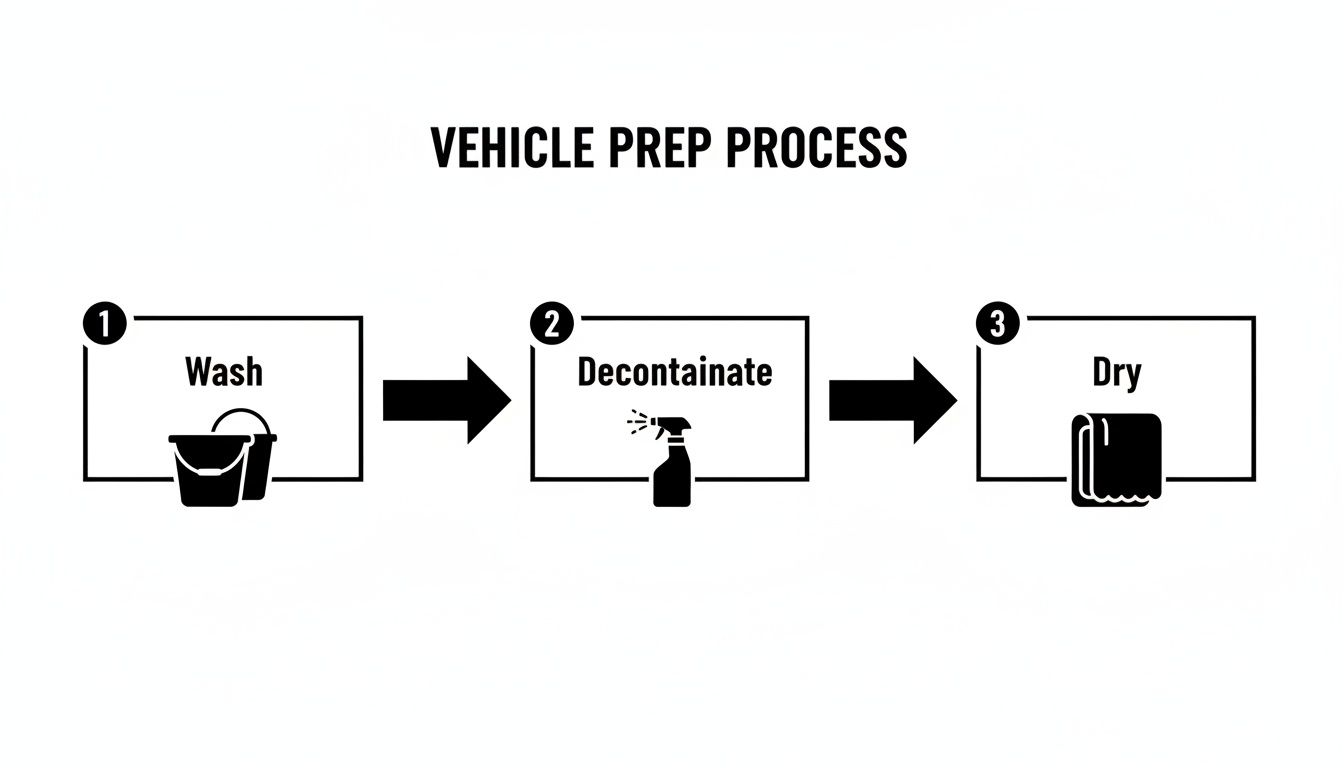
Nailing this sequence is what allows the spray to bond properly to the coating, giving you the performance and durability you paid for.
Titan Ultra Application Methods Compared
So, which method should you choose? Both are fantastic, but they serve slightly different purposes. This quick table breaks it down to help you decide on the fly.
| Attribute | Method 1: Drying Aid (Wet Application) | Method 2: Topper (Dry Application) |
|---|---|---|
| Speed | Extremely fast; combines two steps into one. | More deliberate; takes slightly longer. |
| Best For | Routine maintenance washes, time-saving. | Touch-ups, spot treatments, max gloss. |
| Technique | Spray on wet panel, dry with one towel. | Spray on dry panel, wipe with one towel, buff with a second. |
| Skill Level | Beginner-friendly, very forgiving. | Easy, but requires attention to buffing off. |
| Key Benefit | Unbeatable efficiency and convenience. | Maximum control and visual pop. |
Ultimately, you can’t go wrong with either. I personally use the drying aid method for 90% of my maintenance washes and reserve the dry application for when I’m preparing a car for a show or just want that extra bit of perfection.
Let’s check back in with Alex. He started using Ultra as a drying aid after every single wash. He was blown away. Each application didn’t just maintain the gloss of his original Titan coating—it actually deepened it. The paint became slicker, the water beading got incredibly tight, and his car consistently looked better than the day he drove it home from the detailer. That’s the power of a product designed to build on itself, creating compounding layers of protection and shine.
For a deeper dive into how to select and use these products, check out our complete guide to choosing the right ceramic coating spray for your vehicle.
Elevating Protection Beyond The Paint
Getting that perfect, glossy paint is one thing, but a truly protected vehicle doesn’t stop there. While a maintenance spray like Titan Ultra keeps your car’s body looking incredible, you have to apply that same protective mindset to every other surface. The most critical, and honestly the most overlooked, area? Your glass.
Your windshield is your primary view of the road. Let’s be real—clear visibility isn’t a cosmetic nicety, it’s a core component of your safety. That’s why a dedicated glass coating isn’t just an add-on; it’s an essential piece of the puzzle, working right alongside your paint maintenance routine.
A Quantum Leap in Driving Safety
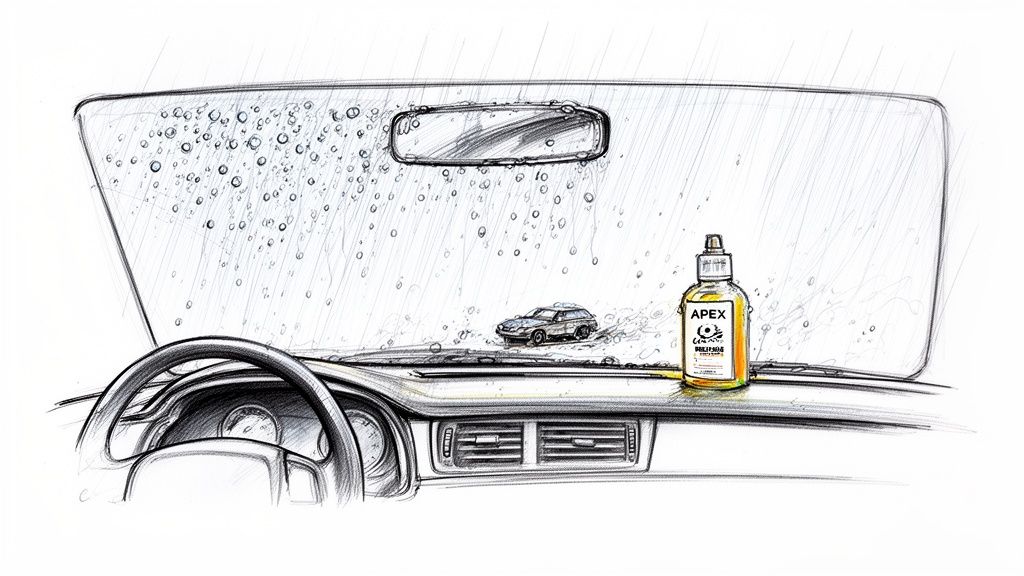
Let’s circle back to our car enthusiast, Alex. He had his wash and maintenance routine dialed in with Ultra, but his windshield was a constant headache. It was a magnet for grime, and driving through a storm was always a tense experience. He finally decided to try Titan’s Apex Glass Ceramic Coating, and the results were nothing short of night and day.
The next time a surprise downpour hit, Alex just watched, amazed. Instead of smearing across the glass, raindrops instantly formed into perfect little beads and were literally blown away by the wind as he drove. Once he hit highway speed, the rain flew off so fast he barely had to touch his wipers. The intense water-beading turned a potential white-knuckle drive into a calm, stress-free cruise.
This is about so much more than keeping your car clean. It’s a massive safety upgrade. An effective glass coating can dramatically improve your reaction time in bad weather by keeping your line of sight completely clear.
Integrating Apex Glass Into Your Routine
The best part is that applying Apex Glass is surprisingly simple and slots perfectly into your existing detailing schedule. The absolute key, as with any coating, is all in the prep work. The glass needs to be flawlessly clean and stripped of any oils or residues for the coating to bond properly.
Here’s the game plan:
- Deep Clean: Kick things off by giving the glass a serious cleaning with a high-quality, dedicated glass cleaner.
- Decontaminate: Run your hand over the glass. If it feels anything but perfectly smooth, grab a clay bar to pull out any bonded gunk. You want it slick.
- Final Wipe: Do one last wipe-down with an isopropyl alcohol (IPA) solution. This ensures the surface is totally bare and prepped for a strong bond.
- Application: Now you’re ready. Apply Apex Glass following the instructions, working in small, manageable sections and buffing it off to a crystal-clear, invisible finish.
This one simple step completes the protective shield around your vehicle. You’re already taking great care of your paint, and maybe even thinking about how to protect your rims with a proper ceramic wheel coating. Now, by treating your glass, you ensure every single critical surface on your car is protected and performing at its peak.
Pro Tips For a Flawless Finish, Every Single Time
Ever wonder what separates a good detail from a truly flawless one? It’s the little things. It’s about understanding the nuances of how these products work and tweaking your technique to get that professional, head-turning result. Most of the headaches people run into—like streaking or a dull finish—are totally avoidable with a few insider tricks.
Let’s start with the number one mistake I see people make: applying product in direct sunlight or on a hot panel. If that surface is warm, the spray’s carrier solvents evaporate almost instantly. They’re gone before the protective polymers even have a chance to spread out and bond. That’s what causes streaks and high spots, leaving you with a blotchy mess.
Do yourself a huge favor: always work in the shade or, even better, inside a garage. Before you start, place the back of your hand on the panel. Is it cool? You’re good to go. The sweet spot for application is generally between 50°F and 80°F (10°C and 27°C). This temperature range gives the product just enough time to do its job before you buff it to a perfect shine.
You Can’t Fix What You Can’t See
Your lighting setup is your secret weapon in the quest for perfection. A single overhead light in your garage just won’t cut it; it hides imperfections. Grab a dedicated detailing light or even just the flashlight on your phone. Scan the panel from different angles. You’ll be amazed at the subtle high spots and streaks that suddenly appear, giving you the chance to level them out before they cure.
If you take away only one tip, let it be this: less is always more. The urge to soak a panel, thinking more product means more protection, is real. But it’s a trap. Over-saturating the surface just makes it a nightmare to buff off, leading to a greasy, streaky finish. A couple of light mists per panel is all you need. Seriously.
Not All Sprays Are Built the Same
Compatibility between your maintenance spray and your base coating is a bigger deal than most people realize. Titan’s maintenance sprays are powered by our unique Dark Matter Technology®, which means they’re specifically engineered to work in harmony with our elastomer-based coatings like Alpha Quartz. This isn’t just a topping; it’s a symbiotic relationship. The spray actively reinforces the flexible, resilient nature of the base coat, which is crucial for resisting things like temperature-induced cracking or stone chips.
The auto care industry is booming, with the ceramic coating market alone hitting USD 12.15 billion in 2024. Spray-on products are a massive part of that growth, blending convenience with serious performance. In fact, advanced formulas like our Dark Matter Technology® have been proven in real-world testing to extend the life of a coating by up to 200%. You can dig into the data on the ceramic coating market’s rapid expansion here.
Now, even if your car wears a different brand of high-quality ceramic coating, a product like Titan Ultra will still deliver exceptional gloss and water-beading. But if you have one of our proprietary elastomer coatings, sticking with the Titan maintenance line is the absolute best way to maximize its performance and longevity. For a deeper dive, our guide on choosing the perfect auto quick detailer can help you dial in your choice.
Answering Your Maintenance Spray Questions
Even the most seasoned pros have questions when trying a new product. So, let’s tackle some of the most common things people ask about maintenance sprays. We’ll get you the clear, no-nonsense answers you need to get this right every time.
How Often Should I Really Be Using Titan Ultra?
Look, it depends on how you use your car. For a daily driver that sees rain, sun, and road grime, a quick application every one or two washes is the sweet spot. That usually means hitting it every 2-4 weeks. This is the perfect schedule to keep that amazing water-beading and deep, wet gloss at its absolute peak.
Now, if you’ve got a garage queen that only comes out on sunny weekends, you can back off a bit. Applying it once every couple of months will be plenty to keep it looking just-detailed.
The real magic of Ultra is that it builds. Each time you apply it, you’re not just topping off the protection—you’re stacking another thin layer, deepening the shine and making the surface even slicker.
Can I Use This On a Car That Isn’t Coated?
Absolutely, and you’ll be blown away by the results. While we designed Titan Ultra to perfectly complement and maintain our elastomer coatings, it’s a phenomenal standalone sealant on bare paint. You’ll get incredible hydrophobic properties, a seriously slick shine, and months of solid UV protection.
Honestly, using it on an uncoated car is a fantastic way to get a taste of what modern ceramic tech can do without going all-in on a full coating. It’s a massive leap forward from any old-school wax or sealant you’ve used in the past.
Help! What Do I Do If I See Streaks?
First, don’t panic. Streaks, or what we call “high spots,” are almost always caused by one of two simple mistakes: using way too much product or applying it to a hot panel. The good news is the fix is super easy.
Just grab a clean microfiber towel and get it slightly damp with a bit of water. Gently wipe over the streaky area—this will reactivate the product just enough. Immediately follow up with a completely dry, separate microfiber towel and buff the area until the finish is perfectly clear and uniform. Problem solved.
To avoid it next time, always work in the shade on a cool-to-the-touch panel and remember: a little goes a long way. 2-3 mists per section is all you need.
Is Titan Ultra Safe for All My Exterior Surfaces?
Yes, it’s designed to be a workhorse. Titan Ultra is incredibly versatile and safe for pretty much every exterior surface you can think of. Go ahead and use it with confidence on:
- Gloss and satin paint
- Glass and windshields
- Plastic and rubber trim
- Chrome accents
- Wheels and even calipers
The formula is engineered to bond to all these different materials without causing any issues. It protects and enhances everything it touches, which makes your maintenance wash way more efficient. It really is an all-in-one maintenance solution.
It’s time to elevate your wash routine with a product that builds layers of gloss and slickness with every single use. Experience the cumulative effect of Titan Coatings‘ advanced technology for yourself.
Discover the lasting, buildable shine of Titan Ultra.
0 Comments