
A clear ceramic coating is a liquid polymer that’s hand-applied to your vehicle’s exterior. Think of it less like a coat of wax and more like a second, ultra-hard skin for your car. Once it cures, it chemically bonds with the factory paint, creating a permanent, transparent shield. This isn’t just a shine-enhancer; it’s serious, long-term protection against the elements, blowing traditional waxes and sealants out of the water.
Why Your Car Needs More Than Just Wax
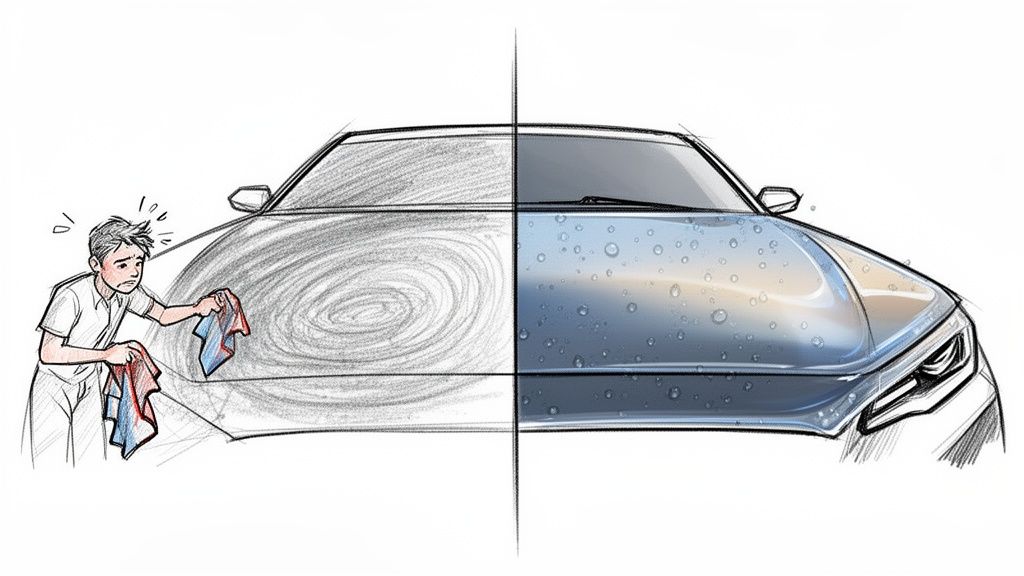
Let me paint a picture. Meet Alex, a car guy through and through. He loved seeing his car gleam, so every other weekend was a dedicated ritual: wash, clay, polish, and then, a careful application of a high-end carnauba wax. The car looked absolutely brilliant… for about a week.
Then, inevitably, the usual suspects would show up. Acidic bird droppings would start to etch the paint, road grime would cling stubbornly to the doors, and the brutal sun would slowly fade that deep, wet shine. It was a constant, aggravating cycle of temporary gloss and persistent anxiety.
This is a story that plays out in garages everywhere. You pour your time, money, and elbow grease into keeping your car looking perfect, but the results just don’t last. Waxes are temporary. They just sit on top of the paint, offering a shallow gloss that breaks down quickly when exposed to rain, sun, and road contaminants. They don’t offer any real, meaningful protection against the things that actually damage your finish.
Moving Beyond Temporary Solutions
This is precisely where a clear ceramic coating changes everything. It’s not just a better wax; it’s a completely different category of surface protection. These coatings are built on nanotechnology, using microscopic particles that actually work their way into the tiny, invisible pores of your car’s clear coat.
After being applied, the liquid polymer creates a chemical reaction, forming a covalent bond with the paint. This bond is worlds stronger and more durable than the weak, adhesive layer a wax provides. What you’re left with is a hardened, glass-like shield that essentially becomes a new, functional part of your vehicle’s surface.
The permanent bond is the secret sauce. Instead of a sacrificial layer that sits on the paint, a ceramic coating integrates with it. You get years of incredible protection from just one professional application.
This semi-permanent second skin acts as a powerful barrier against all sorts of common hazards:
- Environmental Fallout: It shrugs off damage from acid rain, bird droppings, and bug guts.
- UV Radiation: The coating is like a powerful sunscreen for your paint, stopping oxidation and fading in its tracks.
- Chemical Stains: It holds up against nasty road salts, tar, and other chemical messes.
At the end of the day, a ceramic coating preserves your factory paint in like-new condition while making cleaning ridiculously easy. For anyone like Alex who is just tired of the endless waxing cycle, it’s a game-changing solution. If you’re still on the fence, understanding the fundamental differences between wax and ceramic coatings is the best place to start. A clear ceramic coating isn’t just about achieving a great shine; it’s about smart, long-lasting preservation for your investment.
The Science Behind a Flawless Finish
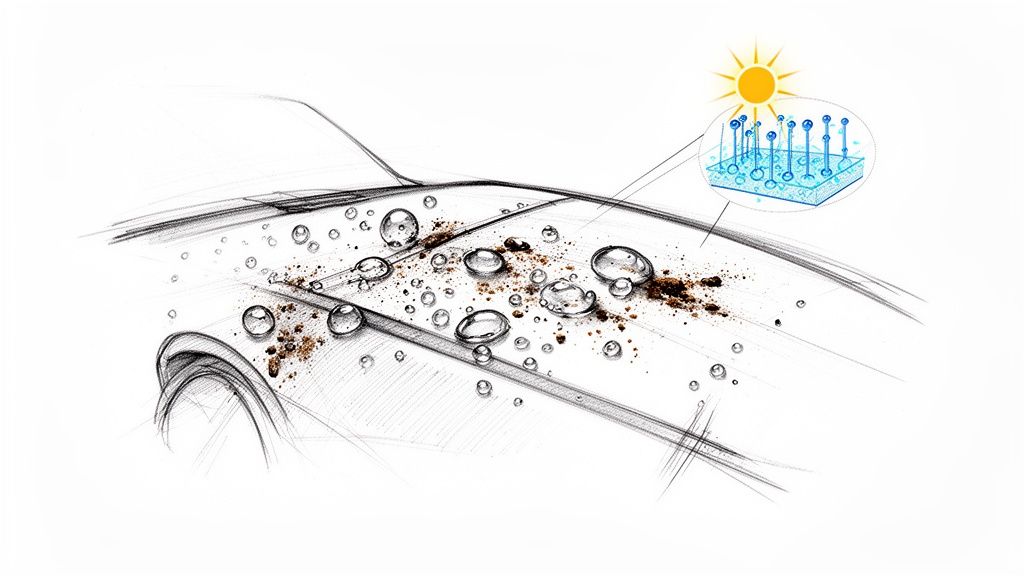
It’s not magic that makes a ceramic-coated car look so incredible—it’s advanced material science working at a microscopic level. These coatings form an impossibly smooth, uniform surface that completely changes how your car deals with the world around it. This science delivers real, tangible benefits that will change the way you think about car care forever.
The most famous benefit is the hydrophobic effect. If you looked at your car’s paint under a powerful microscope, you’d see it’s full of tiny pores and imperfections. A ceramic coating fills every single one, creating a surface so slick that water has nowhere to cling. Instead of spreading out, it forms tight, perfect beads that simply roll off, taking dirt and grime with them.
That’s the secret behind the “self-cleaning” effect everyone talks about. No, it doesn’t mean you can throw away your wash mitts. But it does mean your car stays cleaner for much, much longer and is ridiculously easy to rinse off when it does get dirty.
Beyond Water Beading: The Full Spectrum of Protection
The real genius of a clear ceramic coating is its multi-layered defense system. It’s about more than just making water dance; it’s about building a tough shield against all the invisible enemies constantly attacking your paint.
One of the worst culprits is ultraviolet (UV) radiation. Just like the sun damages your skin, it relentlessly attacks your car’s clear coat, causing it to oxidize, fade, and get that dull, chalky look. A quality ceramic coating is like a powerful, permanent sunscreen, blocking those harmful rays to keep your paint’s color deep and vibrant for years.
Then you have the constant threat of chemical contamination. Your car is a magnet for nasty, acidic stuff, including:
- Bug Splatter: The acidic guts from insects can etch into unprotected paint in just a few hours.
- Bird Droppings: These are notoriously acidic and will leave permanent marks if not removed immediately.
- Road Salt and Tar: These corrosive materials stick to your paint and slowly eat away at the finish.
A ceramic coating creates an impermeable barrier, stopping these contaminants in their tracks. They can’t reach your paint; they just sit on top of the sacrificial coating layer, where they can be washed away easily without causing any lasting damage.
A Story of Superior Engineering
Years ago, a passionate detailer was driving through a storm. He noticed how beautifully the water was beading on his ceramic-coated paint, but at the same time, he was squinting, struggling to see through the sheets of water on his windshield. It was stressful and frankly, dangerous. That moment sparked an idea: what if you could adapt that same hydrophobic science specifically for glass to make driving in the rain stress-free?
This led to the creation of specialized products like Titan’s Apex Glass Ceramic Coating. This formula is engineered to make your windshield intensely slick. Now, when you drive in the rain, the airflow alone whisks the water droplets away, drastically improving your visibility and turning a white-knuckle drive into a relaxed one. You’ll find you barely even need to touch your wipers. You can discover more about what is ceramic coating and see how this technology is customized for different surfaces.
The demand for this level of protection is exploding. The global ceramic coatings market was valued at USD 1.96 billion in 2018 and is projected to skyrocket to USD 3.32 billion by 2026. This growth is fueled by car owners and professionals who are no longer settling for anything less than superior, long-term solutions. You can read the full report on the ceramic coatings market trends. It’s science you can see, feel, and count on every single time you drive.
Rethinking Durability With Elastomer Coatings
While the science behind a clear ceramic coating is impressive, it’s crucial to understand that not all coatings are created equal. For years, the industry chased one single attribute above all others: hardness. The logic seemed sound—a harder surface is tougher to scratch. But this singular focus on hardness created an unintended, and significant, weakness: brittleness.
Think of it like glass. Traditional ceramic coatings, for all their strength, can be incredibly rigid. When struck by a sharp piece of road debris or stressed by a sudden temperature change from frozen to hot, they’re prone to developing micro-fractures. It’s a classic engineering trade-off. Extreme hardness often sacrifices flexibility, which ultimately limits how long a coating can really last in the real world. This is the very problem Titan Coatings was determined to solve.
We started by asking a simple but profound question: What if a coating could be as hard as glass but as flexible as rubber? The hunt for that answer led us to a genuine breakthrough in material science and the creation of an entirely new category of surface protection: elastomer coatings.
The Best of Both Worlds: Hardness and Flexibility
Our innovation didn’t come from tweaking an old formula. It came from a deep dive into advanced materials. By pioneering the use of nano-tube technology combined with our proprietary Dark Matter Tech®, Titan Coatings became the first company to introduce true elastomer coatings to the automotive industry. This was a fundamental shift in how we approach surface protection.
At its core, an elastomer is a polymer that has viscoelasticity. That’s a technical way of saying it has both the resistance of a thick liquid and the springiness of an elastic band. When you engineer this property into a ceramic coating, it’s an absolute game-changer. Our elastic coatings are hard like glass yet flexible, making them last longer.
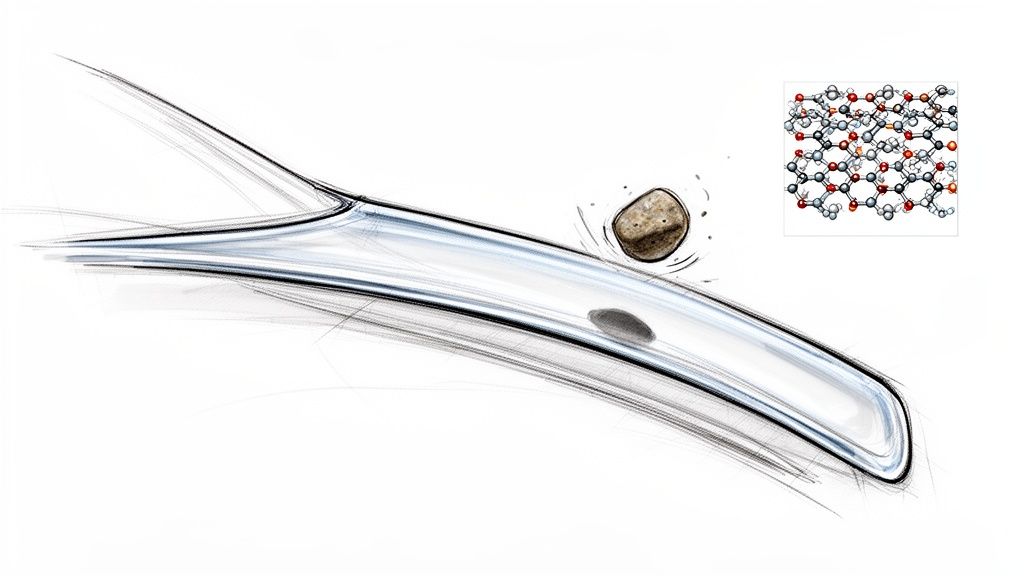
Picture a small rock getting kicked up from the highway. On a standard, rigid coating, that impact energy is focused on one tiny spot, often resulting in a chip or a crack. An elastomer coating, however, behaves differently. On a microscopic level, it flexes, absorbing and spreading that impact energy across its surface before snapping right back to its original state.
This elastic nature is the secret to superior durability. The coating doesn’t just resist damage; it yields to force and bounces back, dramatically reducing the risk of the micro-cracking that degrades other coatings over time.
The same principle applies to thermal stress. When your car goes from a frozen garage into the blazing sun, its metal panels expand. A brittle coating can’t keep up with that movement and develops stress fractures. Our elastic coatings, on the other hand, expand and contract right along with the paint, ensuring the protective bond remains perfect and seamless, no matter the weather. Temperature change won’t affect the coating anymore.
A New Benchmark for Resilience
This unique blend of hardness and flexibility creates a far more resilient shield for your vehicle. It’s built to withstand the kind of punishment that would compromise lesser materials, offering a level of protection that simply wasn’t possible before.
The advantages of this technology are clear:
- Impact Absorption: The coating’s flexible nature helps dissipate energy from small stones and road debris, shielding the paint underneath.
- Thermal Resistance: It remains stable and intact through extreme temperature swings, from freezing winters to scorching summers, without cracking.
- Long-Term Integrity: By preventing micro-cracks from forming in the first place, the coating maintains its structure and protective power for much longer.
This isn’t just an incremental improvement; it’s a smarter, more dynamic approach to protection. By solving the rigidity problem, we’ve created clear ceramic coatings that last longer and perform better in the unpredictable conditions of daily driving. You can dive deeper into the science behind our Titan Coatings Elastomer technology to learn more. It truly represents a new benchmark for what vehicle protection can and should be.
Choosing The Right Shield For Your Vehicle
We don’t just develop advanced material science in a lab; we create real-world solutions for the problems drivers face every single day. This isn’t just about making paint look shiny—it’s about solving specific frustrations, from bug guts baked onto your bumper to those white-knuckle drives in a downpour. This is where specialized, purpose-built coatings really show their worth.
Think about it. You’re on a long road trip on a warm summer evening. It’s inevitable that the front of your car is going to get plastered with bugs. With a standard, brittle ceramic coating, those acidic bug impacts can eventually create tiny stress fractures. The constant cycle of a hot sun followed by a cool night also tests the limits of rigid coatings, often leading to them failing way too soon.
That exact challenge is why we engineered Titan’s Alpha Quartz. As our flagship elastomer coating, it was built from the ground up to solve these problems. Its unique formula is hard like glass but also incredibly flexible, allowing it to absorb and dissipate energy from impacts—whether from bugs or small road debris—without cracking. That elasticity also means it expands and contracts right along with your car’s body panels during temperature swings, maintaining a flawless, protective bond all year.
The Ultimate Defense For Your Paintwork
Alpha Quartz is much more than just a coating; it’s a dynamic, living shield for your vehicle’s body. We also made sure the application is user-friendly, so detailing enthusiasts who demand professional-grade results can get them. Its core mission is simple: provide an uncompromising defense against whatever the road throws at you.
Here’s what sets it apart:
- Elasticity Under Pressure: The coating flexes on impact, which dramatically reduces the risk of chipping or cracking that plagues traditional, rigid ceramics when bugs hit the car’s surface.
- Temperature Stability: From freezing cold to blistering heat, its flexible nature prevents the micro-cracks caused by thermal expansion and contraction.
- Effortless Maintenance: The surface is so hydrophobic and slick that it’s incredibly difficult for dirt, grime, and other contaminants to get a grip.
This level of resilience completely redefines what you should expect from a clear ceramic coating, ensuring your paint stays protected through the harshest conditions imaginable.
Solving The Problem Of Poor Visibility
Now, let’s talk about another critical area for any driver: the windshield. Driving in a heavy downpour can be one of the most stressful experiences you can have behind the wheel. Your wipers can’t keep up, visibility plummets, and your reaction time shrinks. We knew our technology could offer a real solution here.
That’s why we developed Titan’s Apex Glass Ceramic Coating. This isn’t just a re-bottled paint coating; it’s a specialized formula engineered specifically to create an intensely hydrophobic surface on your windshield.
Once applied, water has almost zero surface tension on the glass. Instead of smearing across your view, rain forms into tight, clean beads and is whisked away by the airflow over your car—often before you even think to turn on your wipers.
This effect drastically improves clarity and cuts down on the blinding glare from headlights on wet roads. It transforms a tense drive into a safe and relaxed one, making driving under rain stress-free. It’s a simple, easy-to-use application that provides an unbelievable improvement in driving safety and confidence. You can see just how easy it is to apply our Apex Glass Ceramic Coating and completely change your rainy-day driving.
Titan Coatings Product Comparison
Choosing between our specialized coatings comes down to protecting the right surface with the right technology. Here’s a quick-glance comparison between our premier elastomer coating for paint and our dedicated glass coating. You can find these and other solutions in our shop.
| Feature | Alpha Quartz (Elastomer) | Apex Glass Coating |
|---|---|---|
| Primary Surface | Vehicle Paintwork | Automotive Glass |
| Key Technology | Flexible elastomer for impact and thermal resistance | Specialized hydrophobic formula to repel water |
| Main Benefit | Prevents chips, cracks, and damage from bugs and debris. Keeps paint looking flawless. | Dramatically improves visibility in rain, reducing the need for wipers at speed. |
| Longevity | Multi-year protection for paint | Long-lasting protection for glass, typically reapplied seasonally for best results |
| User Focus | Car owners seeking the highest level of paint protection and easy maintenance. | Drivers who prioritize safety and clarity in all weather conditions. |
Ultimately, both Alpha Quartz and Apex are designed to solve very different, but equally important, problems. One shields your investment’s finish, while the other protects you.
The demand for these kinds of high-performance solutions is exploding as more drivers see the value. The high-performance ceramic coatings market was valued at USD 9.99 billion in 2024 and is projected to hit USD 15.8 billion by 2032. This growth makes one thing clear: people are willing to invest in premium coatings that offer superior durability and advanced features. You can dive into the numbers yourself in the full high-performance ceramic coatings market report.
In the end, choosing the right product is about identifying your biggest pain points and picking a targeted solution—whether that’s ultimate impact resistance for your paint or crystal-clear visibility for your glass. To help make your decision, check out our guide on Paint Protection Film vs. Ceramic Coating to see which technology is the best fit for your needs.
Protecting Your Investment With Proper Care
So, you’ve invested in a top-tier clear ceramic coating. That’s a fantastic move for your vehicle, but the story doesn’t end with what’s in the bottle. The real secret to getting years of jaw-dropping gloss and protection comes down to two things: the prep work done before the coating is applied and the simple care you give it afterward. Get these right, and that investment will pay off every time you look at your car.
The foundation for a durable bond is laid long before the first drop of coating touches the paint. Think of your car’s surface like a surgeon’s operating table—it has to be perfectly clean and sterile. You simply can’t expect a high-tech coating to bond properly to a contaminated surface. That’s why professional preparation is an absolute must. It starts with a deep decontamination wash to pull out all the nasty stuff a regular wash misses, like embedded iron fallout and stubborn tar.
After that, it’s time for paint correction. This is where the magic really happens. A skilled technician will machine polish the paint to erase swirl marks, minor scratches, and any other imperfections that dull the finish. This step does more than just crank up the gloss; it creates a pristine, ultra-smooth surface that allows the ceramic coating to grab on and form the strongest possible chemical bond. Skipping this is like building a house on a shaky foundation—it’s just not going to last.
This simple diagram shows how a comprehensive protection plan comes together, starting with the car and moving to protect both the body and the glass.
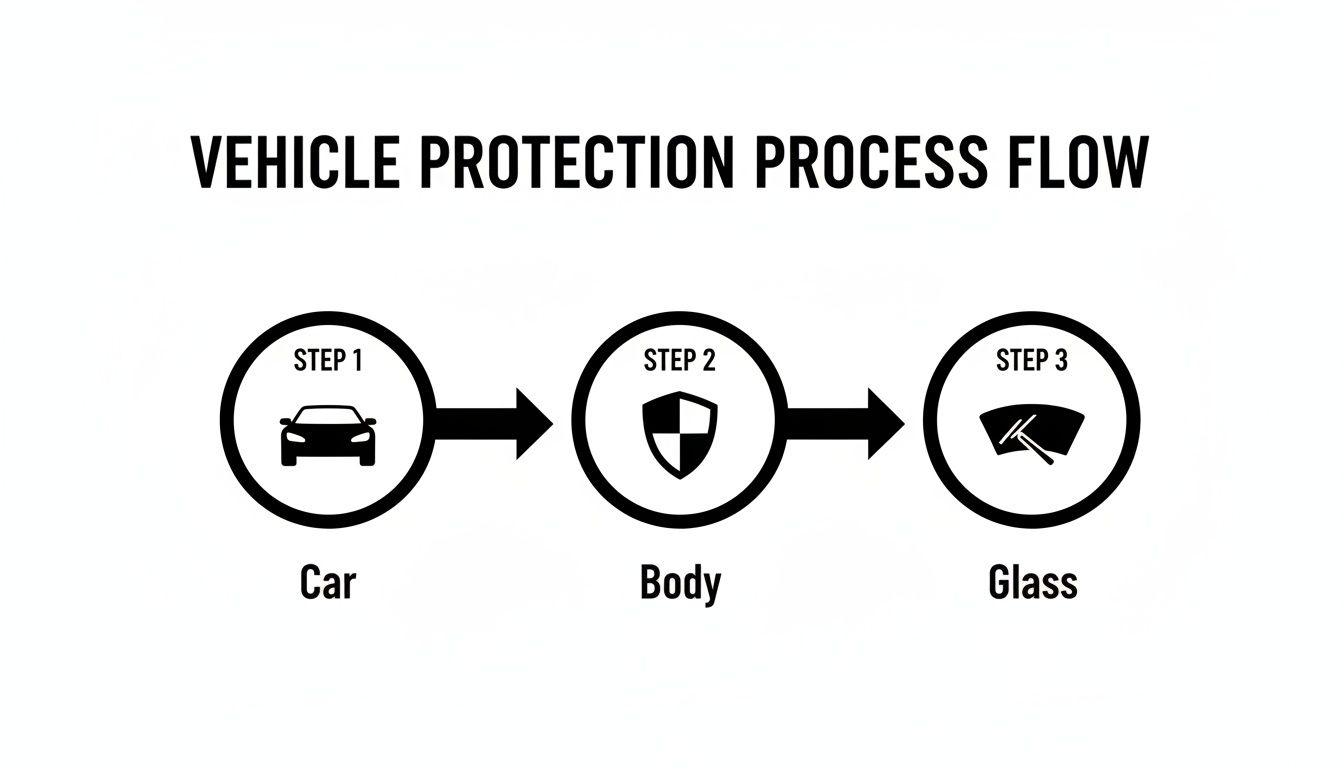
As you can see, true vehicle protection isn’t just about the paint. It’s a holistic approach that covers every critical surface.
Let’s Bust the “Invincibility” Myth
One of the biggest misunderstandings I hear about ceramic coatings is that they’re some kind of invisible force field. They are incredibly tough, but they aren’t bulletproof. To keep that slick, water-beading surface and deep shine, you have to follow a simple aftercare routine. The good news? It’s a whole lot easier than the old cycle of constant waxing and polishing.
The number one rule is to stay away from harsh chemicals and rough washing methods. Those drive-thru tunnel washes with their giant, gritty brushes and aggressive soaps are a coating’s worst enemy. They can easily inflict swirl marks and start to break down the protective layer. The best way to keep your finish looking flawless is to switch to a safe hand-washing method.
The gold standard is the two-bucket wash method. It’s simple: one bucket for your soapy, pH-neutral car wash solution, and a second bucket with plain water for rinsing your wash mitt. This genius technique keeps you from dragging dirt and grit right back across your paint, which is the main culprit behind those dreaded wash-induced scratches.
Your Simple and Effective Maintenance Plan
Keeping that showroom finish doesn’t mean spending your weekends chained to the driveway. A straightforward, consistent routine is all it takes to get the most out of your coating.
- Wash It Right: Stick to the two-bucket method using a quality microfiber wash mitt and a pH-neutral car shampoo. This gently lifts dirt without stripping your protection.
- Dry With Care: Never let the car air-dry, as this will leave mineral deposits and water spots behind. Use a plush microfiber drying towel or, even better, a filtered air blower to safely whisk the water away.
- Avoid Harsh Chemicals: Keep all-purpose cleaners, degreasers, and any non-automotive chemicals far away from your paint. They are often too aggressive and can compromise the coating.
Following these basic guidelines ensures your coating can do its job year after year. For a complete breakdown of the process, we’ve put together an in-depth guide on how to maintain a ceramic coating that covers everything you need to know. Arming yourself with this knowledge is the best way to protect your investment and enjoy that incredible gloss for the long haul.
Frequently Asked Questions About Ceramic Coatings
Stepping into the world of ceramic coatings is a big move for your vehicle’s protection, and it’s totally normal to have a lot of questions. It’s a serious upgrade, and you should have all the facts before you decide. To help you get clear on everything, we’ve put together answers to the questions we hear most often from drivers and detailers just like you.
Our whole goal here is to give you straight, honest answers—no hype, no jargon. We want you to walk away feeling completely confident, knowing exactly what to expect from this incredible technology.
How Long Does a Clear Ceramic Coating Actually Last?
This is usually the first thing people want to know, and the truth is, it really comes down to two things: the quality of the coating and how you take care of it. Your basic, off-the-shelf ceramic sprays might give you a year, maybe two if you’re lucky, before they need to be reapplied. They’re a decent starting point, but they just don’t have the chemistry for true, long-haul protection.
This is where Titan’s advanced elastomer coatings completely flip the script. Their unique, flexible structure isn’t rigid and brittle; it’s engineered for incredible durability. Think of it like this: when traditional hard coatings get hit with a small impact or expand and contract with temperature, they can develop tiny micro-cracks. Our elastic coatings, on the other hand, absorb and disperse that stress. That built-in resilience is why they can protect your vehicle for years, not just a couple of seasons. Of course, proper, consistent maintenance is the key to getting every last bit of that lifespan.
Is a Ceramic Coating a Replacement for Paint Protection Film (PPF)?
Fantastic question. It gets right to the heart of building a smart protection strategy. The short answer is no—they handle different jobs but work together perfectly to create the ultimate shield for your paint.
Here’s a simple way to think about it:
- Paint Protection Film (PPF) is your vehicle’s heavyweight bodyguard. It’s a thick, tough urethane film that physically absorbs the impact from rock chips and stops deeper scratches in their tracks. Its primary mission is to fend off direct, physical hits.
- A Clear Ceramic Coating is the sophisticated, all-weather defense system. It’s an incredibly thin, hard, and slick layer that excels at stopping chemical stains, UV fading, and environmental gunk. It also happens to make washing your car ridiculously easy.
When you layer a top-tier ceramic coating over PPF, you get the absolute best of both worlds. You’re combining the brute-force impact resistance of the film with the unmatched gloss, chemical protection, and “self-cleaning” effect of the coating. They aren’t rivals; they’re the ultimate partners in preservation.
Can I Apply a Clear Ceramic Coating Myself?
While nothing beats the flawless finish of a professional installation, we know there are some seriously skilled DIYers out there. That’s why we specifically designed products like Titan’s Alpha Quartz to be user-friendly for enthusiasts who are meticulous and have some experience under their belts.
But here’s the real secret to success: it’s not the application, it’s the prep work. The paint has to be perfectly clean, decontaminated, and corrected before a single drop of coating touches it. That means a full chemical and clay bar decontamination to remove all embedded iron and tar, followed by machine polishing to get rid of every last swirl mark and imperfection. If you’re not comfortable with paint correction, we strongly recommend going to a pro. A perfect bond and a flawless finish depend 100% on a perfectly prepped surface.
Will a Ceramic Coating Stop All Scratches and Rock Chips?
This is probably the single biggest myth out there. A high-quality ceramic coating dramatically increases your paint’s surface hardness (often rated at 9H or higher), which makes it incredibly resistant to light wash-induced swirls and love marks. But it’s not a suit of armor.
A clear ceramic coating is not bulletproof. It won’t stop a key from a vandal or a rock flying at 70 mph. For that kind of heavy impact defense, Paint Protection Film (PPF) is still the only real answer.
This is another spot where our elastic coatings have an edge. Because Titan’s elastomer coatings are flexible, they can shrug off minor impacts better than a brittle, traditional ceramic. Still, it’s vital to have the right expectations: they are scratch-resistant, not scratch-proof.
What About Protecting My Windshield?
Excellent question—and one that’s too often ignored. Clear visibility is non-negotiable for safety, and your windshield needs a different kind of protection than your paint. A lot of people think they can just use a paint coating on the glass, but that’s a mistake. Glass has unique properties and requires a formula designed specifically for it.
That’s exactly why we created Titan’s Apex Glass Ceramic Coating. Its specialized chemistry forms an intensely hydrophobic (water-hating) surface. Rain literally beads up and flies off the windshield as you drive, often without even needing to turn on your wipers. Driving in a downpour goes from a white-knuckle experience to a calm, clear one. It’s an easy-to-apply solution that provides a night-and-day improvement in driving clarity and confidence.
At Titan Coatings, our mission is to empower you with products that deliver superior results and the knowledge to get the most out of them. From the flexible strength of Alpha Quartz to the vision-clearing power of Apex Glass, our coatings are built to solve real-world problems.
Ready to see the road ahead more clearly? Check out our user-friendly and incredibly effective Apex Glass Ceramic Coating and completely change how you drive in the rain.
0 Comments