
To get tree sap off your car safely, you need to dissolve that sticky mess. The trick is using a gentle solvent—something like isopropyl alcohol or a quality sap remover—and a soft microfiber towel to lift it away. Whatever you do, never scrub or try to pick at hardened sap. That’s a surefire way to cause deep, ugly scratches in your clear coat.
Why Tree Sap Is a Nightmare for Your Car’s Paint
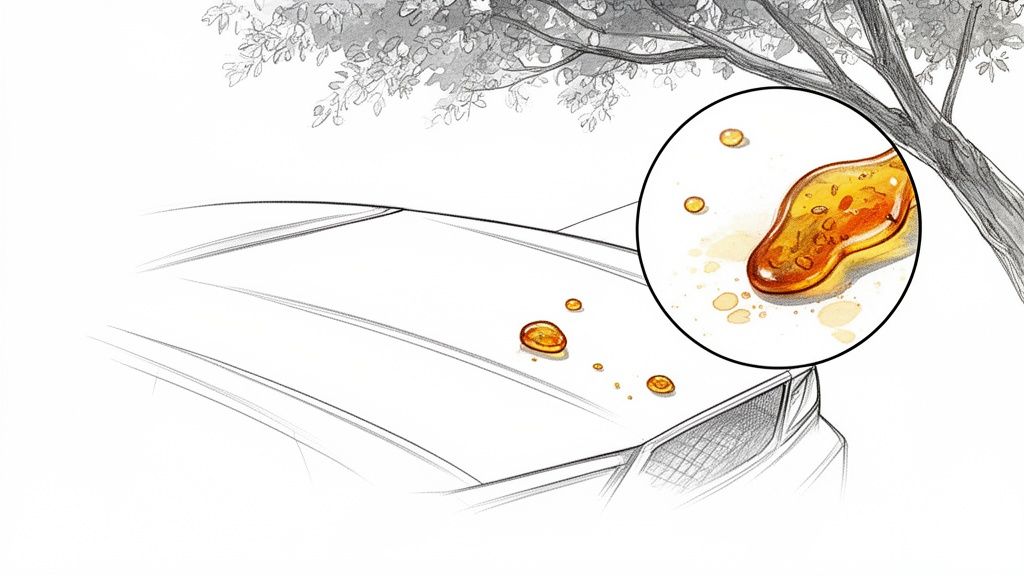
We’ve all done it. You pull into that perfect shady spot under a big, leafy tree on a scorching day, thinking you’re doing your car a favor. You come back later to find it decorated with sticky, amber-colored blobs. That sinking feeling is something every car owner who cares about their finish knows all too well.
Tree sap isn’t just a sticky nuisance; it’s a direct assault on your car’s paintwork. It might look innocent enough, but its chemical makeup turns it into a serious threat.
The Science Behind the Stickiness
At its core, tree sap is a potent mixture of sugars, minerals, and acidic compounds. The moment it lands on your car, it starts a chemical process, bonding itself directly to your clear coat. This isn’t just something sitting on the surface—it’s actively trying to become part of it.
Then, the sun gets involved. The heat bakes the sap, causing it to harden and crystallize. This puts the bonding process into overdrive, making the sap exponentially tougher to remove. What started as a soft drip quickly becomes a hardened resin, chemically fused to your finish.
The longer sap sits, especially under harsh UV rays, the more it eats into the clear coat. This leads to etching—a permanent dulling of the paint that can only be fixed with professional paint correction.
This etching happens because of the sap’s acidity. It slowly degrades the protective clear coat, leaving a permanent blemish. If you ignore it for too long, it can even work its way through to the color coat, causing discoloration and setting you up for some costly repairs.
A Story of Waiting Too Long
I remember a client, Mark, who brought in his beautiful black sedan. He’d parked under a pine tree for just a couple of days during a nasty heatwave. He noticed the tiny specks of sap but figured, “I’ll get it at the next car wash.” By the time a week had passed, those tiny dots were hard, glass-like bumps.
He tried washing them, then scrubbing, but they wouldn’t budge. Out of frustration, he used his fingernail on one spot and immediately left a deep scratch. By the time he came to us, the sap had etched the paint in over a dozen places. It took an expensive, multi-stage paint correction to bring the finish back. His story is a perfect warning: procrastination is your paint’s worst enemy.
Learning how to properly decontaminate your car paint is the first step in preventing this kind of damage. Removing contaminants like sap quickly and safely is non-negotiable for protecting your car’s look and its resale value. The urgency here is real—acting fast with the right tools and techniques makes all the difference.
Your First Response to Fresh Tree Sap
You walk out to your car and there it is: a fresh, glistening drop of tree sap. That feeling is aggravating, isn’t it? Your first instinct might be to grab the nearest rag and scrub it off, but please, don’t do that. The absolute key to handling fresh tree sap is to act quickly but gently, using a method that dissolves and lifts the gunk without damaging your car’s clear coat.
Getting to it within the first few hours is your best shot. It prevents the sap from bonding to the paint and starting the etching process we talked about earlier.
The goal here isn’t to fight the sap with brute force; it’s to outsmart it. You need a good lubricant and something soft to lift it with. Aggressively rubbing at it, even with a seemingly soft cloth, will just drag those sticky particles across your paint. That’s a surefire way to create a frustrating web of micro-scratches and swirl marks. This is precisely where having the right tools makes all the difference.
Choosing Your Tools Wisely
Your go-to weapon should always be a plush, clean microfiber towel. The deep, soft fibers are designed to trap and pull contaminants away from the surface, which is exactly what you want. Stay away from paper towels or old cotton rags—their fibers are surprisingly abrasive and can easily mar your finish.
For the lubricant, a quality quick detailer spray is a fantastic choice. It creates a slick, protective barrier that helps dissolve the sap and lets your towel glide over the surface without friction. No quick detailer on hand? A simple solution of warm water mixed with a pH-neutral car wash soap will also get the job done in a pinch.
Pro Tip: My mantra for any contaminant on paint is “lift, don’t scrub.” Saturate the spot, give the product a moment to work its magic and break down the sap, then gently wipe it away in a single, deliberate direction.
If you want to get a better handle on how these sprays work and the best techniques for using them, our pro guide to using an auto quick detailer is a great resource. It’s packed with practical tips for any car enthusiast.
Comparing DIY Tree Sap Removal Methods
When you’re caught off guard by sap, it’s tempting to reach for whatever you have in the garage or under the kitchen sink. While some household items can definitely work, they all come with their own set of risks. It’s really important to understand the potential fallout for your car’s delicate finish before you start spraying.
Here’s a quick rundown to help you make a smarter choice when you’re faced with a sticky situation.
Comparing DIY Tree Sap Removal Methods
A quick-reference guide to common household remedies for removing tree sap, detailing their effectiveness, safety, and ideal use case.
| Method | Effectiveness (Fresh Sap) | Effectiveness (Hardened Sap) | Safety Risk on Paint | Best For |
|---|---|---|---|---|
| Warm, Soapy Water | High | Low | Very Low | Immediate removal of soft, fresh sap drips. |
| Isopropyl Alcohol (70%) | Very High | Medium | Low to Medium | Stubborn fresh spots. Must be rinsed thoroughly. |
| Hand Sanitizer | High | Low | Medium | Emergency use only; alcohol content can dry out paint. |
| WD-40 / Lubricants | High | Medium | Medium | Resinous pine sap. Requires a full wash afterward. |
| Specialized Sap Remover | Very High | High | Very Low | The safest and most effective option for all sap types. |
As you can see, while several methods can get the job done, they’re not all created equal. The safest and most reliable approach, without a doubt, is a product specifically formulated for automotive paint.
Using the wrong chemical can easily strip your wax or sealant, dull your clear coat, or even cause permanent discoloration. By sticking with a gentle, dedicated solution, you can be sure the sap is the only thing you’re removing, leaving your paint flawless and unharmed.
Removing Hardened and Stubborn Sap Residue
So, what happens when you miss a spot? That innocent little drip of sap bakes in the sun for a few days and turns into a hard, crystallized pebble on your paint. This is the point where your usual car wash soap and a bit of elbow grease just won’t cut it. Once sap hardens into resin, it actually bonds with your clear coat, and you’ll need a much smarter approach to get it off without damaging the paint.
This is the exact scenario every car owner dreads. I’ll never forget a customer who came back from a week-long trip to find his perfect white SUV looking like it had been peppered with dark, hardened pine resin. He’d tried everything—soaking it, scrubbing, he even admitted to picking at it with a plastic card, which only left a mess of fine scratches behind. He was sure the paint was ruined. I had to reassure him it wasn’t a lost cause; it just required the right tools and a bit of patience.
Specialized Solvents and the Art of the Clay Bar
For that rock-hard sap, it’s time to graduate from gentle soaps to something with a bit more punch. This is where specialized tree sap removers are worth their weight in gold. These formulas contain solvents engineered to break down the complex sugars and resins in sap without being too harsh on your car’s finish. They essentially work by rehydrating and dissolving the hardened gunk from the inside out, making it soft enough to be wiped away safely.
But even after a good solvent soak, you might still feel a slightly gritty or rough patch left on the paint. That lingering residue is where a detailer’s secret weapon comes into play: the automotive clay bar. A clay bar is a specially designed resin compound that gently grabs and pulls out embedded contaminants from the pores of your paint—the kind of stuff a normal wash can’t touch.
Using a clay bar isn’t about brute force or scrubbing; it’s all about a smooth glide. The clay latches onto anything sticking up from the paint’s surface, like those last bits of hardened sap, and shears them off, leaving behind a finish that feels as smooth as glass. Just remember, proper lubrication is absolutely non-negotiable to keep things safe and scratch-free.
The basic principle for any sap removal, fresh or stubborn, is to lubricate, lift, and wipe.
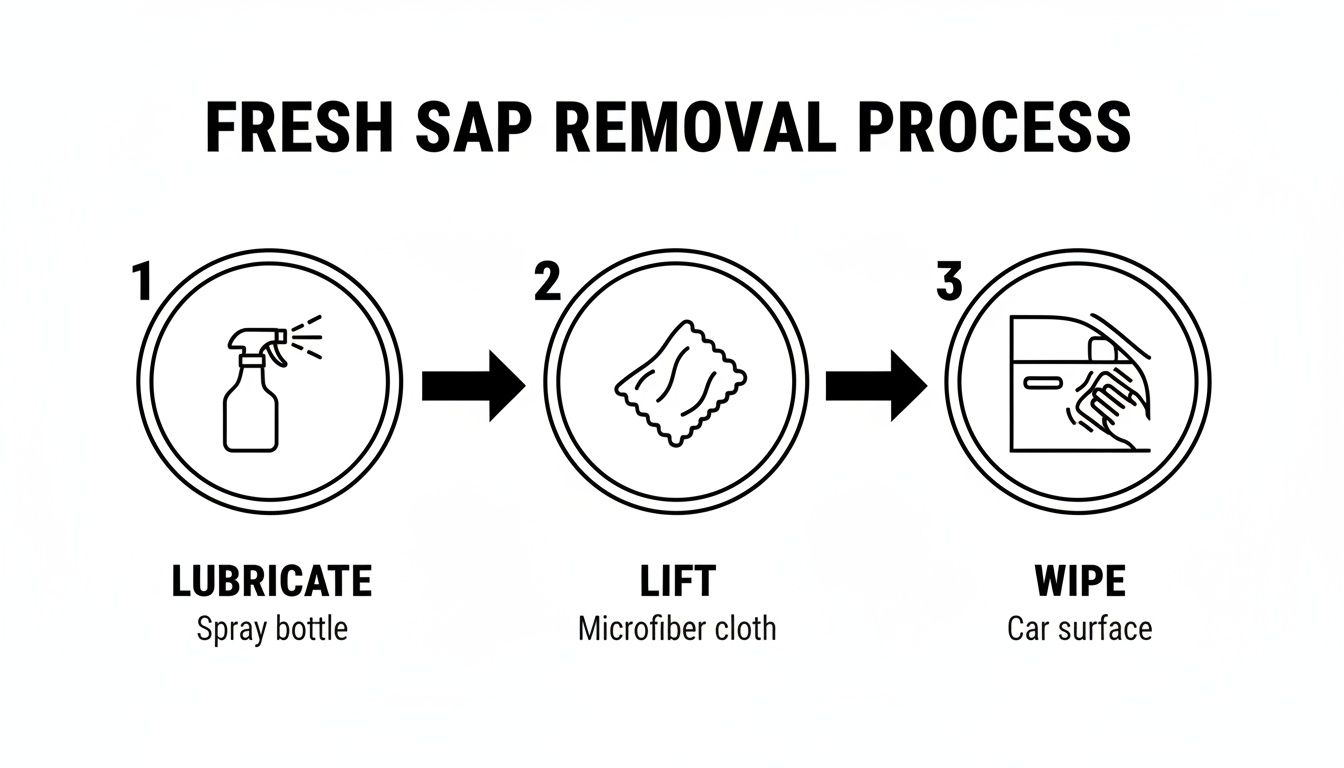
This simple visual nails it: safe removal always starts with reducing friction to protect that precious clear coat.
A Methodical Approach for a Flawless Finish
To get a truly professional-level result on hardened sap, you’ll want to combine these two powerful tools. If you’re new to this essential detailing step, you can dive deeper into our guide on what clay bar treatment is and why it’s crucial for your car’s paint.
Here’s the game plan for tackling those stubborn spots the right way:
- Prep the Area: Always start by washing and drying the spot. You need to get rid of any loose dirt or grit that could get dragged around and cause scratches.
- Bring in the Solvent: Apply your chosen sap remover directly onto the hardened sap. Let it sit and work its magic for the time recommended on the label, usually about 30-60 seconds. You should actually see the sap start to soften or “melt.”
- Wipe, Don’t Scrub: Take a clean microfiber towel and gently wipe away the softened gunk. Use very little pressure. If some remains, apply more solvent and repeat—don’t try to force it off.
- Time for the Clay: Once the bulk of the sap is gone, spray the area generously with a dedicated clay lubricant. Glide the clay bar back and forth over the spot with light, even pressure. You’ll feel the surface go from rough to perfectly smooth as the clay pulls up the last traces of residue.
- Final Inspection: Wipe the area dry with a fresh microfiber and check your work under good lighting. The surface should be completely smooth to the touch, with no trace of the sap left behind.
Believe it or not, tree sap has been a headache for car owners since the 1920s. The key is acting fast. Data shows that rubbing alcohol works in about 85% of cases if you get to the sap within 72 hours, but its success rate drops significantly after that. That’s when clay bars become essential, as they can lift 92% of residues without scratching when used correctly with a good lubricant.
This careful, step-by-step process isn’t just for sap. When you’re tackling stubborn environmental stains like hard water spots, a similar patient approach is needed to avoid damaging the surface. By taking your time and using the right products, you can conquer even the most annoying sap spots and bring your paint back to its flawless, showroom shine.
Your Best Defense Is a Good Offense
So you’ve spent your Saturday carefully getting every last speck of tree sap off your car. Now what? You’re left wondering how to keep from doing it all over again next week. Constantly cleaning up after environmental attacks is a losing battle. It’s time to stop reacting and start preventing.
This is where a high-quality coating completely changes the game. And that’s our specialty.
The story behind Titan Coatings didn’t start in a detailing shop. It began with a mission to redefine surface protection. We were the first company to introduce Elastomer coatings to the market, a revolutionary technology built using nano tubes and our proprietary Dark Matter tech. The result was a level of protection that old-school waxes and sealants just can’t touch.
The Secret is Elastic Technology
What really sets our coatings apart isn’t just how hard they are—it’s how smart they are. The result of our research is a protective layer that’s as tough as glass but has a critical advantage: it’s flexible.
Think about it. Most ceramic coatings are extremely hard, which is great for preventing tiny scratches. But that rigidity is also their weakness.
A car’s body panels expand and contract with temperature changes—from a freezing winter night to a blistering summer day. A rigid, brittle coating can’t move with the metal, leading to micro-fractures over time. Our elastic coatings flex right along with your car’s panels, keeping the bond to your paint strong and secure. This flexibility means the coating won’t crack down due to temperature changes, making them last longer and providing superior protection when bugs or debris hit the car.
This built-in resilience does more than just handle temperature swings. It provides far better resistance to impacts from road debris, bug guts, and, of course, environmental fallout like tree sap.
Proactive Protection, Not Reactive Cleaning
When your car is protected by a Titan coating, your paint gains a permanent, self-cleaning shield. The surface becomes so incredibly slick that contaminants like tree sap struggle to get a grip. Instead of digging into your clear coat and causing real damage, the sap just sits on the surface of the coating.
What was once a painstaking cleaning chore becomes a simple rinse-off.
This chart really drives home the advantages our elastomer technology has over other options you might be considering.
As you can see, Titan’s flexible, durable approach offers a real-world advantage in longevity and protection. If you want to get into the nitty-gritty, our full product comparison page has all the details on what makes our formulas so different.
A Complete Shield for Your Entire Vehicle
This level of defense isn’t just for your paint. A big glob of sap on your windshield is more than just annoying; it can be a genuine safety hazard, smearing and blocking your vision when you need it most.
That’s why we created APEX Glass Ceramic Coatings. It’s an incredibly easy-to-apply coating that makes your glass ultra-hydrophobic.
Rainwater beads up instantly and flies right off the windshield as you drive, making it so much easier and safer to see in a downpour. You’ll find yourself barely needing your wipers, even in heavy rain, for a stress-free drive.
To learn even more, you can read more about environmental damage defense strategies from other experts in the field. By setting up a complete protective system, you can graduate from just knowing how to remove tree sap to a point where it’s hardly ever an issue in the first place. You’re not just keeping your car clean; you’re preserving its value and integrity for the long haul.
For The Ultimate Defense, Consider Alpha Quartz
Knowing how to get sap off your car is one thing, but what if you could stop it from ever becoming a problem in the first place? That’s where a truly professional-grade coating comes in. We developed Alpha Quartz for the car owner who wants elite protection but loves the satisfaction of doing the work themselves.
Think of it as an impenetrable, super-slick shield for your paint. Alpha Quartz creates a surface so hydrophobic that contaminants can’t get a grip. That sticky sap, those frustrating bird droppings, and even road tar? They sit on top of the coating, unable to bond. A simple rinse is often all it takes to wash them right off.
A Story From the Trenches
One of our first customers, a guy named David with a beautiful black sedan, was at his wit’s end. He had to park under a line of maple trees at work, and every single day, his car would be covered in sap. He told me he was spending a half-hour every evening carefully cleaning dozens of sticky spots, terrified he’d damage the paint.
He took a chance and spent a Saturday applying Alpha Quartz. The next week, he called me, completely ecstatic. After a rainstorm, he walked out to his car expecting the usual mess. Instead, every last drop of sap had washed away with the rain. His car was spotless.
That one application completely changed his ownership experience. He went from daily frustration to total confidence, knowing his car was protected. That’s the kind of peace of mind a high-quality coating gives you.
What Makes It Different? Elasticity.
The secret behind Alpha Quartz is our elastomer technology. Most traditional ceramic coatings are incredibly hard, but they’re also brittle. Your car’s body panels are constantly expanding and contracting with temperature changes. A rigid coating can’t flex with the metal, leading to micro-fractures that compromise its integrity.
Our coatings are engineered to be different. They’re hard as glass but remain flexible. This elasticity allows Alpha Quartz to move with your paintwork, so it won’t crack or peel from temperature swings between frozen and hot or minor impacts from bugs and debris. It’s this unique flexibility that gives it such incredible durability and long-lasting performance.
By investing in this kind of protection, you’re not just making cleanup easier—you’re actively preserving your vehicle’s finish and its value. To really understand the science and how it stacks up against other options, check out our in-depth guide on ceramic coating for car paint. It’s the perfect next step for anyone serious about vehicle care.
Enhance Driving Safety with Crystal-Clear Glass
Let’s be honest, that sticky tree sap doesn’t just land on your car’s paint. A big, gooey smear right in your line of sight on the windshield is more than just annoying—it’s a genuine safety hazard. It can blur your view at the worst possible moment, turning a simple drive into a real problem. Knowing how to get tree sap off your car means tackling both the paint and the glass.
This is exactly why we developed a solution that shields your entire vehicle. Meet Titan’s APEX Glass Ceramic Coatings. This isn’t just another glass cleaner; it’s a serious protective barrier that completely changes how you see the road, especially when the weather turns nasty.
See Clearly Through Any Storm
We’ve all been there. You’re driving along, and suddenly the sky opens up. The rain is coming down so hard your wipers are smearing more than clearing, and visibility drops to almost zero. It’s a white-knuckle situation.
Now, imagine that same downpour. But this time, as soon as the rain hits your windshield, it instantly forms into tiny, perfect beads and zips right off the glass as you move. That’s the real-world effect of the ultra-hydrophobic surface created by APEX.
This easy-to-apply formula creates such a slick, repellent layer that rain, sleet, and road grime just can’t get a grip. Water beads up and sheets away, which means you’ll see more clearly and won’t have to rely on your wipers nearly as much.
The difference is night and day. You get a calmer, less stressful drive in chaotic weather and a clearer view of the road ahead. That gives you more time to react, making your journey fundamentally safer.
Everything you need for a professional-grade application comes right in the box, making it simple to create that durable, hydrophobic shield yourself.
More Than Just Rain Protection
While its performance in the rain is incredible, APEX Glass Coating does so much more. That same slick surface makes cleaning off other nasty stuff—like bug guts and, you guessed it, tree sap—a total breeze.
Instead of bonding directly to the glass, the sap sits on top of the coating. A quick wipe is often all it takes to remove it, with no scraping or harsh chemicals needed.
This simple upgrade offers a powerful combination of safety and convenience. It’s the perfect partner to our Alpha Quartz elastomer coating for paint, giving you comprehensive protection for every critical surface of your car. For a deeper dive, check out our guide on windshield ceramic coatings. This is how you move from just cleaning your car to truly preserving it.
Your Top Tree Sap Questions Answered
We’ve walked through the best ways to get tree sap off your car, from acting fast on fresh drips to dealing with those stubborn, petrified blobs. To finish up, let’s tackle some of the most common questions I hear from car owners. Consider this your go-to cheat sheet for handling any sap emergency like a pro.
Is It Really That Bad to Leave Sap on My Car?
In a word, yes. Think of tree sap as an acidic, sticky time bomb for your paint. As it sits on your car and bakes in the sun, it starts a chemical reaction that literally eats into your clear coat. This etching process creates dull spots and discoloration that can permanently mar your finish and tank your car’s resale value.
The longer you wait, the worse it gets.
The financial hit can be shocking, too. Studies show that up to 65% of vehicle owners deal with sap damage every year, and professional repairs often land in the $500 to $1,200 range. What’s worse is that a huge chunk of that cost comes from botched DIY removal attempts—aggressive scrubbing scratches the paint in a staggering 78% of cases. If you want to dive deeper into the science of how sap wrecks paint, you can explore detailed guides on the topic.
Can I Use Household Products Like Nail Polish Remover?
I’d strongly advise against it. While it’s true that a powerful solvent like acetone (the main ingredient in many nail polish removers) will melt sap away, it will also melt your clear coat right along with it. The damage is instant and irreversible.
It’s always a safer bet to use products specifically formulated for automotive paint, like isopropyl alcohol or a dedicated sap remover. Don’t risk a costly paint job to save a few bucks.
How Can I Protect My Car from Sap in the First Place?
The best offense is a good defense. Sure, you can try to avoid parking under sappy trees, but the real solution is to arm your vehicle with a high-quality protective coating. This is where the advanced elastomer technology from Titan Coatings makes all the difference.
I remember a client with a beautiful convertible who was constantly fighting a losing battle with sap from a pine tree in his driveway. After we applied our Alpha Quartz coating, he called me a week later and said it was a total game-changer. The sap just beaded up on the surface and washed away with a quick spray of water. He went from a daily headache to complete peace of mind.
Our coatings, engineered with nano tubes and Dark Matter tech, form a flexible, incredibly slick barrier over your paint. Unlike traditional brittle coatings that can crack under stress or temperature swings, our elastic formula moves with your car’s body panels. This durability is key—it creates a shield so tough and slick that sap can’t get a grip in the first place.
At Titan Coatings, we’re all about proactive protection, not reactive repairs. A single application of a product like Alpha Quartz is an investment that provides a long-term shield, saving you from the stress and expense of environmental damage down the road. Give your car the best defense out there and make sap stains a thing of the past.
0 Comments