
Remember that deep, wet shine on a freshly waxed car? For years, that was the pinnacle of automotive care. But as any car enthusiast knows, that perfect finish is fragile, easily ruined by anything from an unexpected downpour to a single bird dropping. Traditional waxes give you a beautiful, but temporary, moment of glory.
The End of Wax: A New Era in Car Paint Protection
Those days of spending every weekend waxing your car are fading fast. We're seeing a massive shift in how people care for their vehicles, with car lovers, professional detailers, and even daily drivers looking for serious, long-term preservation.
The demand for better protection is undeniable. The global automotive paint market has exploded, jumping from around USD 8.5 billion in 2017 and is on track to hit a staggering USD 36.28 billion by 2035, according to insights on researchnester.com. This boom isn't just about color; it's about the science of protection.
This guide is all about that huge leap forward in car care: advanced paint coatings for cars. We've moved way past the surface-level shine of carnauba wax and into a world driven by nanotechnology and powerful chemical bonds. Modern coatings don't just sit on your paint—they become one with it, forming a tough, semi-permanent shield.
From Temporary Shine to Permanent Armor
The real magic is in how these new coatings work. Wax is just a sacrificial layer that wears away quickly. Today's advanced coatings, on the other hand, create a molecular bond directly with your car's clear coat. This results in a much harder, more resilient surface that delivers some unbelievable advantages:
- Superior Durability: Forget weeks. A professionally applied coating can protect your vehicle for years.
- Chemical Resistance: They stand up to nasty, acidic contaminants like bird droppings and bug guts that would eat right through a normal wax.
- Enhanced Gloss: These coatings produce a slick, glass-like finish that gives you a deeper, richer gloss than even the best carnauba wax ever could. You can dive deeper into the fundamental differences between wax and modern coatings in our detailed guide.
The evolution from wax to advanced coatings is like trading a cheap rain poncho for a suit of high-tech armor. One gives you temporary cover, while the other provides integrated, long-lasting defense against whatever the world throws at it.
This is more than just a simple upgrade; it's a completely new way of thinking about car care. We've shifted from a cycle of constant, repetitive maintenance to investing in upfront, long-term protection. As we'll get into, this new era is being led by unbelievable technologies like ceramic and elastomer coatings that deliver a level of shine and resilience we once could only dream of. Welcome to the future of paint protection.
Choosing Your Armor: A Breakdown of Modern Paint Coatings
Picking the right paint protection for a car isn't just about shine; it's about choosing the right suit of armor. Each option out there offers a totally different level of defense, and knowing the real-world differences is what separates a good decision from a great one. Let's be clear: the world of paint coatings for cars has left old-school carnauba wax in the dust.
Think of traditional waxes as basic leather armor. They give you a beautiful, temporary gloss but offer next to no real resistance against the daily grind. Sure, it looks fantastic for a week or two, but it wears away fast, forcing you to constantly reapply just to keep up appearances.
Modern ceramic coatings are a huge leap forward—more like polished steel plate armor. They create a hard, semi-permanent bond with the paint, forming a durable, glossy shield that can hold up for years. This hardness is great for fending off chemicals, UV rays, and light scratches, which is why they've become so popular for long-term protection.
This visual guide breaks down the evolution from those temporary waxes to the advanced, flexible technologies leading the charge today.
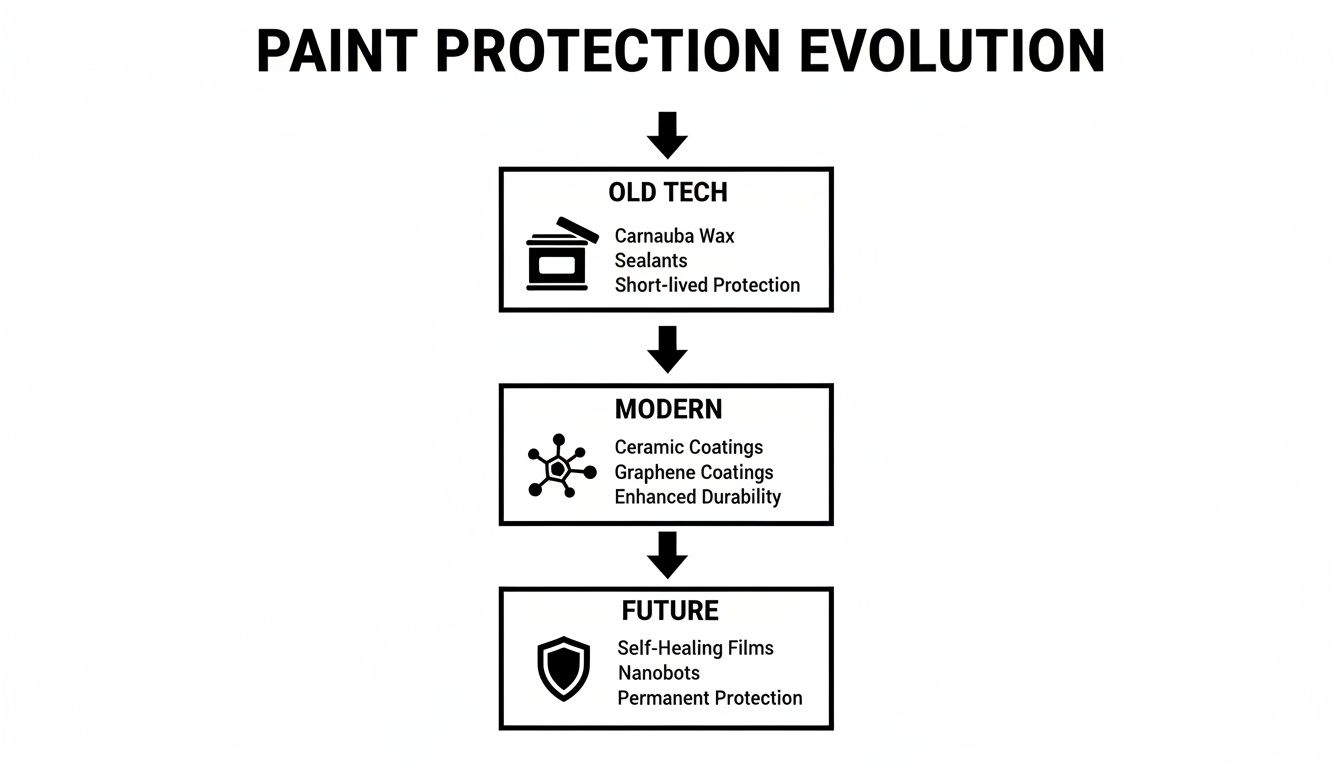
As you can see, the progression from basic protection to cutting-edge elastomer coatings shows a clear path toward smarter, more resilient technology.
To make these choices clearer, here’s a quick-glance comparison of the most popular options available for protecting a vehicle's paintwork.
Comparing Modern Paint Coatings for Cars
| Coating Type | Primary Benefit | Durability | Best For |
|---|---|---|---|
| Wax / Sealant | High Gloss, Easy Application | 1-6 Months | DIY enthusiasts looking for a quick, temporary shine. |
| Ceramic Coating | Chemical & UV Resistance, Hardness | 2-5 Years | Car owners seeking long-term gloss and protection from environmental fallout. |
| Elastomer Coating | Flexibility, Impact Resistance, Durability | 5+ Years | Professionals and enthusiasts demanding the ultimate in resilience and longevity. |
| Paint Protection Film (PPF) | Self-Healing, Rock Chip Defense | 5-10 Years | Maximum physical impact protection, especially for high-risk areas like front bumpers. |
This table lays out the core strengths of each category, helping you match the right technology to the specific needs of the vehicle and its owner.
The Rise of Flexible Armor: Elastomer Coatings
But what if your armor could be as hard as steel yet flexible enough to absorb an impact without breaking? That’s the game-changing idea behind elastomer coatings, the most advanced category in vehicle protection today. They aren't just an improvement; they're a completely different way of thinking about defense, blending the best of hardness with flexibility.
Picture a standard ceramic coating as a pane of glass. It's incredibly hard, but it can also be brittle. A rock chip or the stress from an intense temperature swing can cause it to develop tiny micro-fractures. Elastomer coatings, like those pioneered by Titan Coatings as the first company to introduce them to the market using advanced nano-tube and Dark Matter tech, act differently. They have a built-in elasticity that lets them flex and absorb impacts.
Titan's elastic coatings are engineered to be hard like glass yet remain flexible. This unique combination prevents cracking under stress from temperature swings—from freezing cold to blistering heat—and better resists impacts from road debris, ensuring the coating lasts longer.
This is the kind of real-world resilience that sets elastomer technology apart. For a more detailed breakdown of how these coatings stack up against other options, you can explore our comparison of PPF vs. ceramic coating.
A Story of Innovation and Durability
Let me tell you a quick story that drives this point home. A mobile detailer I know, a long-time user of traditional ceramics, was pretty skeptical. He’d seen countless products promise the moon but fail miserably in his harsh desert climate, where extreme heat and cold were the norm. His clients' cars, coated with so-called "top-tier" ceramics, would often come back with tiny stress fractures after just one brutal winter-to-summer transition.
He decided to give Titan's Alpha Quartz a shot, an elastomer coating known for its easy install and serious durability. He put it on his own truck—a vehicle that took a beating every single day. That winter, temperatures plunged below freezing, followed by a summer of blistering sun. Bugs and road grit were a constant assault on his cross-country drives.
Months later, he pulled the truck into his bay and put it under the intense inspection lights. Where his old ceramic coatings would have shown wear and tear, the Alpha Quartz was flawless. Not a single crack or chip. Its elasticity had allowed it to handle the temperature shocks and impacts that would have shattered a more rigid coating. It was a lightbulb moment; he had finally found armor that could not only deflect but endure. This real-world test is exactly why Alpha Quartz has become a go-to for DIYers and mobile detailers who need dependable, lasting results without the fuss.
The Unseen Shield: How Elastomer Coatings Changed the Game
Picture a protective shield for your car that’s as hard as glass but as flexible as rubber. That might sound like science fiction, but it's the reality behind the game-changing technology of elastomer coatings—a huge leap forward in the world of paint coatings for cars. For years, hard ceramic coatings were the gold standard, but they always had a hidden weakness.
Think of a typical ceramic coating like a thin, perfect sheet of glass laid over your paint. It’s incredibly hard and glossy, giving you fantastic protection from chemicals and UV rays. But that very rigidity is also its Achilles' heel. It's brittle. When a rock chips it on the highway or it endures an unpredictable temperature swing from a freezing night to a blistering morning, that hardness can cause micro-cracks, shattering the very shield you paid to protect your car.
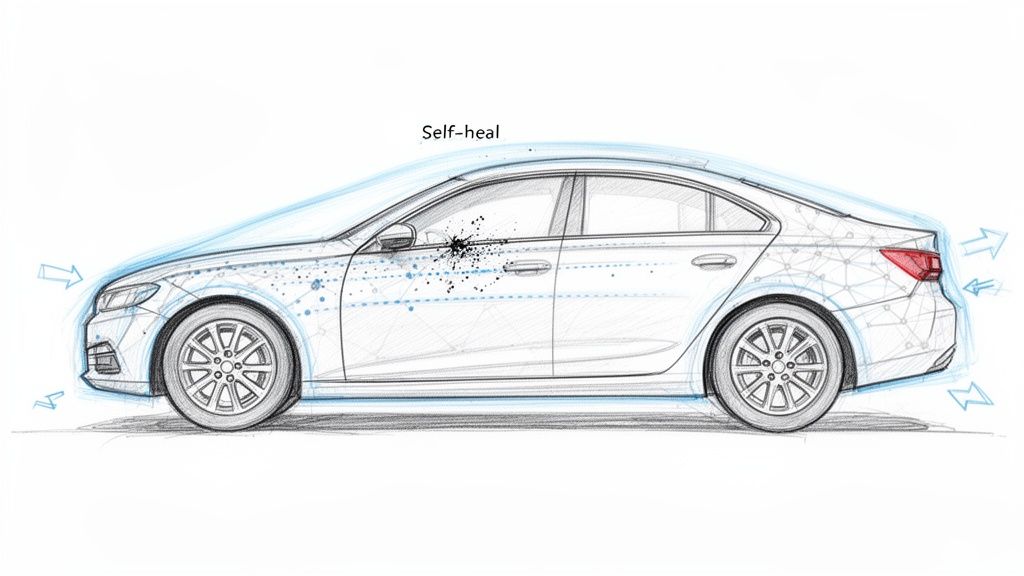
The Power of Flexibility
This is exactly where Titan’s elastomer coatings come in and completely rewrite the rules. As the first company to bring this technology to the automotive market, we built something entirely different. Instead of a fragile pane of glass, imagine wrapping your car in a sheet of self-healing armor. It has all the hardness you need to fend off daily abuse but also possesses the crucial flexibility to absorb impacts without shattering.
That elasticity is the secret sauce. Our proprietary nano-tube and Dark Matter technologies allow these coatings to stretch, flex, and rebound on a microscopic level. It's a characteristic that gives them a resilience rigid coatings can only dream of.
Titan’s elastic coatings are engineered to be hard like glass yet remain flexible. This unique combination prevents cracking under stress from temperature swings—from freezing cold to blistering heat—and better resists impacts from road debris, ensuring the coating lasts longer.
This ability to shrug off punishing environmental shifts means the coating holds up, season after season. It won’t break down when going from a frozen winter to a scorching summer, which is a notorious killer of lesser coatings. You can find out more about Titan’s unique elastomer technology and see exactly what sets a new standard for durability.
Real-World Resilience With Alpha Quartz
This isn't just lab talk; it's proven performance that detailers and car owners are seeing with their own eyes. Take the story of a mobile detailer working in a state with the most unpredictable weather—brutal winters and equally intense summers. He was getting fed up with traditional ceramic coatings failing his clients, spotting tiny stress fractures after just one season.
He was skeptical but decided to give Titan’s Alpha Quartz a shot. It's an elastomer coating we designed for an easy install and amazing results, perfect for pros and committed DIYers alike. He put it on his own work truck, a vehicle that takes a beating every single day. After a full year of freezing temperatures, blazing sun, and a constant barrage of bugs and road grit, he finally pulled it under his shop lights for a close inspection.
Where other coatings would have shown obvious signs of breaking down, the Alpha Quartz was flawless. Not a single micro-crack. Not one chip. Its built-in elasticity had allowed it to absorb the thermal stress and physical hits that would have destroyed a more rigid surface. This resilience is what makes it a true game-changer in the quest for long-term paint protection. It gives you a level of durability that was once thought impossible—a shield that doesn't just protect, it endures.
Getting That Perfect Finish: Pro-Grade Results for Everyone
Getting a flawless, glass-like finish on a car used to be a dark art, something you could only get from a high-end detailing shop with a clean room and specialized gear. Not anymore. Thanks to some serious leaps in coating chemistry, both seasoned pros and dedicated weekend warriors can now achieve unbelievable, long-lasting results right in their own garage.
The driving force behind this is simple: people want their cars to look amazing and stay protected. We’re talking about a market that’s projected to hit an eye-watering USD 43.86 billion by 2034, all because owners are chasing that deep, high-gloss shine that also shields their paint from the elements. This demand has pushed the industry to create powerful coatings that don't require a chemistry degree to apply. You can dig into the numbers in this in-depth market analysis on Precedence Research.
The Pro's Go-To: Alpha Quartz
If you're a mobile detailer or a serious enthusiast, you know the struggle. You've been searching for a true professional-grade coating that delivers jaw-dropping results but doesn't demand a perfectly climate-controlled bay to install. You need something tough, reliable, and efficient enough to apply on the move.
This is exactly why we created Titan’s Alpha Quartz. It’s your direct path to our game-changing elastomer technology, but in a formula that’s refreshingly straightforward to work with. This isn’t just about getting a deep, liquid gloss that turns heads; it’s about giving the paint the signature flexibility of our elastic coatings.
Titan’s Alpha Quartz has a unique trick up its sleeve: it's hard as glass but stays flexible. This elasticity is a huge deal—it stops the coating from cracking when temperatures swing wildly from freezing cold to blistering heat, or from impacts like bugs splattering on the grille at 70 mph.
Its forgiving application makes it a favorite for detailers who can't afford surprises. Predictable, repeatable results are the name of the game. Of course, prepping the surface is still everything—you can learn more about how to buff a car correctly in our guide—but the coating itself glides on smoothly, letting you lock in a truly professional finish every single time.
The Perfect Start: Ultra Ceramic Spray
Look, not everyone is ready to commit to a full-blown, multi-year ceramic coating. That's totally fine. Sometimes you just want a quick and easy way to add a serious layer of shine and protection that you can apply in your driveway in under an hour. For anyone new to coatings or just looking for a powerful topper, Titan's Ultra Ceramic Spray is the answer.
Don't mistake its simplicity for weakness. This isn't your average quick detailer spray. It’s a genuine ceramic coating, just in a user-friendly spray bottle. You get months of intense hydrophobic protection and an incredible shine with a simple spray-on, wipe-off application.
Here’s how easy it is:
- Wash and Dry: Start with a perfectly clean and dry car. No shortcuts here!
- Spray: Lightly mist a small amount of Ultra Ceramic Spray onto one panel at a time. A little goes a long way.
- Wipe and Buff: Immediately spread the product with a clean microfiber towel, then flip the towel to a dry side and buff it off to a streak-free, brilliant shine.
It really is that simple. You can protect your entire vehicle in minutes, leaving behind a slick, water-beading surface that makes future washes a breeze and keeps your paint looking its best. It's the ideal way to get a taste of ceramic technology without the full commitment, putting professional-level results within anyone's reach.
Protecting Your Glass for Ultimate Driving Clarity
A flawless, protected body is fantastic, but let's be honest—when you're behind the wheel, nothing matters more than a clear view of the road. We've all been there: driving at night when a sudden downpour hits. It’s a white-knuckle situation where every drop of visibility counts. This is exactly why a protective coating isn't just for your paint; it's a game-changer for your glass.
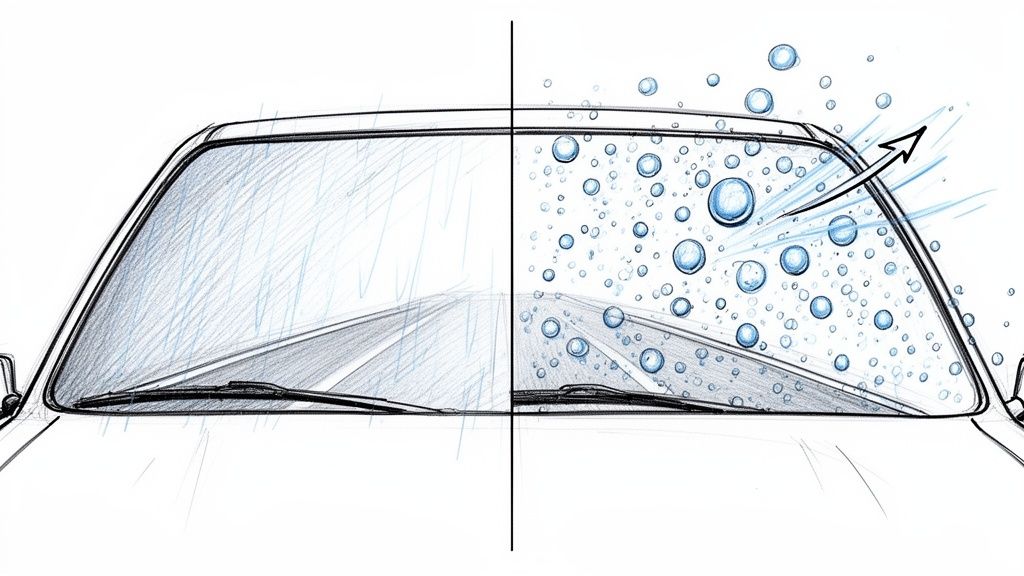
We're not just talking about keeping the glass clean. This is a massive upgrade in driving safety. A coated windshield makes a world of difference in a storm, cutting through the blinding glare from headlights on wet roads and turning a nerve-wracking drive into something you can handle with confidence.
From Smearing Wipers to Effortless Clarity
Let me tell you a story that hits this point home. A buddy of mine loves road-tripping, but he used to absolutely dread driving through storms. His wipers just seemed to smear the rain into a blurry mess, making him anxious and unsafe, especially on dark, unfamiliar highways. It felt like a constant battle against the elements just to see what was ahead.
He was a bit of a skeptic about glass coatings, writing them off as another detailing gimmick. After I nudged him a bit, he finally gave Titan’s APEX Glass Ceramic Coating a shot. He was shocked at how easy it was to apply—he did it himself in his garage in under 30 minutes.
The real proof came a few weeks later. He was driving cross-country when a monster storm rolled in, turning the interstate into a sheet of water. But this time, it was totally different. The rainwater didn't smear. It instantly formed into tight little beads and zipped right off the windshield once he got up to speed. He barely had to turn his wipers on.
The change was like night and day. He could see the road lines, spot other cars, and react to hazards with total clarity. The drive went from a stressful ordeal to a calm, controlled experience. It completely changed how he felt about driving in bad weather. If you want to dive into the specifics, you can explore our guide on windshield ceramic coating.
The Simple Power of a Hydrophobic Shield
That’s the magic of creating a super-hydrophobic surface on your windshield. APEX Glass Ceramic Coating bonds with the glass to form an invisible, slick barrier that water just can't stick to. It's a simple, powerful upgrade that delivers a level of clarity and safety you really have to experience for yourself.
Best of all, its straightforward application makes it one of the most effective DIY safety upgrades you can give your vehicle. In just a few easy steps, you get a durable, professional-grade result that keeps you seeing clearly for months, ensuring every drive is safer, no matter what the forecast says.
Keeping That Showroom Shine: How to Care for Your Coated Vehicle
You’ve made a smart investment in your car's future, giving it an incredible layer of protection. Now, let's talk about keeping that investment looking its best. The good news? It’s easier than you think. While these coatings are incredibly tough, they aren’t magic. They just need the right kind of care, not more care.
Think of it like owning a high-end watch. You wouldn't clean it with sandpaper, right? The same principle applies here. A simple, smart routine is all it takes to maintain that unbelievable gloss and see water fly off the paint for years.
The Do's: Smart and Simple Maintenance
Your goal is simple: clean the car gently. The coating is doing the heavy lifting by keeping dirt from sticking, so you don't need to be aggressive.
- Master the Two-Bucket Wash: This is non-negotiable for a perfect finish. One bucket holds your soapy water, the other holds clean rinse water. Dunk your mitt in the soap, wash a panel, then rinse the dirty mitt in the clean water before going back for more soap. This one trick stops you from dragging grit all over your paint and is the #1 way to prevent swirl marks.
- Stick to pH-Neutral Shampoos: A lot of cheap, off-the-shelf car soaps are incredibly harsh. They use aggressive detergents that can slowly eat away at your coating’s top layer. A quality, pH-neutral car shampoo is your best friend—it cleans effectively without stripping the protection you paid for.
- Dry with a Gentle Touch: Never, ever let your car air dry, especially in the sun. That’s a recipe for stubborn water spots. Instead, use a plush, high-quality microfiber drying towel to gently pat or blot the water away.
The Don'ts: What to Avoid at All Costs
Knowing what not to do is just as important as knowing what to do. A few common mistakes can undo the benefits of your coating.
The two biggest enemies of any paint coating are abrasion and harsh chemicals. Aggressive brushes and strong detergents will degrade even the most advanced coatings, killing the gloss and weakening the water-repellency.
Here's a quick checklist of things to steer clear of:
- Stay Away From Automatic Car Washes: Those giant spinning brushes are a nightmare for your paint. They’re full of abrasive grit from countless dirty cars and will inflict a network of micro-scratches on your beautiful finish. Touchless washes are a better option if you're in a pinch, but a careful hand wash is always best.
- No More Waxes or Polishes: Your coating is the protection. Slathering a traditional carnauba wax on top will just mask the properties of the coating and can interfere with its ability to shed water and dirt. Abrasive polishes are even worse—they'll simply remove the coating.
- Act Fast on Contaminants: Bird droppings, bug guts, and tree sap are your car's arch-nemesis. They are extremely acidic and can begin to etch the coating if left to bake in the sun. Keep a bottle of detail spray and a clean microfiber towel in your car to spot-clean these messes as soon as you see them.
Got Questions? We've Got Answers.
When you dive into the world of advanced car coatings, a lot of questions come up. It's totally normal. Whether you're a pro detailer trying to stay ahead or a car lover wanting the best for your ride, you need straight answers. Let's tackle some of the most common ones we hear.
How Long Does This Stuff Actually Last?
This is the big one, and the answer really depends on the tech you choose. Old-school waxes and sealants? You’re lucky to get a few months out of them. A good ceramic coating can give you a solid 2 to 5 years of real-world protection.
But that’s not the whole story. The latest innovations, like Titan’s elastomer coatings, are built for the long haul. Their secret is flexibility. Instead of being brittle, they flex with your paint, which helps them fight off the cracking and wear-and-tear from daily driving. This means they can outlast even high-end, rigid coatings.
Do I Really Need to Do Paint Correction First?
Yes. 100%. Think of it like this: a coating is a magnifying glass for your paint. It locks in and enhances whatever is underneath. If you apply it over swirl marks, light scratches, or dull, oxidized paint, you're just putting a permanent spotlight on those flaws.
Proper paint correction is the non-negotiable first step. It creates a perfectly smooth, clean canvas for the coating to bond to. This is what gives you that jaw-dropping gloss and ensures the coating can do its job for years to come.
A paint coating doesn't hide imperfections; it magnifies the surface underneath. A perfectly prepared surface is the foundation for a stunning, long-lasting finish.
Can I Actually Apply These Pro Coatings Myself?
You absolutely can. The game has changed. You no longer need a dedicated clean room and years of training to get professional-level results at home. We developed products like Titan’s Alpha Quartz specifically for this reason. It gives you our signature elastomer protection but with a forgiving, straightforward application that’s a go-to for mobile pros and serious DIYers.
And if you're just getting started? Something like Titan’s Ultra Ceramic Spray is a perfect entry point. It's true ceramic protection, but in a simple spray-on, wipe-off formula that anyone can master.
What Should I Do About My Windshield and Glass?
Glass is a different beast and needs its own specialized coating to be safe and effective. You'll want a dedicated product like Titan’s APEX Glass Ceramic Coating. This isn't just for looks; it's a huge safety upgrade.
It creates an unbelievably hydrophobic surface that makes rain bead up and literally fly off your windshield as you drive. It drastically improves your visibility in a downpour, which makes driving in bad weather, especially at night, so much less stressful.
Ready to see what next-generation vehicle protection looks like? The innovative elastomer and ceramic technologies from Titan Coatings are engineered to give your vehicle a durable, flexible, and brilliant shield against whatever the road throws at it.
Explore our full range of advanced paint and glass coatings in the Titan Coatings shop.
0 Comments