
Protective car paint coatings aren’t your grandfather’s car wax. They are advanced, liquid-polymer formulas that chemically bond to your vehicle’s factory paint, creating a tough, sacrificial shield. This layer acts as a second skin, defending against everything the road throws at it—UV rays, chemical stains, and light scratches—all while delivering a deep, glossy shine that waxes and sealants just can’t touch.
Your Car’s Armor Against the Elements
Remember that incredible feeling of driving a brand-new car off the lot? The paint is flawless, a mirror-like surface reflecting the world. But from that moment on, it’s under constant attack. Every drive brings new threats: stone chips kicking up from the highway, acidic bird droppings baking in the sun, and the slow, fading damage from UV radiation. It’s a daily battle for your car’s finish.

For decades, the go-to solution was a thin layer of wax, a temporary fix that demanded constant reapplication every few months. Thankfully, the world of protective car paint coatings has given us something far more permanent and powerful. Don’t think of these as a simple polish; they are a suit of modern armor, engineered to fuse with your vehicle’s clear coat and defend it for years.
A Critical Investment in Preservation
This is about more than just keeping your car shiny. It’s a smart investment in preserving its value and integrity. The demand for real, long-term protection has exploded, completely reshaping the automotive care industry.
The global market for automotive paints and coatings is on track to hit $36.28 billion by 2035. That’s a massive jump, and it’s being fueled by car owners like you who demand durable, lasting solutions. You can explore more data on this growing market and its drivers to see just how significant this trend is.
This shift sends a clear message: people understand that a car’s paint is one of its most valuable and vulnerable assets. A high-quality coating provides a formidable barrier that traditional products simply can’t compete with.
The Next Evolution of Vehicle Armor
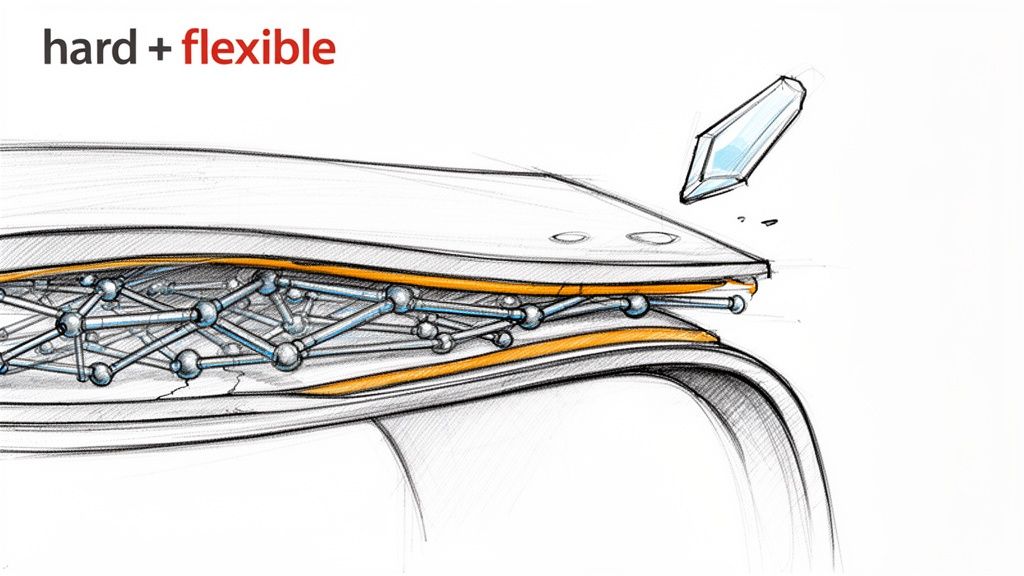
While most coatings provide a hard, glassy shell, a new frontier is opening up—one that marries that hardness with incredible flexibility. Titan Coatings is pioneering this space, introducing the first-ever elastomeric coatings to the market, built on our exclusive Nano Tubes and Dark Matter Tech®.
Imagine a shield that’s as hard as glass but also flexible. This elasticity allows the coating to absorb small impacts and resist cracking or delaminating when faced with extreme temperature swings—from freezing winters to scorching summers. It’s this combination that truly defines the next generation of durability.
This unique flexibility prevents the coating from becoming brittle and failing under stress. It offers a level of resilience that sets a whole new benchmark for protective car paint coatings, locking in that showroom shine year after year.
Decoding the Different Types of Protective Coatings
Walking into the world of paint protection can feel a bit like choosing a screen protector for a brand-new phone. You’ve got your basic films that offer a little peace of mind, and then you have advanced options that promise serious, long-term security for your investment. Figuring out the real differences is the key to picking the right armor for your vehicle.
The old-school choice, car wax, is basically that flimsy plastic film you peel off and throw away after a month. It delivers a nice pop of shine and some temporary defense, but it washes away after just a few weeks, leaving your paint exposed all over again. It’s a quick cosmetic fix, not a durable shield.
The Rise of Hard-Shell Protection
Then ceramic coatings came along and completely changed the game. Think of these as the tempered glass screen protector everyone loves. Formulated with silicon dioxide (SiO2), they create a chemical bond with your car’s clear coat, hardening into a semi-permanent, glass-like layer that’s incredibly tough and slick. This shell gives you fantastic resistance to chemicals, UV damage, and light scratches, all while creating that deep, candy-like gloss we all crave.
But even with that huge leap forward, the very hardness of traditional ceramic coatings can be a double-edged sword. Their rigid nature makes them prone to micro-cracking when the surface experiences rapid temperature swings—like a hot engine cooling down on a freezing night. We break this down even further in our guide comparing graphene vs. ceramic coatings.
For those who need to fend off physical impacts, Paint Protection Film (PPF) is the equivalent of a rugged, OtterBox-style phone case. This thick, clear urethane film is applied to vulnerable spots and is unmatched at absorbing the energy from rock chips and deeper scratches. While it’s great for that specific job, PPF can sometimes slightly alter the paint’s finish and doesn’t offer the same unbelievable gloss or chemical resistance as a high-end liquid coating.
A Story of Strength and Flexibility
Let’s get practical. Imagine you’re a car owner living somewhere with brutal weather—scorching summers that can cook your car’s panels to over 150°F, followed by winters that bring sub-zero temps and corrosive road salt. You invested in a premium ceramic coating and loved the mind-blowing shine. But after one particularly nasty winter, you start to see tiny, web-like cracks forming on the surface. The coating is so rigid that it can’t expand and contract with the metal underneath. The armor is strong, but it’s brittle.
This exact scenario is what pushed the industry to find a better solution. What if you could get the hardness of tempered glass but combine it with the flexibility to handle real-world stress?
This is where Elastomeric Coatings enter the scene. They are the new champions in the protective coatings arena, engineered from the ground up to be both incredibly hard and flexible. It’s like having a self-healing tempered glass protector that can absorb impacts and adapt to change without shattering.
These next-generation coatings, pioneered by us at Titan Coatings, use advanced nanotechnology to create a resilient, rubber-like shield over your paint. This elasticity allows the coating to stretch and shrink with the car’s panels during extreme temperature cycles, which completely prevents the micro-cracking that plagues traditional ceramics. The result is a much tougher, longer-lasting barrier.
This push for smarter, more resilient formulas is happening in the automotive paint industry, too, with a major shift toward more durable, eco-friendly solutions. These modern paints have been shown to cut harmful emissions by up to 60% and exhibit 25-30% less color fade after two years in the sun. You can discover more insights about automotive paint innovations on GlobeNewswire.
Hard Like Glass, Flexible Like Rubber
For a long time, traditional ceramic coatings were the gold standard. They gave us a hard, glassy shell that was a massive improvement over old-school waxes. But that signature hardness, its greatest selling point, was also its hidden flaw. A car’s body panels are always moving—expanding in the summer sun and shrinking in the winter cold. A rigid, glass-like coating can’t move with it. Over time, this constant thermal stress creates tiny, invisible cracks, and suddenly, that impenetrable shield isn’t so impenetrable anymore.
This is where the real evolution in paint protection begins. We asked, what if you could create a coating with the toughness of glass but the resilience of rubber? That question led us straight to the technology that now defines Titan Coatings. We were the first to bring true elastomeric coatings to the market, completely rewriting the rules of durability.
The Science of Elastic Strength
At the core of this leap forward is a powerful combination of Nano Tubes and Dark Matter Tech®. Forget the dense lab-speak; it’s actually pretty simple when you break it down.
- Nano Tubes: Think of these as microscopic rebar mixed into the coating. Just like steel bars reinforce concrete, these tiny tubes build an internal skeleton, giving the coating incredible structural integrity from the inside out.
- Dark Matter Tech®: This is our proprietary chemistry that allows the nano tubes to form a flexible, interconnected web. It’s the magic that lets the coating stretch, bend, and absorb impacts without shattering its molecular bonds.
When you bring these two together, you get a protective layer that is both incredibly hard and shockingly flexible. This is the key. It allows the coating to absorb and shrug off the energy from minor bumps and, more importantly, to flex right along with the car’s panels during those extreme temperature swings. No more micro-cracking, which means the shield stays intact and performing as it should for years, not months.
“The ability of a coating to be both hard and flexible is the key to real-world durability. It allows the surface to endure everything from a stray shopping cart bump to the constant stress of thermal expansion and contraction, which is where rigid coatings often fail.”
This built-in resilience means the coating simply won’t delaminate or fracture when faced with the realities of daily driving. You can dive deeper into how Titan’s elastomer technology is setting a new benchmark for performance.
A Real-World Example: Titan Vulcan TX155
To see this in action, look no further than our flagship, Titan Vulcan TX155. We engineered this coating to be the ultimate expression of our elastomeric philosophy. It’s built to deliver uncompromising protection in the harshest environments on the planet.
The unique properties of Vulcan TX155 allow it to handle extreme temperature swings. From the blistering Arizona sun to a brutal Canadian winter, the coating breathes with the vehicle’s paintwork. That elasticity is what prevents the stress fractures that let moisture, road salt, and other grime get underneath and wreck the clear coat.
For a car owner, this means the protection you paid for doesn’t just look amazing when you pick it up; it stays that way. It maintains its structural integrity and flawless finish for years. For a professional detailer, offering Vulcan TX155 means you’re giving clients a real solution to the failures of older coating tech, building a reputation on trust and genuinely superior results.
What a Professional Coating Actually Does for Your Car
It’s one thing to talk about the science behind advanced paint coatings, but it’s a completely different experience to see and feel the difference for yourself, day in and day out. This is where the theory hits the road. The benefits aren’t just a list on a product sheet; they genuinely change how you own and enjoy your car, making it look incredible while cutting down your maintenance headaches.
Think of it this way: a professional coating transforms your car’s paint from a delicate, porous surface into a slick, hardened, and incredibly tough shield. It’s the difference between wearing a cotton t-shirt and a suit of armor in a rainstorm.
Cleaning Becomes Almost Effortless
The first thing you’ll notice—and probably fall in love with—is the unbelievable water-beading. Top-tier coatings create what’s known as the “Lotus Effect,” mimicking how water just rolls off a lotus leaf without ever wetting it. On your car, water forms into tight, perfect little spheres that fly off the surface with the slightest breeze or incline.
This isn’t just for show. As those water beads roll away, they pick up and carry dirt, dust, and grime with them. This self-cleaning effect means your car stays looking freshly washed for so much longer. And when you do need to wash it? The job is ridiculously fast and easy because nothing can get a good grip on that ultra-slick surface.
A Tough Defense Against Scratches and Swirls
Let’s be honest, daily driving is brutal on paint. Bad wash habits, drive-thru car washes with their abrasive brushes, or even just a jacket zipper brushing against a door can create a web of fine scratches and swirl marks. Over time, that network of tiny marks is what makes your paint look dull and tired.
A professional coating adds a hardened, sacrificial layer right on top of your factory clear coat. This layer is much harder than the paint itself, offering real resistance to those light scratches and swirls that are so common. It takes the abuse so your original paint doesn’t have to. You can dive deeper into the many ceramic coating benefits to see how this protection preserves your car’s finish.
Blocking Chemical and Environmental Attacks
Your car is constantly under assault from things that want to ruin its paint.
- Bird Droppings: These are little acid bombs that can quickly eat into your clear coat, leaving a permanent dull spot.
- Bug Guts: The acidic remains of insects can also etch the surface, especially after baking in the sun for a day.
- Tree Sap & Road Tar: These sticky messes bond to paint and are a nightmare to remove without causing more scratches.
A high-quality coating creates a chemically resistant barrier that stops these contaminants from ever reaching your clear coat. It gives you a safe window of time to wash them off before they can cause any permanent staining or etching, keeping your finish flawless.
A Powerful Sunscreen Against UV Fading
The sun’s UV rays are just as bad for your car’s paint as they are for your skin. Nonstop exposure breaks down the paint’s pigments, causing oxidation—that chalky, faded look you see on older cars. This is especially true for bright colors like red, which can lose their pop in just a few years.
Protective coatings are loaded with powerful UV inhibitors that act like a high-SPF sunscreen for your vehicle. This invisible shield deflects the most damaging radiation, stopping oxidation dead in its tracks. It’s what keeps your paint looking deep, rich, and glossy for years to come. Ultimately, a professional coating is one of the best moves you can make to preserve your car’s value and appearance. It perfectly complements other essential tips to extend your car’s life, forming a complete strategy for protecting your investment.
How to Choose the Right Armor for Your Car
Now that you know what these coatings can do, how do you pick the right one? This isn’t about grabbing the most expensive bottle off the shelf; it’s a personal decision that hinges on your car, your lifestyle, and what you ultimately want to achieve.
Think about your car’s daily life. Is it a commuter that braves gritty highways and bird-bomb-filled parking lots? Or is it a weekend treasure, seeing only sunny skies and the safety of a garage? The answer will point you toward the right blend of toughness, gloss, and self-cleaning ability.
For professional detailers, this is where your expertise shines. The conversation with your client is crucial. You’re not just applying a product; you’re prescribing the perfect solution for their needs. This consultative approach builds trust and a reputation for delivering real-world results that last.
Matching the Coating to the Mission
First things first: what’s your number one priority? Are you after an impenetrable shield that can stand up to almost anything? Is your goal a jaw-dropping, liquid-glass shine that turns heads at every corner? Or are you simply tired of endless washing and just want a car that stays cleaner, longer?
Each goal points to a different type of coating technology.

This decision often involves weighing different kinds of protection. For instance, you might be debating the brute-force impact resistance of PPF versus the slick, chemical-fighting power of a ceramic coating. For a deeper dive into that specific choice, our guide comparing Paint Protection Film and ceramic coatings breaks it all down.
Making a Data-Driven Decision
Once you’ve defined your mission, you can start comparing products with confidence. We believe in transparency, which is why we lay out the performance specs of our entire Titan lineup.
To make this easier, we’ve put together a simple matrix to guide your selection.
Titan Coatings Product Selection Matrix
This table gives you a quick snapshot, matching our leading products to the primary benefits they deliver. It’s a starting point to help you narrow down the best fit for your vehicle.
| Titan Product | Primary Feature | Durability Rating | Ideal Use Case |
|---|---|---|---|
| Vulcan TX155 | Ultimate Hardness & Flex | 10/10 | Daily drivers, harsh environments, maximum longevity |
| HyperQuartz Pro | Extreme Gloss & Shine | 9/10 | Show cars, enthusiasts seeking the best visual pop |
| Titan PX10 | Hydrophobic & Self-Clean | 8/10 | Cars parked outdoors, owners wanting easy maintenance |
| Graphene+ | Heat & Water Spot Resist | 9/10 | Dark-colored cars, hot climates, all-around defense |
This kind of direct comparison helps you understand the trade-offs. You can see exactly why a powerhouse like Vulcan TX155 is the top choice for extreme durability. Its elastomeric properties—a fancy way of saying it can flex with heat and cold—prevent the micro-cracking that kills lesser coatings over time.
On the other hand, a product like HyperQuartz Pro is engineered to push gloss and reflectivity to their absolute limits, making it perfect for a showpiece that lives a more pampered life.
Think of it this way: Choosing the right coating is like picking the right gear for an adventure. Your daily commute through a harsh winter is an expedition requiring the toughness of Vulcan TX155. A Sunday drive in a pristine classic is a gala event, demanding the unmatched brilliance of HyperQuartz Pro.
By matching your real-world needs with a coating’s proven strengths, you’re not just buying protection. You’re making a smart investment in your vehicle’s future.
Protecting Your Investment with Proper Aftercare
Getting a professional coating is a serious investment in your vehicle’s future, but the job isn’t done when you drive away from the shop. Think of it like a world-class athlete; they don’t just win the race and quit. They have a strict regimen to stay in peak condition. The right aftercare is what keeps your coating performing at that elite level for years to come.
Remember, before that coating ever touched your paint, a certified pro went through a painstaking, multi-stage process. We’re talking a full decontamination wash to pull out embedded iron and tar, followed by an intensive paint correction to meticulously polish away every swirl, scratch, and imperfection. That flawless surface is the only way a coating can form a perfect chemical bond and deliver the rock-solid durability you paid for.
Simple Rules for Lasting Brilliance
Once your car is coated, keeping it looking incredible is actually pretty simple—but it’s also incredibly important. The entire goal is to clean the surface without doing anything to harm that protective layer. Harsh chemicals and abrasive brushes are your coating’s worst enemies. This is exactly why you need to steer clear of those automatic tunnel washes with their giant, gritty brushes and recycled dirty water. They’re a shortcut to ruining your investment.
Instead, a gentle hand wash is the only way to go. Here are the keys to doing it right:
- The Two-Bucket Method is Non-Negotiable: Have one bucket for your soapy water and a second one filled with clean water just for rinsing your wash mitt. This simple trick stops you from dragging grit right back across your paint, which is how most swirl marks are created in the first place.
- Stick to pH-Neutral Soaps: Aggressive, high-alkaline detergents will eat away at your coating, stripping its water-beading properties and degrading it over time. A quality, pH-neutral car shampoo is engineered to clean safely without compromising the protection.
- Use a Topper or Booster: Every few months, applying a dedicated topper or spray sealant made for coatings will supercharge its hydrophobic effect. It’s like a quick shot of adrenaline for your coating, instantly reviving that slick, self-cleaning surface.
Following these simple steps does more than just keep your car looking clean—it actively preserves the chemical integrity of the coating. This consistent care is what unlocks the full lifespan of your investment, ensuring the armor stays strong and the gloss stays deep.
A proper wash routine is the single most effective thing you can do to get the maximum performance and longevity out of your coating. To make sure you get it perfect, we’ve put together a complete guide on the best practices for maintaining your ceramic coating. Once you understand the “why” behind each step, you’ll be able to protect your vehicle with total confidence and enjoy that jaw-dropping, just-detailed look for years.
Your Top Car Paint Coating Questions, Answered
Thinking about a professional paint coating? You probably have a few questions swirling around. It’s a big step in protecting your vehicle, so let’s cut through the noise and get you the straight answers you need to feel confident about your decision.
How Long Do These Coatings Really Last?
This is the big one, and the answer truly depends on what you choose. A traditional wax you apply on a Sunday afternoon might look great but will be gone in a few weeks. Step up to a spray sealant, and you might get a few months. Even some entry-level “ceramic” products might only give you 1-2 years of real-world protection.
That’s where the science inside the bottle becomes critical. Our advanced elastomeric coatings at Titan, like the flagship Titan Vulcan TX155, are in a completely different ballpark. They’re engineered from the ground up for relentless durability. When a certified pro applies it correctly and you keep up with basic maintenance, you’re looking at years of solid, unwavering protection.
Are Elastomer Coatings Actually Better Than Ceramic?
In a word, yes. Think of it as the next generation of paint protection. A good ceramic coating is hard, which is great for scratch resistance. But its biggest strength is also its weakness: it’s rigid. Your car’s metal panels are constantly expanding and contracting with temperature swings—baking in the summer sun, then freezing on a winter night. This flexing can cause tiny micro-cracks to form in a stiff ceramic coating over time.
Titan’s elastomeric coatings crack the code by blending that same glass-like hardness with incredible flexibility. This allows the coating to literally move and flex with your car’s body, absorbing the stress instead of cracking under it. The end result is just a tougher, more resilient shield that stands up to the real world.
Can I Just Apply a Professional Coating Myself?
We get it—the DIY spirit is strong. And while there are plenty of consumer-grade products on the shelf, professional coatings are an entirely different beast. The foundation of a lasting coating is a flawless surface, and getting there means hours of painstaking paint correction to eliminate every single swirl mark and imperfection.
Beyond that, the application itself is a science. You need a controlled environment where temperature and humidity are just right for the coating to cure and bond chemically to the paint. To get the performance you’re paying for and protect your investment, we always stand by professional installation. A certified detailer has the skill, tools, and environment to get it done right the first time.
Ready to give your vehicle a flexible, long-lasting shield against the elements? At Titan Coatings, we’ve built the next generation of elastomeric coatings designed to keep your car looking incredible for years.
Explore our lineup and find the perfect armor for your ride. Discover the Titan difference by visiting our product comparison page today.
0 Comments
Trackbacks/Pingbacks