
So, you’re wondering what a professional ceramic coating will set you back. The short answer? It varies. A lot. You can expect to see prices ranging anywhere from $900 to over $3,500 for a full, professional job.
That unbelievable price gap isn’t random. It’s a reflection of your vehicle’s size, how much prep work the paint needs, and the specific type of coating being installed. Let’s break down what really goes into that final number.
What to Expect for Professional Ceramic Coating Costs
Imagine you just drove your dream car off the lot. The paint is perfect, and you want to keep it that way. You start looking into ceramic coatings and immediately get sticker shock. One detailer quotes you $1,200, while a high-end shop down the street quotes $3,000. What gives?
This is a common reaction, but it’s because a ceramic coating isn’t just a product—it’s a highly skilled service. The final price is an investment in your car’s future, locking in that showroom shine and making it ridiculously easy to clean for years. For most car owners, the real question isn’t just about the initial price, but figuring out are ceramic coatings worth it for their specific situation.
A Story of Value and Protection
Even a brand-new car isn’t truly perfect. Under the right light, you’ll see fine swirls and microscopic scratches from the dealership’s quick wash or even from the plastic wrap it wore during transport. A true professional will tell you that all of these blemishes have to be meticulously polished away before the coating goes on. Why? Because the ceramic coating will lock in whatever is underneath, flaws and all. This crucial step, called paint correction, is where a huge chunk of the labor cost comes from.
Then there’s the coating itself. Not all ceramics are created equal. A basic coating might give you a solid year or two of protection. But the more advanced formulas offer much, much more.
This is where Titan Coatings’ elastomer technology really changes the game. Think of traditional ceramic coatings as a thin, hard shell of glass. They’re strong, but they’re also rigid. Extreme temperature shifts from frozen to hot or a minor impact from bugs can cause them to develop micro-cracks over time. As the first company to introduce Elastomer coatings to the market using nano tubes and Dark Matter tech, Titan’s coatings are engineered to be flexible. They’re hard like glass but have an elastic quality, allowing them to absorb impacts and handle the stress of hot summers and freezing winters without cracking or failing. This means you get protection that’s not just tough, but resilient and lasts much longer.
When you start shopping around, you’ll find that these high-end services are offered by specialized detailers, as well as some certified auto repair shops and dealerships.
Estimated Professional Ceramic Coating Costs by Vehicle and Coating Type
To give you a clearer picture of what to budget for, we’ve put together a table showing typical price ranges. This is a great starting point for seeing how the upfront cost of a superior elastomer coating can translate into much better long-term value.
Estimated Professional Ceramic Coating Costs by Vehicle and Coating Type
| Vehicle Size | Standard Coating (1-3 Year) | Premium Coating (5-7 Year) | Elite Elastomer Coating (7+ Year) |
|---|---|---|---|
| Coupe/Sedan | $900 – $1,500 | $1,500 – $2,200 | $2,000+ |
| Small SUV/Truck | $1,100 – $1,800 | $1,800 – $2,600 | $2,400+ |
| Large SUV/Truck | $1,400 – $2,200 | $2,200 – $3,000+ | $2,800+ |
As you can see, the price scales with both the size of your vehicle and the durability of the coating you choose. The longer the protection, the higher the initial investment, but it often saves you money and time in the long run.
Breaking Down Your Professional Coating Quote
Ever gotten two wildly different quotes for the same service and been left scratching your head? One shop quotes you $1,200, but another just down the road hands you an estimate for $3,000. It’s baffling, but that price gap isn’t random. It comes down to a detailed process where the real value is hidden in the prep work and the quality of the products. Let’s pull back the curtain on what really goes into that final number.
The single biggest driver of cost for a professional ceramic coating is almost always the paint correction. This isn’t just a quick wax-on, wax-off job. It’s an incredibly meticulous, labor-intensive process where a trained technician carefully removes every swirl mark, light scratch, and tiny imperfection from your car’s clear coat.
Think of it this way: you wouldn’t hang a priceless painting on a crumbling wall. The same principle applies here. The coating will magnify and lock in whatever is underneath it—the good, the bad, and the ugly.
The Cost of a Flawless Canvas: Paint Correction
Let’s imagine a car owner named Alex. His brand-new car looked great at a glance, but under the harsh inspection lights of a professional detailer, the paint was a mess of fine swirls from the dealership’s quick-and-dirty washes. Getting that paint perfect again can take anywhere from four to over twelve hours of multi-stage polishing, depending on how hard the paint is and how deep the defects are. That skilled labor makes up the lion’s share of your bill.
A suspiciously cheap quote often means they’re cutting corners on paint correction. A true pro, however, knows that achieving that perfectly smooth, mirror-like surface is non-negotiable. They invest the time it takes before a single drop of coating is applied.
“You’re not just paying for a bottle of liquid. You’re paying for the painstaking process. The hours spent decontaminating and machine polishing the paint are what create the foundation for that unbelievable gloss and durability that lasts for years.”
This chart gives you a great visual of how the main costs stack up.
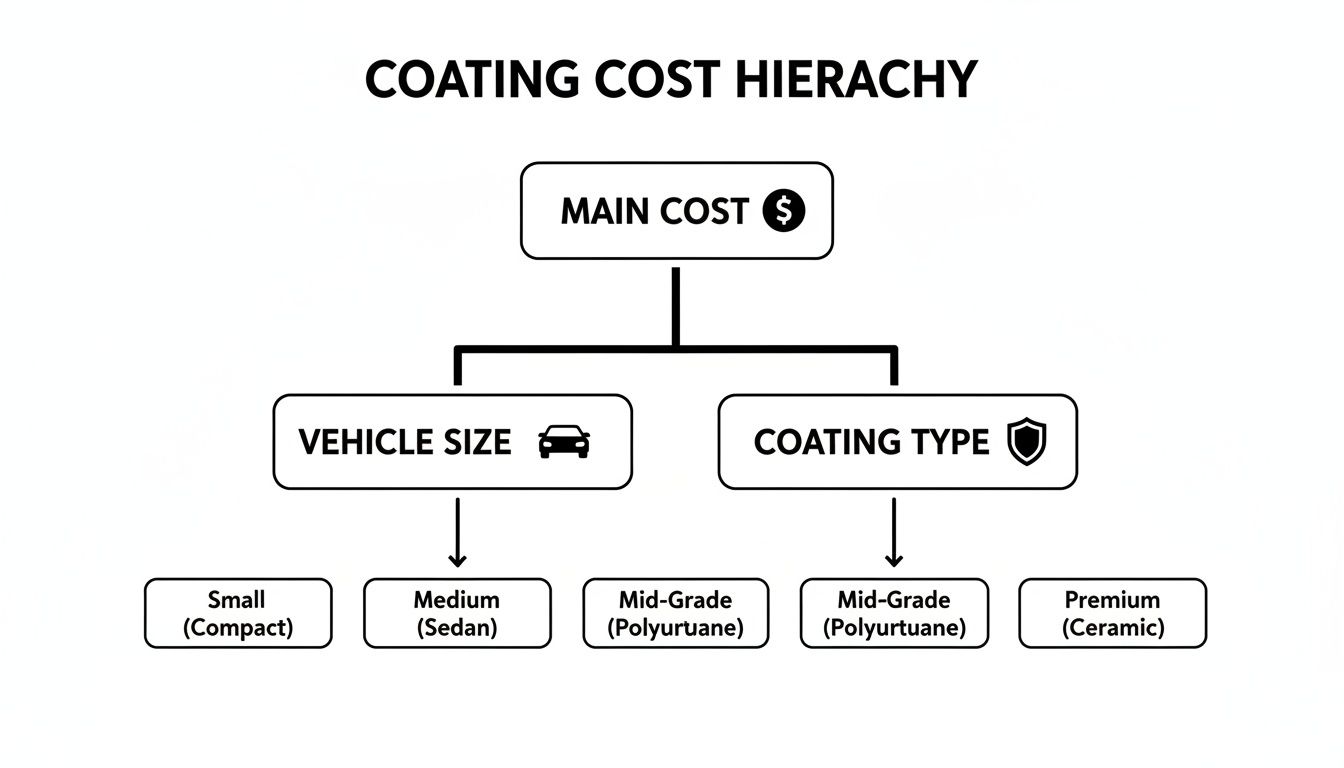
As you can see, the final investment is a blend of your vehicle’s size and the level of coating technology you choose.
Coating Technology: Why the Product Itself Matters
Beyond the labor, the coating itself is a massive part of the equation. Let’s be clear: not all ceramic coatings are created equal. You’ve got your basic ones that might give you a year of protection, and then you have advanced formulas that are in a completely different league. This is where Titan Coatings’ pioneering elastomer technology really changes the game.
See, traditional ceramic coatings are rigid. They’re hard, sure, but that hardness can make them brittle. When your car goes from a freezing winter night into a heated garage, that thermal shock can cause micro-cracking over time. Even a bug hitting your bumper at highway speeds can cause tiny fractures.
Titan’s Alpha Quartz elastomer coating is engineered differently. As the first company to introduce elastomer coatings, we use proprietary nano tubes and Dark Matter tech to create a protective layer that is both incredibly hard and flexible.
This unique elasticity gives you some major real-world advantages:
- Temperature Resistance: It expands and contracts right along with your paint, which stops the cracking that plagues lesser, rigid coatings when temperatures shift from frozen to hot.
- Impact Absorption: Its flexible nature helps to dissipate the energy from small impacts, like rock chips and bug splatters, keeping the coating intact.
- Enhanced Durability: All this resilience means the coating simply lasts longer, giving you a much better return on your investment.
When a detailer uses a premium product like Alpha Quartz, the material cost is naturally higher, and the quote will reflect that. But what you’re really paying for is superior technology that delivers protection you can actually count on for years. If you want to see the nitty-gritty, our guide on applying ceramic coating to your car breaks down the steps professionals follow. This is exactly why a certified installer’s warranty is so valuable—it’s a guarantee of both world-class materials and expert craftsmanship.
From Standard Ceramics to Advanced Elastomers
The type of technology protecting your paint is one of the biggest factors in the final professional ceramic coating cost. To really appreciate the value, you have to understand that not all coatings are built the same. The industry has come a long, long way from decent protection to truly remarkable, long-term solutions.
Think of a traditional ceramic coating like a super thin, rigid layer of glass bonded to your car’s paint. It’s incredibly hard, ridiculously glossy, and does a solid job fending off light scratches and chemical stains. For years, this silicon dioxide (SiO2) chemistry was the top dog in paint protection, blowing old-school waxes and sealants out of the water.
But that very rigidity is also its biggest flaw. Your car’s body panels are always moving—expanding in the summer heat and contracting in the winter cold. A rigid coating simply can’t flex along with the metal, which eventually leads to microscopic stress fractures. This is why you see some older ceramic coatings lose their water-beading magic or just fail completely, especially in climates with wild temperature swings.
The Problem with Rigidity
Picture a flawless sheet of ice. It looks strong and feels solid, but toss a small rock on it or change the temperature too fast, and it cracks. That’s the exact challenge traditional ceramic coatings have been up against for years.
- Thermal Shock: Pulling your car from a freezing winter night into a warm garage can cause the coating to develop tiny cracks, wrecking its protective integrity.
- Minor Impacts: Everyday road debris—small stones, bugs hitting the bumper at 70 mph—can create tiny fractures that weaken the entire layer over time.
- Vibrations and Flex: Car panels naturally vibrate and flex as you drive. A coating that’s stiff and unyielding just can’t keep up with that constant movement, leading to premature wear and tear.
These exact weaknesses are what drove us to innovate at Titan Coatings. We asked a simple question: How can we create a coating with the hardness of glass but the resilience of rubber?
A New Era of Protection: Elastomer Technology
The answer wasn’t to improve the old formula but to invent a new one. Titan was the first to bring elastomer coatings to the market, a genuine game-changer that completely redefined what “durable” means. Instead of just a hard shell, our coatings form a flexible, rubber-like matrix at the molecular level.
This is all possible thanks to our proprietary Dark Matter Tech® and nano tube technology. This combination lets us create a coating that grabs onto the paint with unbelievable strength while still being able to flex, stretch, and absorb impacts.
You can see the dramatic difference in performance right here.
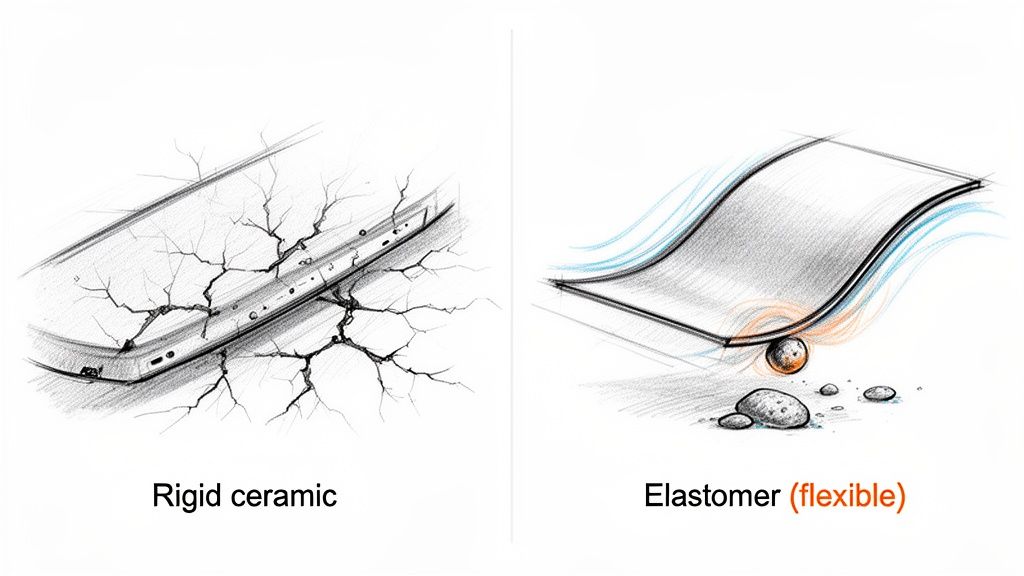
This isn’t just a minor upgrade; it’s a fundamental shift in how paint protection works. And the demand for this level of durability is clear. The global ceramic coatings market was valued at $9.3 billion in 2021 and is projected to hit $17.1 billion by 2029, largely driven by car owners demanding better, longer-lasting protection.
So when you see a quote for a professional ceramic coating between $1,500 and $3,000+, you’re not just paying for a shiny finish. You’re investing in this advanced, resilient technology that was engineered to survive the real world.
Real-World Benefits of Flexibility
Okay, but what does this actually mean for your car?
A standard, rigid ceramic might look great for a year or two, but harsh weather will eventually take its toll, causing it to degrade.
An elastomer, on the other hand, is built for the fight. When a rock chips the hood, the flexible layer absorbs and dissipates the impact, dramatically reducing the odds of a deep chip. When the car moves from a sub-zero driveway to a warm garage, the coating expands and contracts right along with the paint, maintaining a perfect, unbroken seal.
This elasticity is the secret to true longevity. It’s why our elastic coatings last so much longer, giving you a far better return on your investment over the life of your vehicle. That higher upfront cost is directly tied to the superior engineering that keeps your car looking incredible year after year, no matter what the road throws at it.
Want a deeper dive into the science? See for yourself why Titan’s elastomer coatings are the future of surface protection.
DIY vs. Pro: What’s the Real Cost?
It’s easy to get sticker shock from a professional ceramic coating quote. Then you see a DIY kit online for a couple hundred bucks and think, “I can do that myself and save a fortune.” It’s a tempting thought, and one many car owners—let’s call our guy Alex—have had. But Alex quickly discovered that the price on the box is just the beginning of the story.
A truly professional-looking DIY job demands the exact same intense prep work that a certified installer performs. That means the initial cost starts to climb fast once you tally up all the necessary gear.
That “affordable” kit is really just your ticket to entry. To even think about getting it right, Alex realized he’d have to shell out for:
- A Dual-Action Polisher: You can’t skip paint correction. A decent DA polisher will set you back $150 – $300.
- Polishing Pads & Compounds: You’ll need a few different grades for cutting and finishing, tacking on another $50 – $100.
- Clay Bar & Lube: Essential for decontaminating the paint. That’s about $25 – $40.
- Panel Wipe (IPA Solution): Crucial for stripping oils before the coating goes on, costing around $20 – $30.
- A Stack of Quality Microfiber Towels: You need more than you think to avoid scratches and contamination, adding $40 – $60.
All of a sudden, Alex’s DIY weekend project was pushing $500 in supplies alone. And that’s before he even considered the value of his own time—an entire weekend spent hunched over his car, hoping he didn’t mess it up.
The Hidden Dangers of a Garage Application
Beyond the cost of equipment is the biggest wild card: the risk of messing it all up. Professionals work in controlled bays with specialized lighting for a reason. Your garage, on the other hand, is full of dust, pollen, and fluctuating humidity—all of which are enemies of a perfect finish.
Here are just a few of the common mistakes that can turn a DIY dream into a nightmare:
- High Spots: These are ugly, dark patches where the coating was applied too thick or wasn’t leveled off properly. Fixing them means aggressively polishing the area and starting from scratch.
- Uneven Coverage: Without pro-level lighting, it’s almost impossible to see if you’ve applied a perfectly even layer. The result? A blotchy, inconsistent look you’ll notice every time the sun hits it.
- Bad Timing on the “Flash”: Every coating has a specific window of time to “flash” before you wipe it off. Miss that window—too early or too late—and you’re left with a streaky, oily mess that is a serious pain to correct.
When you hire a pro, you’re not just paying for a bottle of coating. You’re paying for their experience, their meticulously prepped environment, and the guarantee of a flawless result. This is why the demand for professional ceramic coatings is booming, with the market projected to grow from USD 720.0 million in 2026 to USD 1,583.5 million by 2036. As application tech gets better, these services become an even smarter investment. You can see more on the market trends shaping professional ceramic coating costs for yourself.
When to DIY and When to Call the Pros
Look, for the dedicated hobbyist who genuinely enjoys the process and has the right setup, a DIY project can be incredibly satisfying. At Titan Coatings, we even offer enthusiast-grade products like our Alpha Quartz elastomer coating, which is more forgiving and easy to install for great results. We break it all down in our guide to DIY ceramic coating for cars.
For most people, though, the risk just isn’t worth the potential savings. A botched DIY job can easily cost you hundreds—sometimes thousands—to have a professional fix. That’s far more than what you would have paid to just get it done right from the start. For Alex, the math was simple. The peace of mind and guaranteed perfection from a certified installer were worth every penny.
Protecting More Than Just Your Paint
When we talk about the professional ceramic coating cost, the conversation usually revolves around the paint. But true, comprehensive vehicle protection goes way beyond the body panels. Think about it—your glass, wheels, and trim are just as exposed to the harsh elements. Your windshield, in particular, is absolutely critical to your safety and how you experience every drive.
We’ve all been there. You’re driving along, and suddenly, a torrential downpour hits. Your wipers are on full blast, but they can’t keep up, just smearing a sheet of water across the glass. The road ahead becomes a stressful, blurry mess.
Now, imagine that same storm. But this time, as the rain hits your windshield, the droplets instantly form tiny, perfect beads and zip right off the glass, even before your wipers make a pass. Your view remains completely clear, making the drive stress-free. That’s the real-world difference a dedicated glass coating makes.
See Clearly and Drive Safer with Advanced Glass Protection
This isn’t just a cool party trick; it’s a massive upgrade in driving safety. When your windshield sheds water this effectively, you enhance your visibility and become far less reliant on your wipers, especially at highway speeds. This drastically reduces driver fatigue and keeps your line of sight wide open, even in the worst weather. It honestly feels like you have a forcefield protecting your vision.
We engineered a solution at Titan Coatings specifically for this. The image below shows exactly how our Apex Glass Ceramic Coating turns your windshield into a super-hydrophobic surface.
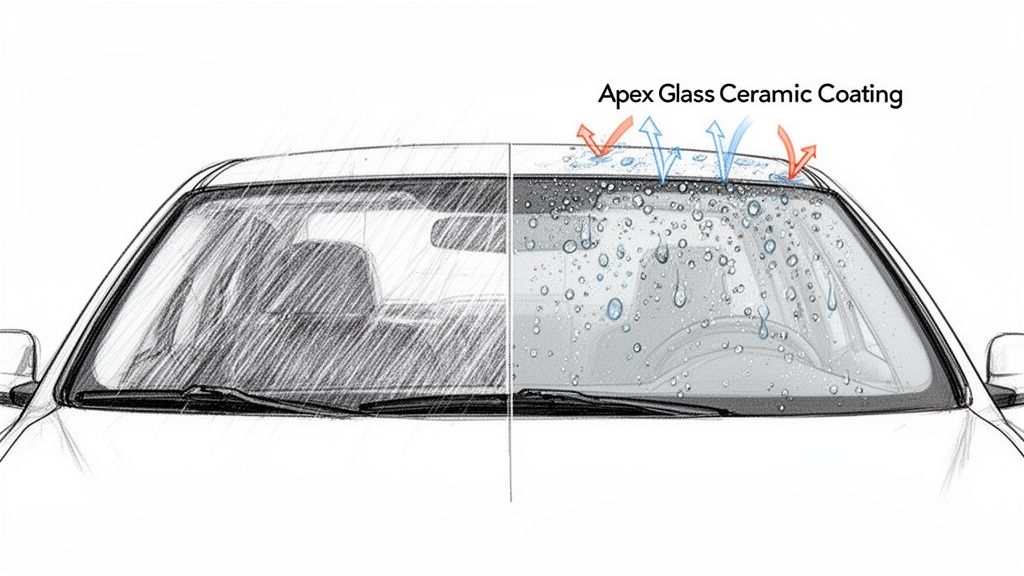
You can see the immediate, dramatic effect. One side is a hazardous, blurry mess, and the other is perfectly clear and safe. This isn’t just a concept—it’s what our customers experience every day.
A Small Investment for a Major Upgrade in Safety
The best part? Adding this level of protection is incredibly straightforward and affordable. Our Apex Glass Ceramic Coating is very easy to use, giving you long-lasting clarity and water repellency. As a bonus, it makes scraping off ice and cleaning away bugs and road grime almost effortless.
A true professional detailer knows the job isn’t done with the paint. They understand that complete vehicle preservation means protecting every critical surface, from the glossy hood to the crystal-clear windshield. It’s all about enhancing the entire driving experience.
So, when you’re getting a quote for a full vehicle coating, make sure to ask your installer about adding protection for your glass, wheels, and trim. The small additional cost pays for itself over and over in safety, visibility, and pure peace of mind.
To dive deeper into how these specialized formulas work, check out our complete guide on ceramic glass coating and see the difference for yourself.
Answering Your Questions About Ceramic Coating Costs
When you start looking into serious automotive protection, a lot of questions pop up, especially around the cost of a professional ceramic coating. Let’s cut through the noise and tackle the most common ones so you can feel confident about your decision.
Is a Professional Ceramic Coating Really Worth the Money?
In a word, yes. The upfront cost is definitely more than a bottle of wax, but you’re not just buying a product; you’re investing in long-term value. A professionally installed coating gives you years of incredible protection against the elements, keeps your car looking like it just rolled off the showroom floor, and makes washing it ridiculously easy.
Even more, it acts as a sacrificial shield for your vehicle’s factory paint. That’s a huge deal when it comes to preserving its resale value down the road. Don’t think of it as just another car expense—it’s an investment in your car’s future.
How Long Does a Professional Ceramic Coating Actually Last?
This is where you see a massive difference between products. Your standard, entry-level coatings might give you 1-3 years of protection. But the demand for better, tougher solutions is exploding—the high-performance coating market is projected to hit USD 15.8 billion by 2032 for a reason. People are tired of temporary fixes. You can see the full breakdown in this high-performance coatings market report.
This is where advanced chemistry changes the game entirely. An elastomer-based coating from Titan, for example, is built for the long haul. Its unique molecular structure allows it to flex with temperature changes and minor impacts, preventing the micro-cracking that kills traditional hard coatings. With the right care, these flexible, elastic coatings are designed to last 7 years or more.
Why Do Quotes for the Same Service Vary So Wildly?
The huge swing in pricing comes down to two things: the quality of the product and the intensity of the labor. A rock-bottom quote almost always means corners are being cut, usually in the critical paint correction stage or by using a less durable, off-the-shelf coating.
A premium quote, on the other hand, is paying for a completely different level of service and result. It accounts for:
- Meticulous paint correction to ensure the surface is absolutely perfect before a single drop of coating is applied.
- The use of advanced coating technology, like Titan’s flexible elastomer formulations.
- The installer’s certified expertise and the clean, controlled environment they work in.
- A real warranty that backs up the performance and durability claims of the coating.
Can I Just Buy a Cheaper Coating and Pay a Pro to Apply It?
You could try, but you’ll find that most certified installers won’t touch it. Their reputation is on the line, so they will only stand behind the professional-grade products they’ve been trained to use and genuinely trust. You can see the differences between our products on our comparison page. The total cost of the service is a direct reflection of both the world-class materials and the expert craftsmanship.
Using a top-tier product like Titan’s Alpha Quartz ensures you’re actually getting the performance and longevity you’re paying for. It’s the powerful combination of a skilled installer and a superior, flexible coating that delivers a result that truly stands the test of time.
Ready to give your vehicle the ultimate in flexible, long-lasting protection? Explore the groundbreaking elastomer technology from Titan Coatings and discover how our advanced formulas deliver a shine and resilience that traditional ceramics simply can’t match.
0 Comments
Trackbacks/Pingbacks