
A ceramic windshield coating is essentially a liquid-polymer sealant that creates a chemical bond with your vehicle’s glass. The result is an incredibly slick, hydrophobic (water-repelling) surface that forces rain, sleet, and road grime to slide right off, dramatically improving your visibility when driving in bad weather. Unlike the temporary sprays you find at an auto parts store, a true ceramic coating delivers serious, long-lasting protection.
Why Your Windshield Needs More Than Just Wipers
We’ve all been there. You’re driving along, and a sudden downpour hits. Visibility instantly drops to near zero as your wipers desperately try to keep up with the wall of water hitting the glass. It’s a classic white-knuckle driving scenario that nobody enjoys.
Now, imagine that same storm, but instead of a sheet of water, the rain forms into perfect little beads and zips right off your windshield. The road ahead stays surprisingly clear, making the drive completely stress-free. This isn’t science fiction; it’s what happens when you apply a high-performance ceramic windshield coating. When you start treating your windshield like a critical piece of safety equipment, you completely change your driving experience.
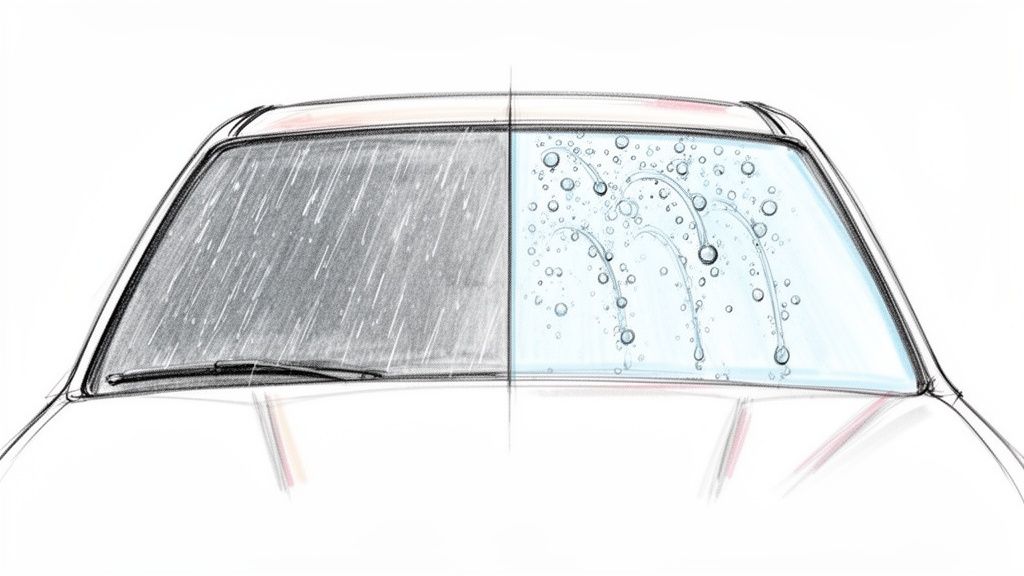
The Next Generation of Glass Protection
For years, the market was dominated by rigid coatings. They worked well at first but had a major flaw: they were brittle. A sudden temperature shock, like a frosty morning after a warm day, or even a direct hit from a large bug, could cause invisible micro-cracks. These cracks would compromise the coating’s integrity and drastically shorten its lifespan.
This is where the next generation of protection changes the game. At Titan Coatings, we pioneered the use of elastomer coatings for automotive use, powered by our own nano-tube and Dark Matter technologies. This isn’t just another ceramic coating; it’s a complete rethink of surface science.
Our coatings are engineered to be as hard as glass but also remarkably flexible. It’s this unique elasticity that creates a durable, super-slick barrier and solves the old brittleness problem for good.
- Temperature Resilience: The coating flexes as the glass expands and contracts, so it won’t crack when the temperature swings from freezing to hot.
- Impact Resistance: That flexibility helps absorb the energy from impacts like bugs or small debris, preventing the coating from chipping or failing.
- Longevity: Because it resists the stresses that degrade traditional coatings, our elastic technology just plain lasts longer, giving you performance you can count on.
Making Rainy Drives Stress-Free
The whole point is to make every drive safer and less stressful, no matter the weather. That’s exactly what products like our Titan Apex Glass Ceramic Coating are designed for. Its formula improves visibility so much that driving in the rain almost feels effortless.
The water-beading is so effective that at highway speeds, you often don’t even need to use your wipers. You can see more of the science behind a top-tier rain-repellant ceramic coating in our detailed guide.
Let’s look at how this plays out in a few common scenarios.
Traditional Wipers vs Ceramic Coating Performance
| Scenario | Standard Windshield with Wipers | Windshield with Titan Apex Glass Coating |
|---|---|---|
| Light Drizzle | Requires intermittent wiper use, which can smear dirt and create streaks. | Water beads up and rolls away, often requiring no wiper use at all. |
| Heavy Downpour | Wipers on high speed struggle to keep up, creating a constant sheet of water and reducing reaction time. | Most water is shed from the glass before wipers even need to activate, maintaining clear visibility. |
| Highway Speeds | Wipers are in constant use, causing wear and noise. | The wind naturally pushes beaded water off the windshield, providing a clear view with minimal wiper use. |
| Bug Splatter | Bugs and grime stick firmly to the glass, becoming difficult to remove and smearing when wipers are used. | The slick surface prevents bugs and dirt from bonding, making them easy to wipe away or wash off. |
As you can see, the difference is night and day. A ceramic coating works with your wipers to provide an entirely new level of clarity and safety.
This technology represents a significant leap forward. By creating a flexible yet durable shield, we’ve addressed the primary failure point of older coatings, ensuring your clear vision is protected for the long haul.
We’re not the only ones who see the value. The global ceramic coatings market was valued at about USD 12.48 billion in 2024 and is projected to hit USD 23.05 billion by 2032. This shows a clear trend: people are choosing advanced, durable solutions over temporary fixes. You can dive into the full market analysis of this growing trend on fortunebusinessinsights.com.
Now, let’s get into how you can achieve these professional-grade results yourself.
Preparing Your Glass for a Flawless Bond
Let me be blunt: the secret to a ceramic windshield coating that sheets water for years isn’t in the bottle. It’s in the prep work. The real magic happens long before you even crack the seal on the coating itself.
Think of it like this: a high-performance ceramic coating needs something to grab onto. It forms a powerful chemical bond directly with the glass, but it can only do that if the surface is absolutely, surgically clean. We’re talking about removing every last trace of contamination—oily road film, caked-on bug guts, stubborn mineral deposits, and the ghosts of old, failed glass treatments.
Why This Prep Work Is Everything
I can’t tell you how many times I’ve heard from frustrated DIYers who thought their coating failed after a few weeks. The water-beading disappeared, and wipers just smeared the rain around. In almost every case, the product wasn’t the problem. The prep was.
A quick wash and a spritz of Windex just won’t cut it. You’re leaving behind a microscopic layer of grime that acts as a barrier, preventing the coating from ever truly bonding to the glass. It’s a classic mistake, and it completely sabotages the time and money you’ve invested.
A coating applied to a dirty surface is like building a house on sand. It might look okay for a minute, but it’s guaranteed to fail. The prep stage is where 90% of your long-term success is locked in.
Your Glass Prep Toolkit
To get that glass ready for a professional-grade product like Titan’s Apex Glass Ceramic Coating, you need to be methodical. Skipping a step here is just asking for trouble down the road.
- Initial Cleaning: First, get the easy stuff off. A good automotive glass cleaner will cut through the top layer of dirt and grime. This is just your opening move.
- Clay Bar Decontamination: This is non-negotiable. Grab an automotive clay bar and some lubricant. As you glide it across the glass, you’ll feel it grab and pull out embedded contaminants that washing can’t touch. You will be amazed—and a little disgusted—by what comes off on the clay.
- Tackling Water Spots: Hard water spots are a coating’s kryptonite. Those little white circles are actually mineral deposits that have etched their way into the glass, and they will absolutely block the coating from bonding. If you see any, you need a specialized product to dissolve them. For really stubborn spots, you’ll want to see how to properly use an auto hard water spot remover to get the surface perfectly clear.
- Glass Polishing (When Needed): Got an older windshield with light wiper haze or really caked-on grime? A light polish using a cerium oxide-based compound can work wonders. It doesn’t just clean the glass; it smooths the surface on a microscopic level, creating the ultimate foundation for the coating.
The Final Wipe-Down: Your Last Chance for Perfection
Okay, the glass is now physically clean. But the final, most critical step is the chemical cleaning that removes every last trace of oil, polishing residue, or fingerprints.
Your best friend here is Isopropyl Alcohol (IPA). I recommend a 50/50 mix with distilled water. Don’t spray it directly on the glass, as it can evaporate too quickly. Instead, spray a liberal amount onto a fresh, clean microfiber towel and wipe down the entire windshield with purpose.
Follow immediately with a second, completely dry microfiber towel to buff off any haze. The glass should be so clean it squeaks. This final wipe-down leaves the surface totally bare, ensuring the nano-particles in the ceramic coating can anchor themselves directly to the glass for the strongest, most durable bond possible.
The Art of Applying Your Ceramic Windshield Coating
You’ve done the hard work, and the glass is perfectly prepped. Now for the fun part. This is where you lay down the protective layer that will transform your driving experience, turning a clean windshield into a high-performance, weather-defying shield. Let’s walk through how to apply Titan’s Apex Glass Ceramic Coating. It’s designed for enthusiasts like us who want pro-level results without needing a pro’s garage, and its ease of use is a game-changer.
If this is your first time, you might feel a little hesitant with the bottle in hand. I get it. But that feeling quickly disappears once you start. The trick is to control your environment and stick to a simple, methodical pattern. This isn’t just wiping a liquid on; you’re creating a durable, molecularly bonded layer of protection that will last.
Setting the Stage for Success
Where you apply the coating is just as important as the prep work itself. Trying to apply a ceramic windshield coating in direct sunlight or heavy humidity is a recipe for disaster. It can cause the coating to cure way too fast, leaving you with high spots and a streaky, uneven mess. Your best bet is to find a shaded spot, like a garage or carport, with stable temperatures.
Think of it like painting; you wouldn’t do it in a windstorm. Give yourself a calm, controlled space where you can focus and work without being rushed.
Before you get started, let’s quickly revisit the prep work. This is the foundation for everything.
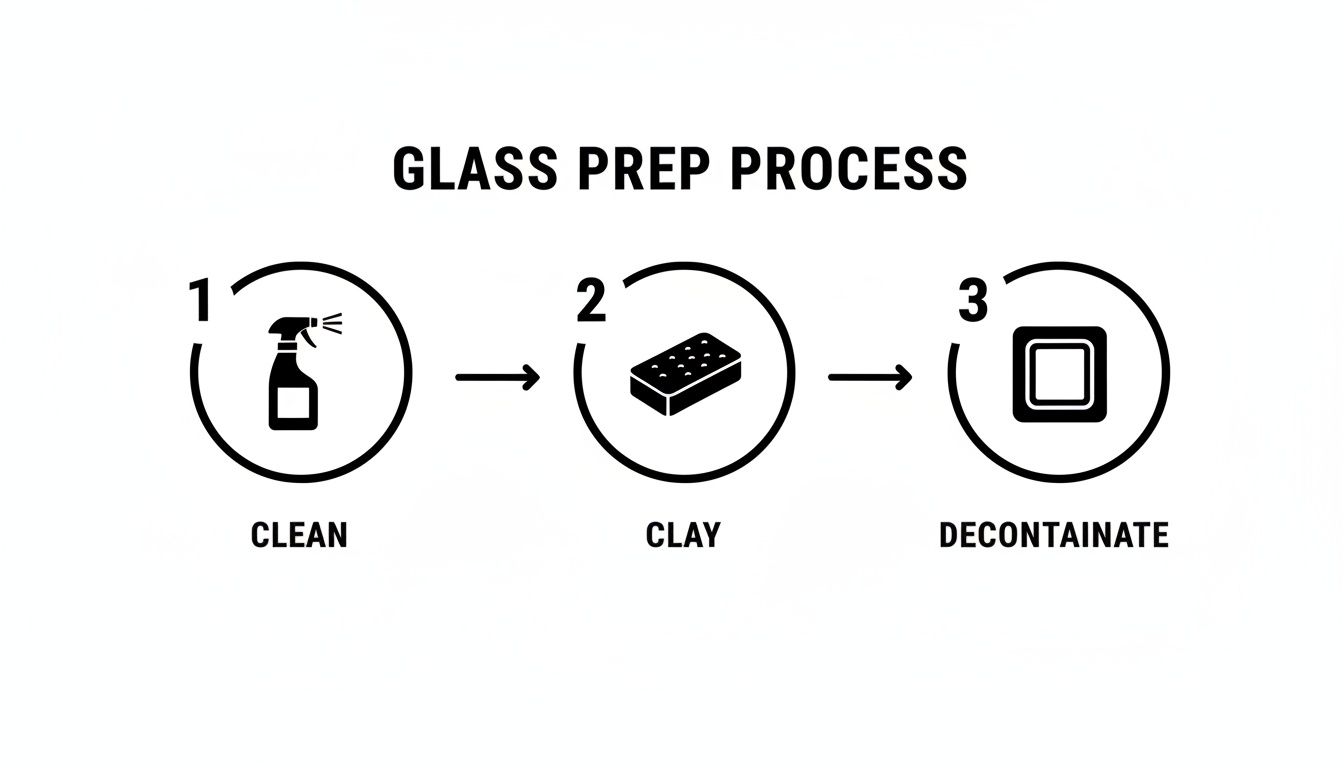
Following these steps ensures the surface is absolutely pristine, allowing the coating to grab on tight and deliver the long-lasting results you’re after.
Your Step-by-Step Application Guide
With your space ready, grab your bottle of Apex Glass and your applicator block. The process itself is straightforward, but precision makes all the difference.
- Prime the Applicator: Don’t be shy here. Apply a solid line of the coating across the top of the microfiber suede. For the very first use, make sure the suede is fully saturated to prevent any dry dragging on the glass.
- Work in Small Sections: Don’t try to tackle the entire windshield at once. I always split it right down the middle, treating the driver’s side and passenger’s side as two separate jobs. This gives you plenty of time to work before the coating starts to dry.
- Master the Cross-Hatch Pattern: Start applying the coating to your first section with a methodical back-and-forth motion—first go top-to-bottom, then side-to-side. This cross-hatch technique is the secret to getting complete, even coverage without missing a single spot. Just overlap your strokes slightly, and you’ll create a perfectly seamless layer.
It’s no surprise that these durable coatings are becoming so popular. The Asia Pacific region has actually become a powerhouse in the ceramics market, accounting for over 41% of the global share. This boom is driven by the massive automotive manufacturing sector in countries like China and India, where advanced coatings are essential.
Nailing the Flash and Final Buff
After a minute or two, you’ll see a cool, iridescent “rainbow” effect appear on the glass as the solvents evaporate. This is called flashing, and it’s your signal that the coating is ready for the next step. The exact timing depends on temperature and humidity, but it’s usually between 30 seconds and a couple of minutes.
Once you see that rainbow haze, it’s go-time.
Grab a clean, high-quality microfiber towel and gently wipe over the section you just coated. You’re not scrubbing here. The goal is to “level” the coating by knocking down any high spots, leaving a perfectly smooth, uniform layer.
Immediately follow up with a second, fresh microfiber towel to buff the glass to a brilliant, streak-free shine. Use a good light source and check your work from a few different angles to make sure you got all the residue. Once the first half is done, repeat the whole process on the other side.
And that’s it! You’ve just applied a professional-grade ceramic coating and learned a skill that will make every drive safer and more enjoyable.
Extending Protection Beyond Your Windshield
Once you see the unbelievable water-beading magic of a ceramic windshield coating, it’s almost impossible not to think, “I need this everywhere.” That’s the exact moment a friend of mine, a professional detailer named Marco, lives for. It’s the perfect opening to talk about a complete vehicle protection strategy.
His approach is brilliant in its simplicity. When a client comes in for a full detail, Marco will often throw in a treatment of Titan’s Apex Glass Ceramic Coating on the windshield as a value-add. When the client returns, he just hands them a spray bottle of water and says, “Go ahead, give it a shot.” The reaction is always the same: a look of shock, followed by a massive grin as the water dances off the glass.
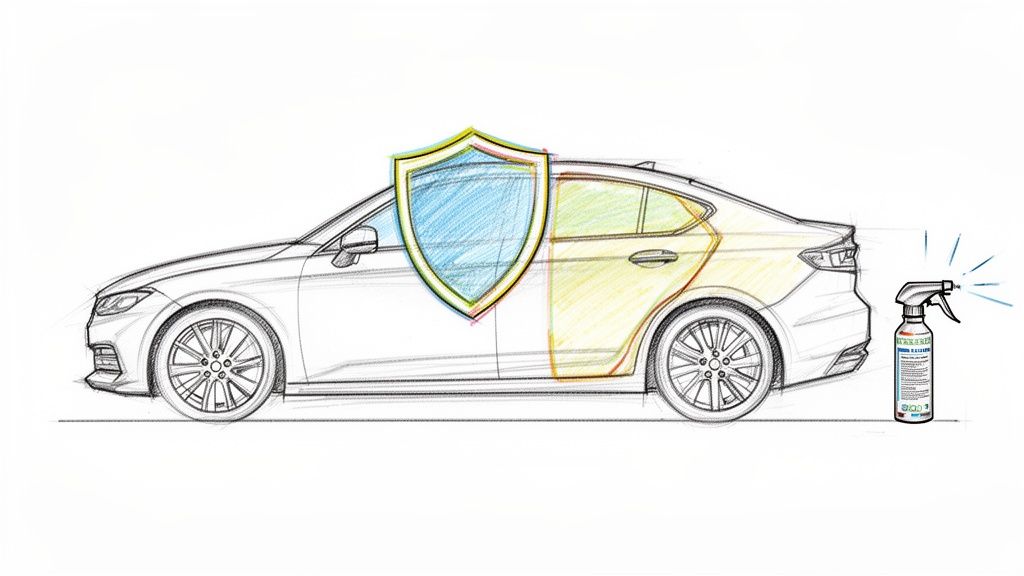
That’s his cue. “Now,” he’ll say, “imagine that same protection, that slickness, and that ease of cleaning on your entire car.” It’s a simple demo that effortlessly shows the value of protecting the whole vehicle, not just the glass.
Introducing a Smarter Kind of Body Armor
For full-body protection, Marco doesn’t just recommend another run-of-the-mill ceramic coating; he introduces his clients to a serious upgrade: Titan’s Alpha Quartz, our top-tier elastomer coating. This is where he explains the game-changing difference between standard, rigid coatings and Titan’s flexible technology.
You see, traditional ceramic coatings are incredibly hard, but that hardness makes them brittle. This weakness really shows when temperatures change. As your car’s paint expands in the summer heat and contracts in the winter cold, a rigid coating can develop microscopic stress fractures. These tiny cracks compromise the entire protective layer, drastically reducing its lifespan and effectiveness.
Titan’s elastomer technology, which grew out of our work with nano-tubes and Dark Matter tech, completely solves this problem. Our coatings, like Alpha Quartz, are as hard as glass but remain flexible. This elasticity allows the coating to move with your vehicle’s panels, preventing cracks and ensuring a much longer, more durable bond to the paint.
This same principle applies to everyday driving hazards. When a bug smacks your front bumper at 70 mph, a brittle coating can chip or fracture. Alpha Quartz, on the other hand, has the flexibility to absorb that impact, keeping the shield intact. It’s simply smarter, more resilient protection built for the real world.
Two Paths to Total Vehicle Protection
We get it—a professional-grade elastomer coating is a significant investment. That’s why it’s great to have options that fit different needs and budgets, which you can see on our product comparison page. The end goal is the same: getting that incredible hydrophobic, self-cleaning effect you love on your glass onto your paintwork.
Here’s a look at two fantastic ways to get there:
- For the Enthusiast Seeking Ultimate Durability: Titan Alpha Quartz is the flagship. It’s a pro-grade elastomer coating that delivers years of relentless protection against UV rays, chemical contaminants, and the elements. This is the “do it once, do it right” solution for anyone who demands the absolute best. Its flexible hardness means it won’t crack from temperature swings or bug impacts—a common failure point for lesser coatings.
- For the DIYer Wanting Simplicity and Great Results: Not everyone has the time or garage space for a full multi-stage coating application. For them, we have Titan’s Ultra Ceramic Spray. This formula gives you outstanding hydrophobic properties and solid protection in an incredibly easy-to-use spray-on, wipe-off package. It’s the perfect way to get a taste of full-body ceramic protection with minimal effort and fantastic results.
This isn’t just automotive tech, either. The aerospace and defense industries have relied on ceramic coatings for decades, protecting everything from jet engine components to aircraft canopies. The proven reliability of these materials in extreme environments—where failure simply isn’t an option—is a powerful testament to their effectiveness. As a full industry analysis on gminsights.com shows, by choosing an advanced coating, you’re applying that same level of battle-tested technology to your own car.
Keeping Your Coating Performing Like Day One
So you’ve done the work. You applied a killer ceramic windshield coating, and the glass looks absolutely pristine. The first time you hit the road in a downpour, the way the water zips right off is nothing short of magic. But getting that perfect application is only half the battle. The real secret to keeping that unbelievable hydrophobicity for the long haul comes down to simple, smart maintenance.
The good news? Taking care of a coated windshield is a whole lot easier than dealing with raw glass. A quality product like Titan’s Apex Glass Ceramic Coating does most of the heavy lifting for you, thanks to its self-cleaning properties. This means less scrubbing and ditching the harsh chemicals just to get a clear view. But “easier” doesn’t mean you can just forget about it. You’ve got to protect your investment from a few key enemies.
What Wrecks a Perfectly Good Coating?
Let’s clear the air on a common myth. A ceramic coating is tough, but it’s not a force field. A few common things can degrade it way faster than they should, so just being aware of them will make a huge difference in how long your coating lasts.
- Aggressive Car Washes: I get it, those drive-through tunnel washes are convenient. But those giant, spinning brushes are brutal on any coating. It’s not just the bristles; the real culprit is the harsh, high-pH detergents they spray. That stuff is designed to strip everything off a surface, including your meticulously applied protective layer.
- Worn-Out Wiper Blades: Your wipers are now gliding across a super-slick surface. If the blades are old, cracked, or have bits of grit stuck in the rubber, they essentially turn into fine-grit sandpaper, slowly scuffing up the coating with every single pass.
- The Wrong Towels: Grabbing any old rag or, even worse, a paper towel to dry your windshield is a fast track to problems. Contaminated or abrasive towels will introduce micro-scratches that mess with the coating’s ability to sheet water off cleanly.
The Simple Plan for Long-Term Clarity
Your new maintenance routine is really about a shift in mindset. You’re not trying to scrub the glass clean anymore; you’re just gently helping the coating do its job.
The absolute foundation of this new routine is a pH-neutral car shampoo. Unlike those aggressive, all-purpose cleaners that can eat away at a coating’s structure, a gentle, pH-neutral soap is all you need. It’ll lift the dirt and road grime without chemically attacking the coating itself.
When it comes to drying, always reach for a dedicated, high-quality microfiber towel. A plush, clean towel soaks up water without leaving behind lint or creating those pesky little scratches. This one simple change makes a massive difference over time.
Here’s the bottom line: The coating is doing the hard work. Your job is just to use gentle cleaning methods that don’t undermine it. Avoid harsh chemicals and unnecessary friction, and that coating will keep beading water like you wouldn’t believe.
A Quick and Easy Maintenance Routine
This is the simple process I follow every time I wash a car with a coated windshield. It’s effective and keeps the ceramic windshield coating in prime condition.
- Pre-Rinse is Key: Before you ever touch the glass with a mitt, give it a solid rinse with your hose or pressure washer. This knocks off the loose, gritty stuff so you aren’t grinding it into the surface.
- Gentle Wash: Grab a soft wash mitt and your pH-neutral shampoo, then gently wash the glass. You don’t need to put any muscle into it. Let the slickness of the coating and the suds do all the work.
- Final Rinse: Rinse every last bit of soap off the glass. You’ll get that instant satisfaction of seeing the water bead up and fly off—the perfect confirmation that your coating is healthy.
- Dry with Care: Use a clean, plush microfiber towel to pat or lightly wipe the glass dry.
Stick to these simple steps, and you’ll get years of incredible performance out of your coating. For a deeper dive into the specifics, check out our complete guide to ceramic coat maintenance.
Answering Your Top Questions About Ceramic Windshield Coatings
Even after walking through the whole process, you’re bound to have a few questions. Trust me, I’ve heard them all over the years from DIYers just starting out to seasoned pros in the detailing bay. Let’s run through the most common ones so you can get started with confidence.
Think of this as the final check-in before you completely change the way you see the road. It’s not just about knowing how to do it, but why you’re doing it.
Can I Just Coat Over Existing Scratches or Chips?
I get this one a lot, and the answer is a hard no. A ceramic coating is purely a protective layer, not a magic filler. We’re talking about a layer that’s measured in microns—it’s incredibly thin. It simply doesn’t have the mass to fill in rock chips or those annoying scratches left by old, worn-out wiper blades.
In fact, if you try to coat over that kind of damage, you’ll probably just make it more obvious by locking it under a super glossy, reflective surface. Do yourself a favor: get any glass repairs or polishing done before you even think about opening that coating bottle. A clean slate is critical for a perfect bond.
How Long Will This Coating Actually Last?
The real-world lifespan comes down to three things: the quality of the coating you choose, how well you prepped the glass, and how you maintain it afterward. A cheap consumer spray from the auto parts store might give you a few months if you’re lucky. A true professional-grade coating, on the other hand, is engineered to last for years.
This is where Titan Coatings’ elastomer technology really shines. Our coatings, like Apex Glass Ceramic Coating, are flexible. That means they can handle the constant expansion and contraction of the glass from temperature swings without getting the micro-cracks that kill traditional, brittle coatings. With the right care—like using pH-neutral soaps and staying away from harsh car washes—you’re looking at years of water beading right off your windshield.
Will It Mess With My Wiper Blades or Rain Sensors?
Nope, not at all. A properly applied ceramic coating makes the glass surface incredibly slick—way slicker than bare glass. This actually helps your wipers by reducing friction and drag, letting them glide across the windshield smoothly and quietly. You might even find your blades last a bit longer.
As for automatic rain sensors, they work perfectly. Those sensors detect light distortion from raindrops, and the coating is so thin and optically clear that it has zero effect on that process. If anything, you’ll probably notice your wipers kicking on less often because the coating is already doing most of the work, sheeting water away before it can even form a proper drop.
Key Takeaway: The slick, hydrophobic surface doesn’t fight against your car’s features; it actually works with them, making your wipers and sensors more effective.
What’s the Deal With Curing?
Curing is the critical phase where the coating chemically bonds to the glass and hardens into that durable, protective shell. The surface might feel dry in an hour or so, but the real magic—the full chemical cure—takes a bit longer. You absolutely have to protect it from moisture and chemicals during this initial window.
Here’s a quick breakdown of the timeline:
- First 24 Hours (Initial Cure): The car needs to stay completely dry. No rain, no sprinklers, and definitely no washing.
- Up to 7 Days (Full Chemical Cure): You can’t wash the car with any soap or chemicals. A little rain won’t hurt, but don’t let water pool and dry on the glass.
Being patient here is non-negotiable if you want that long-term durability. A little patience now pays off with years of performance down the road.
Ready to see the world through a clearer, safer windshield? Titan Coatings offers the most advanced elastomer-based coatings you can get, built for unbelievable durability and performance. It’s time to make your next drive a stress-free one.
Discover the difference with Titan Apex Glass Ceramic Coating today.
0 Comments