
A ceramic coating for your windshield is a specially formulated liquid polymer that forms a chemical bond directly with the glass. The result is an incredibly slick, tough, and transparent layer of protection. This advanced shield forces rain to bead up and literally fly off the glass, which dramatically improves your visibility and safety in bad weather while making your windshield a whole lot easier to clean.
The Unseen Shield Revolutionizing Your Drive
You know the feeling. You’re driving along, and suddenly, the sky just opens up. The downpour is so intense your wipers can’t keep up, no matter how fast they’re going. They just smear a blurry, stressful mess across the glass. We’ve all been there—white-knuckling the steering wheel, squinting to make out the road ahead.
Now, imagine that same storm. But this time, as soon as the rain hits, the drops instantly form tiny, perfect beads and shoot right off the windshield. Your view is crystal clear, even before the wipers have a chance to kick in. Driving in the rain becomes stress-free.
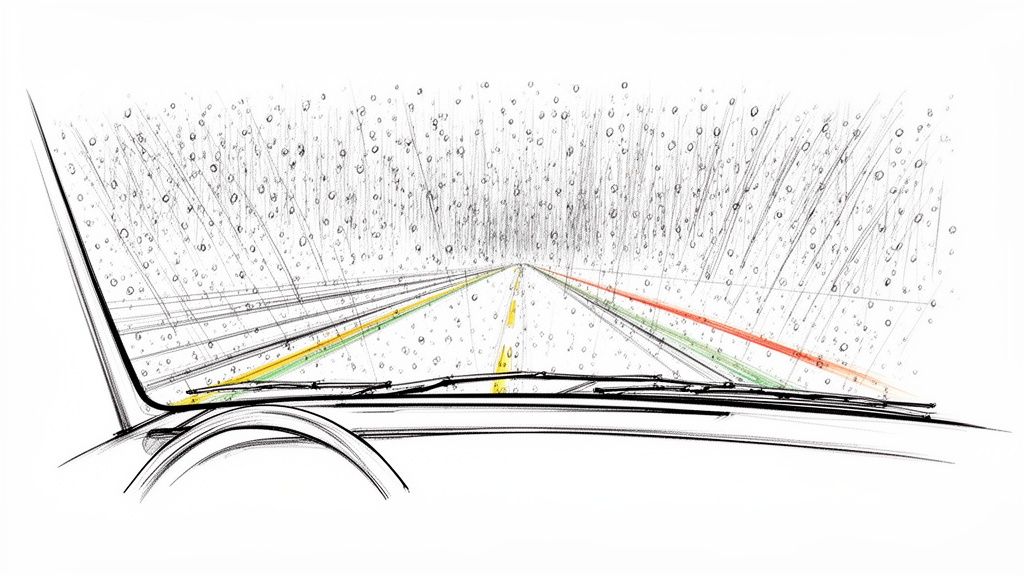
This isn't some far-off fantasy; it's exactly what happens when you apply a high-quality ceramic coating. We're talking about technology that goes way beyond those temporary sprays or waxes you find at the auto parts store. This is a semi-permanent solution that completely changes how your glass handles the elements.
From Military Labs to Your Driveway
The science that makes this possible didn't start in the detailing world; it was born from a need for extreme, uncompromising durability. At Titan Coatings, we’ve been at the forefront of this shift, pioneering the use of elastomer coatings built with groundbreaking nano-tube technology and our proprietary Dark Matter Tech™. As the first company to introduce elastomer coatings to the market, we spent years refining these advanced polymers, originally developed for tough military applications, for your vehicle's glass.
This isn’t your average ceramic coating. Traditional formulas can be rigid and brittle, which is a major weakness on a surface like a windshield. Our elastic coatings are engineered to be as hard as glass but with built-in flexibility. It’s a total game-changer.
An elastic coating can withstand the constant vibrations, the wild temperature swings from freezing cold to blistering heat, and the small impacts from road debris without cracking or failing. That flexibility is the secret to its incredible longevity and performance.
A Clearer, Safer Driving Experience
This is just the start. We're about to show you how this technology offers a massive upgrade in safety, clarity, and simple maintenance for any vehicle. Whether you're a professional detailer looking for an edge or a dedicated DIYer working on your own car, understanding the power of a true ceramic coating for glass is non-negotiable.
Let's dive in and see how this invisible shield creates a safer, less stressful, and far more enjoyable drive every single time you get behind the wheel.
What Puts Ceramic Coatings in a Different League Than Waxes and Sealants?
To really get why a ceramic coating for a windshield is such a game-changer, you first have to understand what it isn't. Most of us have used traditional waxes or those spray-on rain repellents. They work, for a little while, by leaving a slick film on the glass. It's a decent temporary fix, but that's all it is—temporary.
Think of it like this: wax is a light jacket. It gives you a little protection, but it wears off fast and won't do much when things get really nasty. A true ceramic coating, however, is more like a permanent, microscopic suit of armor for your glass.
It doesn’t just sit on top of the surface; it creates a powerful chemical bond with the glass itself. This covalent bond forms a semi-permanent layer that is leagues ahead of any wax or sealant in terms of sheer resilience. If you want to go deeper, we break it all down in our guide on the difference between wax and ceramic coating.
The Science Behind It: Nanotechnology and SiO2
So, what's the magic behind this incredibly strong bond? It all comes down to nanotechnology. At its heart, a ceramic coating is a liquid polymer packed with nanoparticles, most often SiO2, which you might know as silicon dioxide—the main component of glass itself.
When you apply the coating to your windshield, these tiny particles link up and organize themselves into a super-tight, crystal-clear grid. This nano-structure is what creates the unbelievable water-beading, or super-hydrophobic, effect everyone loves.
The surface becomes so perfectly smooth on a microscopic level that water can't find anything to grab onto. Instead of smearing across the glass, water droplets form into tight little beads and just roll right off, taking dirt and grime along for the ride.
The Titan Coatings Difference: Elastomer Technology
Traditional SiO2 coatings were a huge step forward, but they had one major flaw, especially on a windshield: they were brittle. Glass is always expanding and contracting with temperature swings and flexing from road vibrations. A rigid coating just can't handle that stress and eventually develops micro-cracks, which kills its performance.
This is exactly where Titan Coatings rewrote the rulebook. We were the first to bring elastomer coatings to the market, creating a whole new level of performance with our nano-tube technology and proprietary Dark Matter Tech™.
Our elastomer coatings are engineered to be hard like glass yet remarkably flexible. This elasticity is the secret to their unmatched longevity. The coating can flex and adapt to temperature extremes—from frozen winters to scorching summers—without cracking or failing.
This unique flexibility also means a Titan coating is better at shrugging off small impacts, like bugs splattering on the windshield at 70 mph. A rigid coating might chip or degrade under that kind of assault, but our elastic coatings maintain their protective shield. This is the core difference that sets Titan's technology apart, giving you a windshield coating that doesn't just work on day one but keeps protecting your glass for years to come.
Real-World Benefits of a Ceramic Coated Windshield
The science behind elastomer and nano-tube technology is impressive, sure, but what really matters is how a coated windshield actually performs on your daily drive. Let's get out of the lab and talk about the real-world situations where these coatings make a genuine difference in your safety, convenience, and overall peace of mind. The benefits aren't just theoretical—they're immediate and you'll notice them every single time you get behind the wheel.
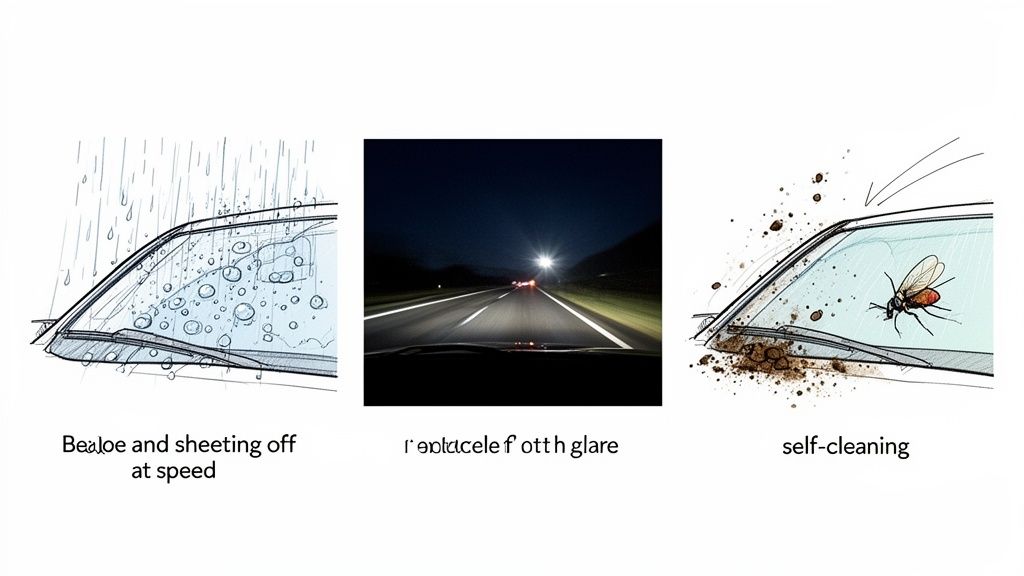
Picture this: you're hours into a road trip, and your car has become a magnet for bugs, dust, and all sorts of road grime. With a standard windshield, you'd be hitting the washer fluid button every few minutes. But with a properly coated windshield, a lot of that gunk struggles to even stick in the first place. That’s the self-cleaning effect in action, and it's an absolute game-changer.
Driving Through Rain Becomes Stress-Free
The most jaw-dropping benefit is the unbelievable water repellency. During a downpour, an untreated windshield forces your wipers to work overtime, often just smearing water around and making visibility worse. A coated windshield does the exact opposite. Water beads up into perfect little spheres and gets whisked away by the airflow over the car. At highway speeds, you often don't even need your wipers.
This isn’t just a cool party trick; it's a massive safety upgrade. By keeping your line of sight crystal clear, you can spot and react to road hazards much faster. Products like Titan’s Apex Glass Ceramic Coating are engineered from the ground up to maximize this effect, turning a tense drive in a storm into a surprisingly calm and safe experience. Its easy-to-use formula means you can enhance visibility yourself and make driving under rain stress-free.
Clearer Nights and Easier Mornings
Night driving has its own challenges, especially the blinding glare from oncoming headlights. The incredibly smooth, uniform surface created by a ceramic coating helps reduce how that light scatters, meaning less distracting glare and a sharper view of the road for you.
And the perks don't stop when you park the car.
- Frost and Ice Resistance: Live in a cold climate? The slick surface makes it much harder for ice to get a solid grip on the glass. That means less time scraping on a frozen morning.
- Repels Dirt and Grime: The same properties that shed water also push away dirt, tree sap, and bird droppings, keeping your glass cleaner for way longer.
- Effortless Bug Removal: Splattered bugs are the worst part of any summer drive. A coated windshield keeps them from baking on, so they wipe away with almost zero effort.
This combination of protection and easy maintenance is exactly why the global ceramic coating market has exploded, surging from $9.3 billion in 2019 to a projected $13.6 billion by 2026. People are catching on. Coatings provide a hydrophobic shield that not only repels water and grime but also protects the glass itself. In fact, studies show that unprotected windshields exposed to UV rays can degrade up to 40% faster.
To see just how stark the difference is, let's look at a side-by-side comparison.
Untreated Windshield vs Titan Apex Coated Windshield
| Condition | Untreated Windshield | Titan Apex Coated Windshield |
|---|---|---|
| Heavy Rain | Water "sheets" across the glass, wipers struggle to keep up, causing smearing and reducing visibility. | Water forms tight beads that are blown away by airflow, often making wipers unnecessary at speed. |
| Night Driving | Headlights and streetlights create significant glare and "starburst" effects, causing eye strain. | Glare is noticeably reduced as light scatters less on the ultra-smooth surface, improving focus. |
| Morning Frost | A thick, stubborn layer of ice forms that requires heavy scraping and defrosting time. | A thin layer of frost may form, but it adheres weakly and is much easier and faster to clear. |
| Bug Splatter | Bug guts bake onto the glass in the sun, requiring harsh chemicals and intense scrubbing to remove. | Bugs wipe away easily with a simple wash, as they can't bond to the slick, coated surface. |
As you can see, the upgrade is clear. In every common scenario, a windshield treated with Titan Apex simply performs better, making driving safer and vehicle maintenance far less of a chore.
For a car enthusiast or a professional detailer, these benefits translate directly into time saved. Less time scrubbing bugs and grime means more time enjoying the drive and admiring a pristine vehicle.
The Durability of Flexibility
One of the most important real-world advantages of Titan’s elastomer technology is its sheer longevity. Traditional, rigid glass coatings can crack under pressure—literally. The constant expansion and contraction of the glass, from a freezing night to a blazing hot day, can cause micro-fractures in brittle coatings, completely ruining their effectiveness.
But because Titan’s coatings are engineered to be both hard and flexible, they move with the glass, withstanding those environmental stresses without breaking down. This built-in elasticity is the key, ensuring the hydrophobic and self-cleaning properties last season after season. It’s a reliable shield you can count on.
To see more, check out our detailed look at how a rain-repellant ceramic coating can completely transform your driving experience.
Choosing Your Path: Professional Application vs. DIY
Deciding to coat your windshield is the easy part. The real question is: who’s going to do the work? This is a fork in the road every car owner faces, and both options—hiring a pro or rolling up your sleeves—have their perks. Ultimately, the right choice boils down to your budget, how comfortable you are with hands-on work, and the results you're aiming for.
Going the professional route is all about buying peace of mind. A certified detailer isn’t just applying a product; they’re working in a controlled environment, away from the dust, humidity, and temperature swings that can ruin a perfect finish. They have the right tools and, more importantly, the experience to prep the glass to a surgically clean state. This meticulous process is what guarantees a flawless bond and maximum coating performance.
But let's be honest, there's a special kind of satisfaction that comes from achieving incredible results with your own two hands. For the DIY enthusiast, coating your own windshield is a deeply rewarding project that also happens to save you a good chunk of change. Modern coatings have made this more accessible than ever, putting a pro-level finish within reach of anyone passionate enough to try.
The Professional Advantage: Precision and Peace of Mind
When you pay a professional, you're not just buying a bottle of coating. You're investing in their time, their specialized environment, and their hard-won expertise. A pro can spot and correct tiny imperfections in the glass—like pitting or stubborn contamination—that most of us would never even notice. They also have access to professional-grade coatings that often come with longer warranties and even higher performance.
For anyone with a high-value vehicle or those who simply can't settle for anything less than perfection, this is almost always the best move. Sure, the upfront investment is higher, but the results are guaranteed. If you're weighing the cost, it's worth knowing what goes into the final price. Our detailed guide on professional ceramic coating costs breaks it all down for you.
This path is perfect for the owner who wants a flawless, long-lasting finish and would rather leave the painstaking work to a seasoned expert.
The DIY Revolution: Titan's User-Friendly Solutions
The world of DIY detailing has changed. Gone are the days when you needed a shop full of complex tools and years of practice to get a great result. Titan Coatings has been on the leading edge of this shift, engineering powerful yet incredibly user-friendly coatings that bring professional technology right into your garage. You can explore our full range of products at the Titan Coatings shop.
This isn’t just a niche hobby; it’s a massive movement. The ceramic coating industry is projected to explode from USD 11.16 billion in 2023 to USD 19.20 billion by 2030, and automotive glass protection is a huge driver. Why? Because these coatings block 99% of UV rays, preventing the hazing that plagues 25% of vehicles under five years old in sunny regions.
We've designed our products to meet you exactly where you are, whether you're a complete beginner or a seasoned weekend warrior.
For the Beginner: Ultra Ceramic Spray
If you're just dipping your toes into ceramic coatings, this is your perfect entry point. Ultra delivers unbelievable hydrophobic properties with an unbelievably simple spray-and-wipe application. You can coat your windshield in minutes and immediately see rain dance off the glass. It’s a taste of high-end protection with almost zero effort.For the Enthusiast: Alpha Quartz
Ready for professional-grade durability in a DIY-friendly formula? Alpha Quartz is a true elastomer coating, giving you the same flexible, long-lasting protection found in our pro-only lines. It's engineered for a straightforward application but creates a tough, elastic shield that won't crack from temperature shocks or bug strikes, ensuring your glass stays crystal clear.
Choosing the DIY path with Titan isn't about compromising on quality. It's about empowering yourself with advanced, easy-to-use technology that delivers outstanding results and the immense satisfaction of a job well done. To see how our products stack up, check out our comparison page.
A Step-by-Step Guide to a Perfect DIY Application
Ready to get that pro-level finish on your own? Good. While the science behind ceramic coatings can sound intimidating, the actual application process is surprisingly straightforward—as long as you’re meticulous. The real secret to a tough, long-lasting bond isn’t in the final buff, it's in the prep work you do before you even open the bottle.
Every single step, from the first wash to the final cure, is critical.
This flowchart breaks down the decision between rolling up your sleeves for a DIY job versus calling in a professional.
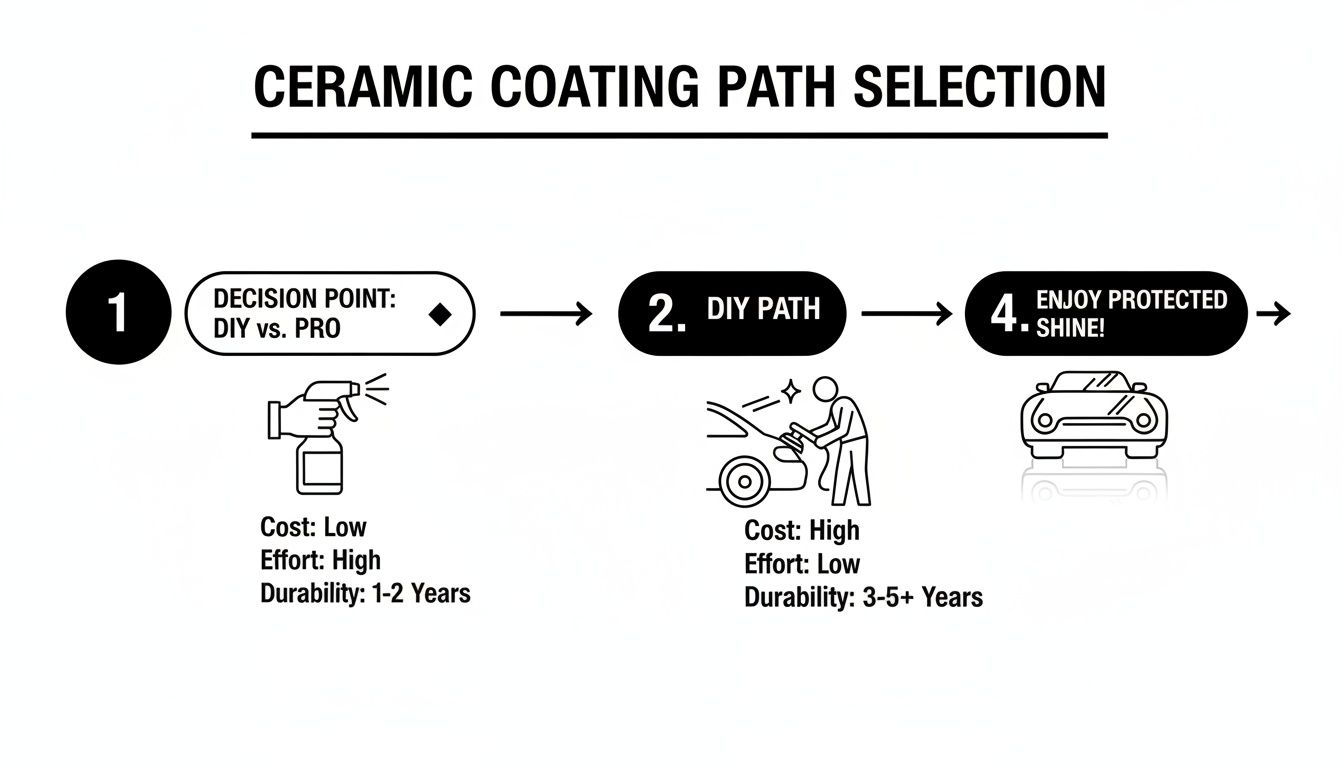
As you can see, the DIY route is a great way to save money and get some hands-on satisfaction. On the other hand, going with a pro guarantees an expert result without you lifting a finger.
Phase 1: The Critical Preparation Stage
You can't get a perfect finish on an imperfect surface. It’s that simple. The whole point here is to get the glass so clean it’s practically sterile. This creates the ideal canvas for the ceramic coating to form a powerful chemical bond.
Anything left behind—oils from your hands, old water spots, stubborn road film—acts like a barrier. It will weaken the bond and completely undermine the results you’re working so hard for.
Here’s how to get your glass pristine:
- Deep Clean: Kick things off by washing the windshield with a quality car shampoo and water. Dry it off completely with a fresh microfiber towel.
- Decontaminate with a Clay Bar: Even after a good wash, microscopic gunk is still clinging on for dear life, embedded in the glass. A clay bar is your non-negotiable tool for yanking it out. Lube the glass with a clay lubricant and gently glide the bar across the surface until you feel zero friction. Smooth as… well, glass.
- Final IPA Wipe-Down: The last step before the magic happens is a wipe-down with Isopropyl Alcohol (IPA). A 50/50 mix of IPA and distilled water will strip away any final traces of oils, residue, or fingerprints, leaving behind a perfectly prepped surface.
Think of it like painting a wall. You wouldn't just slap a fresh coat over dirt, dust, and peeling paint, right? You'd expect a disaster. The same rule applies here: a flawless foundation is everything.
Phase 2: Applying Titan's Apex Glass Ceramic Coating
With the prep work nailed, you’re ready to lay down the shield. For this guide, we're working with Titan's Apex Glass Ceramic Coating, which was engineered for serious performance and a user-friendly application.
Make sure you're working in a shaded, well-ventilated spot. Direct sunlight is the enemy here.
- Step 1: Apply Sparingly: Squeeze just a few drops of Apex onto your applicator pad. A little goes a very, very long way. You're aiming for a thin, even layer, not a thick, goopy mess.
- Step 2: Work in Small Sections: Don't try to tackle the whole windshield at once. Mentally divide it into small, manageable sections, about 2×2 feet. Apply the coating to one section at a time using a cross-hatch pattern—first up and down, then side to side—to ensure you don’t miss a spot.
- Step 3: Watch for the Flash: This is the most important part of the timing. After about 30-60 seconds (this can vary with temperature and humidity), you’ll see a faint, rainbow-like haze on the surface. That’s called “flashing.” It’s the visual cue that the solvents are evaporating and the coating is ready for the next step.
Phase 3: Leveling and Curing for Maximum Durability
Once you see that flash, it’s time to level the surface. Grab a clean, high-quality microfiber towel and gently wipe the treated area to knock down the excess residue. Immediately follow up with a second, perfectly clean microfiber for a final buff, revealing a crystal-clear, streak-free shine.
Repeat this process—apply, wait for the flash, level—section by section until the entire windshield is done.
After the application is finished, the coating needs time to cure. Keep the vehicle dry and out of the elements for at least 24 hours. During this crucial window, the coating is cross-linking and hardening, forming that tough, flexible shield that makes Titan’s elastomer technology so effective. A little patience now pays off with years of maximum hydrophobic protection.
Keeping Your Coated Windshield Crystal Clear for the Long Haul
So, you’ve put in the work to apply a top-notch ceramic coating, giving your windshield a serious defensive upgrade. The big question is: how do you keep that unbelievable water-beading and pristine clarity going for years to come? The good news is, taking care of a coated windshield is actually easier than dealing with bare glass, but it does require a little shift in your routine.
First, let's toss out the old-school car care playbook. The absolute worst thing you can do is reach for a harsh, high-pH soap or subject your car to a brutal automatic car wash. Those aggressive detergents and stiff brushes will tear right through that hydrophobic layer you created, killing its performance in no time.
The secret is simple: be gentle. A mindful, straightforward approach is all it takes to protect the coating's integrity.
The Ground Rules for Coated Glass Care
Proper maintenance isn't about creating more work for yourself. It’s about working smarter, using the right tools and products to support the protection you already have. You wouldn't clean a masterpiece with a scouring pad, right? Same idea here.
Your Simple Maintenance Checklist:
- DO Stick to pH-Neutral Shampoos: When washing your vehicle, always grab a quality, pH-neutral car shampoo. These formulas are made to clean away grime without stripping the delicate nano-structure of your coating.
- DO Use Soft Microfiber: This one's non-negotiable. Only use clean, plush microfiber towels for washing and drying. They’re soft enough to avoid scratching and are champs at trapping dirt instead of just pushing it around.
- DON'T Use Harsh Chemicals: Steer clear of any glass cleaners that are loaded with ammonia or high concentrations of alcohol. They're far too aggressive and can slowly eat away at the coating.
- DON'T Use Automatic Car Washes: The recycled water, mystery chemicals, and abrasive brushes found in most drive-through washes are the number one enemy of any ceramic coating. A careful hand wash is always the way to go.
The goal is straightforward: clean the glass without damaging the shield. A gentle touch with the right gear ensures your coating performs at its best, season after season, keeping your view perfectly clear.
Boosting Performance with a Ceramic Topper
Even the most durable ceramic coatings can use a little pick-me-up. After months of battling road grime, UV rays, and bad weather, the very top layer of the coating might start to lose a bit of its water-shedding magic. This is exactly where a maintenance spray, or "topper," becomes your best friend.
A product like Titan's Ultra Ceramic Spray is purpose-built for this job. Think of it as a quick tune-up that brings your coating back to life. Every few months, after giving the car a proper wash, a light mist of Ultra will instantly rejuvenate the hydrophobic effects and lay down another slick, protective layer. It’s a dead-simple spray-on, wipe-off process that takes minutes but adds months of peak performance to your base coating.
This small step locks in the value of your initial work, ensuring your windshield continues to repel water and grime with that "wow" factor you love. For a deeper dive, check out our complete guide on how to maintain ceramic coating for truly lasting results.
Your Top Questions About Windshield Coatings Answered
It's smart to have questions before you commit to coating your windshield. After all, clarity and safety are on the line. Let's walk through some of the most common things we hear from both seasoned pros and dedicated car enthusiasts, so you can move forward with confidence.
Will a Ceramic Coating Mess With My Wiper Blades?
That’s a great question, and the answer is a definitive no—a high-quality ceramic coating won't harm your wipers. In fact, it's quite the opposite.
The slick, low-friction surface means your blades glide effortlessly across the glass. This reduces the strain on the wiper motor and can actually help your blades last longer. Since water beads up and flies off so easily, especially on the highway, you’ll find yourself reaching for the wiper stalk far less often anyway.
Seriously, How Long Does a Windshield Coating Last?
Longevity is a huge factor, and it really depends on the product, how well it was applied, and the environment your car lives in. You'll see some basic sprays that might give you a few months of performance, but a true ceramic coating is in a different league entirely.
A professional-grade formula like Titan's Apex Glass Ceramic Coating is engineered to last 1-2 years or more when you take care of it. What’s our secret? It comes down to our unique elastomer technology. Glass expands and contracts with temperature, and rigid coatings can develop tiny cracks over time. Ours is flexible, moving with the glass to maintain a strong, unbroken bond that stands up to the elements.
Can I Just Coat Over Scratches or Chips to Hide Them?
We get this one a lot. Unfortunately, a ceramic coating is not a magic fix for existing damage. Think of it as an incredibly thin, transparent layer of armor that follows every contour of the surface—including any flaws.
Applying a coating over a scratch or chip won't fill it in or hide it. In some cases, it can even make those imperfections a little more obvious. Your best bet is to get any significant damage professionally repaired before you even think about applying the coating. A coating is there to protect a perfect surface, not to repair a damaged one.
Ready to transform your view of the road, make driving in the rain almost enjoyable, and keep that glass crystal clear? Titan Coatings has the advanced, easy-to-use solutions that deliver unparalleled clarity and real-world protection.
See the difference for yourself. Check out Titan's Apex Glass Ceramic Coating and get ready to see your world more clearly.
0 Comments
Trackbacks/Pingbacks