
You’ve seen it everywhere, right? The promise of a “9H ceramic coating” that acts like an invisible, diamond-hard shield for your car. It’s marketed as the ultimate defense, making your paint immune to scratches, rocks, and anything else the road throws at it. But while 9H hardness is a legitimate measurement, it's also one of the most misunderstood and over-hyped terms in the car care world.
The Unbreakable Myth of 9H Ceramic Coatings
Picture this: you just drove your dream car off the lot. The paint is a flawless, liquid mirror, and your mission is to keep it that way. You dive into research mode, looking for the best protection money can buy, and quickly get lost in the world of ceramic coatings. The term that pops up over and over is "9H", usually next to videos of cars shrugging off abuse without a scratch.
It’s easy to get swept up in the hype. The idea of an unbreakable force field for your car is a powerful one. You imagine your car looking showroom-new for years, completely unfazed by bad weather or road debris. That's the story "9H" sells, and it’s an incredibly compelling one. The problem is, this popular perception is built on a massive misunderstanding.
Cracking the Code of Hardness
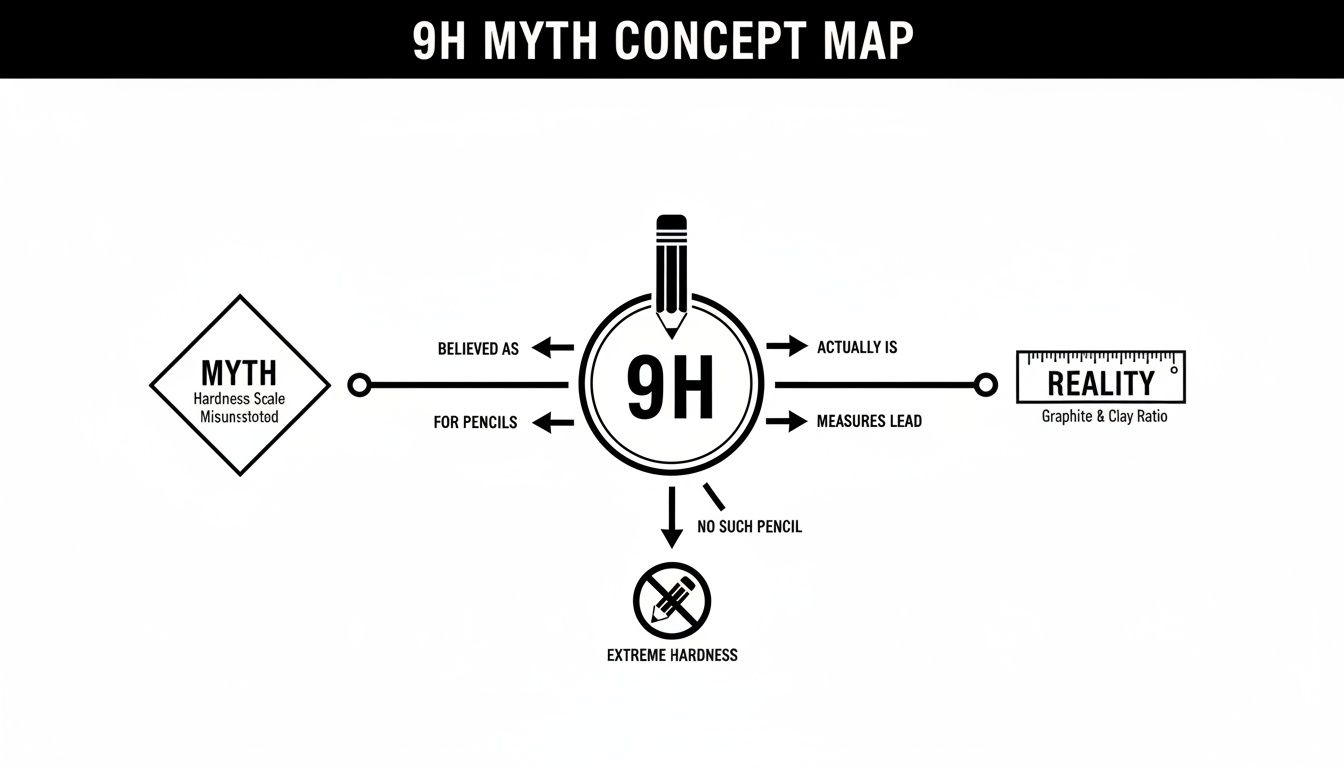
Here’s the biggest myth we need to bust: 9H has nothing to do with the Mohs scale of mineral hardness, where diamonds score a perfect 10. If that were the case, your car would be virtually indestructible.
The reality is far more mundane. The "9H" in ceramic coatings refers to the pencil hardness scale. It's a test where coatings are subjected to graphite pencils of varying hardness to see which one is hard enough to scratch the surface. A 9H rating simply means the coating can resist a scratch from the hardest pencil.
This distinction is everything. A 9H ceramic coating offers fantastic resistance to the light swirl marks and micro-scratches that dull your car's finish. It is not designed to stop a key from digging into your paint or prevent a rock chip on the highway.
This is where the real science of paint protection gets interesting. While hardness is a useful trait, it’s just one part of the equation. Think about it: glass is very hard, but it's also brittle. An overly rigid coating can develop micro-fractures when it flexes with your car's body panels during temperature changes or from simple road vibrations. This is a critical weakness in many conventional ceramic coatings.
As you start asking yourself if ceramic coatings are worth it, understanding these limitations is the first step. True, long-lasting protection isn't just about being hard—it's about being tough and flexible enough to handle the real world.
So, What Does 9H Hardness Actually Mean?
Let’s get straight to it. You see "9H Hardness" slapped on just about every ceramic coating bottle out there. It sounds impressive, right? It conjures up images of diamond-like armor that can deflect rocks on the highway. But the reality is a little more down-to-earth, and frankly, far more interesting.
That 9H rating comes from a very specific, standardized lab procedure called the Pencil Hardness Test (officially, ASTM D3363). Think of a set of sketching pencils, which range from soft and dark (9B) to incredibly hard and light (9H). In the test, these pencils are pressed against the cured coating at a precise angle and pressure.
If a coating earns a 9H rating, it means it was tough enough to resist being scratched by the hardest pencil in the set. That’s it. This is a fantastic measure of a coating's ability to stand up to the fine scratches and swirl marks that come from a bad car wash, but it’s not a gauge of its resistance to a key, a sharp rock, or a parking lot ding.
Pencils vs. Minerals: A Crucial Distinction
This is where a lot of the marketing hype gets a bit out of control. The pencil test is for coatings, not for classifying the raw hardness of minerals. For that, geologists use the Mohs scale, where talc is a 1 and a diamond is a perfect 10. A 9H pencil and a 9H coating are nowhere near a 9 on the Mohs scale.
Let's put this into perspective.
Pencil Hardness vs. Mohs Hardness: A Reality Check
This table cuts through the confusion, showing what 9H means in our world versus the world of geology.
| Hardness Scale | 9H Rating (Pencil) | Mohs Rating (Mineral) | Real-World Example |
|---|---|---|---|
| Relative Hardness | The hardest graphite pencil. | Equivalent to a low-to-mid-range mineral. | Quartz is a 7 on the Mohs scale and will scratch a 9H coating. |
| Scratch Resistance | Excellent against the micro-scratches and swirls from washing. | Measures resistance against other minerals. | A 9H coating resists automatic car wash brushes but not a deliberate key scratch. |
| Key Takeaway | A scientific measure of surface marring resistance. | A geological scale for mineral toughness. | Diamonds are a 10 on the Mohs scale; a 9H coating is not. |
The takeaway here is simple: a certified 9H ceramic coating is incredibly tough against the kind of daily wear that makes paint look old and tired. It's designed to protect the finish, not make your car bulletproof. To get a better feel for what these coatings are built for, you can learn more from our complete guide on what ceramic coatings are.
This image perfectly illustrates the common misunderstanding versus the scientific reality of the 9H pencil test.
At the end of the day, "9H" is a standardized benchmark for scratch resistance from a specific source (graphite), not a general claim of indestructibility.
The Problem with Chasing Pure Hardness
Here’s a story every seasoned detailer knows. A car comes in with a super-hard, super-rigid 9H coating that looked incredible when it was first applied. But after a few months of real-world driving—hot sun, cold rain, temperature swings—the coating is failing. Why?
Because extreme hardness often leads to brittleness. A coating that's as rigid as a sheet of glass can't cope with the natural expansion and contraction of the metal panels on your car. As the bodywork flexes, that inflexible coating develops micro-fractures, invisible to the naked eye but big enough to let water, dirt, and chemicals seep through to the paint.
This is the fundamental flaw in the industry's obsession with a single number. True, lasting protection isn’t just about lab-tested hardness. It’s about creating a tough and flexible shield that can actually survive on a vehicle out in the real world.
Why Flexibility Is the New Frontier in Paint Protection
For years, the paint protection world was obsessed with one thing: hardness. The conversation revolved almost entirely around the ceramic coating 9H rating, driving the idea that harder was always better. But while other brands were in a race to create the most rigid, glass-like shield possible, our team at Titan Coatings saw a huge flaw in that logic. We knew there had to be a better way, which led us to pioneer a new path.
It’s a flaw that becomes painfully obvious the second a car leaves a sterile lab and hits the real world. We were the first company to introduce Elastomer coatings to the market, leveraging nanotube technology and our proprietary Dark Matter Tech to redefine what durability means.
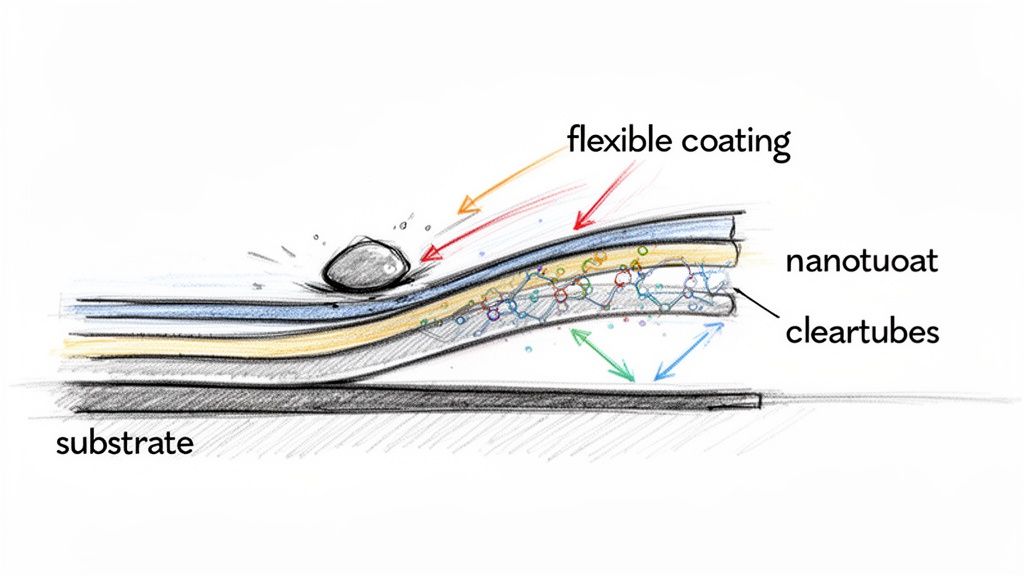
Think about the screen protector on your phone. The old-school glass ones are incredibly hard and resist scratches well. But what happens the first time you drop your phone? The screen protector shatters. It’s too rigid, too brittle. Now, compare that to a modern, flexible film protector. It might not feel as hard as glass, but it can absorb an impact and bounce right back.
That’s the exact principle we’ve applied to protecting your vehicle’s paint.
The Problem with a Brittle Shield
A traditional, ultra-rigid ceramic coating behaves just like that glass screen protector. When a coating is engineered only for hardness, it can’t handle the stresses a car goes through every single day.
- Thermal Expansion and Contraction: Your car's body panels are constantly expanding in the summer heat and shrinking in the winter cold. An inflexible coating can't move with the metal, which eventually leads to microscopic cracks. These tiny fractures compromise the entire protective layer, letting moisture and contaminants seep through to the paint.
- Minor Impacts: A bug hitting your bumper on the highway or a piece of gravel getting kicked up might seem small, but these impacts transfer a surprising amount of force. A rigid surface has no way to dissipate that energy, causing it to chip or develop spider-web cracks over time.
This realization completely changed our approach. We knew that true, long-lasting protection wasn't just about resisting a pencil scratch in a lab. It had to be about creating a shield that was both hard and resilient.
Titan's Elastomer Technology: The Best of Both Worlds
This is where Titan's elastomer technology is a genuine game-changer. Our elastic coatings are hard like glass, providing the unbelievable gloss, chemical resistance, and 9H scratch protection you expect. But they are also flexible, allowing them to stretch, absorb impacts, and return to their original shape without cracking.
This unique marriage of hardness and elasticity is what sets our technology apart. A coating like our Alpha Quartz won't crack under extreme temperature changes, from frozen winters to scorching summers. That elasticity also means it can better withstand impacts from bugs and road debris. It's this intelligent design that makes them last longer.
The market for high-performance ceramic coatings, valued at $7.84 billion in 2018, is projected to hit $12.63 billion by 2026, and that growth is fueled by demand for smarter, more advanced formulas. Reading the full industry analysis here makes it clear that consumers want real-world protection.
Our elastomer technology directly meets this need. It means that whether your car is baking in the Arizona sun or braving a frozen Canadian winter, the coating remains fully intact. It shrugs off constant thermal cycles and minor impacts that would compromise a lesser, more brittle coating. This isn't just an improvement; it's the evolution of paint protection. You can see exactly how our elastomer technology delivers this superior durability.
Achieving Crystal Clear Vision in Any Weather
Protecting your vehicle isn't just about the paint. We’ve all been there: you’re cruising down the highway, and suddenly, the sky opens up. That unexpected downpour turns your windshield into a blurry mess, and your wipers can't seem to keep up. It's a stressful, white-knuckle experience that Titan's Apex Glass Ceramic Coating was specifically engineered to prevent, making driving in the rain stress-free.
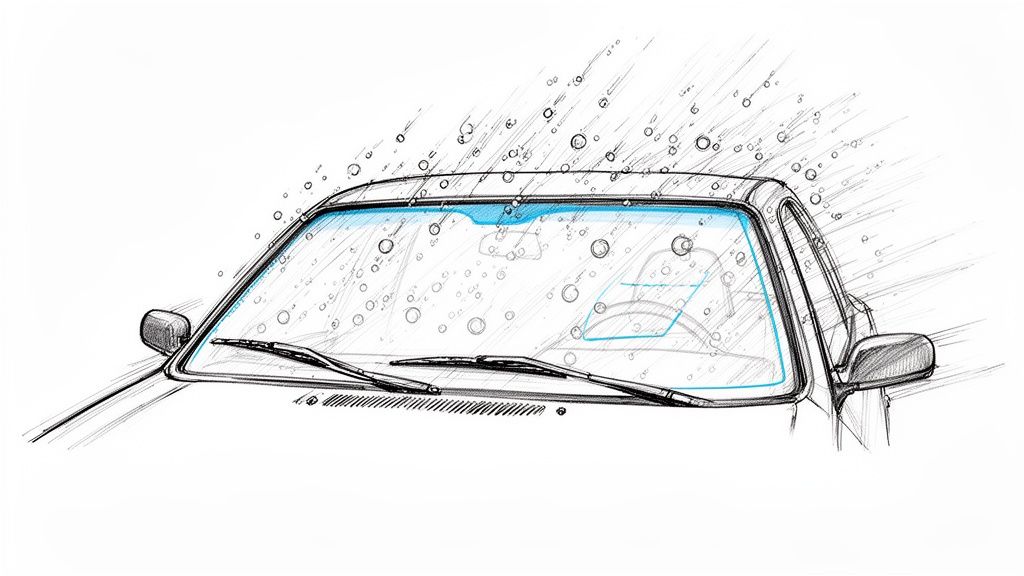
Forget basic glass cleaners. This is a dedicated ceramic coating 9h formula built just for glass. When applied, it forges a molecular bond with your windshield, creating a slick, intensely hydrophobic surface that fundamentally changes the way water behaves on contact. Instead of smearing and sheeting across your field of view, raindrops form into tight, perfect beads that have nowhere to stick.
Turning Rain into a Non-Issue
Here’s where the real magic happens. Once you hit speeds as low as 35 mph, the airflow over your car is enough to whisk those water beads right off the glass. The effect is almost unbelievable—your windshield stays so clear that you often won't even need your wipers. This is a massive improvement for visibility, cutting down on driver fatigue during storms and making every drive safer. Understanding the difference between hydrophilic and hydrophobic surfaces is key to appreciating how this technology works.
This focus on real-world performance is why the high-performance coatings market is booming. With the industry embracing 9H ceramic coatings, projections estimate the market will surge toward $15.42 billion by 2028. Much of that growth is coming from the automotive and aerospace sectors right here in North America, where coatings that deliver under pressure are a necessity, not a luxury. This gives detailers the power to offer clients proven, lasting protection that makes their vehicles genuinely better.
More Than Just Rain Repellency
The perks of a coated windshield go far beyond a rainy day. It also makes routine maintenance a breeze.
- Effortless Bug and Grime Removal: Bugs, sap, and road film can't get a good grip on the slick surface, meaning they wash away with minimal effort.
- Easier Ice and Frost Scraping: In the winter, ice forms on top of the coating, not directly on the glass. This makes scraping it off dramatically easier.
- Reduced Wiper Wear: You'll be using your wipers a whole lot less, which means the blades last longer and you save money on replacements.
By transforming your windshield from a passive component into an active part of your vehicle's safety system, Apex Glass Ceramic Coating provides a practical, tangible upgrade. Its very easy-to-use application makes it a quick investment with a profound impact on your daily drive.
For anyone wanting a coating that delivers measurable benefits beyond looks, protecting your glass is one of the smartest moves you can make. Find out more about how a dedicated windshield ceramic coating can completely change your view from the driver's seat.
Making Professional Protection Accessible to Everyone
Not long ago, getting top-tier paint protection meant booking an appointment at a professional detailing shop. That deep, liquid gloss and rock-solid shield were reserved for those with access to specialized tools and the know-how to use them. For most car lovers, it was simply out of reach.
But things have changed. Today, achieving professional-grade results right in your own garage isn't just a fantasy—it’s easier than you think. The old myth that a true ceramic coating had to be a nightmare to apply is dead. Modern chemistry now delivers serious, long-lasting protection without the professional price tag.
The Weekend Warrior's Secret Weapon
Picture this: It's Saturday morning. You just finished washing your car. Instead of dedicating the rest of your day to a grueling multi-step polish and wax, you reach for a single bottle. This is the new reality of paint protection, and it’s powered by products like Titan's Ultra Ceramic Spray.
Its "spray on, wipe off" application might sound too good to be true, but don't let the simplicity fool you. This isn’t some weak sealant that disappears after a couple of rainstorms. It’s a genuine ceramic spray that lays down a slick, durable barrier on your paint with great results.
- Intense Gloss: It amplifies your paint's depth and clarity, giving it that wet, just-detailed look.
- Durable Hydrophobicity: Water beads and flies off the surface, taking dirt and grime with it. This makes your next wash a whole lot faster.
- Meaningful Protection: You get a real layer of defense against the stuff that ruins paint, like UV rays, bird droppings, and road salt.
Democratizing Detailing Technology
This shift toward user-friendly ceramics is part of a much bigger trend. The market for thermal spray technology, a core process for applying high-performance coatings, grabbed over 50% market share back in 2020 and is on track to become an $8 billion industry by 2027. This explosion shows just how much people want durable, efficient protection. For more on this, check out these insights on ceramic coating market growth.
Our own Dark Matter Technology® was born from this same drive for innovation, using advanced polymers to give you real-world 9H durability in a bottle. We believe you shouldn’t need a business license to give your vehicle the best. With Ultra Ceramic Spray, you can maintain that flawless finish yourself, closing the gap between DIY passion and pro-level results.
To see how DIY options stack up against professional services, take a look at our guide on professional ceramic coating costs. Ultimately, our goal is to put the power of advanced ceramic coating 9h technology right where it belongs: in your hands.
So, Which Ceramic Coating Is Right for You?
Now that we’ve pulled back the curtain on what “ceramic coating 9h” really means—and why flexibility is just as important as hardness—you’re in a great position to make a smart choice. Finding the best coating has less to do with a single number on a label and everything to do with matching the right chemistry to your vehicle, your lifestyle, and what you hope to achieve.
Let’s figure out which Titan solution is your perfect match. The first thing to consider is how you like to work. Are you a hands-on enthusiast who finds satisfaction in the detailing process, or is your main goal getting incredible results as efficiently as possible?
For the Dedicated DIYer Seeking Ultimate Durability
If you're after professional-grade, long-lasting protection and you're not afraid to roll up your sleeves, then an elastomer-based coating is calling your name. You need something that provides that signature glass-like shell but has the built-in toughness to handle the real world without failing.
This is exactly where Titan's Alpha Quartz excels. As our premier elastomer coating, we engineered it for the enthusiast who refuses to compromise. Its specialized formula cures hard but remains flexible enough to absorb temperature shifts and minor impacts from things like road debris and bug splatters without micro-cracking. For those who put longevity and resilience first, this is the one. Its surprisingly straightforward installation has also made it a go-to for DIYers and mobile pros who need to deliver amazing, lasting results every time.
For the Driver Who Puts Safety and Clarity First
Let's be honest, sometimes the most critical layer of protection isn't on your paint at all. If you've ever tensed up driving through a torrential downpour, squinting through smearing wiper blades, you know that clear glass isn't just a convenience—it's a core safety feature. A dedicated glass coating is a game-changer for anyone who wants a practical upgrade that proves its worth every time the weather turns.
Titan's Apex Glass Ceramic Coating is the undisputed champion for this job. We formulated it to create an intensely hydrophobic barrier on your windshield. Rain doesn't just bead; it practically jumps off the glass at driving speeds. It’s a simple application that delivers a massive payoff in the form of safer, less stressful driving. If you want protection you can actually see working, start with your glass.
For the Enthusiast Who Values Efficiency
What if you want that deep gloss, amazing water beading, and real ceramic protection, but don't want to block off an entire weekend for the project? For a lot of us, time is the most precious commodity. You need a solution that delivers that jaw-dropping finish without a complicated, time-consuming process.
This is the exact reason we developed Titan's Ultra Ceramic Spray. It was born from the need to bridge the gap between pro-level performance and everyday convenience. With a simple "spray on, wipe off" application, you can protect your entire vehicle in minutes, not hours. The result is a brilliant shine and durable protection that leaves old-school waxes and sealants in the dust. It's the ultimate choice for maintaining a perfect finish with minimal effort.
At the end of the day, picking the right ceramic coating 9h product is about matching your needs to the right technology. Whether you're drawn to the flexible strength of Alpha Quartz, the clear-as-day safety of Apex Glass, or the effortless shine of Ultra Ceramic Spray, we've designed a solution to give your vehicle the exact protection it deserves.
Feel free to browse all our options over in the Titan Coatings shop.
Your Questions Answered: A Deep Dive into 9H Coatings
Let's be honest, the world of car care can be full of confusing terms, and "ceramic coating 9h" is right at the top of that list. To cut through the noise and give you the straight scoop, we've put together answers to the questions we hear most often from car lovers just like you.
So, is a 9H Ceramic Coating Really Scratch Proof?
No, and this is probably the single most important thing to get straight. Let's clear up the myth right now. The 9H rating is about one specific thing: resisting a scratch from the hardest type of graphite pencil under very controlled lab conditions.
What does that mean for your car? It means the coating is brilliant at fighting off the light swirl marks and micro-scratches that come from a bad car wash. But it’s not going to stop a key, a rock chip, or someone deliberately trying to damage your paint.
That’s where Titan’s flexible elastomer technology comes in. Our coatings are designed to absorb and scatter the energy from minor impacts, giving them a resilience that hard, brittle coatings just don't have. But it’s crucial to have realistic expectations—no coating on the market will turn your car into a tank.
What’s the Big Deal with Titan's Elastomer Coatings?
The secret sauce is flexible durability. Think of most traditional 9H ceramic coatings like a thin sheet of glass. They're hard, sure, but they're also incredibly rigid. When your car's body panels naturally expand and shrink with temperature changes, that rigidity can lead to tiny micro-cracks, which compromises the protection.
We took a different path. Titan’s elastomer technology gives our coatings a unique elasticity. A product like Alpha Quartz is hard like glass, but it can also flex and move with your vehicle's surface without breaking. This quality is why it lasts so much longer and keeps protecting your paint through brutal winters and blistering summers.
Can I Actually Apply a Top-Tier Ceramic Coating Myself?
You bet. While some brands lock their best products away for "professionals only," we believe every enthusiast deserves access to the good stuff. We’ve poured tons of R&D into creating products for the DIY community.
Our Ultra Ceramic Spray is a fantastic example. It delivers that signature gloss and amazing water-beading with a simple spray-and-wipe application.
If you're ready for something a bit more serious but still totally manageable, Alpha Quartz is designed for a hassle-free installation that gives you incredible, long-lasting results. It's great for DIYers and mobile detailers. We're all about empowering car lovers, so we provide crystal-clear instructions to help you get a pro-level finish right in your own garage.
How Can a Glass Coating Actually Make Driving Safer?
It all comes down to visibility. Our Apex Glass Ceramic Coating isn't just about making your windshield look clean; it dramatically improves how well you can see in bad weather.
The formula creates an incredibly slick surface that water just can't cling to. Rain doesn't smear across the glass—it instantly forms into tiny, perfect beads and gets whisked away by the wind as you drive, especially over 35 mph.
The result? You often don't even need to turn your wipers on. You get a clearer, less obstructed view of the road, which reduces eye strain and stress during a downpour. It effectively turns your windshield into an active safety feature.
At Titan Coatings, we believe in protection that means something in the real world, not just on a lab report. Our elastomer and glass coatings are built for durability and safety you can truly rely on. See what we mean by exploring our Apex Glass Ceramic Coating.
0 Comments