
Mark had the kind of black daily driver that looks flawless for about two hours after a wash. He tried wax, then synthetic sealants, then one of the early ceramic packages that promised a harder shell. Every time, the same pattern showed up. The shine was easy to love. The upkeep, the fragility, and the gap between promise and real use were not.
The Endless Quest for the Perfect Shine
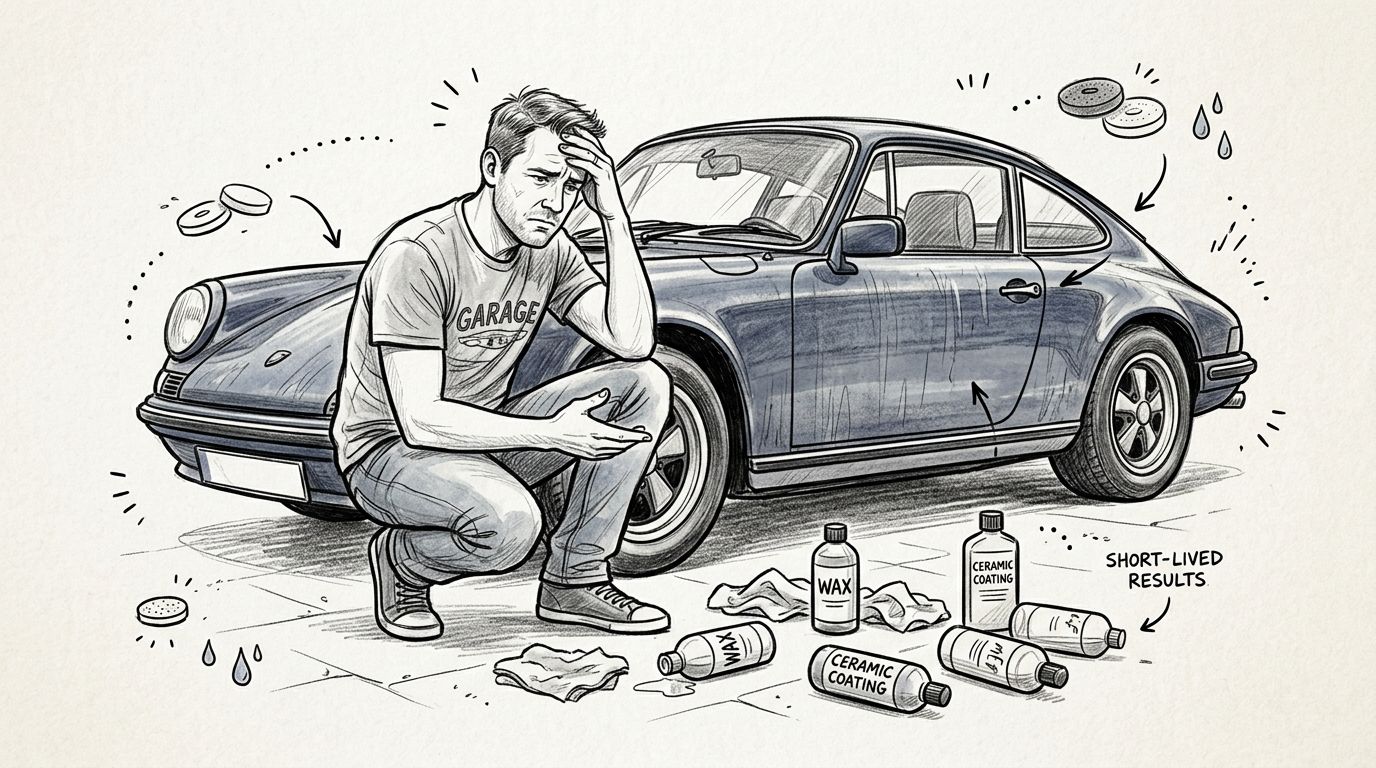
Most car owners don’t start by asking for a polymer coating for cars. They start with a problem. The hood gets dull in the sun. Bug residue sticks too long. Water no longer sheets cleanly. A coating that looked strong in the shop starts feeling less convincing after seasonal heat, winter cold, repeated washes, and daily road grime.
Mark’s experience is common because old protection categories always forced a compromise. Wax looked good but faded quickly. Early polymer products bought you more time, but not enough for many daily drivers. Rigid ceramic systems added serious surface protection, yet some users found them unforgiving. Prep had to be exact. Application had to be exact. Maintenance still mattered more than marketing suggested.
This problem didn’t begin in the detailing aisle
Modern polymer chemistry has been tied to automotive finishing for far longer than many enthusiasts realize. According to the American Coatings Association’s history of automotive coatings technology, thermoplastic acrylic resin technology dominated automotive topcoats for about two decades, from the 1950s through the 1970s, and by the 1960s General Motors was painting virtually every car with acrylic lacquer topcoats. That matters because polymer-based protection wasn’t born as a boutique add-on. It grew out of industrial-scale finishing systems that shaped how cars looked and held up.
That history also explains why this category keeps evolving. Once polymers became central to automotive appearance, the next challenge was performance under real use. Gloss was never enough on its own. Durability, chemical resistance, and surface feel all had to improve.
The coating that wins in a brochure isn’t always the coating that survives a neglected wash routine, a hot parking lot, and a freezing morning.
Where traditional protection still falls short
The weak point in many protection conversations is simple. People compare labels instead of behavior.
- Wax gives warmth and gloss. It can still make sense for hobbyists who enjoy frequent touch-ups.
- Polymer sealants raise the baseline. They usually offer a cleaner, sharper look and a more engineered barrier.
- Ceramic systems raise expectations. They bring stronger bonding and a more durable film, but they also demand discipline.
- Flexibility stays under-discussed. Yet temperature swings, impact stress, and repeated wash abrasion are exactly where coatings get exposed.
That’s where next-generation elastomer thinking enters the conversation. The goal isn’t just a harder surface. The goal is a surface that keeps performing when the car stops living in ideal conditions.
Understanding the Science of Polymer Coatings
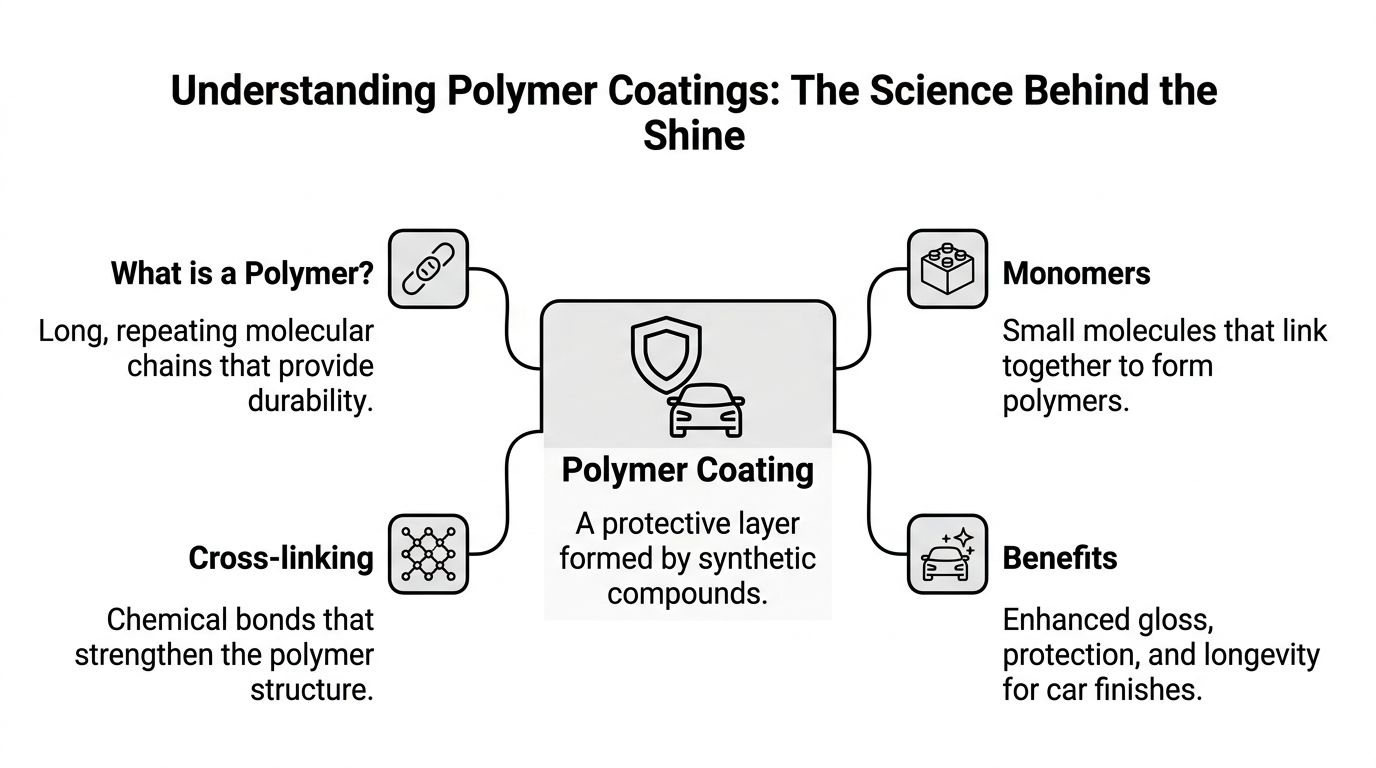
A polymer coating for cars is a film built from synthetic molecular chains. Those chains link together on the paint and form a barrier that changes how the surface handles water, grime, chemical exposure, and light abrasion. If you strip away the marketing language, that’s the practical purpose. Build a more stable outer layer than bare clear coat gives you on its own.
Older sealants versus bonded coatings
A useful way to think about the category is this. A traditional polymer sealant behaves like a fitted raincoat. It covers the surface, sheds contamination better than naked paint, and improves gloss. A more advanced bonded coating behaves more like a treatment integrated into the outer layer itself. It doesn’t just sit there loosely. It anchors more tightly and changes how the surface behaves over time.
A review in PMC describes polymer sealants as long-chain synthetic polymers that crosslink on painted surfaces to form a protective film with hydrophobic behavior, contaminant resistance, and the ability to mask fine scratches and swirl marks. The same review notes a typical service life of 4 to 6 months for polymer sealants, which helps explain why they remain useful for quick-turn detailing and seasonal refresh work rather than long-term set-and-forget protection in demanding use cases. See the PMC review on polymer sealants and coating behavior.
Why this category keeps growing
The market has grown because car owners increasingly want protection that lasts longer than a wax cycle and does more than add gloss. According to 24 Chemical Research’s ceramic car coating market report, the global ceramic car coating market was valued at USD 6.82 billion in 2024 and is projected to reach USD 11.45 billion by 2032, with a 6.7% CAGR. Ceramic coatings are advanced liquid polymer solutions that chemically bond to factory paint, and that demand reflects how mainstream long-term paint protection has become.
For a deeper primer on the category itself, Titan’s overview of what polymer coating means in automotive protection is a helpful place to start.
Practical rule: If a product sounds easy, cheap, permanent, and maintenance-free all at once, the description is doing more work than the chemistry.
The science that matters in the driveway
Most owners don’t need a chemistry lecture. They need to know what changes after application.
- Water behavior changes first. The surface beads or sheets differently, so washing gets easier.
- Contaminants release faster. Dirt, bug residue, and road film don’t cling as stubbornly.
- The finish looks sharper. A smoother film alters the way light reflects off the surface.
- Maintenance becomes more forgiving. Not maintenance-free. Just less punishing.
That last point matters most. A good coating doesn’t eliminate care. It gives the paint a more resilient working surface.
The Titan Coatings Revolution Elastomer Technology
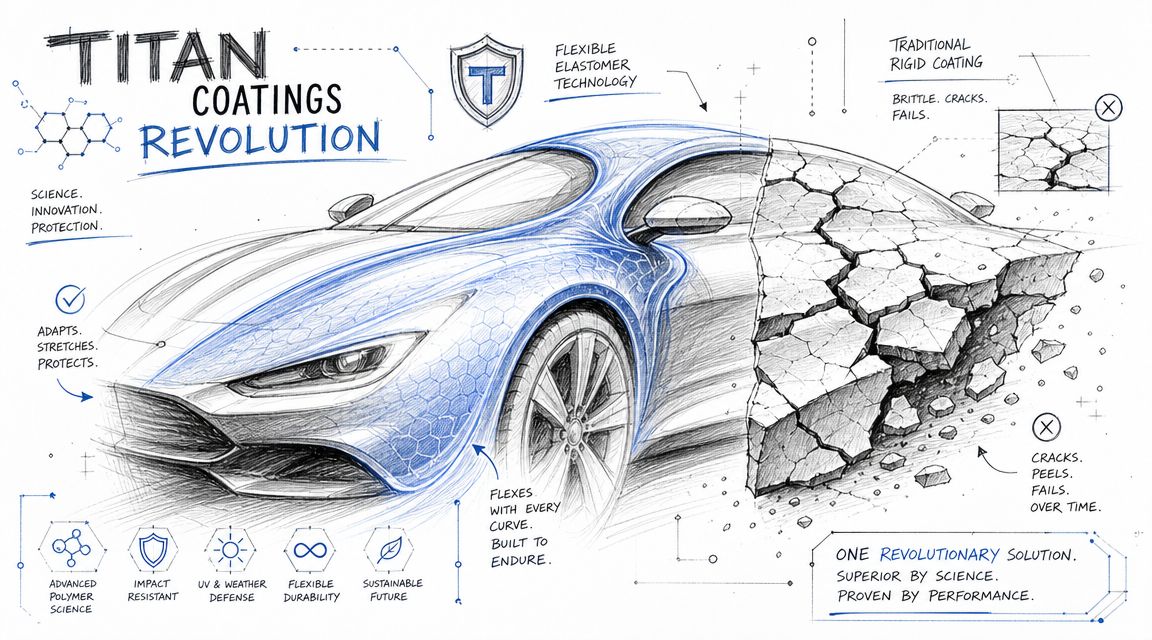
The biggest limitation in rigid coating systems isn’t hardness. It’s what happens when hardness has no give.
A coated panel expands in heat, contracts in cold, gets hit with bug strikes, sees wash contact, and lives through constant vibration. A coating that treats every stress event like a static lab panel is already behind. That’s why elastomer coatings matter. They push the category forward by addressing something detailers see all the time but many product pages barely mention. Flex matters almost as much as hardness.
Hard like glass, flexible under stress
The easiest analogy is glass. Standard glass is hard. It’s also vulnerable when stress concentrates in one spot. Tempered safety glass manages force differently. It remains hard, but it’s built for a more demanding environment.
Elastomer coating design follows that same logic. Titan developed this approach around elastomer behavior, nano tubes technology, and Dark Matter Technology® to create a film that aims to stay hard on the surface while remaining flexible enough to handle movement and stress more intelligently than a brittle layer. That matters in climates where the vehicle can see freezing conditions and then intense heat, or in everyday driving where bug impact and minor surface stress are unavoidable.
If you want a general technical read on why elastomer sealing products behave differently under stress, Polymerize’s guide to elastomers gives useful background.
Why flexibility changes the durability conversation
A rigid coating can still be excellent in the right hands and the right environment. But not every vehicle lives a pampered life. Daily drivers, mobile clients, outdoor-kept vehicles, and work fleets all expose coatings to repeated mechanical and environmental stress.
That changes the decision framework:
- Temperature cycling matters because coatings don’t live at one stable temperature.
- Impact tolerance matters because front ends and mirrors get hit by debris and insects.
- Installer margin matters because mobile work isn’t always done inside ideal bays.
- Surface movement matters because panels flex, especially on vehicles used every day.
Titan’s elastomer system is built around that practical reality, not just a hardness claim. The concept is straightforward. Protection shouldn’t become vulnerable the moment the environment stops being controlled.
A closer look at Titan’s own elastomer coating platform helps explain how the company positions this technology for real-world automotive use.
A coating can be chemically advanced and still fail the driveway test if it can’t tolerate stress.
Where this approach fits
Elastomer technology isn’t trying to erase every other coating class. It solves a specific problem. It gives owners and installers another option when they want the slickness, gloss, and protective behavior associated with advanced coatings, but don’t want all performance to depend on a rigid shell staying perfect under changing conditions.
That’s the practical appeal. Not theory. A harder surface that can also move.
Polymer vs Ceramic and Wax A Clear Comparison
The easiest way to understand a polymer coating for cars is to compare what each protection type asks from the user and what it gives back.
Traditional wax still has a place. It looks good, it’s familiar, and many enthusiasts enjoy applying it. Polymer sealants give a more engineered barrier and, as noted earlier, typically deliver 4 to 6 months of service life. At the other end, a technical article from Optimum Car Care explains that ceramic coatings chemically bond to the clear coat rather than sitting on top, and cites a professional SiC-based coating applied in four layers totaling 12 microns with 10+ years of durability under proper conditions. Read the technical discussion on ceramic bonding, film build, and durability.
For readers comparing categories at a high level, Titan also has a useful page on the difference between wax and ceramic coating.
Coating type comparison
| Attribute | Carnauba Wax | Polymer Sealant | Ceramic Coating | Titan Elastomer Coating |
|---|---|---|---|---|
| Protective mechanism | Surface layer | Crosslinked synthetic film | Chemical bond to clear coat | Flexible protective film designed to combine hardness with elasticity |
| Typical use case | Show-car gloss, frequent reapplication | Seasonal protection, maintenance-friendly use | Long-term protection with strict prep and curing | Real-world durability where movement and temperature swings matter |
| Durability profile | Short-lived | 4 to 6 months | Can reach 10+ years in high-end systems under proper application | Built qualitatively around durability plus flexibility |
| Surface feel and gloss | Warm, rich appearance | Slick, bright finish | Crisp, glass-like appearance | Gloss and slickness with added stress tolerance |
| Flexibility | High, but soft | Moderate | Lower than elastomer-style systems | High relative flexibility by design |
| Resistance to wash wear | Limited | Better than wax | Strong when properly installed | Aims to resist wear without relying on a brittle shell |
| Application difficulty | Easy | Moderate | Higher, prep-sensitive | More forgiving than many rigid systems, depending on product |
| Best buyer profile | Hobbyist who enjoys frequent detailing | Driver who wants easy repeatable protection | Owner seeking long-term bonding and will follow strict process | Driver or detailer prioritizing performance in changing conditions |
The trade-offs that actually matter
People often ask which one is best. That’s usually the wrong question.
Ask these instead:
- How much prep will you tolerate
- How often will you maintain the finish
- Does the car live outdoors
- Do you need forgiveness in changing weather
- Are you chasing gloss, longevity, or all-around usability
Ceramic coatings win on long-term bonded protection when the prep, install environment, and maintenance all line up. Sealants remain practical because they’re fast and repeatable. Wax still earns its place for enthusiasts who like the ritual.
Elastomer coatings are most compelling when the owner wants advanced protection without pretending the car will live in perfect conditions.
Putting Titan Coatings to the Test
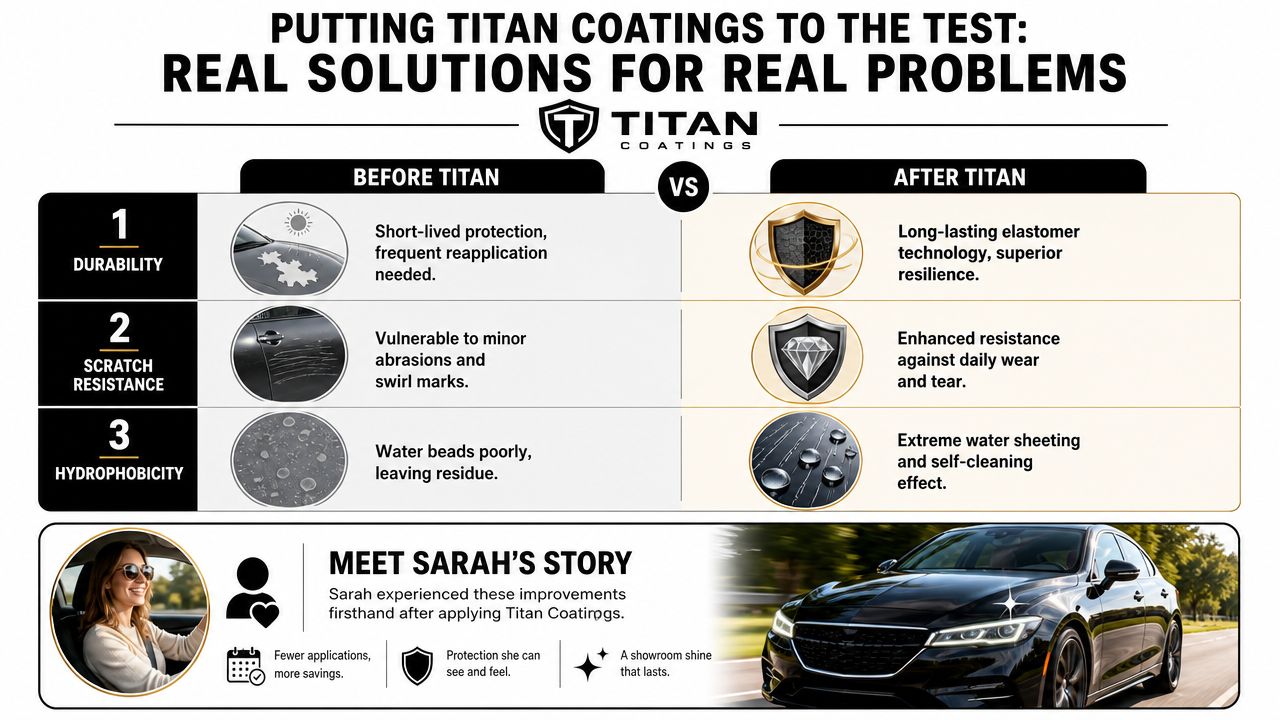
A coating only proves itself when it solves a specific job for a specific user. That’s where product choice matters. Not every owner needs the same install style, and not every detailer works in the same environment.
Sarah and the mobile detailer problem
Sarah runs a mobile detailing setup. Her challenge isn’t just getting a finish to look good. It’s getting repeatable results when conditions aren’t as controlled as a fixed shop. Wind changes. Panel temperature changes. Client expectations don’t.
For that kind of work, Alpha Quartz fits the conversation because it’s positioned as an elastomer coating that is easy to install and practical for DIY users and mobile detailers. The value isn’t hype. It’s usability. A product like this matters when you need a coating that lays down cleanly, gives strong visual payoff, and isn’t overly fragile in everyday field use.
Mobile detailers don’t need theory-heavy products. They need products with enough working forgiveness to deliver consistent outcomes on real schedules.
That practical side of coating work is why process education matters as much as chemistry. Titan’s coating excellence resources are relevant here because they focus on how coating performance is tied to application discipline, not just bottle claims.
Tom and the enthusiast who wants easy upkeep
Tom already has a protected vehicle. His problem is maintenance. He wants to keep slickness high, washing easy, and the finish lively without turning every weekend into a full correction session.
That use case points to ULTRA Ceramic Spray. Spray-format maintenance products work well when the owner wants a fast topper that refreshes water behavior and helps keep the surface feeling freshly protected. They don’t replace full prep and base-layer work, but they can support it. For enthusiasts, that’s often the difference between a coating that keeps performing and one that slowly feels neglected.
A good spray product earns its place when it does three things well:
- It applies quickly so upkeep is readily performed.
- It restores surface behavior after washing and exposure.
- It supports existing protection instead of fighting it.
Maria and the windshield problem people overlook
Maria’s issue isn’t paint gloss. It’s rain.
A lot of owners spend heavily on paint protection and ignore the glass, even though the windshield is the surface they interact with most directly when the weather turns ugly. That’s why Apex Glass Coating is one of the more practical products in this discussion. A well-designed glass coating enhances hydrophobic behavior on the windshield and side glass, which can improve visibility in wet conditions and make the car easier to keep clean.
For daily drivers, that’s not a vanity upgrade. It’s comfort and reduced stress behind the wheel. Titan’s Apex Glass Coating product page is worth reviewing if glass protection is part of the plan.
Matching the product to the job
A lot of disappointment in coatings comes from mismatch, not bad chemistry.
- Choose Alpha Quartz when flexibility and easier install matter.
- Choose a spray maintenance product when the base layer needs support between major details.
- Choose a dedicated glass coating when visibility in rain is a real pain point.
Used that way, the coating system works like a system. Not like a single miracle bottle.
How to Apply and Maintain Your Polymer Coating
A polymer coating for cars starts succeeding before the bottle opens. Surface prep decides whether the film bonds cleanly or struggles from day one. If oils, embedded contamination, or old residue remain on the panel, the coating has to fight the surface instead of locking into it.
That means the basics still matter. Wash thoroughly. Decontaminate chemically if needed. Clay when the surface calls for it. Correct paint defects if the owner expects a refined finish under the coating. Then wipe the panel so it is clean and bare enough to accept the product properly. Titan’s guide to coating surface preparation aligns with that principle.
Application discipline beats speed
Most coating failures aren’t dramatic. They show up as uneven behavior, weak longevity, smearing, or disappointing gloss retention. The usual cause is rushed prep or rushed leveling.
A simple working sequence helps:
- Stabilize the surface. Apply to cool, clean panels whenever possible.
- Work small sections. That gives you better control over flash and wipe-off.
- Level thoroughly. Remove residue before it hardens where it shouldn’t.
- Respect cure time. Early exposure can compromise the film before it settles.
Maintenance is where durability gets earned
One of the most useful truths in this category is also the least glamorous. Durability claims vary widely in real life because climate, wash frequency, and UV exposure change the result. Neutral detailing sources also note that polymer sealant performance drops faster in harsh weather and frequent washing environments, which is why maintenance is essential rather than optional. The discussion in this durability-by-use-case detailing video is useful because it frames longevity around conditions, not just label promises.
Wash habits decide whether a coating keeps acting like a coating.
A few maintenance habits make the difference:
- Use pH-neutral wash products so you clean the surface without beating up the protection.
- Avoid harsh automatic brushes if preserving the finish is the goal.
- Top up protection when needed instead of waiting for obvious failure.
- Adjust your expectations by climate because outdoor cars live a harder life.
If you work on larger vehicles, especially RVs with different panel sizes and exposure patterns, a specialized motorhome body shop can also be a useful reference point for how professionals approach surface repair and finish preservation on demanding exteriors.
Is an Elastomer Polymer Coating Right for Your Car?
If you’ve used wax and got tired of short cycles, you’re already asking the right question. If you’ve looked at ceramic coatings and liked the idea but worried about brittleness, prep sensitivity, or how they behave in harsh conditions, you’re asking an even better one.
Elastomer coatings make sense for owners who want protection that doesn’t treat the car like a static object. They fit vehicles that see heat, cold, repeated washing, bug impact, and long hours outside. They also fit detailers who need a coating system that works in practical conditions, not only in perfect shop conditions.
Ask yourself a few direct questions:
- Does your car live through major temperature swings
- Do you want a hard protective surface with more give under stress
- Do you need an option that feels more forgiving in day-to-day use
- Do you care as much about usability as maximum headline durability
If the answer is yes, elastomer technology deserves a serious look. It’s not a replacement for good prep or good maintenance. Nothing is. But it does address a weakness that many owners have felt for years and couldn’t always name clearly. A hard coating can protect. A hard coating with flexibility can keep protecting when the environment gets difficult.
If you’re comparing practical coating options for paint, glass, trim, wheels, or maintenance products, explore APEX NANO – Titan Coatings and match the product to the way your vehicle is used.
0 Comments