
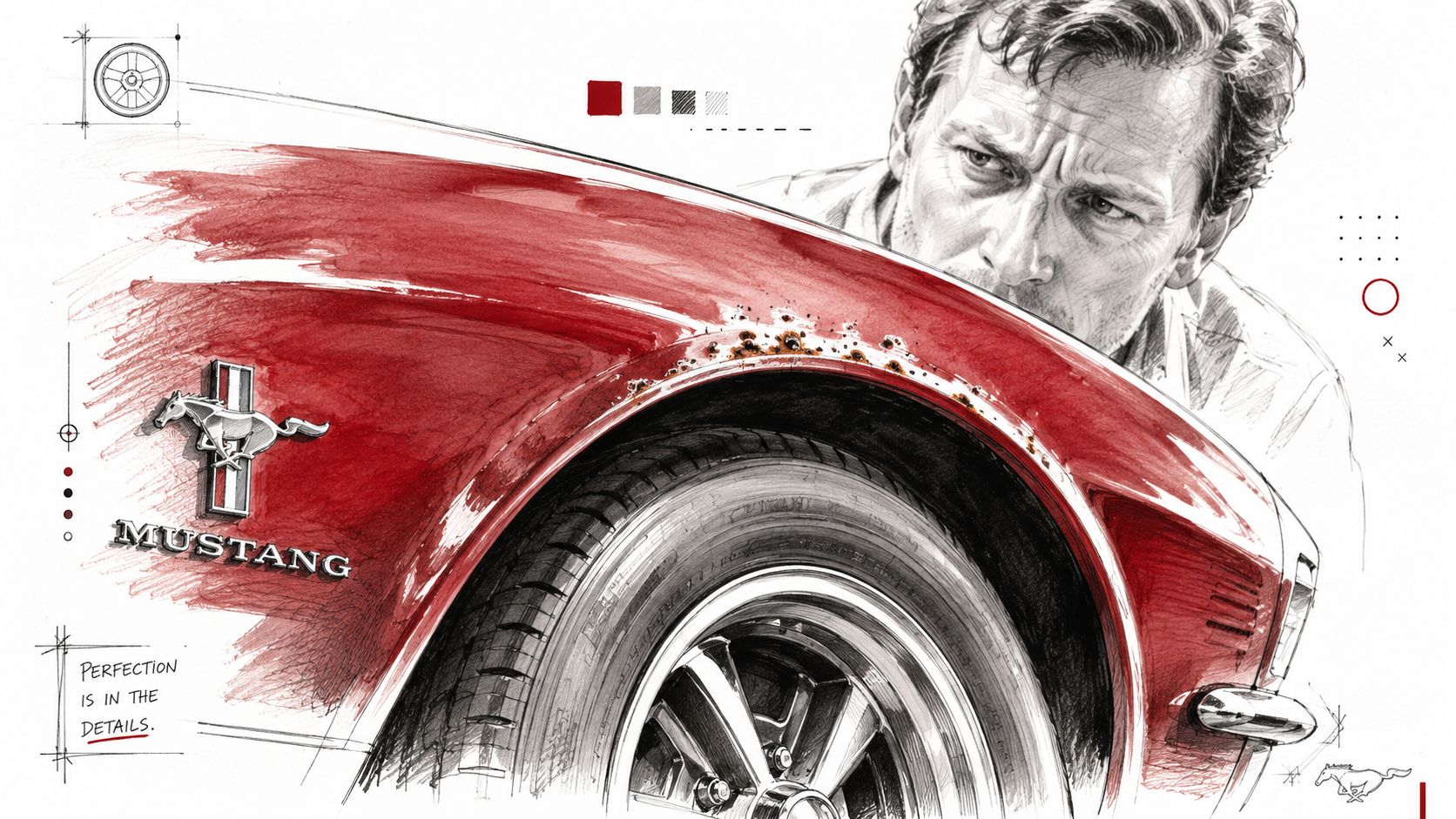
Mark bought the car he’d wanted for years, a classic Mustang with clean lines, fresh paint, and wheel arches that looked perfect under shop lights. One winter later, tiny rust freckles started blooming around the edges, not because he neglected the car, but because the coating on it looked hard and glossy while failing where real life is brutal.
The Unseen Battle on Your Car’s Surface
Rust never starts with drama. It starts with a chip, trapped moisture, road salt, and one weak point at an edge or seam.
That’s why corrosion catches owners off guard. The paint still shines. The panels still feel smooth. Then one day you spot bubbling near a wheel well, a door edge, or the lower rocker, and by then the chemistry has already been working underneath the surface.
Why corrosion is never just cosmetic
A lot of car owners still treat corrosion like a detailing issue. It isn’t. It’s a materials failure issue.
Steel, aluminum, fasteners, trim hardware, and exposed underbody parts all live in a hostile environment. Water, oxygen, salts, traffic film, acidic contaminants, and repeated temperature swings keep attacking the surface. If your protective layer is brittle, thin, poorly bonded, or compromised at the edge, corrosion gets a foothold.
The scale of the problem is massive. The global anti-corrosion coating market was valued at USD 34.8 billion in 2022 and is projected to reach USD 43.3 billion by 2028, according to MarketsandMarkets research on anti-corrosion coating growth. That’s not niche demand. That’s industry, transportation, marine, defense, and vehicle owners all paying to stop the same enemy.
What detailers should take from that
If a market reaches that scale, one thing is obvious. Corrosion resistant coating isn’t a vanity add-on. It’s part of asset preservation.
For a skilled detailer, that changes the conversation with clients. You’re not selling shine. You’re helping them interrupt a chemical process that destroys value, shortens service life, and creates repair work that gets expensive fast.
Corrosion always starts smaller than the invoice that follows.
If you want the practical side of rust prevention before it becomes body-shop work, Titan’s guide on how to protect a car from rust is worth reading. It connects the everyday owner’s problem to the essential protection choices.
How Coatings Fight Back Against Corrosion
A proper coating system does one job. It keeps the environment away from the metal long enough, and intelligently enough, to slow the electrochemical attack underneath.
That sounds abstract, but it’s easy to understand once you stop thinking about coatings as “one liquid in a bottle” and start thinking about them as layered armor.
The three protection modes that matter
AMPP identifies barrier, inhibitive, and sacrificial protection as the core mechanisms in protective coatings, and effective systems usually use a multi-layer architecture with a primer followed by a tougher topcoat, as outlined in AMPP’s guidance on protective coatings for corrosion control.
Here’s what that means in practice:
- Barrier protection blocks water, oxygen, salts, and grime. Consider it a raincoat wrapped tightly around the panel.
- Inhibitive protection interferes with the corrosion reaction at the metal surface. It doesn’t just cover the problem. It calms the reaction down.
- Sacrificial protection gives up part of the coating system to protect the metal below. Zinc-rich primers are the classic example. The bodyguard takes the hit first.
Why one layer is rarely enough
A single glossy top layer can look impressive and still fail early. If the lower layer doesn’t bond well, or the stack lacks the right chemistry, moisture migrates in from edges, chips, and microscopic defects.
That’s why serious systems are built in sequence:
- Surface prep first so the substrate is clean and chemically ready.
- Primer next to anchor, inhibit, or provide sacrificial protection.
- Topcoat last to resist weather, abrasion, UV, and contamination.
If you work on metal components or want another automotive perspective on durable finishing systems, this piece on JB Powder Coating for automotive protection gives useful context on why coating architecture matters beyond simple appearance.
Practical rule: If a product only talks about gloss and hydrophobics, ask what it’s doing at the substrate level.
Bond strength matters just as much as product chemistry. Titan breaks that part down well in its article on coating adhesion. Detailers who understand adhesion make better install decisions, and they get fewer callbacks.
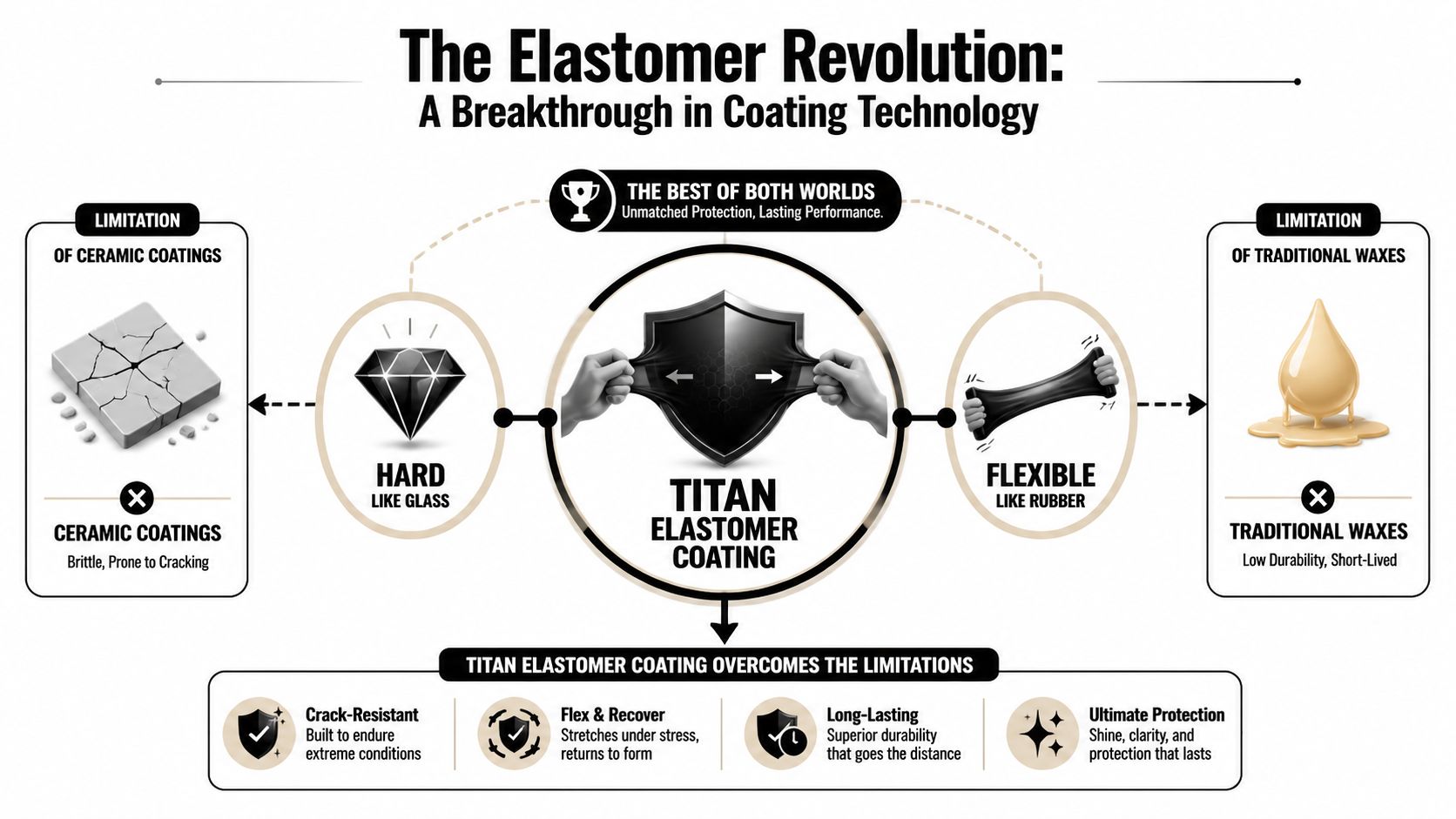
The Elastomer Revolution Hard Like Glass Flexible Like Rubber
The old tradeoff was frustrating. You could choose a coating that felt hard but behaved like thin glass under stress, or you could choose something softer that moved with the panel but didn’t hold up for long.
That tradeoff is outdated.
The real-world failure most brands avoid discussing
A lot of coatings look strong in static testing. Then winter mornings, engine heat, sun load, cold rain, and road impact expose the weakness. Independent studies show that many nanocomposite coatings lose up to 40% of their integrity after 500 hours of rapid thermal cycling from -20°C to 80°C. That’s the thermal-cycling reality gap. It exposes how coatings without flexibility can degrade when the surface keeps expanding and contracting.
A brittle film under that stress behaves like a dry cracker bent back and forth. It may not split all at once. It starts with micro-cracks, edge weakness, and invisible fracture paths. That’s where moisture wins.
Why elastomer chemistry changes the game
Titan’s position in the market is clear. Elastomer coatings are the next logical step because a vehicle surface doesn’t live in a laboratory. It flexes, vibrates, heats up, cools down, gets peppered by grit, and takes repeated impact from bug strikes and wash cycles.
A rigid coating handles some of that. A flexible coating handles more of it. A coating that combines hardness with flexibility is where the science gets interesting.
Think about a sheet of ordinary glass and a sheet of polycarbonate. Both can look smooth and solid. One resists deformation poorly and fractures when overloaded. The other absorbs movement and impact without giving the damage an easy crack path. That’s the difference detailers should care about.
Titan’s elastomer approach, built around its nano tube and Dark Matter technology language, is designed around that exact problem. The value isn’t a flashy phrase. The value is that flexibility reduces crack initiation under thermal stress, and that directly matters in corrosion control because corrosion often starts where the protective film breaks first.
- Hardness matters because the surface still has to resist wash wear, contamination, and day-to-day abrasion.
- Elasticity matters more than most brands admit because coatings that can move with the panel are less likely to craze or crack during rapid temperature swings.
- Impact resilience matters because bug strikes, road debris, and routine contact loads aren’t hypothetical.
If you want to understand how Titan frames advanced surface protection in a broader formulation context, their page on eco-friendly coating systems adds useful background.
A coating that survives the test panel but fails on a cold morning commute isn’t advanced. It’s incomplete.
A Practical Comparison of Modern Coating Technologies
Most buyers don’t need more hype. They need a clean comparison.
Different coating chemistries solve different problems, and every one of them gives something up. That’s why the smartest choice depends on whether you care more about hardness, flexibility, UV stability, install simplicity, or resistance to weather and chemicals.
Coating Technology Comparison
| Coating Type | Hardness | Flexibility / Impact Resistance | UV Resistance | Best For |
|---|---|---|---|---|
| Polymer sealant | Low to moderate | Good | Good | Quick gloss and short-term maintenance |
| Traditional ceramic coating | High | Low to moderate | Good | Hard surface feel and contamination resistance |
| Epoxy coating | High toughness | Low | Limited without topcoat | Primers and chemically resistant base layers |
| Polyurethane coating | Moderate to high | Better than epoxy | Strong | Exterior durability and topcoat use |
| Elastomer-based coating | High surface durability | High | Strong | Vehicles exposed to thermal swings and regular real-world stress |
The trade-offs that actually matter
Traditional sealants are easy to use. That’s their strength. They wipe on fast, refresh gloss, and give casual owners a simple entry point. But they don’t behave like long-term armor.
Traditional ceramic coatings give that crisp, hard-shell feel detailers like. The downside is brittleness. If the chemistry leans too far into hardness without enough flexibility, the coating can become vulnerable where the panel moves, the temperature swings fast, or impact stress accumulates.
Epoxies are excellent workers in a full system. They bond well and resist chemicals, which is why they’re common in primers. But as exposed automotive top layers, they usually need help with UV durability.
Polyurethanes are balanced. They’re tougher outdoors and often make sense as a topcoat chemistry. That’s why many industrial systems rely on them.
Titan’s elastomer line fits in a different category. It’s less useful to compare it as “just another ceramic” and more useful to view it as a hybrid answer to an old problem. Products like Alpha Quartz aim to combine the hard, clean feel clients want with the movement tolerance that older brittle systems struggle to deliver. If you’re weighing broader protection strategies, Titan’s article on paint protection film vs ceramic coating helps frame where each approach belongs.
Choosing Your Armor A Detailer’s Product Guide
The right product depends on who’s applying it and what the car deals with every week. That’s where most coating advice falls apart. It talks chemistry but ignores the installer.
For the mobile detailer who needs forgiveness
Mike is working out of a van. He doesn’t always have controlled indoor conditions. He needs a product that gives him enough working time to level properly and enough flexibility to survive what client cars see on the road.
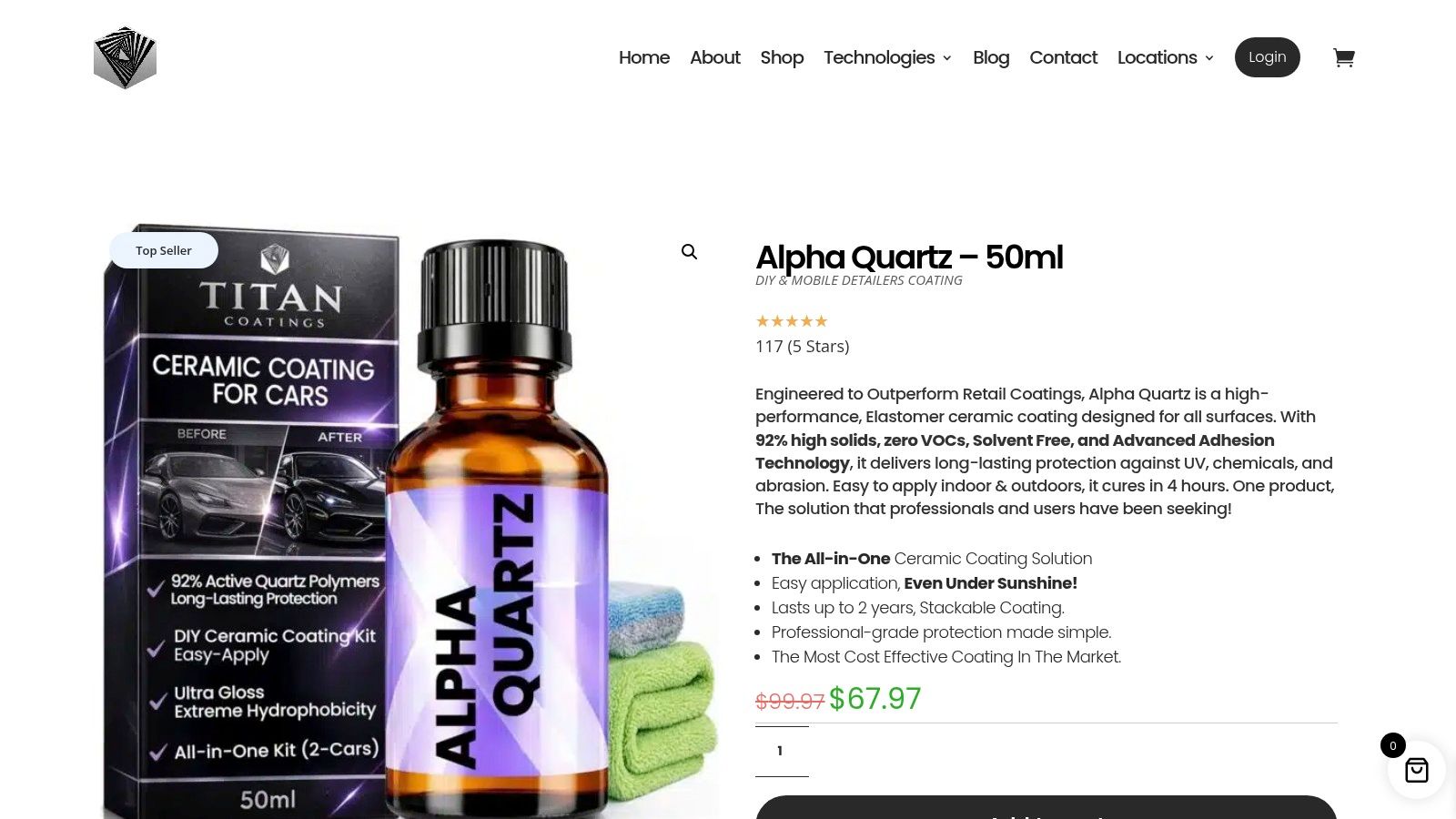
That’s where Alpha Quartz fits well in Titan’s range. It’s positioned for easy installation and makes sense for DIY users and mobile detailers who want a user-friendly coating instead of a temperamental one. The key point isn’t a dramatic label. It’s that an elastomeric matrix makes more sense than a brittle shell when the car will see hot panels, cold nights, bug impact, and repeated washing.
For the commuter who hates driving in the rain
Sarah doesn’t care about coating jargon. She cares about visibility and stress reduction.
For that use case, Apex Glass Coating is the obvious recommendation. It’s easy to use and focused on the surface drivers notice immediately: the windshield. When water beads and clears more effectively, the drive feels calmer and the glass is easier to maintain. That’s a practical win, not a showroom gimmick.
For the owner who wants quick protection without complexity
Then there’s the DIY crowd. They want better protection, deeper gloss, and easier maintenance, but they don’t want a long install day.
Ultra Ceramic Spray fits that need. Spray-on formats are accessible, fast to refresh, and useful for maintaining coated vehicles between larger correction and coating jobs. They also work well for detailers adding a practical upsell without turning a maintenance visit into a multi-stage project.
A simple way to choose:
- Pick Alpha Quartz if you want a more durable installed layer with the flexibility advantage Titan emphasizes.
- Pick Apex Glass Coating if visibility in wet weather is your pain point.
- Pick Ultra Ceramic Spray if your priority is easy upkeep and quick protection.
If you want to browse the full lineup directly, Titan’s coating product shop is the cleanest place to compare options.
The Art of Application Achieving a Flawless Finish
Even the most advanced corrosion resistant coating will fail on a contaminated surface. Coatings don’t bond to dirt, traffic film, polishing oils, mineral residue, or embedded iron. They bond to clean substrate.
That’s why prep decides the result.
Build the surface before you build the coating
The prep sequence should be disciplined, not rushed:
- Wash thoroughly to remove loose contamination.
- Decontaminate chemically with iron remover or similar chemistry where needed.
- Decontaminate mechanically with clay if the surface still feels rough.
- Polish as needed to level defects and create a clean, uniform finish.
- Panel wipe properly so you’re not trapping oils under the coating.
For detailers who want the deeper prep science, Titan’s guide on coating surface preparation is useful because it connects cleanliness to actual coating behavior instead of treating prep like a ritual.
Film build is not a minor detail
For high-performance applications, coating thickness matters. Keronite notes that 20 μm is often recommended as a minimum for outdoor conditions, while professional-grade powder coatings can be 80 μm and above, as discussed in Keronite’s comparison of corrosion-resistant metal coatings. Automotive surface products aren’t identical to industrial powder systems, but the lesson carries over. Protection depends on forming a real, continuous film.
If the layer is inconsistent, too thin, or unevenly leveled, weak spots appear first at edges, curves, and high-stress zones.
Thin spots don’t announce themselves during install. They announce themselves months later.
Application habits that separate good from sloppy
Use a cross-hatch pattern. That gives more uniform coverage than random wiping.
Watch the flash. Don’t rush the buff and don’t leave excess sitting so long that removal becomes a fight.
For maintenance, keep it simple:
- Use pH-appropriate wash products so you’re not stripping or stressing the surface unnecessarily.
- Wash with discipline using clean media and sensible technique.
- Use a maintenance topper when appropriate to keep hydrophobic behavior and slickness from falling off between major details.
A well-applied coating isn’t just glossy. It’s even, bonded, and stable.
Your Questions on Advanced Coatings Answered
A lot of coating confusion comes from marketing language. Let’s clean that up.
Is self-healing real
Sometimes. Often, no.
Many “self-healing” claims are based on passive thermoplastic flow, which may help minor marks relax visually but cannot repair deep scratches. True regenerative coatings rely on a different mechanism, often involving redox-driven film re-formation. That’s a critical regeneration mechanism gap, and it matters because buyers often lump all self-healing claims into one bucket when they’re not the same thing.

Do ISO and ASTM certifications guarantee real-world durability
No. They matter, but they’re a baseline.
Certifications tell you a product or process has been tested to a standard. They do not automatically tell you how a coating will behave through repeated thermal shock, bug impact, outdoor exposure, or poor wash habits. Real-world durability comes from chemistry, flexibility, adhesion, and application quality working together.
Can you stack a coating like Alpha Quartz
Yes, if the product system and timing allow it.
Layering can help build a more complete protective film and improve uniformity. The key is compatibility and proper install windows. More isn’t always better if the surface isn’t prepared or the previous layer isn’t ready.
How is an elastomer coating different from wax or sealant
Wax sits on the surface and fades relatively quickly. Sealants improve on that but still behave more like temporary protection.
An elastomer-based coating is designed to create a more durable bonded layer with better resistance to environmental stress. The big difference isn’t just longevity. It’s the combination of hardness and movement tolerance. That’s why it makes more sense for drivers who deal with real weather and real use.
If your client wants protection that survives both heat and winter wash abuse, flexibility is no longer optional.
If you want a coating approach built around real-world durability instead of brittle showroom performance, explore APEX NANO – Titan Coatings. Start with the product range that fits your job, whether that’s windshield protection, an easy-install elastomer coating, or a fast maintenance spray that keeps protected vehicles performing the way they should.
0 Comments