
You repaint the shop. You pay extra for the can that promises scratch resistance. The walls look sharp for about a week. Then a rolling stool clips a corner, a hose drags across a lower panel, a cart kisses the doorway, and now the room has those black marks and ugly lines that never seem to fully wash out.
That frustration is real. Every detailer wants a clean studio, a professional backdrop, and surfaces that don't look tired after normal work. But in a pro auto environment, the phrase scratch resistant interior paint usually solves a smaller problem than the one that is costing you trust, time, and money.
The bigger question isn't just how to protect drywall. It's how to protect the vehicles inside the building, the glass the customer stares through in the rain, and the finish they expect you to preserve better than anyone else.
Beyond the Walls Protecting Your Real Assets
A shop owner I know had the place dialed in. Fresh lighting. Clean floors. Bright walls. He chose a premium wall coating because he was tired of seeing traffic lanes form anywhere carts, pads, and vac hoses passed too close. For a little while, it worked. Then normal shop life started again.
The first marks weren't dramatic. A rubber wheel brushed the wall. A shelf edge tapped a corner. A plastic bottle caddy left a gray rub line. The space still looked good from ten feet away, but up close it already had that worn look detailers hate.
What the wall is really doing
Wall paint matters. In commercial interiors, premium scratch resistant paint systems built as 100% acrylic formulations can be applied to a recommended dry film thickness of 1.7 mils (43 micrometers) to create a dense, cross-linked polymer matrix that helps deflect abrasion from frequent contact and frequent washing, especially in hard-use spaces like hospitals and schools, according to this technical product data sheet.
That tells you something important. Good wall paint can help with maintenance. It can improve washability. It can buy you time.
It still isn't the center of the job.
Practical rule: If your walls take abuse, your vehicles take higher stakes abuse.
A detailing business doesn't win on wall durability alone. It wins on how well it protects paint, trim, glass, wheels, and every visible touchpoint that a client notices the second they pick up the keys.
The smarter protection mindset
A lot of shop owners learn this same lesson at home. You can spend time fixing surfaces after damage, or you can reduce the damage in the first place. The same logic behind protecting your furniture from pets applies in a studio. Protect the high-contact assets first, then make cleanup easier everywhere else.
Titan Coatings built its reputation around that higher standard. Titan Coatings is ISO 9001 certified, and its proprietary formulations including Dark Matter Technology®, DiamondTech, and HyperQuartz® undergo third-party ISO/ASTM testing and real-world analysis in harsh climates, validating scratch resistance, chemical durability, and regenerative properties, as described on the Titan Coatings company site.
If you're evaluating heavy-duty surface protection for professional use, it also helps to understand how specialist providers approach harsh-service materials through the lens of industrial coating suppliers.
The lesson is simple. Keep the shop looking good, yes. But don't stop at the walls when your primary assets are sitting on four wheels in your bay.
The Problem with So-Called Scratch Resistant Paint
Those searching for scratch resistant interior paint are often trying to solve one of two things. They either want walls that don't show marks, or they want something that can take real contact from tools, carts, and hard-edged equipment. Those are not the same problem.
The paint industry blurs that line all the time.
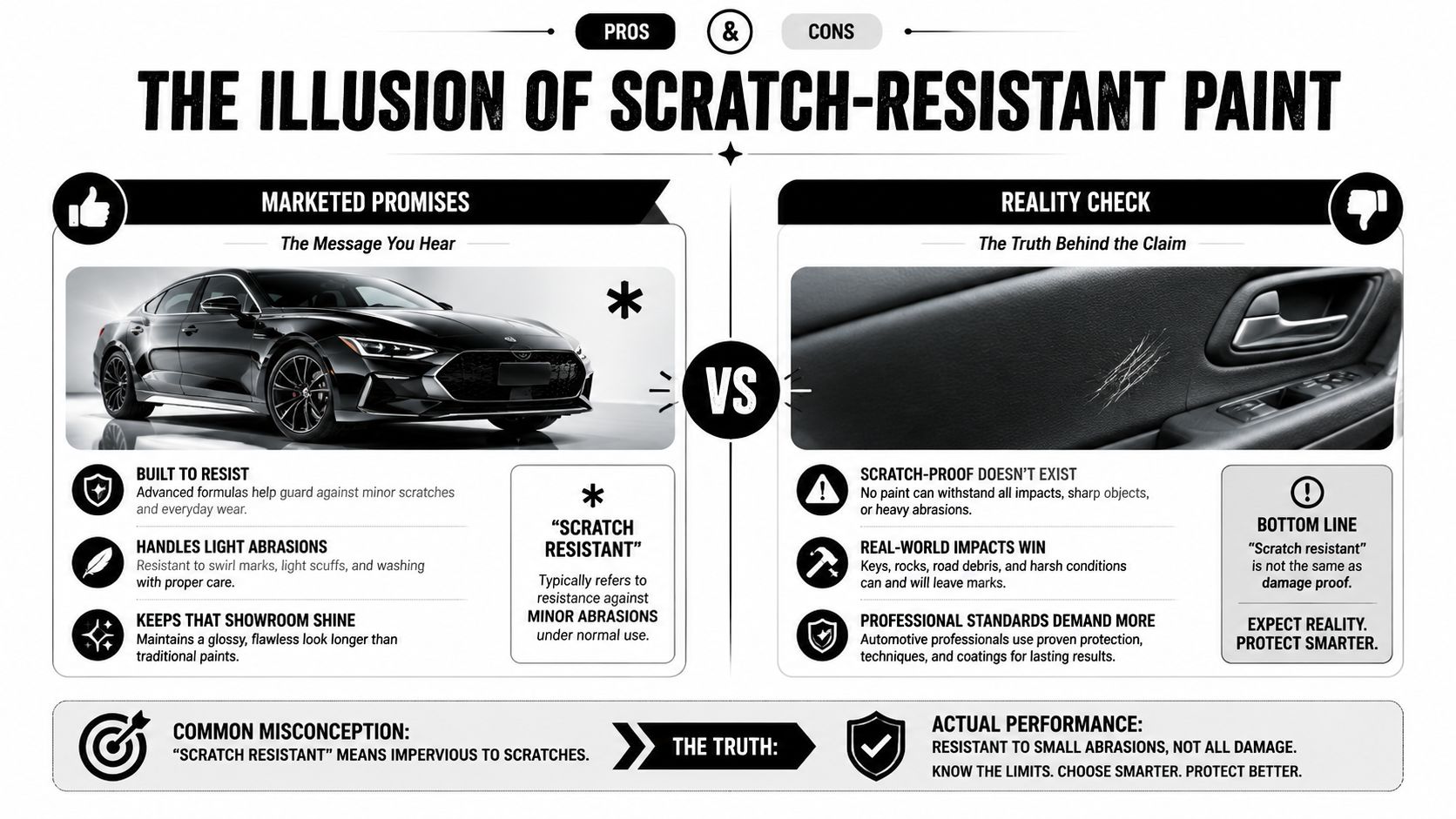
Scuff resistance is not scratch resistance
Scuff resistance usually means friction from softer contact. Think shoes, bags, bumped chairs, or something rubbing across a painted wall. Scratch resistance is different. That's about a sharper object or harder edge cutting into the surface.
That distinction matters in a detailing studio because your environment isn't a hallway in a house. It's hoses with grit on them, aluminum ladder feet, cart corners, metal triggers, bottles with crusted product on the base, and tools getting set down fast when the day gets busy.
A 2024 analysis found that the industry often conflates scuff resistance with scratch resistance, and even top-rated "scuff defense" paints offered "no defense at all" against the sharp abrasion common in detailing studios, showing how inconsistent these products can be under real stress, as discussed in this Klappenberger & Son analysis.
Why detailers feel misled
The frustration usually isn't bad application. It isn't always bad prep. Often, the product wasn't made for what you're asking it to survive.
Here's the practical breakdown:
- Soft-contact testing: Many paints are built for bumps and rub marks, not hard-edge gouging.
- Marketing language: "Scuff defense" sounds close enough to "scratch proof" that buyers assume more protection than they're getting.
- Shop reality: Detail bays create repeated sharp contact at lower wall levels, around doors, and near storage zones.
- Cleanup limits: Once the film is cut or burnished, washing won't restore the original look.
If you work in mobile detailing or run a small studio, it also helps to understand why coating flexibility matters when a surface has to endure repeated contact and movement. This deeper look at coating flexibility gets to the heart of why rigid protection fails sooner in demanding environments.
A wall coating can be good at staying clean and still be bad at surviving a sharp hit.
That's why "best scratch resistant interior paint" often turns into an aggravating search. You're shopping for a wall finish, but your environment behaves more like a work zone than a living room.
A New Story From Wall Protection to Vehicle Perfection
A shift happens when a detailer stops asking, "How do I keep the building from getting marked up?" and starts asking, "What protection can I put on the customer's vehicle that they can see, feel, and value?"
That sounds like a change in topic, but it isn't. It's a change in priority.
A wall takes abuse because the work is happening. A vehicle deserves protection because the work is the business. When you frame it that way, the smartest investment usually isn't another promise on a paint can. It's a protective system applied directly to the surfaces your customer paid you to improve.
What clients remember
They might notice the walls for a second. They definitely notice:
- how the paint finish beads and cleans
- how the windshield behaves in heavy rain
- how easily bug residue releases
- whether the vehicle still looks protected after normal driving
That changes the conversation from maintenance expense to service value.
A fresh coat of interior paint is overhead. A high-level protection package can become part of your offer, part of your reputation, and part of why clients come back instead of price-shopping the next shop down the road.
The better business move
In practical terms, wall protection is defensive. Vehicle surface protection is productive.
One reduces visible wear in the room. The other helps you deliver a more advanced result on the asset that matters most. That's a different level of professionalism. It also gives you a stronger story when you're explaining why your detailing service isn't just wash, polish, and send.
I've seen detailers spend more energy researching wall finishes than windshield performance, coating behavior in heat and cold, or how a flexible protective layer responds to real impact. That's backwards.
The walls should be durable enough. The vehicle should be exceptional.
Once you start thinking that way, the whole "scratch resistant interior paint" search becomes a signpost. It points to a real concern about durability, but the highest-value answer sits on the car, not on the drywall.
The Science of Elastic Armor
Rigid protection sounds good until it gets hit. That's where a wrong assumption often takes hold. The belief is that the hardest coating always lasts the longest. In practice, a brittle surface can lose the fight because it can't move.
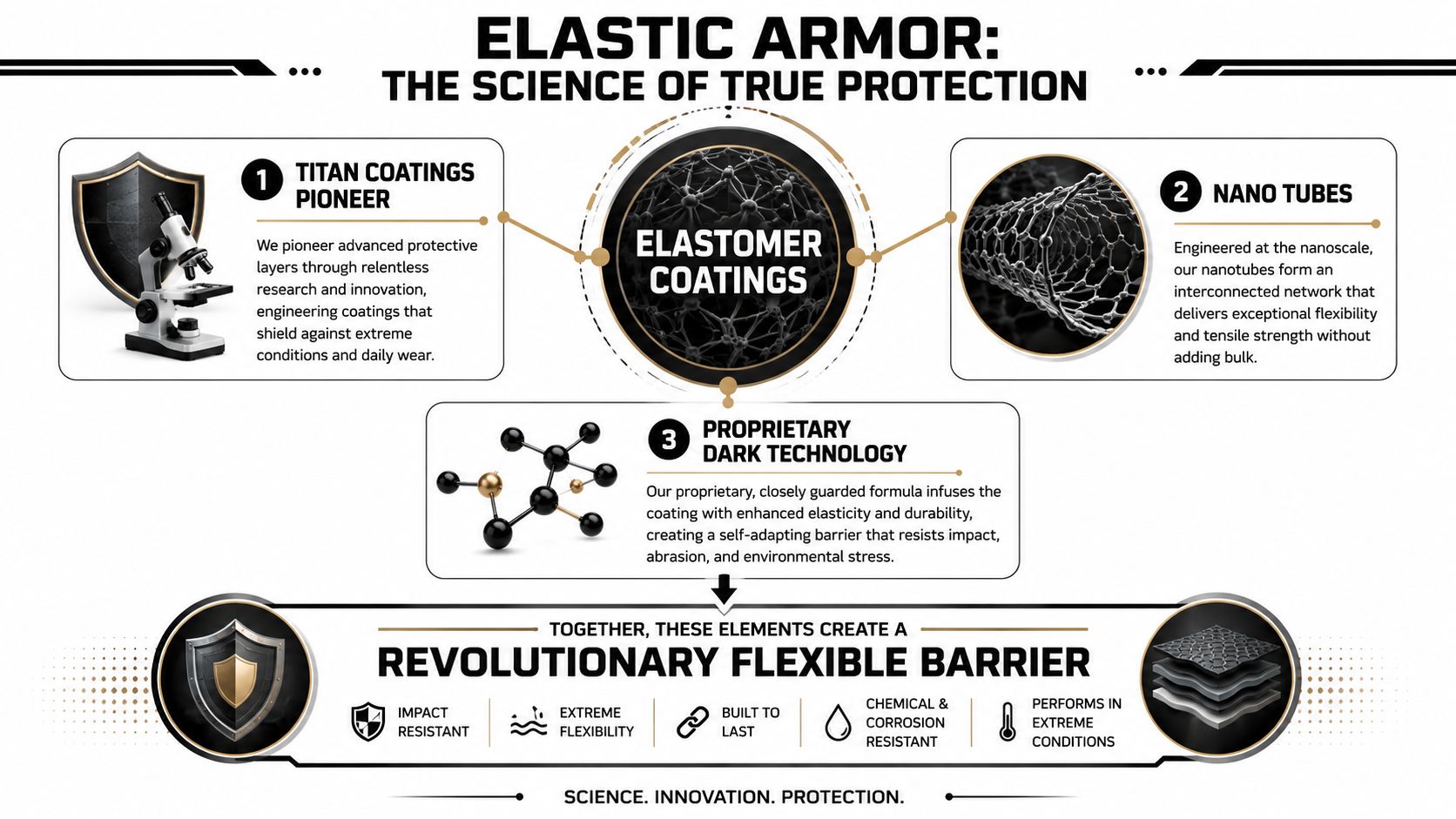
Titan changed that equation by bringing elastomer coatings into the market using carbon nanotube technology and Dark Matter Technology®. The easiest way to understand it is this. The coating behaves hard like glass and flexible like rubber.
Why hardness alone isn't enough
Traditional thinking loves hardness. Hardness matters, but only if the coating can survive impact, vibration, expansion, contraction, and repeated stress without breaking down.
Titan's proprietary elastomer coatings incorporate carbon nanotubes that provide exceptional stiffness and strength, while the elastomer blend allows the coating to stretch and return to its original shape, creating a flexible, self-healing shield, according to Titan's explanation of the technology in Tech Explained.
That combination is what many rigid products miss. They can feel tough at first touch but struggle when the substrate moves, temperatures swing, or debris hits at speed.
How to think about elastic protection
Use this simple mental model:
| Property | What it does in real use |
|---|---|
| Hard surface behavior | Helps resist abrasion and day-to-day contact |
| Elastic movement | Lets the coating absorb stress instead of cracking |
| Nanotube reinforcement | Adds structure and strength to the protective layer |
If you've ever helped a customer compare choosing between epoxy paint or coating, you already know the substrate and the chemistry matter as much as the promise on the label. Surface protection isn't just about what goes on top. It's about how that layer bonds, flexes, and holds under use.
That bond is a big part of long-term performance, and it's why serious installers pay attention to coating adhesion instead of focusing only on gloss or hardness claims.
Flexible protection wins when the surface has to survive real life, not just the brochure test.
Dark Matter and the reinforcement effect
Titan's Dark Matter Technology® also shows what's possible when carbon nanotube reinforcement gets pushed further. Titan describes Dark Matter Technology® as the world's first coating made from vertically aligned carbon nanotubes grown on chlorine-etched aluminum foil, capable of absorbing 99.995% of incident light, which demonstrates the extreme density and mechanical strength achievable through nanotube-based reinforcement in protective coatings, as noted in this Titan Dark Matter Technology post.
You don't need to get lost in the chemistry to see the takeaway. Elastic armor works because it doesn't force you to choose between toughness and movement.
Your Go-To Solution Alpha Quartz for Ultimate Durability
Some coatings sound advanced but turn into a fight the minute you open the bottle. That's where a lot of DIY users and mobile detailers get burned. The chemistry may be strong, but the install window is too tight, the surface prep tolerance is unforgiving, or the process demands a controlled environment they lack.
Alpha Quartz stands out because it brings elastomer-style protection into a format that's approachable.
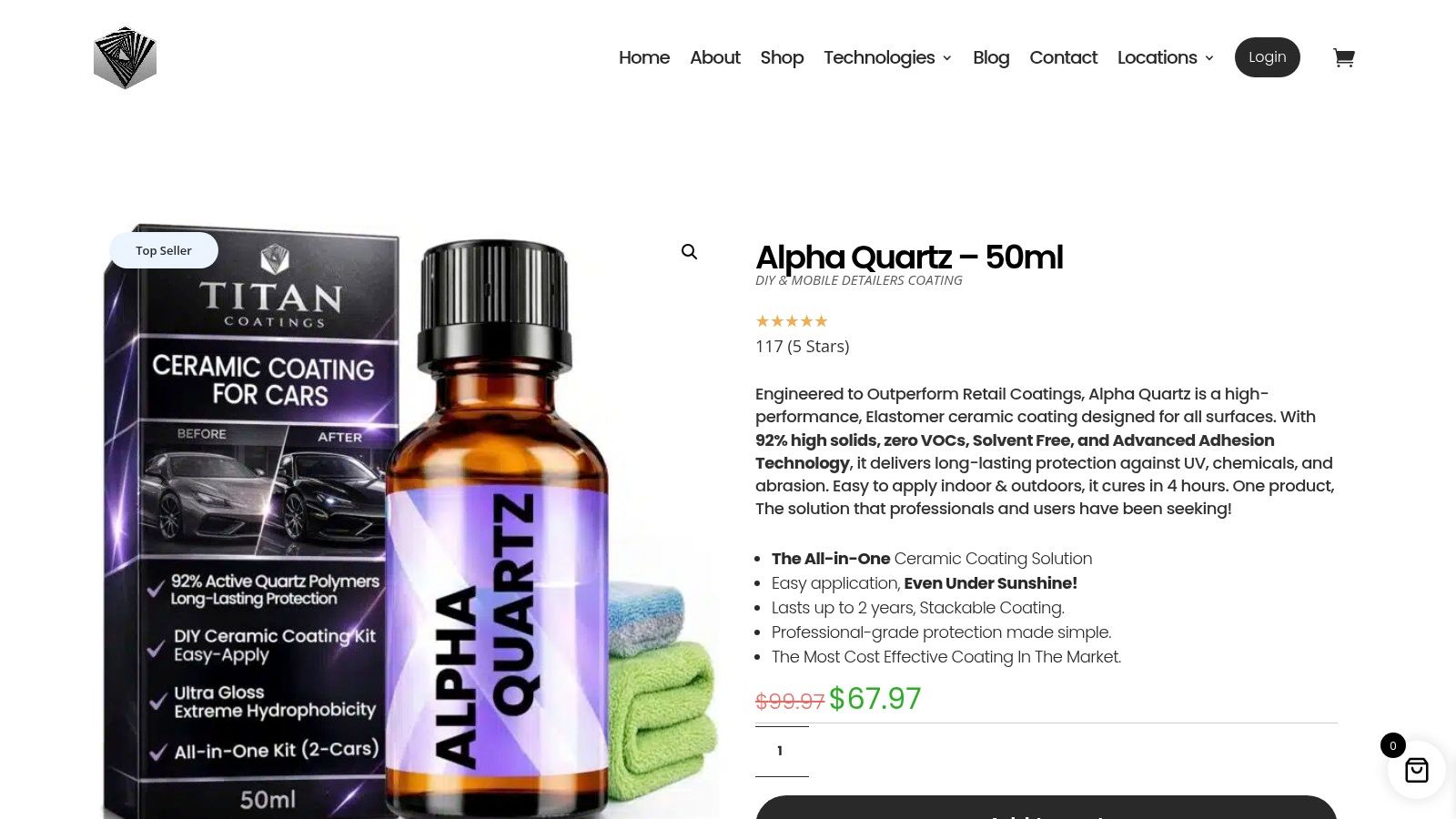
Why Alpha Quartz fits real-world detailers
Mobile operators don't always control lighting, temperature, or bay conditions. DIY users don't always want a product that punishes them for being a little slow on removal. A coating that installs cleanly under broader conditions is worth a lot because it reduces hesitation.
Alpha Quartz makes sense for people who want a serious upgrade without turning every install into a lab exercise.
Here's where it earns attention:
- Easy application: It suits DIY users and mobile detailers who need repeatable results.
- Elastic behavior: The protective layer is designed to move with the surface instead of acting brittle.
- Practical durability: It aims at real use, not just a showroom moment.
- Strong fit for varied climates: It isn't built as a fair-weather-only solution.
What temperature swings do to lesser coatings
For coatings designed to withstand harsh conditions, flexibility transcends a mere benefit, becoming essential. Coatings using carbon nanotubes and silicon carbide additives, as found in Titan's technologies, exhibit thermal stability that allows them to withstand extreme temperature fluctuations between frozen and hot conditions without cracking, according to Titan's overview of its coating technologies.
That matters on paintwork, trim, and exposed surfaces that heat up, cool down, and get hammered by the environment day after day.
A rigid layer can look fine until repeated expansion and contraction start opening the door to failure. A more elastic membrane is better equipped to absorb that movement.
Bugs at speed, heat cycles, cold mornings, long drives. Those are real tests. A coating that can't flex won't stay pretty for long.
Who should use it
Alpha Quartz is a strong match for:
- Mobile detailers who need something forgiving enough to apply outside a fixed studio.
- DIY owners who want pro-grade behavior without a complicated learning curve.
- Studios adding coating services and looking for a system that delivers polished, consistent outcomes.
If your original search started with wall paint, the conversation now gets more useful. Instead of trying to make drywall survive a detail bay, you're putting advanced protection where clients expect premium results.
Expand Protection with Ultra Spray and Apex Glass
A complete protection package shouldn't stop at painted panels. The best detailers build layers into the service menu so the customer leaves with a vehicle that feels protected everywhere they interact with it.
That means adding a maintenance-friendly surface product and handling the glass with the same seriousness as the paint.
Ultra Spray for fast wins
Ultra Ceramic Spray fits shops and mobile setups that want easy installation with solid visual results. It works well as a quick protection option, and it also makes sense as a topper in a maintenance program.
What detailers like about products in this category is simple. They don't bog down the schedule. They help you add gloss, slickness, and easier upkeep without needing a long appointment window.
For a lot of businesses, that's not a side item. It's a reliable add-on service.
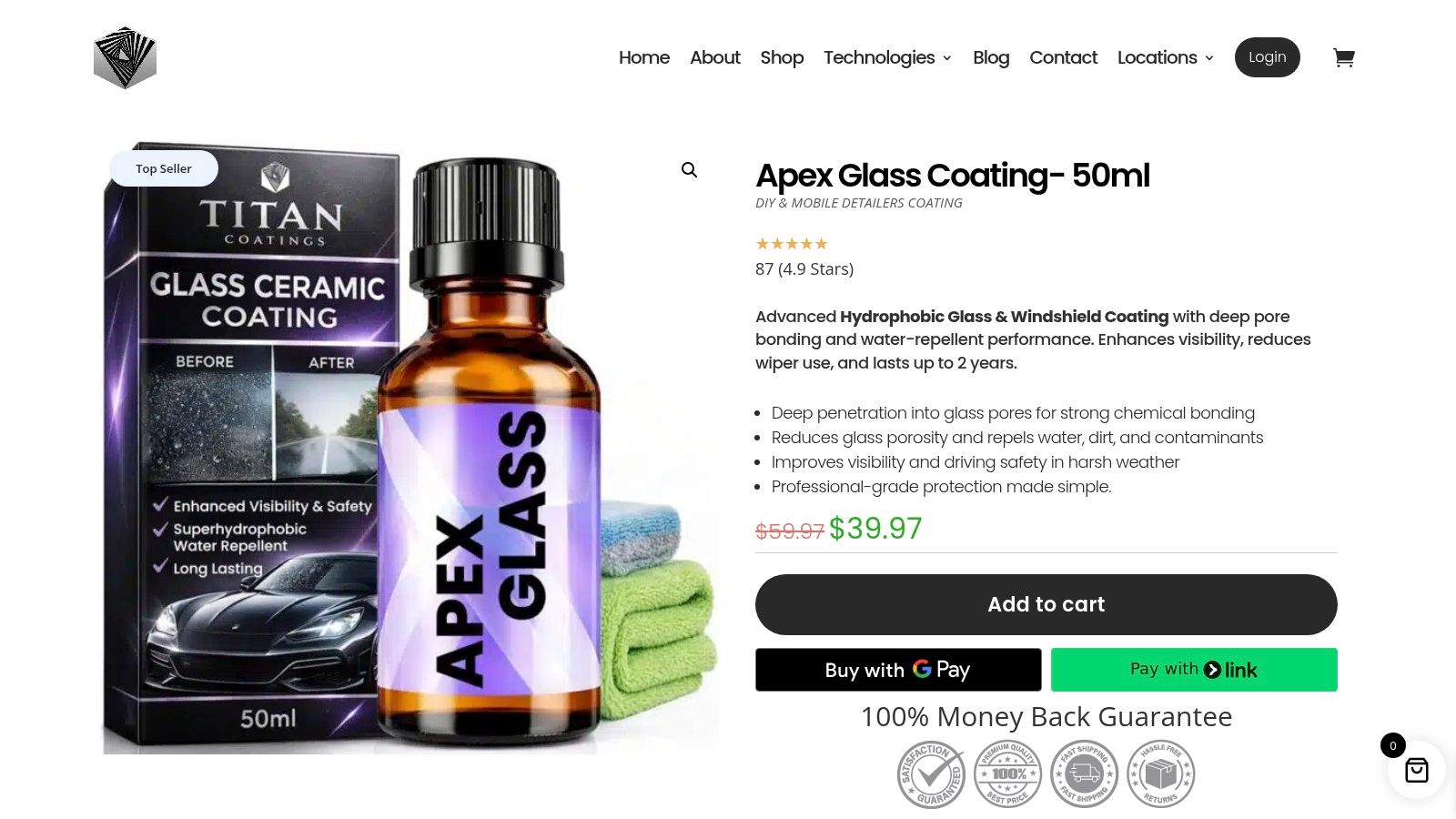
Apex Glass changes the driving experience
Glass is one of the easiest places to create a visible improvement a customer feels during daily use. Apex Glass matters because enhanced windshield behavior in rain isn't just cosmetic. It changes confidence behind the wheel.
When the water sheds better, the drive feels calmer. Cleanup gets easier too. Road film, residue, and bug impact on the windshield become less annoying to manage.
If you're comparing options for rain performance and driver visibility, this guide to the best ceramic coating for windshield is worth reading.
Apex Glass is also easy to use, which matters more than people admit. A product can have great chemistry, but if the install becomes messy or fussy, many users won't apply it consistently. Simpler application closes that gap.
A better menu for customers
A smart protection package can look like this:
- Alpha Quartz: Main surface protection with elastic durability.
- Ultra Ceramic Spray: Fast maintenance layer or entry-level protection add-on.
- Apex Glass: Windshield and glass treatment that improves wet-weather visibility.
That mix gives you broader coverage without making every customer jump straight to the most involved package.
Building Your Detailing Arsenal with Titan
The search for scratch resistant interior paint usually starts with a sensible frustration. You want a cleaner-looking workspace. You want less visible damage. You want surfaces that don't seem worn out after normal use.
But in a detailing business, the stronger move is to build protection around the vehicle, not just the room.
What the right arsenal actually does
A stronger lineup gives you different tools for different jobs:
- Alpha Quartz for flexible, durable protection that suits both pros and ambitious DIY users.
- Ultra Ceramic Spray for easy installs, maintenance services, and quick-turn packages.
- Apex Glass for visibility, rain performance, and a result customers notice immediately.
That approach does more than tidy up your process. It makes your service menu more complete.
If you still need guidance for the building side of the equation, this practical piece on choosing the right wall paint is a useful complement to everything above. Handle the walls intelligently, then put your best technology where it has the biggest impact.
The next step for working detailers
Start with your workflow. Look at what you already offer, what customers ask for after delivery, and where you can add visible value without slowing the day down. Then choose products that match your operating style, whether that's studio-based, mobile, or a mix of both.
For mobile pros especially, this checklist of mobile detailing equipment can help you think through how protection services fit into your setup.
Watch the product videos. Learn the application habits. Test the system on your own vehicle or a controlled client job first. Then roll it into your premium packages with confidence.
Stop asking wall paint to solve every durability problem in the shop. Build a better protection business instead.
If you're ready to upgrade from basic surface care to advanced vehicle protection, explore APEX NANO – Titan Coatings. Check the shop for Alpha Quartz, Ultra Ceramic Spray, and Apex Glass, and use the application resources to build a protection package that fits your studio, your mobile setup, or your personal vehicle.
0 Comments
Trackbacks/Pingbacks