
A black coupe rolled into the bay looking perfect under shop lights. By the next cold snap and a few heat cycles later, that “rock-hard” ceramic looked less permanent than the sales pitch.
The Agony of a Cracked Coating
The owner had done everything detailers usually recommend. The paint was corrected. The surface was cleaned carefully. The coating was applied with patience, leveled properly, and left to cure. For a while, the finish had that sharp, glassy look everyone wants.
Then real driving started.
Where the failure shows up first
The first signs usually aren’t dramatic. You see faint stress lines on edges, near body contours, or around areas that take repeated vibration. Then the coating starts losing its uniform look. The water behavior changes. Washes don’t feel the same. On darker paint, the damage becomes obvious sooner because every defect catches light.
That’s the part many enthusiasts hate most. The car still looks glossy from ten feet away, but up close the protection has already started to give up.
Practical rule: A coating doesn’t fail only from bad prep. It also fails when the film can’t move with the surface underneath it.
Cars move more than people think. Panels flex. Bumpers flex even more. Hood skins expand in heat and contract in cold. Daily vibration from rough roads adds constant low-level strain. Add bug strikes, light road debris, and repeated wash contact, and you have a surface that punishes brittle films.
Why this hurts detailers and owners
A coating that cracks doesn’t just lose its appearance. It loses trust. The owner paid for durability and gets a finish that now needs correction, spot repair, or full removal. For mobile detailers, that can mean difficult conversations. For studio installers, it can mean explaining why hardness alone didn’t solve the problem.
Coating flexibility moves beyond an abstract lab term, becoming the difference between long-term protection and early disappointment.
If you’ve ever seen a coating fail in a way that looks suspiciously like a clear coat issue, it’s worth understanding the difference between the coating itself and the paint system below it. Titan’s guide on how to fix clear coat peeling is useful for spotting where the underlying issue begins.
The missing property
People talk about gloss, slickness, chemical resistance, and hardness because those are easy to sell. Flexibility gets less attention because it’s harder to explain in one sentence. But on a vehicle, it’s one of the properties that decides whether a coating survives outside the garage.
A rigid film can look beautiful on day one and still be the wrong answer for a moving substrate. That’s the agony of a cracked coating. The finish didn’t fail because the owner didn’t care. It failed because the coating couldn’t live in the same world the car lives in.
The Hard Truth About Brittle Protection
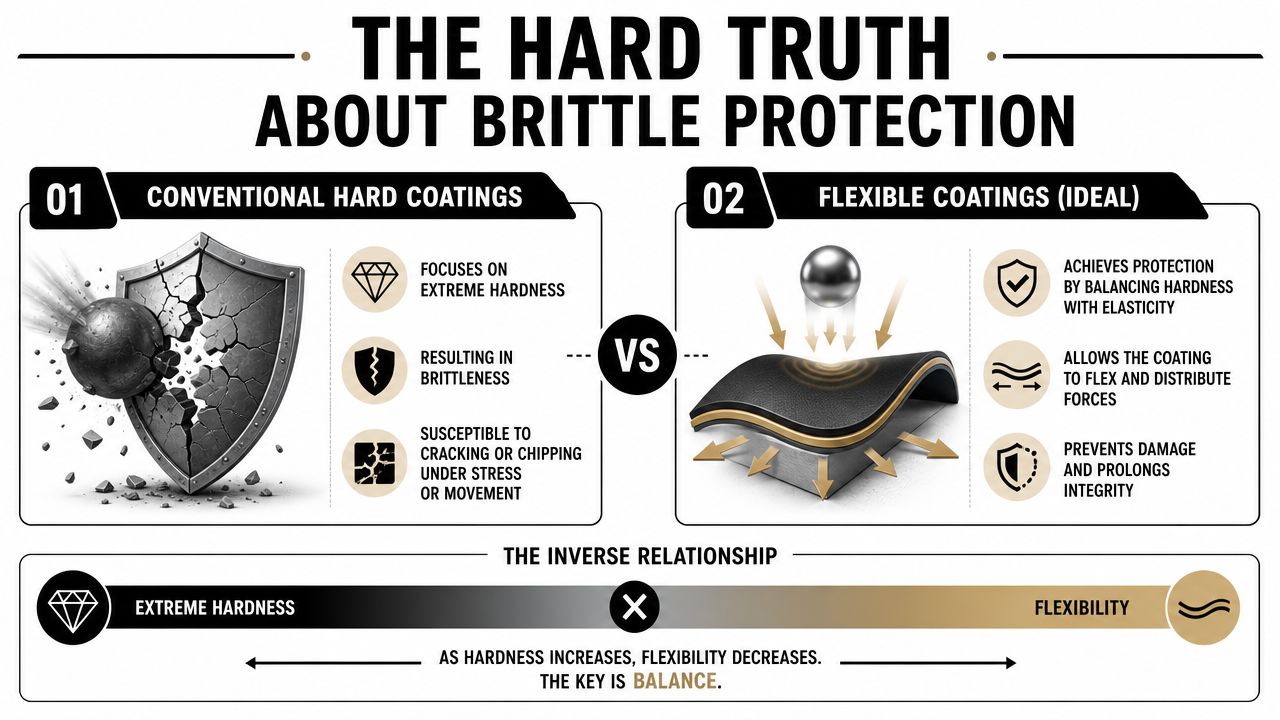
For years, the conversation around ceramic coatings got reduced to one idea. Harder must be better. That sounds logical until you remember what happens when you drop a glass plate.
A car isn’t a granite countertop. It’s a vibrating, flexing, temperature-cycling structure covered in thin painted panels and molded parts. On that kind of surface, a very hard but brittle film can become its own weakness.
Hardness without elasticity is a trap
Glass is hard. Rubber is flexible. If you want a coating to survive road life, you need some of both.
That’s why the old hardness-only mindset causes problems. A coating can resist a narrow scratch test and still crack under movement that happens every day on a real vehicle. Those are different stresses. A static pencil rating or a marketing label doesn’t automatically tell you how the film behaves when the panel bends, heats, cools, and vibrates.
This is also why buyers who focus only on “scratch resistance” often end up asking the wrong question. Titan’s overview of scratch-resistant coating helps frame the issue correctly. Resistance matters, but durability depends on more than one property.
What actually stresses a coating on a car
The most common failure forces are ordinary, not exotic:
- Thermal movement: Cold mornings and hot afternoons make panels expand and contract. If the coating can’t move with that change, stress builds in the film.
- Panel flex: Doors shut. Hoods vibrate. Bumpers deform slightly. Even a well-built car keeps moving under load.
- Low-energy impact: Bugs at speed, light gravel contact, and wash media don’t always create a dramatic chip. They can still start microscopic damage in a brittle surface.
- Repeated contact: Wiper passes, drying towels, wash mitts, and wind pressure create cumulative mechanical stress.
A coating that behaves like a shell often looks strong until the substrate asks it to bend.
What works and what doesn’t
What doesn’t work is chasing maximum rigidity as if the car never moves.
What works is balancing surface hardness with enough elasticity to distribute force instead of concentrating it at one weak point. In practical terms, that means the coating is less likely to fracture when the panel changes shape slightly or when the weather swings from frozen to hot.
Here’s the trade-off in plain terms:
| Coating behavior | What happens in service |
|---|---|
| Very hard, very brittle | Sharp appearance, but more prone to cracking or chipping under movement |
| Balanced hardness and flexibility | Better ability to absorb stress and stay intact over time |
| Too soft | Can give up abrasion resistance and feel less durable |
The breakthrough in modern coating design isn’t choosing one side blindly. It’s engineering a film that keeps the protective feel detailers want while staying flexible enough to survive reality.
Measuring What Matters in Coating Flexibility
In coatings R&D, flexibility isn’t a poetic claim. It’s a measurable property. If a brand talks about flexibility but never discusses how that behavior is evaluated, that should raise questions.
Professionals don’t guess at this. They test it.
ASTM D522 in plain English
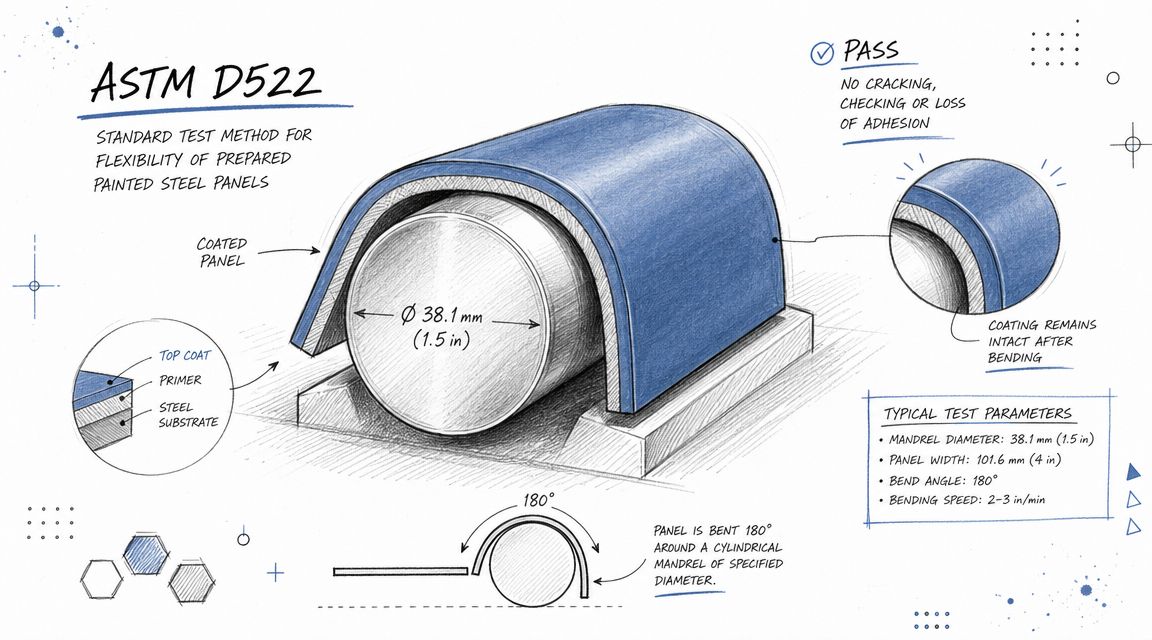
Coating flexibility is commonly quantified through standardized bend tests like ASTM D522, which rates how coatings resist cracking during deformation according to SpecialChem’s flexibility guide. In simple terms, you coat a panel, bend it under controlled conditions, and inspect when the film starts to crack.
That matters because it turns “flexible” from a sales adjective into a performance characteristic. If a coating survives tighter bends at a given build, it has a stronger case for handling movement in service.
Thickness changes the result
One of the most overlooked details in detailing is film build. Thickness isn’t just about how much product you used. It changes how the coating behaves.
SpecialChem notes that a coating’s flexibility is often specified as a minimum bend diameter at a given film thickness, which means thickness is a practical variable, not a cosmetic one. If you apply a coating too heavily, you may end up with a film that looks rich and glossy but loses the ability to move cleanly.
If you want a better feel for how film build is managed on painted surfaces, Titan’s guide on how to measure paint thickness is worth reviewing.
Why cold weather exposes weak films
Temperature shifts don’t just change the panel. They change the coating itself. The same SpecialChem reference notes that flexibility typically drops as temperature drops because the coating gets more brittle near or below its glass transition temperature, or Tg.
That’s why some coatings seem fine in mild weather and then start showing weakness once winter arrives. The film hasn’t changed chemically overnight. The environment has pushed it closer to a brittle state.
Shop-floor takeaway: If a coating only behaves well in perfect weather, it isn’t durable enough for daily-driven vehicles.
A lab lesson that carries into the real world
Danick Specialties highlights how sharply bend performance can change with thickness in powder coatings. Their technical guidance notes that some thermoset polyester powder coatings can achieve 0-T bend flexibility at 25 microns, but only pass a 1/8-inch mandrel flex test at 2–3 mils (about 50–75 microns), and they report that adding 5–7% urethane curative to super-durable TGIC-cured polyesters can improve flexibility and impact resistance. The same document also reports certain additives raising impact resistance from under 20 inch-pounds to 160 inch-pounds in super-durable powder coatings, as detailed in the Danick Specialties technical paper.
That isn’t automotive ceramic data, but the lesson is universal. Chemistry matters. Thickness matters. Formulation choices matter. If you want coatings that survive real stress, you have to engineer for flexibility on purpose.
The Titan Breakthrough Elastomer Technology
The old compromise in surface protection was familiar. You could build something hard, or you could build something flexible, but getting both in one film was difficult. For detailers, that usually meant choosing between a coating that felt sharp and one that tolerated abuse.
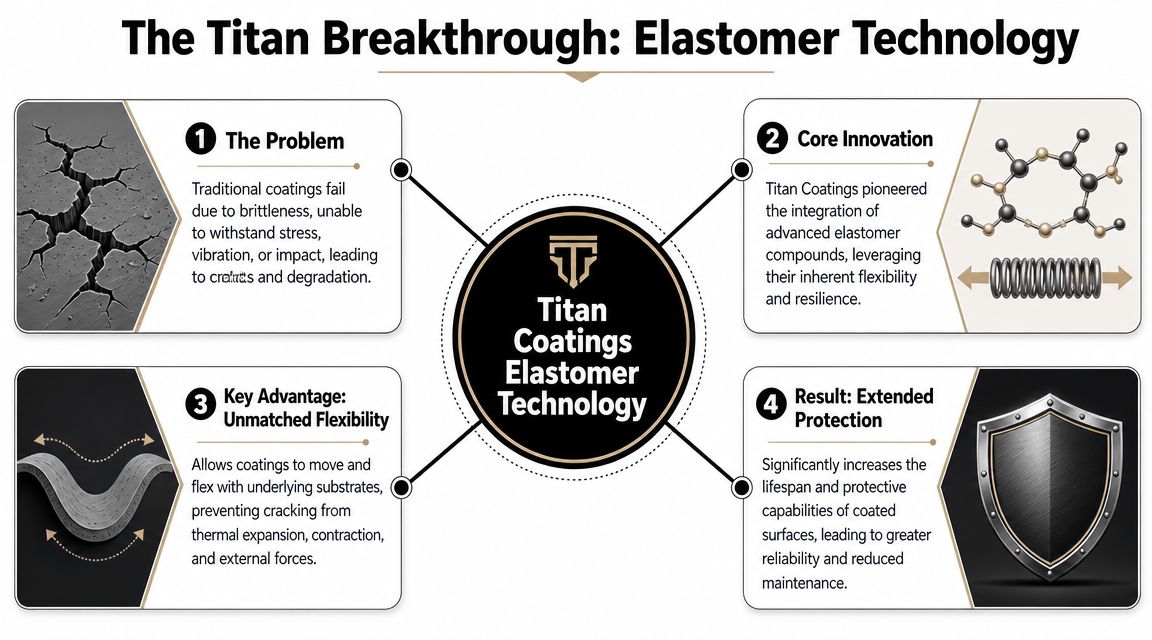
Titan’s answer to that problem centers on elastomer-based coating design.
Why elastomer chemistry changes the conversation
An elastomeric film is built to stretch and recover rather than crack at the first sign of movement. In automotive terms, that matters everywhere a brittle coating struggles. Hood vibration. Seasonal temperature shifts. Small impacts from bugs. Subtle flex in bumper covers and contoured panels.
Titan describes its elastomer coatings as combining hardness with flexibility, using nanotube technology and its proprietary Dark Matter Technology in pursuit of that balance. The practical goal is straightforward. Keep the hard, glossy, glass-like protective character people want, while giving the coating enough resilience to move with the vehicle.
That’s a different design philosophy from the traditional “make it harder and hope for the best” approach.
The practical appeal for installers
For a DIY owner or a mobile detailer, advanced chemistry only matters if the product can be applied without turning the job into a lab experiment. Ease of use is part of performance because difficult products create inconsistent installs.
One example is Titan Coatings elastomer solutions, which present the flexible-coating idea as a system rather than a one-claim feature. In the field, that matters more than slogans. Installers need a coating that levels predictably, doesn’t punish minor environmental variation, and still leaves a clean finish on a daily driver.
The best coating for a detailer isn’t the one with the loudest hardness claim. It’s the one that still looks intact after weather, washes, and road use.
Why this isn’t only an automotive idea
If you want a useful parallel outside detailing, look at Texas roof protection from hail and heat. The surface and service conditions are different, but the logic is similar. A protective film lasts longer when it can absorb movement and temperature stress instead of fighting it.
That same principle is what makes elastomer technology interesting on vehicles. Cars don’t need a coating that wins a static argument. They need one that survives motion.
Where Alpha Quartz fits
Within Titan’s lineup, Alpha Quartz is positioned around this flexible-protection idea. For detailers, the appeal is simple. You’re not just laying down a shell. You’re applying a coating meant to behave more like a protective membrane that still presents with a glass-like finish.
That matters when the car leaves the shop and starts doing normal car things. Highway bugs hit the nose. The panel sees frozen mornings and hot asphalt reflections. The owner washes the vehicle every week. A brittle coating can start collecting damage from each of those events. A more elastic film is better suited to absorb and redistribute that stress.
For mobile detailers, that changes the conversation with clients. Instead of selling hardness as the whole story, you can explain longevity in a way customers understand. The coating lasts because it doesn’t crack when the environment changes.
Extending Flexible Protection Beyond the Paint
Paint gets most of the attention, but it isn’t the only surface that suffers when a coating is too rigid. Glass, trim, wheels, and marine surfaces all deal with movement, contamination, and repeated mechanical contact.
That’s why flexibility matters beyond the hood and doors.
Glass takes more abuse than people admit
A windshield lives a harsh life. Heat, cold, road film, washer fluid, hard water spotting, and constant wiper passes all attack the surface. So when a glass coating is easy to apply and remains uniform under that mechanical stress, it solves a real driving problem.
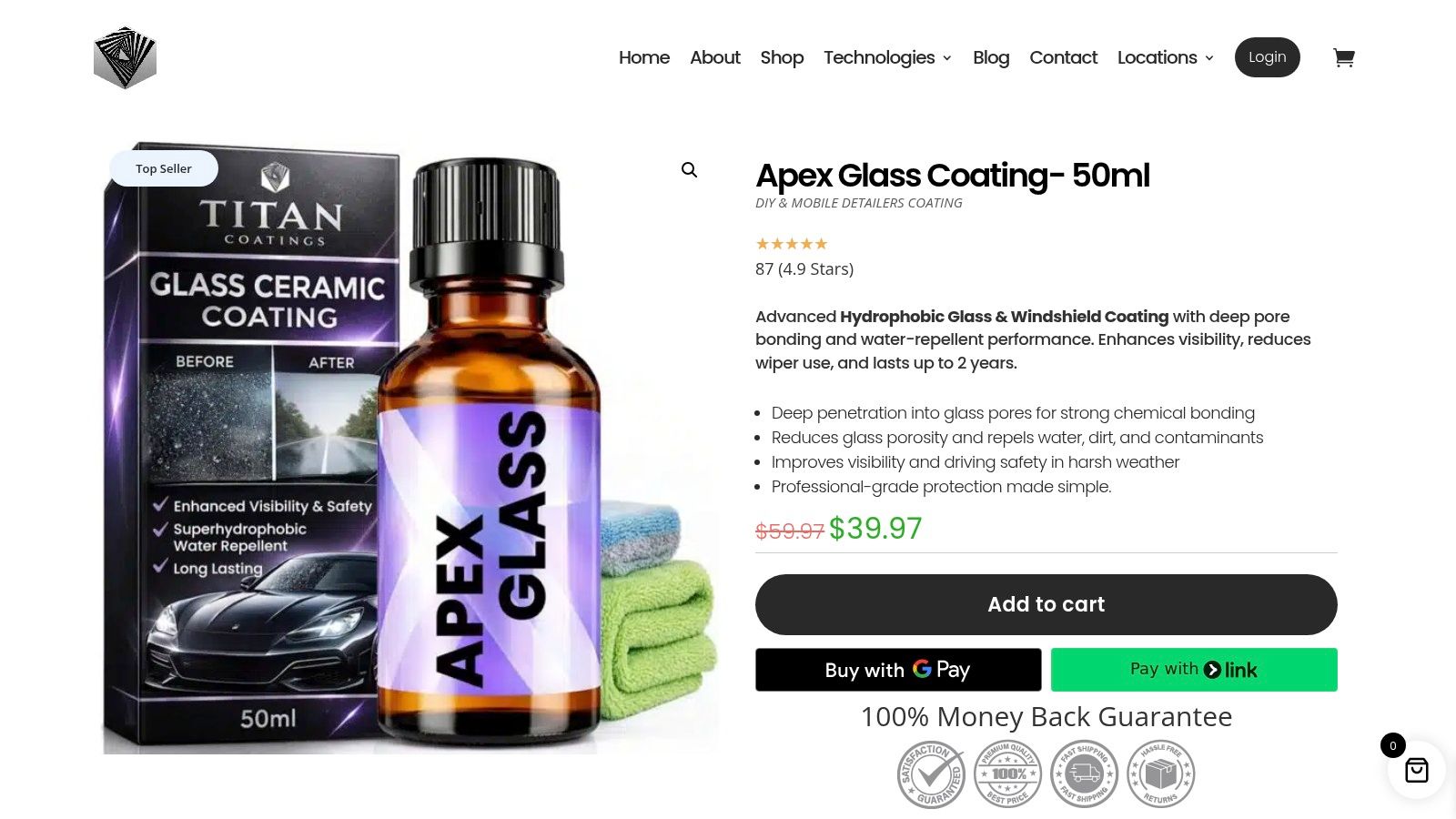
Titan’s APEX Glass & Windshield Coating is relevant here because the user benefit is immediate. In rain, drivers want cleaner water release and better visual clarity. In daily use, they want a product that doesn’t become a headache to install or maintain. On glass, durability isn’t just about chemistry on paper. It’s about whether the coating keeps doing its job under repeated wiper action and changing temperatures.
For a lot of drivers, the most memorable coating upgrade isn’t on the paint. It’s the first storm where visibility feels calmer and the windshield sheds water more cleanly.
Flexible protection on the rest of the vehicle
A full vehicle sees different stress on different materials. Wheels get heat and contamination. Trim expands and contracts. Plastic parts flex more than metal. That’s why one rigid solution doesn’t always make sense across every surface.
ULTRA Ceramic Spray fits the “easy install, broad use” side of the conversation. For detailers and owners who want a simpler application path, a sprayable ceramic product can make sense for maintenance and for surfaces that benefit from quick coverage with less complexity.
A practical system often looks like this:
- Windshield and side glass: Use a dedicated glass product when visibility in rain is the priority.
- Paint and exposed bodywork: Choose the more durable flexible coating where long-term panel protection matters most.
- Wheels and trim: Use a simpler maintenance-friendly product where speed and repeatability matter.
- Special environments: Boats and watercraft need the same thinking because surfaces expand, contract, and stay exposed to punishing conditions. Titan’s page on marine ceramic coating gives a useful example of how coating demands change once water, sun, and salt become constant.
What detailers should take from this
The main lesson isn’t to coat every surface with the same chemistry. It’s to choose products that match how that surface actually behaves.
Glass needs optical clarity and wipe resistance. Paint needs balanced hardness and elasticity. Trim and wheels benefit from products that can be applied quickly and refreshed easily. When you think in terms of movement and stress instead of only gloss, product selection gets smarter fast.
Your Guide to Choosing and Applying Flexible Coatings
If you’re buying or installing coatings with long-term durability in mind, stop asking only how hard the film gets. Ask how it behaves after months of movement, weather, washing, and impacts.
That’s where good choices start.
What to look for before you buy
Use this checklist when comparing coatings:
- Evidence of flexibility: Look for signs the manufacturer treats flexibility as an engineered property, not decorative language.
- Clear film-build guidance: Since thickness affects bend performance, vague application instructions are a warning sign.
- Use-case honesty: A coating meant for painted panels may not be the right answer for glass, trim, or maintenance work.
- Installer realism: Products should match who’s using them. A studio can manage more complexity than a mobile detailer working in changing conditions.
Field note: If the product sounds durable only in a controlled environment, expect trouble on a daily driver.
What helps during application
The best flexible coating still needs disciplined application. These habits matter:
- Control the build. Thick doesn’t automatically mean better. Heavy application can hurt the very flexibility you’re trying to preserve.
- Match the product to the panel. Bumper covers, glass, wheels, and painted metal don’t all want the same solution.
- Think about climate. If the vehicle lives through freezing mornings and hot summers, coating flexibility matters more, not less.
- Plan for maintenance. Some surfaces benefit from a durable base layer and an easier top-up product later.
A surprising number of coating failures come from installers treating every substrate the same. Cars don’t forgive that.
Learn from adjacent trades
Detailers can also learn from other sealant and coating categories where movement is part of the job. RV technicians, for example, care a lot about how products flow, settle, and remain intact across seams and expansion zones. If you want a simple example of how application behavior matters in another field, this guide to applying Dicor self-leveling sealant is a good reminder that the right product has to work with surface movement, not against it.
The decision that lasts longer
The smartest shift in mindset is this. Don’t shop for the hardest coating. Shop for the coating that stays intact.
That usually means a film with a balanced structure, sensible application thickness, and chemistry built to tolerate the abuse vehicles see every day. If you want to compare options for paint, glass, and sprayable maintenance products, browse the Titan Coatings shop and look at each product through the lens that matters most: will it flex when the car does?
If you want one place to explore flexible protection across automotive, marine, aviation, and specialty surfaces, take a closer look at APEX NANO – Titan Coatings. The value isn’t just shine. It’s choosing coatings built for real movement, real weather, and real use.
0 Comments