
Rain started halfway through a customer handoff. The owner expected the usual wiper chatter and blurry glare, but the glass stayed clear, the paint still looked freshly corrected, and the biggest surprise was what you couldn't see: no stress lines, no brittle surface response, no coating drama when the temperature swung again the next morning.
From Battlefields to Showrooms The Evolution of Coatings
Industrial coating applications sound distant until you watch a valued vehicle get punished by the same forces that attack larger assets every day. Sun, water, chemicals, abrasion, thermal cycling, bug impact, road film. The scale changes from a military vehicle or marine structure to a weekend car, but the problem is the same. Surfaces fail where protection turns rigid, thin, or poorly bonded.
That's why this category matters far beyond factories. The global industrial coatings market reached USD 96.7 billion in 2025 and is projected to reach USD 132.5 billion by 2033, growing at a 4.1% CAGR from 2026 to 2033, according to Grand View Research's industrial coatings market analysis. Those numbers reflect something detailers already know from the bay floor. Protection isn't cosmetic. It's infrastructure for the surface.
Why car lovers should care
A coating developed for harsh-duty use solves a very familiar consumer problem. Traditional protection often looks great on delivery day, then starts giving back performance when weather, wash friction, or impact loading show up. That's the gap between appearance products and functional coatings.
For years, advanced chemistry lived behind procurement departments, defense programs, and specialized industrial channels. Now the line has blurred. The same thinking behind military specification coating systems is shaping products that a mobile detailer, studio installer, or serious DIY owner can use.
A daily driver in Arizona, a truck in coastal humidity, and a sports car parked outdoors all teach the same lesson. Protection has to survive movement, not just exposure.
The old assumption that no longer holds
A lot of people still hear “industrial” and think bulky, ugly, overbuilt, or irrelevant to a polished vehicle. That's outdated. Modern industrial coating applications don't just defend steel tanks and process equipment. They also influence how we protect paint, trim, wheels, glass, and high-contact surfaces that need both aesthetics and resilience.
The shift matters because car owners don't live in laboratory conditions. They park outside. They wash fast. They drive through insect-heavy highways, winter mornings, hot pavement, and acid rain. A coating that only works on a pampered garage queen isn't enough anymore.
Where the story changed
Change came when high-performance protection stopped being defined only by hardness. Hardness without flexibility creates its own failure point. Strong is good, but strong and adaptable is where the technology finally became useful.
That's the bridge from battlefields to showrooms. What protected mission-critical assets started informing a new standard for enthusiast vehicles: coatings that resist damage while moving with the surface, not fighting it.
Understanding the Science Behind Superior Protection
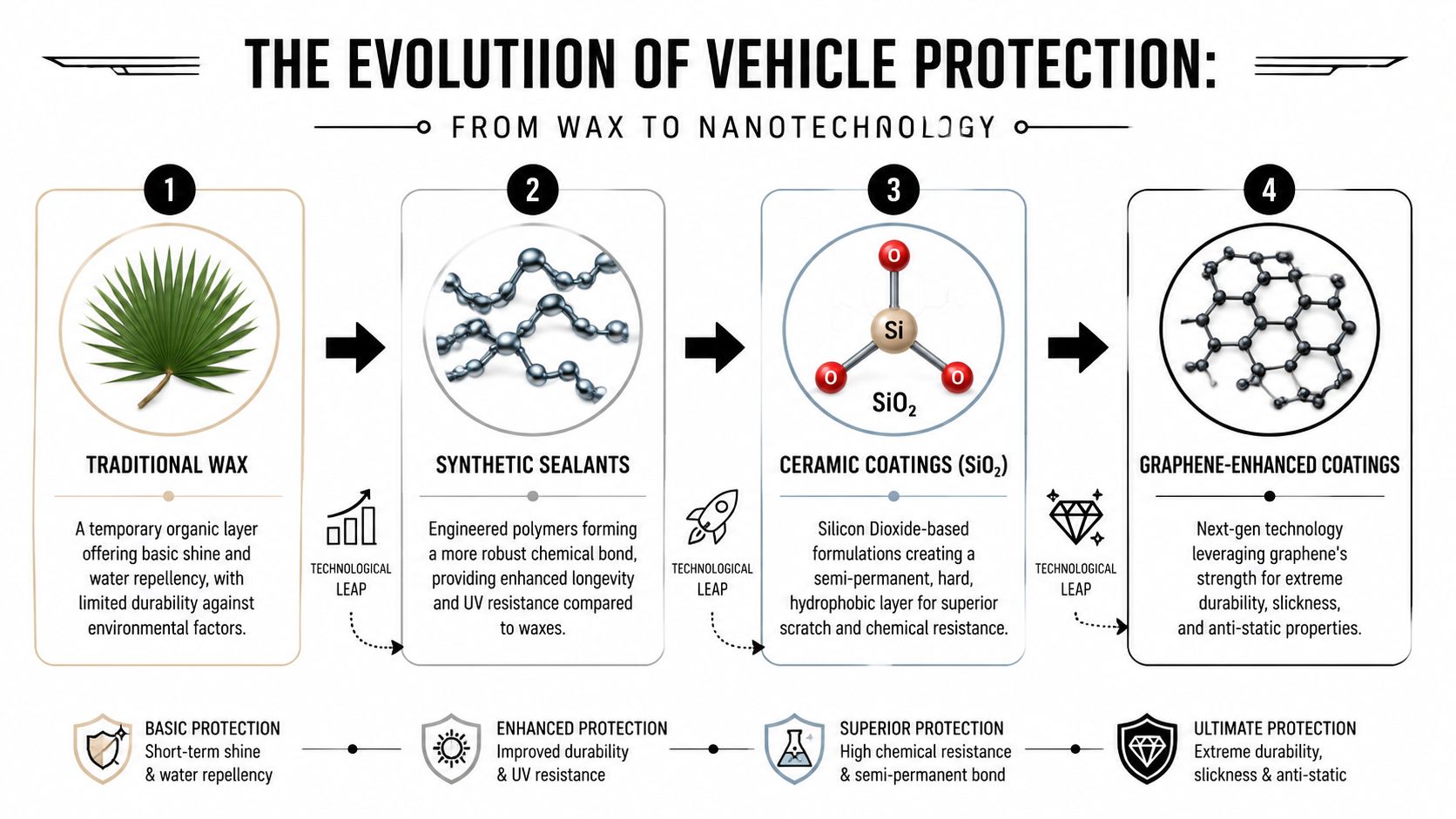
Most coating failures aren't mysterious. The chemistry was wrong for the stress, the surface was poorly prepared, or the coating solved one problem by creating another. Older systems often forced a compromise. You could get gloss and hardness, or you could get flexibility, but not both.
That's where newer membrane-style systems changed the conversation.
What old coatings get wrong
A brittle coating can look impressive right after installation. Then the substrate expands, contracts, vibrates, gets peppered with road debris, or sees repeated heat and cold cycles. If the film can't absorb that movement, micro-failure starts. Sometimes you see it as cracking. Sometimes you don't see it until water behavior changes, contamination sticks harder, or the finish stops looking uniform.
Adhesion is part of this story too. Surface energy, cleanliness, and compatibility decide whether the coating becomes part of the protection system or just sits on top waiting to fail. Good installers pay attention to that, which is why coating adhesion fundamentals matter as much as gloss charts and marketing language.
Why elastomer chemistry changed expectations
The breakthrough with elastomer coatings is simple to explain and hard to engineer. The coating needs to cure into a surface that feels hard and refined, yet still stretches and returns instead of fracturing under stress. That combination is what detailers had been missing.
Titan's ElastoTek® elastomer membrane coating incorporates carbon nanotubes that provide exceptional stiffness and strength, allowing the coating to achieve glass-like surface hardness while maintaining flexibility, enabling it to stretch and return to its original shape without cracking under temperature fluctuations between -40°C and +120°C, as described in Titan's technical explanation of ElastoTek®.
That matters because a vehicle surface doesn't live one static life.
- Heat loading changes panels during parking, driving, and engine soak.
- Cold contraction stresses films in winter starts and overnight exposure.
- Minor impacts test elasticity every time bugs, grit, and wash contact hit the surface.
Practical rule: If a coating can't move with the panel, the panel eventually wins.
Carbon nanotubes and Dark Matter tech in plain language
Carbon nanotubes reinforce the coating at the molecular level. They help create a film with more structural discipline, so the coating doesn't feel soft or vague just because it flexes. That's the part many people misunderstand. Flexibility isn't weakness. In a well-built coating, flexibility is controlled energy management.
Dark Matter tech pushes the same philosophy further. Instead of relying on surface hardness alone, the coating system is designed to deal with harsh environmental load without becoming fragile over time. That's why this category feels closer to industrial engineering than old-school detailing chemistry.
Here's the simplest way to understand it:
| Protection approach | Typical failure mode | Better approach |
|---|---|---|
| Hard but brittle | Cracks under stress | Hard with elastic recovery |
| Slick but temporary | Drops performance fast | Functional, durable membrane |
| Gloss-first chemistry | Looks good, ages poorly | Protection built around stress resistance |
That's why modern industrial coating applications aren't just newer products. They represent a different design philosophy.
Protecting Critical Assets Across Industries
The US market tells you where demand is strongest. In the United States, the industrial coatings market was valued at USD 71 billion in 2024 and is forecast to grow at a 4.6% CAGR from 2025 through 2034, with automotive demand playing a major role, according to GM Insights' industrial coatings market report. High-performance finishes aren't a niche preference. They're a response to real service conditions.
Automotive pressure is constant
Cars don't fail in one dramatic moment. They age through repetition. UV exposure dulls trim and stresses the uppermost protection layer. Repeated washing introduces marring risk. Bug strikes and road grit create small but relentless impact events. Brake dust and road film stay chemically active if they sit too long.
That's why the best automotive industrial coating applications don't focus on one headline benefit. They need a balanced profile. Chemical resistance, wash durability, environmental stability, and enough elasticity to handle panel movement all matter.
Marine and aviation ask different questions
Marine exposure is less forgiving because saltwater attacks every weakness in the system. If the coating leaves a pathway, corrosion starts working underneath the pretty finish. In that environment, adhesion and film continuity matter more than hype.
Aviation stresses coatings differently. Thermal shifts, airspeed abrasion, UV exposure at altitude, and contamination control all shape what works. The same logic applies to performance vehicles that see heat cycles, outdoor storage, and extended road use. The environment changes, but the question stays the same: does the film stay intact when the surface is under pressure?
The best coating on paper is useless if the service environment exposes a weakness the chemistry can't absorb.
Defense and infrastructure reveal the real test
Defense and heavy infrastructure don't choose coatings because they look dramatic under lights. They choose systems that keep assets in service. Abrasion, weathering, chemical contact, and harsh maintenance schedules expose weak formulations fast.
For companies trying to explain these distinctions to technical buyers, good education matters as much as product quality. Teams that need help translating complex chemistry into clear messaging can learn a lot from this guide to digital marketing for industrial companies, especially when they're trying to reach customers who care about performance details rather than slogans.
What this means for detailing
If a coating strategy can survive industrial and harsh-duty logic, it usually scales down beautifully to premium vehicle care. That's why more pros are looking beyond the old “hardness equals quality” shortcut and toward suppliers that understand substrate behavior, service conditions, and application discipline. A useful place to explore that side of the market is this overview of industrial coating suppliers.
For detailers, the takeaway is simple. Tough environments don't just exist on ships, aircraft, and defense equipment. They exist in parking lots, highways, coastal towns, and driveway maintenance. The chemistry should reflect that reality.
A DIY Revolution With Professional Grade Results
The most interesting shift in this space isn't only technical. It's practical. Products that once felt reserved for advanced installers are now reaching mobile detailers and hands-on owners who want high-level protection without turning application into a high-risk event.
I've seen the same pattern repeatedly. A mobile detailer starts skeptical because “easy to apply” usually means watered down performance. Then they use an elastomer-based coating that levels predictably, behaves well in less-than-perfect field conditions, and leaves behind a finish that doesn't feel compromised.
Why Alpha Quartz fits the real world
That's where Alpha Quartz stands out. It's easy to install, it suits DIY users and mobile detailers, and it solves a common frustration with rigid coatings that can become vulnerable when temperatures swing or the vehicle takes repeated bug hits. Elastic recovery changes that ownership experience. The finish isn't just glossy on day one. It's better prepared for normal driving.
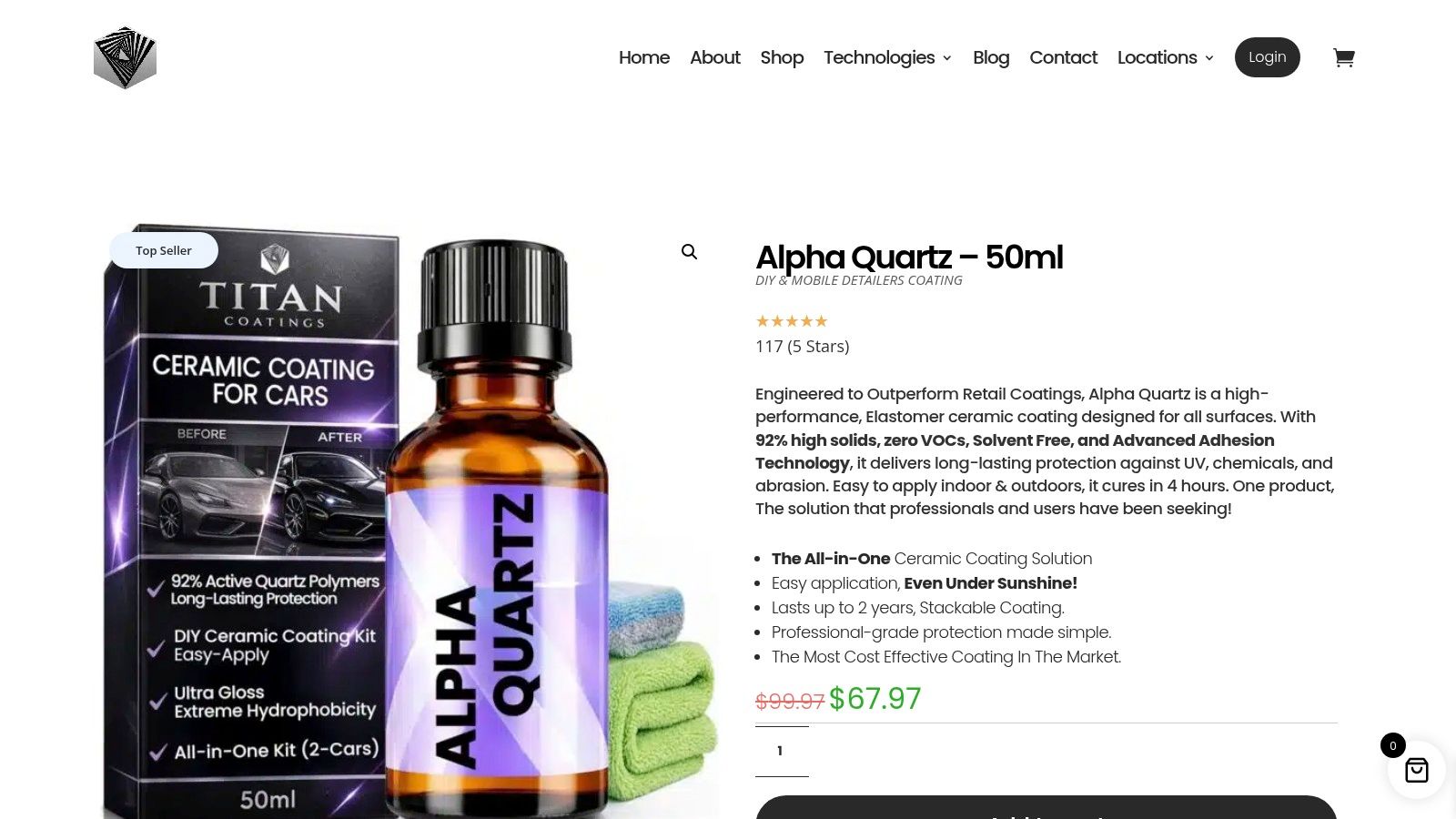
Titan Coatings pioneered the introduction of carbon nanotubes in the automotive coatings market in 2021, becoming the first company to integrate CNTs into elastomer-based protective coatings for vehicles, which enhanced stiffness and durability through molecular reinforcement, according to Titan Coatings' technology overview. That first-mover step matters because it helped bring advanced coating logic into a format installers could work with.
What makes it approachable
A lot of DIY failures come from finicky products. They flash too aggressively, punish small timing mistakes, or require ideal shop control. A coating can have outstanding chemistry and still be the wrong choice for a driveway user or mobile operator.
Alpha Quartz fits a different application reality:
- Friendly installation behavior helps newer users stay in control.
- Elastic performance supports durability when weather changes fast.
- Good fit for mobile work means you don't need a laboratory to get a clean result.
For newcomers who want a starting point that doesn't feel intimidating, a purpose-built DIY ceramic coating kit makes more sense than piecing together random products and hoping the chemistry plays nicely.
The best DIY coating isn't the one with the loudest claims. It's the one that gives the installer enough control to apply it correctly.
That's why this feels like a revolution, not just another product launch. Professional-grade results are no longer locked behind a studio door.
Specialized Coating Solutions for Total Vehicle Care
Vehicle protection isn't only about paint. Some of the most noticeable daily benefits come from glass, trim, and maintenance layers that make the car easier and calmer to live with.
The easiest example is driving in rain. If the windshield sheets water poorly, headlights bloom across the glass, wipers work harder, and fatigue sets in fast. Good glass protection changes that immediately.
Glass protection that improves the drive
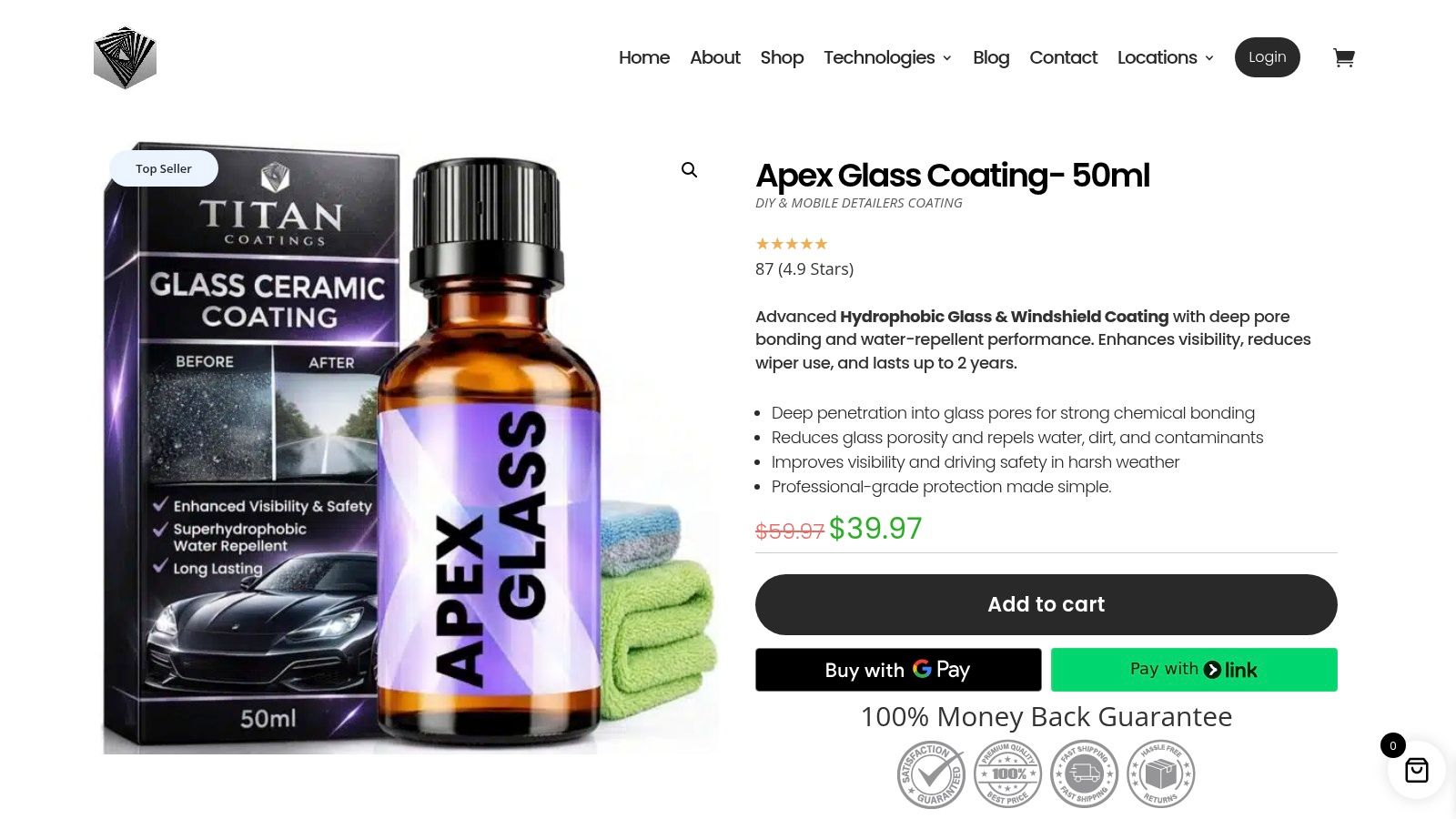
Apex Glass Ceramic Coatings addresses a simple but important pain point: visibility. It enhances water behavior on the windshield and helps make rain driving less stressful. Just as important, it's easy to use. That matters because glass coatings fail when people avoid them or apply them inconsistently.
If you work with clients who are comparing local service options before they buy products for home use, a practical reference point is this overview of ceramic coating services. It helps frame what professional installation can involve, which makes it easier for owners to decide whether they want a service, a maintenance product, or a DIY route.
Dark Matter tech and harsh exposure
For surfaces facing brutal environmental pressure, UV and thermal shock matter as much as water behavior. Titan's proprietary Dark Matter Technology® uses vertically aligned carbon nanotubes grown on chlorine-etched aluminum foil, enabling the coating to absorb 99.995% of incident light and energy, which supports ultra-high resistance to UV degradation, thermal shock, and chemical corrosion in extreme environments, as described in this Dark Matter Technology® post.
That kind of engineering explains why advanced coatings can be relevant far beyond body panels. Heat-stressed surfaces, exposed components, and severe-environment use cases all benefit from chemistry built to stay stable under load. For readers dealing with demanding thermal conditions, high-temperature ceramic coatings are worth understanding because not every surface sees the same type of abuse.
Fast maintenance still needs good chemistry
Then there's the maintenance side. Ultra Ceramic Spray fills an important role because not every owner wants a full coating session every time they refresh protection. A spray format that installs easily and leaves strong visual and functional results is useful for topper duty, maintenance intervals, or stand-alone protection when time is short.
A complete vehicle care strategy usually looks like this:
| Vehicle area | Main problem | Better coating choice |
|---|---|---|
| Windshield and glass | Rain visibility, film buildup | Apex Glass Ceramic Coatings |
| Paint maintenance | Quick refresh, easy install | Ultra Ceramic Spray |
| High-stress paint protection | Temperature swings, impact stress | Alpha Quartz |
That's total vehicle care. Not one bottle trying to do everything, but the right chemistry on the right surface.
A Practical Guide to Coating Selection and Prep
Bad prep ruins good chemistry. That's the blunt truth. Most complaints people pin on coatings start with contamination, leftover polishing oils, rushed panel wiping, or choosing a product that doesn't fit the installer's environment.
The prep workflow doesn't need to be complicated, but it does need to be disciplined.
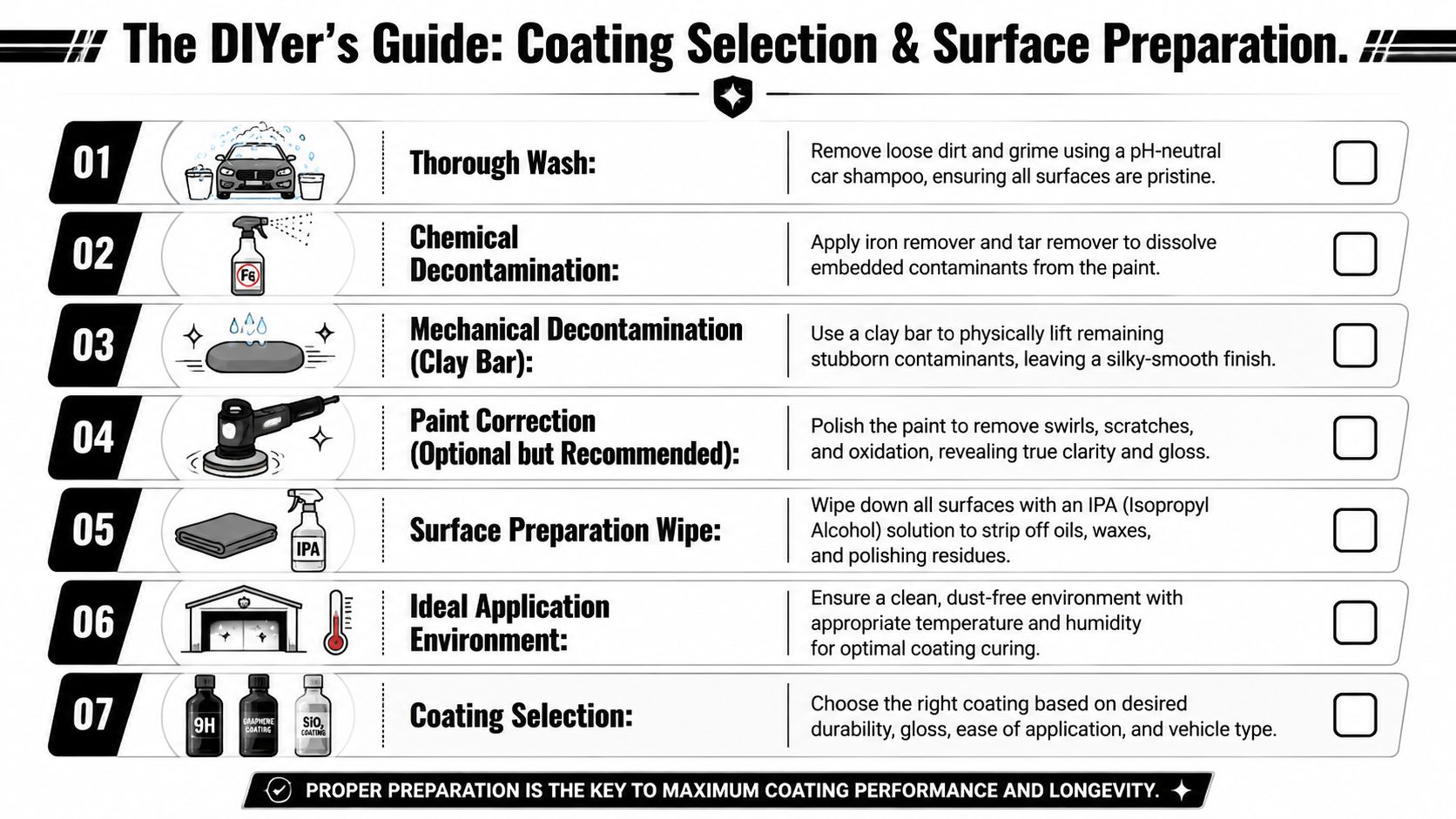
The prep sequence that actually works
Use a fixed order and don't skip steps just because the paint looks clean.
- Wash first. Remove loose dirt with a pH-neutral shampoo.
- Chemically decontaminate. Dissolve embedded fallout and tar before touching the surface more aggressively.
- Clay if needed. A smooth panel gives the coating a cleaner base.
- Correct the paint if the owner expects maximum gloss and clarity.
- Panel wipe thoroughly. Remove oils and residues that interfere with bonding.
- Control the environment as much as possible. Shade, clean air, and stable conditions help.
- Match the coating to the user, not just the marketing sheet.
Choosing the right product for the job
Many installers commonly err in their judgment. They buy for bragging rights, not use case.
- If you're a beginner, choose a coating with forgiving application behavior.
- If you work mobile, prioritize products that stay manageable outside perfect shop conditions.
- If the car lives outdoors, favor durability and environmental resilience over hype terms.
- If glass performance matters every day, use a dedicated glass product instead of expecting paint coating leftovers to do the job.
A simple comparison helps:
| User type | Best priority | Common mistake |
|---|---|---|
| DIY owner | Ease of application | Chasing the most aggressive coating available |
| Mobile detailer | Workability in variable conditions | Using products that need perfect control |
| Studio installer | Finish optimization | Assuming all clients need the same package |
Clean paint isn't prepared paint. A surface can look perfect and still be carrying enough residue to weaken the bond.
What surface-tolerant thinking teaches us
In industrial settings, ideal prep isn't always possible. That's why surface-tolerant coatings matter. They're designed to bond more effectively to less-than-perfect substrates such as aged coatings, tightly adhered rust, or contaminated conditions, as discussed in this video on surface-tolerant coatings for marginally prepared substrates. The lesson for detailers isn't to become sloppy. It's to understand that adhesion science decides outcomes.
That also explains why easier-install products often perform better in the hands of real users. A forgiving coating applied correctly beats a temperamental coating applied poorly every time.
The Future of Protection Is Flexible and Strong
The next stage of industrial coating applications won't be defined by hardness alone. The future belongs to coatings that stay intact when surfaces move, heat up, cool down, vibrate, and take real-world abuse. That's the lesson the automotive world borrowed from harsher industries, and it's the reason elastomer technology matters so much now.
Titan's upcoming 2026-release VULCAN ELASTOTEK® Rubber Membrane Coating uses Nano-Micro Expansion Technology to build a self-reinforcing polymer network that resists thermal expansion and contraction, helping the coating remain intact and non-cracking across frozen to extreme hot temperatures without flexural failure, according to this VULCAN ELASTOTEK® release reference. That's a projection tied to a specific product release, but it points in a clear direction. More protection systems are being designed to absorb stress instead of pretending stress doesn't exist.
What smart users will pay attention to
The winning question isn't “How hard is it?” It's “How does it behave over time?”
That means checking:
- Application fit for your skill level
- Surface compatibility with the substrate you're protecting
- Environmental resilience in your actual climate
- Safe handling discipline during storage and use
Anyone working regularly with coatings should also understand the basics of managing hazardous chemicals, because performance products still need to be handled responsibly.
The direction is clear. Coatings are getting smarter, more adaptable, and more useful to ordinary enthusiasts. The old trade-off between a hard finish and a durable one is fading. Strong protection now has to flex.
If you want coating technology built around that exact idea, explore APEX NANO – Titan Coatings. Their lineup brings advanced elastomer, nanotube, glass, and spray coating solutions into a form that works for detailers, mobile pros, and committed DIY owners who want protection that looks sharp and holds up effectively in practice.
0 Comments