
John had his boat hauled on a Thursday morning, looked at the brown slime line and the first barnacle clusters, and said what every owner says at some point: “I just painted this thing.” By Saturday, he was back in the yard wearing dust, rolling fresh antifouling, and wondering why boat protection always seems to start and stop at the waterline.
The Annual Battle for a Clean Hull
Every yard has a John.
He's the owner who washes the topsides, keeps the stainless polished, covers the cockpit, and still gets blindsided when the bottom starts failing. If a boat lives in the water, growth wins unless the protection system is right.
What owners usually get wrong
Most owners think bottom paint is a once-a-year product decision. It isn't. It's a maintenance strategy that starts with where the boat lives, how often it moves, what hull material sits under the coating, and whether the old paint system still has enough integrity to support another season.
The frustrating part is that a boat can look excellent from the dock and still be losing performance underneath. Slime starts first. Then soft growth. Then the hard stuff. By the time you feel it at the throttle or see it when the boat is hauled, the work is already waiting for you.
Shop-floor truth: The bottom usually fails long before the owner admits it needs attention.
I've seen owners chase the wrong fix by buying a “stronger” paint when the underlying problem was poor prep, incompatible layers, or a boat that sat still in a fouling-heavy marina too long. I've also seen the opposite. A smart owner chooses the right paint, applies it correctly, and still watches the rest of the boat age faster than it should because nobody treated the protection system as a whole-vessel job.
Bottom paint is only one piece
Hull bottoms need antifouling. That part doesn't change. But if you're serious about preserving a boat, you can't ignore the topsides, the exposed fiberglass, and the glass. Sun, salt, wash cycles, dock rash, and temperature swings don't stop at the waterline.
That's why experienced owners start thinking beyond one annual haul-out and look at the entire envelope of protection, including gel coat care for fiberglass boats. A clean hull matters. So does keeping the visible part of the boat from oxidizing, staining, and losing clarity.
A smarter routine cuts wasted labor. It also cuts the cycle of fixing the same surfaces over and over.
Understanding the Unseen Enemy Below
Marine boat bottom paint exists for one reason. It keeps marine life from turning your hull into habitat.
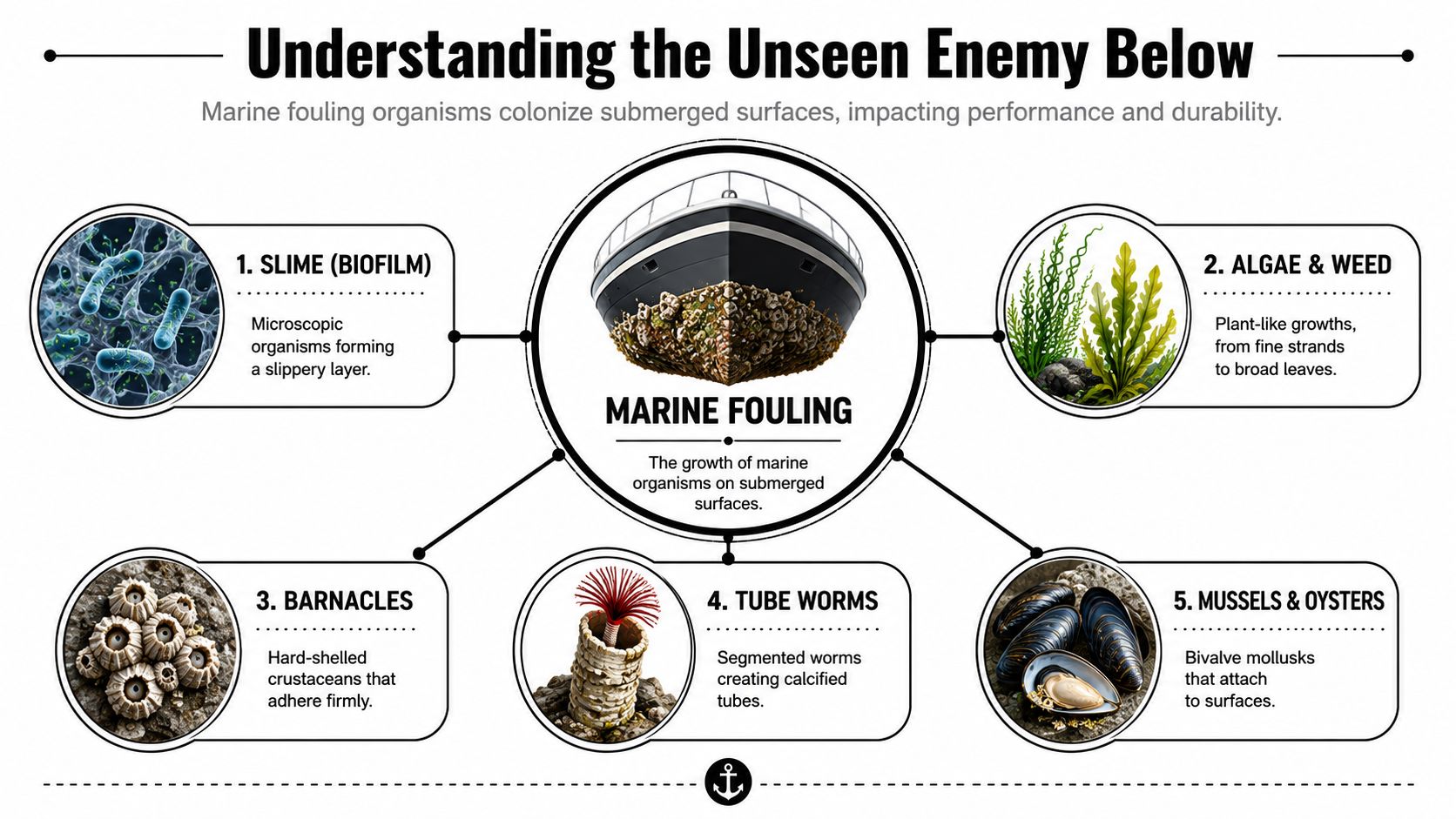
Below the waterline, growth starts small and gets expensive fast. A thin biofilm doesn't look dramatic, but it creates resistance. Add algae, weed, barnacles, tube worms, mussels, or oysters, and the hull stops moving cleanly through the water. In practical terms, fouling acts like a drag device attached to the boat all day, every day it sits submerged.
What fouling actually looks like
The enemy isn't just barnacles.
- Slime and biofilm build first. They form a slick layer that feels harmless but creates drag and gives heavier growth something to hold onto.
- Algae and weed spread next in many waters. They can stay soft, stringy, or leaf-like depending on temperature, nutrients, and how often the boat moves.
- Barnacles and shell growth are what owners notice most because they lock on hard and turn removal into grinding, scraping, and repainting work.
- Tube worms, mussels, and oysters show up where conditions suit them, especially on neglected bottoms, running gear, and waterline transitions.
Why the paint exists at all
This problem is old. The history matters because it explains why today's coatings are built the way they are.
The history of antifouling development in Proceedings notes that the first major breakthrough was copper sheathing in the 18th century, but that approach failed once iron ships arrived in the 19th century because galvanic corrosion between copper and iron destroyed hulls. That pushed the industry toward modern antifouling paints that could sit over protective coatings on steel.
That historical shift still affects product selection today. You're never choosing “paint” in a generic sense. You're choosing a controlled barrier that has to balance adhesion, compatibility, release rate, service interval, and hull material.
Growth doesn't care whether the owner had a busy month. It keeps attaching every day the boat is in the water.
The practical consequence
If your boat lives on a trailer and only splashes for short runs, you have more flexibility. If it stays in the water, especially in warm or nutrient-rich areas, bottom protection moves from optional to operational.
That's the first mindset shift. Marine boat bottom paint isn't cosmetic. It's a working system that protects speed, handling, cleaning effort, and the condition of the hull itself.
Choosing Your Shield Types of Antifouling Paint
I have seen plenty of hulls painted with the wrong product for the job. Fresh coat, nice color, owner feels good at launch. Sixty days later the bottom is loaded up, the waterline is furry, and everyone blames the brand when paint selection was the problem.
Bottom paint has to match how the boat lives. Then the rest of the protection plan should match the same standard. A smart owner treats the hull, topsides, and glass as one exposure system, not separate chores.
Ablative paint
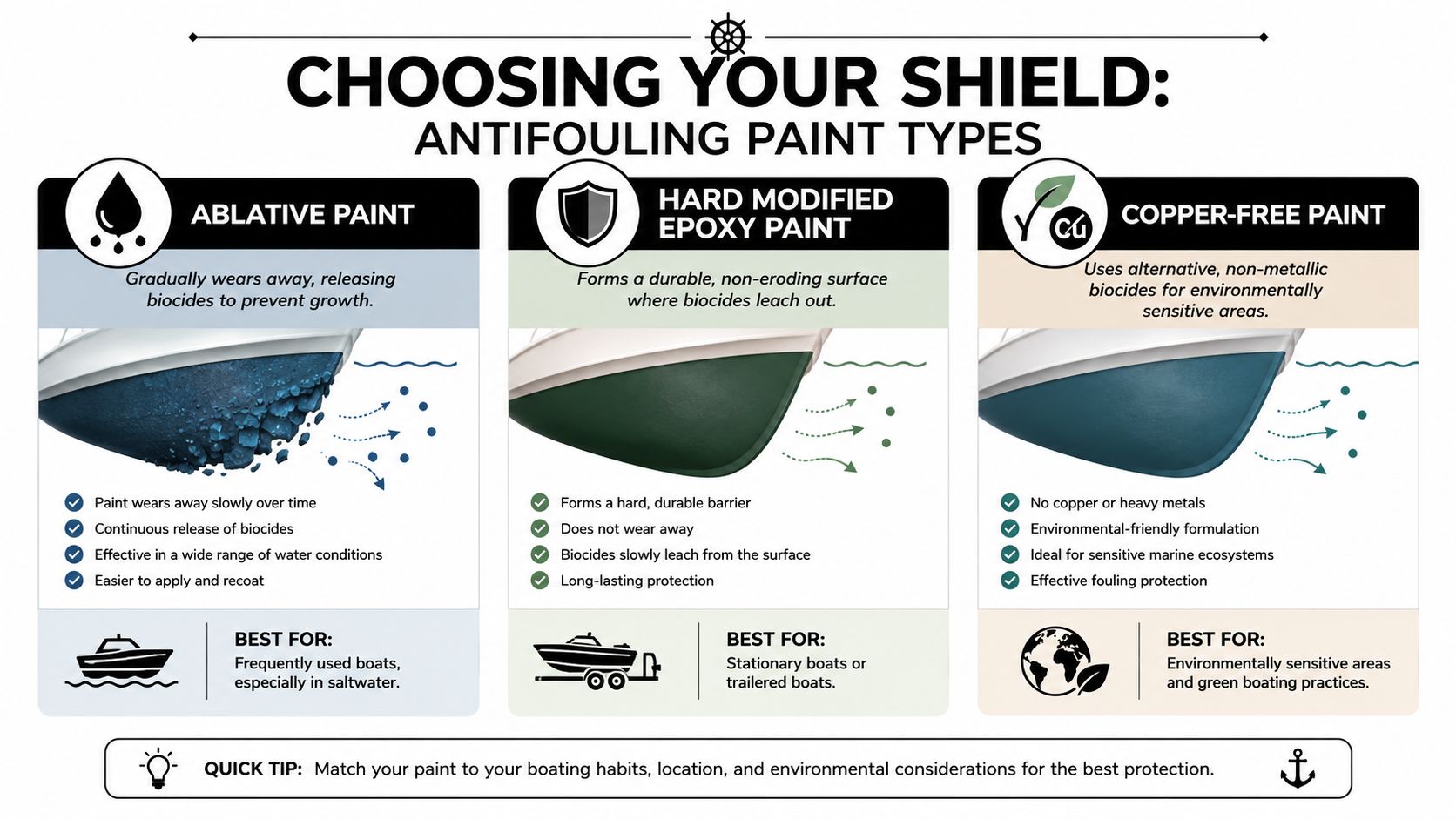
Ablative paint wears away in service and keeps exposing fresh biocide. That makes it a strong fit for boats that stay active, especially cruisers, center consoles, and seasonal boats that rack up real water time.
The big advantage is reduced paint buildup. Year after year, that matters. You avoid stacking up heavy old layers that eventually have to be sanded back or stripped.
The trade-off is simple. Ablatives are not the best choice where frequent aggressive scrubbing is part of the maintenance routine. Use the wrong brush or clean too hard, and you shorten the service life you paid for.
Hard paint
Hard paint cures into a firmer film and holds up better under cleaning, trailering contact, and higher-abrasion use. It is often the better choice for faster boats, race boats, and owners who know divers will be cleaning the bottom on a regular schedule.
Practical Sailor's field-trial review of bottom paints found that certain hard antifouling paints with high copper content performed better against hard and soft fouling in multi-year testing. That lines up with what yards see in the field. In heavy-growth areas, a harder film can hold its line better if the maintenance plan includes periodic cleaning.
Hard paint still comes with a cost. It builds film thickness over time. After enough recoats, the hull usually needs a reset.
Copper-free and aluminum-safe systems
Copper-heavy paint and aluminum do not belong together. For aluminum hulls, outdrives, and other sensitive metals, the coating has to be chosen with galvanic risk in mind from the start.
BoatUS explains aluminum bottom-paint selection clearly. Avoid cuprous oxide on aluminum and use aluminum-safe antifouling systems instead, including copper-free products where appropriate.
That same thinking is spreading beyond metal compatibility. Some marinas and local waters push owners toward lower-copper options, so copper-free paints are no longer a niche category. They are a practical answer for certain hulls, certain harbors, and owners trying to reduce environmental load without giving up fouling control.
Practical rule: If the hull is aluminum, confirm compatibility for every layer, primer, antifouling, and any exposed underwater metals before paint goes on.
Quick selection table
| Boat situation | Usually the better fit | Why |
|---|---|---|
| Boat lives in the water and gets regular use | Ablative | Fresh antifouling surface renews over time |
| Boat needs a durable, scrubbable finish | Hard paint | Better resistance to cleaning and abrasion |
| Aluminum hull | Copper-free or aluminum-safe formula | Avoids galvanic corrosion risk |
| Environmentally restricted marina | Copper-free system | Helps meet local product restrictions |
What actually works
Use pattern matters more than label language.
- Trailered boats often do fine with lighter protection strategies because they are not sitting wet long enough to justify a heavy antifouling system in many cases.
- Slip-kept saltwater boats usually need a more durable fouling-control plan because growth pressure is higher and missed maintenance shows up fast.
- Boats that sit idle often foul harder at the waterline and in low-flow areas than boats that run often.
- Switching paint types calls for compatibility checks and, in many cases, the right primer between systems.
Good owners also start looking past the bottom. A clean hull helps performance, but it does nothing for chalked gelcoat, stained glass, or UV-beaten topsides. That is where a full-vessel approach pays off. Traditional antifouling handles what lives underwater. Advanced elastomer coatings from Titan protect exposed painted surfaces and marine glass above the waterline, so the whole boat stays easier to clean, better looking, and better protected.
If you are comparing products before haul-out, this guide on where to buy marine paint for boats helps narrow the options by hull type, usage, and protection goals.
The Foundation of Flawless Application
I have seen expensive antifouling fail before the season even got going, and the can was not the problem. The hull was.
Good bottom paint lives or dies on surface prep, film build, and timing. Brand matters. Chemistry matters. But a dirty, unstable, poorly primed hull will beat any product on the shelf.
Prep decides whether the paint lasts
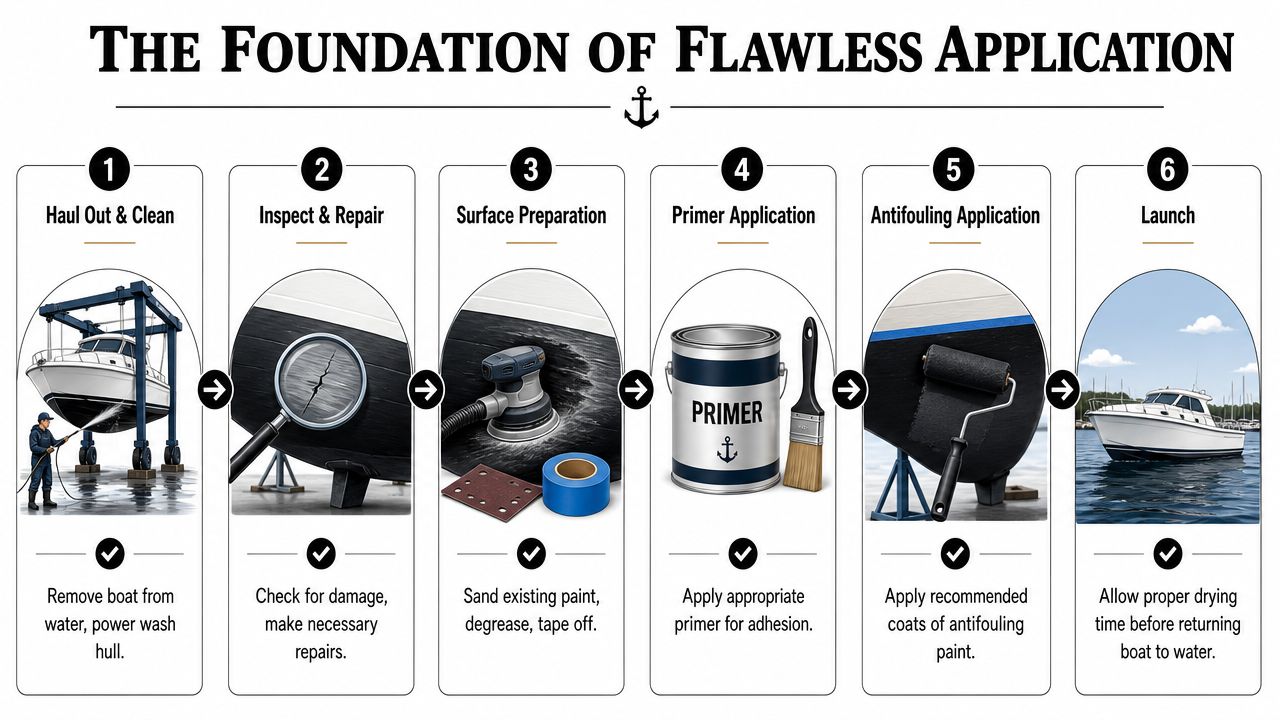
Start at haul-out, not the day you open the paint. Pressure wash while growth is still soft. Once the hull dries, inspect it with a hard eye. Check the waterline, previous repairs, keel edges, through-hulls, transducers, blister repairs, and any area where the old coating looks chalky, soft, or loose.
A sound existing coating can usually be sanded, cleaned, and recoated. An unstable one needs to be removed or sealed off with the right tie-coat or primer. Painting over weak edges only hides the problem until the boat is back in service.
A working application sequence
This sequence holds up in the yard because it cuts out the usual causes of early failure:
Wash before sanding
Get rid of slime, salts, and loose residue first. Sanding contamination into the surface creates more work and weaker adhesion.Inspect every transition area
Hard corners, chines, strakes, keel bottoms, around trim tabs, and repaired sections usually fail first because film thickness gets inconsistent there.Sand for profile, not appearance
The goal is a uniform mechanical tooth. Feather old edges, remove loose material, and leave a surface the next coat can bite into.Remove dust and solvent-wipe correctly
Dust, wax, oil, and even sweaty fingerprints can interfere with bond strength. Clean after sanding, then tape and mask.Prime bare substrate and system changes
Exposed fiberglass, barrier-coated areas, metals, and paint-system transitions need the primer the manufacturer calls for. Skipping that step is one of the fastest ways to lose a bottom job.Apply for coverage and film consistency
Roll the antifouling evenly, watch your spread rate, and pay attention to leading edges and high-wear zones. Those areas often need extra attention because they erode faster underway.
The paint cannot protect a hull it never bonded to.
Timing and conditions decide how the coating cures
Application conditions are where many DIY jobs go sideways. If the hull is too cold, too hot, damp, or sitting in heavy humidity, the coating may flash improperly, hold solvent, or cure soft. Recoat windows and launch windows matter just as much as prep because antifouling systems are built around a specific cure schedule.
The right approach is simple. Read the technical data sheet for the exact product in hand and follow its temperature, humidity, overcoating, and launch guidance without improvising. Those numbers vary by resin system, solvent package, and substrate, especially on aluminum-safe products.
Common failure points
- Coating over incompatible paint systems leads to peeling and sheet failure.
- Leaving moisture, dust, or wax on the hull causes patchy adhesion and localized blistering.
- Using copper-based paint on aluminum or other sensitive metals creates a corrosion problem that can cost far more than the paint job.
- Missing the launch window can reduce performance on paints designed to go in the water within a defined time after application.
- Ignoring seams and detail areas on metal boats lets water work into vulnerable edges long before the broad hull panels show trouble.
Owners working on aluminum hulls should also pay attention to seam protection and corrosion-sensitive joints before paint goes on. This guide to aluminium boat sealant for marine seam and edge protection is a useful reference during prep.
The Titan Difference Protecting the Entire Investment
John finally got his bottom paint sorted. Then he looked up.
The hull sides still took UV every day. The windshield still spotted and lost clarity in bad weather. The exposed surfaces still expanded and contracted in changing temperatures. He had solved the underwater problem and left the rest of the boat in a separate maintenance battle.
Hull protection shouldn't stop at the waterline
Traditional antifouling does one job. It protects submerged surfaces from growth. It does not solve oxidation on topsides, water spotting on glass, or stress from heat and cold on exposed finishes.
That's where advanced elastomer coatings change the conversation. Titan pioneered the introduction of carbon nanotubes into the automotive coatings market in 2021, becoming the first company to integrate CNT reinforcement into elastomer-based coating systems for marine and industrial applications, as described on Titan's technology page.
The upper half of a vessel exhibits different failure characteristics than the lower half. It gets hit by UV, chemical exposure, wash abrasion, bug residue on tow vehicles, dock contact, and repeated temperature swings.
Why elastomer chemistry matters
Titan's ElastoTek® technology explanation describes a membrane-forming elastomer blend that is hard like glass yet flexible enough to withstand temperature extremes from frozen to hot without cracking. That combination is exactly what many exposed marine and transport surfaces have needed for years.
A coating that stays rigid in all conditions can become brittle. A coating that stays soft may not deliver the surface durability owners expect. The appeal here is the balance. Hard surface behavior with elastic movement underneath.
Above the waterline, flexibility is often the difference between a coating that survives and one that starts micro-failing where owners can't yet see it.
Practical product fit above the waterline
Three products make sense in the practical care routine around boats, tow rigs, and support equipment:
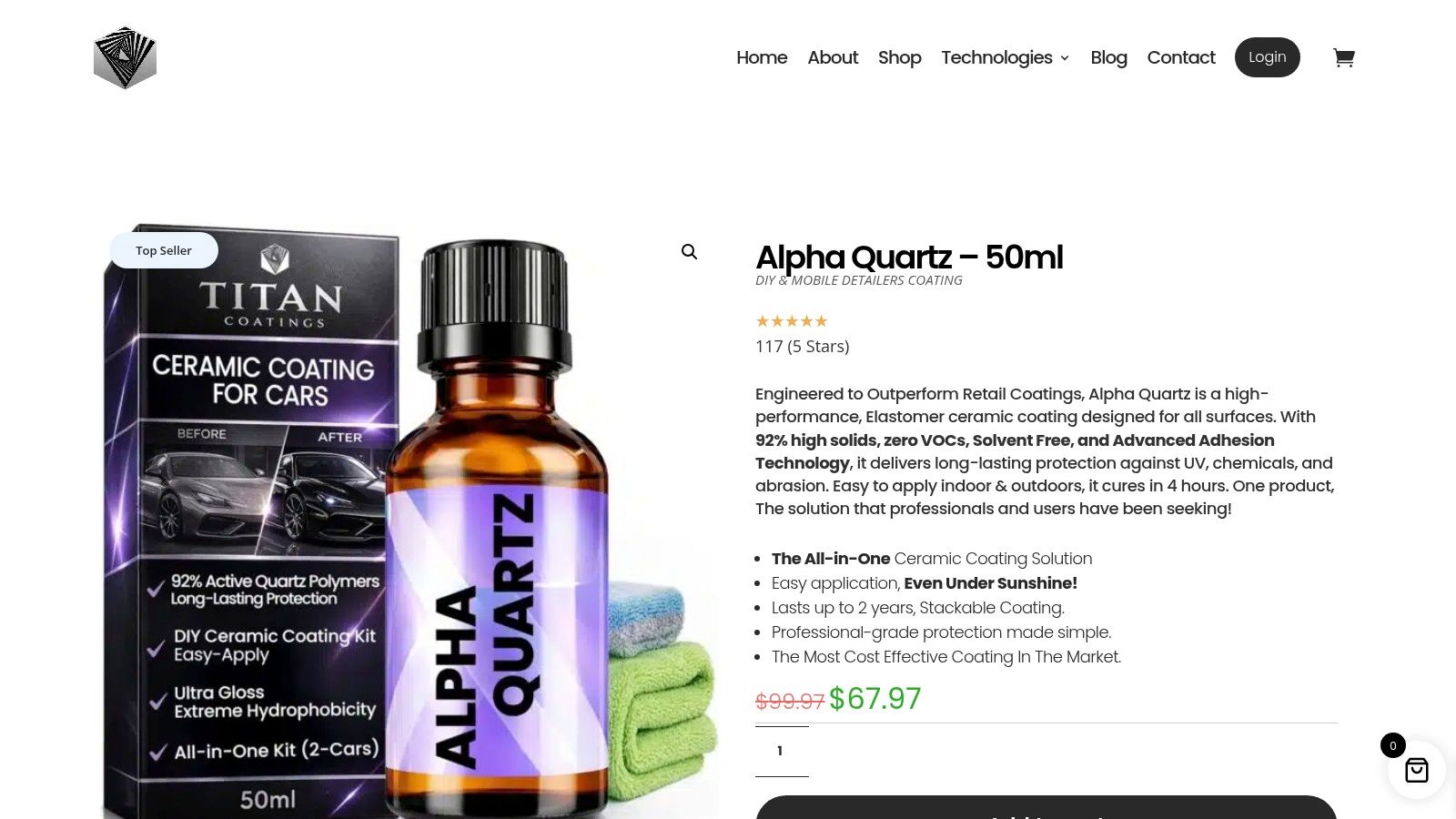
- Alpha Quartz fits owners and detailers who want an easy-to-install elastomer coating for visible painted and finished surfaces. It's a good match for DIY users and mobile detailers who need strong results without turning application into a lab project.
- Apex Glass addresses one of the most overlooked safety issues on any vessel or tow vehicle. Visibility in rain. The Apex Glass ceramic coating product page is worth a look if you want a glass and windshield coating that's easy to use and reduces the stress of driving or running in wet weather.
- Ultra Ceramic Spray is the fast-application option for users who want a simpler install with clean results. The Ultra Ceramic Spray product page suits detailers and owners who value ease and consistency.
Titan also presents its broader elastomer approach on the Titan Coatings elastomer page, which helps explain why these systems complement rather than replace antifouling. Bottom paint still belongs below the waterline. Elastomer coatings make the rest of the vessel tougher, easier to maintain, and better protected in service.
The advanced materials angle
Titan's Dark Matter Technology® overview states that the coating system combines vertically aligned carbon nanotubes with high-performance matrices and can absorb 99.995% of incident radiation while delivering protection against UV degradation, chemical exposure, and abrasion.
That's a different class of thinking than old-school “wax it again” maintenance. It's not about making one surface shiny. It's about building a more resilient vessel exterior from the hull sides to the glass.
Navigating Environmental and Safety Regulations
The old mindset was simple. Put copper on the bottom and call it protected. That approach doesn't age well in tightly packed marinas, enclosed bays, and places where runoff, hull cleaning, and leaching all stack up in the same water.
The environmental pressure is no longer theoretical. It's measurable in the places where boats concentrate.
The copper problem owners can't ignore
The Rocket Trailers overview of bottom painting states that a standard 30-foot boat can release approximately two pounds of copper annually from copper-based bottom paint. The same source cites San Diego Bay research showing that 72% of the copper entering the water came from antifouling paint discharges and in-water hull cleaning activities.
That changes how responsible owners evaluate product choice. Copper still works. It also carries consequences in sensitive waters, especially where many boats sit close together for long periods.
What compliance looks like in practice
Some marinas already restrict copper-based paints or strongly steer owners toward alternatives. Even where a ban isn't in place, the direction is clear. Owners need to expect more scrutiny around what goes on the hull, what comes off during cleaning, and how sanding waste is contained.
The same thinking shows up in adjacent maintenance categories. If you handle winterization and service materials yourself, it helps to understand broader shop and yard standards around compliance for eco-friendly antifreeze, because environmental compliance rarely stops with one product type.
Safety in the yard still matters
Bottom paint is a coatings job, not a casual weekend chore.
- Wear a respirator when sanding old antifouling. You don't want that dust in your lungs.
- Use gloves and eye protection during prep, mixing, and application.
- Contain debris and dust instead of letting the yard or driveway collect it.
- Read local marina rules first because disposal standards and approved products can differ.
If your goal is to reduce environmental burden while protecting marine surfaces, this overview of sustainable coating approaches is a useful starting point for broader coating strategy.
A Smarter Future for Marine Maintenance
I have seen plenty of boats with a fresh bottom job and tired everything else. Six months later, the hull is still doing its part, but the topsides are chalking, the glass is spotting, and owners are back to polishing surfaces they thought they had already handled.
Smart maintenance treats the boat as one system. Bottom paint still matters. So do the surfaces above the waterline that take UV, salt, heat, wash chemicals, and dock rash every week. A more complete approach protects the hull with the right antifouling, then adds flexible elastomer coatings and advanced glass protection where traditional waxes and sealants fall short.
That shift changes the maintenance cycle. Instead of resetting the boat every season, owners spend less time correcting oxidation, chasing water spots, and dealing with surface cracking after temperature swings. The payoff is practical. Better appearance, easier washdowns, and fewer coating failures across the vessel.
Cleanup discipline stays part of the job. If you are removing old coatings, collecting sanding dust, or disposing of contaminated waste, 360 Hazardous Cleanup's compliance guide is a solid reference for handling the mess correctly.
Titan stands out here because the product line goes beyond the hull. Traditional antifouling handles growth control below the waterline. Titan's elastomer and ceramic-based options extend protection to topsides and glass, helping owners protect the full investment instead of solving one exposure point at a time.
If you want coating solutions that go beyond routine maintenance, explore APEX NANO – Titan Coatings. Their elastomer and advanced ceramic technologies bring durable protection to marine, automotive, and other exposed surfaces, with easy-to-use options like Alpha Quartz, Apex Glass, and Ultra Ceramic Spray for owners and detailers who want smarter long-term results.
0 Comments