
The first time I swapped a crate of small bottles for a row of labeled 5-gallon containers, the whole van changed. The mess dropped, the workflow tightened up, and I stopped looking like a guy chasing supplies instead of running a professional detailing operation.
The End of Fumbling with Small Bottles
Every detailer starts with the same optimism. A few trigger sprayers, a shelf of consumer bottles, maybe a tote full of backups, and the belief that staying organized will be easy if you just “keep on top of it.”
That works for a while. Then the van fills up.
Alex was the kind of mobile detailer with real hands. Good correction work, careful around trim, disciplined with prep, and strong with customers. But his setup was holding him back. He had small bottles rolling under seats, half-used sprayers with faded labels, and products decanted so many times he had to stop and sniff before using them.
The hidden cost of small-bottle habits
The actual problem wasn't only clutter. It was interruption.
Every refill broke momentum. Every spill ate product. Every time he had to unscrew a cap, top off a sprayer, wipe a drip, and guess whether that bottle still had enough for the next vehicle, he lost the one thing a detailer can't buy back once the job starts. Rhythm.
I've seen that exact stage in plenty of vans. The detailer isn't lazy. The system is.
A small bottle setup feels flexible because you can move things around. In practice, it creates constant friction:
- Refill delays: You finish one stage and then stop cold to mix or refill.
- Inconsistent output: One bottle mists well, another dribbles, another has a weak trigger.
- Cross-use mistakes: Similar bottles lead to wrong-product grabs when you're moving fast.
- Wasted space: Dozens of little containers take up more working room than people expect.
For lighter day-to-day jobs, a good trigger spray bottle for detailing chemicals still has its place. The mistake is building your entire workflow around small bottles as if you're still testing products on weekends.
The moment the switch makes sense
Alex finally got it when he visited a higher-end shop. The wall was clean. Bulk containers were fixed in place. Each chemical had a dedicated pump. No guessing, no clutter, no searching.
That setup did more than look professional. It changed the pace of work.
Practical rule: If you touch the same liquid on most jobs, it deserves a permanent place in your system.
The broader market is moving the same way. The 5-gallon water bottle market was valued at USD 7.83 billion in 2024 and is projected to reach USD 10.39 billion by 2032, growing at a CAGR of 3.6%, with the 5-gallon dispenser serving as the critical interface for controlled, hygiene-focused dispensing, according to Credence Research on the 5-gallon water bottle market.
In detailing, that same logic applies. A 5 gallon pump dispenser isn't just a container accessory. It's a sign you've stopped working out of convenience and started building for consistency.
Choosing Your Pro Dispensing System
The first real upgrade is not the coating. It's the moment you stop buying pumps by cap thread and start choosing a dispensing system like it affects your margin, because it does.
I learned that after switching a shop from scattered quart bottles to fixed 5-gallon product stations. Product loss dropped. Misfires dropped. Techs stopped overpouring expensive chemistry because every stroke delivered the same amount. That is the rite of passage. A 5 gallon pump dispenser marks the point where a detailer stops working like a weekend tester and starts building a repeatable business.
Some pumps survive soap and dressings just fine. Advanced elastomer coatings, heavier concentrates, and cold-thickened liquids expose weak seals, poor valve design, and sloppy output fast.
Start with the type of pump
Pump choice comes down to three things. How often you dispense, how thick the product is, and how controlled the dose needs to be.
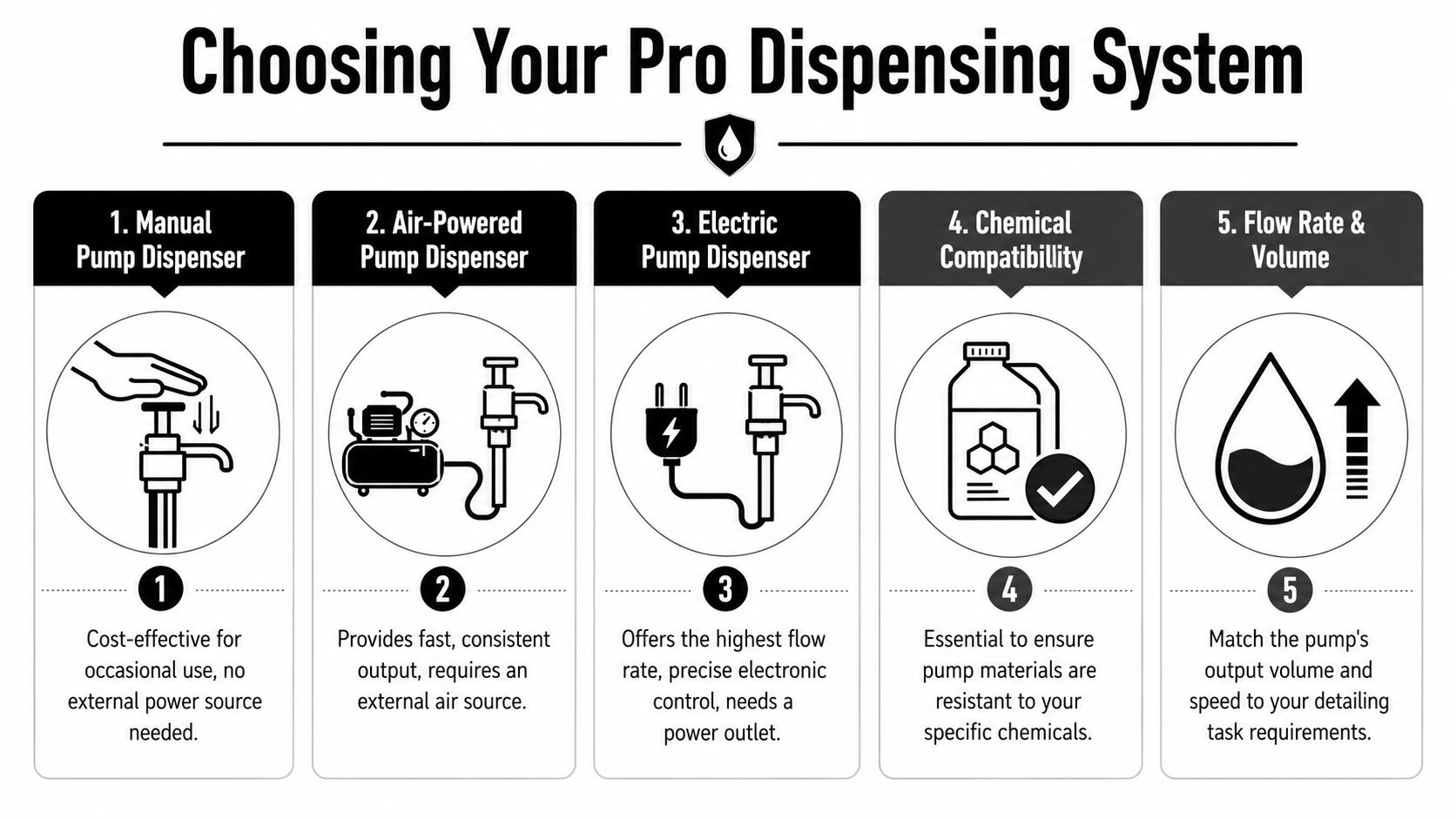
Here's the breakdown I give apprentices:
| Pump type | Best fit | Trade-off |
|---|---|---|
| Manual pump | Lower-volume use, simple mobile setups | Slower, depends on operator consistency |
| Air-powered pump | Higher throughput in a shop | Needs an external air source |
| Electric pump | Fast dispensing and repeatable control | Needs power and more planning |
Manual pumps work when the product moves easily and the crew is disciplined. Air-powered setups suit busy shops where speed matters and compressed air is already part of the bay. Electric pumps earn their keep when you need repeatable fills and less hand fatigue, but they add wiring, charging, or inverter planning.
If you're mapping out a full van or studio workflow, a practical mobile detailing equipment list helps you plan pumps as part of the whole system instead of treating them like an afterthought.
The mistake most detailers make
Too many buyers focus on fitment first and chemistry second. That is backwards.
A pump can screw on perfectly and still be the wrong tool. Viscosity matters. Seal material matters. Internal passage size matters. A lot of pumps claim they can handle thick liquids, but the critical test comes on a cold morning with a high-value product that has no patience for weak priming or inconsistent draw. The pump FAQ notes on thick-liquid priming and compatibility are worth reading for that reason.
I've seen detailers blame the coating when the dispenser was the source of the problem. The pump would hesitate, burp, then spit an uneven dose. By the end of the week, there was residue around the neck, guesswork in the mix process, and a tech who had started compensating with extra strokes. That is how profit leaks out of a shop.
Bad dispensing does not stay at the jug. It shows up in waste, rework, and inconsistent results on the vehicle.
Match the pump to the work
Advanced elastomer coatings raise the standard for hardware. Titan's coating technology is a good example. Products built around more advanced chemistry deserve a dispenser that can move them cleanly, meter them consistently, and keep contamination out.
Alpha Quartz makes the point well. It's approachable for DIY users and mobile detailers, but its elastomer-based behavior still calls for clean, controlled handling. On the panel, that flexibility helps with temperature swings and light impact resistance. In the container, you still need a pump that flows smoothly and does not trap product in dead spots or fight the operator every time they prime it.
That is why I tell newer techs to buy for the hardest product they plan to use, not the thinnest one on the shelf. If the pump can handle advanced coatings cleanly, it will usually handle your lighter chemicals without drama.
If you want a useful outside-industry comparison, hospitality operators also care about throughput, hygiene, and repeatability. That makes this guide to commercial dispenser machines a helpful reference for system design, even though the fluids and use cases are different.
Check the full product range at Titan Coatings shop if you're comparing coating options alongside dispensing hardware.
Installation for Your Shop or Mobile Rig
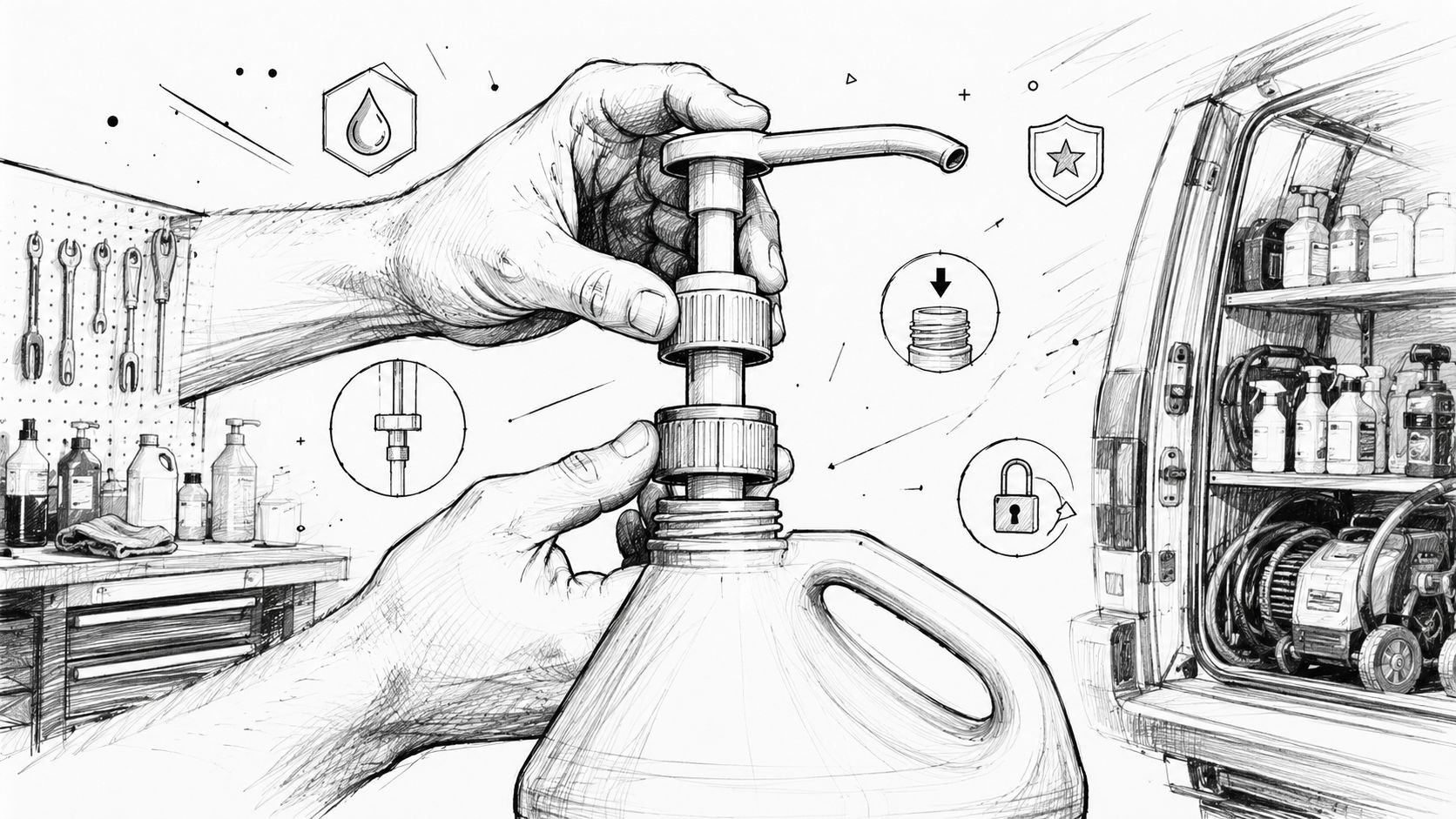
A good pump still fails if the install is sloppy. Most dispenser problems blamed on “bad equipment” start with poor mounting, poor placement, or a container that shifts every time the vehicle turns.
The right installation feels boring. That's the point. It should disappear into your workflow.
Shop setup that works every day
In a fixed shop, I want bulk containers mounted where the tech can reach them without bending awkwardly or walking across the bay. Shoulder-to-mid-torso height usually keeps dispensing controlled and keeps the floor cleaner.
The best installs share a few habits:
- Leave hand clearance: Don't crowd the pumps so tightly that your knuckles hit the next jug.
- Use visible labels: Product name, intended use, and whether the pump is dedicated.
- Add drip control: A tray, pad, or catch surface keeps residue off shelving and floors.
- Keep the sequence logical: Wash-stage products together, decon together, coatings in a protected zone.
A clean wall of pumps tells your team where everything belongs. It also tells the customer that your process isn't improvised.
Mobile rig setup without the headaches
In a van or trailer, movement is the enemy. A 5-gallon container that tips once can waste product, soak other tools, and leave residue in places you'll be cleaning for weeks.
Use rigid shelving if you can. If not, heavy-duty strapping is the minimum. The container shouldn't slide, rock, or lean when you brake hard. The pump head also needs enough overhead space so it doesn't take impact every time you load gear nearby.
If you're planning the whole water and fluid side of a van, this practical guide on a mobile detailing water tank setup is worth reviewing alongside your chemical layout.
Secure the jug first, then tune the workflow around it. Never do that in reverse.
The little details that prevent big mistakes
Cross-contamination usually starts small. One unlabeled pump. One reused tube. One product moved “temporarily” into an empty container.
Avoid that with a simple discipline:
- Dedicate pumps to product families when possible.
- Color-code or mark the heads so nobody guesses.
- Keep coatings separate from general cleaners and degreasers.
- Test actuation after transport before starting the next job.
A mobile rig should survive potholes, heat, cold, and long days without turning into a leak test. If your install can't handle that, it isn't done.
Mastering Precise Dosing and Application
Most detailers think a pump is there to move liquid from a big jug into a smaller bottle. That's only half the story. The key advantage is repeatable dosing.
Once you get that right, your mixes get steadier, your coating use becomes more disciplined, and your results stop drifting from one vehicle to the next.
What a proper pump gives you
A standard 5-gallon pump dispenser for industrial coatings typically delivers 30 to 45 mL per actuation, and high-precision models are calibrated to 30 mL per push. That matters for nano-coatings, where film thickness needs to remain within ±5% of the target to perform as intended, according to ACP Detail's pump dispenser specification page.
That number changes how you work.
Instead of free-pouring and hoping your eye is good that day, you build a repeatable routine. Two pumps into a mixing bottle. One pump onto an applicator prep tray. A measured amount into a dedicated transfer bottle. Less guesswork means fewer avoidable errors.
Prime it properly and keep the stroke consistent
A new pump needs to be primed fully before you trust the output. Don't half-prime it and assume the next stroke will be full. It won't.
Use the same stroke length every time. Bottom out the pump cleanly, then let it return fully before the next press. Short-stroking gives you uneven volume, and uneven volume is where material waste and application inconsistency start.
Here's the habit I teach:
- Prime before the first job: Make sure the tube is loaded and flow is stable.
- Use complete strokes: Partial presses create partial doses.
- Dispense into the same vessel each time: Mixing cup, transfer bottle, or dedicated measuring container.
- Watch temperature: If a liquid feels slower than normal, don't force the pump. Check flow and reassess.
For other wash-stage dispensing tools that benefit from the same consistency mindset, a car soap foamer setup makes a good comparison. Good detailing gets easier when the tool meters product predictably.
Why this matters with glass and spray coatings
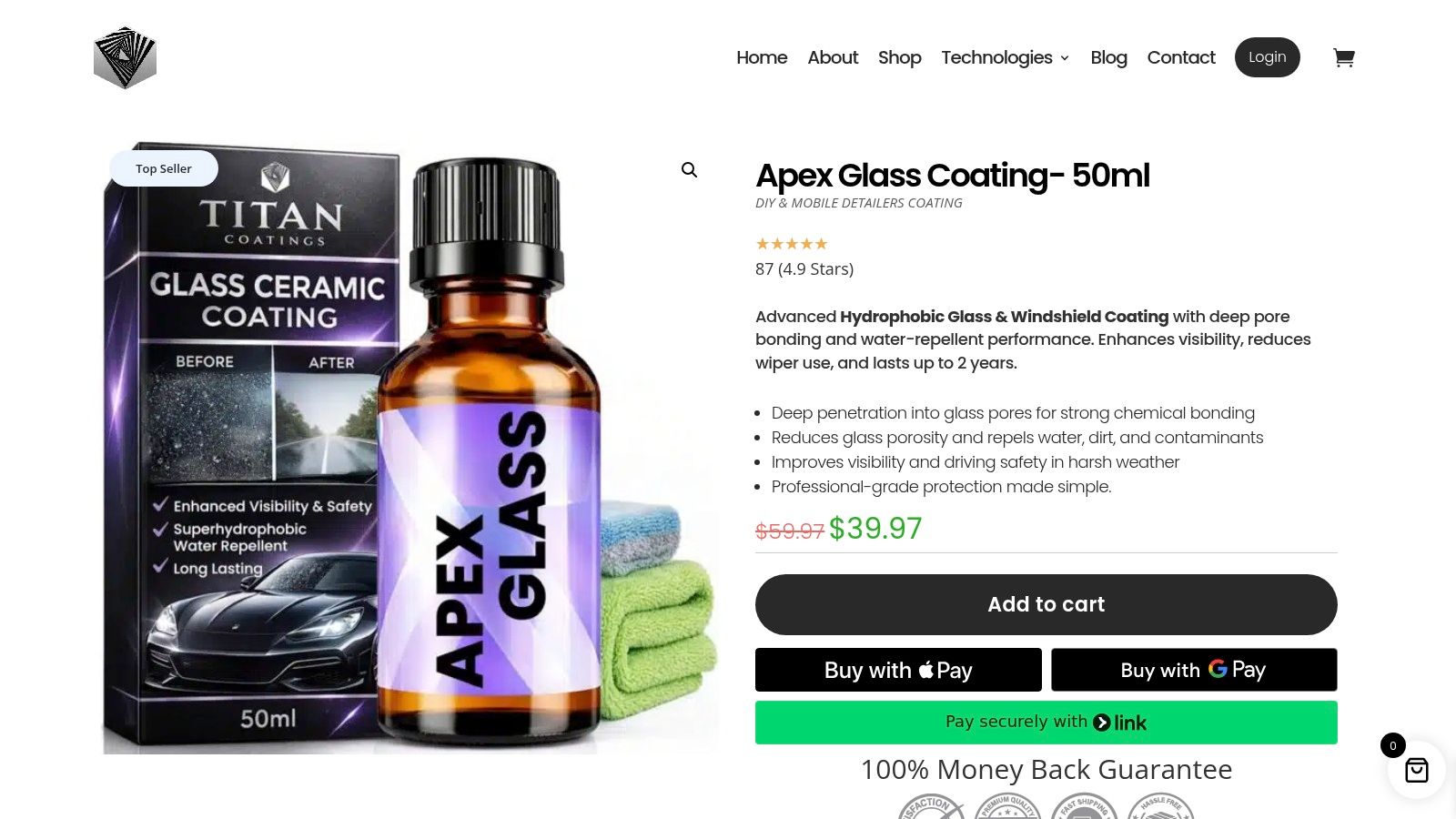
Apex Glass Ceramic Coating is one of those products that proves how valuable control is. It enhances visibility and helps make driving in the rain feel far less stressful, and one reason people like it is that it's straightforward to use when the prep is right. You can review it directly on the Apex Glass Ceramic Coating product page.
When you're feeding a transfer bottle or setting up a measured application routine, a controlled pump keeps you from overloading the process. That matters on windshields, where over-application can turn a simple job into extra leveling and cleanup.
The same thinking applies to Ultra Ceramic Spray. Easy installation is only easy when the product entering your process is consistent from the start.
Precision in dosing shows up later as precision in finish quality.
Titan's elastomer coatings are worth understanding through that lens. They are hard like glass and flexible, and that flexibility helps them last longer because they resist cracking when temperatures swing from frozen to hot. But coatings with advanced behavior still depend on disciplined application. A pump can't make up for bad prep, though it absolutely can remove one major source of inconsistency.
Essential Maintenance and Chemical Safety
The fastest way to ruin a good dispensing system is to treat every fluid like water. That's the old mistake. It survives because basic pumps are often sold with basic cleaning advice.
That advice isn't enough for reactive coatings.
Why a quick rinse isn't a maintenance plan
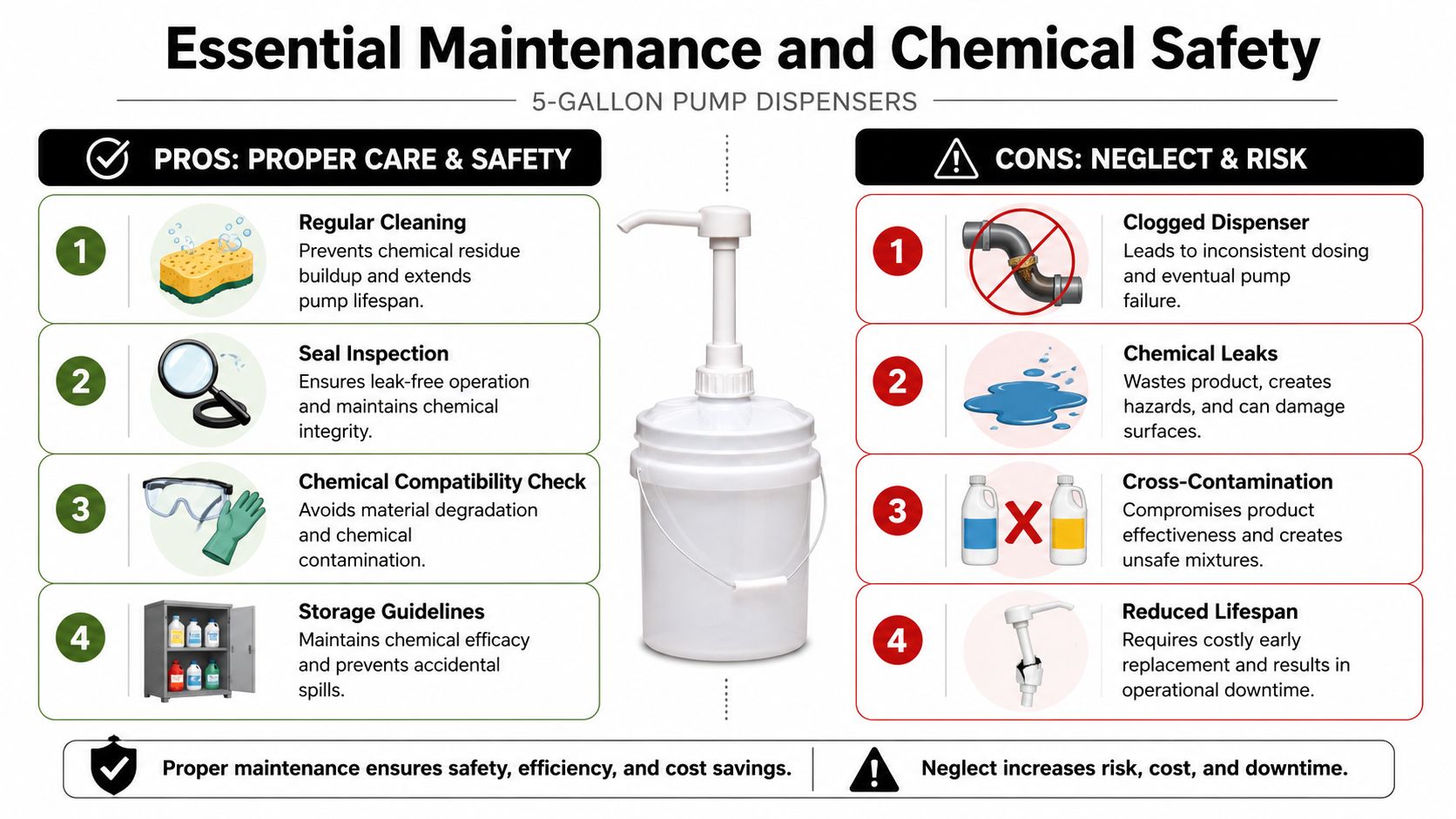
Standard cleaning advice for water dispensers often suggests vinegar and hot water on a routine schedule. That is inadequate for pumps holding reactive nano-coatings, and residue buildup plus chemical degradation of seals are leading causes of dispenser failure, while manufacturer guidance for nanomaterial-specific cleaning is still sparse, according to this water dispenser care document that highlights generic cleaning practices.
That gap matters in detailing because coatings don't behave like drinking water. They can leave active residue, attack the wrong seal material, and contaminate the next product if you reuse a pump casually.
What to do instead
I don't treat pump maintenance as housekeeping. I treat it as product protection.
Use a written routine, especially if multiple people touch the system:
- Inspect seals regularly: If the pump starts feeling different, don't ignore it.
- Flush with a compatible cleaner: The correct flush depends on the chemical involved.
- Keep pumps dedicated when possible: Shared pumps create risk faster than people think.
- Tag pumps out of service: If one is questionable, nobody should “just use it once.”
One of the most overlooked problems is the detailer who runs one coating, leaves the pump sitting, then comes back later expecting full performance. Internal residue hardens, flow changes, and the next application starts with bad dosing before anyone notices.
Cross-contamination is a shop problem, not just a pump problem
Titan was the first company to introduce elastomer coatings using nano tube technology and Dark Matter tech. That kind of chemistry deserves more respect in handling, not less. Advanced coatings can give outstanding durability because they combine hardness with flexibility, but that doesn't mean they tolerate careless transfer and storage.
If your shop also handles petroleum-based products, solvents, or hydraulic systems, it helps to review outside safety guidance like this hydraulic fluid flammability guide to sharpen your thinking around storage and hazard awareness. Different fluids behave differently. The habit of checking matters.
For mobile operators carrying multiple aggressive chemicals, a self-contained degreaser on wheels setup is another useful reminder that transport, containment, and dispensing all belong in one safety conversation.
A clean pump protects more than the tool. It protects the chemistry you paid for.
My own rule is simple. If I wouldn't trust the inside of a pump with a fresh coating batch, that pump doesn't go back into service until it's properly cleaned, checked, and reassigned.
Your New Standard of Detailing Excellence
Alex's van looked different after the switch. Fewer loose bottles. Less fumbling. Better pacing through the job. Customers might not have known what changed mechanically, but they could feel the difference in how the work flowed.
That shift is the true value of a 5 gallon pump dispenser.
What changes when you level up
You stop working like you're constantly restocking. You start working like the job has a system behind it.
The gains are practical:
- Cleaner workflow: Bulk storage reduces clutter and random bottle shuffle.
- Better consistency: Dosing becomes more repeatable.
- Safer handling: Containers are secured, labeled, and less likely to spill mid-job.
- Stronger presentation: Clients see a professional process, not a pile of supplies.
And there's a mindset change that matters just as much. Moving into a bulk system is a rite of passage for a serious detailer. It says you're not dabbling anymore. You're building repeatable results.
Professional tools deserve professional standards
The broader pump and dispenser market reflects that move toward precision and more advanced dispensing hardware. It is valued at approximately USD 8.8 billion globally in 2026 and is forecast to expand to USD 13.0 billion by 2033 at a CAGR of 5.7%, while the U.S. market was valued at USD 1.6 billion in 2024 and is anticipated to reach USD 2.4 billion by 2035, and the automotive pump and dispenser market is estimated at USD 0.7 billion in 2025 and projected to reach USD 1.3 billion by 2035, according to Persistence Market Research on pump and dispenser market growth.
That doesn't mean every detailer needs the most complex setup. It does mean the industry is moving toward cleaner, more controlled fluid management. Good shops are doing it because it works.
Titan Coatings is an ISO 9001 certified company, and it validates products through third-party ISO/ASTM testing and real-world analysis in extreme climates to ensure proprietary Dark Matter Technology® and HyperQuartz® formulas deliver state-of-the-art durability. That kind of standard pairs naturally with a disciplined shop process, whether you're coating one daily driver or running a full schedule of correction and protection work.
If you're still carrying a maze of half-used bottles, you're making the job harder than it needs to be. Build the system once. Label it properly. Maintain it like a pro. Then let the work get smoother from there.
For detailers refining the customer side of the craft along with the workflow side, this guide on how to detail a car professionally is a solid next read.
If you're ready to build a cleaner, more professional coating workflow around products engineered for durability, explore APEX NANO – Titan Coatings. You can review solutions like Apex Glass Ceramic Coating, Alpha Quartz, and Ultra Ceramic Spray, then match your dispensing system to coatings that are built with advanced elastomer technology, hard like glass and flexible for longer-lasting performance.
0 Comments