
I still remember the hood. Jet black, freshly corrected, coating leveled beautifully, then ruined in two lazy passes by a towel that looked clean and wasn't. The marks didn't come from the machine. They came from the rag.
Getting Started with Rags for Cars
A lot of people treat rags for cars like an afterthought. Soap gets the attention. Polish gets the attention. Coatings get the attention. Then someone grabs “a clean towel” from a bin, folds it twice, and drags leftover grit or old dressing across the very panel they spent hours refining.
I learned that lesson on a mobile job where the customer wanted a coated daily driver to look sharper than the day it left the lot. The wash went smoothly. Decon went smoothly. The coating flashed evenly. Then, during the final wipe, faint trails appeared under the inspection light. Not deep. Not catastrophic. Just enough to tell me the towel was wrong for that moment. It was too low in pile, too eager to press contamination back into the paint, and too familiar with jobs it should never have touched in the first place.
That was the day I stopped thinking in terms of “clean enough” and started thinking in terms of protocol.
The bigger market tells the same story. The global hard surface cleaning rags market was valued at USD 11.41 billion in 2023 and is projected to grow at a CAGR of 7.03% through 2029, a sign that professional users keep demanding better materials and more specialized wiping tools, not fewer, according to Research and Markets on the global hard surface cleaning rags market.
The rag is part of the result
When detailers talk about finish quality, they usually mean pad choice, pressure, residue removal, panel prep, or coating technique. All of that matters. But the rag is what physically meets the surface at the last, most visible stage.
A bad rag can cause:
- Micro-marring: Fine marks that only show in sunlight or under LEDs.
- Streaking: Product residue that smears instead of lifting away.
- Cross-contamination: Old compounds, degreasers, dressings, or road film moving onto fresh paint.
- Wasted time: Rewiping the same panel because the towel can't finish cleanly.
A good rag does the opposite. It lifts. It cushions. It separates contamination from the paint long enough for you to get it off the panel.
Why serious detailers get picky fast
There's a reason mobile pros and studio detailers build towel systems instead of towel piles. Once you've corrected soft paint, coated a dark vehicle, or cleaned glass in direct sun, you stop guessing.
Practical rule: If a towel doesn't have a single, protected purpose, it already has too many.
That's why I like seeing newer detailers start with a dedicated setup instead of a random shelf mix. A purpose-built car cleaning cloth collection for exterior detailing makes more sense than a bargain bundle with no clear use case. The less you improvise with towels, the less you redo.
And that's the essential starting point with rags for cars. Not fabric labels. Not brand hype. Respect for contact. The rag in your hand can either preserve the finish or degrade it.
Understanding Rag Materials
Not all towels fail the same way. Some lint. Some smear. Some hold grit too close to the surface. Some feel soft in your hand and still behave poorly on paint. Material decides a lot before GSM, edge type, or color coding ever enter the conversation.
Why microfiber changed detailing
When I started detailing full days instead of weekends, microfiber changed everything. Cotton still had a place in rough work, but paint, trim, gloss black, and coated panels all responded better to fibers that could trap dirt instead of skate it across the surface.
Microfiber towels can trap up to 99% of dirt and moisture without scratching surfaces because of their polyester-to-polyamide ratio, which is one reason they became the default choice for modern detail work, as explained in OCD Car Care's guide to microfiber towel types.
That's not marketing fluff. You feel it when you wipe a panel that was polished an hour earlier. A proper microfiber towel doesn't just absorb. It holds contamination in the towel structure instead of keeping it flat against the paint.
If you're choosing your first serious set of detailing microfiber towels for paint, polish, and coatings, start with task-specific towels instead of one universal stack.
Material trade-offs on real jobs
Here's how I think about the common rag materials on a working day:
| Material | Where it shines | Where it struggles |
|---|---|---|
| Microfiber | Paint, coating wipe-downs, interiors, final buffing | Can load up with residues if neglected |
| Cotton | Greasy mechanical work, rough absorption jobs | Can lint, can be too harsh for delicate paint |
| Terry weave | General-purpose buffing and residue removal | Some versions drag more on soft paint |
| Waffle weave | Glass and drying tasks | Not my first pick for final paint buffing |
| Plush microfiber | Sensitive paint, wax removal, final finishing | Too bulky for tight areas or dirty work |
Cotton gets romanticized by old-school shops, but I don't use it where finish quality is at stake. It still has a role around non-delicate work. Door jambs. Dirty edges. Certain greasy cleanup jobs. Just not where I want zero debate about marring.
The material decision most people miss
The mistake isn't buying the “wrong” fabric. It's expecting one fabric to do every job.
A waffle towel that behaves beautifully on glass can feel awkward on a coating wipe. A plush towel that's perfect for a final buff can become a residue sponge during heavier compound removal. A recycled shop rag may be perfectly acceptable around tools and completely unacceptable near a corrected quarter panel.
A rag earns trust by staying in its lane.
That's why experienced detailers end up with a small fabric ecosystem. Not because they love buying towels, but because every surface asks for a different kind of contact.
Evaluating GSM Weave and Edge Quality
Once the material is right, the next question is density. However, many hobbyists buy a towel based on softness alone, missing what genuinely protects paint: pile structure, weave behavior, and edge finish.
A towel can feel luxurious in your hand and still be wrong for the panel in front of you.
What GSM actually changes
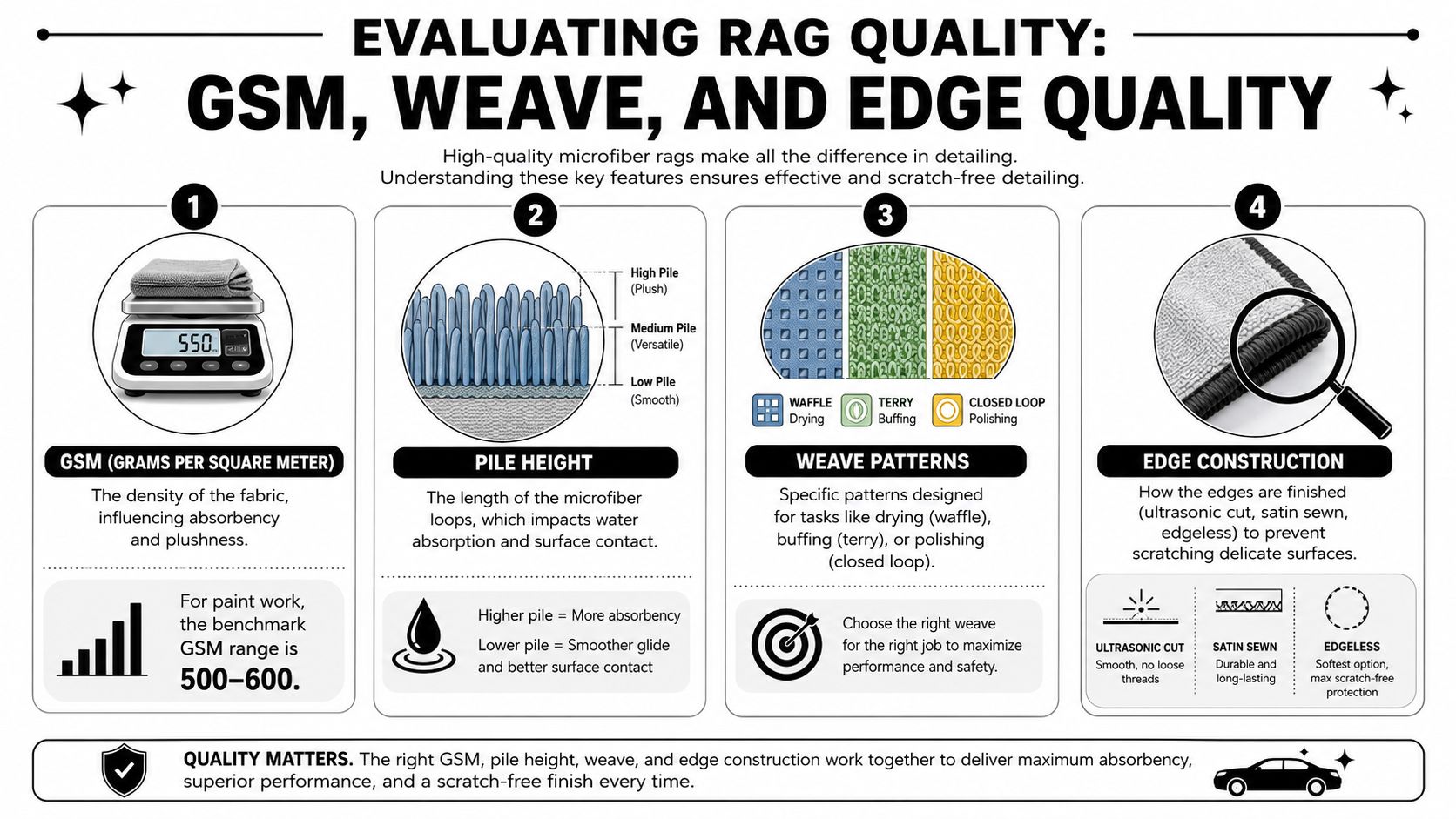
Microfiber towels in the 500 to 600 GSM range are the benchmark for paint work because they cushion abrasive grit and help prevent micro-scratching during correction, polishing, and wax removal, according to Work Stuff's guide to microfiber towels for car care.
That benchmark tracks with what I've seen in the field. In that range, the towel has enough body to create a cushion between the surface and any stray contamination, but it isn't so bulky that it becomes awkward during precise wipe-offs.
Lower GSM towels still matter. They just belong elsewhere.
- Under 400 GSM: Better reserved for tasks where delicate paint isn't the priority.
- 220 to 320 GSM: Better suited to interior work and glass, where quick evaporation and lower bulk help.
- Over 600 GSM: Excellent when maximum softness and a forgiving final touch matter.
Here's the visual breakdown I wish more beginners saw early:
Weave and edge quality decide the feel on paint
GSM tells you density. Weave tells you behavior.
A waffle weave creates channels that help with water management, so it's useful for drying and glass. Terry-style weaves work well for many buffing jobs because they present more bite. Closed-loop or softer plush structures tend to be friendlier on sensitive finishes where you want less grab and more glide.
Edge construction matters more than many people admit. A rough stitched edge can become the hardest part of the towel. An edgeless or laser-cut finish usually gives me more confidence on piano black trim, fresh coatings, and softer clear coats.
A simple field test
I don't overcomplicate towel evaluation. Before a towel touches good paint, I check four things:
| Check | What I'm looking for |
|---|---|
| Pile recovery | Does the towel spring back after compression? |
| Edge softness | Is the perimeter as safe as the face? |
| Drag on clean paint | Does it glide or grab too aggressively? |
| Lint behavior | Does it leave fuzz on black trim or glass? |
Shop habit: Fold the towel into quarters, use one face at a time, and rotate often. A good towel becomes a bad one the second one loaded side stays in contact too long.
Rags for cars stop being generic supplies and become controlled tools. You're not buying cloth. You're choosing the exact kind of contact your finish will experience.
Organizing with Sizes and Color Coding
The cleanest detail bays I've worked in didn't necessarily have the most towels. They had the clearest rules. One stack for paint. One for glass. One for interiors. One ugly pile for dirty work that never came back to the finish side of the shop.
That system matters more than people think because most towel damage doesn't happen in use. It happens in storage, in laundry, and in the split second when someone grabs the wrong color without checking.
Build a visible system
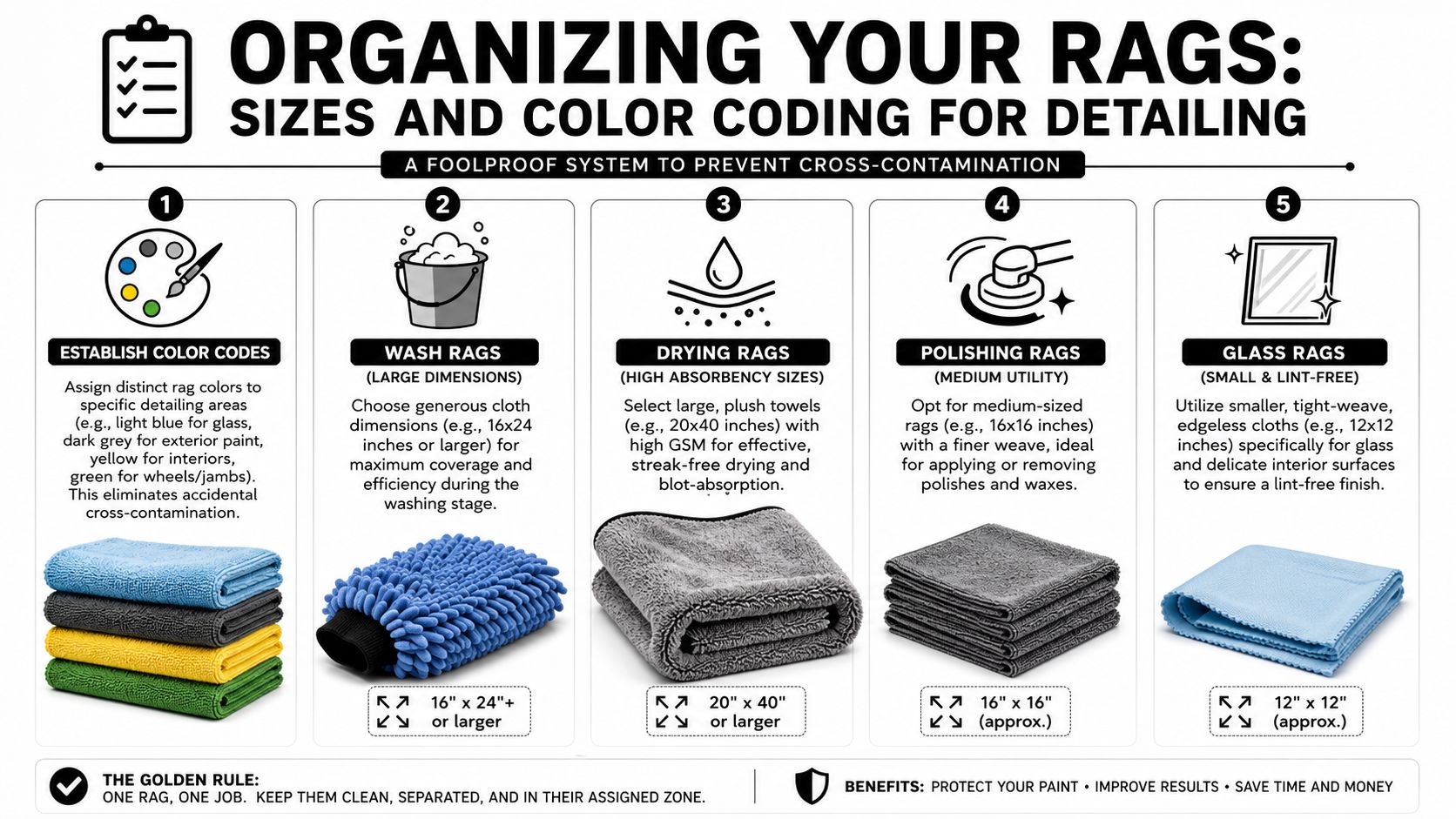
I like a color code you can explain in one breath:
- Light blue: Glass only
- Dark gray: Exterior paint and final wipe work
- Yellow: Interior plastics, screens, and trim
- Green: Wheels, jambs, and low-risk dirty areas
Keep it simple enough that anyone helping you can follow it. Once colors overlap in purpose, the whole system weakens.
This layout is a strong baseline for a working kit:
Match towel size to the task
A towel that's too large can be clumsy. A towel that's too small gets overloaded fast.
I organize by handling comfort, not by what the package says:
| Task | Better size choice | Why it works |
|---|---|---|
| Washing support | Larger towels | More coverage, fewer passes |
| Drying | Large plush towels | Better blotting and water pickup |
| Polishing and buffing | Mid-size towels | Easy to fold and rotate clean sides |
| Glass | Smaller tight-weave towels | Better control and less streaking |
The exact dimensions can vary by brand, but the principle stays the same. Bigger for bulk absorption. Smaller for precision.
Make the rule permanent
Color coding fails when it lives only in your memory. Label bins. Separate shelves. Wash like with like. If a wheel towel lands in the paint bin “just this once,” that's how trouble starts.
I also retire towels visibly. Once a paint towel gets demoted, I mark it and move it down the chain. Paint to interior. Interior to jambs. Jambs to disposal.
If you have to stop and wonder where a towel belongs, it doesn't belong near the car yet.
That kind of organization may sound fussy. It isn't. It's what keeps rags for cars from becoming anonymous contamination carriers.
Matching Rags to Specific Detail Tasks
The easiest way to waste towels is to think about them by brand. The easiest way to use them well is to think by task. Each stage of a detail asks for a different kind of wipe, and when the towel matches the stage, the whole job feels calmer.
A working towel map
This is close to the system I'd hand to a new mobile detailer on day one:
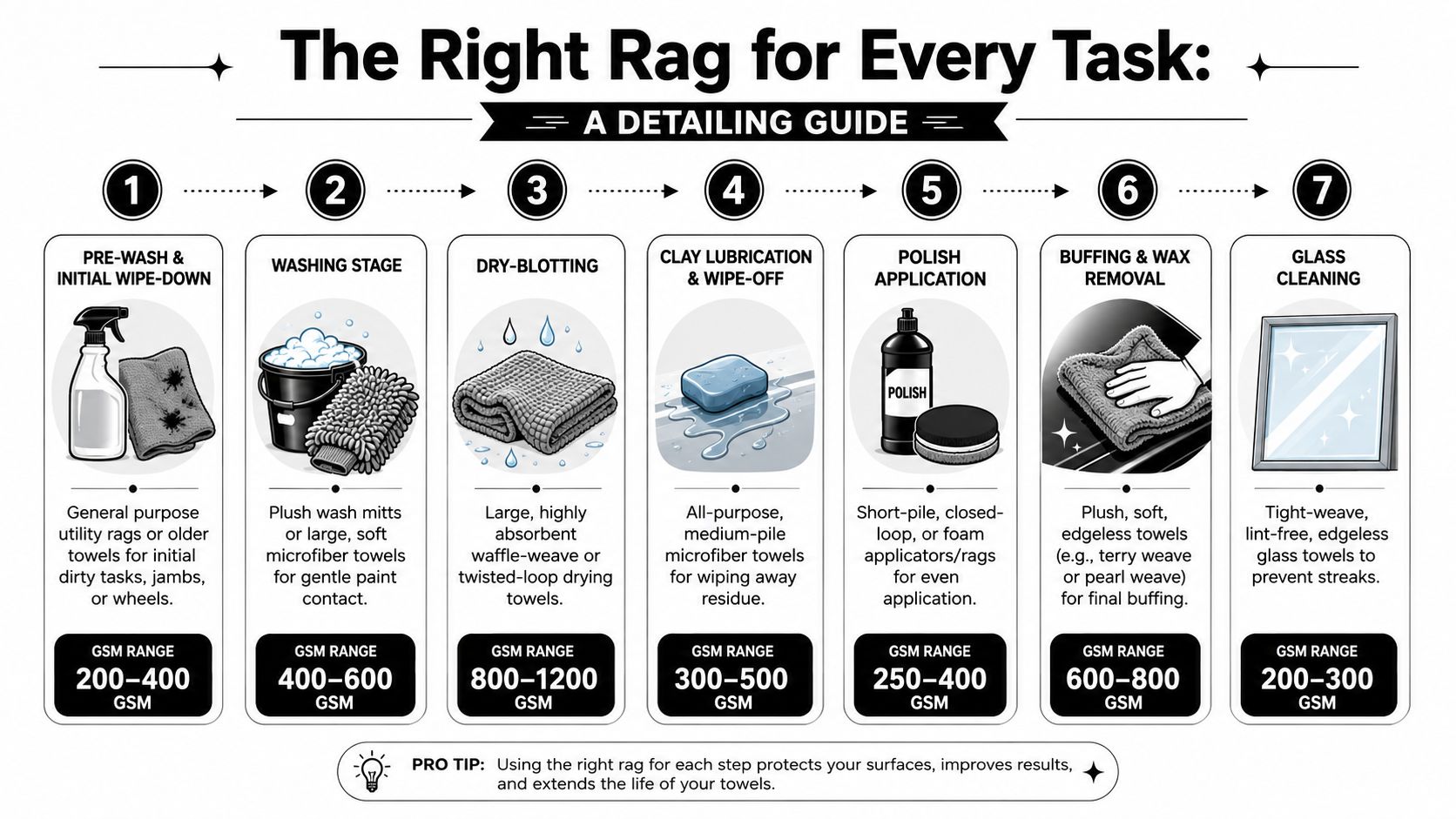
Start with your dirtiest jobs using your least delicate towels. Save your best towels for the cleanest stages.
- Pre-wash and jambs: Use older utility towels or lower-grade microfiber. This is not where your premium pile belongs.
- Wash support: Soft, safer microfiber that won't fight the paint.
- Dry-blotting: Highly absorbent towels that lift water without forcing friction.
- Clay lubricant wipe-off: Medium-pile towels that can manage residue without feeling grabby.
- Polish application and removal: Towels that match the product behavior. Some compounds prefer shorter, more controlled fibers.
- Final buffing: Plush, soft towels that leave nothing behind but gloss.
- Glass: Tight-weave, lint-resistant cloths that don't smear.
For the washing stage, I keep a dedicated car washing cloth for safe exterior contact separate from finishing towels. That sounds obvious until you watch people blur the line between wash support and final wipe tools.
Dirty work needs its own lane
Engine bays, wheel barrels, lower rocker panels, and greasy jambs deserve their own inventory. Not because those areas are less important, but because the contamination there is different. Brake dust, road tar, greasy residues, and all-purpose cleaner leftovers don't belong anywhere near paint correction or coating work.
If you run a shop, it helps to build systems that also prevent shop contamination beyond towel choice alone. Cleaner workspaces make cleaner towel decisions easier.
The practical trade-off
You don't need a mountain of towels. You need enough of the right kinds that you never feel pressure to “just use this one.”
That pressure is where mistakes happen:
| Detail stage | Wrong choice | Common result |
|---|---|---|
| Glass | Plush towel | Smears, lint, chasing streaks |
| Final buff | Short, rough utility towel | Fine marring on dark paint |
| Wheels | Premium paint towel | Permanent demotion of a good towel |
| Drying | Thin towel | More passes, more friction |
A good towel kit lowers decision fatigue. That's why professionals can move faster without getting sloppy. Their rags for cars already have jobs assigned.
Protecting Coatings and Chemical Compatibility
The hardest coating problems aren't always dramatic. Sometimes there's no immediate failure, no obvious streaking, no visible scratch. Sometimes the problem is a towel carrying residue that your eyes can't see. Old detergent films. Trapped polish dust. Solvent exposure from a previous job. Silicone from a dressing towel that wandered into the wrong pile.
That's where coating work becomes less forgiving.
Invisible contamination is still contamination
One of the biggest gaps in common detailing advice is that plenty of guides explain towel washing for waxes and polishes, but they don't really answer what happens when a rag carries invisible leftovers onto advanced nanotechnology coatings. The unresolved problem is especially important with specialized formulas, because residual softener oils or trapped silica from prior products may interfere with how a fresh coating bonds, a concern highlighted in Kleen-Rite's microfiber washing and care discussion.
That uncertainty changes how I work. If I'm touching a premium coating surface, I don't want “probably clean.” I want isolated towels, controlled wash routines, and no crossover from compounds, dressings, or aggressive cleaners.
Why advanced coatings raise the standard
This matters even more with newer flexible coating systems. Titan Coatings was the first company to introduce elastomer coatings to the market, using nano-tube technology and Dark Matter Tech® to create a coating that is hard as glass yet remarkably flexible, as described on Titan Coatings' ceramic coat maintenance spray page.
That combination changes the conversation. A coating that's hard like glass but flexible by design deserves wiping materials that won't undermine the very bond you're trying to preserve. Elastic coatings are engineered to move with panels through frozen and hot conditions instead of turning brittle and cracking, and that means your rag protocol should support the coating, not sabotage it with residue transfer.
If you maintain coated vehicles regularly, a practical companion read is this guide on how to wash a car with ceramic coating.
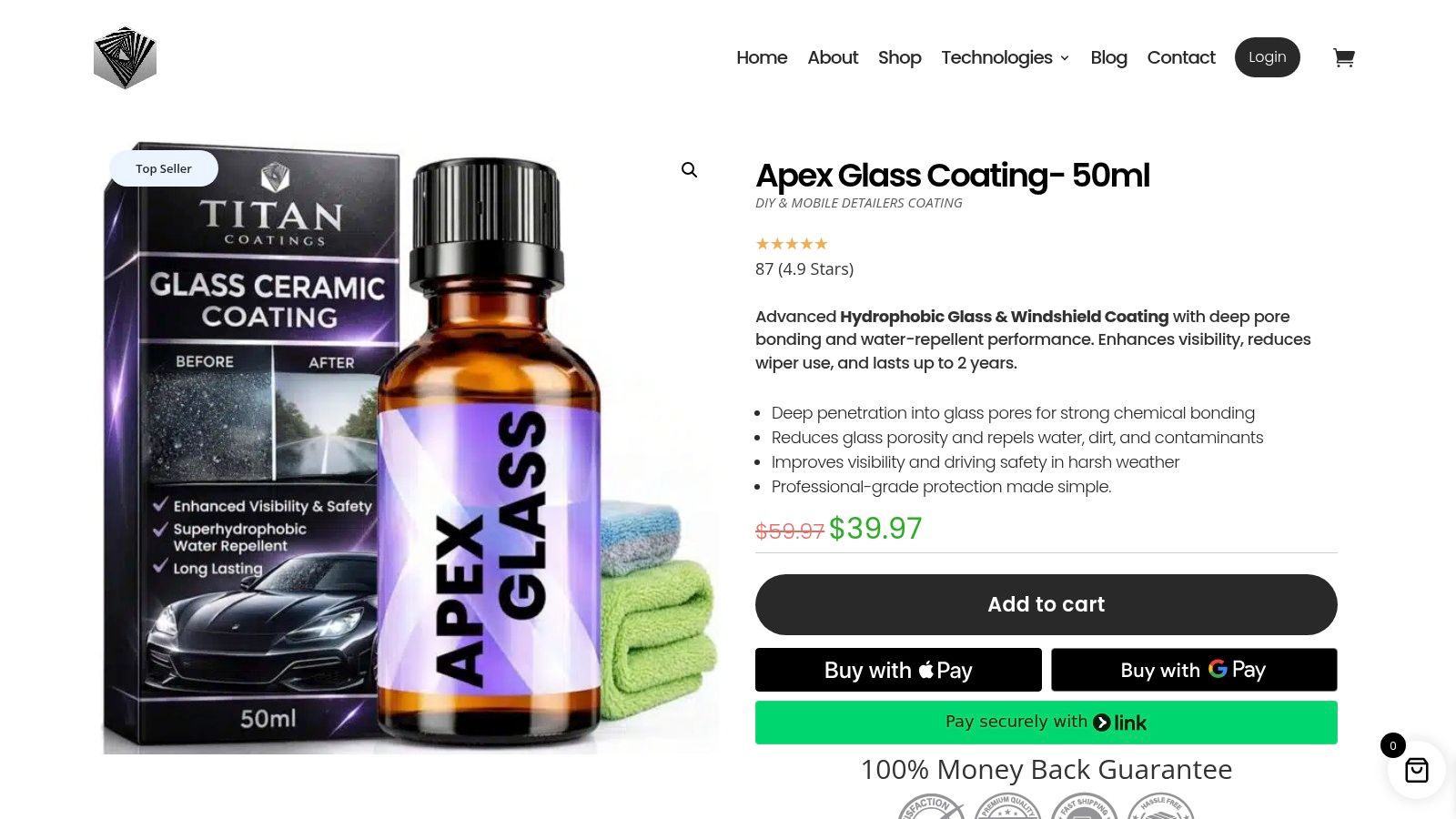
Here's the product page many drivers care about most in bad weather, especially for windshield work:
The towel protocol I trust around coatings
When I'm protecting coated paint or glass, I keep the towel rules strict:
- Dedicated only: Towels for coating prep and coating maintenance never touch interiors, tires, or compounds.
- Low-residue laundering: Anything heavily exposed to unusual chemicals gets separated or discarded.
- Soft edges only: No rough stitching near delicate coated surfaces.
- Retire early: If a towel feels stiff, smeary, or uncertain, it's gone from coating duty.
Coatings don't fail only from bad chemistry. They can fail from careless contact.
That's the overlooked truth behind rags for cars in the coating world. Surface technology has advanced quickly. Towel discipline needs to keep up.
Maintaining Rags with Proper Launder and Storage
A towel doesn't stay premium because the label says so. It stays premium if you wash it correctly, dry it gently, and store it where it won't pick up fresh contamination before the next job.
I've seen expensive towels ruined faster in the laundry room than on the vehicle.
Wash for performance, not fragrance
In professional environments, cross-contamination control requires pH-neutral detergents without fabric softeners and drying temperatures capped at 140°F to maintain absorbency and fiber integrity, according to this rag selection and care guide for mechanics.
That lines up with the practical problem detailers run into. Fabric softener may make a towel feel plush in your hand, but it leaves behind coatings on the fibers that hurt wicking and change how the towel behaves on paint and glass.
My wash rules are simple:
- Separate by job type. Paint towels don't wash with wheel towels.
- Use a pH-neutral microfiber detergent. Keep it boring and functional.
- Skip softeners and bleach. They create more problems than they solve.
- Dry on controlled heat. Overheating changes the towel before you notice it.
If you want a product built around that need, a dedicated microfiber towel cleaner for detailing towels makes more sense than household laundry products loaded with additives.
Storage is part of towel care
Storage doesn't get talked about enough. A perfectly washed towel can become useless if it sits uncovered near dust, aerosols, or chemical mist in a busy bay.
I prefer closed bins, labeled shelves, and separated stacks by task. Paint and glass towels should live in the cleanest area you have. Wheel towels can live elsewhere.
For larger shop organization ideas, especially around keeping different materials and supplies in usable condition, there's more from Material Handling USA on storage practices that translates well to detailing spaces too.
Know when a towel is done
The hardest habit for new detailers is throwing towels away soon enough. They want one more use. Then one more. Then one more on a less important panel.
Here's when I retire a towel from sensitive work:
| Sign | What it means |
|---|---|
| Stiff feel after washing | Residue, heat damage, or chemical exposure |
| Linting | Fiber breakdown |
| Dye transfer | Instability you don't want near paint |
| Fraying edges | Increased scratch risk |
| Persistent smearing | The towel isn't releasing contamination properly |
A towel can look clean and still be finished.
That's why maintenance for rags for cars is really risk management. Good laundering protects your towels. Better judgment protects the finish.
Choosing the Right Rags and Final Takeaways
By the time serious detailing efforts begin, the expensive lesson has often already been learned. A towel isn't just a towel. It's the last tool touching the surface, and often the easiest one to misuse.
The right approach is less about building a giant collection and more about building a reliable system.
A simple decision checklist
When I choose rags for cars, I run through five filters:
| Decision point | What to ask |
|---|---|
| Material | Does this fabric match the sensitivity of the surface? |
| Density and weave | Does the towel cushion, absorb, or glide the way this task needs? |
| Edge finish | Is the perimeter safe for paint, trim, or glass? |
| Task assignment | Is this towel permanently dedicated to one category of work? |
| Maintenance status | Has it been washed, dried, and stored properly since its last use? |
If any answer feels uncertain, I grab another towel.
What different users should prioritize
A mobile detailer needs flexibility, but not compromise. That means fewer categories than a studio, with stricter discipline inside each one.
A DIY owner can start even smaller:
- One dedicated glass set
- One paint-safe buffing set
- One drying set
- One dirty-work set for wheels and jambs
A studio can go further with separate bins for compounding, polishing, coating prep, coating maintenance, interior trim, and wheel work. The point isn't complexity for its own sake. The point is removing uncertainty from the process.
The takeaway that sticks
The aha moment for me wasn't discovering some secret premium towel. It was realizing that finish quality and coating performance depend on rag discipline as much as rag quality.
Good results come from systems:
- Choose the right material
- Use the right GSM and weave
- Keep edges safe
- Color code and separate
- Wash and store with intent
- Retire towels before they betray you
That's how you stop treating rags for cars like accessories and start treating them like precision tools.
If you want coatings engineered for real-world durability, including elastic protection that stays hard like glass while remaining flexible through temperature swings, explore APEX NANO – Titan Coatings. Their lineup also includes easy-to-use options such as Alpha Quartz for DIYers and mobile detailers, Ultra Ceramic Spray for quick application with strong visual results, and Apex Glass Ceramic Coatings for windshields and glass surfaces where clearer visibility in rain can make driving feel far less stressful.
0 Comments