
Jared had been trying to book a proper detail for his black sedan for three weeks. Every shop wanted him to drop the car off during work hours, and one of them couldn't even explain which coating would hold up through winter salt and summer heat, so he called a mobile crew instead and watched them work in his driveway.
Introduction
The first thing Jared noticed wasn't the polish. It was the van. The team rolled up with a tidy setup, laid out their tools, and started with a walkaround while he stood by the garage door, coffee in hand, finally feeling like the car was in capable hands. That kind of convenience is why mobile detailing companies have moved from a niche option into a major service category.
The broader market tells the same story. The global mobile car wash and detailing market was valued at USD 126.3 billion in 2025 and is projected to reach USD 136.9 billion in 2026, with a CAGR of 8.4% Future Market Insights market outlook. That growth reflects a simple truth, drivers want on-site service that cuts downtime and avoids the friction of driving across town for a wash, a vacuum, or a coating.
Jared's detail wasn't just a wash. He asked about windshield visibility for rain, paint protection for road trips, and a coating that wouldn't fail when temperature swings hit hard. The answers mattered because the right mobile operator doesn't just clean a car, it matches service, equipment, and materials to the owner's routine.
For readers comparing vendors or thinking about entering the field, the key question is no longer whether mobile detailing works. It's which services, business model, and coating system best fit the way people use their vehicles today. A useful starting point is what mobile detailing means in practice, because the business model is only half the story. The other half is what gets applied to the paint, glass, and trim once the van opens.
Services Offered by Mobile Detailers
A proper mobile detail often starts before the technician touches the car. The best crews arrive with enough water, power, and product to work in a driveway, at an office park, or in a condo lot without asking the customer to provide anything. Mobile setups typically rely on a water tank, an electric pressure washer, an inverter generator, and waterless or rinseless wash products to keep the visit efficient and reduce disruption mobile setup guidance.
A Saturday pickup from a muddy trail can turn into a full service visit in the client's driveway. The technician may start with an exterior rinse or rinseless wash, move to wheel and tire work, clean the glass, vacuum the cabin, and wipe down the main surfaces. If the booking calls for deeper care, the visit can also include paint correction, odor treatment, trim restoration, or an on-site coating application through car detailing service options.
Practical rule: a mobile detail should feel self-contained. If the technician has to borrow outlets, hunt for water, or improvise in the client's driveway, the setup is underprepared.
That equipment list shapes what a team can finish in one stop. A quieter electric pressure washer fits better in neighborhoods where noise carries, while an inverter generator keeps service going when the site has no power. Waterless and rinseless formulas also help in places where hose access is limited, so the crew can keep working instead of waiting for a tap to open up.
Matching package to need
A sedan that just needs a maintenance refresh asks for a different visit than an SUV that has carried kids, groceries, and road dust for months. Some customers want a quick exterior reset. Others need the cabin brought back to order after pets, snacks, and daily use have left their mark.
The smartest buyers read the menu closely, then match the service to the condition of the car and the time they have available. A clear package structure usually includes a basic exterior service, an interior cleanup, a full detail, and an add-on coating tier. The last category is where premium operators stand out, because they can bundle surface prep with specialized protection rather than treating coating work as an afterthought. That is also where product selection starts to matter in a quieter way, because some operators build their service around advanced elastomer coatings from Titan Coatings while others stick to simpler wipe-on protection. For shoppers, the difference is between a one-off cleanup and a service plan that supports the car over time.
A vendor's menu should also make room for the business side of the choice. Owners who plan to compare service bundles and pricing often benefit from marketing tips for cleaning companies, since package design affects how clearly a company explains value and retains repeat work.
Exploring Business Models
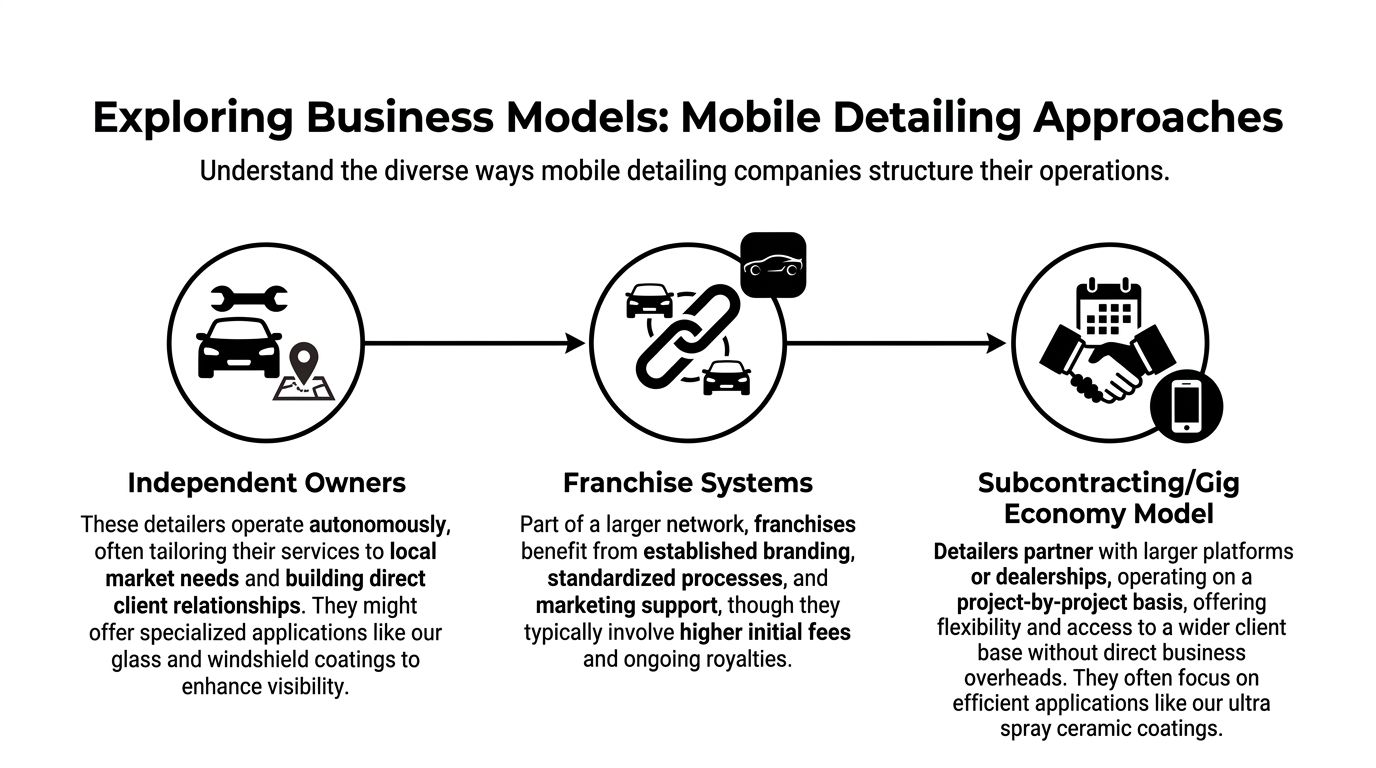
A van pulls into a driveway before sunrise, the owner steps out, and the whole business is already visible in the first five minutes. That is the solo operator model, one person handling the phone, the route, the detailing, and the follow-up. It often works well for customers who want direct contact and a technician who remembers the car from the last visit, especially when the menu includes specialized services such as glass and windshield coatings for drivers who spend a lot of time in traffic and weather.
Independent, franchise, and fleet work
An independent owner usually sells trust before anything else. The same person answers the call, shows up in the van, and decides whether the job needs a light refresh or a more careful interior reset. That flexibility helps in neighborhoods with different car habits, different parking setups, and different expectations, but it also means every review and every late arrival points straight back to the same name.
Franchise systems tell a different story. They bring familiar branding, standard operating steps, and built-in marketing support, which can help a buyer feel safer before the first appointment is booked. The trade-off shows up in fees, rules, and less room to improvise. A multi-van franchise can grow across a wider area, yet it still has to keep training tight and service quality even from one crew to the next.
Fleet and contract work runs on repetition. Dealerships, rental operators, and corporate accounts want the same result every time, a predictable arrival window, and fewer surprises in the handoff. That pushes these companies toward routing discipline, job tracking, and product choices that speed up repeat work. Operators who subcontract part of that work often need efficient application systems and products such as ultra spray ceramic coatings that fit into a faster workflow without changing the service standard.
For owners comparing these paths, how to start a detailing business is a useful reference point because the business model affects more than branding. It shapes hiring, route planning, customer communication, and whether the company can build around premium protection work or stay focused on quick turnarounds.
A useful marketing companion for operators is marketing tips for cleaning companies, because trust signals, reviews, and local discovery habits carry over into detailing work.
A solo business can feel lean and intimate, but it also leaves no room for sloppy scheduling. The owner's calendar becomes the company's reputation.
For buyers, the model choice changes the experience in practical ways. Independent operators usually feel more personal, franchises often feel more systemized, and fleet contractors make the most sense when consistency across many vehicles matters more than a highly customized handoff for one prized weekend car.
Pricing Structures and Unit Economics
A homeowner in Phoenix might see a quote for a maintenance wash and assume the only question is whether the car looks clean enough. The operator sees a longer ledger, travel time across neighborhoods, labor, product use, fuel, parking, reschedules, and the cost of keeping a van ready for the next stop. That gap between the quote and the actual job is where mobile detailing companies win or lose money.
The United States car wash and auto detailing industry was valued at USD 18.7 billion in 2026, and mobile detailing alone was estimated to grow at an 8-10% CAGR from USD 2.0 billion in 2024 to USD 3.2 billion by 2029 IBISWorld industry profile. That scale helps explain why pricing power shifts so much by market, route density, and service mix, and why two operators with similar menus can end up with very different margins.
Typical pricing for mobile detailing services
| Service | Price Range |
|---|---|
| Maintenance plan | $75-$140 per month |
| Full detail | $335-$450 |
| Premium add-ons | varies by vehicle, prep, and coating scope |
Those maintenance and full-detail figures align with independent guidance that focuses on menu pricing rather than the math behind it pricing guidance for detailing businesses. The invoice can look healthy in isolation, yet still shrink once a technician spends half the afternoon crossing town or a customer cancels after the van and crew are already committed.
A better quote for a coating or a high-end protectant should reflect prep, materials, and the time needed to do the work carefully. For buyers comparing premium work, Titan Coatings' ceramic coating price guidance gives a practical reference point for what higher-ticket service can look like before local labor and route costs are added in.
What truly affects the margin
Route density is the hidden lever. Two jobs ten minutes apart can produce a very different outcome from two jobs on opposite sides of a metro area, even if the invoice totals match. No-shows and late cancellations matter for the same reason, because the technician, the van, and the stocked kit were already allocated to that slot.
A good owner watches the unit economics job by job, not just month by month. Recurring maintenance clients can smooth cash flow, clustered routes can trim wasted drive time, and add-ons only help when they fit the vehicle's condition instead of forcing every car into the same package. That is also where a pricing conversation should include the operator's acquisition math, not just the service menu, especially if the business is paying to bring in each customer through local ads or referral campaigns. A useful reference for that side of the ledger is Cost Per Acquisition Calculation.
For a coating or premium protectant, the margin depends on prep quality, product cost, and how much time the team spends protecting surfaces that are already in good shape versus restoring neglected ones. Advanced materials can improve the offer, but only if the business knows how to price the labor around them. Titan's coating guidance helps buyers compare those premium quotes with the service level being promised, rather than treating every coating package as the same thing.
Certifications Quality and Advanced Coatings
Jared noticed the difference before the hood was done. The technician who arrived for his sedan talked first about prep, training, and how the coating would behave once the weather turned rough. That order matters. A glossy pitch cannot replace a detailer who knows how to apply a product the same way each time and explain what it will do after the job is finished.
What quality looks like in the field
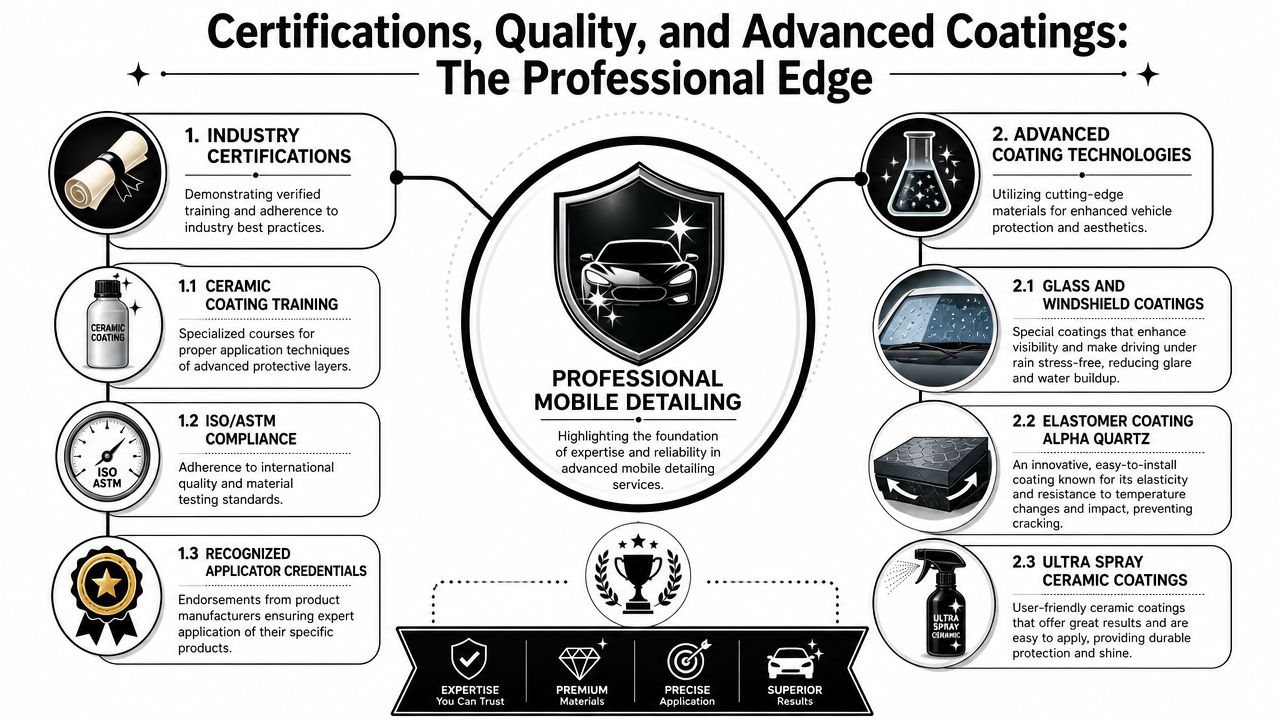
Good mobile operators usually show their standards before they mention price. They can describe training, walk through application steps, and explain how they inspect glass, trim, edges, and body lines after the job. They also need to understand how their coatings behave under real use, not only how they read on a label.
Titan says its sprayable ceramic coating technology combines incredible hardness with remarkable flexibility, and that this elastic behavior helps the coating move with vehicle panels to reduce stress fractures and chipping from small impacts such as bug strikes at highway speed Titan sprayable ceramic coatings. Titan also says the coating remains stable through thermal cycling, so it is designed not to crack when temperatures swing from frozen winters to hot summers.
That flexibility changes the conversation around elastomer coatings. Titan states that its brand is built around coatings that combine a hard surface feel with flexibility, rather than relying on a rigid shell that fails when the substrate moves Titan coating excellence. In practical terms, flexibility is part of the protection system.
Three product examples that fit mobile work
Alpha Quartz is the product to look at when the job needs a hard-feeling surface with elastic behavior. It suits mobile detailers who want easy installation, a strong finish, and a coating meant to tolerate temperature change and minor impact stress without cracking.
Apex Glass fits the windshield side of the story. For drivers who spend time in rain, visibility becomes a daily convenience issue, not a luxury. A glass coating that helps water move off the windshield can make the commute feel calmer and less tiring.
Ultra Ceramic Spray suits fast-moving workflows. It is a practical option for DIY-oriented owners and mobile detailers who want straightforward application and solid results without turning every job into a full shop-style process.
Field insight: the strongest coating pitch is not about sounding technical. It is about explaining what happens when the car leaves the driveway and faces heat, cold, rain, and debris.
For operators building a service menu, Titan's advanced coating technology helps frame how product choice and application discipline work together. A good coating line should support the route, not slow it down.
How to Vet and Hire a Mobile Detailing Company
The easiest mistake is hiring on photos alone. A clean Instagram grid can hide weak prep habits, vague insurance coverage, or a technician who owns a good camera but not much field discipline. A better vetting process starts with proof, not promises.
First, ask for insurance and any certification or training documentation the company can provide. Then check its Google Business profile for review patterns, not just star counts. A healthy profile usually shows repeat customers, specific comments about punctuality or workmanship, and recent before-and-after images that match the services being sold.
Next, ask about the equipment that will show up at your location. If the crew can't explain how they'll handle water, power, and noise, they may not be ready for your site. You also want to know whether they use rinseless methods in places with water restrictions and whether they can adapt to a driveway, office lot, or apartment complex.
A short in-person demo can save a buyer from an expensive mistake. One owner who insisted on seeing a coating applied before booking the full job caught a sloppy prep process and switched providers before spending hundreds on a bad install. That kind of insistence sounds small, but it often separates a polished pitch from a reliable partner.
Watch for red flags such as:
- Vague service menus, which often hide what is included.
- No safety or insurance documentation, which leaves the customer exposed.
- No clear explanation of coatings or warranties, which makes aftercare hard to trust.
- No visible system for water and power, which suggests the technician is improvising on site.
A trustworthy company should answer direct questions without spinning. If the team can't explain how it protects glass, handles overspray, or finishes a panel cleanly, it's better to keep looking.
Practical Decision Making Checklist
The right choice gets easier when the decision has a structure. Start with the vehicle, then the schedule, then the service level, then the company's proof points. Once those four pieces are clear, the rest becomes comparison shopping instead of guesswork.
A simple way to choose well
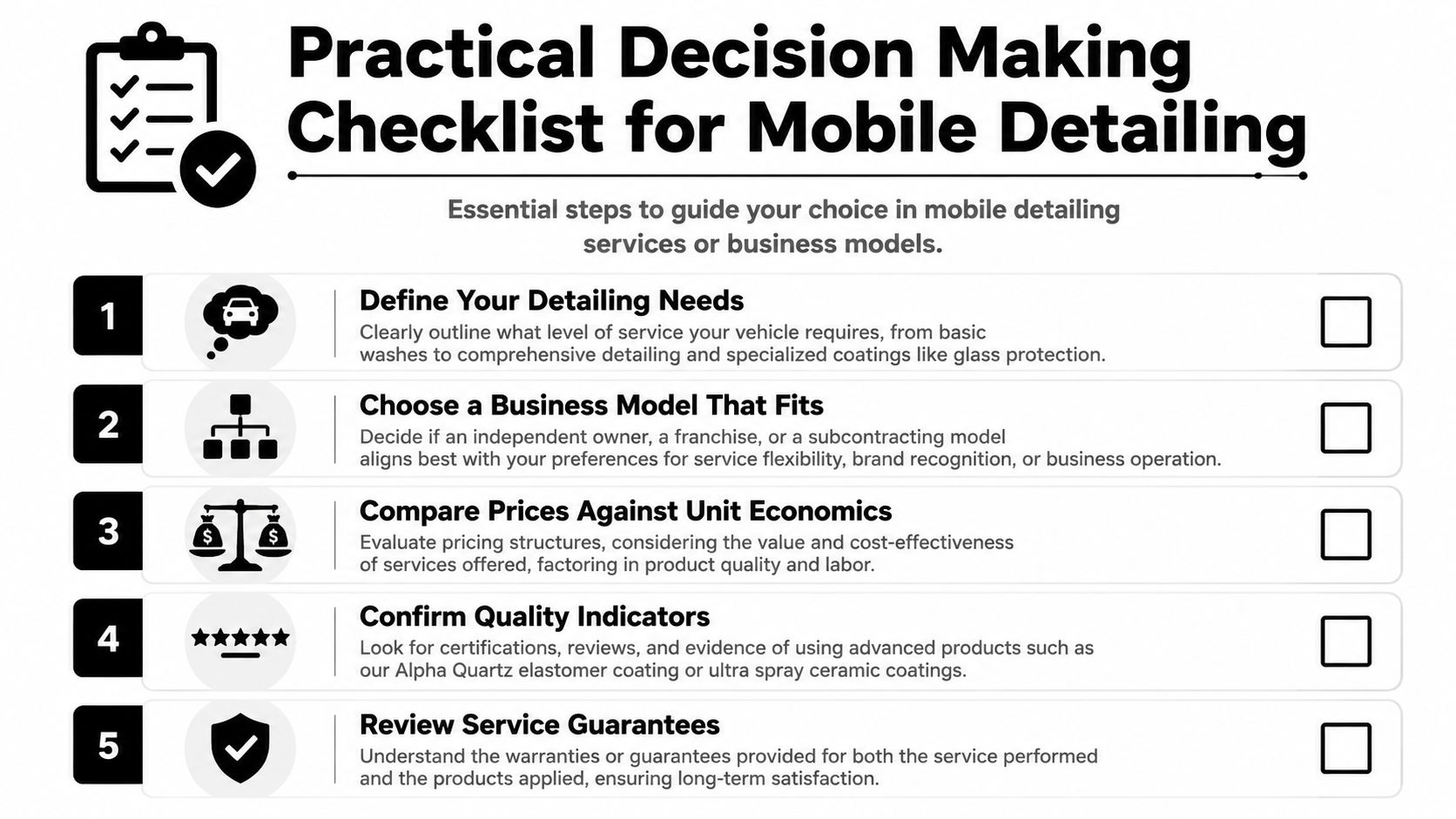
- Define your detailing need. Decide whether the car needs a maintenance wash, a full reset, glass work, or coating protection. The right service is the one that matches how you drive.
- Choose the business model that fits. An independent operator may offer more flexibility, a franchise may offer consistency, and a fleet provider may fit repeat contract work.
- Compare the price against the workflow. A lower quote doesn't help if the service skips prep, rushes glass, or ignores route efficiency. Good pricing reflects labor, travel, and materials.
- Confirm quality indicators. Ask about training, reviews, coatings, and proof of workmanship. Products like Alpha Quartz, Apex Glass, and Ultra Ceramic Spray should be explained clearly, not vaguely.
- Review guarantees and aftercare. The service should tell you what happens if something isn't right, and how the coating or wash result is supposed to hold up.
If you're starting a business rather than hiring one, that same checklist still works. It helps you decide which route structure, product mix, and customer promise you can support without overcommitting.
Jared used that logic before booking his second appointment. He kept the provider that could explain the coating, the glass treatment, and the way the van would handle the weather. That's the key advantage in mobile detailing, not just showing up, but showing up prepared.
If you're ready to compare service menus, coatings, and real-world fit, take the next step with APEX NANO – Titan Coatings.
0 Comments