
A black SUV came back into the bay after one winter and one brutal summer. The gloss was still there, but the edges of the protection had started telling the truth. Fine stress lines, a few impact points, and the kind of brittle failure every professional detailer recognizes once they’ve seen it enough times.
Beyond Ceramic The New Era of Advanced Coating Technology
For years, the industry sold hardness as the whole story. Harder meant better. Harder meant longer lasting. Harder meant premium. That logic worked, right up until vehicles started living real lives outside a climate-controlled studio.
A customer can leave your shop with a finish that looks immaculate under LEDs, then spend months parked in frozen mornings, hot afternoons, acid rain, bug strikes, road grime, and repeated wash cycles. Protection that performs on a test panel but can’t move with the surface will eventually reveal its weakness. Rigidity protects, until the panel flexes and the coating doesn’t.
Where the old thinking breaks
Traditional ceramic systems earned their well-deserved reputation. They brought better chemical resistance, sharper gloss, and stronger environmental protection than waxes and sealants. But many detailers have also seen the other side of that equation. A coating can be very hard and still fail because it’s too stiff for the environment it’s asked to survive.
That’s why advanced coating technology has moved past the idea that hardness alone defines durability. The broader market is moving in the same direction. The global smart coatings market is projected to rise from USD 4.91 billion in 2024 to USD 48.91 billion by 2035, at a CAGR of 25.84%, reflecting demand for coatings with enhanced durability and regenerative properties, according to Spherical Insights on the smart coatings market.
That shift matters to detailers because customers don’t judge chemistry. They judge outcomes. They ask whether the coating still beads after heat, whether it still looks clean after bug season, whether it cracks when temperature swings hit hard, and whether it still feels worth what they paid.
Practical rule: If a coating can’t tolerate movement, it won’t deliver the kind of longevity people think they bought.
Durability now means adaptation
The new frontier is a coating that behaves less like a brittle shell and more like an engineered membrane. That’s the difference between a surface that only resists and a surface that can absorb stress without breaking down.
That’s also why more professionals are paying attention to flexible systems, elastomer chemistry, and material science that balances hardness with movement. Sustainability is entering the same conversation, especially as more shops and clients ask for formulations that reduce environmental compromise without giving away performance. Titan’s work in that direction is part of the broader move toward eco-friendly coating development.
A modern coating shouldn’t just look sharp on day one. It should survive the argument between winter, summer, impact, vibration, and daily use.
Understanding the Science of Surface Protection
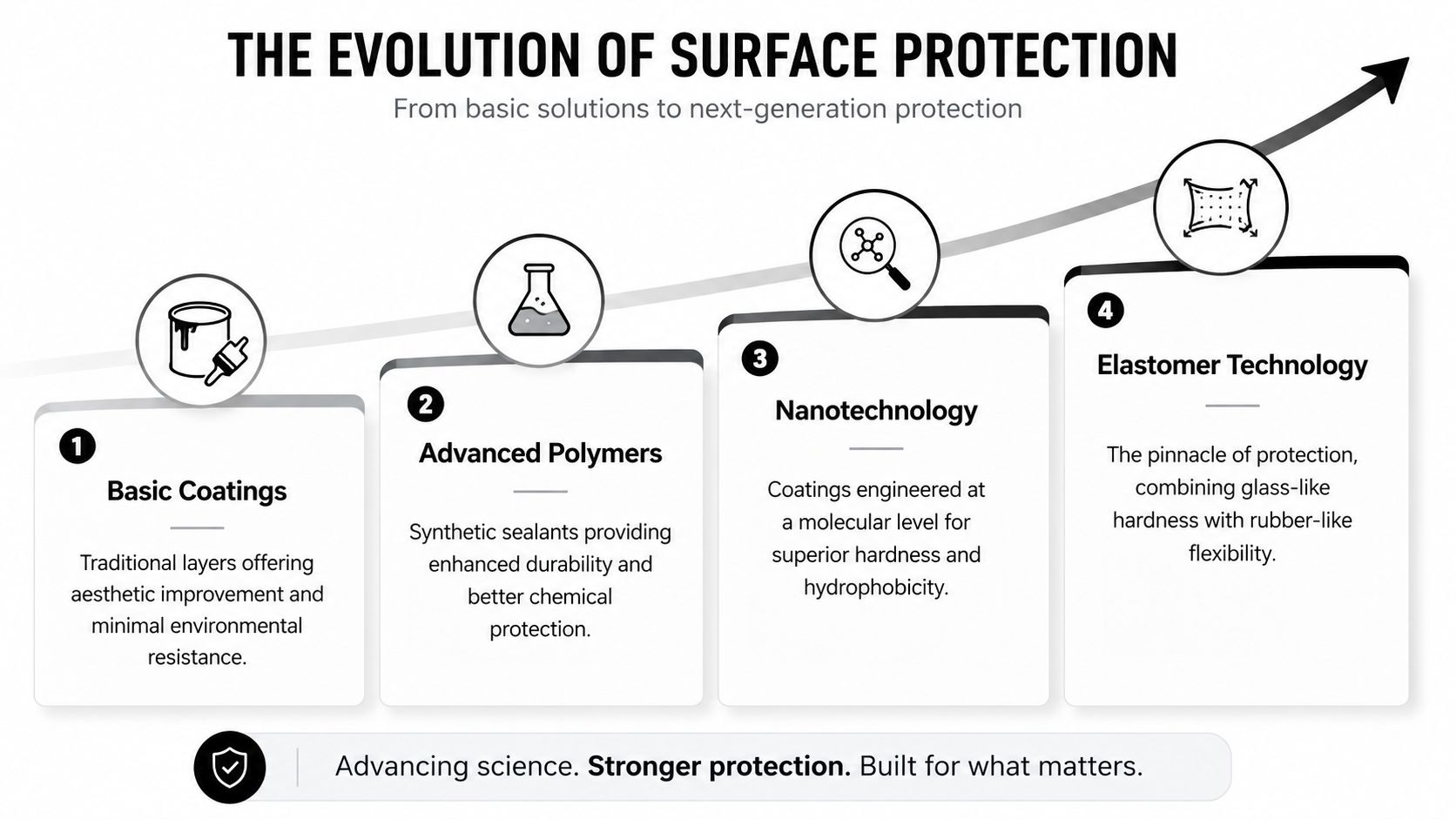
Most surface protection products solve one problem and create another. To understand why, it helps to look at the progression of technologies detailers have used for decades.
From sacrificial layers to molecular films
Waxes came first. They gave warmth, gloss, and a sacrificial buffer, but they wore away fast. Polymer sealants improved on that with better chemical design, stronger slickness, and longer service life. They were a meaningful step forward, especially for clients who wanted easier maintenance.
Then ceramic coatings changed expectations. They introduced a denser, more durable film and gave detailers a product class that could offer stronger resistance to chemicals, UV exposure, wash abrasion, and environmental contamination. That’s why ceramic systems became the professional benchmark.
But every chemistry has a personality.
A traditional ceramic behaves a lot like glass. That’s excellent when you want hardness, surface tension, and resistance to many external contaminants. It’s less ideal when the substrate expands, contracts, vibrates, twists, or takes a small impact. Paint systems move. Plastic trim moves. Glass heats and cools. Metal panels change dimension with temperature. If the coating layer is too rigid, stress has to go somewhere.
Why brittleness shows up in the field
Here’s the simplest way to explain it to a client. A rigid coating can resist a lot, but it doesn’t negotiate well. Once stress exceeds what that structure can tolerate, it begins to fracture at a microscopic level. You may not see the failure immediately, but over time that loss of continuity starts to affect performance.
A professional detailer sees that in several ways:
- Thermal cycling: Frozen nights and hot days force expansion and contraction.
- Impact events: Road grit, bug strikes, and wash contact create repeated localized stress.
- Panel flex: Hoods, bumpers, mirrors, and high-vibration areas never stay perfectly still.
- Aging under use: A coating may keep its shine longer than its structural integrity.
Surface science is more critical than marketing language. A coating doesn’t just need hardness. It needs adhesion, elasticity where appropriate, and the ability to maintain a stable protective film over time. That’s why understanding coating adhesion fundamentals matters as much as understanding gloss or contact angle.
If your coating is harder than the surface movement it has to survive, the surface eventually wins.
For shops that also customize trim pieces, badges, accessory panels, or branded elements, the same logic applies to decorative layers. Compatibility between the substrate and the overlay matters. That’s one reason some installers also look at resources like Raccoon Transfers’ sticker solutions, especially when they need durable surface graphics that won’t undermine finish quality.
The real evolution
A simple comparison makes the progression clear:
| Technology | Main strength | Common limitation |
|---|---|---|
| Wax | Easy gloss, sacrificial protection | Short life |
| Polymer sealant | Better durability, slickness | Limited long-term resilience |
| Traditional ceramic | Hardness, chemical resistance, gloss | Brittleness under stress |
| Elastomer technology | Hard surface feel with flexible behavior | Requires chemistry designed for controlled flexibility |
That last category is where advanced coating technology gets interesting. It doesn’t discard what ceramic chemistry did well. It solves what rigid chemistry couldn’t.
The Elastomer Revolution Hard Glass Meets Flexible Durability
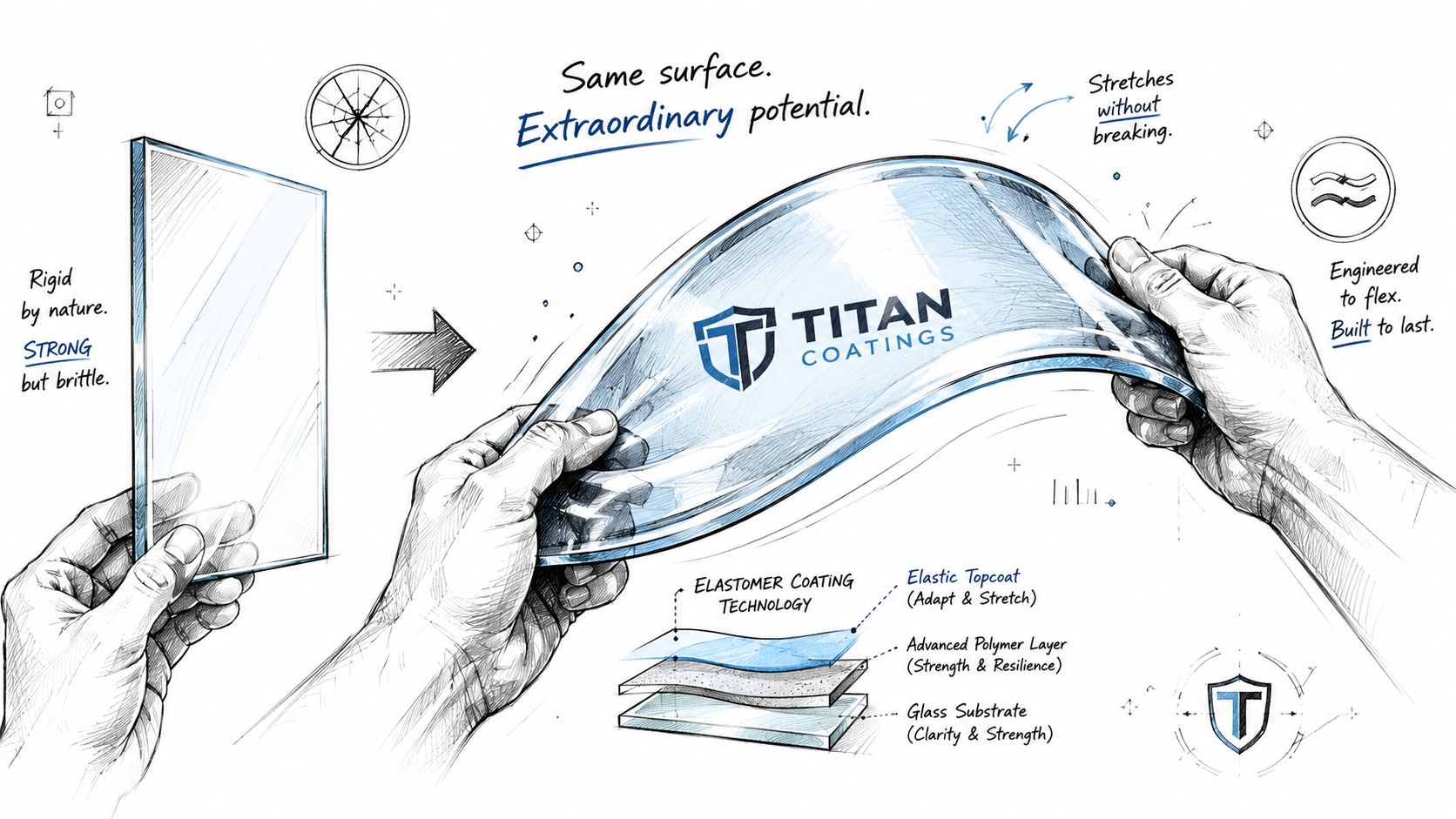
The breakthrough wasn’t making a coating harder. The breakthrough was making it hard like glass and flexible like rubber.
That’s the line professional detailers remember because it captures the engineering challenge in plain language. A coating has to resist abrasion, chemicals, and weathering, but it also has to move with the surface instead of cracking when temperatures swing from frozen conditions to extreme heat. That’s where elastomer chemistry changes the game.
What Titan changed
Titan created its own coating technology and pushed the market beyond conventional rigid ceramic thinking. Titan Coatings® pioneered the introduction of CNTs in the automotive coatings market in 2021, and its proprietary Dark Matter Technology® uses carbon allotropes to deliver high mechanical strength and thermal stability, as explained in Titan Coatings’ technology overview.
That matters because carbon nanotube integration isn’t just a branding exercise. It gives formulators another structural tool. Used correctly, it supports a coating matrix that can combine strength, thermal stability, and resilience under demanding conditions.
Titan’s elastomer approach was built to solve a detailer’s everyday problem. Customers don’t drive in laboratory conditions. Their cars get hit by bug acids, road film, wash friction, panel flex, and sharp temperature changes. A coating that can’t tolerate movement becomes a liability.
Why flexibility lasts longer
A rigid shell takes force and concentrates it. An elastomeric membrane spreads force, absorbs part of it, and recovers. That difference is why flexibility is the new frontier for durability.
Think of two protective layers over the same panel:
| Coating behavior | Response to stress |
|---|---|
| Rigid ceramic-like layer | Resists until stress exceeds tolerance, then can micro-crack |
| Elastomeric Titan layer | Resists while also flexing with expansion, contraction, and impact |
This is the practical value of coating flexibility in real-world protection. A bumper in summer heat doesn’t behave like a steel lab coupon. A hood at dawn and the same hood at noon aren’t experiencing the same conditions. A door panel that gets slammed, washed, and driven at highway speed is under repeating stress cycles.
Field note: The coating that survives longest usually isn’t the one with the most aggressive hardness claim. It’s the one that stays intact.
Dark Matter Technology and the elastomer advantage
Dark Matter Technology® gives Titan a platform to engineer coatings that are dense, durable, and stable under heat, while still preserving flexibility where it matters. That’s the key distinction. This isn’t softness. It’s controlled elasticity.
Soft coatings mar too easily. Brittle coatings chip too easily. The target is a film that presents a hard protective face to the environment while retaining enough internal flexibility to avoid stress fracture. In practice, that means a vehicle can face freezing weather, hot pavement, repeated washing, and bug impact without the coating turning into a cracked shell.
One of the most overlooked benefits is thermal behavior. Detailers often focus on gloss, slickness, and water behavior because that’s what clients can see. But many failures begin invisibly when expansion and contraction cycles create internal stress. An elastic system tolerates those cycles far better than a rigid one.
Why this matters to professional detailers
If you’re offering premium protection, you’re not just selling shine. You’re selling durability under abuse. The coating has to survive mobile installs, less-than-perfect climates, customer neglect, and environmental punishment.
That’s where Titan’s elastomer technology becomes more than a chemistry story. It becomes a business advantage for detailers who want fewer callbacks, more consistent outcomes, and a better explanation for why their protection package costs more than a wax job.
The old standard asked, “How hard is it?” The better question is, “How well does it survive when the surface moves?”
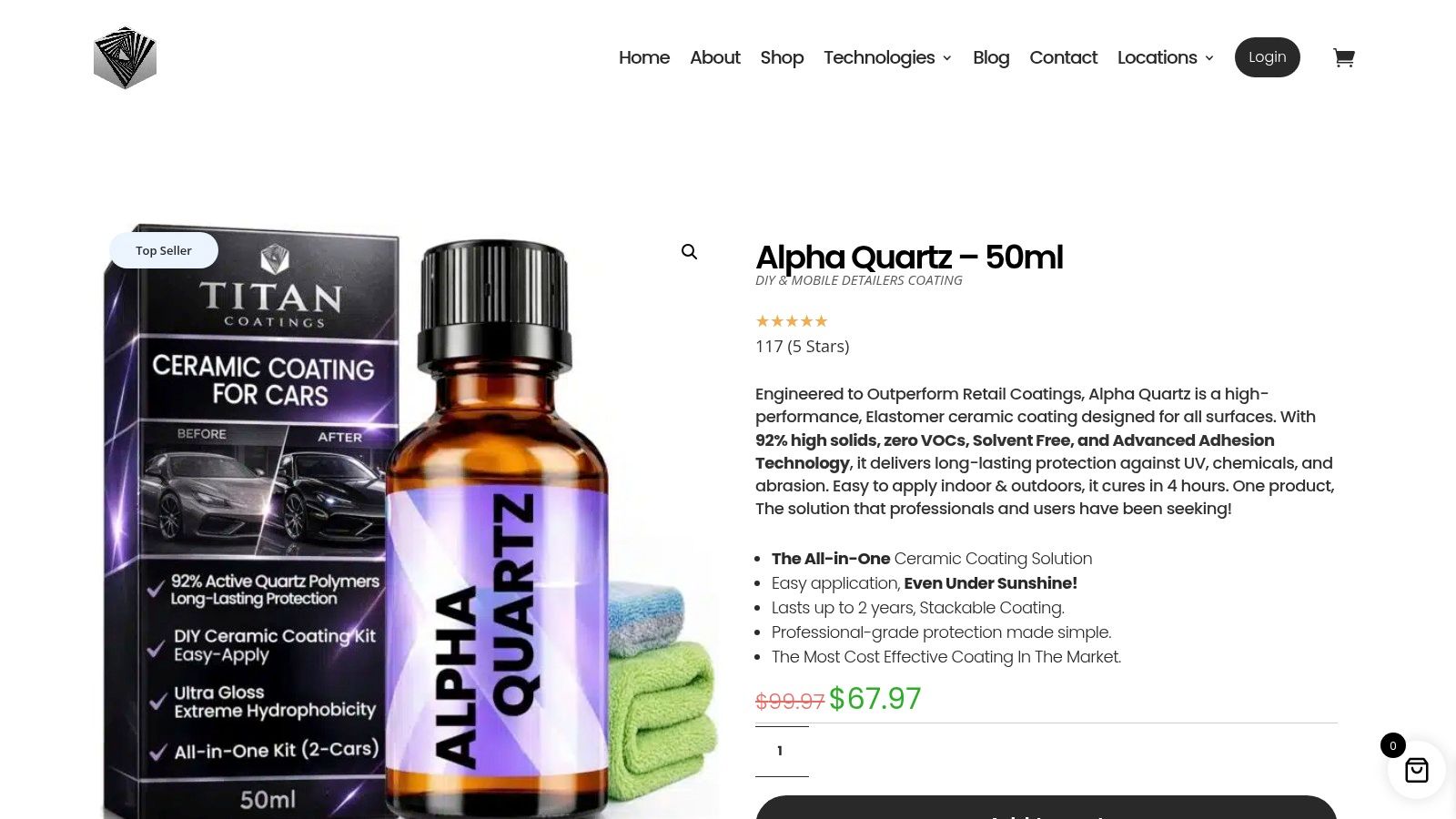
A Titan Coating for Every Surface and Need
Chemistry matters, but products earn trust when they solve a specific problem in someone’s day.
A mobile detailer doesn’t need a lecture on polymer architecture when he’s working under shifting clouds in a customer’s driveway. A parent driving home in heavy rain doesn’t care about material science language. She cares that the windshield stays clearer. A DIY enthusiast wants something forgiving enough to install without turning a Saturday into a correction marathon.
Alpha Quartz for the working detailer
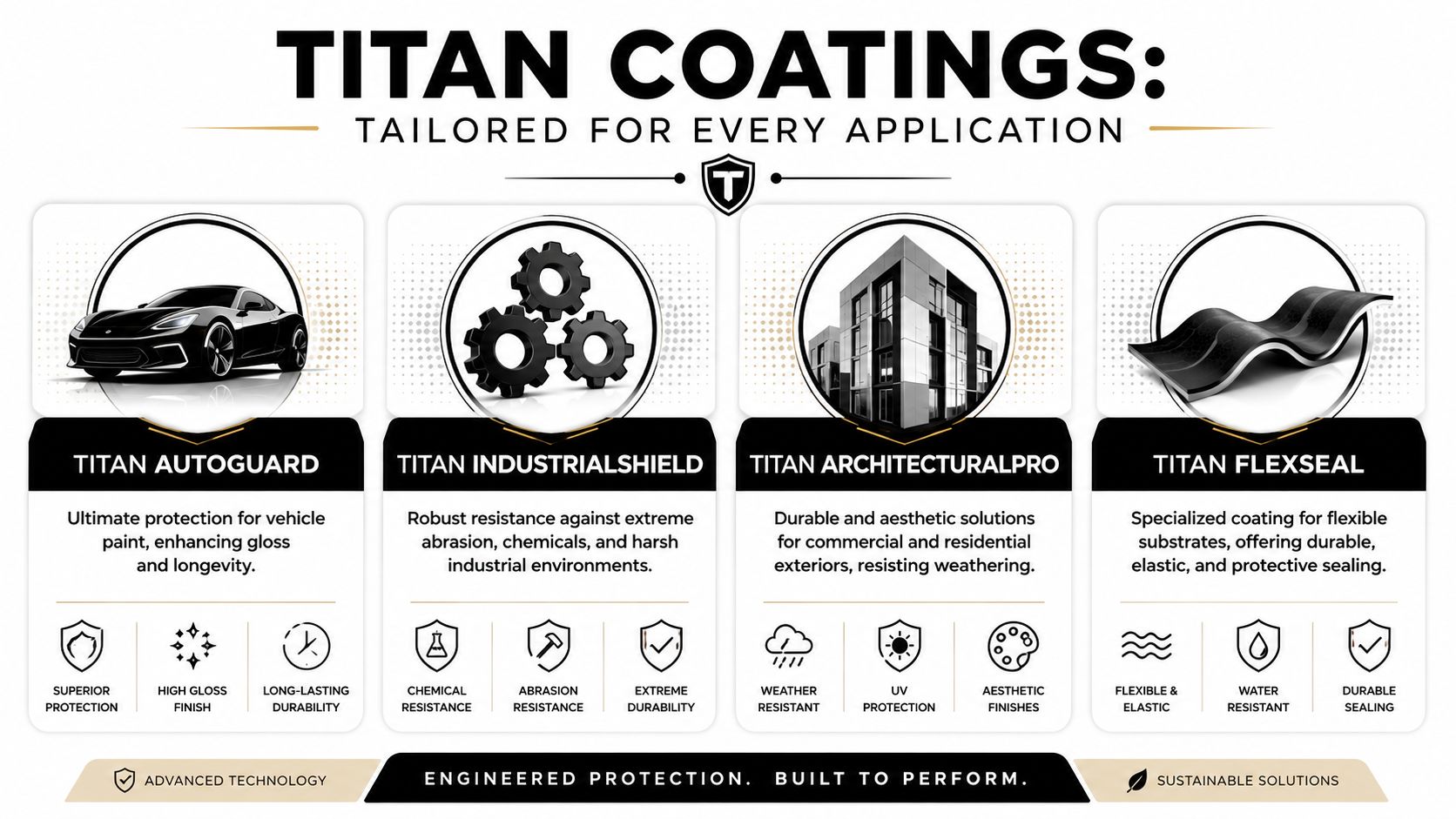
Alpha Quartz is the product I’d point to when someone says, “I need elastomer performance without a stressful install.” It’s easy to install, gives strong visual results, and fits both DIY users and mobile detailers who can’t always count on perfectly controlled shop conditions.
The important part isn’t convenience by itself. The important part is what that convenience is attached to. Alpha Quartz lives inside the Titan philosophy that a coating should be hard like glass and flexible enough to move. That flexibility is why temperature swings from frozen mornings to hot afternoons are less likely to turn protection into a brittle film. It also helps when the vehicle takes everyday impact from road debris or bug strikes on the front end.
A lot of coatings look strong until the surface is stressed. Alpha Quartz was built for surfaces that are actively driven.
Apex Glass for easier driving in rain
Glass coatings are often underestimated because installers think of them as an add-on. They’re not. A strong windshield coating changes the driving experience.
Take a customer leaving work in a hard rain at night. Headlights flare, road spray builds, wipers smear, and stress goes up fast. A dedicated glass coating changes how water behaves on the windshield, helping visibility feel calmer and more controlled. Titan’s Apex Glass Ceramic Coatings are designed for exactly that use case. They’re easy to use and make sense for both professional installs and customers who want better day-to-day drivability.
A good windshield coating doesn’t just bead water. It reduces workload on the driver.
That’s why I always tell detailers not to undersell glass. Customers remember how their car feels in weather more than how it looked under your inspection light.
Ultra Ceramic Spray for fast wins
Not every customer wants a full correction and long-form coating install. Some want an easier maintenance option. Some DIY users need a forgiving way to improve gloss and hydrophobic behavior without stepping into a more technical application.
That’s where Ultra Ceramic Spray fits. It’s straightforward, fast to use, and gives strong cosmetic results with minimal drama. For professionals, it works well as a maintenance layer or as part of an efficient service menu. For enthusiasts, it lowers the barrier to entry.
Choosing the right Titan product
Different users need different paths. A simple decision framework helps:
- For mobile detailers: Alpha Quartz makes sense when you need easier installation and better tolerance for real-world working conditions.
- For daily drivers in rough weather: Apex Glass belongs in the package because visibility is part of protection.
- For DIY owners or maintenance visits: Ultra Ceramic Spray is the practical choice for speed and simplicity.
- For clients comparing systems: Titan Coatings shop products give you a useful starting point for matching coating type to use case.
There’s also room in that conversation for one broader system option. APEX NANO – Titan Coatings is a ceramic coating platform used across hard surfaces, built around nano-technology and a hybrid polymer matrix. In a professional setting, it fits when the job calls for a structured ceramic system rather than an elastomer-focused install.
True skill isn’t pushing one bottle for every job. It’s pairing the right chemistry with how the vehicle will be used.
Mastering Application for Flawless Professional Results
The biggest gap between average and elite installs usually isn’t the coating. It’s preparation.
You can put advanced chemistry on a poorly prepared surface and still get a disappointing result. You can also take a user-friendly coating and make it perform far above average with disciplined prep, good lighting, and patience in the wipe. That’s why surface preparation is never optional. Titan has a useful reference on coating surface preparation fundamentals that aligns with what professionals already know from the field.
The application sequence that matters
The process doesn’t need to be complicated, but it does need to be clean.
Wash thoroughly
Remove loose contamination first. If dirt stays on the surface, every next step becomes less effective.Decontaminate mechanically and chemically
Embedded fallout, road film, and bonded contamination interfere with both bonding and finish quality.Correct what needs correcting
Coatings preserve what’s underneath. They don’t hide poor polishing decisions.Panel wipe carefully
Any residue left behind can interfere with the film formation and visual clarity.Apply with discipline
Work in manageable sections, monitor flash behavior, and level the coating before residue becomes stubborn.
Why easier products win in the field
A product can be technically impressive and still be frustrating to install. That’s one reason Alpha Quartz stands out for many detailers. It’s known for being easy to install and delivering strong results without demanding a panic-paced wipe pattern.
The phrase I hear most from installers is simple: it gives them room to work. That matters for mobile operations, changing humidity, and jobs where the environment isn’t perfectly controlled. Products like Apex Glass and Ultra Ceramic Spray also lower the chance of user error because their application style is straightforward.
Shop advice: Choose chemistry that fits your working environment, not just your sales script.
That same principle shows up in adjacent trades. If you’ve ever worked around resin systems, protective clear layers, or multi-part materials, application windows and prep discipline always determine the finish. For installers who also cross into coatings beyond detailing, Value Tools Co’s guide for epoxy pros offers a useful reminder that material performance starts long before the final wipe.
Common mistakes that cost finish quality
A short list catches most failures:
- Rushing prep: The coating bonds to what you leave behind.
- Overapplying product: More material doesn’t mean better protection. It often means high spots.
- Ignoring temperature and humidity: Products behave differently across conditions.
- Using tired towels: Wipe quality changes fast when towels are overloaded.
- Treating glass like paint: Dedicated glass products need their own workflow.
Advanced coating technology should make professional results more achievable, not more stressful. The right formulation gives installers a wider margin for success. The right process makes that margin count.
How Advanced Coatings Are Tested for Real World Performance
The coating industry has no shortage of dramatic claims. The problem is that many claims are easy to say and hard to verify.
That’s why testing matters. If a product promises resilience, chemical resistance, self-healing behavior, or long-term durability, detailers should ask how that performance was evaluated and under what conditions. The gap in public explanation is real. Existing content rarely explains the molecular mechanisms or real-world validation data behind self-healing claims, and often omits third-party ISO/ASTM testing from harsh climates, which leaves detailers uncertain about real durability, as discussed in Springer Nature’s piece on AI and thermal barrier coatings.
What meaningful testing looks like
A serious testing program connects lab protocols with field abuse. That includes standards-based evaluation and then real exposure to heat, UV, contamination, chemicals, and repeated cleaning.
Useful categories include:
- Surface hardness testing: Helps assess scratch and mar resistance.
- Chemical resistance checks: Shows how the coating reacts to aggressive cleaners, fallout, and acidic contamination.
- UV exposure testing: Evaluates whether the film maintains integrity under prolonged sunlight.
- Impact and abrasion testing: Reveals whether the coating resists chipping or breaks under localized force.
- Environmental cycling: Exposes the coating to changing conditions that mimic real seasonal use.
Titan’s approach leans on both third-party standards and field validation, and that’s the right mindset. A coating isn’t proven because it survives one clean panel in ideal conditions. It’s proven when it keeps its structure after repeated stress. More on that process is outlined in Titan’s discussion of coating testing methods.
Why flexibility changes test outcomes
Here’s the practical point. A brittle layer may post a strong resistance profile right up until the moment stress exceeds tolerance. Then failure can be abrupt. An elastomeric coating behaves differently because it dissipates force rather than opposing it.
That shows up most clearly in the categories detailers care about but customers rarely name directly:
| Test area | What the customer experiences |
|---|---|
| Impact resistance | Fewer stress-related failures from debris and daily use |
| Thermal cycling | Less cracking through seasonal change |
| Chemical resistance | Easier maintenance and less finish degradation |
| UV durability | More stable appearance over time |
If your standard for proof is “it looked glossy after install,” you don’t know much. If your standard is verified performance under repeated stress, now you’re talking about real protection.
The Future of Protection and What Comes Next
Once you understand why flexibility matters on a vehicle, it becomes easier to see where coating science is headed across the rest of industry.
Automotive detailing is only one expression of advanced coating technology. The same material priorities show up in aviation, marine, defense, electronics, and energy systems. Those sectors don’t care about trendy language. They care about thermal stability, substrate compatibility, long-term integrity, and protection under punishing conditions.
Where the next demands are coming from
The strongest future signal is that coatings are becoming functional materials, not just barriers. They are being asked to insulate, manage heat, resist corrosion, maintain reliability, and contribute to system performance.
One clear example is energy storage. The market for electric vehicle battery coatings is projected to expand at a CAGR of 9.8% from 2026 to 2036, according to IDTechEx research on advanced coatings. That projection matters because EV battery coatings aren’t cosmetic. They support thermal management, electrical insulation, and protection inside a demanding environment.
Why that matters to detailers now
Professional detailers may not be coating battery cells or aerospace assemblies, but the science transfers. When a technology proves useful in sectors that punish materials, it tells you something about its direction. The lesson is simple. The future belongs to coatings that do more than sit on the surface.
That’s why the move from rigid ceramic logic toward flexible elastomer systems is more than a product trend. It’s a materials shift. The coatings that last will be the ones that balance surface hardness, adhesion, thermal stability, and flexibility instead of forcing one property to do everything.
Titan sits in that shift because Titan didn’t just follow the ceramic era. It helped push beyond it with elastomer coatings, nanotube integration, and Dark Matter Technology®. For detailers, that means the conversation with customers can become smarter and more honest. Not just “this is harder,” but “this is engineered to survive how your vehicle lives.”
Protection is no longer a shell. It’s a responsive layer. That’s where the industry is going.
If you want a coating system built around advanced material science rather than old hardness myths, explore APEX NANO – Titan Coatings. Review the product range, compare elastomer, glass, and spray options, and match the chemistry to the way your customers drive.
0 Comments