
You've just washed your car. The paint looks sharp, the glass is clear, and water rolls off the hood in neat beads. Then the car sits outside through a hot afternoon, a cold night, road grime, and another wash. By the end of the week, the finish feels rough again, the windshield carries mineral spots, and the shine you worked for has started to fade.
That cycle is why nano car coating has become more than a show-car accessory. A properly prepared coating changes how the surface handles water, grime, light abrasion, and chemical exposure. The newer direction is even more practical: elastomer coatings can combine a glass-like surface with flexibility, helping the film move with the panel instead of behaving like a brittle shell.
Why Your Car Deserves Better Than Traditional Wax
A customer once arrived at the shop with a dark sedan that looked excellent from a few feet away. Up close, its hood told a different story. Water spots sat around the badge, the wash mitt had left fine swirls, and the wax applied only weeks earlier had already lost much of its behavior. He wasn't careless. He was repeating a maintenance routine that could improve shine temporarily but couldn't create a durable bonded surface.
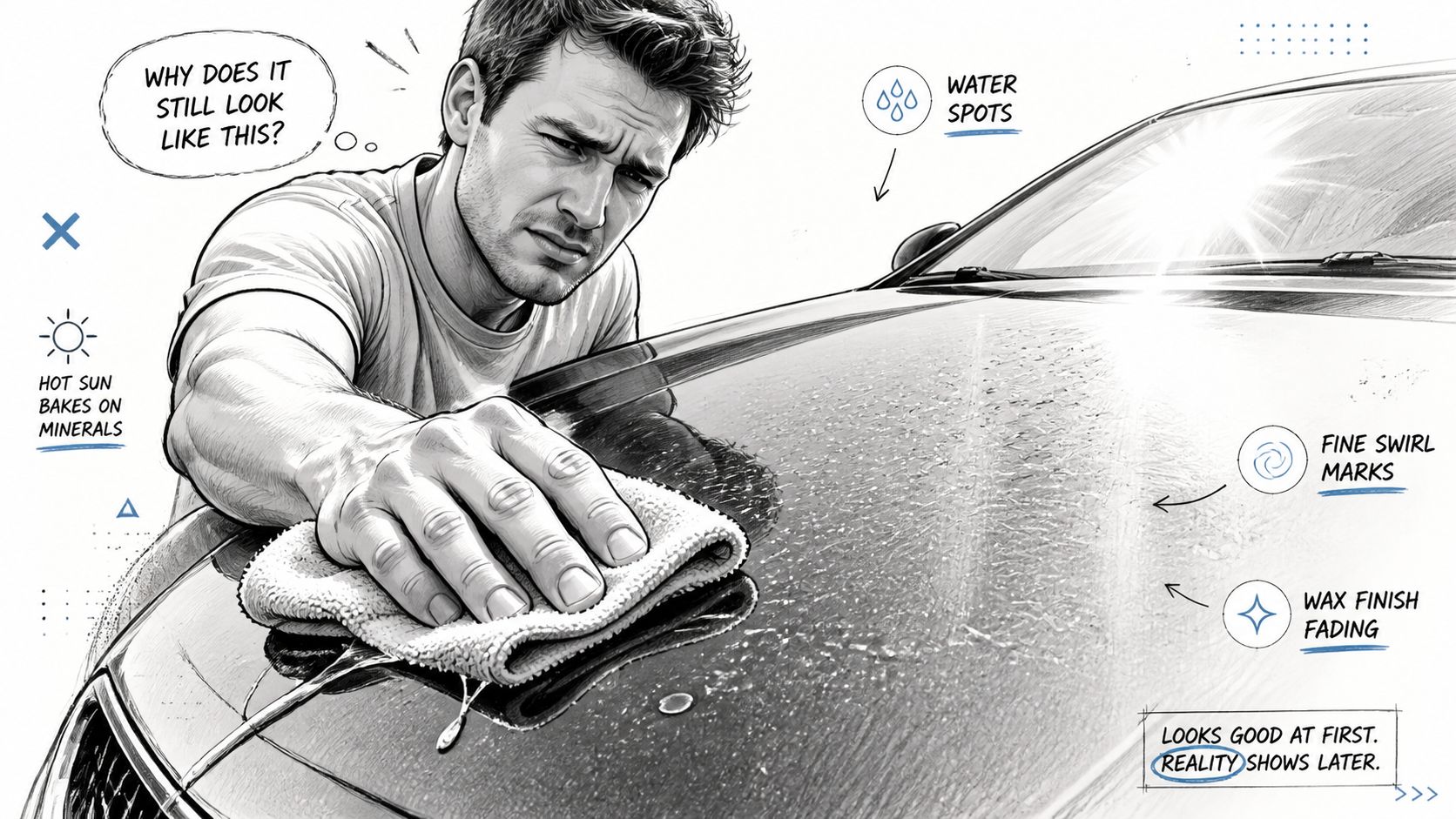
Wax still has a place. It can add warmth and gloss, and it's familiar to almost every car owner. But wax sits on the surface as a comparatively temporary layer. A nano car coating is designed to bond with the prepared clear coat and create a more persistent barrier against contamination, UV exposure, water behavior, and wash-induced wear.
From temporary shine to surface engineering
The broader nanocoatings field has roots in materials research and protective surface testing. Automotive paint protection research has examined wear through methods such as ball-cratering, which helps explain why modern coatings are discussed in terms of abrasion resistance, chemical durability, and hydrophobicity rather than appearance alone. The technology has since moved into a rapidly expanding commercial category. One estimate places the global nanocoatings market at USD 21.50 billion in 2025, with a projection of USD 135.88 billion by 2034, while another estimates growth from USD 9.2 billion in 2024 to USD 41.6 billion by 2034. These are market projections, not a promise about an individual vehicle, but they show the scale of the protective-coatings industry. (Fortune Business Insights nanocoatings market overview)
Practical rule: A coating won't restore neglected paint. It preserves the condition you create before installation.
Before choosing protection, some owners also compare lower-cost appearance upgrades, including the guidance on The Alloy Hub Ltd. cost-effective styling. For paint itself, though, the preparation decision comes first. A useful comparison between wax and bonded protection appears in this guide to the best wax for a new car, especially if you're deciding whether a familiar product is enough for your driving routine.
The customer with the sedan chose correction and decontamination before coating. The result wasn't magic. The coating didn't erase every risk, and it couldn't stop stone chips. What changed was the daily experience: water and dirt released more easily, washing required less scrubbing, and the corrected finish stayed easier to maintain.
The Science Behind Nano Car Coating Technology
Nanotechnology sounds abstract until you compare it with a familiar object. Think of the clear coat as a wall with tiny surface irregularities. A well-formulated coating flows across those irregularities, chemically anchors to the prepared surface, and cures into a continuous film. You can't see the individual structures, but you can observe the changes in water behavior, gloss, and resistance to everyday contamination.
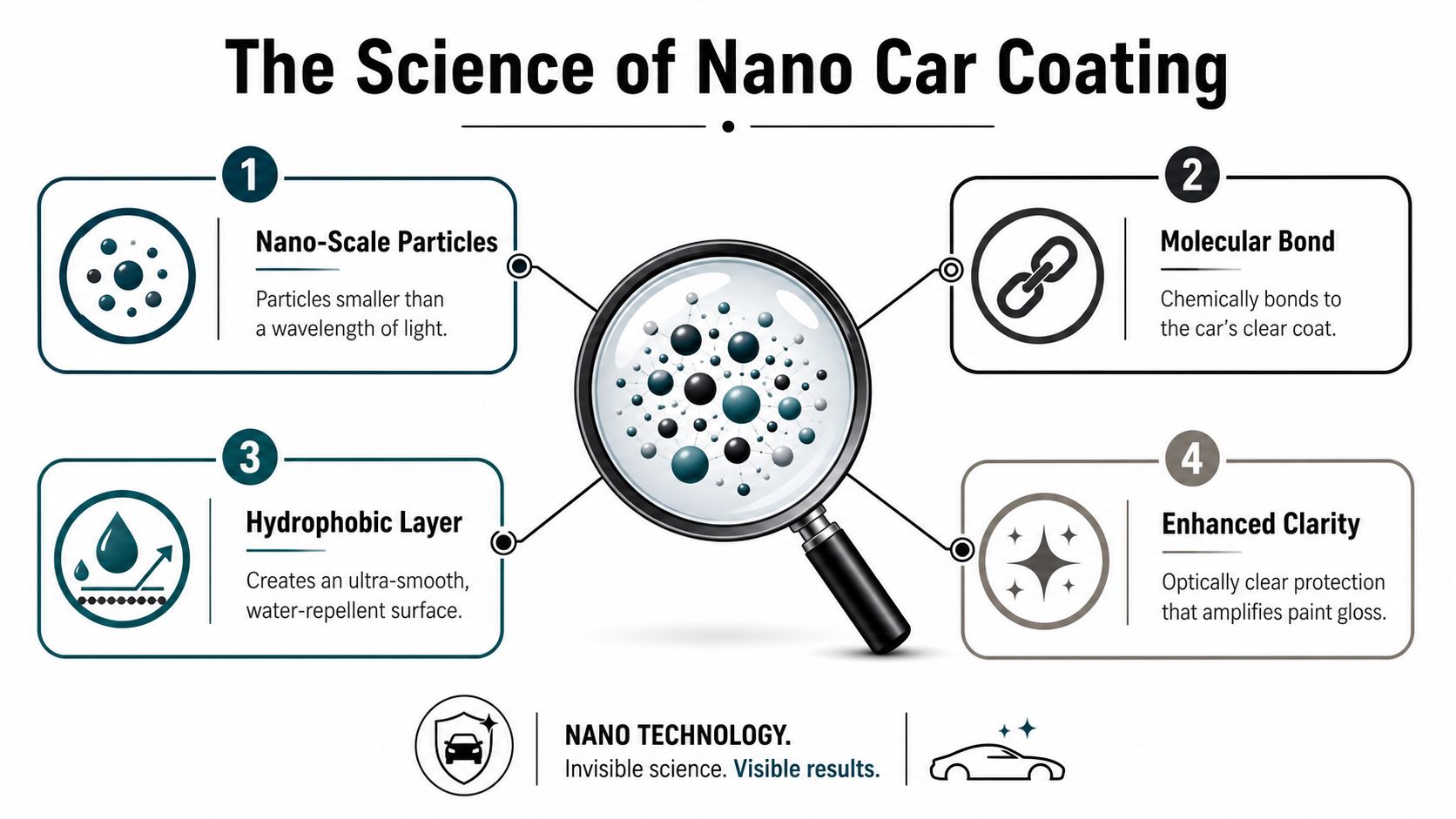
Four parts of the protective effect
Nano-scale particles help the formulation interact with the surface at a very fine level. Molecular bonding gives the cured layer more staying power than a product that merely rests on top. Silica-based systems can form an SiO2-rich network that becomes hard and chemically resistant under controlled conditions. Related automotive research has reported pencil-hardness ratings exceeding 9H, but that test result describes resistance to a specific controlled measurement, not immunity from every scratch or impact. (Technical literature on silica-based automotive coatings)
Hydrophobic chemistry changes the way water meets the surface. Instead of spreading broadly, droplets bead and move more readily, carrying loose soil with them during rinsing. Published nano-SiO2 research reported a water contact angle of roughly 111° for vinyl-silane-modified material, compared with 34° for the base polymer and 91° for another silane treatment. The same study reported scratch-resistance gains ranging from 25% to 37.5%, depending on the modifier. (Published nano-SiO2 surface research)
What the coating can and can't do
The coating's hardness mainly helps reduce micro-abrasion and wash marring. It doesn't turn paint into armor against deep scratches, keys, falling objects, or stone chips. A hard surface can still be damaged when a sharp object applies enough force.
Preparation is part of the chemistry, not a cosmetic extra. Polishing can remove or reduce visible swirls, while decontamination removes bonded particles that interfere with the film. If you seal defects beneath an optically clear coating, you'll preserve those defects in place. Titan's advanced coating technology follows the same practical principle: the final result depends on the interaction between the formula, the surface, and the application process.
Nano Coating vs Traditional Protection Methods
A weekend car that stays indoors may only need occasional protection. A commuter parked outside faces road salt, automatic washes, and airborne grit every week. Those owners may choose different products, even when both vehicles have similar paint. The higher-priced option is not automatically better value, and a low-cost product can still suit an owner who enjoys regular detailing.
The table compares the durability ranges in the available market guidance. Actual performance depends on the paint condition, preparation, exposure, and maintenance routine.
| Protection Type | Durability | UV Protection | Maintenance Frequency | Cost Per Year |
|---|---|---|---|---|
| Traditional wax | Short-term protection, often measured in months | Basic surface support | Frequent reapplication | Depends on product and labor |
| Polymer sealant | About 6 to 12 months (comparative coating guidance) | Moderate surface protection | Periodic renewal | Depends on product and labor |
| Spray sealant | About 2 to 4 months | Short-term support | Frequent top-ups | Depends on product and labor |
| Professional nano or ceramic coating | About 2 to 5 years with proper care | Designed for longer-term resistance | Coating-safe washing and inspection | Installation cost spread across service life |
The protection tradeoff
Wax can produce a rich finish quickly, but a customer who washes often may need to repeat the application regularly. Polymer sealants stretch the interval, while spray sealants work well for quick refreshes and short-term enhancement. A professional nano car coating requires more surface preparation and a controlled installation environment, yet it can reduce repeated full applications.
The materials also behave differently. Silica-rich coatings can strengthen resistance to micro-abrasion, water spotting, and chemical exposure. Hydrophobic behavior helps water and loose soil leave the surface more readily. These benefits do not replace paint protection film when the main concern is impact from stones or road debris.
Elastomer technology adds another practical distinction. Traditional hard ceramic films can struggle when paint and coating expand or contract at different rates during sharp temperature changes. A coating that combines hardness with controlled flexibility can better follow those movements, reducing the cracking problem associated with a rigid film. This is one reason owners comparing products should examine the coating chemistry, not only the label. A detailed ceramic coating versus nano coating comparison can help clarify those differences.
Calculating value without false precision
Annual cost includes the purchase price, installation labor, paint correction, maintenance products, and the period the coating remains useful on that vehicle. An owner keeping a car for years may value fewer complete protection applications. Someone who changes vehicles often, or enjoys applying sealant at home, may prefer a shorter commitment.
The practical question is simple: which protection level matches the vehicle's wash habits, climate, value, and the owner's willingness to prepare the surface correctly?
Real-World Lifespan and Performance Expectations
A customer's daily driver often reveals coating limits within ordinary routines. The hood collects insects and road film, the lower doors take on grit, and every wash adds another round of contact. A garage-kept car usually faces less exposure, while coastal air and winter roads place greater stress on the surface.
Product lifespan falls into several practical ranges. DIY consumer sprays generally last about 4 to 12 months, professional-grade coatings about 2 to 5 years, and premium multi-layer systems about 5 to 8 years. Preparation, climate, washing, and exposure can shift the result. The Real-world coating lifespan guide outlines these categories and the conditions behind them.
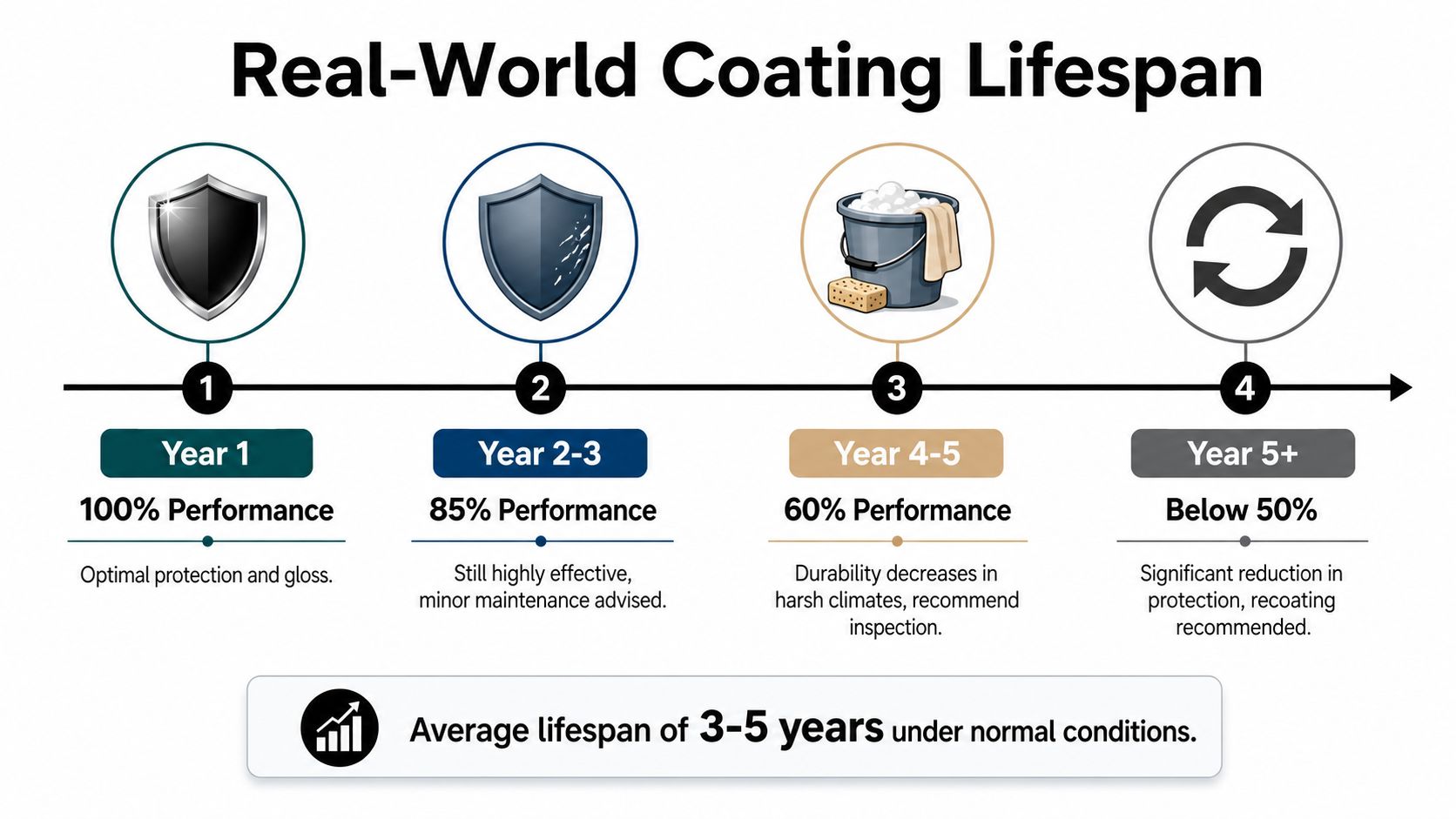
Four ownership situations
- Daily driver: Repeated contamination and washing increase maintenance demands. A coating-safe wash routine protects the work done during installation.
- Garage-kept car: Less outdoor exposure can support a longer service life, especially when the owner removes bird droppings, insects, and other contaminants promptly.
- Coastal vehicle: Salt-laden air and frequent moisture call for regular rinsing and inspection. Hydrophobic behavior helps water and loose soil leave the surface, but it does not remove salt.
- Fleet vehicle: Shared vehicles need consistent washing procedures because different drivers and locations can produce uneven care.
Automatic washes and poor preparation can shorten coating life by 40% to 70% or more, according to the guidance cited above. Detailers see the same pattern repeatedly: a coating works as part of a maintenance system, not as a product that can be installed and ignored.
A lifetime warranty usually describes a reapplication policy. It does not mean the original chemical film will provide indefinite protection without inspection or maintenance.
Performance usually fades in stages. Water may bead less tightly, the paint may lose some slickness, and contamination may cling sooner. Those changes point toward decontamination, a compatible maintenance product, or professional inspection rather than immediate replacement. A coating with elastomer technology can also help address cracking caused by sharp temperature changes, because its flexibility allows the film to accommodate panel movement while retaining a hard surface.
The Elastomer Breakthrough That Changes Everything
A dark hood can be cool in the morning and scorching by afternoon. Its clear coat and any protective film respond to that shift, but not always at the same rate. Traditional ceramic coatings earn their reputation for hardness, yet a rigid film can develop stress when the panel repeatedly expands and contracts. Cracks and breaks in continuity then create paths for contamination and wear.
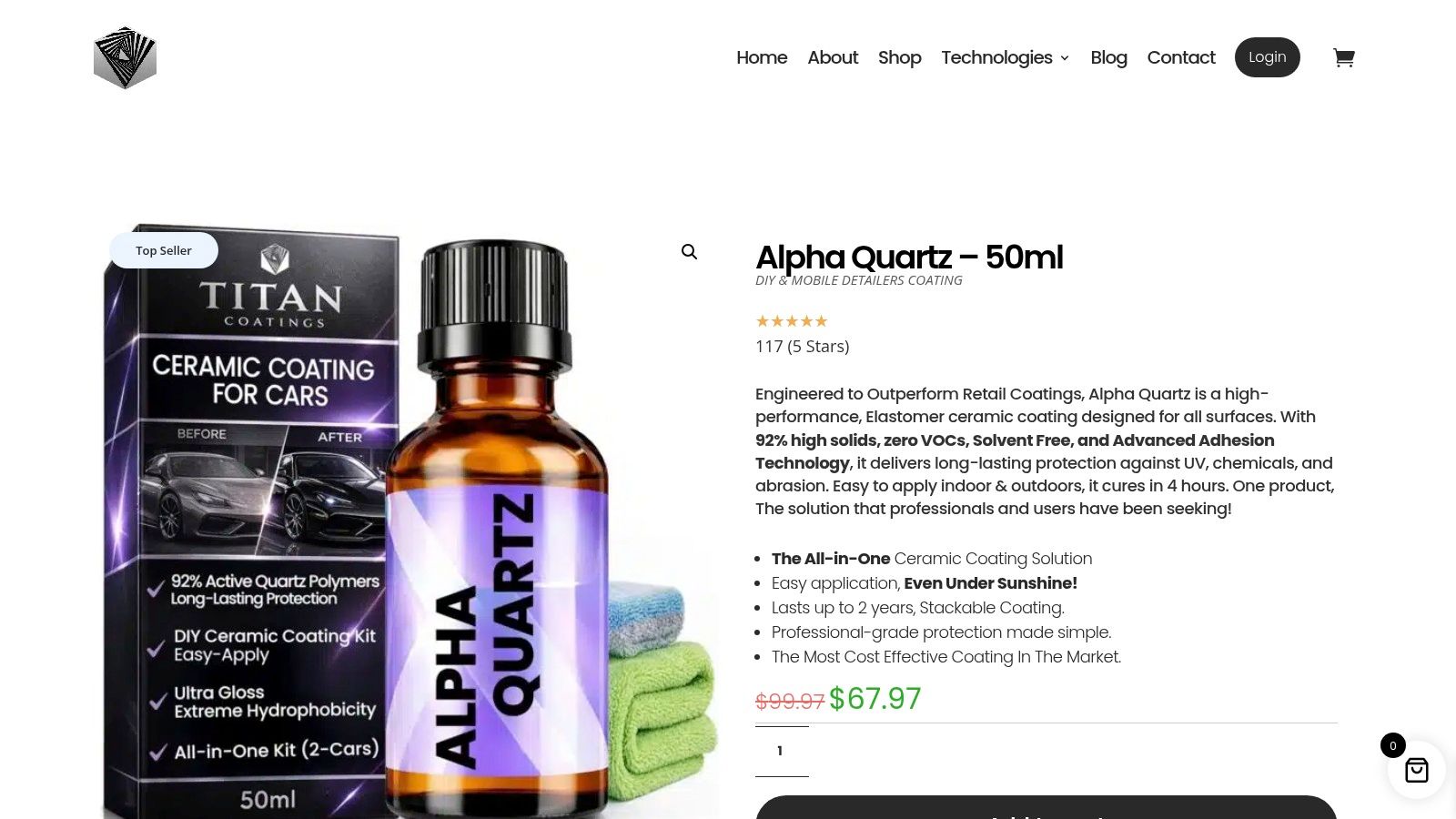
Titan Coatings built its approach around elastomer chemistry, carbon nanotube technology, and Dark Matter Technology. The company describes its elastomer coatings as hard like glass yet flexible. In practical terms, the surface is designed to resist abrasion while moving with the panel underneath, instead of depending on hardness alone. Details about this elastomer coating technology are available through Titan's elastomer breakthrough.
Why flexibility matters in the driveway
Materials research helps explain why thermal flexibility matters. One MWNT-silicone composite film endured more than 4,000 thermal cycles from −30 °C to room temperature, while its open porous structure helped relieve stress created by mismatched expansion. (MWNT-silicone thermal-cycle study) Another study found that adding carbon nanotubes can change thermal-expansion behavior, including a CNT-epoxy composite with a zero thermal-expansion point of about 62 °C. (CNT-epoxy thermal-expansion study)
Those results do not establish identical performance for every automotive coating. They do show why researchers examine nanotube-reinforced composites for thermal response, wear resistance, and surface protection. A review of carbon nanotube-based coatings discusses these combined functions rather than treating nanotubes as a cosmetic additive. (Review of carbon nanotube-based surface coatings)
Titan products for different surfaces
Alpha Quartz is intended for paint, PPF or vinyl, plastic, and wheels. Its elastomer design suits DIY owners and mobile detailers who want a practical installation process with a hard, flexible finish. Bugs, temperature swings, and panel movement still make preparation important, but the flexible film is designed to reduce the cracking risk associated with rigid coatings.
For windshields, Apex Glass is formulated for glass rather than painted panels. Its hydrophobic behavior helps rain form mobile droplets and clear from the driver's sightline more readily. The product is presented as easy to use, while the glass still requires thorough cleaning and residue removal before application. (Apex Glass windshield coating)
The design balances two demands. Hardness resists wear. Elasticity helps the coating accommodate movement and temperature change.
Application Options and Maintenance Best Practices
A successful nano car coating begins before the bottle is opened. I've seen owners blame a product for high spots that were caused by poor lighting, rushed leveling, or residue left on contaminated paint. The same formula can produce very different results on a polished, panel-wiped surface and on paint carrying embedded grime.
Professional or DIY installation
Professional installation makes sense when the vehicle needs substantial paint correction, the owner wants uniform coverage, or the workspace can't control dust, moisture, and lighting. A trained detailer can inspect the paint under focused illumination and identify high spots before they cure.
DIY application can work for a careful owner or mobile detailer who follows the product directions. Alpha Quartz is designed for accessible application, while Ultra Ceramic Spray offers a simpler spray format for owners seeking an easier installation path and strong visible results without the workflow of a traditional multi-step coating.
The preparation sequence
- Wash thoroughly. Remove loose dirt before touching the paint repeatedly.
- Decontaminate the panels. Bonded particles can prevent consistent contact between coating and clear coat.
- Correct the finish when needed. Polishing reduces visible swirls and restores clarity before sealing the surface.
- Panel wipe carefully. Remove polishing oils and residue so the coating can bond consistently.
- Apply in small sections. Work with controlled coverage and watch the surface under suitable lighting.
- Level residue promptly. Follow the manufacturer's flash and wipe instructions rather than guessing.
- Allow the coating to cure. Keep the vehicle away from water and contamination for the period specified by the product instructions.
Use separate, clean microfiber towels for leveling and inspection. If you notice a high spot, correct it while the product remains workable according to the manufacturer's guidance. Don't attack cured residue with abrasive materials unless you understand the risk to the underlying finish.
Maintenance habit: Gentle washing protects the coating you paid to install. Aggressive brushes can create the very marring the coating was meant to reduce.
Use coating-safe wash products, soft wash media, and clean drying towels. Avoid harsh chemicals, abrasive tools, and automatic brush washes. The guide to washing a car with ceramic coating provides a practical routine for keeping the surface clean without turning maintenance into another source of damage.
Choosing the Right Nano Coating for Your Needs
A commuter arrives with road film packed around the wheels. A weekend enthusiast brings in a car that spends most of its life indoors. A mobile detailer needs one system for several surfaces, while a first-time DIY installer needs a forgiving process. The right nano coating starts with that owner and vehicle, not the boldest label on the bottle.
Match the product to the owner
The daily commuter needs paint protection that can handle repeated contamination and washing. Alpha Quartz suits owners seeking a hard yet flexible elastomer surface for paint, wheels, plastics, or PPF, provided they are ready to maintain it correctly.
The garage-kept weekend car can use a paint-focused coating chosen for gloss retention and easier cleaning. With less exposure to traffic and weather, its owner has more time for careful washing and routine inspection.
The mobile detailer needs predictable handling, a workable process, and coverage across different client surfaces. Alpha Quartz can serve that role. Ultra Ceramic Spray offers another option when a customer prefers a quicker application or a layer aimed at ongoing maintenance.
The DIY beginner should judge a product by preparation requirements, working time, lighting, and clear manufacturer instructions. A manageable coating, clean towels, and small application areas create a better first installation than rushing after the highest hardness claim.
Consider the climate and the glass
Coastal salt, desert heat, and northern winters expose vehicles to different stresses. Elastomer technology addresses one of the weaknesses seen with rigid ceramic coatings. Its flexibility is intended to accommodate panel movement and temperature changes, reducing the risk of cracking as conditions shift. The coating still needs washing, inspection, and sensible storage.
Windshield protection calls for its own product. Apex Glass is made for glass, with emphasis on water repellency and clearer visibility during rain. Paint and glass coatings bond to different substrates, so treating every exterior surface the same way can produce a poor match. Titan's research and development work covers automotive and other hard-surface applications, with its publisher information describing ISO 9001 certification, third-party ISO and ASTM testing, and real-world analysis across more than 30 countries. (APEX NANO by Titan Coatings)
Price should match the ownership plan. A professional flexible coating can make sense for a vehicle kept for years, especially when the owner accepts the preparation and care it requires. A spray coating or sealant may fit a shorter ownership period or someone who enjoys applying protection more often.
APEX NANO by Titan Coatings lists options for painted panels, wheels, plastics, PPF or vinyl, and windshields, including Alpha Quartz, Apex Glass, and Ultra Ceramic Spray. Visit APEX NANO – Titan Coatings to compare product details and select a nano car coating suited to the vehicle, climate, and detailing routine.
0 Comments