
You finish polishing a windshield, wipe away the residue, and it looks perfect in the shade. Then the sun drops low, the glass catches the light, and a faint washboard of scratches and haze appears in front of the driver's eyes. The pad removed the contamination, but it may also have reshaped the glass unevenly.
That's why glass buffer pads deserve more attention than a product-page accessory. The pad controls contact, heat, abrasive movement, and the final surface texture. Those choices matter even more when you plan to apply a glass coating, because a coating can only protect the surface you leave behind.
Why Glass Buffer Pads Matter for Every Detailer
Glass feels hard and smooth under your fingertips, but the surface still contains microscopic peaks, valleys, mineral deposits, wiper trails, and fine scratch patterns. A pad doesn't “clean” that terrain. It carries abrasive material across it and determines how evenly the abrasive removes or refines material.

A soft finishing interface can follow a curved windshield and distribute pressure. A dense felt pad can remove defects faster, but it can also create more heat and leave a harsher scratch pattern if you dwell in one area. The result depends on the whole system, not just the bottle of polish sitting beside the machine.
The practical mistake is easy to make. A detailer sees stubborn water spots, reaches for the most aggressive pad, and spends the same thirty minutes correcting the glass that a gentler combination would have finished more cleanly. The windshield may look bright after the residue is removed, yet still show haze or optical distortion when headlights and sunset reflections strike it.
The coating starts with the glass
Titan developed its own coating technology around elastomer coatings, nanotube technology, and Dark Matter technology. The useful lesson for glass polishing is straightforward: a protective layer can't compensate for a poorly prepared substrate.
If the pad leaves loose residue, uneven micro-scratches, or localized heat damage, the coating has to sit on that compromised surface. Cleaning the glass with the correct process, as described in this auto windshield cleaning guide, is only the starting point. Polishing must leave the surface uniformly clean and optically consistent.
Titan describes its elastic coatings as hard like glass while remaining flexible. That flexibility can help a coating tolerate movement and temperature-related stress, but it doesn't make aggressive polishing harmless. A coating lasts longer when the detailer gives it a stable, properly refined surface before application.
Practical rule: The pad is part of the coating system. Choose it for the finish you need, not merely for the defect you can see.
Demand for glass polishing pads is also moving beyond occasional spot removal. One market outlook projects global demand for glass polishing pads to grow at a 6% to 8% compound annual growth rate through 2035, connected to automotive and architectural glass, curved panels, smart glass, and electrochromic windows (IndexBox market outlook). A separate estimate places the market at about USD 500 million in 2025 and roughly USD 850 million by 2033, with a projected 7% CAGR (Data Insights Market report). Those projections reflect a simple reality for detailers: glass finishing is becoming a more deliberate process, not an afterthought.
Understanding Pad Materials and Construction
Start by matching the pad's face material to the kind of contact the glass can tolerate. Then examine the backing and profile. Felt, foam, microfiber, and cerium-oxide interfaces distribute pressure and abrasive slurry differently, so the same compound can produce very different results. That difference affects coating longevity: a pad that leaves uneven micro-scratches or localized heat can shorten the service life of even a premium glass coating such as APEX Glass.
Felt for controlled correction
Felt pads are firm workhorses for glass restoration. They carry cerium oxide evenly and transfer enough pressure to address mineral etching, wiper trails, and light pitting. Their dense structure holds its shape, so more of the machine's pressure reaches the glass instead of being absorbed by pad compression.
The trade-off is reduced forgiveness. A slight tilt, a dry face, or excessive dwell time can concentrate heat and abrasive action in one area. On a curved windshield, an overly rigid pad may contact with its edge rather than its full face, creating an uneven correction pattern that must be refined before coating.
Foam for refinement
Closed-cell or glass-specific foam usually glides more smoothly. It suits finishing haze, light contamination, and coating preparation, where the goal is an even, optically clear surface rather than fast material removal.
Foam also gives the operator useful tactile feedback. You can feel the pad begin to drag, notice compound drying, or sense the machine losing a flat contact patch. That feedback helps during final refinement. Foam still cannot replace a firm felt interface when the defect requires meaningful correction.
Microfiber and abrasive interfaces
Microfiber and cerium-impregnated interfaces sit between these two behaviors. They may hold slurry more actively than some foams while leaving a finer pattern than an aggressive felt setup. Their response depends on pile, backing, compound load, and pressure, so color alone is a poor selection guide.
Glass polishing products commonly use cerium oxide or felt-backed abrasive interfaces. Cerium oxide is chosen for its chemical-mechanical action, which helps address micro-scratches and water spots while limiting the distortion risk associated with harsher abrasive approaches. For a broader comparison of polishing and buffing pads, check the face and backing construction rather than judging only by the label.
Construction details that change handling
The face is only one part of the system. Check the backing, edge thickness, hook-and-loop fit, and rotational balance before polishing.
- Backing fit: A 3-inch pad should sit correctly on a 3-inch backing plate. Overhang can flex the edge and fling abrasive slurry beyond the intended work area.
- Edge profile: A controlled edge helps you work near seals and borders without letting the rim dig into the glass.
- Density: Denser pads hold their shape more consistently. Less dense interfaces conform more readily but may lose cutting consistency.
- Balance: A wobbly pad creates vibration, uneven contact, and operator fatigue. A stable pad keeps pressure more predictable.
A well-matched construction leaves a more uniform surface for the coating to bond with. That preparation helps preserve the coating's performance instead of asking it to hide pad-induced defects.
Grit Grades Thickness and Density Explained
If a windshield shows stubborn wiper marks, choosing a pad by grit alone can lead to uneven correction. Grit, thickness, and density work together, much like the blade, suspension, and tires of a vehicle. A coarse abrasive on a thick, compliant pad behaves differently from the same abrasive on a thin, firm interface.
Glass abrasives can range from very fine to comparatively coarse, so the product label is only a starting point. Pressure, compound load, machine movement, and pad construction can make a fine setup cut more aggressively than expected. That matters after polishing: microscopic haze or uneven refraction can leave a premium coating, including APEX Glass, with a less uniform surface to bond to, shortening its useful life.
A practical grade framework
The categories below are working bands rather than universal laboratory standards.
| Grade | Thickness | Density | Best For |
|---|---|---|---|
| Coarse, around 800 to 1,200 effective grit | 3/8 inch for firm tracking | Firm or medium-firm | Wiper scars, mineral etching, heavier correction |
| Medium, around 1,500 to 2,000 effective grit | 3/8 to 1/2 inch | Medium | General haze, water spots, pre-coating preparation |
| Fine, above 3,000 effective grit | 1/2 inch or a thin finishing interface | Soft to medium | Light oxidation, final polish, burnishing, streak-free finishing |
A coarse grade removes material quickly, but it commonly leaves a finish that needs refinement. Medium grades balance correction and clarity for routine work. Fine grades belong near the finish, where the goal is to reduce haze and unify the surface rather than chase deep defects.
Thickness changes the feel
A 3/8-inch felt pad cuts directly and tracks firmly. A 1/2-inch or thicker pad conforms more easily to a curved windshield and spreads pressure across a wider area, although that cushion reduces feedback. On a flat panel, the extra compliance can make consistent pressure harder to judge.
Density changes how the pad carries compound. A dense face tends to retain slurry and keep the abrasive working beneath the pad. A more open structure may release compound toward the edge, increasing sling and complicating heat control.
Fixed-abrasive pad specifications show why mechanical behavior matters alongside grade. The reference lists thickness around 1.1 to 1.2 mm, nap thickness around 400 to 500 µm, compressibility of 14% to 24%, elasticity of 86% to 93%, and hardness of 37° to 42° (technical fixed-abrasive pad reference). These properties affect contact, pressure distribution, and finish consistency.
For larger panels, compare available 6-inch polishing pads only after confirming that the backing plate, machine, and work area match. A controlled finish gives the coating a more even surface, helping preserve its performance instead of asking it to conceal pad-induced defects.
Choosing the Right Pad for Each Glass Task
Start with the defect, then consider the glass shape and the desired finish. A windshield needs different handling from a flat side window, and maintenance polishing has a different goal from restoration.
Light water spots and road film rarely justify a heavy-cut setup. A soft foam pad or fine felt interface with a controlled cerium oxide slurry can remove the film while preserving a more uniform finish. Work in small sections, inspect under changing light, and stop once the glass becomes consistently clear.
Stubborn wiper streaks and minor pitting call for more bite. A medium-density felt pad paired with a moderately stronger compound can correct the area through short passes. Keep the pad moving, especially where the defect is concentrated, because repeated pressure in a narrow zone can create uneven refraction.
Deep scratches and acid-etched marks require caution. An aggressive felt or wool-felt hybrid may reduce the visible defect, but it can also remove enough material to create distortion. If a scratch is severe, the safest answer may be professional glass repair or replacement rather than prolonged machine correction.
Use these decision signals
- Defect depth: If you can feel the scratch clearly with a fingernail, don't assume a stronger pad is the answer. The defect may exceed what safe polishing can correct.
- Glass location: Windshields demand optical consistency. Side windows and flatter architectural panels may offer more forgiving geometry, but coatings, tint films, and substrate condition still matter.
- Correction goal: Restoration needs controlled cutting. Maintenance needs a mild interface that preserves the finish.
- Surface condition: Aftermarket tint, coatings, and compromised glass can react poorly to abrasive polishing. A car-glass polishing guide warns that abrasive work can damage aftermarket-tinted glass and that etched pits may be unsafe to polish (windshield polishing guidance).
- Pad color: Treat color as a manufacturer's convention, not a universal hardness code. Verify the actual material and intended use.
| Defect Type | Severity | Pad Recommendation | Compound Pairing |
|---|---|---|---|
| Road film or light water spots | Low | Soft foam or fine felt | Fine cerium oxide or glass polish |
| General haze | Low to medium | Finishing foam | Fine polish with light pressure |
| Wiper trails | Medium | Medium-density felt | Moderate-cut cerium oxide slurry |
| Minor pitting | Medium | Firm felt, controlled passes | Medium-grade cerium oxide |
| Deep scratches or etching | High | Aggressive felt only after testing | Graded cerium oxide, professional assessment recommended |
A gentler pad often finishes cleaner than the strongest option. That matters before coating application, because removing a visible mark is only half the job. You also need to preserve optical clarity and avoid leaving a new pattern behind.
Pairing Pads With Compounds and Coatings
A glass polishing system has three parts: the pad, the compound, and the protection applied afterward. Change one part and the behavior of the other two changes with it.
Dense felt loaded with cerium oxide slurry maximizes correction for deeper restoration. It also creates more mechanical action, so the surface may require a separate refinement stage. Softer foam cuts more slowly, but it can produce a smoother finish that's easier to clean and prepare for a coating.
Cerium oxide is especially common in glass work because it combines abrasive action with chemical-mechanical interaction with silica. The working range can be broad, from fine interfaces for clarity to coarser grades for material removal. The important trade-off is simple: more cut can shorten the distance to correction, but it increases the need for inspection and refinement.
Powder and liquid compounds also behave differently. A powder mixed too dry can make the pad drag and build heat. A liquid slurry that's too thin may sling away from the contact patch before the abrasive has done useful work. Pad density controls how long the compound remains under pressure, so the right consistency depends on both the product and the interface.
Coating preparation is part of correction
Traditional rigid ceramic coatings need a clean, stable, evenly refined surface. A dense restoration pad may leave micro-fissures or a coarse pattern that looks acceptable from a distance but interferes with uniform bonding.
Titan's elastomer coating approach adds another consideration. Titan says its elastic coatings are hard like glass and flexible, combining surface hardness with flexibility intended to help the coating tolerate movement and temperature change. Research on coatings supports the underlying principle: a polymer's glass-transition temperature affects whether it behaves more softly and rubberily or becomes brittle and prone to cracking (coatings thermal-mechanical properties).
Research on protective coatings also connects thermal-cycle stress with elasticity, film thickness, service temperature, and the difference in thermal expansion between coating and substrate (high-build epoxy coating research). That doesn't make a flexible coating immune to poor preparation. An overly aggressive pad can shorten the useful life of even a premium glass coating by leaving an unstable surface beneath it.
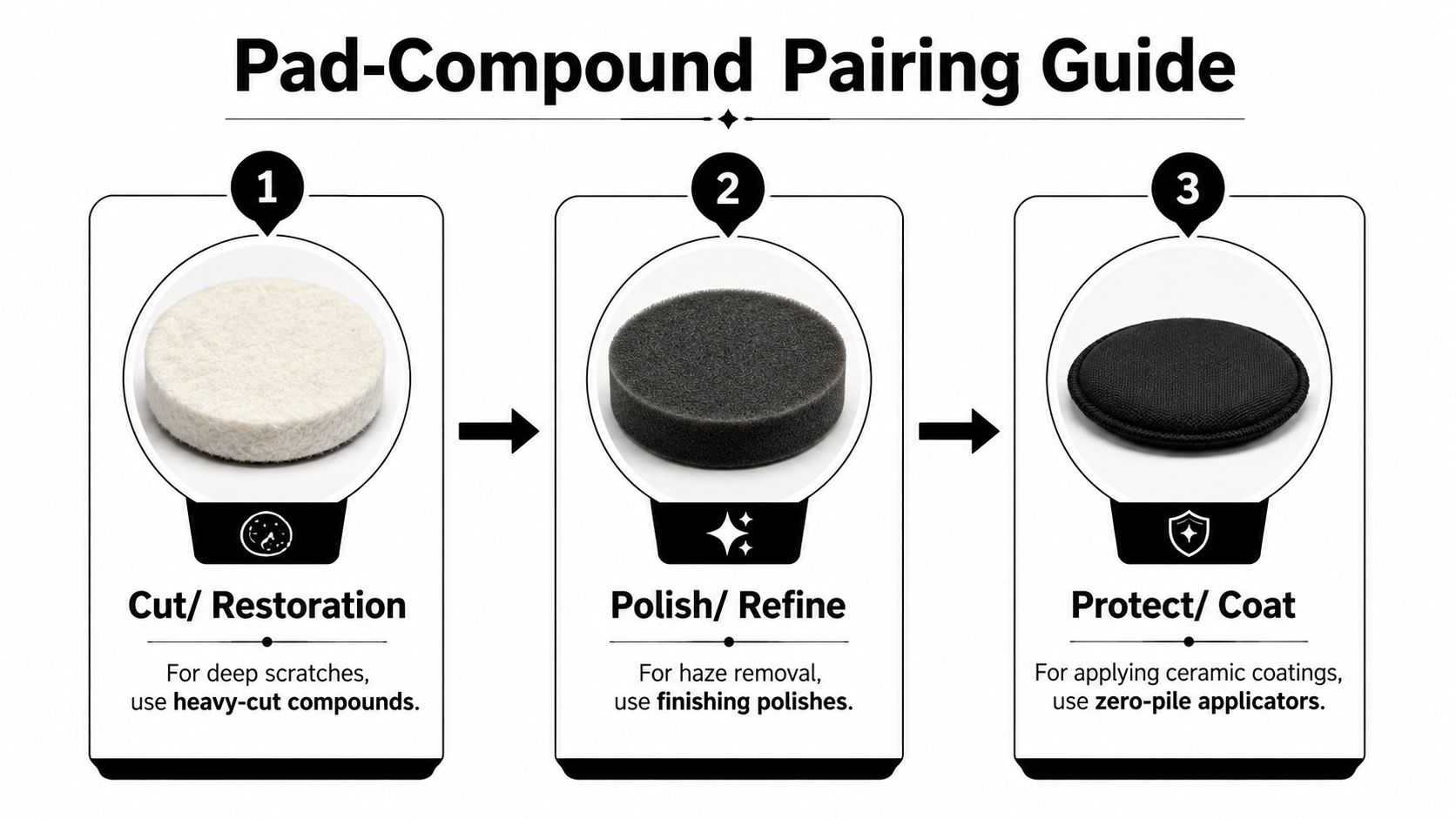
A matched system might look like this:
- Restoration: Dense felt with a controlled cerium oxide slurry for deeper defects.
- Refinement: Finishing foam with a fine glass polish to reduce haze and unify the surface.
- Protection: A clean, zero-pile applicator or the manufacturer's recommended applicator for the coating stage.
For compound selection principles, use this compound guide for buffing work as a reference, then test the combination on a small area before committing to the full windshield.
APEX Glass is Titan's dedicated glass and windshield coating. Its stated purpose is to improve water release and visibility in wet conditions, and its application workflow includes buffing the surface after application. That makes the pre-coating pad choice important. If you plan to use APEX Glass, finish with a clean, uniform surface rather than applying it over the residue or micro-marring left by a tired correction pad.
Technique Tips and Common Mistakes to Avoid
A detailer can use a high-quality pad and still damage glass through poor technique. The usual trouble starts when the operator focuses on the defect instead of the heat, contact, and movement around it.
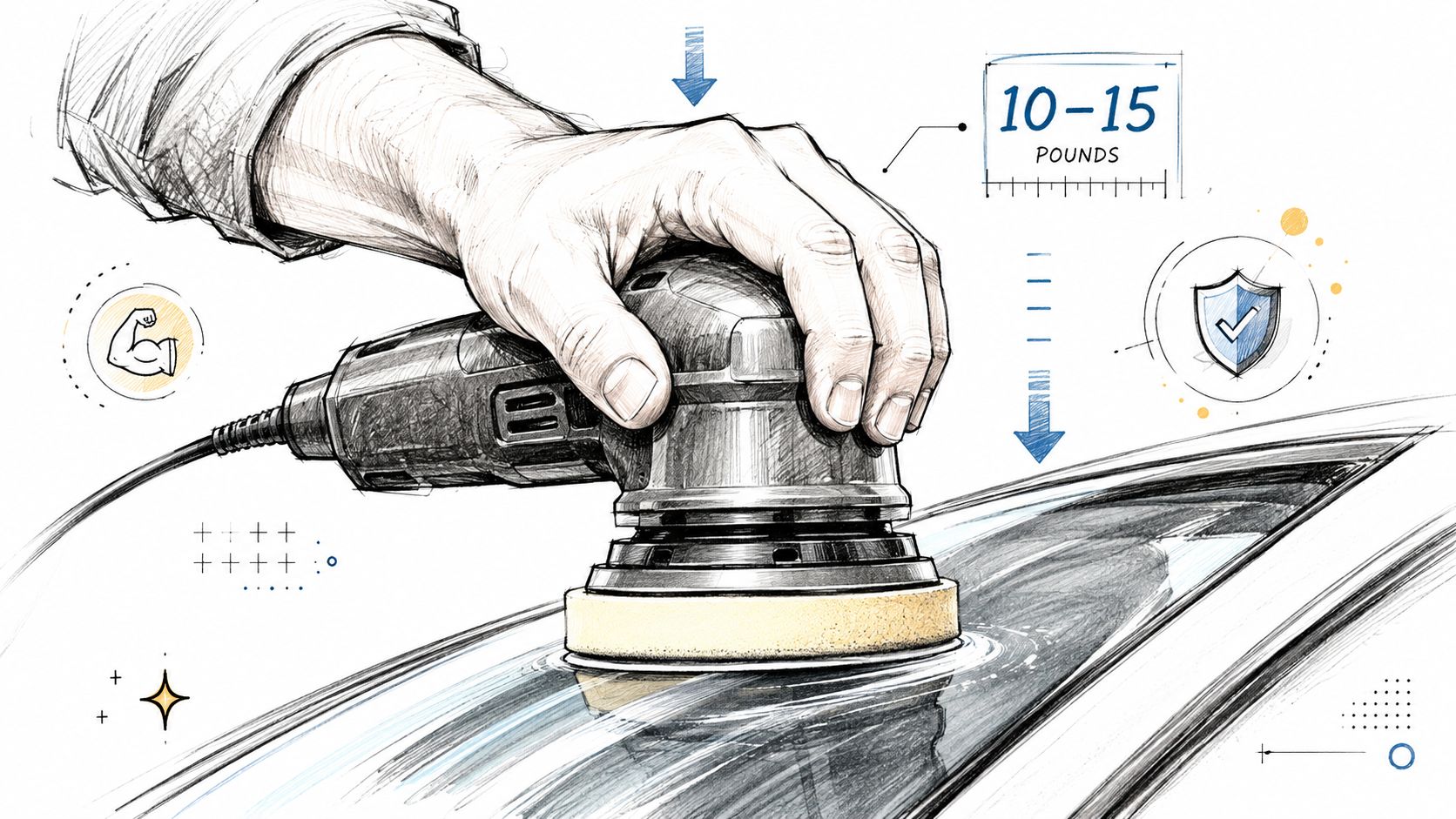
On most glass pad work, use about 10 to 15 pounds of downward force and keep the pad flat. That's enough pressure to maintain contact without stalling the polisher. Typical rotational speeds fall around 1,200 to 1,800 RPM for many glass-pad applications, with slower movement helping the slurry stay active and heavier correction requiring careful control.
Those figures are working guidance, not permission to force the machine. Glass condition, pad diameter, compound viscosity, and machine type all change the result. A test spot tells you more than a speed dial.
What a controlled pass looks like
- Prime the face: Spread a thin, even amount of compound so the pad doesn't begin dry.
- Control the area: Work a small section rather than chasing the entire windshield at once.
- Cross-hatch the surface: Make overlapping horizontal passes, then repeat vertically to even out the cut.
- Watch the slurry: Add lubrication before the face dries or starts dragging.
- Refine lightly: Reduce pressure during the final passes and inspect the result under direct, angled light.
A dry pad creates heat quickly. That risk becomes more serious when the glass is cold, because sudden localized heating can stress the windshield. Repeatedly working one spot can also create uneven correction, even if the glass never visibly cracks.
Stop when the machine gives you a warning
- Pad glazing: The face becomes shiny, slick, or less receptive to compound.
- Sudden vibration: The backing, pad edge, or compound distribution may be uneven.
- Glass discoloration: Heat or residue may be accumulating in the work zone.
- Dry dragging: Lubrication has dropped below a safe working level.
- Edge wandering: The pad or backing plate may be mismatched.
Avoid skipping the test spot, using a backing plate that's larger than the pad, or allowing slurry to dry on the surface. If you want a more formal workflow for machine correction, compare it with this professional car polishing resource, then adjust the process to the glass rather than copying paint-polishing habits.
Stop signal: If the pad starts vibrating, drying, or dragging, pause before adding more pressure. The surface is telling you the process has moved out of control.
Pad Care Storage and When to Replace
A glass pad is a precision tool, not a disposable sponge. Cerium oxide residue can harden in the face, and trapped glass particles can turn a previously safe pad into a source of fresh micro-scratches.
After each session, purge residue by spinning the pad against a clean microfiber with a light mist of pad conditioner or an isopropyl alcohol solution. Let the pad air-dry flat so the face keeps its intended profile. Don't soak felt or cerium-impregnated pads, because water can swell the fibers and change the pad's balance.
Keep grades separated
Store pads by grade and purpose in breathable bags. Keep them away from direct sunlight and excessive heat, and reserve a dedicated set for coated glass. A pad used for heavy correction can retain abrasive residue long after it appears clean, and that residue can undercut a fresh elastomer layer or create unwanted haze during a finishing pass.
Use a simple inspection routine:
- Feel the face: A glazed or hardened surface has lost useful texture.
- Check the fibers: Shedding, bald spots, or separated backing indicate failure.
- Inspect the finish: Micro-marring visible in bright angled light means the pad is no longer finishing reliably.
- Watch correction speed: If water spots no longer respond as they once did, the face may be loaded or worn.
- Check balance: Vibration that wasn't present earlier can signal a distorted pad.
Rotating two pads on the same machine helps distribute heat and can extend working life. Log pad hours or sessions the way you would track blades or cutting discs. The exact lifespan depends on the material, compound, pressure, cleaning method, and glass condition, so performance is a better replacement guide than a calendar.
Thermal cycling can stress a coating-substrate interface when the two materials expand differently. An industrial coatings source recommends validation across approximately -40°C to +150°C, warning that inferior products can develop micro-cracks that spread into visible failures (constant-climate coating testing). A separate study reported that carbon-nanotube-based rubber developed by AIST and JST remained flexible from −196°C to 1000°C in an oxygen-free environment, demonstrating how engineered elastomer behavior can remain stable across an exceptionally broad temperature range (AIST and JST carbon-nanotube rubber research). Those findings describe material behavior, not a guarantee for every coating, but they explain why flexibility matters when a protected glass surface moves between freezing and hot conditions.
A tired pad can make a coating look like the problem when the actual failure happened during preparation. Clean the tool, store it correctly, replace it when its face or finish changes, and apply protection only after the glass passes a careful inspection.
APEX NANO – Titan Coatings offers glass protection products such as APEX Glass for windshield and glass applications, along with elastomer-focused options and Ultra Ceramic Spray for straightforward coating workflows. Visit APEX NANO – Titan Coatings to review the products, including the shop selection, and match your coating choice to the glass preparation process you can control.
0 Comments