
Mark stood in front of his new car with two bottles in hand, one labeled ceramic and the other polymer sealant. Both promised shine, water repellency, and protection, but neither label explained what would happen when road grit, temperature swings, and daily washing tested the coating.
The difference between ceramic and polymer matters, but the old two-option debate misses the most important question: can a coating combine surface hardness with enough flexibility to survive movement, impact, and thermal stress? That's where modern elastomer coating technology changes the decision.
The Protective Coating Maze
Mark's confusion is familiar to anyone who has compared paint protection products. One installer described ceramic coating as a hard shield. Another recommended a polymer sealant because it would flex with the paint. A third conversation introduced hybrid chemistry, silica systems, spray ceramics, and claims about glass-like protection.
The labels sound precise, but they often describe different parts of the same product. A polymer sealant may emphasize flexibility, easy application, and water repellency. A conventional ceramic coating may emphasize hardness, chemical resistance, and long service life. Neither description automatically tells you how the film will behave after repeated heating, cooling, washing, contamination, or minor impacts.
Mark's first mistake was treating “hard” and “flexible” as complete buying criteria. Hardness can help resist abrasion, but hardness alone doesn't guarantee durability. A rigid layer can develop stress when it expands differently from the surface beneath it. A softer layer may tolerate movement better, but it can sacrifice scratch resistance and dimensional stability.
The question behind the label
A coating protects a vehicle through several connected properties:
- Surface hardness, which influences resistance to scratching and abrasive wear.
- Flexibility, which helps the film tolerate movement and impact.
- Chemical resistance, which affects exposure to cleaners, contaminants, and environmental deposits.
- Thermal stability, which affects behavior during heating and cooling.
- Adhesion, which determines whether the film stays bonded to properly prepared paint, glass, plastic, or metal.
A useful starting point is Titan's guide to car paint protective coatings, but product selection still requires more than reading a category name. You need to match the coating's behavior to the vehicle, the climate, the maintenance routine, and the installer's skill.
Practical rule: Choose the coating that manages the vehicle's real stresses, not the one with the most dramatic label.
Ceramics and polymers remain useful categories for understanding performance. The stronger approach, however, is to look for a formulation that preserves the useful traits of both. Titan Coatings introduced Elastomer coatings using nanotube technology and Dark Matter Technology®, positioning flexibility as a core part of protection rather than an afterthought.
Understanding the Old Guard of Car Protection
Traditional polymer protection starts with a synthetic film that sits on the surface and helps separate paint from water, grime, ultraviolet exposure, and chemical contamination. Polymer sealants are generally easier to spread, wipe, and refresh than more demanding ceramic systems. Their flexibility helps them accommodate surface movement, but their surface durability depends heavily on formulation and hardness.
Conventional ceramic coatings work differently in perception, but not always in basic structure. Many liquid automotive ceramic coatings are polymer-based layers that use silica or titania chemistry to increase hardness, durability, hydrophobic behavior, and resistance to environmental attack. The tested ceramic coating overview describes this important nuance. “Ceramic” often refers to the performance-producing chemistry inside the applied film, not a solid ceramic slab sitting on the vehicle.
What polymer sealants are designed to do
A polymer sealant makes sense when the owner values manageable application and regular maintenance. It can improve gloss, help water leave the surface, and create a sacrificial barrier over paint. The film's ability to deform can be useful on surfaces that experience movement or minor impacts.
That convenience comes with tradeoffs. Polymer coatings can have low surface hardness, and one review reports polymer coating hardness around 1 to 3 on the Mohs scale. Abrasion resistance varies, though, and modern formulations can perform much better. A separate study reported an organic polymer coating with hardness of about 0.78 ± 0.02 GPa that completed 250 steel-wool abrasion cycles without visible wear tracks, showing that “polymer” doesn't automatically mean fragile or soft. The available findings are summarized in this polymer coating hardness review.
What ceramic coatings are designed to do
A conventional ceramic system aims to create a harder, more chemically stable film with stronger water behavior and better resistance to environmental exposure. Proper preparation matters because contamination, poor correction, uneven coverage, or incorrect curing can undermine the result.
The practical lesson is simple. The ceramic versus polymer debate is really a formulation and performance debate. A polymer matrix can carry ceramic ingredients, and an advanced coating can be engineered to use flexibility without abandoning hardness. Buyers should ask what the product is designed to tolerate, not just which word appears on the bottle.
For a clearer foundation, Titan's explanation of what polymer coating means helps separate the material category from the performance claims attached to it.
A Head to Head Comparison of Traditional Coatings
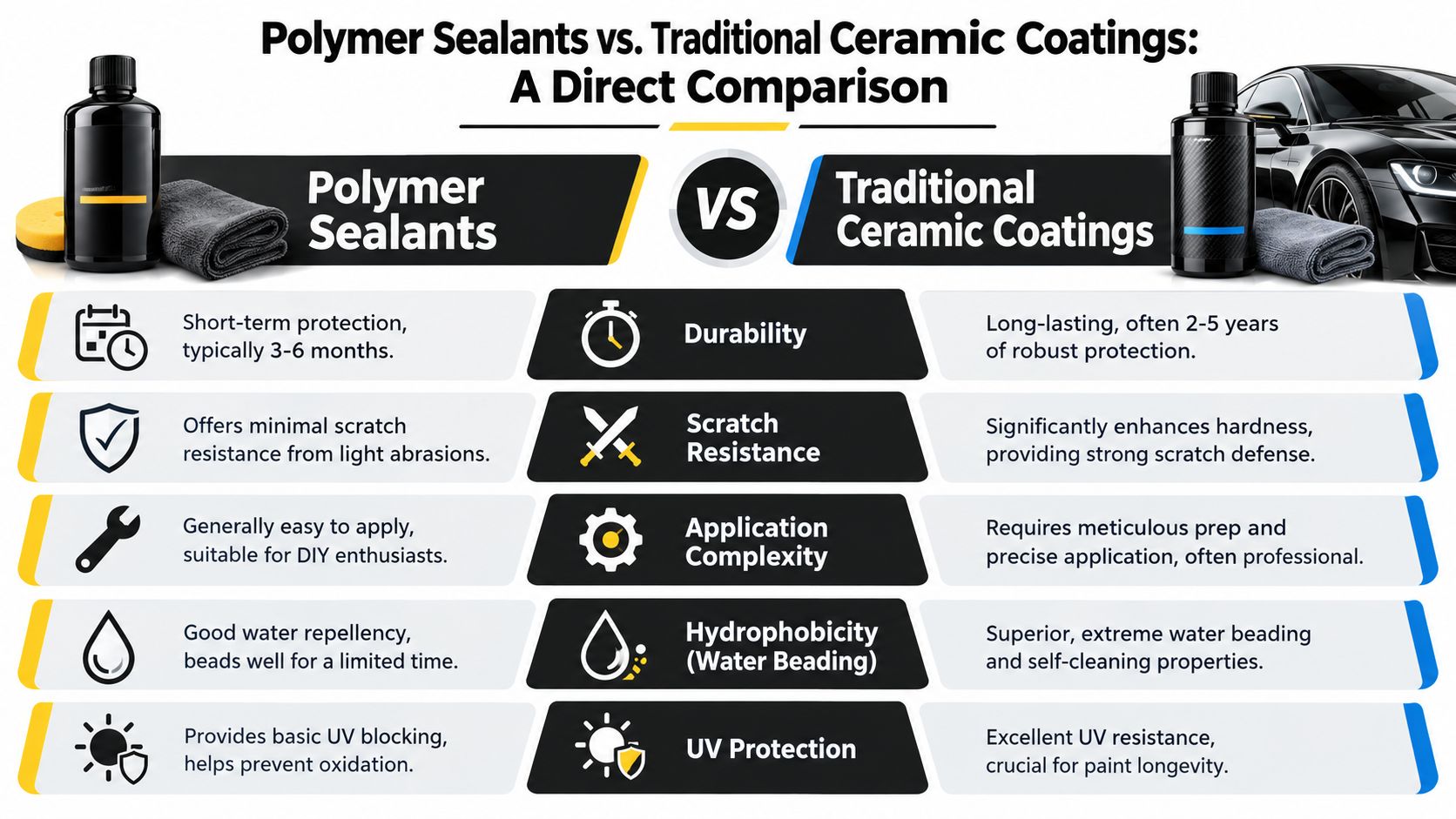
Traditional polymer sealants and conventional ceramic coatings solve different problems. Polymer sealants prioritize accessibility and deformation tolerance. Ceramic coatings prioritize hardness, chemical stability, and longer-lasting surface behavior. The right choice depends on whether the vehicle's main challenge is easy maintenance, abrasive exposure, heat cycling, contamination, or a combination of all four.
Hardness and scratch resistance
Ceramics generally have the advantage in hardness and stiffness. An independent materials comparison lists ceramic hardness at about 1,100 to 3,300 HV, compared with less than 20 HV for polymers. The same comparison lists ceramic tensile strength at roughly 100 to 1,200 MPa, versus 20 to 100 MPa for polymers, and ceramic fracture toughness around 2 to 10 MPa·m^0.5, versus 1 to 5 MPa·m^0.5 for polymers. See the ceramics, metals, and polymers comparison.
For an automotive coating, that advantage usually means better resistance to light abrasion and surface marring. It does not mean the coating makes paint immune to stone chips, careless washing, or deep impact.
Thermal behavior
Thermal expansion separates the two traditional material classes even more clearly. The comparison lists ceramic thermal expansion at 3 to 11 ×10⁻⁶/K, while polymers sit around 50 to 200 ×10⁻⁶/K. Lower expansion generally supports better dimensional stability during heat cycling.
Polymer systems can still be engineered for thermal and dielectric performance. In one peer-reviewed polymer nanocomposite study, in-plane thermal conductivity increased from 0.21 to 1.02 W m^-1 K^-1 as ceramic hexagonal boron nitride content increased, as reported in this polymer nanocomposite study. The lesson is that ceramic fillers often provide the performance boost while the polymer remains the flexible carrier.
Durability, chemistry, and water behavior
Traditional ceramic coatings usually offer stronger chemical and ultraviolet resistance than basic polymer sealants. Their harder film can remain stable under environmental exposure, and their surface chemistry often produces pronounced water beading. Polymer sealants also repel water and contaminants, but their performance usually depends more on formulation and maintenance frequency.
Water beading is useful, but it isn't the same as complete protection. Beading can decline when the surface accumulates oils, mineral deposits, detergent residue, or airborne contamination. A clean coating can appear hydrophobic again after proper decontamination without requiring immediate replacement.
Application and ownership
Polymer sealants generally suit DIY owners because they're easier to apply and more forgiving during removal. Conventional ceramic systems demand more careful preparation, controlled application, and attention to curing. That additional labor can make ceramic a poor choice for a neglected surface unless the owner is prepared to correct and prepare the paint first.
| Feature | Polymer Sealant | Traditional Ceramic Coating |
|---|---|---|
| Surface hardness | Generally lower, highly formulation-dependent | Generally higher |
| Flexibility | Stronger deformation tolerance | More rigid and potentially more brittle |
| Scratch resistance | Limited to moderate surface protection | Stronger resistance to light abrasion |
| Thermal stability | More sensitive to heat and dimensional movement | Better dimensional stability |
| Chemical and UV resistance | Useful, but varies by formula | Typically stronger |
| Water repellency | Good when maintained | Typically stronger and longer-lasting |
| Application | Easier and more DIY-friendly | More preparation and precision required |
| Main risk | Wear and loss of surface performance | Cracking, stress, or application defects |
The traditional answer is straightforward: select polymer for ease and flexibility, or ceramic for hardness and stability. That answer becomes incomplete once elastomer systems enter the discussion.
The Hidden Flaw in Traditional Hard Coatings
Mark liked the idea of a hard coating until an experienced detailer showed him a panel after repeated environmental stress. The finish looked glossy, but the detailer explained that a rigid film can carry hidden stress even when the surface appears intact. Hardness protects against abrasion, yet rigidity can make the coating less tolerant of expansion, contraction, and impact.
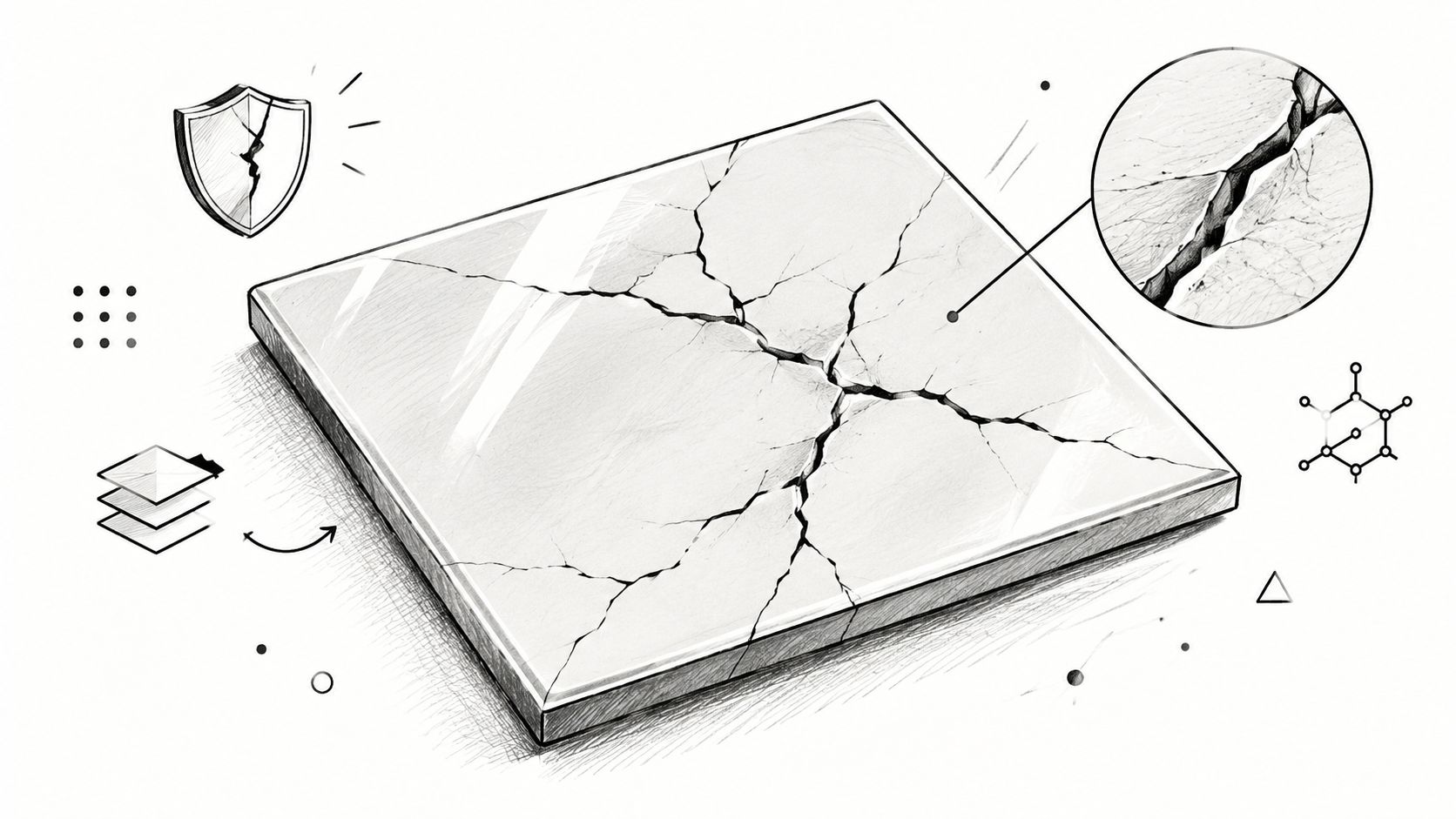
Ceramic and silicon-based coatings have a documented critical coating thickness often below 10 µm. Above that threshold, cracking and spallation become more likely, particularly when the coating and substrate expand at different rates, according to the OSTI coating-thickness research.
Why temperature creates stress
A vehicle's painted surface and its coating don't necessarily expand or contract at the same rate. During rapid heating and cooling, the interface must accommodate that difference. If the stress exceeds the coating's strength or its adhesion to the substrate, the film can crack, segment, delaminate, or spall.
Thickness can amplify the problem. A thicker layer may sound more protective, but added material can also increase stress during thermal movement. The engineering literature on ceramic coating flexibility reinforces the point that durability depends on adhesion, thickness, expansion behavior, and formulation together.
Hardness isn't the whole score
A rigid coating may perform well against light scratching and chemical exposure while remaining vulnerable to mechanical shock. Bugs, gravel, washing tools, and expanding substrates all apply different stresses. A coating that cannot flex at the interface may transfer more of that stress into the film.
The better question: What happens when the surface moves, not just when a fingernail or wash mitt touches it?
This is why “harder is always better” is a weak buying rule. The best protection must resist abrasion without becoming so brittle that ordinary thermal and mechanical events create a path to failure.
The Titan Revolution Hardness Meets Flexibility
Titan approaches the coating problem from a different direction. Its Elastomer coating technology is designed to combine a hard surface with a flexible film, using nanotube technology and Dark Matter Technology®. Titan presents this as a first-to-market elastomer coating approach, built around the idea that protection should flex instead of cracking when the vehicle and coating experience movement.
The concept is persuasive because it addresses the central weakness of traditional categories. A polymer-only system may flex but lack sufficient surface hardness. A rigid ceramic system may resist abrasion but struggle with impact and thermal mismatch. An elastomer system aims to place those functions in the same film.
Alpha Quartz as the practical example
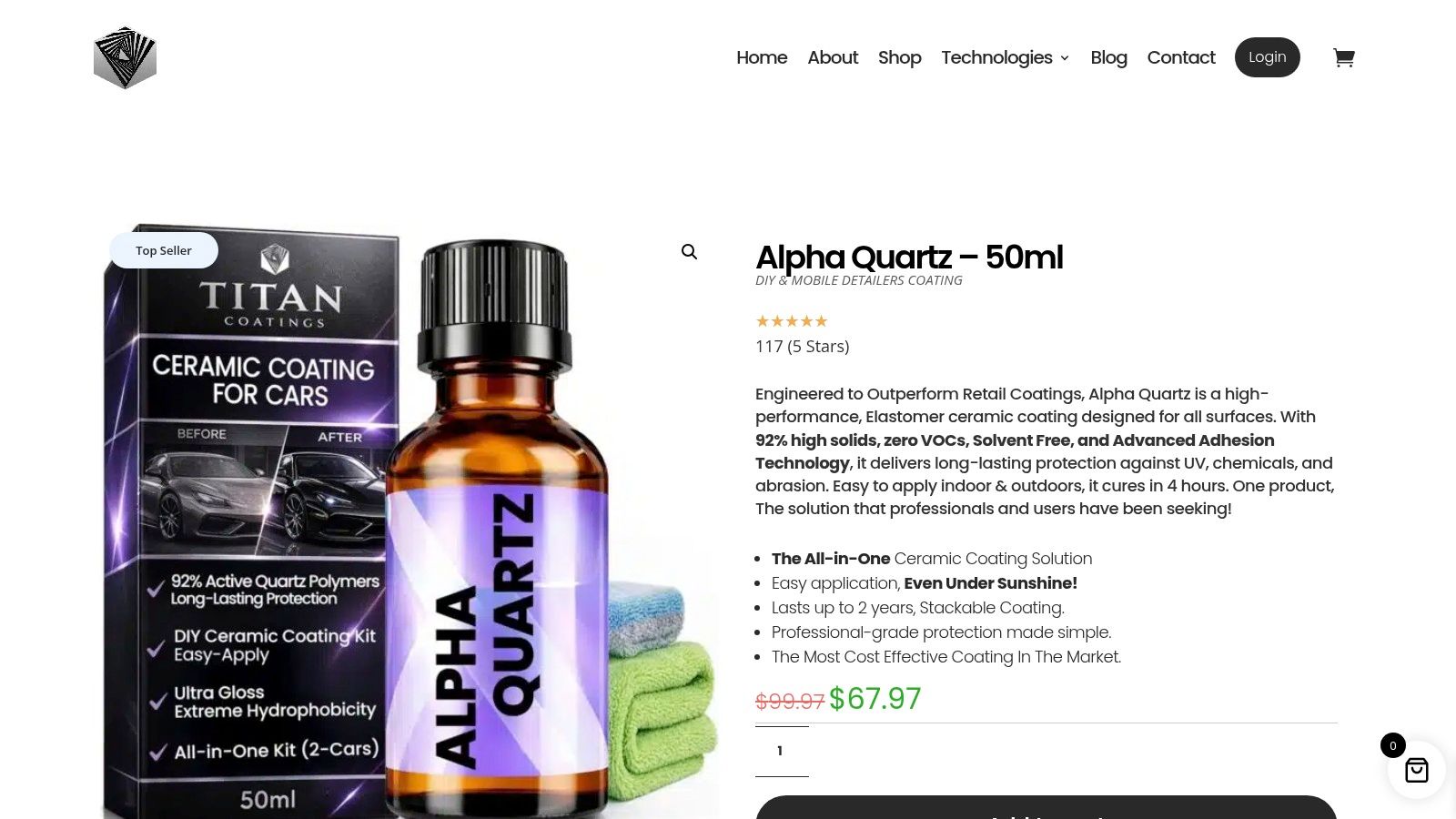
Alpha Quartz is the product to consider when you want the next step beyond the hard-versus-flexible binary. Titan positions its elastomer coating as hard like glass while remaining flexible, which matters because a flexible film can better accommodate minor movement and impact instead of transferring every force into a brittle layer.
That flexibility is especially relevant to daily-driven vehicles. Bugs strike the front end, wash media drags across the surface, and panels move through repeated hot and cold cycles. Alpha Quartz is designed for those conditions, and Titan presents it as easy to install for both DIY owners and mobile detailers.
The recommendation is direct. If the owner wants a coating that prioritizes conventional hardness alone, a traditional ceramic system can make sense. If the owner wants a film designed around resilience, Alpha Quartz is the more logical elastomer-focused option.
Why flexibility can extend service life
Specialized coating research supports the broader engineering principle that hardness and flexibility can coexist. An inorganic SiOx protective coating was reported to remain flexible above 6 µm thickness, while a polymer-derived ceramic coating with excellent adhesion showed no damage after 10 thermal cycles reaching above 1250 °C, as described in this advanced coating study.
Those findings don't prove that every automotive coating will tolerate extreme conditions. They do show that engineered coating systems can be designed to resist cracking without giving up hardness. Titan's Elastomer coating technology applies that design logic to vehicle protection.
For a detailer, the commercial benefit is clear. You can explain protection in terms clients understand: a hard surface for abrasion, a flexible structure for movement, and a formulation intended to remain intact through temperature change. That is a stronger conversation than repeating a hardness label without discussing brittleness.
Practical Applications and Easy Solutions
Advanced chemistry only matters if the product fits the user's workflow. Titan's product range includes formats for owners who want a simple spray application, detailers who need repeatable installation, and drivers who care about a specific visibility problem rather than full-body paint protection.
Ultra Ceramic Spray for accessible protection
Ultra Ceramic Spray is the practical entry point for users who want ceramic-style surface behavior without committing to a complex coating installation. Its Ultra Ceramic Spray product page presents a spray format designed for straightforward application and strong results.
Use it on a clean, dry, properly prepared surface. Spray an even amount, spread it with suitable microfiber, and follow the product's directions for removal and curing. Preparation still controls the outcome. Oils, dust, and residues can interfere with bonding, so washing and surface cleaning should come before application.
APEX Glass Coating for rain visibility
Windshields deserve a separate strategy. A clean, hydrophobic glass surface helps rainwater move away more readily, which can make wet-weather driving feel less stressful and improve the driver's view through the windshield.
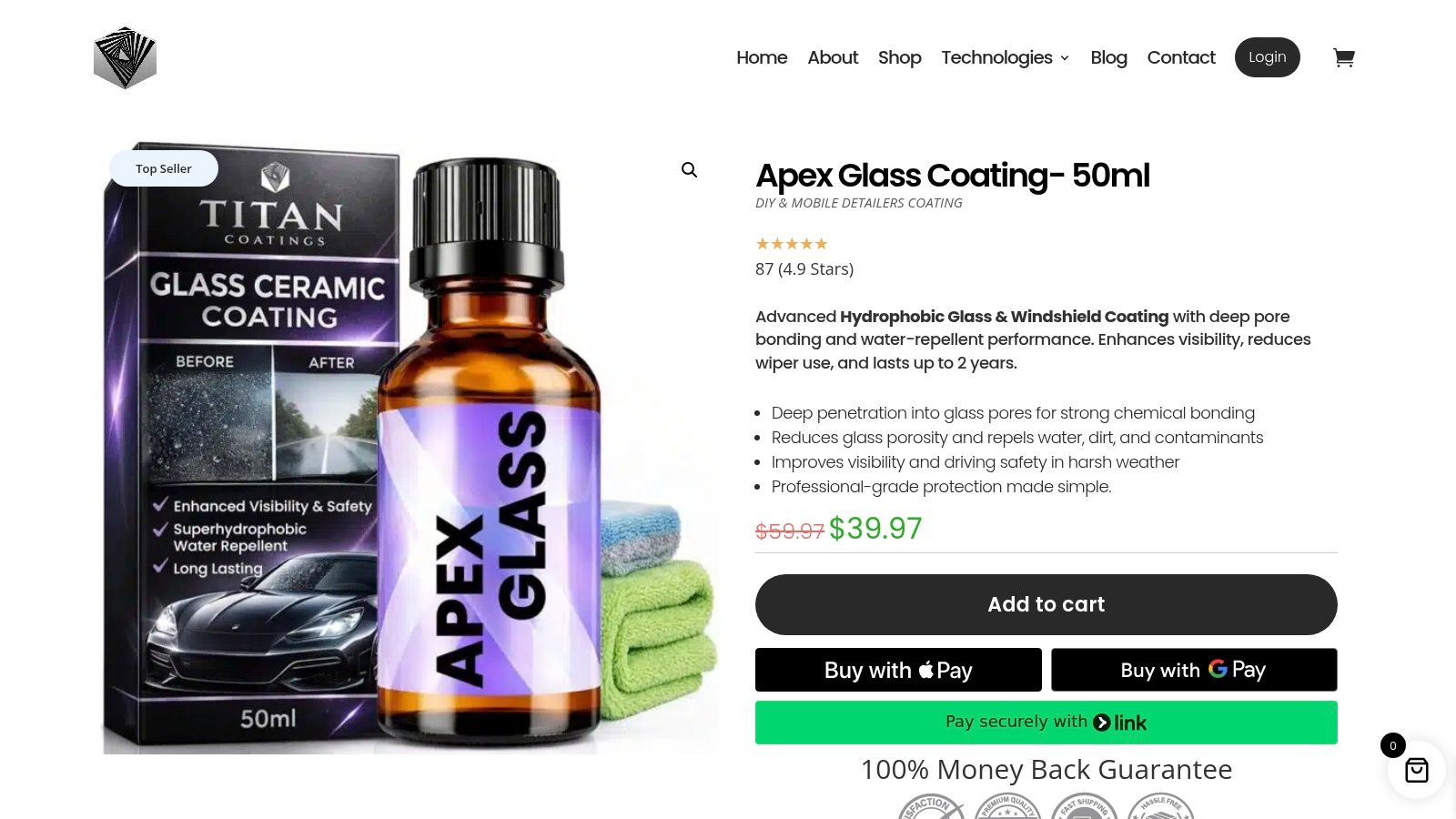
Titan's APEX Glass Ceramic Coating is presented as easy to use for glass protection. Start with thoroughly cleaned glass, remove film and contamination, apply the coating evenly, and wipe according to the product directions. Clean glass is essential because residue can reduce clarity and create uneven behavior under rain.
For mobile detailers, the product offers a focused service that solves an obvious customer problem. For DIY owners, it provides a manageable project with a visible benefit during wet weather. It won't replace functional windshield wipers or safe driving, but it can make rainwater management more effective.
Making the Right Choice for Your Vehicle
Mark no longer asks whether ceramic or polymer is universally superior. He asks what the vehicle faces, how the coating will be installed, and whether the chosen film can tolerate movement as well as abrasion.
Traditional polymer sealant remains sensible for easy DIY maintenance and flexible, lower-complexity protection. Conventional ceramic remains useful when hardness, chemical resistance, and thermal stability are the main priorities. But ceramic is not automatically the best choice for marine exposure, harsh climates, or daily driving. Academic testing found that both polymeric and ceramic-based coatings can protect against aggressive water environments, while performance varies by chemistry. In one electrochemical study, the polymeric coating reduced corrosion rate to about one-seventh of the uncoated rate, while the ceramic-base coating reduced it to about one-half, as reported in this coating corrosion study.
For vehicle owners comparing interior upkeep alongside exterior protection, express interior detail options can help complete the maintenance plan. For new-car owners, Titan's guidance on paint protection for new cars provides a useful starting point.
Choose by use case, substrate condition, maintenance discipline, and resilience, not by the ceramic label alone. Mark chooses Alpha Quartz because he wants hardness without surrendering flexibility. That is the direction modern coating design should take.
APEX NANO – Titan Coatings offers elastomer-focused protection such as Alpha Quartz, along with Ultra Ceramic Spray and APEX Glass Coating for paint, glass, and practical daily-driving needs. Visit APEX NANO – Titan Coatings to compare the available coating solutions and choose the system that matches your vehicle, climate, and application skill.
0 Comments