
You're halfway through a rainy commute when the windshield turns into a sheet of glare. At the next stop, you notice dried sprinkler spots on the hood, a bird mark near the badge, and fine wash marring around the door handle. None of those problems arrived with a warning. They accumulated while the vehicle sat outside, traveled to work, or passed through an ordinary car wash.
Polymer nanocomposite coatings address that daily punishment by combining a polymer film with engineered nanoscale fillers. The polymer supplies adhesion and movement, while the filler can improve hardness, barrier performance, thermal stability, or chemical resistance. Titan Coatings has built its own coating technology around elastomer coatings, nanotube technology, and Dark Matter technology, with the practical idea that a protective layer should be hard like glass while remaining flexible.
That combination matters to detailers and drivers because a coating doesn't live in a laboratory. It lives on a panel that heats in sunlight, cools overnight, flexes during driving, and collects contamination every week.
Why Your Car's Paint Never Stands a Chance
A commuter sedan parked at the curb gets tested before its owner reaches the office. Morning sunlight warms the roof. A sprinkler sends mineral-rich water across one side. A bird leaves acidic contamination on the trunk. Dust settles into the clearcoat, then a wash mitt drags those particles across the surface. By Friday, a shopping cart adds a sharp scrape to the list.
The damage comes from several directions at once. UV photons can break polymer bonds and gradually promote oxidation. Acidic contamination can etch the clearcoat if it remains on the surface. Dust and poor washing technique create micro-abrasions, while daily heating and cooling make the paint system expand and contract.

The clearcoat has a difficult job
Factory paint is thin and optimized for appearance, adhesion, manufacturing speed, and ordinary service. It isn't a deep impact shield, and it can't indefinitely absorb UV exposure, chemical deposits, abrasion, and thermal cycling without showing wear.
The problem gets more noticeable on high-contact areas. Door cups collect fingernail marks. Front bumpers take insects and road film. Lower doors collect grit. Windshields face wipers, mineral deposits, and rain glare rather than paint contamination, but they need their own surface treatment.
Practical rule: A coating doesn't eliminate the hazards. It gives those hazards a more engineered surface to attack before they reach the original finish.
Polymer nanocomposite coatings became a distinct research and industrial topic as nanotechnology matured over the last two to three decades, with reviews describing substantial progress in synthesis, processing, and performance over the past 20 to 30 years (NIH-hosted review of polymer nanocomposite nanocoatings). The important shift wasn't only about adding particles to a bottle. It was learning how to disperse them, bond them to the polymer, and convert their small size into useful barrier and mechanical behavior.
That science leads to a different kind of protective layer. Instead of asking a brittle film to resist every movement, a well-designed elastomer nanocomposite can combine a dense barrier with controlled flexibility. Titan's elastic coatings are presented around that principle, so temperature changes and impacts are less likely to create the cracking associated with a rigid, poorly matched film.
The Building Blocks of Polymer Nanocomposite Coatings
A polymer nanocomposite coating has three structural parts. Once you understand them, product labels become easier to interpret and application mistakes become easier to avoid.
Start with the matrix
The matrix is the continuous polymer phase. It forms the film that wets the surface, holds the ingredients together, and supplies the coating's basic flexibility and adhesion. Depending on the formulation, that matrix may use an elastomeric or thermoset resin such as a polysiloxane, polyurethane, or fluoropolymer.
Think of the matrix as the concrete in a reinforced slab. It occupies most of the space, but its behavior alone doesn't define the finished structure. An elastomeric matrix can move with the surface more readily than a rigid glass-like network, which is useful when a panel experiences heat, cold, vibration, and minor impacts.
Add the nanofiller
The nanofiller consists of extremely small particles or platelets, commonly silica, alumina, titania, graphene oxide, layered silicates, or other ceramic materials. Nanofillers don't automatically improve a coating. They must be distributed through the matrix without forming clumps.
Their small size gives them a large amount of surface area relative to their volume. That creates more opportunity for interaction with the polymer, while well-dispersed particles can reinforce the film without making it visibly cloudy. A useful garage analogy is rebar in concrete, although nanofillers work at a much smaller scale and can influence barrier pathways as well as strength.
The interphase makes the structure work
Between the particle and the polymer sits the interfacial region, or interphase. Chemical coupling can involve silane linkers, hydrogen bonding, or other interactions that help transfer stress from the flexible resin into the reinforcing filler.
Without that connection, a particle behaves like a loose pebble in wet concrete. Under stress, it can pull away and leave a defect. With effective interfacial bonding, the filler becomes part of the load-bearing network, more like reinforcement integrated into a kayak paddle rather than grit sprinkled on its surface.
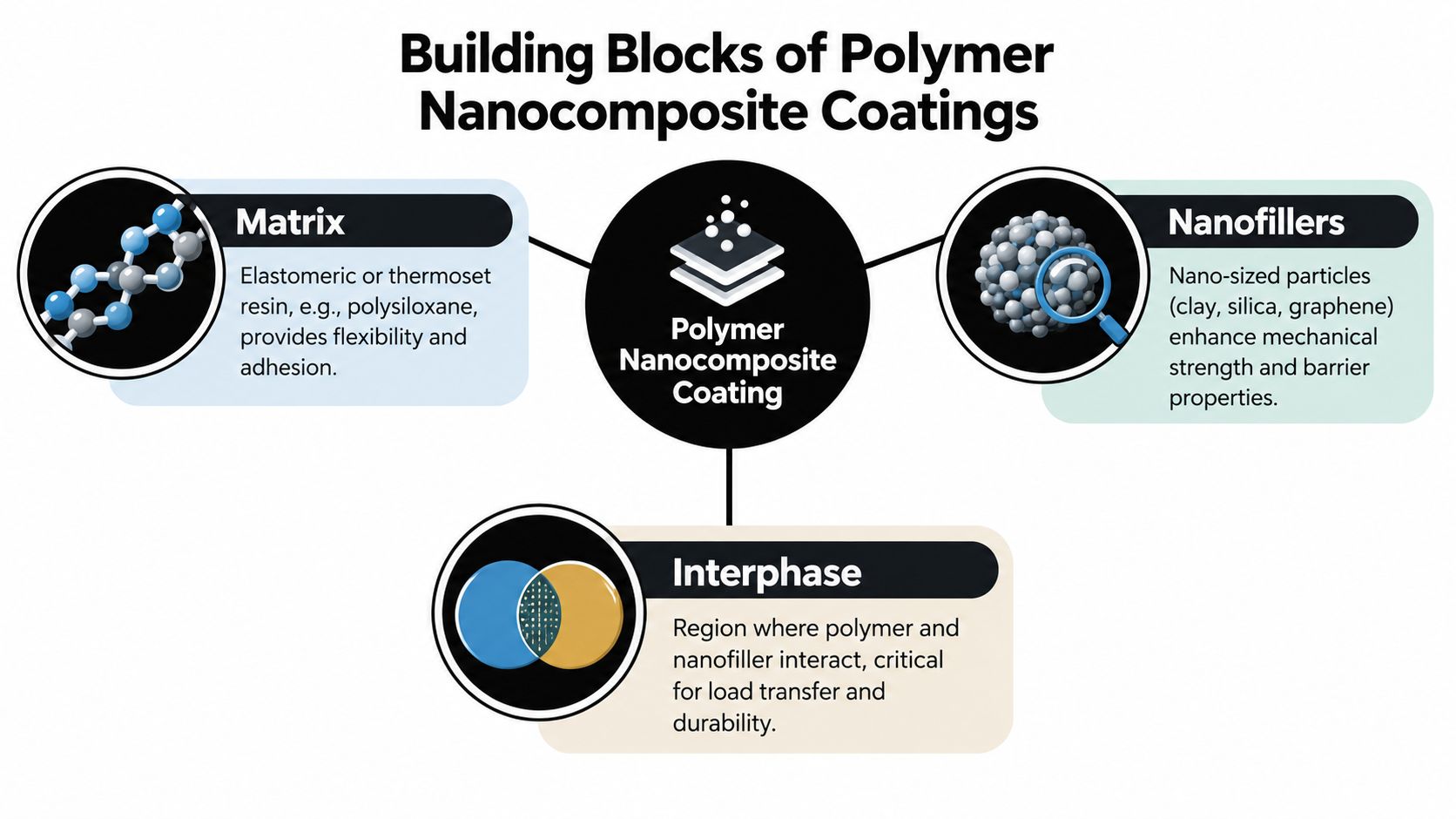
A coating buyer can use this three-part model when reading a technical description. Ask what the matrix does, what the filler contributes, and how the manufacturer controls the interphase. Titan's overview of what polymer coatings are is useful background, but the practical question remains formulation-specific: does the finished film stay bonded, clear, and continuous after it encounters real contaminants and movement?
The answer depends on architecture, not on the word “nano” alone. The next issue is how different fillers change the film's behavior.
How Nanofillers Supercharge Protection
Nanofillers perform different jobs, and a single coating may use more than one type. The strongest formulation isn't necessarily the one with the longest ingredient list. It's the one that keeps the filler dispersed, connects it to the matrix, and matches the resulting film to the vehicle's service conditions.
| Nanofiller | Primary Benefit |
|---|---|
| Titanium dioxide and cerium oxide | UV absorption and scattering |
| Silica and alumina | Hardness, friction reduction, and wear resistance |
| Graphene oxide and layered silicates | Tortuous barrier paths against water, oxygen, and contaminants |
| Ceramic platelets | Thermal stability and heat management |
| Carbon nanotubes | Mechanical and thermal reinforcement |
Four protection mechanisms
UV protection comes from fillers such as titanium dioxide and cerium oxide, which can absorb or scatter radiation before it reaches as much of the polymer network. The objective isn't to make the coating immune to aging. It's to slow photodegradation and protect the underlying surface.
Scratch and wear resistance depend on hardness, load transfer, and friction. A tribological review reported alumina-filled coatings on steel surviving 250,000 sliding cycles at 12 N at 3 wt% and 5 wt% loading, while versions at 0 wt% and 0.5 wt% failed after 20,000 and 50,000 cycles, respectively (tribological review in Nanomaterials). The lesson for a detailer is practical: loading and dispersion can matter more than a product's generic hardness claim.
Chemical resistance improves when graphene oxide or layered silicates force water, oxygen, chloride ions, and acidic species to take a longer, more complicated route through the film. This is called a tortuous diffusion barrier, and it can reduce the rate at which corrosive species reach the substrate (review of polymer-based nanocomposite anticorrosion coatings).
Thermal stability can benefit from ceramic platelets and carbon nanotubes. One epoxy study found that 0.1 wt% functionalized CNTs increased glass-transition and decomposition temperatures by roughly 35 to 40°C compared with unfilled epoxy (CNT-reinforced epoxy coating study). That doesn't mean every automotive coating delivers the same result. It shows why small loadings can produce meaningful changes when the interface is engineered well.
Titan's HyperQuartz and Dark Matter platforms are described around controlled nanocomposite processing, including ultrasonically processed sol-gel synthesis intended to break up agglomerates before cure. In any brand's system, the same principle applies: a clump is a defect, not reinforcement. Titan's information on boron nitride coatings provides another example of how filler selection can be tied to thermal and protective functions.
The loading window also matters. At a suitable concentration, particles may begin forming an interconnected network. Too little filler can leave isolated islands, while too much can increase viscosity, reduce clarity, or create agglomeration. A good formulator treats dispersion and interfacial chemistry as design variables, not afterthoughts.
Nanocomposite Coatings vs Traditional Ceramic and Elastomer Finishes
Traditional ceramic, pure elastomer, and polymer nanocomposite coatings each solve a different problem. A rigid silica-rich film can provide a hard surface and strong water behavior, but it may have limited tolerance for movement. A pure elastomer can flex with a panel, yet it may not supply the same hard barrier against abrasion.
The hybrid approach places inorganic reinforcement inside a polymer matrix. That architecture aims to keep the matrix flexible while using nanofillers to raise hardness, barrier performance, and resistance to repeated contact.
| Property | Traditional Ceramic (SiO2) | Pure Elastomer | Polymer Nanocomposite |
|---|---|---|---|
| Hardness | High surface hardness potential | Moderate, formulation-dependent | Tunable through filler and matrix design |
| Flexibility | More limited in rigid formulations | High | Designed to combine movement with reinforcement |
| Hydrophobicity | Often strong | Can be strong | Can be engineered through surface chemistry |
| Chemical resistance | Strong when fully bonded | Varies with polymer chemistry | Benefits from barrier fillers and matrix selection |
| UV stability | Depends on formulation | Depends on polymer and stabilizers | Can use UV-active nanofillers |
| Lifespan | Depends on prep, cure, and maintenance | Depends on elasticity and adhesion | Depends on dispersion, interface, use, and maintenance |
Choosing by use case
A lightly used weekend vehicle stored indoors may benefit from a hard ceramic-focused finish if the owner prioritizes gloss and straightforward contamination release. A daily-driven vehicle exposed to temperature swings, road debris, and frequent washing may gain more from an elastomeric or hybrid design that can tolerate movement.
Coastal roads and winter conditions raise the importance of barrier performance because water, salts, and contaminants can exploit small defects. Repeatedly washed fleet vehicles raise the importance of abrasion resistance. A flexible elastomer layer can also be useful where a rigid film might be vulnerable to impact or thermal mismatch.
The practical distinction is not that one chemistry wins everywhere. It's that the coating has to match the movement and abuse of the substrate. Titan's explanation of the difference between ceramic and polymer coatings helps frame that choice. For many drivers, an elastomer nanocomposite is attractive because it doesn't force a choice between flexibility and a reinforced protective barrier.
Inside the Titan Coatings Lineup and Application Workflow
The cleanest way to understand a coating system is to follow a vehicle through the garage. Consider a daily-driven SUV arriving with road film, mineral spots, and a windshield that turns difficult in rain.
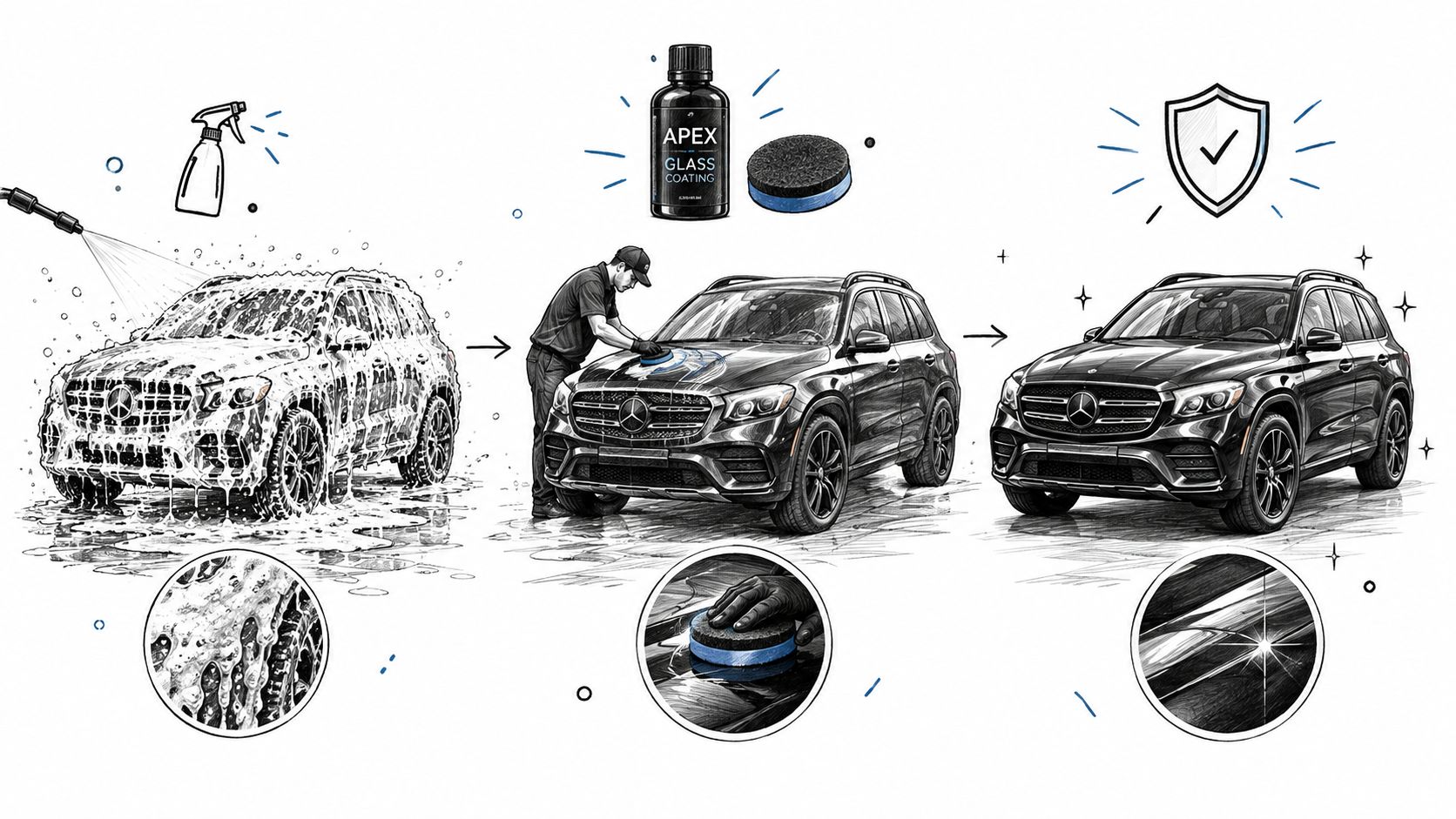
The detailer starts with a careful wash, chemical decontamination where appropriate, and mechanical decontamination only when needed. Paint correction follows if the owner wants the coating to preserve a refined finish rather than lock existing haze beneath it. The surface must be clean, residue-free, and cool enough to control the product's working time.
Glass needs a separate plan
The windshield receives its own preparation because glass behaves differently from clearcoat. The detailer cleans and degreases the panel, checks for remaining oils, then applies APEX Glass Ceramic Coatings in a controlled section. The product is positioned for easier application and improved rain visibility, which can make wet-weather driving less stressful when the surface is properly prepared and maintained. Product details are available on the APEX Glass Ceramic Coatings page.
The critical mistake is rushing the wipe-off. Apply a manageable section, observe the product's flash behavior in the actual garage conditions, then level residue before it becomes difficult to remove. Humidity, temperature, airflow, and panel size affect the working window, so the label and technical instructions should control the exact timing.
Paint receives the flexible foundation
After the paint is ready, the detailer applies Alpha Quartz as the elastomeric base layer. Titan positions its elastic coatings as hard like glass while remaining flexible, a useful combination for a daily driver exposed to thermal movement and occasional bug impact. That flexibility is intended to reduce the risk of cracking when the panel shifts between frozen conditions and hot ones.
The next layer, Ultra Ceramic Spray, can serve as a practical spray-applied ceramic option when the detailer wants a quick wipe-on, wipe-off workflow with a visible finish. It belongs in Titan's Ultra Ceramic Spray product range, where ease of installation is central to the product's appeal.
Dark Matter and HyperQuartz are the technology throughline. In editorial terms, Dark Matter represents the company's nanotube and elastomer approach, while HyperQuartz points toward a denser quartz-reinforced structure. The exact layer sequence should follow Titan's product directions rather than a generic stacking recipe.
Garage discipline prevents rework
Work indoors when possible, control dust, and keep the vehicle out of rain during the initial cure. Outdoors, a mobile detailer needs shade, stable weather, and a plan for airborne contamination. Don't chase an arbitrary flash time if the panel tells you the product is ready earlier or later. Check the surface under multiple angles of light, confirm that high spots are removed, and let the film settle before exposing it to direct sun or moisture.
Titan's explanation of its elastomer coating technology gives the broader context. The application lesson is simple: surface preparation and controlled leveling create the bond that the nanocomposite chemistry depends on.
What Actually Happens After the Coating Cures
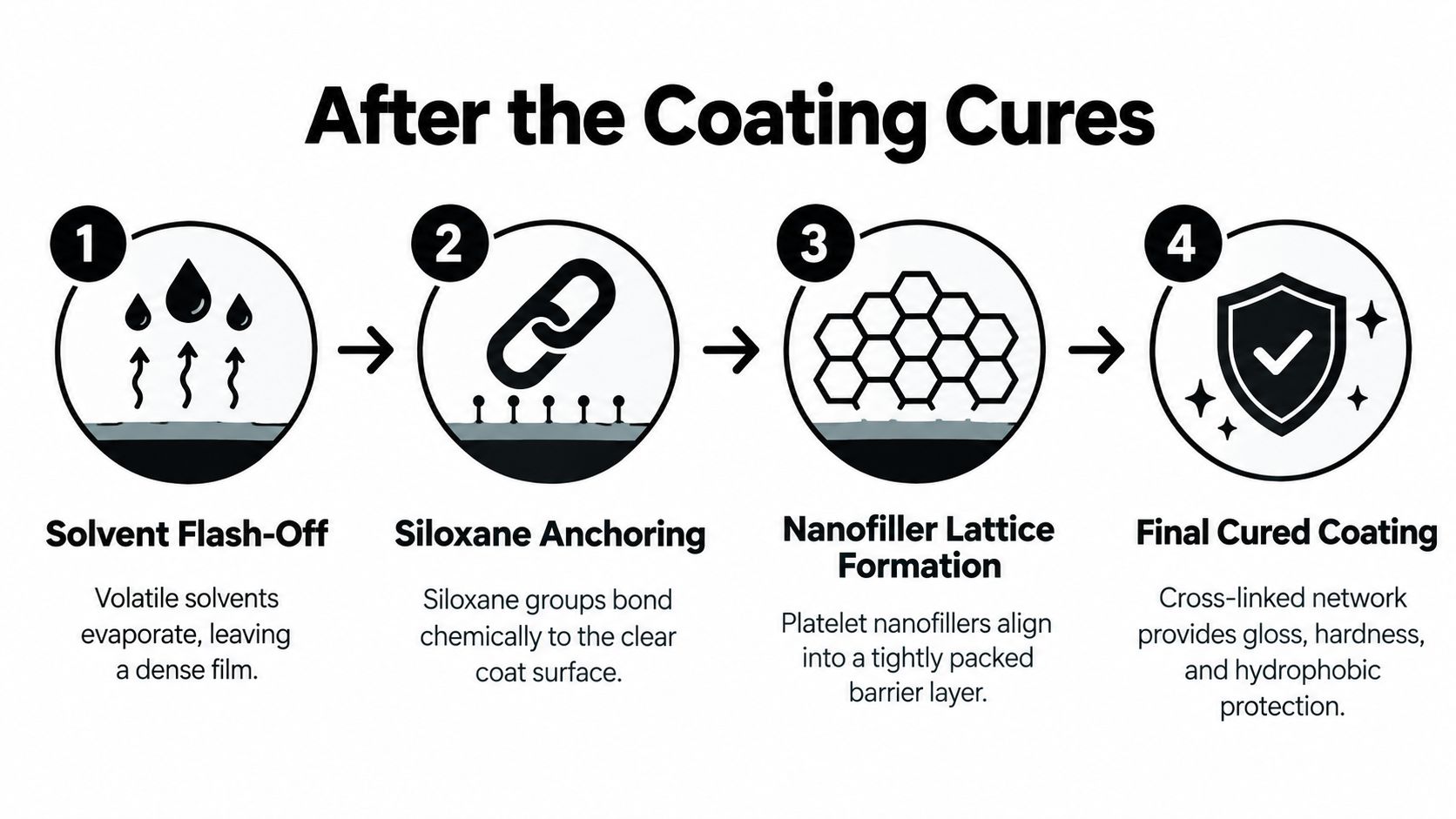
A freshly applied coating doesn't become finished the instant the towel leaves the panel. First, volatile components begin to leave the wet film. As the solvent flashes off, the remaining resin and filler become more concentrated, and the coating starts moving from a liquid application into a continuous protective layer.
Siloxane groups can anchor to suitable surface chemistry on the clearcoat, while other interactions may include covalent bonding, hydrogen bonding, or physical interlocking. Nanofiller platelets can arrange through the drying film, creating a denser path for water, oxygen, and contaminants to cross.
The first cure period is vulnerable
Residual volatiles may continue to leave the film during the early cure window. For that reason, the vehicle should remain dry and protected from contamination while the network develops. Exact cure requirements vary by product, film thickness, temperature, and humidity, so a detailer should follow the product documentation rather than assume every coating behaves alike.
Once the network is established, the driver notices the macroscopic effects. Water can bead and release more readily, the surface feels slicker, and contamination may require less aggressive cleaning. Those effects are useful, but they aren't proof that the coating will resist every scratch, solvent, or impact.
A coating's real service life is a negotiation between chemistry, preparation, exposure, and maintenance.
Accelerated testing can reveal useful weaknesses, yet it can't reproduce every parking habit, wash method, climate, or substrate condition. Reviews continue to emphasize that nanofiller dispersion, functionalization, interfacial interaction, and test conditions strongly influence results, making field durability harder to predict than a single laboratory number (recent review on polymer nanocomposite coating performance).
That gap matters for Alpha Quartz and similar elastic systems. Flexibility may help the film tolerate movement, but it doesn't excuse poor preparation or neglected maintenance. A vehicle parked outside under intense sun and washed with abrasive tools will challenge any coating more severely than a garaged vehicle washed with clean media and compatible products.
Testing Standards That Separate Marketing from Science
A coating data sheet becomes useful when it tells you what was tested, on what substrate, after which preparation, and under which cure conditions. A logo alone doesn't answer those questions.
Here's a plain-English guide to common methods:
| Test Standard | Property Measured | Real-World Equivalent |
|---|---|---|
| ASTM D3363 pencil hardness | Resistance to marks from pencils of defined hardness | Surface resistance to light contact and scratching |
| ASTM B117 salt spray | Corrosion behavior in a salt-laden chamber | Exposure to salty moisture and corrosive environments |
| ISO 2409 crosshatch adhesion | How well a coating stays attached after a scored grid is made | Resistance to lifting or peeling after damage |
| ASTM G155 UV exposure | Resistance to controlled light and moisture cycles | Aging from sunlight and weather |
| Taber abrasion | Wear from repeated abrasive contact | Repeated washing, rubbing, and contact wear |
These tests don't all measure the same thing. Pencil hardness isn't a direct prediction of stone-chip resistance. Salt spray isn't a complete simulation of a coastal road. UV chambers accelerate selected stressors, but they can't reproduce every combination of heat, contamination, flexing, and maintenance.
Questions worth asking before purchase
- What substrate was tested? Bare metal, painted panels, plastic, glass, and PPF can produce different results.
- How was the surface prepared? Polishing, degreasing, activation, and cure conditions should be stated.
- What film thickness was used? Thickness can affect drying, hardness, flexibility, and barrier behavior.
- Were results independently verified? Third-party testing carries different weight from an unverified in-house claim.
- What counted as failure? A transparent pass or fail threshold is more informative than a superlative.
Titan describes support for its APEX Nano and Dark Matter claims through ISO and ASTM results, alongside real-world analysis. Its stated ISO 9001 certification concerns the company's quality-management system, not automatic proof that every performance claim has passed every coating test. Buyers should still request the relevant report, batch information, substrate, and conditions through Titan's coating testing resources.
Independent process research reinforces the importance of manufacturing and microstructure. A review reported low-pressure plasma-sprayed environmental barrier coatings surviving 1,000 thermal cycles without failure, while air plasma-sprayed coatings averaged 576 cycles, showing that process conditions can strongly affect lifetime (review of nanocomposite coating thermal cycling). That isn't an automotive durability guarantee. It's a reminder to ask how a result was produced.
Choosing the Right Polymer Nanocomposite Coating for Your Vehicle
Start with the vehicle's life, not the product's label. A weekend car stored indoors has different needs from a commuter parked under trees, and a coastal or off-road vehicle puts more emphasis on contamination resistance, flexibility, and maintenance discipline.
A garage-kept enthusiast vehicle may suit a multi-layer Dark Matter approach when the owner values a reinforced finish and is prepared to follow careful preparation and cure practices. A daily commuter may be better served by a simpler APEX Nano application that fits the available installation time. A vehicle used on rough roads or near saltwater may benefit from a HyperQuartz-oriented system paired with an elastomeric topcoat, provided the selected products are compatible.
Don't compare only the purchase price. Compare preparation, installation, maintenance, repairability, and the time you'll spend refreshing the surface. A lower-cost coating that fails because the paint wasn't corrected or the surface was contaminated can become more expensive than a carefully selected system installed once and maintained correctly.
Avoid the mistakes that shorten service life
- Skipping paint correction: A coating preserves what it covers, including haze and marring.
- Ignoring cure conditions: Moisture, dust, and temperature can interfere with early film development.
- Using harsh wash chemistry immediately: Follow the product's initial-care instructions.
- Stacking incompatible sealants: A spray product can change bonding, appearance, or removal behavior.
- Assuming more filler is always better: Poor dispersion can create defects instead of reinforcement.
DIY application makes sense when you can control lighting, temperature, cleanliness, and working time. Hire a trained installer when the vehicle needs substantial correction, the product has a narrow application window, or the cost of a visible high spot is greater than the installation fee. Elastomer-based nanocomposites may forgive minor technique errors better than highly rigid professional ceramic systems, but they still depend on clean preparation and complete leveling.
A sensible maintenance routine is gentle washing, clean drying media, prompt removal of bird contamination and bug residue, and periodic inspection under direct light. For drivers who want rain-focused visibility, the APEX Glass treatment should be maintained as a dedicated glass system rather than treated as another layer of paint coating. For paint, the goal is consistent care that preserves the flexible barrier, hydrophobic behavior, and UV resistance instead of repeatedly abrading the surface.
APEX NANO – Titan Coatings applies polymer nanocomposite thinking to vehicle protection through technologies such as Dark Matter, HyperQuartz, elastic coatings, glass treatments, and spray ceramic options. Visit APEX NANO – Titan Coatings to compare products, review application information, and choose a system that matches your vehicle's surface, climate, and maintenance routine.
0 Comments