
A client picks up the car on Saturday, loves the finish, and sends photos that night. Three months later the same client calls back asking why the slick feel is gone, why water behavior changed, and why the hood now shows marks that didn’t wash off.
That call usually gets blamed on maintenance, weather, or installer error. Sometimes those are factors. But a lot of premature disappointment starts much earlier, in a bottle that looked good under lights and never had the chemistry or test discipline to survive real use.
The Moment of Truth for Every Coating
Most coating failures don’t begin when the customer notices them. They begin when a product reaches the bay with a weak bond profile, inconsistent film build, or cure behavior that wasn’t checked in a meaningful way.
Professional detailers know the uncomfortable version of this story. The paint looked excellent on delivery day. The application flashed correctly. The finish leveled. The car left glossy and sharp. Then daily life got involved. Heat cycles, wash friction, bug impact, road film, parking outdoors, and rushed maintenance routines exposed what the product really was.
That’s why coating testing matters long before the first wash. It’s the difference between a coating that only performs on social media and one that keeps doing its job after the customer forgets the install date.
A reliable system starts before application even begins. Surface condition, contamination removal, and consistent prep affect every later result, which is why detailers who care about long-term outcomes usually treat coating surface preparation as part of product performance rather than a separate step.
A coating can hide weak chemistry for a short time. It can’t hide it for long on a daily driver.
Published coatings guidance makes the point clearly. Performance isn’t judged by appearance alone. Adhesion, layer thickness, hardness, chemical resistance, and corrosion resistance are core properties used to catch process errors early and improve durability, and thickness work itself depends on standardized measurement and verification rather than one casual reading because geometry and substrate condition can affect the result (coatings testing and thickness guidance).
That’s the moment of truth for every coating. Not the gloss shot. Not the beading video. The moment when real use starts asking questions the chemistry has to answer.
Why Coating Testing Is Your Ultimate Insurance Policy
Shine sells a coating once. Durability sells it again.
If you’re a detailer, your reputation lives in the gap between day-one appearance and month-after-month performance. A coating that looks rich, dark, and slick under LEDs can still fail when it sees road salt, detergent, environmental fallout, and repeated contact washing. That’s why objective coating testing is less about marketing support and more about risk control.
Why visual appeal isn’t enough
A polished hood can make almost any fresh application look convincing. The hard part is predicting whether that coating will stay bonded and functional after normal abuse. Field feedback helps, but it’s slow. By the time enough cars come back with patterns you can trust, the damage to your customer relationships may already be done.
AMPP makes the reason straightforward. Without historical field performance data, testing programs are the only objective way to decide on future work, and those programs typically use controlled exposure and later lab measurement instead of guesswork. NIST also highlighted coating tests that move beyond simple scratch work to understand why coatings fail, which gives manufacturers a better path to better materials (protective coatings testing and failure analysis).
What testing protects
For a pro shop, testing acts like an insurance policy in several ways:
- It protects comebacks: Products with disciplined test programs are less likely to surprise you after installation.
- It protects pricing: Premium services are easier to defend when the product behind them has evidence, not just claims.
- It protects client trust: Customers may not know ASTM or ISO language, but they understand when protection lasts and when it doesn’t.
- It protects product selection: A broad lineup means nothing if you can’t separate a durable formula from a nice-looking short-term topper.
One practical way to think about it is this. A coating package isn’t only about gloss, hydrophobics, or hardness language. It’s about whether the manufacturer has done enough work to reduce uncertainty for the installer. That’s what makes professionally positioned options such as a 5-year ceramic coating category worth evaluating through test discipline rather than label language.
The business side detailers feel first
The customer usually doesn’t call and say, “I think adhesion retention after exposure may be poor.” They say the car doesn’t look protected anymore. They say washing got harder. They say the finish doesn’t feel like it did.
Practical rule: If a coating brand can explain the look but can’t explain the test plan, you’re carrying too much of the risk.
That’s why experienced installers stop asking only, “How does it apply?” and start asking, “How was it evaluated, under what conditions, and what failure mode was it built to resist?” The first question helps you get through the job. The second helps you keep the customer.
Inside the Lab A Breakdown of Key Coating Tests
“Lab tested” sounds impressive until you ask what was tested.
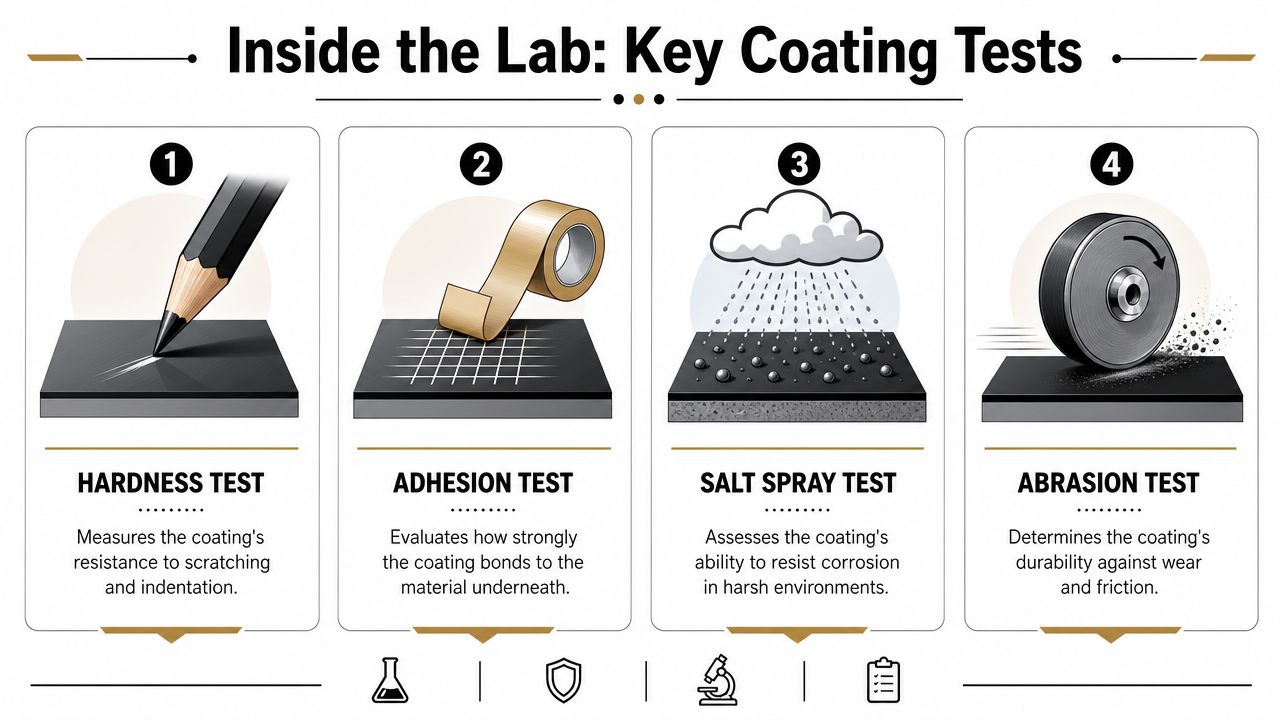
A strong coating-test program doesn’t rely on one dramatic demo. It combines measurements that tell you whether the film was applied correctly, whether it bonded, whether it cured, and whether it resists the things that usually break coatings down in service. For practical coatings QA, the most actionable data points are wet film thickness, adhesion, hardness, abrasion, and chemical resistance, with common methods including ASTM D3359, ASTM D3363, ASTM D4060, ASTM D2794, and ASTM D1308 (coating QA test methods and what they reveal).
Film build tells you whether the install even has a chance
Wet film thickness is one of the earliest checkpoints. Guidance notes that it’s commonly checked immediately after application with notched gauges, step gauges, or MIL gauges. That matters because thin application can reduce barrier protection, while excessive build can trap solvents and weaken adhesion.
In detailing terms, many issues frequently emerge imperceptibly. The finish may still look level, but the coating may be outside the range where it cures and performs as intended.
Adhesion shows whether the coating wants to stay
A coating can be glossy and still have a weak bond. ASTM D3359 cross-hatch adhesion is a common way to evaluate how well the coating remains attached to the substrate after a patterned cut and tape pull.
Poor adhesion often points to contamination, prep issues, incompatible substrate conditions, or cure problems. If a detailer wants to understand whether a product is built for real service and not only first impressions, adhesion is one of the first numbers worth asking about. It’s also why buyers interested in a scratch resistant coating shouldn’t treat scratch language as a substitute for bond quality.
Hardness and abrasion are related, but they aren’t the same
ASTM D3363 pencil hardness looks at resistance to scratching and indentation. It’s useful, but it gets misunderstood. Hardness doesn’t automatically equal toughness, and it definitely doesn’t guarantee impact tolerance.
ASTM D4060 abrasion resistance gets closer to repeated wear. This test is useful because wash-induced marring, towel friction, and environmental grit are wear problems, not only hardness problems.
Hard coatings often impress on a spec sheet. Durable coatings prove themselves when contact, movement, and contamination happen over and over.
Chemical resistance tells you how the coating handles bad days
ASTM D1308 chemical resistance matters because vehicles don’t live in ideal conditions. They see cleaners, residues, acidic contaminants, mineral deposits, and neglected wash intervals.
When a coating performs poorly here, the likely causes often trace back to under-cure, inadequate crosslinking, or a formula that doesn’t fit the intended use. For a professional detailer, that’s valuable because it links a lab result to a realistic customer complaint.
Impact matters because roads don’t care about lab neatness
ASTM D2794 impact resistance is often where lab language starts becoming real. A finish may survive a controlled scratch setup and still respond poorly to sudden force. On a daily driver, that force can come from debris, hard contamination during washing, or repeated minor contact.
Quick reference for the methods that matter
| Test Method | Standard (Example) | What It Measures | Real-World equivalent |
|---|---|---|---|
| Wet film thickness | Notched gauge, step gauge, or MIL gauge | Applied film build during installation | Whether the coating was laid down within a usable range |
| Adhesion | ASTM D3359 | Bond strength to the underlying surface | Risk of peeling, lifting, or early failure after washing and weather |
| Hardness | ASTM D3363 | Resistance to scratching and indentation | How easily the surface marks during light contact |
| Abrasion resistance | ASTM D4060 | Resistance to wear from repeated friction | Wash marring, towel contact, and grit-related wear |
| Impact resistance | ASTM D2794 | Response to sudden force | Damage from debris strikes and incidental knocks |
| Chemical resistance | ASTM D1308 | Resistance to chemical attack | Exposure to cleaners, fallout, residues, and contamination |
The takeaway is simple. A serious coating should be able to answer more than one question. If all you hear is hardness, you still don’t know enough.
Decoding the Standards ISO and ASTM Certifications
Standards matter because they create a common rulebook. Without that rulebook, every manufacturer can stage a demo, choose a flattering condition, and declare victory.
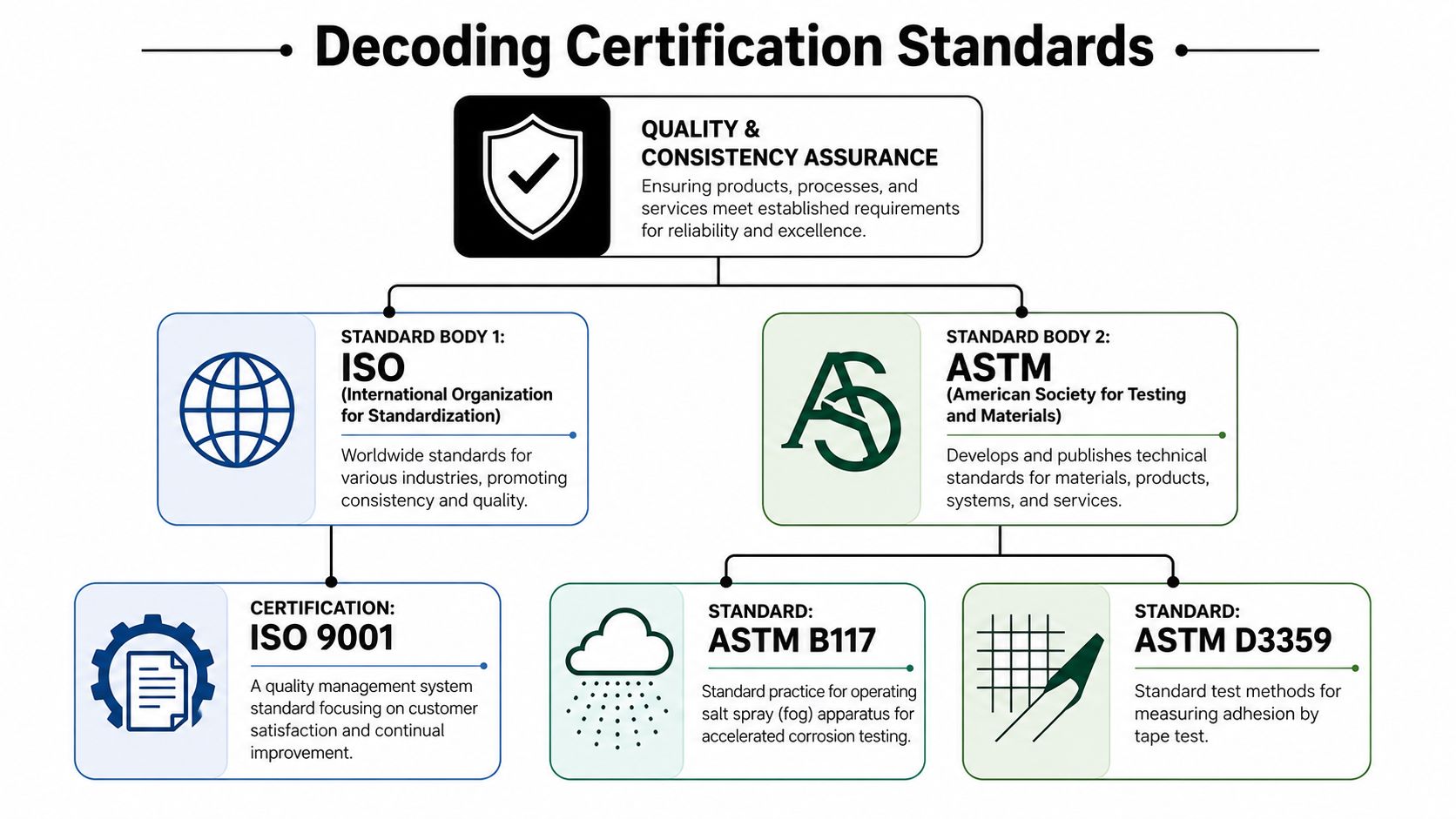
ASTM and ISO don’t make a coating premium by themselves. What they do is force consistency into the conversation. They define methods, conditions, and acceptance logic so two people aren’t using the same words to describe completely different levels of performance.
What ASTM gives you
ASTM standards are useful because they make testing repeatable and comparable. When a manufacturer references a known ASTM method, the discussion moves away from “trust us” and toward “this was measured in a recognized way.”
That doesn’t mean every claim tied to a standard is equally useful. It means the method itself can be checked, understood, and tied to a specification instead of floating as a vague promise.
What ISO adds
ISO frameworks become more interesting when they combine multiple stressors and insist that performance survives aging, not just initial application. A technically robust coating-test program combines film-thickness control, adhesion verification, and environment-specific aging rather than leaning on a single pass-fail snapshot.
KTA’s summary of ISO 12944-based testing shows how demanding that can be. It requires unexposed adhesion testing before artificial aging, and the threshold depends on film build. Systems over 250 μm require at least 2.5 MPa pull-off adhesion, while ISO 12944-9 requires 5 MPa, and immersion systems at 800 μm or more require 8 MPa. The same standard family uses one-week cyclic aging with alternating UV and condensing humidity, neutral salt spray, and low temperature exposure, along with required recovery windows of 7 days for ISO 12944-6 and 14 days for ISO 12944-9 (ISO 12944 testing requirements and adhesion thresholds).
Why this matters to automotive pros
Real coatings rarely fail from one stress alone. They fail from combinations. Heat after chemical exposure. Wash abrasion after UV aging. Moisture after weak adhesion. That’s why a standard that forces a coating to deal with changing conditions is more useful than a dramatic single-test video.
Benchmarks matter: A coating that starts strong but can’t retain bond after exposure isn’t giving you the whole protection story.
For detailers, standards aren’t trivia. They’re a filter. They help you separate disciplined development from selective storytelling.
From Lab Data to On-the-Road Dominance
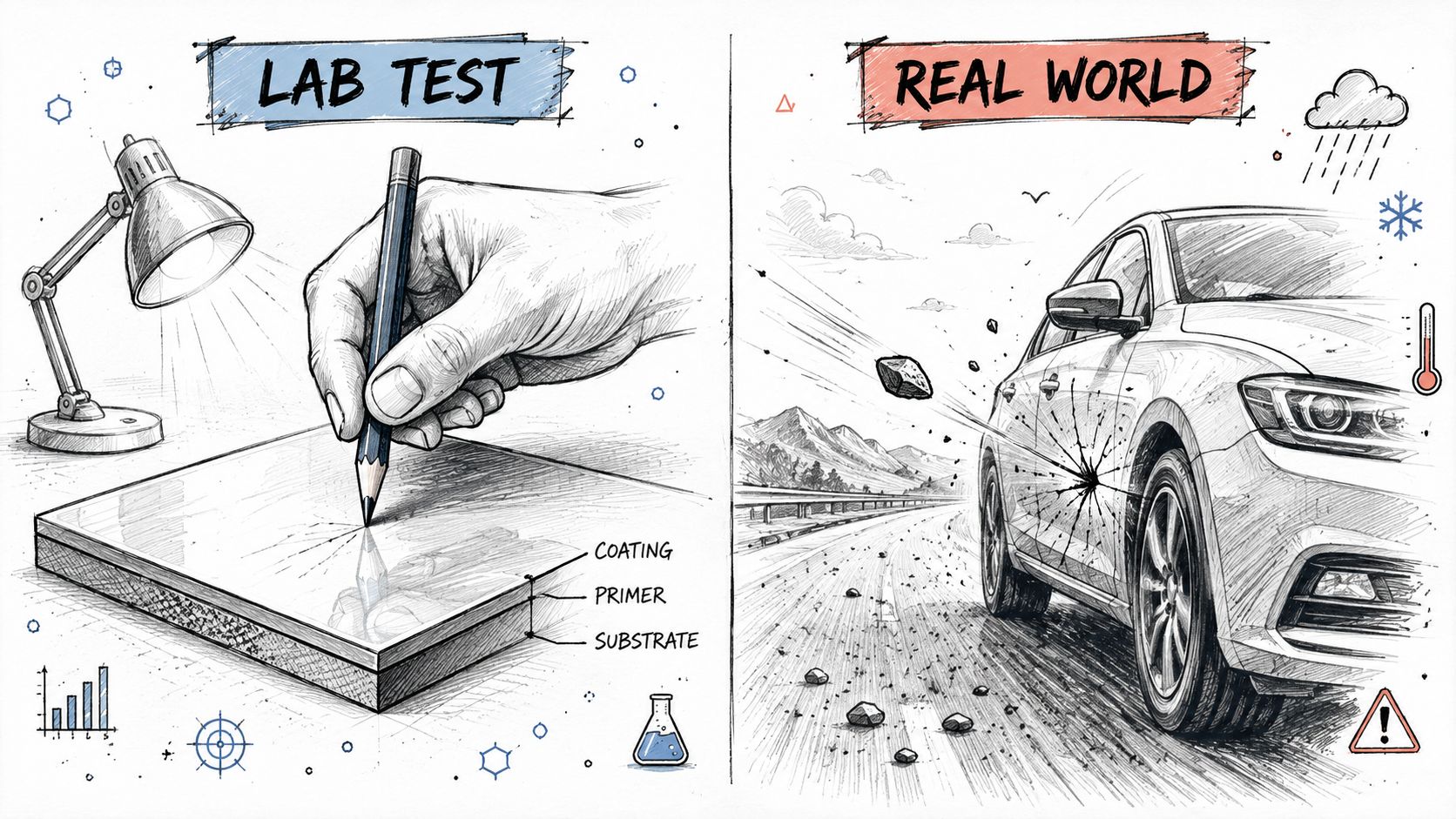
The lab is where coatings earn the right to make claims. The road is where those claims get challenged.
A lot of installers have seen some version of the same problem. A coating is sold on hardness, slickness, and beautiful early behavior. Then it sees daily use. The owner parks outside, drives through weather swings, hits bug-heavy highways, and washes the car in less-than-ideal conditions. The coating may still be present, but the practical protection story starts to unravel.
Where lab wins can mislead
This is one of the biggest gaps in coating education. Buyers don’t just want to know the test name. They want to know which result predicts durability in their climate and driving pattern. That gap matters because practical decision-stage content is often missing the translation from standard to use case, especially in automotive detailing (why translating coating tests to real-world use matters).
A coating can score well in a dry abrasion setup and still struggle if its bond degrades after weather exposure. It can feel hard and still react poorly to impact or flex. It can bead water nicely and still be vulnerable to the contamination cycle that customers experience in normal ownership.
The brittleness problem detailers recognize fast
Traditional ceramic positioning often rewards one type of language: harder, stronger, more resistant. Hardness has value. Nobody serious denies that. But on a vehicle, stiffness alone can become a trade-off.
A coating on a car doesn’t sit in a protected cabinet. Panels expand and contract. Temperatures swing. Surface stress changes. Road debris arrives at speed. Bug impact isn’t theoretical. Neither is the repeated movement caused by normal use and washing.
That’s why flexible chemistry is such an important real-world concept, especially when talking about elastomer-based approaches such as Alpha Quartz. In practical terms, a coating that combines a glass-like surface character with flexibility is trying to solve a problem some brittle systems struggle with. It needs to resist wear without becoming so rigid that it loses tolerance for movement, impact, and thermal change.
What that means for product choice
For mobile detailers and DIY users, this becomes less academic and more operational:
- If the vehicle sees harsh weather: Flexibility matters because temperature change can stress a rigid film.
- If the owner drives often: Impact tolerance matters because bug strikes and road debris aren’t rare events.
- If maintenance varies: A coating needs more than showroom traits. It needs resilience when care isn’t perfect.
Alpha Quartz fits this discussion because it represents the type of coating technology aimed at balancing hardness with elasticity rather than treating them as opposites. That matters to installers who’ve watched a coating look excellent at delivery and then behave poorly when the car starts living a normal life.
For readers who want a broader consumer-oriented perspective, this piece on understanding ceramic coating for your vehicle is useful because it frames durability in terms owners ask about, not just spec language.
The best real-world coating isn’t the one that wins the neatest demo. It’s the one that keeps working when the environment gets messy.
The strongest product decisions come from combining both sides of the story. Respect the lab. Then ask whether the chemistry is built for movement, impact, thermal cycling, and the daily abuse your customers drive through.
Putting Protection to the Test in Your Own Bay
You probably don’t have a climate chamber in the shop. You still have ways to evaluate whether a coating is being installed and behaving like a serious product.
Good in-bay testing starts with discipline, not gadgets. Coatings guidance stresses that quality control means controlling performance before failures happen, using standardized thickness measurement, verification, and multiple readings rather than trusting one isolated number because geometry and substrate condition can skew results (paint thickness and coatings QA checks).

What to check right after application
Immediately after install, the first job is consistency.
- Look for uniform leveling: High spots, smearing, and uneven flashing are application warnings, not cosmetic quirks.
- Check panel-to-panel behavior: If one section behaves differently during wipe-off, something changed. It could be prep, temperature, humidity, or film build.
- Inspect edges and complex curves: Tight geometry often exposes uneven application first.
A clean, even appearance doesn’t prove long-term durability. But inconsistency at this stage often predicts trouble later.
Use practical verification, not only visual satisfaction
Published coatings guidance notes that a single thickness reading should seldom be trusted and that several readings should be averaged because curvature, substrate condition, and profile can materially affect results. That principle translates well to detailing. Don’t let one “good” spot become your conclusion about the whole panel.
A disciplined bay routine usually includes:
- Measuring multiple points on representative areas.
- Recording environmental conditions during application.
- Comparing wipe characteristics across panels.
- Checking cured behavior after the appropriate wait window.
Shop habit worth keeping: If a coating only looks good from one angle or on one panel, assume nothing until you’ve checked the rest.
Simple product-specific reality checks
Some products give you immediate, useful feedback because their benefit is easy to observe.
Apex Glass Coating is a good example. On glass, the practical test is direct. The coating should apply cleanly, level predictably, and produce the kind of water behavior that helps visibility when weather turns ugly. For many drivers, that windshield performance is one of the easiest coating benefits to understand because they experience it in real time. The Apex Glass Coating product page is relevant here because it focuses on exactly that use case.
Ultra Ceramic Spray shows another side of real-world testing. Ease of installation matters because inconsistent user technique can make a decent formula look bad. A spray product that wipes cleanly and produces stable results with less application drama is easier to trust in mobile detailing, maintenance work, and owner-applied scenarios. The Ultra Ceramic Spray product page fits this practical category.
What works and what doesn’t
What works:
- Repeating the same inspection routine on every job
- Comparing behavior across panels instead of trusting one area
- Matching product choice to use case
- Watching how the coating handles real maintenance conditions
What doesn’t:
- Judging performance by gloss alone
- Treating beading as total proof of protection
- Ignoring environmental conditions during install
- Assuming easy application always means strong durability
The best bay testing is simple, repeatable, and honest. It won’t replace the lab, but it will tell you quickly whether a product and process deserve your confidence.
Choose a Coating Backed by Science Not Hype
The coating market doesn’t suffer from a lack of claims. It suffers from a lack of disciplined interpretation.
A premium coating should be able to answer hard questions about bond, film control, wear, chemical exposure, and what happens after the shine settles into normal use. If it can’t, the installer becomes the test program. That’s a bad business model.
The same principle shows up outside automotive work. Anyone comparing protective finishes on cabinetry, for example, benefits from practical guidance that goes beyond label promises, which is why a resource like this GTA homeowners’ guide to cabinet paint is useful. Different surface, same lesson. Finish claims only matter when they survive real conditions.
For vehicle protection, that means looking for products grounded in methodical development, real specifications, and chemistry built for actual service. It also means favoring systems that account for both hardness and flexibility, especially where temperature change, impact, and repeated maintenance can expose brittle behavior over time. If you’re comparing long-term options, start with categories centered on protective car paint coatings and ask harder questions than “How glossy is it?”
Good coating testing doesn’t make the buying decision harder. It makes it clearer.
Choose the brand that welcomes scrutiny. Choose the formula that can explain its trade-offs. Choose the coating that was built to last after the customer drives away.
APEX NANO by Titan Coatings builds its reputation around exactly that standard. If you want coatings developed for real durability, including advanced elastomer technology that combines a hard, glass-like feel with flexibility to better handle temperature swings and daily abuse, explore APEX NANO – Titan Coatings.
0 Comments