
You're in the garage with a polisher in your hand, looking at paint that has survived decades of sunlight, road grit, and previous repairs. The surface looks dull, but the hesitation is sensible. On an older car, the wrong polishing pass can remove the very finish you're trying to preserve.
That's the real question behind ceramic coating for old cars. It isn't simply whether a coating can bond to an aging vehicle. It's whether the paint is stable, thick, and healthy enough to polish and coat without turning preservation into permanent damage.
The Classic in Your Driveway and the Modern Question
A 1972 Mustang, a Mercedes with 180,000 miles, and a ten-year-old commuter may look unrelated in the driveway. Under the inspection light, they can present the same problem: a finish with an uncertain history and limited material left to correct.
The Mustang might still wear single-stage lacquer. The Mercedes may have been resprayed after an accident. The commuter could have a modern clear coat weakened by automatic washes and years of outdoor parking. Ceramic coatings were developed as a modern protective technology, not as a repair system for tired paint. One independent industry history places early automotive ceramic-coating development in the early 1980s, with later development accelerating in the 1990s as products improved durability and scratch resistance, while another paint-protection history identifies major automotive nano-ceramic products around 2010. This history of automotive ceramic coatings helps explain why the technology belongs to a later era than many classics.
The hesitation at the polisher
A seasoned detailer doesn't begin by chasing maximum gloss. The first inspection asks what kind of paint is present, how much material remains, and whether the defects are cosmetic or structural.
Look for active peeling, flaking, deep checking, rust, and unstable respray edges. A coating bonds to the existing surface. It won't rebuild a failing clear coat, fill a deep scratch, or stabilize paint that's already separating from the panel. Guidance for older and repainted vehicles also notes that paint manufacturers commonly recommend waiting 30 to 90 days after fresh refinishing before applying a coating, sealant, or wax, so solvents can escape and the finish can cure properly. This guidance on coating repainted vehicles is especially relevant to restored classics.
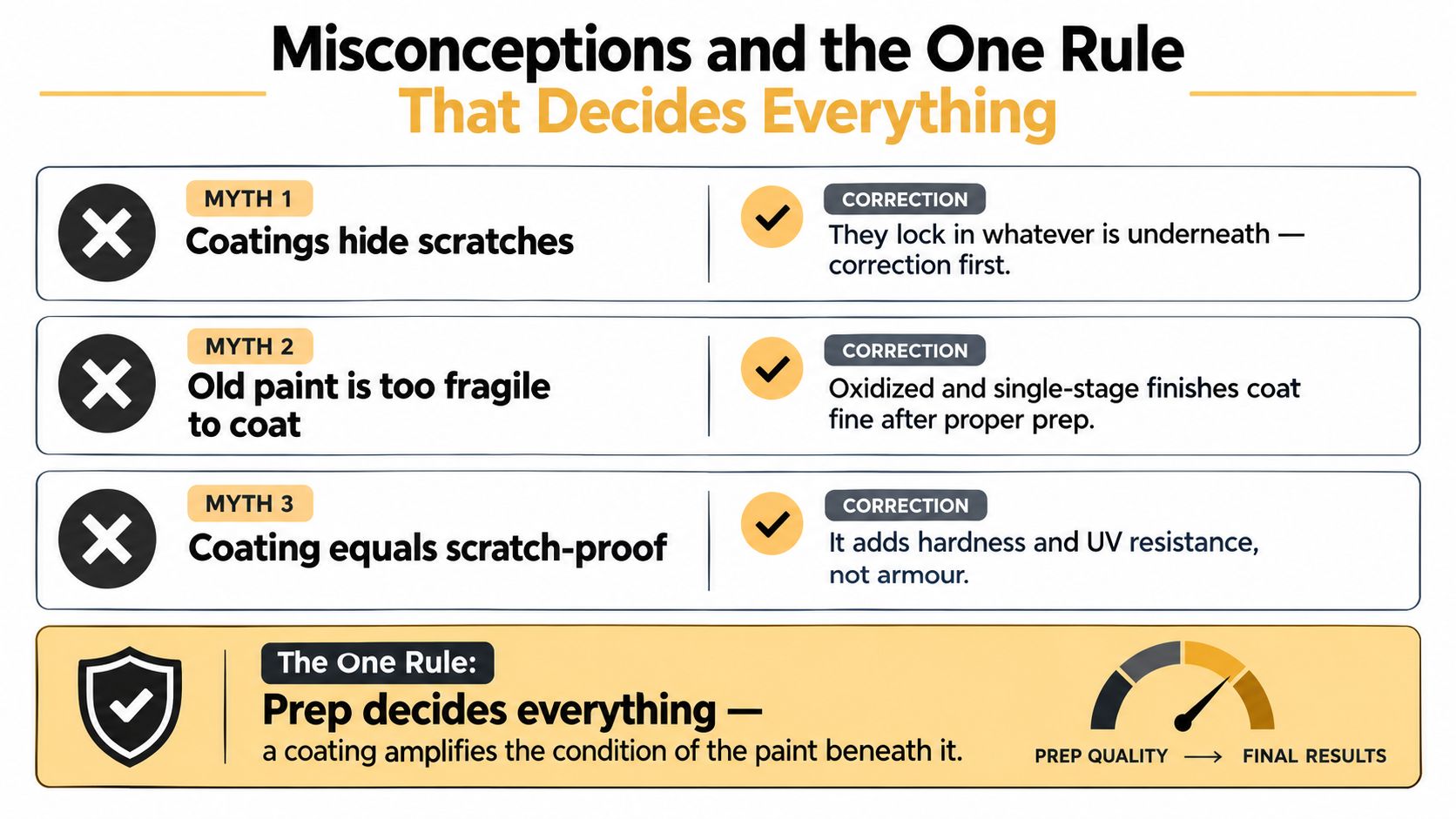
Practical rule: A coating amplifies the condition of the finish beneath it. It doesn't give fragile paint permission to become healthy.
Restore or preserve
Classic-car culture often pushes owners toward restoration. Sometimes that means measured correction and a deep, reflective finish. Sometimes the responsible decision is preservation-only protection, with minimal polishing and no attempt to make every defect disappear.
That choice matters when a car is being moved between storage, shows, and a new home. Owners arranging enclosed car shipping for classics should document the finish before transport, because a coating decision is easier when the paint's existing condition is known rather than guessed.
The useful mindset is simple: measure first, correct only what the substrate can safely surrender, then protect what remains.
What Ceramic Coating Actually Is
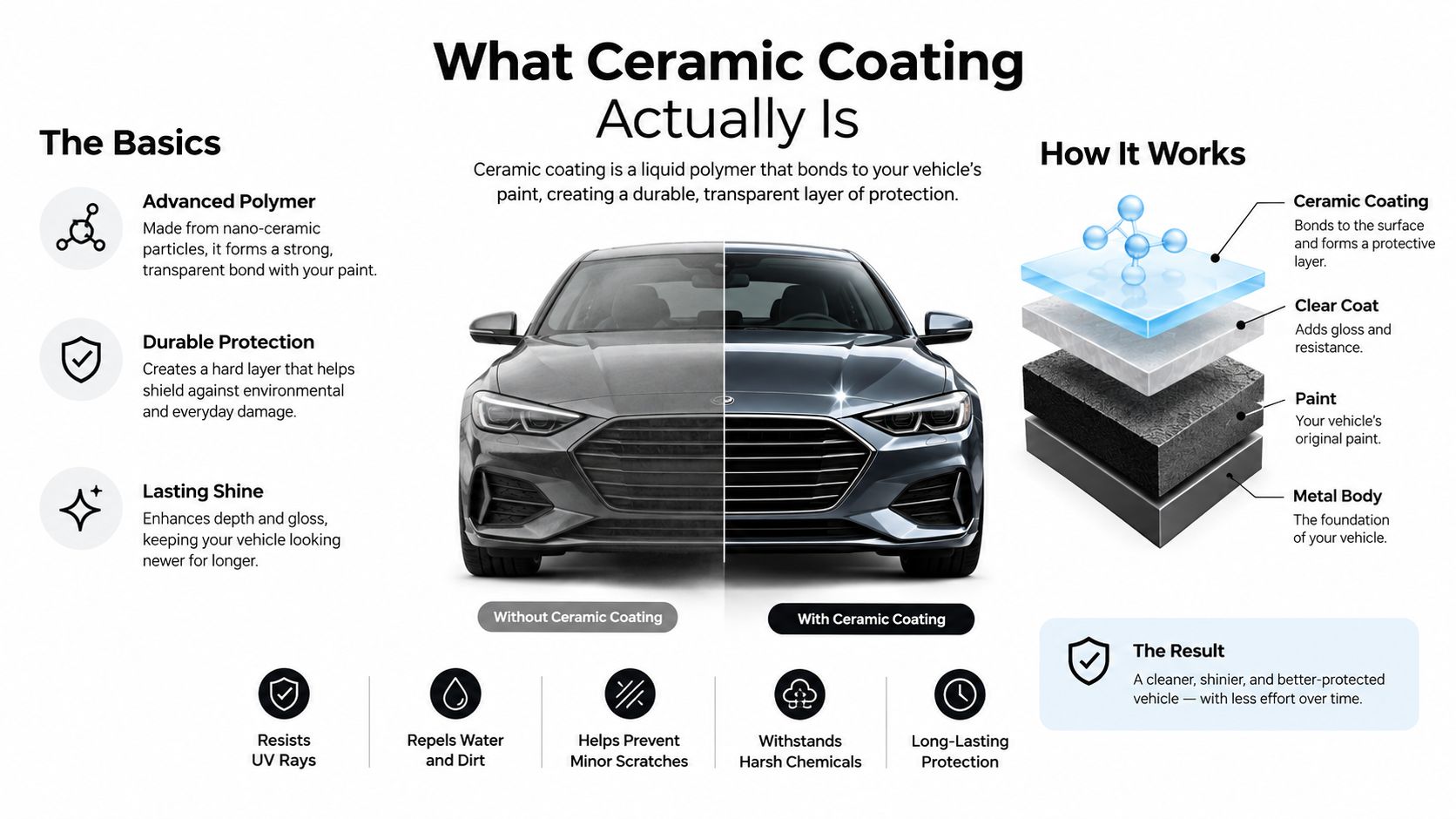
A ceramic coating is a liquid polymer system that uses nanotechnology to chemically bond with a vehicle's clear coat. It isn't a wax sitting loosely on top of the paint, and it isn't a permanent replacement for the finish. Once cured, it creates a transparent protective film with a glass-like feel and behavior. Titan's explanation of ceramic coating technology provides a useful starting point for understanding the difference between coatings, waxes, and sealants.
The practical effects are familiar to anyone who has maintained a coated vehicle. Water tends to sheet or bead away, road film releases more readily, and the surface gains resistance to environmental contamination, ultraviolet exposure, and chemical attack. The coating's hardness can also provide some resistance to minor marring, but it won't stop stone chips or deep scratches.
Hard does not have to mean brittle
Traditional ceramic thinking often treats hardness as the main specification. That can be incomplete on older panels. A body panel expands and contracts as temperatures change, and an aged finish may be less uniform or less resilient than modern, factory-baked clear coat.
Elastomer coatings approach the problem differently. They're designed to remain hard like glass while retaining flexibility, allowing the film to move with the surface instead of behaving like a brittle shell. The flexibility is intended to reduce cracking when the vehicle moves between frozen conditions and intense heat. Titan's information on flexible glass-ceramic systems explains why elastomer-based chemistry matters where thermal movement is part of the service environment.
What the coating can and can't do
A ceramic film can improve gloss, help contaminants release, and shield a sound finish from environmental exposure. It can also make routine washing less abrasive because less effort is needed to remove bonded grime.
It cannot correct oxidation by itself. It cannot conceal a sanding mark or make failing clear coat stable. It isn't paint-protection film, and it isn't armor against impact damage.
For owners comparing DIY vs pro ceramic coating, the important distinction is preparation quality. A careful DIY application can work on a manageable, stable surface, while a professional job earns its value through inspection, correction restraint, residue removal, and controlled application.
One product that illustrates the flexible approach is Alpha Quartz 50ml Ceramic coatig. Its stated formulation includes 92% high solids, zero VOCs, a solvent-free composition, and advanced adhesion technology. It's described as an elastomer ceramic coating for all surfaces, designed for UV, chemical, and abrasion protection, with indoor or outdoor application and a stated four-hour cure.
Reading Your Paint Before You Touch It
The assessment starts with a wash, not a machine polisher. A proper contact wash removes loose soil, while chemical decontamination and a clay test reveal what remains beneath old wax, sealant, and road film. An apparently smooth panel can still carry bonded iron, tar, overspray, or embedded grime that interferes with correction and coating adhesion.
The decisive tool is a paint-depth gauge. Measurements show whether a panel has enough material for controlled abrasion, but they don't replace judgment. Readings should be taken across each panel, because a resprayed door, blended quarter panel, and original roof may have very different thicknesses. Titan's guide to measuring paint thickness covers the basic reason this check belongs before correction.
The visual inspection
Walk around the vehicle under strong, even lighting. Note whether the defects sit in the surface or indicate failure underneath it.
- Oxidation: Chalky haze may respond to careful correction on a stable finish, but severe oxidation can signal limited remaining material.
- Clear-coat failure: Peeling, lifting, and delamination aren't polishing defects. Coating over them only preserves the failure in place.
- Checking and micro-cracking: Fine cracks can indicate an unstable finish that needs preservation or refinishing rather than aggressive machine work.
- Etching: Bird-dropping and water-spot marks may be superficial, but the depth has to be tested rather than assumed.
- Panel variation: Uneven readings often reveal previous repairs, blends, or replacement panels.
Single-stage paint deserves special caution. There's no separate clear layer to sacrifice during correction, so the pad can remove colored paint immediately. A small amount of transfer onto the pad is normal with some single-stage finishes, but heavy correction can expose primer or create a visible strike-through before the operator has time to react.
A practical decision table
The ranges below are working inspection triggers, not universal guarantees. Paint type, gauge accuracy, panel history, and film uniformity all matter.
| Paint Depth (microns) | Paint Type | Recommended Action | Risk if Polished |
|---|---|---|---|
| Under roughly 100 | Modern base-clear or uncertain respray | Preservation-focused cleaning and light protection | High risk of removing too much clear coat |
| Any reading without clear coat separation | Single-stage paint | Test spot, minimal correction, or preservation-only protection | Immediate color removal and possible burn-through |
| Uneven readings across one panel | Repaired or blended paint | Map the panel, use the least aggressive method | Breaking through a thin blend or repair edge |
| Stable surface with adequate measured material | Base-clear or sound respray | Controlled correction followed by coating | Localized thinning if the operator overworks defects |
| Peeling, flaking, or deep checking | Failing finish | Stop polishing and address refinishing or preservation | Coating failure and further visual damage |
The decision rule is blunt: if the finish is original and thin, stop correcting and start preserving. A softer reflection with intact paint is better than a perfect-looking panel that has lost its protective layer.
The Prep and Application Workflow
Older cars carry history in their pores. Wax from past owners, silicone-heavy dressings, iron fallout, tar, and polishing oils can remain after an ordinary wash. Ceramic coating adhesion depends on removing that history before the bottle is opened.
Begin with a shaded, controlled wash using a two-bucket method. Follow with iron-removal treatment, tar removal where needed, and clay-bar decontamination. Rinse thoroughly and dry without dragging grit across the finish.

Correct only where the paint allows it
If the gauge and test spot confirm that correction is safe, use the least aggressive combination that achieves the owner's actual goal. A light polish may remove haze and improve clarity without pursuing every scratch. Compounding belongs only on panels with enough stable material and a technician who can monitor heat, edge behavior, and paint transfer.
On thin, single-stage, or fragile finishes, skip heavy correction. Clean the surface, reduce loose oxidation where safe, and protect the remaining paint. Titan's paint-preparation guidance follows the same practical logic, preparation should expose a clean bonding surface without treating aged paint like an unlimited material.
The panel wipe decides the bond
After polishing, remove residue with a dedicated panel wipe or an appropriately prepared 15% IPA solution. Polishing oils can make a panel look rich and glossy while blocking the coating from wetting and bonding uniformly. A surface may appear clean and still fail this invisible test.
Work in small sections, roughly 2 by 2 feet, especially on curved or historically repaired panels. Apply a thin, even layer, watch the product's flash behavior, then level high spots with a clean microfiber towel. Follow with a second leveling pass if the coating's behavior requires it. Product-specific flash times vary, so the bottle's instructions take priority over a generic clock.
Cure without interference
Keep the vehicle away from moisture, dust, and direct sun during the initial 24-hour cure window. Don't rush the first wash, and don't place a cover over a surface that hasn't cured properly.
For later wipe-downs, OMNIGUARD – Waterless Wash is described as a quick sealant for fast wipe-downs, water-mark removal, and UV protection. Its HYPERBEAD™ particles are also described as supporting self-cleaning and oxidation resistance, with durability stated as up to six weeks. Use any maintenance product only after confirming compatibility with the installed coating.
Cost, Value, and What the Coating Will and Will Not Do
The financial decision changes dramatically when an old car needs correction. A coating applied to a clean, stable, already-presentable daily driver is a different job from a classic that needs decontamination, testing, paint mapping, and cautious polishing.
The requested market comparison often cites professional ceramic-coating prices from $800 to $2,000 installed for an older vehicle once correction is included, while basic wax or polymer-sealant services are often described as costing up to $150 every few months. Those figures come from the supplied editorial brief rather than the verified data, so they shouldn't be treated as universal prices. Local labor, vehicle size, paint history, and the chosen product can move the quote substantially.
Value depends on the ownership plan
A coating makes more sense when you plan to keep the vehicle and maintain its finish. It makes less sense when the paint is already headed toward refinishing, when the car will be sold immediately, or when its storage and washing habits will undermine the investment.
| Option | Upfront Cost | Recurring Cost/Year | Durability | Annualized |
|---|---|---|---|---|
| Ceramic coating | Higher initial outlay, quote varies by condition | Maintenance washing and compatible products | Product and preparation dependent | Calculate from the actual quote and expected service life |
| Polymer sealant | Lower initial outlay | Reapplication required periodically | Shorter than a professionally installed coating | Lower entry cost, more recurring labor |
| Wax | Lowest entry barrier | Repeated application through the year | Short-lived compared with a coating | Affordable per visit, but labor accumulates |
The useful calculation is personal, not promotional. Divide the complete coating invoice by the years you realistically expect to keep the car, then compare that figure with your actual annual spending on wax, polishing, and detailing. The ceramic-coating cost guide can help frame the categories, but a real inspection is more reliable than an online average.
Protection has limits
Ceramic coating can deepen reflection, resist UV exposure, shed road film, and make maintenance washing gentler on a thin finish. It can't hide deep scratches, stop rock chips, or replace paint-protection film. If the car sees regular highway use and the front end is vulnerable to impact, PPF addresses a different problem.
A lower-effort option is ULTRA Ceramic Spray. Ultra 4.0 is described as a concentrated, water-based flexible membrane sealant for paint systems, wraps, PPF, glass, wheels, plastic trim, and various household and personal items. It belongs in the maintenance conversation, not as a substitute for proper correction or a full coating system.
Why Elastomer Coatings Change the Equation
Older paint can move, soften, and respond unevenly to temperature. A rigid film may look impressive during the first inspection and become a poor match if repeated expansion and contraction create stress at the coating-substrate interface.
Titan's elastomer approach addresses that mismatch by combining a hard, glass-like surface with flexibility. The stated purpose is straightforward: the coating should tolerate panel movement through changes from frozen conditions to hot ones without cracking down because the film can flex. That flexibility also matters when small impacts, such as insects striking the surface, create movement rather than a purely rigid collision.
A system for paint, glass, and maintenance
Alpha Quartz is positioned as Titan's elastomer coating technology for surfaces such as paint and chrome. On an older vehicle, the appeal isn't a promise that defects disappear. It's the possibility of protecting a properly prepared finish without forcing aged material to live under a brittle layer.
Glass deserves separate treatment. Windshields and windows face wiper friction, rain, mineral deposits, and changing temperatures, while older rubber seals may already be less forgiving. Apex Glass Ceramic Coating is described as a hydrophobic glass and windshield coating with deep-pore bonding and water-repellent performance. Its catalog description says it enhances visibility, reduces wiper use, and lasts up to two years.
Rain driving is where glass coating earns attention quickly. Water can release more readily from a treated windshield, and improved beading can make wet-weather visibility less tiring. It isn't a replacement for good wipers, clean glass, or safe driving, but it can make rain management more predictable.
Between major applications, a flexible spray sealant can maintain surface behavior. Titan's product shop gives detailers and owners a place to review the available coating categories rather than treating one formula as suitable for every substrate.
Misconceptions and the One Rule That Decides Everything
The first myth is that ceramic coating hides scratches. It doesn't. The coating follows the surface beneath it, so a scratch, haze pattern, sanding mark, or uneven repair remains visible and may become more noticeable after gloss increases.
The second myth is that old paint cannot be coated. Stable aged paint can receive protection, including some single-stage and oxidized finishes, but only after inspection and appropriate preparation. A coating can preserve what remains. It can't repair active peeling, deep checking, or a panel that has already lost its protective layer.
The three checks that prevent expensive mistakes
Myth three is that any detailer can apply any coating to any finish. Temperature, humidity, panel movement, contamination, and substrate condition all influence the result. Product knowledge matters, but the operator's restraint matters just as much.
Use this filter before agreeing to a coating:
- Measure the paint. Map variations instead of relying on one reading.
- Identify the finish. Distinguish base-clear, single-stage, lacquer, enamel, repainted panels, and unstable clear coat.
- Test a small area. Choose the least aggressive process that meets the owner's goal.
- Inspect after correction. Don't assume a glossy panel is also structurally sound.
- Protect without overworking. If the paint is too thin or fragile, choose preservation-only protection.
The finish you can't safely polish is the finish you must protect with restraint.
Once clear coat or colored paint is gone, no ceramic product brings it back. Elastomer chemistry can help a suitable coating tolerate movement, but it can't compensate for poor preparation or an unstable substrate.
The sharp takeaway is this: the right ceramic coating for an old car begins with a paint-depth reading, not a product bottle.
APEX NANO – Titan Coatings offers elastomer coating options for prepared paint, glass, and other vehicle surfaces, including Alpha Quartz, Apex Glass, and Ultra Ceramic Spray. Review the system at APEX NANO – Titan Coatings, then choose the product and application method that match your car's measured finish, driving conditions, and preservation goals.
0 Comments