
Yes, car windows do have UV protection, but not evenly, with front windshields reducing UV-A transmission by an average of 99.25% in a 2025 study while driver-side windows reduced it by 88.78%. That gap exists because windshields are usually laminated glass with a UV-filtering plastic interlayer, while side windows are usually tempered glass without that interlayer.
You're parked outside all afternoon, the dashboard is hot, your left arm has taken sun through a closed window on the drive home, and the black trim that looked deep last spring now looks grey. It's a familiar moment for commuters, mobile detailers, and anyone whose car lives outdoors. The glass didn't fail you completely. It protected you in one place and let you down in another, pane by pane. If you're asking do car windows have UV protection, stop thinking of the cabin as one sealed bubble. Treat every pane as a separate product with its own construction, its own UV-A number, and its own fix. Measure first, then spend money only where the glass is weak.
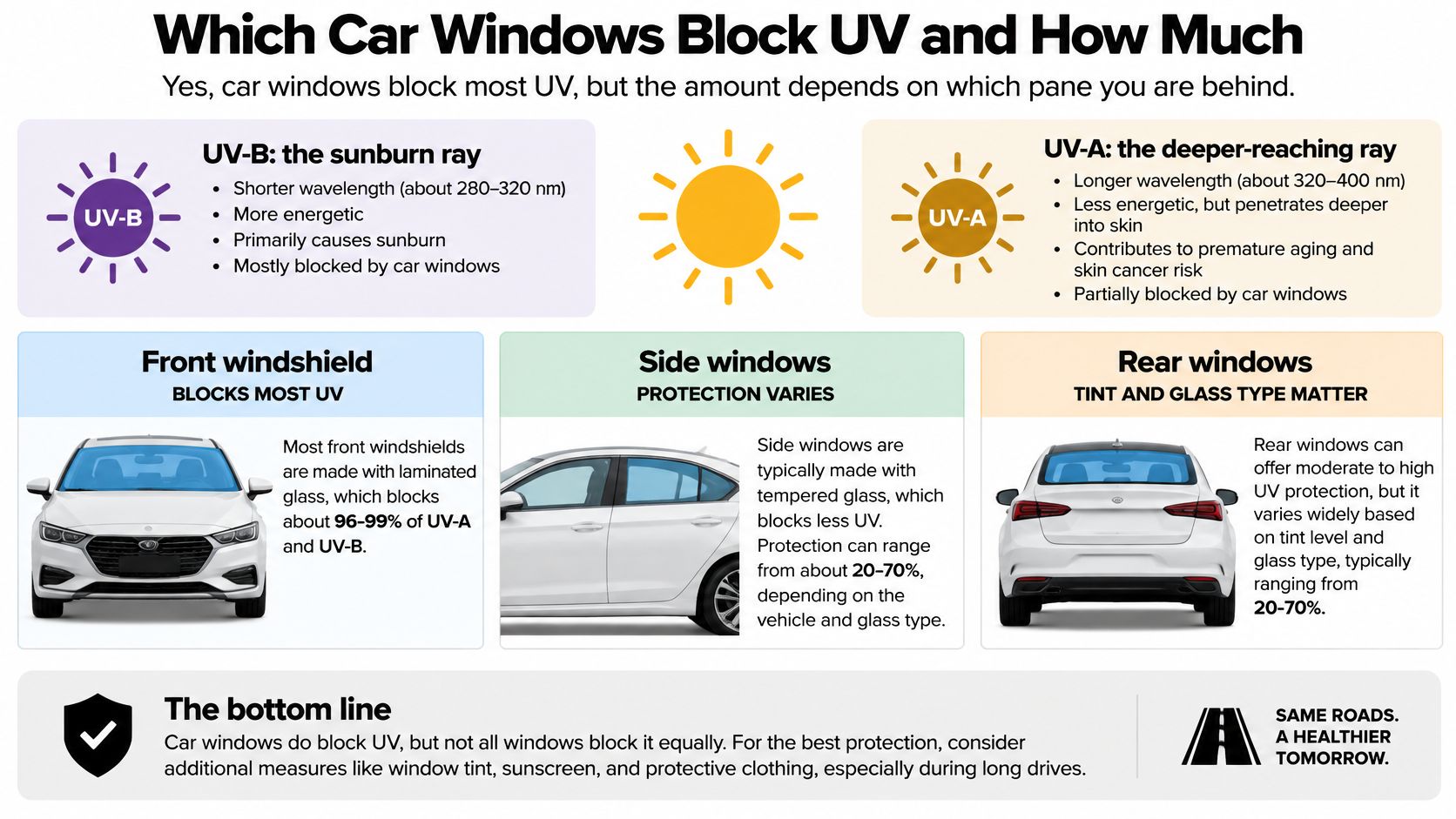
Which Car Windows Block UV and How Much
If your car spends hours in the sun, the glass at each seat matters more than the shade of the windows. UV-A protection varies by pane, so check the figures before deciding where added protection is needed.
The Numbers by Pane
A 2025 study of 34 gas, hybrid, and electric vehicles found that front windshields reduced UV-A transmission by an average of 99.25%, while driver-side windows reduced it by 88.78%. In a 2016 peer-reviewed study of 29 automobiles from 15 manufacturers, windshields blocked an average of 96% of UV-A, with results ranging from 95% to 98%. Side windows blocked an average of 71%, ranging from 44% to 96%. Only 4 of the 29 vehicles had side windows that blocked more than 90%.
| Window position | Glass type | UV-A blocked, 2016 study (29 vehicles) | UV-A blocked, 2025 study (34 vehicles) |
|---|---|---|---|
| Windshield | Laminated | 96% average (95% to 98%) | 99.25% average |
| Driver-side window | Tempered | 71% average (44% to 96%) | 88.78% average |
| Rear window | Usually tempered | No average reported | No average reported |
| Sunroof | Usually tempered or laminated by model | No average reported | No average reported |
Sources for the study figures: 2016 peer-reviewed study and 2025 study.
Compare panes within each study, not across studies, because the vehicles examined differed. Neither study reported average results for rear windows or sunroofs. Until you check those panes, don't assume they block UV-A as well as the windshield. To protect furnishings from sun damage, start by identifying which glass needs extra protection.
Closed windows reduce exposure, but they do not eliminate it. Older occupational-exposure research found arm exposure inside sampled cars was about 3 to 4% of ambient radiation with windows closed, compared with 25 to 31% with windows open.
Check the panes separately. Darker glass is not proof of stronger UV-A protection.
Why Windshields and Side Windows Differ
A windshield is a sandwich. Two sheets of glass sit bonded around a plastic interlayer, and that interlayer does most of the UV-A filtering. A typical side window is one heat-treated sheet of tempered glass with no interlayer at all.
Tempered glass has a safety job. Manufacturers heat-treat it so it breaks into small pieces instead of sharp shards. That design protects occupants in a crash, but it doesn't give the pane a built-in UV-A filter. Laminated glass has a different job. It holds together when cracked, and the bonded layer that keeps it intact also stops most long-wave UV before it reaches your face and arms.
What the Transmission Gap Looks Like
A separate assessment of automobile windows reported average ultraviolet transmission of 10.47% through side windows compared with 4.06% through front windows, a difference the researchers attributed mainly to tempered side glass and laminated windshields. Both glass types block UV-B effectively. Only laminated construction blocks most UV-A consistently, which is why two panes on the same car can behave like two different products.
| Feature | Laminated glass | Tempered glass |
|---|---|---|
| Construction | Two glass sheets bonded around a plastic interlayer | One heat-treated sheet with no interlayer |
| UV-B blocking | Blocks most | Blocks effectively |
| UV-A blocking | Blocks most | Lets substantially more through, 10.47% average transmission against 4.06% for front windows |
| Typical location | Windshield | Side and rear windows |
| Main design goal | Holds together when cracked and filters UV | Breaks into small pieces for safety |
Don't judge any pane by shade. Visible darkness and UV attenuation are separate properties, so a dark factory tint can look protective while still passing UV-A, and a lighter film with a tested UV rating can outperform it. I've seen owners pay for the darkest legal shade and never ask for the UV-transmission specification. That's buying sunglasses by frame color.
Check the etched manufacturer markings in the corner of each pane instead. They identify the glass maker and type, and they let you compare the windshield against the side and rear panes on the same vehicle. Some newer and higher-trim cars do use laminated side glass, so don't assume either way. Read the markings, ask for the specification sheet, or put a calibrated UV meter on the glass. Measuring the installed pane beats trusting a brochure claim every time.
How Much UV Reaches You on a Daily Drive
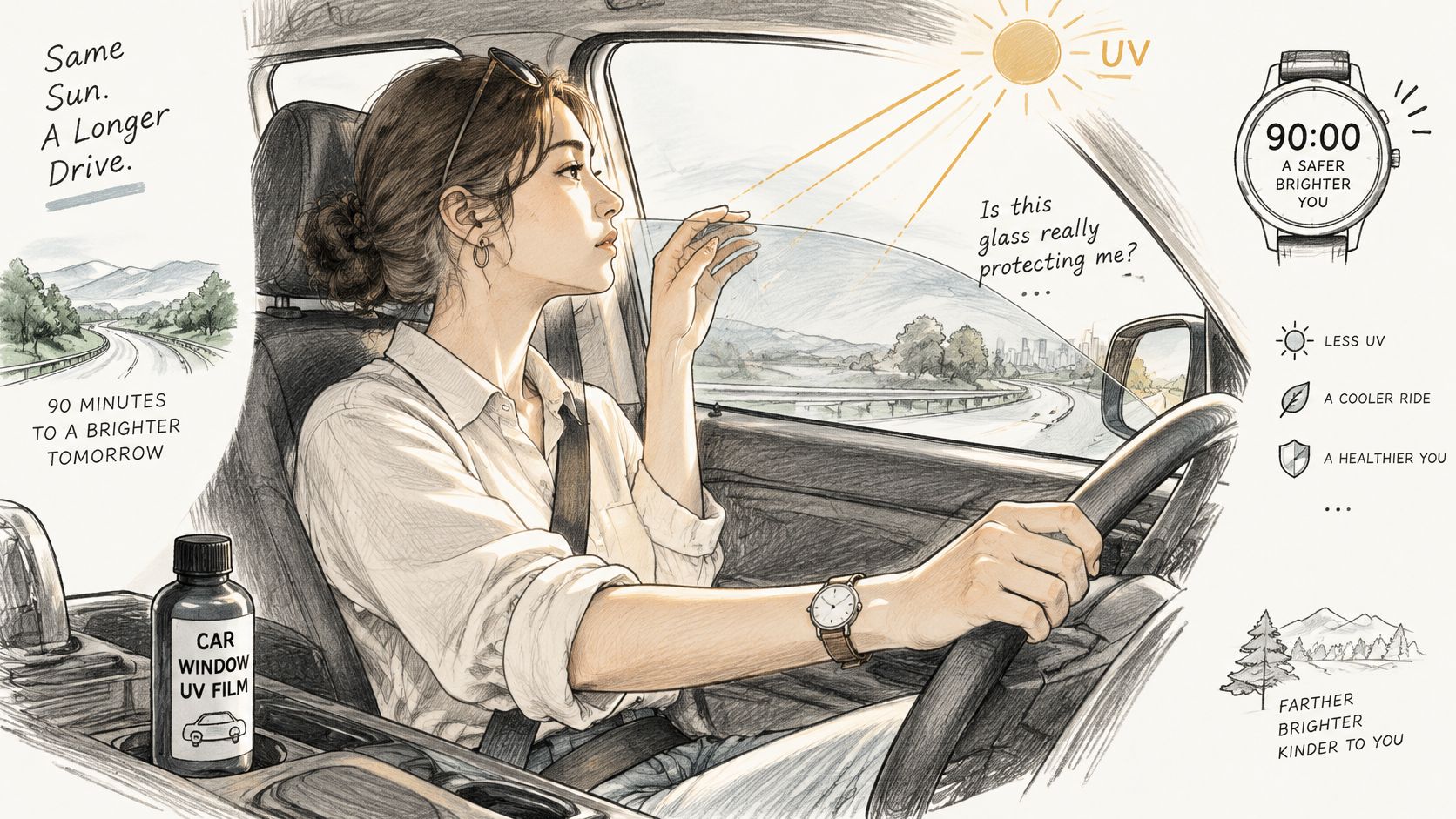
Closed side windows can still pass UV-A. Occupational-exposure research found that an arm received about 3 to 4% of ambient UV with car windows closed, compared with 25 to 31% when they were open. The gap matters most on repeated drives with the sun hitting one side of the cabin.
| Cabin condition | Share of ambient UV reaching the arm |
|---|---|
| Windows closed | About 3 to 4% |
| Windows open | About 25 to 31% |
What Changes Your Dose
- Trip length: A ten-minute school run and a three-hour sales route add up to different exposure.
- Latitude and season: Stronger sun and longer days raise the dose.
- Cabin orientation: A route that keeps one side facing the sun exposes that arm, cheek, and door card repeatedly.
- Open windows: Lowering the glass removes its UV filtering and shade.
- Pane position: Windshield and side glass can pass different amounts of UV-A.
Keep UV protection separate from heat rejection, glare reduction, and fading protection. A cooler cabin does not prove that the glass blocks UV-A, and a dark pane does not guarantee less fading. Ask for the rating you need, rather than treating one feature as proof of another. The same care applies to exterior surfaces. Read how to protect car paint from sun damage before choosing protection for paint.
Professional drivers, children in rear seats, people with photosensitivity, and anyone who spends long hours driving should pay close attention to side-glass exposure. For occasional short trips, closed windows and sensible sun precautions reduce exposure. Base your decision on your driving habits and the actual glass in your car, not a broad promise on a film package.
What UV Does to Paint, Plastic and Leather
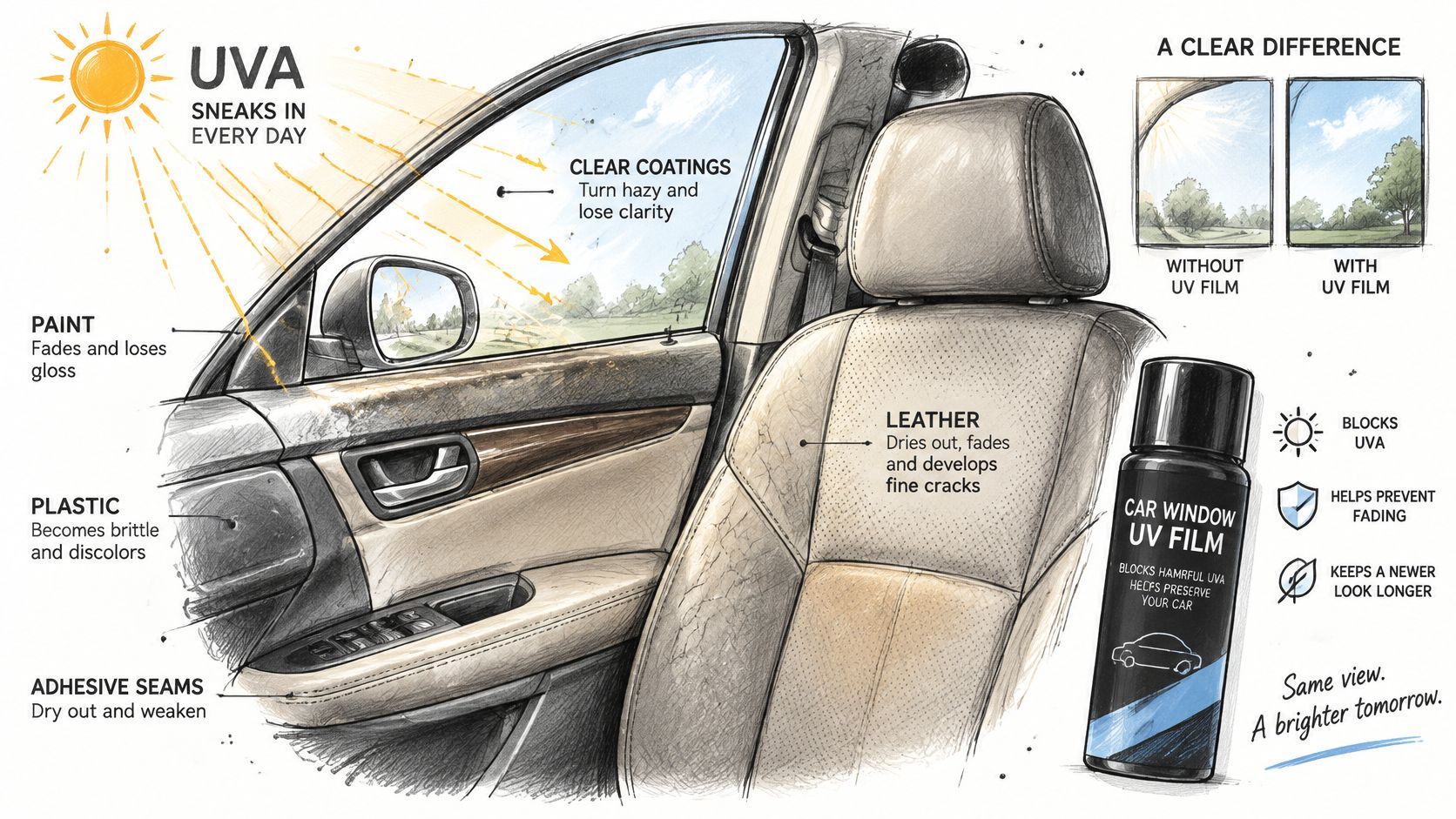
A daily drive can fade the door card beside you while the dashboard, seats, steering wheel, and rear parcel shelf also take repeated sun exposure. Over time, UV can fade dyes, dry leather, yellow trim, and weaken adhesives.
Reducing the UV that enters the cabin helps limit that exposure. Interior care supports the surfaces, but it cannot make up for side glass that lets substantial UV-A through.
Why the First Layer Matters Most
Field measurements of tinted and untinted vehicles found that tinting all vehicle windows except the windshield reduced erythemally weighted UV exposure by a factor of 42 compared with an untinted vehicle. A separate comparison reported average normalized UVA exposure 3.8 times lower in a tinted car than in a similar untinted car. Reducing UV before it reaches cabin surfaces helps slow pigment fading and deterioration of polymers and finishes.
For routine coating maintenance, Titan Coatings' DIY products Ultra and Omniguard help maintain and refresh a coating at home. They are maintenance products, not a fix for UV passing through side glass.
Paint, plastic trim, and polycarbonate lenses face direct sunlight outside the cabin. A UV-protective coating for polycarbonate can protect polycarbonate, while flexible elastomer coatings protect paint and trim. Choose a coating suited to the surface and its movement. These coatings protect paint and trim, not glass.
Window Film, Tint Limits and Your Options
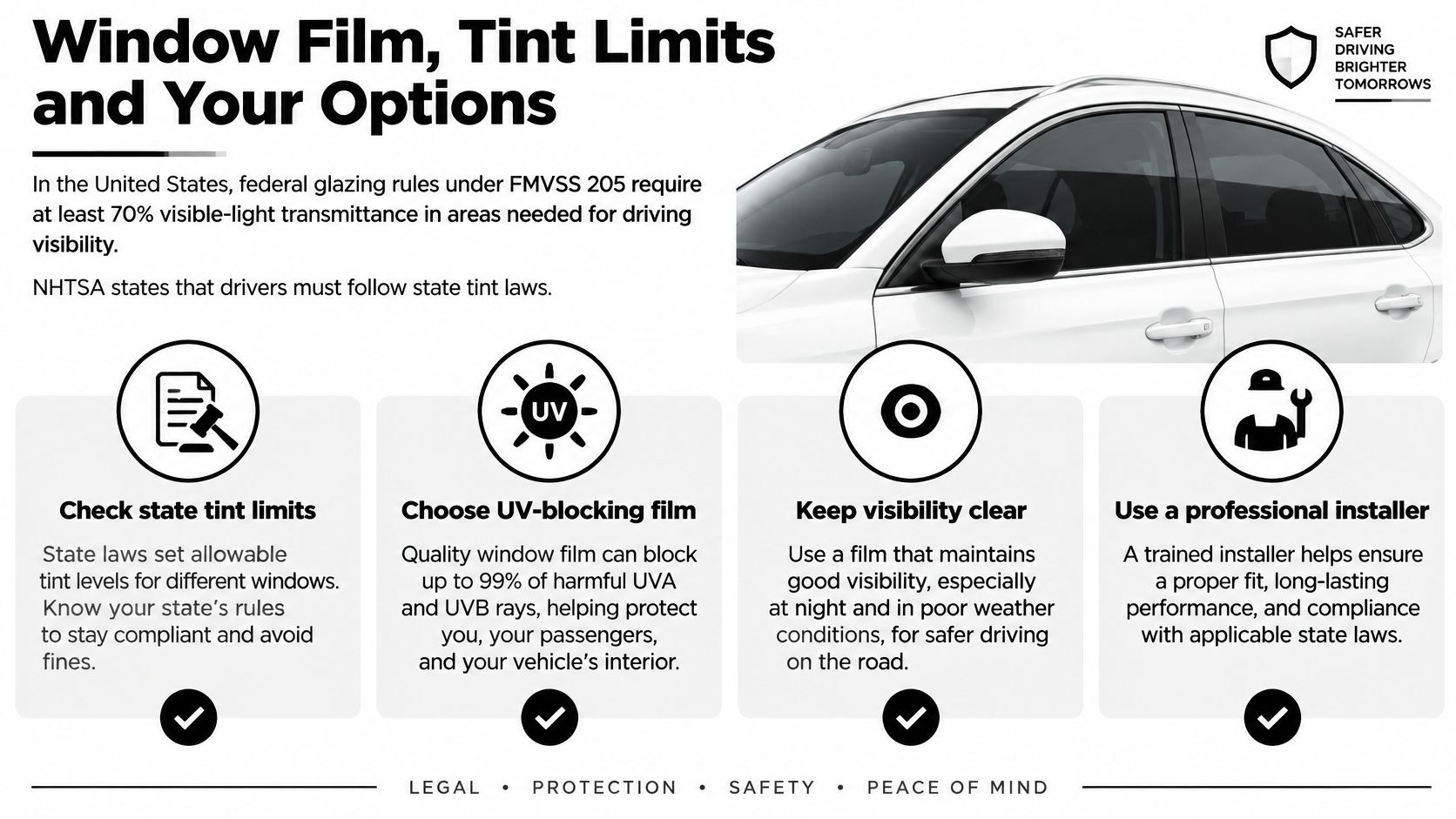
If side glass transmits more UV-A than you want, UV-rated film can reduce exposure without relying on a darker shade. Choose film by its tested UV performance, then check the final visible-light transmission against the rules for your location.
In the United States, the NHTSA interpretation of Federal Motor Vehicle Safety Standard No. 205 says the combined glazing and film must meet the applicable 70% visible-light transmittance requirement in areas needed for driving visibility. It also states that manufacturers, dealers, distributors, and repair businesses may face civil penalties of up to $1,000 per noncomplying installation. Visible-light transmission and UV blocking are separate measurements, so check both.
Your Options Side by Side
| Option | What it helps with | Limit to know | Best for |
|---|---|---|---|
| Factory laminated windshield | UV-A and UV-B through the front | Does not cover side or rear glass | Keeping an intact windshield as is |
| Factory tempered side glass | Some UV-B and visible-light control | UV-A blocking varies widely | Owners who test the glass before choosing film |
| UV-rated window film | Reduces UV-A and heat when rated for UV | Must comply with local visible-light transmission limits | Side and rear glass when testing shows a gap |
| Exterior elastomer coating on paint and trim | Protects paint and trim surfaces and is designed to flex with temperature change | Does not change UV transmission through glass | Protecting paint and trim |
| Glass coating such as Apex Glass | Repels water and supports visibility in rain | Does not replace UV-rated glazing or film | Drivers who want water repellency on glass |
| Interior protectant | Helps protect plastics and leather | Does not stop UV coming through glass | Dashboards, seats, and trim |
Keep a sound laminated windshield intact. If testing shows that side or rear glass allows more UV-A through than you want, compare tested products such as nano carbon tint and confirm the film will comply with local rules. Treat paint and trim separately with a suitable exterior coating, and use an interior protectant for cabin materials.
Before installation, ask the installer:
- Glass type: Which panes are laminated, and which are tempered?
- UV rating: What is the film's tested UV-A rating?
- Final light transmission: What will the combined glass and film measure after installation?
- Local rules: Have you checked the current limits for each pane?
Get clear answers and measurements before authorising the work.
Protecting Paint and Trim with Elastomer Coatings
Elastomer coatings protect vehicle surfaces, not the cabin from UV passing through glass. Choose a coating for paint, trim, leather or glass according to the surface and the protection it offers. For owners focused on protecting luxury car paint in Dubai, flexibility matters: Titan Coatings' formulas offer UV resistance, helping prevent oxidation, fading and sun damage over time.
Dark Matter Technology® combines carbon nanotubes with high-performance coatings and is designed for cars, boats and aircraft. It resists UV rays, scratches and chemicals. Titan's Dark Matter Technology®, DiamondTech and HyperQuartz® formulas also offer regenerative properties. These are surface-protection features, not a substitute for glazing or film that blocks UV before it enters the cabin.
Matching Each Product to One Problem
For paint protection, Titan Coatings offers formulas including Zeus, Vulcan, Apex, Hydro and PX10. ZEUS resists pollutants such as industrial emissions and acid rain. VULCAN TX155 is a reinforced top coat for the PX10 base coat, with omniphobic properties and the ability to self-regenerate and heal from abrasions, swirls and light scratches. Some products are available only to professional detailers and shops.
For home maintenance, Ultra and Omniguard help maintain and refresh a coating. Wash with pH-neutral shampoo and avoid harsh chemicals and abrasive cleaning products. For ingredient information, see Titan's guide to UV-protection ingredients.
On glass, a coating has a different job. Titan Hyperglass and Apex Glass Coating are glass coatings. ACCR fills small scratches and increases glass hardness, lowering the chance of windscreen chips and scratches. Glass coatings do not replace UV-rated glazing or film, and they do not change how much UV-A passes through the pane. Choose them for glass-surface protection, not cabin UV control.
Confirm Your Glass Before You Choose Protection
You can settle your own car's UV question this week. It takes one inspection, a few direct questions, and a decision for each pane instead of one blanket purchase.
Your Five Step Check
- Identify every pane. Read the etched markings on the windshield, side windows, rear glass, and sunroof, or pull the installer's records if film is already fitted.
- Compare panes, not averages. Check the windshield first, then judge each side and rear pane on its own construction.
- Get a number. Request the manufacturer's UV-transmission specification, or measure with a calibrated UV meter if you detail professionally. Our guide to UV resistance rating explains how to read those figures.
- Check legality before film. Confirm the finished visible-light result stays at or above the legal limit for driving-visibility areas and verify your local rules before installation.
- Protect the surfaces, then retest. Apply a flexible coating to paint and trim, condition the interior, and measure the finished glass again so you've documented what changed.
Maintenance decides whether the work lasts. Wash with a pH-neutral shampoo and avoid harsh chemicals and abrasive cleaning products. If a coating degrades, a certified installer must inspect the vehicle, provide feedback, and work on restoring the coating as needed. Don't strip a failing coating with aggressive chemicals at home and hope for the best.
Budget for upkeep as part of the plan. Our ULTRA Ceramic Spray 100ml ceramic sealant currently costs $39.97, which makes routine refreshing accessible for DIY owners who prefer to maintain protection rather than pay to rebuild it. Browse the full range in our Titan Coatings shop to compare glass, paint, and trim options side by side before you order. Start with the panes that test weakest, fix those first, and let coatings handle the surfaces they're designed to protect.
Your windshield is doing its job, so put your effort into the side glass, paint, and trim that aren't protected. At APEX NANO – Titan Coatings, you'll find flexible elastomer coatings for paint and trim, glass coatings that support clear visibility in rain, and spray sealants you can maintain at home. Visit us today, match each product to the surface it protects, and build a UV plan based on measured glass rather than guesswork.
0 Comments