
You’ve probably seen UV damage before you knew its name. A hood loses its deep gloss, black trim turns gray, and a windshield starts scattering glare through a film that no wash seems to remove. The difficult part is that a product label may promise “UV protection” without telling you what was tested, how it was tested, or whether the coating can survive the heat and movement that your vehicle experiences every day.
A useful UV resistance rating should answer more than “does this coating resist sunlight?” It should help you understand how the material handles ultraviolet exposure, moisture, heat, color change, gloss loss, cracking, and adhesion. For detailers and vehicle owners, the rating becomes valuable only when you can connect a chamber result to the hood in your garage, the climate where you drive, and the maintenance you’re willing to perform.
The Day Your Car’s Paint Lost the Sun
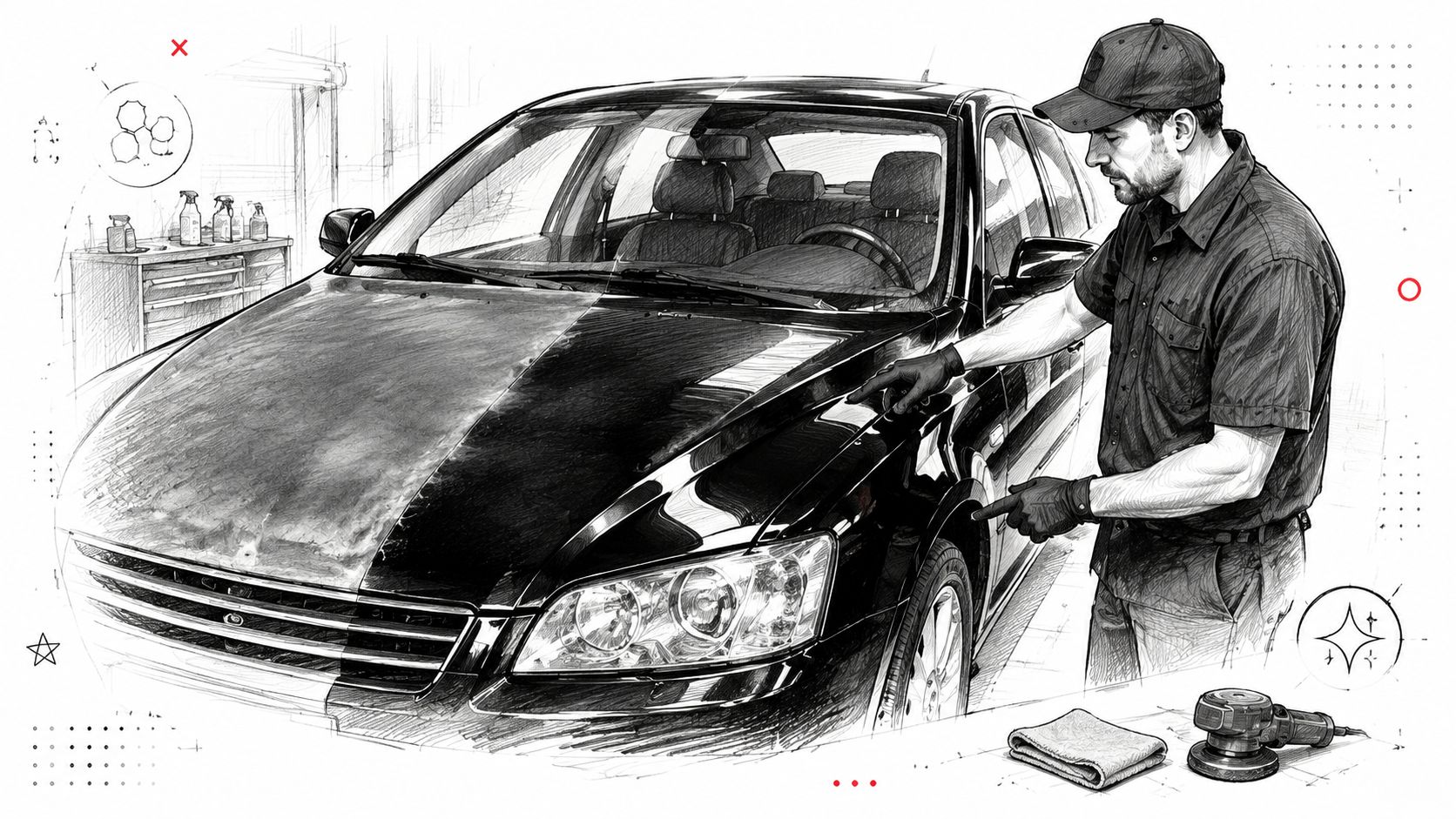
A detailer pulls a five-year-old black sedan into the shop. At first glance, the car looks merely tired. Under the inspection lights, the hood tells a different story. A dull, chalky sheen spreads across the center, while the lower portions of the doors still hold a deeper reflection because they’ve spent more time away from direct overhead sunlight.
The detailer runs a clean microfiber across the hood. White dust transfers onto the towel. In raking light, the clear coat looks thin and uneven, not because the owner neglected every wash, but because years of ultraviolet exposure have slowly changed the surface. The trim that once looked satin gray has faded toward a dusty lavender. Nothing failed in a single afternoon. The sun kept taking small pieces of performance until the damage became impossible to miss.
Why the damage stays hidden
UV degradation often begins below the threshold that catches an owner’s eye. A coating can lose some surface chemistry, gloss, or flexibility long before the paint appears visibly faded. Heat and moisture add their own stress, especially on horizontal panels that warm quickly and cool rapidly after sunset or rain.
That’s why a UV resistance rating exists. Manufacturers need a repeatable way to expose materials to controlled ultraviolet light, moisture, and heat instead of relying only on a vague promise that a coating is “long lasting.” ASTM and ISO methods turn an invisible process into an observable set of changes, such as gloss loss, color shift, cracking, chalking, and adhesion failure. The standards don’t eliminate uncertainty, but they give buyers a more useful starting point.
A practical question for every coating claim: What did the material have to endure, and what condition was it in when the test ended?
Standing beside that sedan, the owner eventually asks the question most drivers reach after seeing sun damage: how long would a coating have needed to hold up to stop this, and how would I have known before buying it? The answer begins with understanding what the rating measures, not with choosing the largest hour number on a bottle.
What a UV Resistance Rating Actually Measures
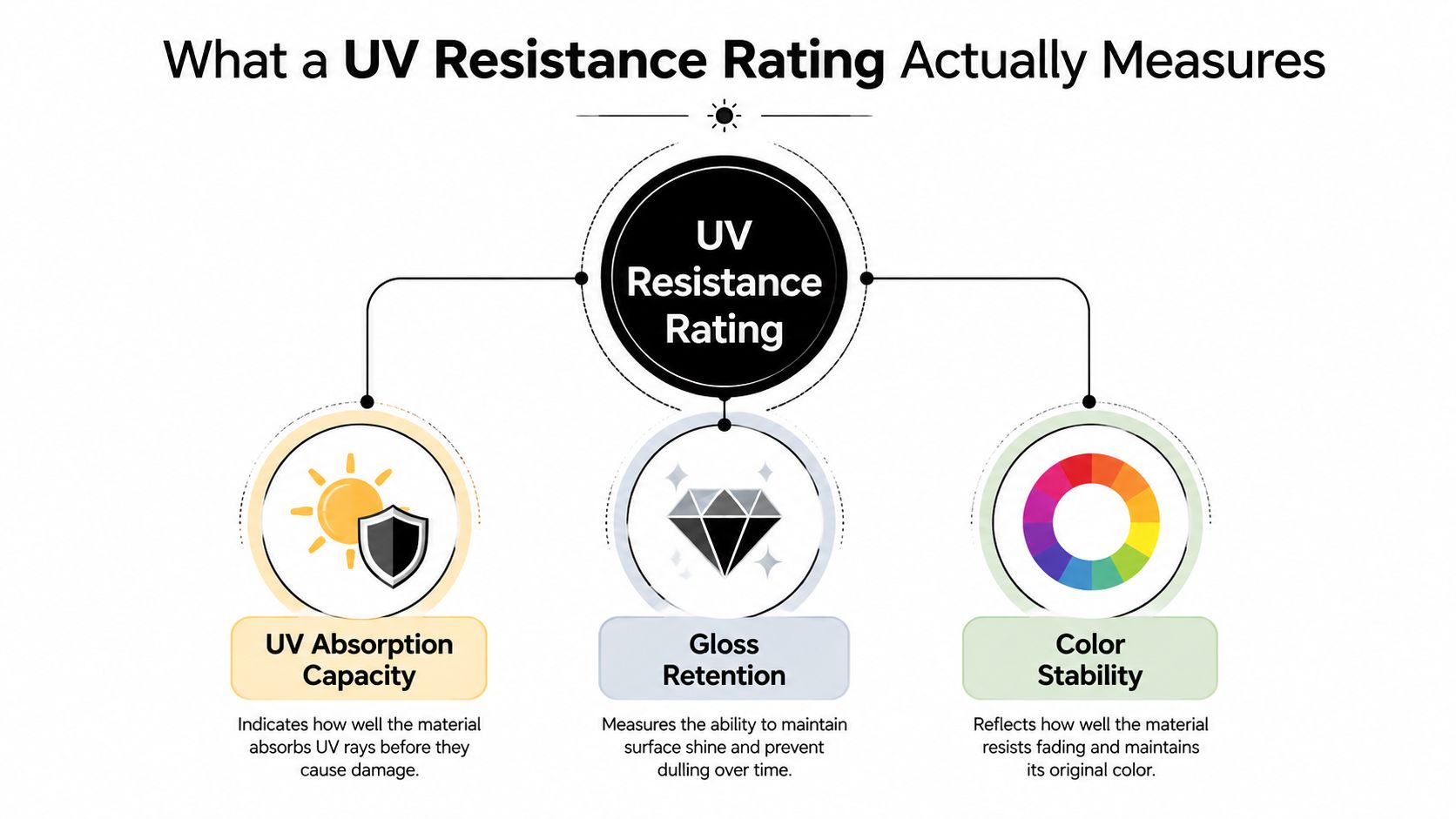
In plain language, a UV resistance rating describes how a material responds after controlled exposure to ultraviolet light and related weathering stresses. The laboratory observes whether the coating changes color, loses gloss, becomes brittle, cracks, chalks, or loses adhesion. A strong result means the tested sample retained more of its original appearance and physical performance under that particular method.
Three ideas make the rating easier to read:
- UV absorption capacity describes how the coating or its additives manage ultraviolet energy before that energy can damage the binder, pigment, or substrate.
- Gloss retention compares the surface shine after exposure with its original shine. A panel can remain dark while becoming noticeably dull.
- Color stability measures whether the original color remains visually consistent after weathering. Technical reports may express color movement using a color-difference value such as delta E, but the meaning depends on the reporting method and acceptance threshold.
Accelerated weathering compresses outdoor stress into a controlled laboratory sequence. A chamber can cycle ultraviolet light, heat, condensation, and sometimes water spray, allowing manufacturers to compare formulations without waiting through years of natural exposure. ASTM G154-23 is used to induce property changes from UV, moisture, and heat in nonmetallic materials, while related plastics standards include ASTM D4329 and ASTM D2565. ISO 4892 provides an international family of laboratory light-source exposure methods. ASTM and ISO UV-weathering background
The rating is not a calendar promise
A chamber result isn’t a direct prediction that your coating will last the same number of years on a vehicle. The lamp type, irradiance, temperature, condensation cycle, panel preparation, film thickness, color, and evaluation criteria all affect the outcome. A test report therefore has more meaning when you read the standard, cycle, exposure duration, and failure criteria together.
A black hood parked outdoors doesn’t experience the same conditions as a silver vehicle kept under cover. Washing frequency, contamination, water spotting, repair quality, and application technique also affect field performance. For a practical overview of sun-related paint protection, the Nanak Car Wash paint protection guide offers useful context for vehicle owners.
Titan’s explanation of the chemistry and purpose behind this category is available in its guide to what UV coating means. The central lesson is simple: a rating helps you compare tested materials, but it doesn’t remove the need to ask what the test represents.
The Standards Behind the Numbers
Automotive coating claims commonly point toward several ASTM, ISO, or SAE methods. They aren’t interchangeable. ASTM G154 and ASTM D4587 commonly use fluorescent UV exposure with condensation, while ASTM G155 and SAE J2527 use xenon arc systems designed to approximate a broader sunlight spectrum. ISO 4892 includes methods using xenon and fluorescent light sources.
ASTM D4587 includes automotive-coating cycles with defined irradiance, temperature, UV time, and condensation time. One common cycle uses 8 hours of UV followed by 4 hours of condensation at 0.83 W/(m²·nm), with a black-panel temperature of 70 ± 2.5 °C during UV and 50 ± 2.5 °C during condensation. Another uses 4 hours of UV and 4 hours of condensation at 0.89 W/(m²·nm), with 60 ± 2.5 °C during UV and 50 ± 2.5 °C during condensation. These parameters come from the ASTM UV resistance testing overview.
| Standard | Light Source | Typical Cycle | Best Simulates |
|---|---|---|---|
| ASTM G154 | Fluorescent UV lamps | UV and condensation cycles, selected by the test program | Focused UV, heat, and moisture stress |
| ASTM D4587 | Fluorescent UV lamps | Automotive paint cycles with controlled UV and condensation | Paint and coating weathering comparisons |
| ASTM G155 | Xenon arc | Broad-spectrum light with controlled moisture or spray | More complete sunlight simulation |
| ISO 4892-2 | Xenon arc | Laboratory exposure using xenon light and environmental controls | International full-spectrum weathering work |
| ISO 4892-3 | Fluorescent UV lamps | Fluorescent UV exposure with moisture and temperature control | International fluorescent-UV comparisons |
| SAE J2527 | Xenon arc | Automotive-oriented xenon exposure protocol | Automotive exterior durability assessment |
Why the method name belongs beside the hours
A reported exposure duration has no complete meaning by itself. Two samples can both show a 2000-hour result while facing different light spectra, moisture patterns, temperatures, and evaluation schedules. The standard name tells you what kind of stress the material experienced.
ASTM G154 remains current as a 2023 practice, with ASTM’s publication record updated in 2025, and manufacturers use accelerated protocols to estimate sunlight-related degradation in weeks or months rather than waiting through outdoor aging. Those estimates support product development, but they don’t turn chamber time into a universal vehicle warranty.
For a buyer or installer, the sensible response isn’t to memorize every parameter. Ask the supplier to identify the standard, light source, cycle, panel preparation, and measured failure modes. Titan’s overview of coating testing methods can help detailers understand why a test name matters before comparing products.
From Lab Hours to Real-World Longevity
Many buyers want a simple translation. They see an exposure duration and ask how many seasons it represents on the road. The honest answer depends on the relationship between the chamber cycle and the vehicle’s environment. UV intensity, humidity, condensation, temperature swings, parking position, washing, and whether the car sits under cover all change the result.
A shorthand such as “one laboratory hour equals roughly one month outdoors” may appear attractive, but it isn’t a reliable universal conversion. It can mislead a driver in a high-sun desert, a coastal climate, or a covered garage because the chamber doesn’t reproduce every combination of location and use. A report should therefore be treated as a comparison under stated conditions, not as a hidden odometer for coating life.
A safer translation method
Start with the test method. Then identify what the report measured, such as gloss retention, color change, cracking, chalking, or adhesion. Finally, compare that information with the vehicle’s exposure pattern.
| Climate Scenario | 1000 Lab Hours | 2000 Lab Hours | 3000 Lab Hours |
|---|---|---|---|
| Temperate, garage-kept vehicle | Not reliably convertible without outdoor correlation | Not reliably convertible without outdoor correlation | Not reliably convertible without outdoor correlation |
| Sun-exposed desert vehicle | Not reliably convertible without outdoor correlation | Not reliably convertible without outdoor correlation | Not reliably convertible without outdoor correlation |
| Coastal daily driver | Not reliably convertible without outdoor correlation | Not reliably convertible without outdoor correlation | Not reliably convertible without outdoor correlation |
This table may feel less satisfying than a year estimate, but it reflects the evidence available. Current industry discussion highlights acceptance criteria such as gloss retention, color change, and adhesion after 2000 to 2500 hours, yet those are laboratory benchmarks rather than consumer lifetime promises. Accelerated weathering and coating performance context
A laboratory’s controlled environment also depends on the chamber and supporting equipment. Readers who want to understand how environmental test facilities are organized can review environmental testing lab furniture as background on the physical setup around testing equipment.
Use the hour number as a screening tool, not a promise. A credible claim identifies the protocol and the measured condition at the end.
For vehicle-specific guidance, compare the report with your storage habits and inspect the panel regularly. The best UV protection for car paint should be judged through both documented testing and a maintenance plan that fits your climate.
How Titan Coatings Validates UV Performance
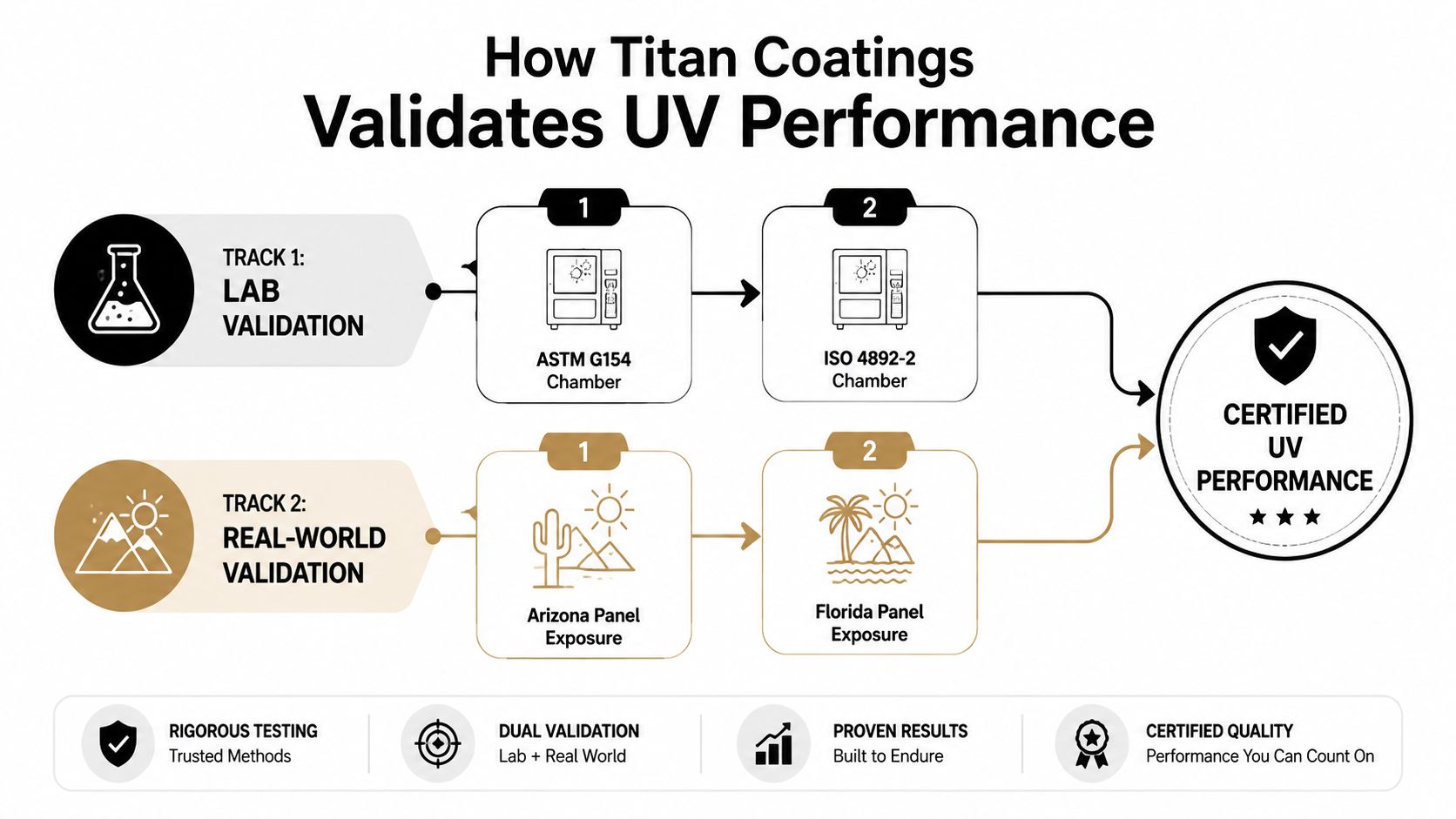
Titan describes a two-track approach to UV validation. The first track uses third-party ASTM and ISO chamber testing. The second uses real-world panel exposure in demanding environments, including Arizona and Florida. The value of combining them is straightforward: laboratory methods improve repeatability, while outdoor panels reveal how a formulation behaves under a changing mixture of sunlight, heat, humidity, contamination, and temperature movement.
Titan connects this development work with Dark Matter Technology, described as a self-crosslinking elastomeric SiO2-Si matrix. The company also identifies HyperQuartz as a proprietary top-layer additive intended to absorb UV energy in the 280 to 400 nm band before photons reach pigments. Those are formulation descriptions, not a universal substitute for a complete report, so buyers should still ask for the test method and evaluation results attached to any published rating.
What a responsible validation record should show
A useful record explains how the sample was prepared, what substrate was used, which cycle ran, and what changed afterward. Titan’s described process refers to Q-Pan panels, SAE J2527 cycle parameters, gloss readings, and delta E readouts. Those details matter because a rating based only on visual inspection is less informative than one that separates gloss loss from color change.
Real-world exposure adds another layer. An Arizona panel can reveal intense sun and heat stress, while a Florida panel can expose the formulation to humid conditions and repeated wetting. Neither location becomes a universal forecast for every owner. Instead, the two tracks help formulators adjust the chemistry and identify weaknesses that a single chamber program might not reveal.
Titan also states that advertised hour numbers reflect tested panels, not guaranteed field life. That qualification is exactly what buyers should expect from any responsible coatings supplier. A panel result can guide selection, but application quality, film build, prep, storage, washing, and climate still shape what happens on your car.
Why Flexibility Matters as Much as Hardness
A coating can be hard and still fail under repeated movement. That distinction matters on a dark hood, where the substrate expands in heat and contracts as temperatures fall. A rigid film that can’t accommodate that movement may develop microscopic stress points, then cracks or loses adhesion. Once the surface opens, sunlight and moisture can reach areas that were previously protected.
Hardness ratings, including familiar 9H pencil-hardness claims, describe resistance to a particular scratching method. They don’t automatically describe elongation, thermal movement, impact response, or resistance to cracking after weathering. A coating designed for long outdoor service needs a balance between surface hardness and the ability to move with the panel.
The elastomer advantage
Titan positions its elastomer coatings as hard like glass while remaining flexible. The intended benefit is mechanical continuity. Instead of acting like a brittle shell over a moving substrate, an elastomeric film can flex as the surface changes, reducing the chance that temperature swings create a pathway for cracking.
That principle is tested in practical ways across the coatings industry. ASTM D6083 requires liquid-applied acrylic roof coatings to undergo at least 1000 hours of accelerated weathering, followed by low-temperature flexibility checks and additional evaluations involving elongation, tensile strength, water swelling, adhesion, fungi resistance, and tear resistance. ASTM D6083 requirements show why UV endurance can’t be separated from physical performance.
Independent technical data sheets also report low-temperature flexibility checks at -30°F, -40°F, and -15°F, using bend or mandrel-style methods after weathering. These tests demonstrate the mechanic behind flexible protection. The coating must remain intact when cold stress follows exposure, not merely look glossy immediately after application. Cold-weather flexibility testing data
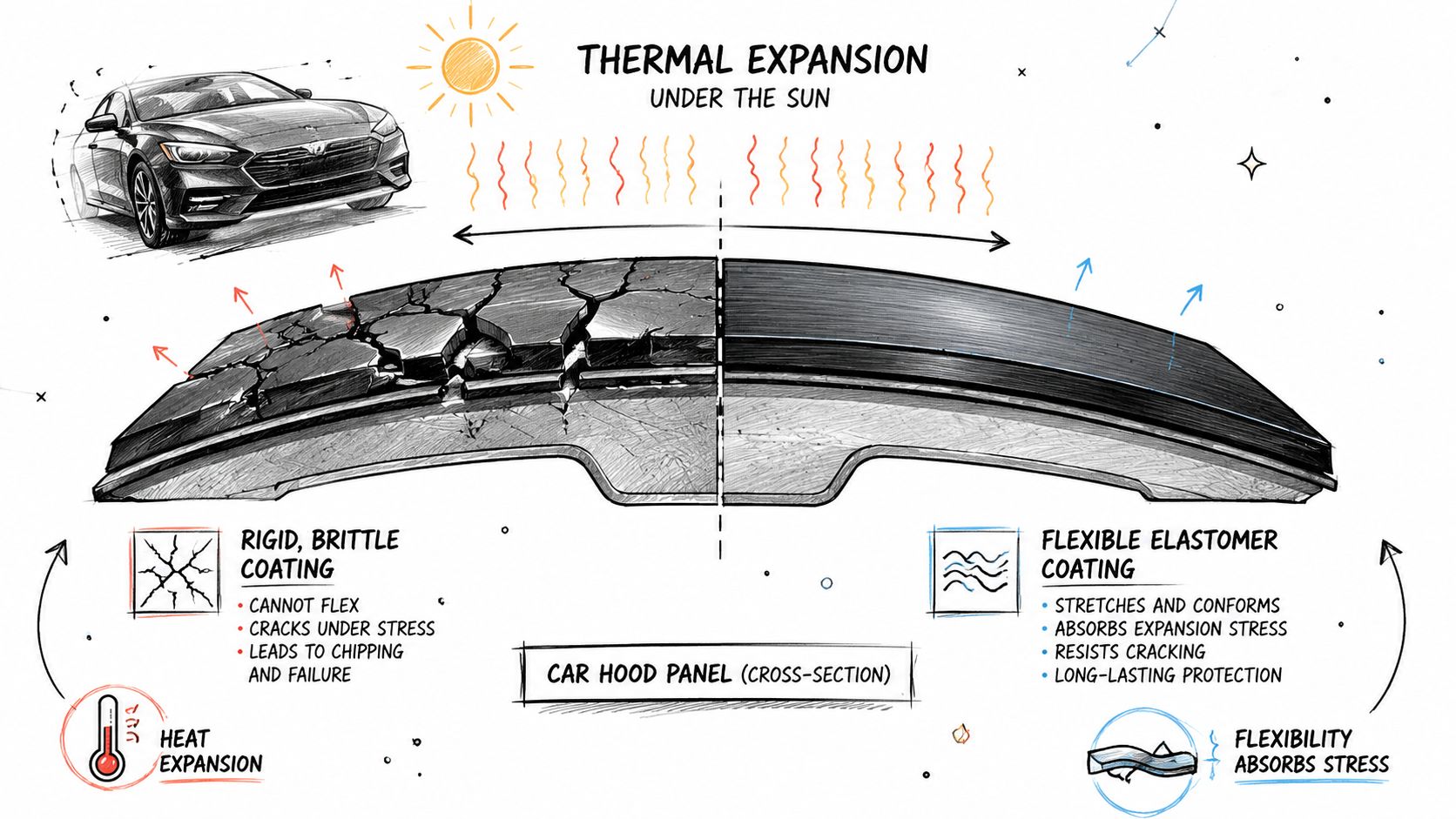
Alpha Quartz is presented as Titan’s flexible quartz-hybrid option for DIY users and mobile detailers. Its purpose in this discussion is practical: a film that remains flexible can better tolerate temperature movement and impacts such as bugs striking the front of a vehicle, while maintaining the protective layer needed to slow UV-related surface change. Read more about coating flexibility before treating hardness as the only durability metric.
Apex Glass and the Windshield UV Problem
A windshield deals with a difficult combination of conditions. Direct sunlight creates glare, rain changes the optical surface within seconds, and bug residue leaves a stubborn film exactly where your eyes need clean contrast. Repeated heating and cooling also place the glass coating under thermal stress, so UV stability and water behavior need to work together.
Apex Glass Ceramic Coating is designed for this windshield-specific problem, combining hydrophobic behavior with a straightforward application sequence. Start by decontaminating the glass, then polish away wiper haze and surface residue. Wipe the surface with isopropyl alcohol, apply the coating in straight lines, level it after 30 seconds, and allow it to cure for 12 hours before water exposure, following the product guidance at Apex Glass Ceramic Coatings.
A clearer view in changing weather
A driver leaving a sunny highway enters a rain shower. Without a clean, protected surface, water spreads into a continuous film, bug residue catches wiper blades, and glare becomes more distracting. A hydrophobic coating can help water gather and move away from the glass, while proper preparation helps the layer bond evenly instead of locking contamination beneath it.
UV resistance matters because the windshield coating must maintain its optical and water-shedding behavior while exposed to solar load. A product that yellows, loses adhesion, or stops beading can become another source of visual distraction. The best ceramic coating for a windshield should therefore be evaluated for application quality, cure requirements, clarity, water behavior, and durability claims together.
Keep the application area shaded and the glass completely clean. After curing, maintain the surface with products that won’t leave a greasy film, and replace worn wiper blades before they turn minor contamination into permanent haze.
How to Read Any UV Resistance Rating With Confidence
A useful rating begins with a named method. If a seller gives you only “1000-hour UV protection,” you don’t yet know the light source, moisture cycle, temperature, pass criteria, or whether the result concerns appearance, adhesion, or cracking.
Use this checklist before choosing a coating:
- Confirm the standard: Look for ASTM G154, ASTM G155, ASTM D4587, ISO 4892, or SAE J2527. The method determines the stress applied.
- Identify the light source: Ask whether the chamber used fluorescent UVA-340, UVB-313, or xenon arc exposure. Different sources create different comparisons.
- Find the cycle details: Check UV duration, condensation or spray, irradiance, temperature, and total exposure hours.
- Separate the failure modes: Ask for gloss loss and color shift separately. A panel can retain color while becoming dull, or remain glossy while changing color.
- Check the threshold: Find the stated delta E, gloss-retention, adhesion, cracking, or chalking limit used to define a pass.
- Ask about flexibility: Confirm whether the coating was evaluated for movement, cold-bend performance, elongation, or cracking after weathering.
- Match the climate: A result from a controlled chamber doesn’t automatically represent a daily-driven car in desert heat, coastal humidity, or an uncovered parking lot.
A report that identifies these details gives you something you can compare. A vague label doesn’t. The same caution applies to adjacent UV claims, including products marketed for personal sun protection. Readers comparing everyday protection can use this guide to top UV400 sunglasses for style as a reminder that the protection category and test language should be clearly defined.
Glossary: Accelerated weathering means controlled laboratory exposure. Gloss, color stability, adhesion, cracking, and chalking are separate outcomes. A UV resistance rating is meaningful only beside the method and pass criteria.
For your vehicle, the best buying question isn’t “how many hours does it claim?” Ask which standard was used, what changed afterward, and whether the coating combines UV defense with the flexibility needed to remain intact as the panel moves. That turns a marketing phrase into a decision you can defend at the counter or in your own garage.
APEX NANO by Titan Coatings offers coating options for painted panels, glass, and spray applications, including elastomer-focused protection designed to balance a hard surface with flexibility. Visit APEX NANO – Titan Coatings to review the products, application information, and testing-focused guidance before choosing protection for your vehicle and climate.
0 Comments